
Travel Medical and Evacuation from France
Travel Medical and Evacuation from France

Jason Stolz CLTC, CRPC, DIA, CAA
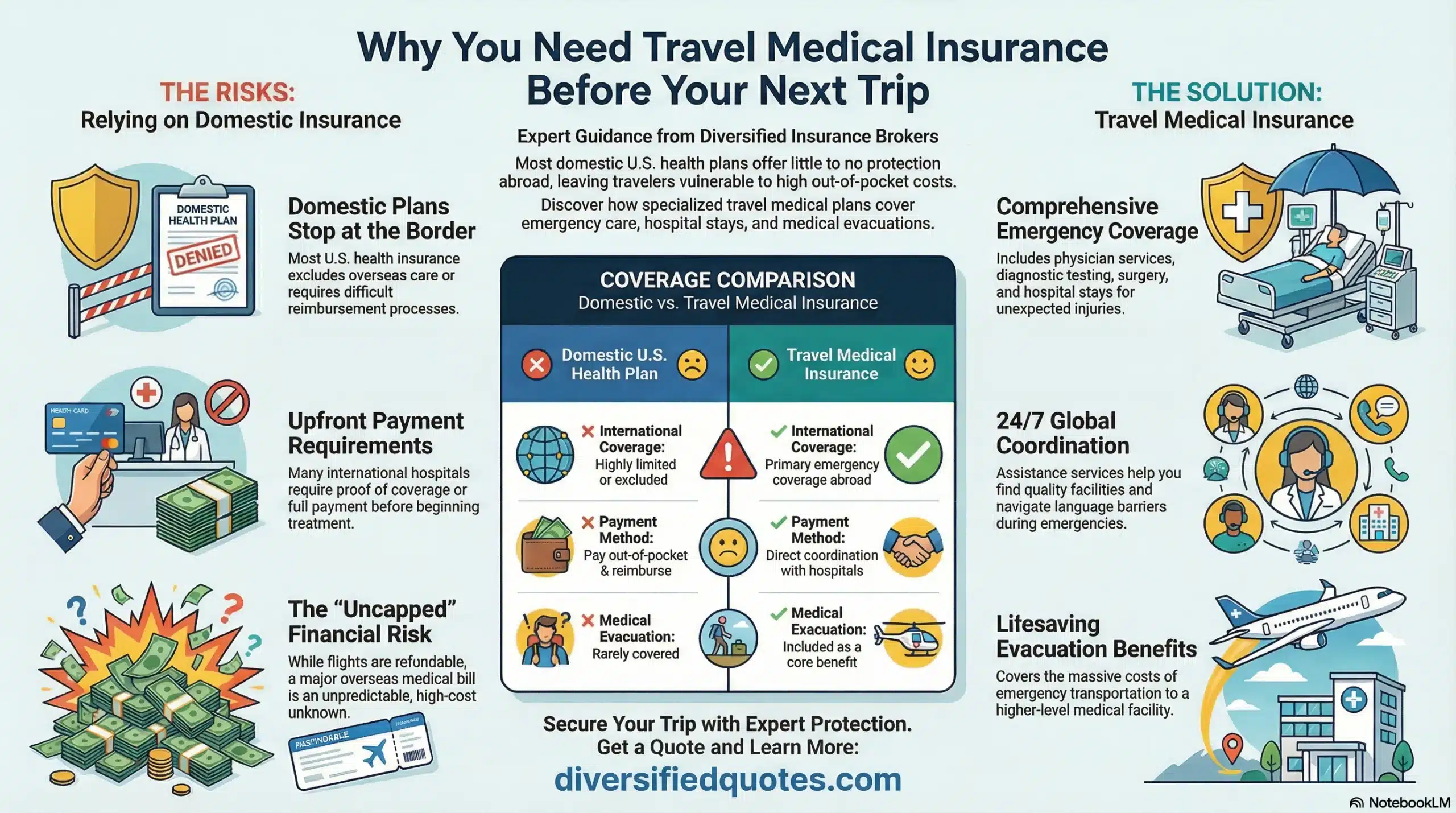
Travel to France is often considered routine from a destination standpoint — but the moment a real medical event happens, the logistics become anything but routine. A surprise emergency room visit in Paris, a broken ankle on uneven cobblestones in Lyon, a respiratory infection that requires imaging and follow-up in Bordeaux, or a sudden cardiac event while touring the Provence countryside can turn into a high-cost problem quickly for a U.S. traveler who does not have appropriate coverage in place. The issue is not whether France has good medical care — it does. The French healthcare system, anchored by the Assistance Publique–Hôpitaux de Paris network of 38 hospitals in the capital alone, regional CHU university hospital complexes in Lyon, Marseille, Bordeaux, Toulouse, and Lille, and a nationwide SAMU emergency medical dispatch system with response times that compare favorably to any system in the world, is genuinely capable. The challenge for U.S. travelers is how you access that care as a visitor without French Sécurité Sociale coverage, how the bills are handled, and what happens when a physician recommends a higher level of care or a medically supervised return home. Travel medical and evacuation insurance for France is the mechanism that solves those practical problems — paying eligible costs, coordinating care, and providing the evacuation support that handles transport decisions when the trip takes an unexpected turn.
At Diversified Insurance Brokers, we build travel medical and evacuation coverage around the real-world scenarios travelers actually face in France — short trips and multi-city European itineraries, river cruises along the Seine and the Rhône, extended stays and academic programs, multi-generational family travel, and business travel mixing work and leisure across multiple Schengen countries. For a foundational overview of how travel medical policies work, our resource on travel medical insurance provides the framework that makes France-specific planning decisions much easier. For the mechanics of how evacuation benefits work and why coordination matters as much as financial limits, our resource on emergency medical evacuation insurance covers the process in detail. For travelers combining France with other European destinations and needing a broader framework for how coverage structures adapt across multi-country itineraries, our resource on international travel health coverage covers the structural differences between short-term trip coverage and longer-duration alternatives.
Compare Travel Medical + Evacuation Options for France
Compare travel medical and evacuation plans designed for international trips, then select coverage that fits your dates, age, and travel style.
Get Travel Medical QuotesWhy France Travel Creates Real Coverage Exposure Despite Strong Healthcare
France’s healthcare system consistently ranks among the strongest in the world — but that quality belongs to people enrolled in the French social security system, not to U.S. tourists visiting as self-pay private patients. The Sécurité Sociale covers French residents and EU nationals with appropriate EHIC documentation at statutory rates. American travelers without that coverage are billed as private patients at rates that create meaningful financial exposure even for relatively routine events. A consultation at a Paris private clinic, an emergency room presentation at the Hôpital Lariboisière or the American Hospital of Paris, or a hospital admission for a gastrointestinal event that requires IV hydration, diagnostics, and overnight monitoring can generate bills that accumulate quickly — and while France’s emergency services are excellent and accessible, the payment relationship between a foreign uninsured visitor and a French hospital is straightforwardly commercial. Travel medical insurance closes that gap by providing a coverage structure designed for the visitor scenario — paying eligible emergency and urgent care costs, providing direct billing arrangements where available, and removing the need to negotiate financial terms while sick or injured far from home.
The geographic reality of France travel adds a second layer to the coverage calculus. Paris and France’s major cities have dense hospital infrastructure, but France is also a country whose most popular travel experiences are deliberately rural: the Dordogne river valley, the lavender fields of Haute-Provence, the vineyards of the Burgundy and Bordeaux wine regions, the châteaux of the Loire Valley, the D-Day beaches of Normandy, the Pyrenees border with Spain, and the French Alps around Chamonix and Annecy. Travelers on these itineraries are often 30–90 minutes from a major hospital center, and the specific nature of their activity — wine touring, hiking, skiing, cycling — creates injury and illness scenarios that may require care that is not available at the nearest regional clinic. In those situations, evacuation to the nearest appropriate facility — whether that means a different French hospital or, for the most complex events, a return to the United States under medical supervision — is the coverage benefit that prevents a manageable situation from becoming a catastrophic one. The combination of France’s strong but visitor-unfriendly billing environment and its geography of popular but medically remote destinations is what makes travel medical and evacuation coverage a practical planning requirement rather than an optional add-on.
France Travel Medical: Coverage Priorities by Itinerary and Traveler Type
| France Itinerary / Traveler Type | Practical Medical Consideration | Key Coverage Priority | Evacuation Scenario |
|---|---|---|---|
| Paris — city tourism / business / culture | Dense hospital infrastructure including AP-HP network; private-patient billing applies for non-EU visitors; walking-intensive itineraries create fall and overexertion risk on Paris cobblestones and Metro stairs; pickpocket-related stress and disruption can aggravate underlying conditions | Financial protection against Parisian private-patient billing; direct billing or payment guarantee support; assistance team guidance for American Hospital of Paris vs. AP-HP vs. private clinic depending on event type; documentation collection from first care contact | Medically supervised repatriation to U.S. when recovery duration makes home-country follow-up medically appropriate; intra-France transfer for subspecialty events exceeding initial facility capability |
| French Alps — Chamonix / Annecy / skiing | Europe’s highest terrain accessible to mass tourism; serious orthopedic injury risk from skiing and alpine hiking; mountain rescue via PGHM (Peloton de Gendarmerie de Haute Montagne) available but costly for international visitors; altitude considerations for cardiac history travelers | Explicit skiing and alpine hiking activity coverage confirmation; mountain rescue cost coverage under evacuation benefit; orthopedic surgical cost protection; transfer to Grenoble or Geneva for complex orthopedic or neurosurgical events | PGHM rescue to Chamonix hospital for initial stabilization; transfer to Grenoble University Hospital or Geneva for specialist care; repatriation to U.S. after stabilization for prolonged orthopedic recovery |
| Loire Valley / Provence / Bordeaux wine regions — rural touring | 30–60 minutes from major hospital centers in most rural wine country and château touring areas; wine-related dehydration and heat illness in summer months; driving on French rural roads creates road accident risk; slower emergency response times than Paris | Assistance team routing knowledge for rural France; heat illness and dehydration coverage for summer touring; road accident injury coverage; coverage that functions consistently in rural France not just major cities | Regional hospital staging then transfer to nearest CHU (Lyon, Bordeaux, Toulouse) for serious events; repatriation from Paris Charles de Gaulle or Lyon Saint-Exupéry for transatlantic cases |
| Seine / Rhône river cruises | Onboard medical staff limited to basic first aid on most river cruise vessels; disembarkation at port towns creates variable proximity to hospital infrastructure; itinerary structure makes it difficult to divert for medical care without significant logistical disruption | Assistance team with river cruise evacuation protocol familiarity; coverage for onshore care at port town clinics and hospitals; evacuation from vessel disembarkation points to nearest appropriate city hospital; cruise interruption medical necessity documentation support | Disembarkation-point ground transport to nearest regional hospital; air evacuation to Paris for complex events; repatriation to U.S. after stabilization for cases requiring extended follow-up |
| Senior travelers / 65+ | Walking-intensive French city itineraries create cardiovascular and fall risk; cobblestones in Paris, Lyon, and Normandy historic areas create ankle and fall injury exposure; minor events more likely to require extended observation, specialist consult, or imaging for older patients; pre-existing condition prevalence higher | Higher emergency medical limits for extended observation and specialist costs; pre-existing condition language explicit review before purchase; lower deductible for travelers likely to need outpatient care; real-time assistance coordination not reimbursement-only structure | Medically supervised repatriation when recovery makes home-country follow-up appropriate; family coordination support when U.S. family manages logistics remotely; case management for multi-day French hospital stays |
| Multi-country Schengen — France plus Spain / Italy / Germany | High-speed TGV and Eurostar connections between countries create fluid itineraries where a medical event can occur in any country; private-patient billing exposure in all Schengen countries for non-EU visitors; policy dates and territory must cover full itinerary | Geographic territory confirmation covering all countries before purchase; consistent benefit levels regardless of which country a medical event occurs in; assistance team with multi-country European coordination capability | Repatriation routed from whichever Schengen country the traveler is in at time of serious event; assistance team manages cross-border coordination regardless of event location |
What Travel Medical Plans Cover and How the Assistance Process Works in France
Travel medical plans for France address unexpected medical needs during the trip — emergency room treatment at an AP-HP hospital or private clinic, hospital admission, outpatient physician visits, specialist consultations triggered by a covered event, diagnostics including blood work, imaging, and CT scans, emergency procedures, and prescription medications related to a covered illness or injury. The practical value in France’s care environment is the combination of financial protection against private-patient billing and the real-time coordination support that helps a traveler navigate from symptom to appropriate care to proper documentation without having to improvise in a foreign language under stress. France’s emergency services are genuinely strong — SAMU dispatch (calling 15) routes callers to medical professionals who assess and deploy appropriate response — but a U.S. traveler’s ability to interact with that system efficiently, understand the billing and documentation sequence, and identify the right facility for their specific event type is substantially improved by a plan with an active assistance team that can support those decisions in real time.
The documentation habits that produce smooth France travel medical claims: request itemized billing statements before leaving any care facility, collect receipts for any out-of-pocket payments, preserve discharge summaries and clinical notes in digital form, and record the treating provider’s name and hospital contact. In Paris, major hospital administrative staff often have English capability. In regional France, that may be less consistent — another reason assistance team support that can bridge language gaps is valuable beyond its financial function. For travelers combining France with Italy and Spain, our pages on travel medical and evacuation from Italy and travel medical and evacuation from Spain cover how coverage priorities shift across these similar but distinct Western European healthcare environments. For France as part of a broader European touring itinerary that includes Sweden or England, our pages on travel medical and evacuation from Sweden and travel medical and evacuation from England provide useful comparative context. For travelers comparing France’s care access to destinations where evacuation complexity scales dramatically with distance from major medical centers, our pages on travel medical and evacuation from Vietnam and travel medical and evacuation from Australia illustrate how the same underlying planning framework applies across very different infrastructure environments. For emergency-focused coverage context, our resource on emergency travel health insurance covers the key differences between plans built for routine access versus plans optimized for sudden high-severity events.
Get Travel Medical + Evacuation Coverage for France
Select travel dates, compare options, and choose a plan that protects you from major medical and transportation costs while abroad.
Get Travel Medical QuotesBenefit Limits, Deductibles, Pre-Existing Conditions, and Evacuation Planning
Selecting the right benefit limits for France travel should start with the itinerary and traveler profile rather than the minimum available premium. For healthy travelers under 50 on a short Paris city visit, emergency medical limits of $50,000 with evacuation coverage of $150,000 or more provide meaningful protection against the most common events. For travelers over 65, those with any meaningful medical history, those on active alpine or rural itineraries, or those combining France with multiple additional European countries over several weeks, medical limits of $100,000 or more and evacuation limits of $250,000 or more are more appropriate baselines. Medically supervised repatriation from France to the United States — when indicated after a prolonged hospitalization or serious event requiring home-country follow-up — involves transatlantic transport logistics that accumulate significantly in cost regardless of the quality of the initial French care. Deductible selection should reflect actual tolerance for first-dollar costs: lower deductibles for travelers who want the plan to function for outpatient visits and urgent care without financial hesitation; higher deductibles for those primarily seeking protection against catastrophic events at reduced premium cost.
Pre-existing conditions are the most consequential plan detail for France travelers with any health history — the events most likely to generate expensive French private-patient hospitalization are often those with pre-existing condition connections: cardiac events during physically demanding touring days, respiratory crises from urban air quality exposure, digestive events from dietary changes, and joint injuries with underlying orthopedic history. Different plans define pre-existing conditions differently — look-back periods, stability windows, acute-onset provisions, and purchase-timing waivers all vary by carrier — and explicitly confirming how the plan’s language applies before purchase is more important than comparing premium alone. For travelers evaluating coverage rates across different plan structures, our resource on how to get the best travel medical insurance rates covers the variables that most affect premium and how to optimize cost-to-benefit ratio. For Algeria as a North Africa destination commonly combined with a France stop on a trans-Mediterranean itinerary, our page on travel medical and evacuation from Algeria covers how the coverage priorities shift when the itinerary moves from France’s strong care environment to a more operationally complex one.
Related Travel Medical Pages
Related Destination Pages
Talk With an Advisor Today
Choose how you’d like to connect—call or message us, then book a time that works for you.
Schedule here:
calendly.com/jason-dibcompanies/diversified-quotes
Licensed in all 50 states • Fiduciary, family-owned since 1980
Travel Medical and Evacuation from France — FAQs
Many travelers do — especially if their U.S. health coverage is limited overseas or reimburses slowly after the fact. France has excellent medical infrastructure, but the challenge for American visitors is that U.S. domestic health insurance often does not cover foreign medical expenses the way travelers assume. Some plans provide limited emergency reimbursement outside the U.S., some provide none at all, and even when coverage technically exists, travelers often face the practical burden of paying up front, documenting everything correctly, and navigating a foreign billing system while recovering abroad. Dedicated travel medical coverage is built specifically for the visitor scenario — it is designed to respond to sudden illness and injury abroad, provide a structured claims process, and support next steps including coordination with providers and transportation decisions if the trip cannot safely continue. For most France travelers, the question is not whether coverage is worth having, but which structure fits their specific trip, age, and health profile.
Travel medical coverage helps pay for treatment while you are in France — doctor visits, hospital care, diagnostics, prescriptions, and other medically necessary services arising from sudden illness or injury during the trip. Evacuation coverage helps pay for medically necessary transport when a physician determines that care should occur at a different facility or that returning home under medical supervision is appropriate. These are related but distinct benefits, and most travelers benefit from having both rather than one or the other. Treatment pays for what happens where you are. Evacuation pays for moving you when where you are is not the right place for what you need. The decisions around evacuation are typically made by medical professionals based on what is clinically appropriate — and the cost of arranging medically supervised transport, whether within France, to a neighboring country, or back to the United States, is substantial enough that evacuation coverage is generally not something to treat as optional.
Deductibles on travel medical plans work similarly to deductibles on other health coverage — they represent the portion of covered expenses you pay out of pocket before the plan begins paying its share. A higher deductible typically lowers the premium cost, while a lower deductible raises the premium but reduces your exposure if care is actually needed. The practical consideration for France travelers is that the deductible decision matters most at the worst possible moment — when you are ill, dealing with a foreign healthcare system, and not in a position to absorb a significant unexpected bill easily. Many travelers choose a moderate deductible that keeps the plan reasonably priced while avoiding the worst-case out-of-pocket scenarios. For older travelers or travelers with higher base probabilities of needing care, the case for a lower deductible is typically stronger, because the expected cost of care is higher and the financial disruption of a large deductible payment during travel is more significant.
Coverage for neighboring countries during a France trip depends on the policy’s geographic territory and how the covered travel dates are defined. Many international travel medical plans provide broad geographic coverage that includes multiple European countries under a single policy, so a France trip that includes side visits to Italy, Spain, Switzerland, Belgium, or the UK is typically covered as long as all travel dates fall within the policy period. However, this is highly plan-specific, and some plans restrict coverage to specific named destinations or geographic regions. The safest approach is to define your travel dates to cover the entire itinerary including any planned side trips, and to verify the plan’s geographic coverage scope before purchasing. If your itinerary is genuinely multi-country with significant time in each destination, confirming coverage for each country explicitly is worthwhile rather than assuming the policy extends automatically.
No — the vast majority of evacuation benefit uses are for ordinary medical logistics rather than dramatic remote rescues. Evacuation decisions are typically made by physicians based on what is clinically appropriate and what is medically safe, not based on the drama of the situation. Common evacuation scenarios include transport from a regional facility to a larger hospital with specialized capabilities, medically supervised commercial flight arrangements when a patient is stable but cannot travel alone safely, or medical repatriation back to the home country after initial stabilization in a French facility. The “helicopter rescue from a mountain peak” scenario is far less common than “patient needs to be transferred to a better-equipped facility two hours away” or “patient is ready to return home but needs medical oversight during the flight.” Planning for the latter scenarios rather than just the cinematic version is what makes evacuation coverage genuinely valuable for France travelers.
Yes — many travel medical plans offer coverage for older travelers, including seniors well into their 70s and 80s. The available options and pricing do vary with age, and some plans have age limits or modified benefit structures for older applicants, which makes comparing across multiple plans more important at older ages than at younger ones. For senior travelers heading to France, the most important plan variables are typically the medical benefit limit relative to the potential cost of a serious hospitalization, the deductible level relative to the traveler’s financial situation, and the way the plan handles evacuation if something becomes complicated. Price is a consideration, but the plan that performs best when needed is generally worth more than the cheapest available option. Companion coverage for spouses or travel partners and the way the plan coordinates logistics for a solo traveler are also worth evaluating specifically when planning France travel as an older traveler.
Coverage for pre-existing conditions varies significantly across travel medical plans, and this is one of the most important policy dimensions to review carefully before purchasing. Some plans offer an acute onset of pre-existing conditions benefit, which covers sudden unexpected flare-ups of an existing condition that require emergency treatment — even if the underlying condition is pre-existing. This benefit typically has specific definitions, look-back periods, and stability requirements that determine whether a given condition and event qualify. Other plans exclude pre-existing conditions entirely, meaning only new sudden illnesses and injuries that arise during travel are covered. For travelers with significant medical histories traveling to France, identifying plans that offer meaningful pre-existing condition coverage — and understanding exactly what “acute onset” means within the specific policy language — is a critical step in plan selection rather than an afterthought.
Most travelers purchase travel medical coverage soon after booking flights or lodging — ideally when the trip is confirmed and departure details are known but not yet imminent. Buying early has practical advantages: coverage is in place if something happens between purchase and departure, and some plans offer additional benefits such as trip interruption or cancellation coverage that may only be available when purchased within a defined number of days after the initial trip deposit. For France trips specifically, there is no meaningful advantage to waiting — the plan does not become better or cheaper by purchasing closer to departure, and the potential gap in protection during the pre-departure period is an easily avoided risk. For travelers who are still comparing options, completing the comparison and purchasing at least a few weeks before departure gives time to review the policy documentation and address any questions before the trip begins.
Evacuation coverage becomes a more central planning consideration for several traveler profiles heading to France. Older travelers whose age increases the statistical probability of a medical event that requires escalated care benefit significantly from meaningful evacuation limits rather than token coverage. Travelers with existing medical histories — particularly cardiovascular conditions, diabetes, or conditions that could create complications in a foreign healthcare environment — have higher base risk for events that might lead to transport decisions. Solo travelers, who lack a companion who could navigate logistics and advocate during a crisis, benefit from the assistance component of evacuation coverage that provides an English-speaking coordination team during transport decisions. Travelers on fast-paced multi-destination itineraries or those exploring rural France rather than major cities may be further from appropriate specialist care in a crisis. And any traveler whose financial situation would make the cost of air medical transport genuinely problematic should treat evacuation coverage as essential rather than optional.
France is considered a lower-risk destination from a healthcare infrastructure standpoint — hospitals are modern, emergency services are reliable, and care quality in major cities is excellent. The primary planning considerations are access to care as a non-citizen, the payment and reimbursement process, and evacuation logistics rather than the quality of care itself. This is meaningfully different from destinations where healthcare infrastructure is limited, evacuation distances to adequate facilities are substantial, or political instability creates additional operational complexity. For travelers also visiting Africa, Southeast Asia, or other higher-complexity destinations in the same travel season, the evacuation planning calculus is more urgent and the benefit limits required are generally higher. France travel can typically be addressed with a standard international travel medical plan with strong evacuation coverage, while destinations like Senegal or Kenya may warrant more deliberate evaluation of evacuation provider networks and repatriation logistics specifically. The contrast is useful for travelers who visit multiple destination types and want to calibrate their coverage appropriately for each.
About the Author:
Jason Stolz, CLTC, CRPC, DIA, CAA and Chief Underwriter at Diversified Insurance Brokers (NPN 20471358), is a senior insurance and retirement professional with more than 25 years of real-world experience helping individuals, families, and business owners protect their income, assets, and long-term financial stability. As a long-time partner of the nationally licensed independent agency Diversified Insurance Brokers, Jason provides trusted guidance across multiple specialties—including fixed and indexed annuities, long-term care planning, personal and business disability insurance, life insurance solutions, Group Health, Travel Medical and Evacuation Insurance, and short-term health coverage. Diversified Insurance Brokers maintains active contracts with over 100 highly rated insurance carriers, ensuring clients have access to a broad and competitive marketplace.
His practical, education-first approach has earned recognition in publications such as VoyageATL, and contributions from his agency featured in Kiplinger and GoBankingRates— highlighting his commitment to financial clarity and client-focused planning. Drawing on deep product knowledge and years of hands-on field experience, Jason helps clients evaluate carriers, compare strategies, and build retirement and protection plans that are both secure and cost-efficient. Visitors who want to explore current annuity rates and compare options across multiple insurers can also use this annuity quote and comparison tool.
Explore More Travel Medical Insurance Options: Browse our complete guide to Europe, Asia & Pacific Travel Medical Insurance — covering medical evacuation coverage for Europe, Asia, Australia & Pacific destinations.
Last Reviewed: June 18, 2026 |
Reviewed by: Jason Stolz, CLTC, CRPC, DIA, CAA
Chief Underwriter, Diversified Insurance Brokers, Inc. | NPN: 20471358 | Diversified Insurance Brokers, Inc. — Licensed in all 50 states
Fact Checked by: Tonia Pettitt, CMIP©
Medicare Specialist, Diversified Insurance Brokers, Inc. | NPN: 14374308 | Diversified Insurance Brokers, Inc. — Licensed in all 50 states
Did you find this content helpful? Leave us a Google review — it helps others find trustworthy guidance too.
Editorial Standards: Diversified Insurance Brokers maintains rigorous editorial standards to ensure accuracy, clarity, and independence in all content. Learn more about our editorial standards and commitment to transparency.
