
Medicare Quotes
As an Independent Medicare Broker, Tonia Pettitt (CMIP©) compares available plans across the major carriers to help you find the right coverage for your health, needs and budget.
Medicare Quotes

Comparing Medicare plans and getting accurate Medicare quotes is one of the most important financial and healthcare decisions you will make in retirement. Medicare is not just one plan — it is a layered system of coverage options, private insurance structures, enrollment timing rules, and cost-sharing designs that directly affect your monthly budget, provider access, prescription drug costs, and long-term healthcare flexibility. The right Medicare structure for one retiree can be entirely wrong for another with an identical income and health history, because geographic availability, provider relationships, prescription profiles, and personal priorities all interact differently across individual situations. In 2025, there are more than 4,000 Medicare Advantage plan options available nationwide, and the pricing for an identical Medigap plan can vary by $50 to $100 or more per month across carriers offering the same standardized benefit — which means comparison shopping is not just advisable, it is essential for making an informed decision. At Diversified Insurance Brokers, Tonia Pettitt, CMIP©, and Jason Stolz, CLTC, CRPC, DIA, CAA, help retirees and pre-retirees compare Medicare Supplement, Medicare Advantage, and Part D prescription plans side by side using real carrier data across all 50 states and 100+ carriers — not marketing summaries or single-carrier presentations that obscure how plans compare.
The financial stakes of the Medicare comparison decision are significant and long-lasting. A retiree who selects the wrong Medicare Supplement carrier — paying $80 more per month than necessary for identical Plan G benefits — incurs $960 in unnecessary annual premium cost and nearly $19,200 in unnecessary lifetime cost over a 20-year retirement. A retiree who chooses a Medicare Advantage plan with a $6,700 annual out-of-pocket maximum instead of a plan with a $4,500 maximum faces $2,200 in additional annual exposure in a high-utilization year. A retiree who selects a Part D plan that places a critical maintenance medication on Tier 4 instead of Tier 2 can pay $1,000 to $2,000 more per year in drug costs than a plan that handles the same medication at a lower tier. These are not edge-case scenarios — they are predictable consequences of comparison approaches that focus on one cost element rather than total annual exposure. Whether Medicare is expensive depends significantly on the specific plan decisions made at enrollment, which is why those decisions deserve the same rigor as any other major retirement financial decision.
Compare Medicare Plans in Minutes
See real Medicare Supplement, Medicare Advantage, and Part D quotes based on your ZIP code, prescriptions, and doctors.
Request Medicare Quote ComparisonWhy Medicare Planning Matters More Than Most People Realize
Choosing the wrong Medicare structure creates financial ripple effects that compound across a retirement spanning 20 or more years — not just in the enrollment year when the decision seems most consequential. Most people focus initially on premiums, because premiums are the most visible and most easily comparable cost element at enrollment time. But total annual Medicare cost is determined by the interaction of premiums, deductibles, copays, coinsurance, prescription drug tier placement, and annual out-of-pocket maximums across all the services the enrollee actually uses during the year. A plan with a lower monthly premium and higher per-visit copays can produce a higher total annual cost for an enrollee with frequent specialist visits than a plan with a higher premium and no copays — and a plan with a $0 premium and a $7,550 annual out-of-pocket maximum creates more financial risk in a high-utilization year than a Medigap plan with a $220 monthly premium and no annual out-of-pocket cap above the Part B deductible.
Medicare decisions also affect provider flexibility, referral requirements, and the ability to access specialized care when it is needed most. A Medicare Advantage plan that requires prior authorization for specialty care or imaging can add days or weeks to a care pathway in time-sensitive medical situations. A Medigap plan that preserves Original Medicare’s nationwide provider access allows the enrollee to seek care from any Medicare-accepting provider anywhere in the country without network approval — a distinction that matters most precisely when it would be most difficult to navigate network restrictions. These structural differences are not visible in a premium comparison and are not adequately captured by plan star ratings alone. How Medicare works provides the foundational structure overview that frames why these differences matter and how the four parts — A, B, C, and D — interact to determine actual coverage experience. How to choose the best Medicare plan covers the decision framework that produces sound plan selection across the full range of individual circumstances.
Understanding the Main Medicare Paths
Most Medicare decisions begin with one primary structural choice — Original Medicare with supplemental Medigap coverage and a standalone Part D plan, or Medicare Advantage with bundled coverage replacing Original Medicare. Each path has genuine advantages for specific enrollees, and neither is universally superior.
Original Medicare plus Medigap is typically chosen by retirees who want maximum provider flexibility, plan benefit stability that does not change from year to year, and the most predictable total cost structure across a wide range of healthcare utilization scenarios. Under this approach, Part A and Part B remain primary coverage, the Medigap plan eliminates most of the deductibles and coinsurance that Original Medicare leaves to the enrollee, and a standalone Part D plan covers prescription drugs. The monthly premium is higher than most Medicare Advantage plans, but the out-of-pocket exposure at the point of care is minimal and the provider access is unrestricted. The best Medicare Supplement plans for seniors covers how Medigap options compare across the standardized letter designations. Medicare Supplement Plan G versus Plan N provides the specific comparison between the two most commonly selected Medigap plans for new enrollees.
Medicare Advantage is typically chosen by retirees who prioritize lower monthly premiums, bundled supplemental benefits including dental and vision, and annual out-of-pocket maximums that cap worst-case spending. Under this approach, a private plan approved by Medicare replaces Original Medicare and typically bundles hospital, medical, and prescription drug coverage alongside supplemental benefits. The lower premium can be appealing, but the cost-sharing at the point of care — copays, coinsurance, and deductibles for each service — can accumulate quickly in a high-utilization year, and the provider network constrains which physicians, specialists, and hospitals are covered at in-network rates. Medicare Advantage versus Medicare Supplement comparison covers how these two fundamentally different approaches compare across all the dimensions that matter most for long-term plan selection. Medigap versus Medicare Advantage explained addresses the underlying structural differences that determine which approach fits which household situation. Many retirees also consider affordability as a primary sorting criterion — low cost Medicare plans for retirees provides the framework for evaluating total annual cost rather than premium alone across both plan structures.
How Medicare Quotes Actually Work
Medicare quotes are not generic pricing tables — they are highly individualized calculations based on a specific combination of variables that interact in ways that produce meaningfully different results for different enrollees even in the same household. Understanding what drives Medicare quote variation helps explain why comparison shopping across multiple carriers and plan types is the only reliable way to identify the best value for a specific situation rather than the best-marketed option in a given area.
| Quote Variable | How It Affects Medigap Quotes | How It Affects Advantage Quotes | How It Affects Part D Quotes |
|---|---|---|---|
| ZIP code / county | State rating area determines carrier pricing and availability; same plan varies by state | County determines plan availability; plan benefits and premiums vary by county | County determines plan availability; premium and formulary vary by region |
| Age | Most states use attained-age or issue-age pricing; premiums increase with age under attained-age | Less directly age-dependent; plan premiums standardized within county | Premium not age-dependent; IRMAA surcharges apply based on income |
| Tobacco status | Tobacco users pay higher Medigap premiums at most carriers; surcharge varies by carrier | Not typically a premium variable for Advantage plans | Not a premium variable for Part D |
| Prescription profile | Medigap does not cover prescriptions; affects standalone Part D selection | Drug formulary and tier placement in bundled Advantage plan affects total drug cost | Most important variable; tier placement and formulary coverage determine annual drug cost |
| Provider preferences | All Medicare-accepting providers accessible; no network restrictions | Network determines in-network coverage; specific providers must be verified | Preferred pharmacy determines cost at point of fill |
| Household discounts | Many carriers offer 5–12% household discounts when multiple household members enroll | Not typically applicable to Advantage plan premiums | Not applicable |
Medicare Advantage Quotes: What Drives Total Cost
Medicare Advantage plans frequently lead with $0 or low-premium marketing because the premium is the most visible number in any comparison — but for retirees who use healthcare regularly, the premium is rarely the most important cost driver. Total annual cost under a Medicare Advantage plan is determined by the interaction of the premium with the plan’s specific copay and coinsurance structure for the services used, the annual out-of-pocket maximum that caps worst-case exposure, and the prescription drug formulary’s tier placement for medications the enrollee actually takes.
A $0 premium Advantage plan with a $50 specialist copay, $350 inpatient hospital copay per admission, and a $7,550 annual out-of-pocket maximum creates a very different financial profile than a $65 per month Advantage plan with a $20 specialist copay, $175 hospital copay, and a $4,500 annual out-of-pocket maximum. For a retiree with four specialist visits per year and one hospital admission, the second plan may produce a significantly lower total annual cost despite its higher premium. The maximum out-of-pocket comparison is especially important because it represents the worst-case scenario in a catastrophic health year — the year when coverage matters most. Medicare for people with chronic conditions addresses how chronic disease management patterns specifically affect Medicare Advantage total annual cost in ways that premium-focused comparisons systematically miss.
Medicare Supplement Quotes: Why Pricing Varies by Carrier
Medigap plans are standardized by federal law in most states — meaning a Plan G from one carrier provides exactly the same core medical benefits as a Plan G from any other carrier. The Part A deductible coverage, the Part B coinsurance coverage, the skilled nursing facility coinsurance, the Part B excess charge coverage, and the foreign travel emergency benefit are identical across every carrier offering Plan G in a given state. What differs across carriers is the monthly premium, the rating methodology used to determine how premiums change over time, the carrier’s financial stability and long-term pricing behavior, and the customer service quality.
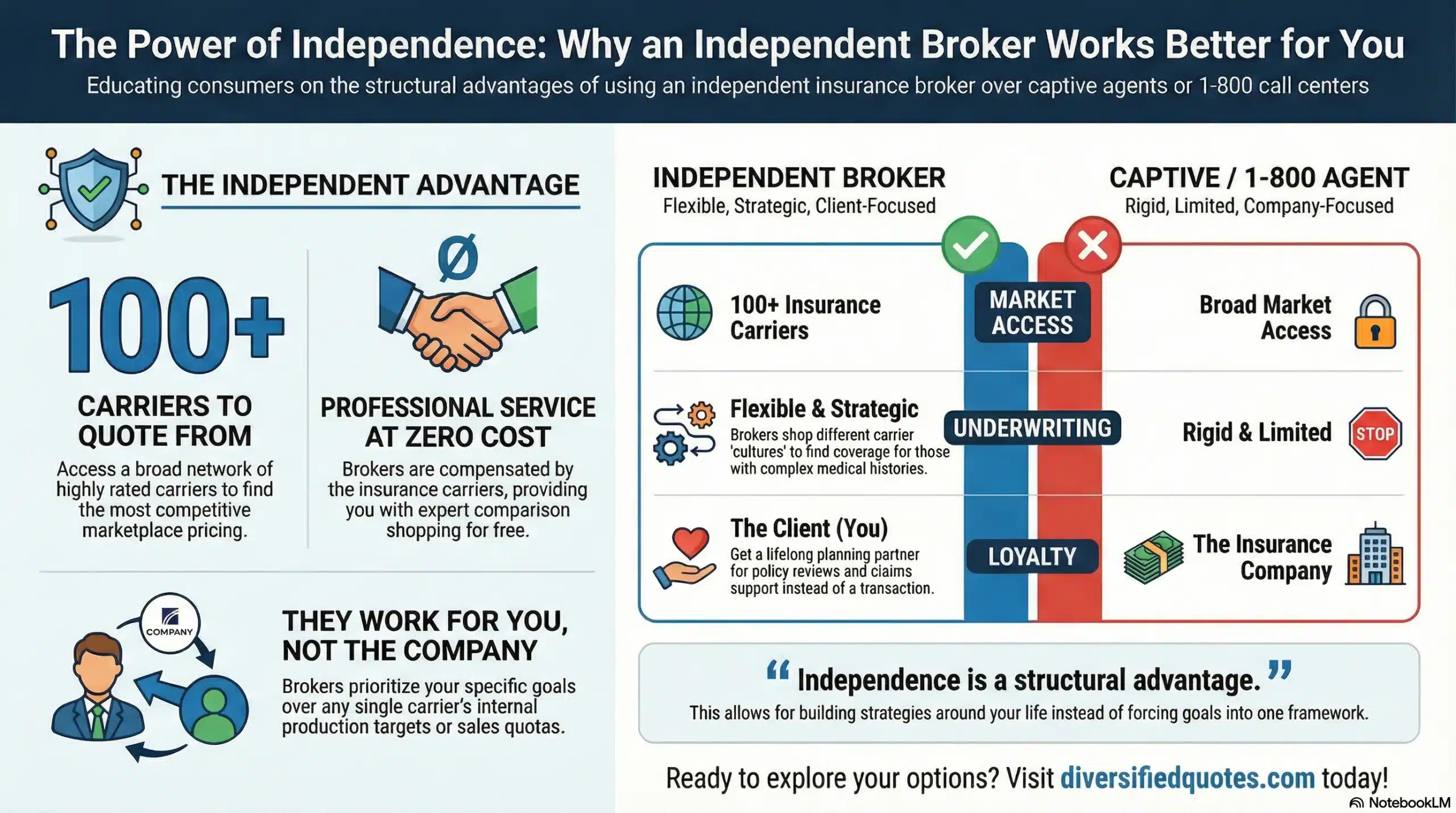
This benefit standardization is precisely why independent carrier comparison is the most financially consequential step in Medigap selection. Across three to five carriers offering Plan G in any given state to a 65-year-old enrollee, the monthly premium variation can span $50 to $150 for identical benefits — a difference that compounds to $600 to $1,800 annually and $12,000 to $36,000 over a 20-year retirement for identical coverage. The lowest premium carrier is not always the best long-term value if that carrier has a history of aggressive annual rate increases that eventually push its pricing above competitors — which is why understanding carrier pricing philosophy alongside current premium is part of a complete Medigap comparison. The best independent Medicare broker covers why access to multiple carriers — rather than a single-carrier or captive agent — is the structural advantage that produces the most competitive Medigap pricing for each individual enrollee.
Prescription Drug Quotes: The Most Overlooked Cost Factor
Prescription drug coverage is one of the largest drivers of annual Medicare cost variability — and one of the most consistently underanalyzed dimensions of plan comparison. The same medication can be on Tier 1 at one Part D plan (a $0 to $5 copay) and on Tier 4 at another (a $50 to $100 or more copay per fill), and both plans can appear comparable in a premium-only comparison. A retiree who takes three ongoing maintenance medications and selects a Part D plan without verifying formulary tier placement for all three may pay $1,000 to $2,000 more per year in drug costs than a plan available in the same area that covers the same medications at lower tiers.
The 2025 $2,000 annual out-of-pocket cap on Part D drug spending is a significant improvement from prior years, but it only applies to the plan’s covered drugs — drugs not on the formulary or subject to coverage restrictions are not automatically protected by the cap. Prior authorization requirements, step therapy protocols (requiring a trial of a different drug before the requested medication is covered), and quantity limits can all affect access to medications even when those medications appear on the formulary. For retirees on specialty medications, biologics, or high-cost brand-name drugs, verifying specific coverage restrictions before enrollment is as important as verifying the tier placement. The Medicare Part D donut hole covers the full cost phase structure and how the 2025 reforms changed the out-of-pocket exposure picture for high-cost drug users. Medicare plan benefit structures covers how dental and vision coverage decisions fit alongside prescription drug plan selection in a complete Medicare planning approach.
Compare Medicare Costs Instantly
When to Request Medicare Quotes and Why Timing Matters
Requesting Medicare quotes three to six months before enrollment provides the most time to compare networks, verify prescription coverage, confirm provider participation, and avoid the last-minute enrollment pressure that leads to decisions made on incomplete information. For new Medicare enrollees approaching 65, this typically means beginning the comparison process around age 64 and a half — early enough to understand the landscape before the Initial Enrollment Period opens three months before the 65th birthday. Enrolling in Medicare at 65 covers the full enrollment sequence and how the quoting and comparison process fits within the timing of Parts A, B, and D enrollment decisions. What to know before you enroll in Medicare covers the full pre-enrollment preparation framework.
For existing Medicare enrollees reviewing coverage, the annual open enrollment period — October 15 through December 7 — is the primary window for Medicare Advantage plan changes and Part D plan switches, with changes taking effect January 1 of the following year. The Medigap comparison timeline is less rigidly constrained by a single enrollment window, but is most flexible during the initial six-month Medigap open enrollment period that begins when an enrollee is 65 and enrolled in Part B — during which insurers cannot use health history to deny coverage or charge higher premiums. Outside this open enrollment window, Medigap applications in most states are subject to medical underwriting, which is why comparing Medigap options and locking in the best available carrier at the earliest opportunity typically produces the most favorable long-term outcome. How to switch Medicare plans covers the mechanics and limitations of plan changes outside the standard enrollment windows. Getting a second opinion on your Medicare quote is the most direct way to confirm whether a quote already received represents the best available option in the full carrier market rather than accepting the first competitive offer presented. If you are still working past 65 and coordinating Medicare enrollment with employer coverage transition, Medicare enrollment for people still working covers the timing coordination and penalty avoidance considerations that make this scenario particularly important to manage carefully. Medicare enrollment mistakes to avoid covers the specific errors that create permanent coverage and cost consequences for new enrollees and those returning to Medicare after delayed enrollment.
Income timing also interacts with Medicare quoting in ways that require proactive planning. The IRMAA surcharges that increase Part B and Part D premiums for higher-income enrollees are based on income from two years prior — meaning retirement income decisions made at 63 affect Medicare costs at 65. Large income events including Roth conversions, required minimum distributions, capital gains, and business income in the years surrounding Medicare eligibility can create elevated premiums that a well-timed quote review can help anticipate and plan around. What IRMAA is covers the income threshold structure and how surcharges affect total Medicare premium cost. How Medicare and Social Security work together covers the financial integration that affects monthly net income when Medicare premiums are deducted from Social Security benefits. The pre-retirement checklist provides the comprehensive sequencing framework for aligning Medicare quoting and enrollment decisions with Social Security, retirement income, and tax planning before retirement begins.
Get Personalized Medicare Plan Guidance
Share your doctors and prescriptions and receive a personalized Medicare comparison.
Start My Medicare ComparisonRelated Medicare Planning Resources
Continue researching Medicare coverage, cost comparisons, and enrollment strategies.
Financial Protection Essentials
Retirement income and planning tools that coordinate with Medicare quote and enrollment decisions.
Compare Medicare Carriers
Book a free consultation with Tonia to review highly-rated Medicare Advantage plans and choose the best fit for your retirement.
Frequently Asked Questions: Medicare Quotes and Plan Comparison
Why do Medicare quotes vary so much between carriers for the same plan?
For Medicare Supplement (Medigap) plans, benefits are standardized by federal law — a Plan G from one carrier provides exactly the same core medical benefits as a Plan G from any other carrier. What varies is the premium, which is set independently by each carrier based on their rating methodology, claims experience, administrative structure, and pricing philosophy. The premium spread for identical Plan G benefits across carriers offering coverage in the same state to a 65-year-old can span $50 to $150 per month — a difference of $600 to $1,800 annually for identical coverage. This is why comparing multiple carriers rather than accepting the first quote presented consistently produces better long-term value for Medigap enrollees. For Medicare Advantage plans, quote variation reflects actual differences in plan design, network structure, copay schedules, and benefit structures rather than pricing variations for identical benefits.
What information do I need to get an accurate Medicare quote?
For a Medigap quote, the key variables are your ZIP code, date of birth, gender, tobacco status, and Medicare eligibility date — these determine which plans are available in your area and what the pricing will be based on each carrier’s rating methodology. For a Medicare Advantage quote, your ZIP code and county determine which plans are available, and your list of current medications and preferred physicians allows an accurate total annual cost comparison rather than just a premium comparison. For a Part D standalone plan quote, your complete medication list — including drug name, dosage, and quantity per month — is the most important variable, because tier placement and formulary coverage for your specific drugs determines actual annual drug cost far more than the plan’s base premium.
Is it better to compare Medicare quotes online or through an agent?
Online Medicare quote tools provide useful preliminary pricing data across multiple carriers, but they typically compare premiums rather than total annual cost and may not account for all the variables that determine whether a plan is the best fit for a specific situation — including prescription drug tier placement across different Part D formularies, the in-network status of specific physicians at different Medicare Advantage plans, the nuances of Medigap carrier rating methodologies that affect long-term price trajectory, or the interaction between income levels and IRMAA surcharges. An independent Medicare agent or broker with access to multiple carriers adds the analytical layer that converts premium comparison into total annual cost comparison and incorporates the individual circumstances that determine actual plan value. The combination — using online tools for initial research and orientation, followed by working with an independent broker for detailed carrier-specific comparison — typically produces the most informed enrollment decision.
Can I change my Medicare plan after I enroll?
Medicare Advantage and standalone Part D plans can be changed annually during the fall open enrollment period — October 15 through December 7 — with changes taking effect January 1. Medigap plan changes after the initial six-month open enrollment period that begins when you turn 65 and enroll in Part B are subject to medical underwriting in most states, which means carriers can decline coverage or charge higher premiums based on health history. A small number of states have additional guaranteed-issue Medigap protections, and federal law provides limited guaranteed-issue rights in specific circumstances such as losing Medicare Advantage coverage through no fault of your own. The practical implication is that Medigap decisions are most flexible — and most protected from underwriting — during the initial open enrollment window, which is the most important reason to make a well-informed Medigap carrier selection at the outset rather than expecting to refine it later without health scrutiny.
How do I know if a Medicare plan includes my doctors and medications?
For Medicare Advantage plans, provider participation must be verified directly through the plan’s provider directory or by calling the plan’s member services, because provider network contracts change and directories are not always current. Verifying your specific physicians — particularly specialists you rely on for ongoing care — before enrolling in any Medicare Advantage plan is essential rather than optional. For Part D coverage, drug formularies are published by each plan and are searchable by medication name on Medicare.gov’s Plan Finder tool, which allows side-by-side comparison of what different plans pay for your specific medications at your preferred pharmacy. For Medigap plans, no provider network verification is required — Medigap works alongside Original Medicare and any provider who accepts Medicare assignment is accessible at the same in-network cost regardless of which Medigap carrier you use.
About the Author:
Tonia Pettitt, CMIP©, (NPN 14374308), is a seasoned Medicare specialist with more than 40 years of hands-on experience guiding individuals and families through the complexities of Medicare planning. As a senior advisor with the nationally licensed independent agency Diversified Insurance Brokers, Tonia provides clear, dependable guidance across all areas of Medicare—including Medicare Advantage, Medicare Supplement (Medigap), and Part D prescription coverage. Leveraging active contracts with dozens of highly rated insurance carriers, she helps clients compare options objectively and secure the most suitable coverage for their health and budget.
Known for her patient, education-first approach, Tonia has built a reputation as a trusted resource for retirees seeking reliable, unbiased Medicare support. With four decades of experience across evolving Medicare laws, carrier changes, and plan structures, she brings unmatched insight to every client conversation—ensuring clients feel confident, protected, and fully prepared for each stage of their retirement healthcare journey.
Explore More Medicare Options: Browse our complete guide to Medicare Advantage vs Medicare Supplement — covering plan comparisons, supplement plans, Advantage plans & finding the best coverage.
Last Reviewed: June 15, 2026 |
Reviewed by: Tonia Pettitt, CMIP©
Medicare Specialist, Diversified Insurance Brokers, Inc. | NPN: 14374308 | Diversified Insurance Brokers, Inc. — Licensed in all 50 states
Fact Checked by: Jason Stolz, CLTC, CRPC, DIA, CAA
Chief Underwriter, Diversified Insurance Brokers, Inc. | NPN: 20471358 | Diversified Insurance Brokers, Inc. — Licensed in all 50 states
Did you find this content helpful? Leave us a Google review — it helps others find trustworthy guidance too.
Editorial Standards: Diversified Insurance Brokers maintains rigorous editorial standards to ensure accuracy, clarity, and independence in all content. Learn more about our editorial standards and commitment to transparency.
