
How to Choose the Best Medicare Plan
As an Independent Medicare Broker, Tonia Pettitt (CMIP©) compares available plans across the major carriers to help you find the right coverage for your health, needs and budget.
How to Choose the Best Medicare Plan

Choosing the best Medicare plan is one of the most consequential financial decisions retirees make — and one of the most frequently rushed. Medicare coverage affects not just monthly premiums but doctor access, specialist availability, prescription drug costs, hospital coverage, and total out-of-pocket healthcare spending across potentially decades of retirement. Because Medicare includes several structurally different coverage options — Original Medicare, Medicare Advantage, and Medicare Supplement (Medigap) policies — understanding how each option actually works, who it serves best, and what it costs in practice is essential before enrolling.
Many retirees begin the comparison process focused on monthly premium — the most visible number. However, the true cost of Medicare coverage depends on the combination of premium, deductible, copayment and coinsurance structure, prescription drug coverage, and annual out-of-pocket maximum. A plan that appears inexpensive in premium can produce significantly higher total costs if it limits doctor access, requires substantial copayments for specialist visits, or exposes the beneficiary to high out-of-pocket liability in a serious medical year. Conversely, a plan with a higher premium may produce a lower and more predictable total cost profile for retirees with regular healthcare needs. The premium is only one variable in a multi-variable equation.
The best Medicare plan is not the same for everyone — and it is not the same for any individual across all retirement years. Some retirees prioritize predictable healthcare costs and broad provider access nationwide. Others prioritize lower monthly premiums with bundled benefits including dental, vision, and hearing coverage that Original Medicare does not cover. Still others have specific prescription drug needs that make formulary design the dominant selection criterion. Understanding how these priorities map to different plan structures — and how those structures perform across different health usage scenarios — is the foundation of an informed Medicare decision. Individuals comparing Medicare coverage often begin by using tools such as a Medicare plan comparison calculator to see how premiums, copays, and prescription costs interact for their specific situation.
Find the Right Medicare Plan
Our team helps retirees compare Advantage and Supplement options, evaluate costs, and choose coverage that fits retirement healthcare needs.
Compare Medicare Plans
Use the comparison tool below to evaluate plan types, premiums, and coverage options side by side.
Understanding Your Medicare Coverage Options
Medicare coverage begins with Original Medicare — Part A for hospital and inpatient coverage, and Part B for outpatient medical services including physician visits, diagnostic testing, durable medical equipment, and certain preventive services. These two components form the foundational framework of Medicare, but they do not cap out-of-pocket spending. Under Original Medicare alone, there is no annual maximum on what a beneficiary might owe for covered services — a hospitalization or serious illness can generate substantial cost-sharing obligations without a ceiling. This is the primary reason most Medicare-eligible retirees add either Medicare Advantage or Medicare Supplement coverage to their Original Medicare foundation.
Medicare Advantage plans, also known as Part C, are offered by private insurance companies that contract with Medicare to administer benefits. These plans bundle Part A hospital coverage, Part B outpatient coverage, and typically Part D prescription drug coverage into a single integrated plan. Many Medicare Advantage plans also include additional benefits that Original Medicare does not cover — dental care, vision services, hearing aids and exams, fitness memberships, and various supplemental programs. Medicare Advantage plans typically operate within defined provider networks and use cost-sharing structures including copayments and coinsurance, with an annual out-of-pocket maximum that caps the beneficiary’s total liability for covered services within the plan year.
Medicare Supplement insurance — commonly called Medigap — works fundamentally differently. Rather than replacing Original Medicare, a Medigap policy works alongside Original Medicare to help pay the cost-sharing obligations that Original Medicare creates: Part A and Part B deductibles, coinsurance, and copayments. Medicare Supplement plans are standardized by federal regulation — a Plan G from one insurance company covers the same benefits as a Plan G from another company, though premiums vary by insurer, age, and location. Because Medigap policies coordinate with Original Medicare rather than replacing it, they generally allow beneficiaries to see any provider nationwide who accepts Medicare assignment — without network restrictions. Individuals evaluating supplement options frequently compare policies such as Medicare Supplement Plan G vs Plan N to determine which coverage structure best fits their healthcare usage and financial profile.
The Real Cost of Medicare: Beyond the Monthly Premium
Understanding the true cost of a Medicare plan requires moving beyond the premium to evaluate the full cost-sharing picture across different healthcare usage scenarios. A Medicare Advantage plan with a $0 monthly premium sounds appealing in isolation — but its actual cost in a year with significant healthcare needs depends on the copayments for each specialist visit, the coinsurance for hospital stays, the out-of-pocket maximum that limits total liability, the drug formulary that determines prescription costs, and whether the beneficiary’s physicians are in-network. For a retiree who uses healthcare frequently or who has ongoing specialist needs, those cost-sharing elements may produce total annual costs well above what a Medigap plan with a higher monthly premium would cost.
Conversely, a Medicare Advantage plan’s lower premium and bundled benefits can produce significantly lower total costs for a retiree in good health who primarily needs preventive care and occasional physician visits. The point is not that one structure is universally better but that the right structure depends on the individual’s healthcare usage pattern, provider preferences, prescription needs, and tolerance for cost variability. A retiree who wants to know with high confidence what their maximum healthcare exposure is in any given year is typically better served by a Medigap plan with its predictable cost structure. A retiree who prioritizes a lower monthly commitment and is comfortable with the network and copayment structure of an Advantage plan may find that option more financially efficient.
Factors That Determine the Best Medicare Plan for You
Provider access is one of the most important practical considerations when choosing between Medicare Advantage and Medicare Supplement coverage. Medicare Advantage plans operate within provider networks — HMO designs typically require primary care referrals and restrict coverage to network providers except in emergencies, while PPO designs allow some out-of-network access at higher cost-sharing. A retiree whose primary care physician, cardiologist, oncologist, or other regularly used specialist does not participate in a given Advantage plan’s network faces a meaningful practical barrier to the care relationship they have established. In contrast, Original Medicare combined with Medigap coverage generally allows beneficiaries to see any provider in the country who accepts Medicare assignment without network restrictions — a significant advantage for retirees who travel frequently, spend time in multiple locations seasonally, or have established care relationships they do not want to disrupt.
Prescription drug coverage is another critical and frequently underestimated factor. Medications may be covered through drug coverage built into a Medicare Advantage plan or through a standalone Part D prescription drug plan paired with Original Medicare and Medigap. Each plan maintains its own formulary — the list of covered drugs and the tier at which each is placed — which determines both whether a specific medication is covered and what it costs. Two plans may both technically cover a medication but price it very differently depending on tier placement and pharmacy network. For retirees taking multiple brand-name or specialty medications, formulary review is often the most financially significant element of the plan selection process.
Enrollment timing carries its own consequences that amplify the importance of getting the initial decision right. Individuals comparing prescription coverage enrollment rules should review resources such as Medicare Part B penalties and Special Enrollment Period rules to understand the timing requirements that apply to their situation — because late enrollment in Part B or Part D can result in permanent premium penalties that last for the duration of Medicare coverage.
Medicare Advantage vs. Medicare Supplement: The Core Tradeoff
The fundamental tradeoff between Medicare Advantage and Medicare Supplement coverage comes down to premium versus flexibility. Medicare Advantage plans typically offer lower monthly premiums — often $0 for the plan premium, though the Part B premium continues regardless — and often include bundled benefits like dental, vision, and hearing that Original Medicare does not cover. In exchange, the beneficiary accepts network constraints, copayment-based cost-sharing that varies by service type, and plan designs that may change significantly from year to year during the Annual Enrollment Period.
Medicare Supplement plans typically carry higher monthly premiums but provide broader provider access and more predictable cost-sharing. A Plan G policyholder, for example, pays the Part B deductible and the monthly Medigap premium, and Original Medicare plus the Medigap plan cover essentially everything else — leaving very limited additional out-of-pocket exposure regardless of how much healthcare the beneficiary uses. This predictability is particularly valuable for retirees with complex or chronic conditions who use healthcare frequently, for whom the variable copayment structure of a Medicare Advantage plan can produce meaningfully higher and less predictable total costs. However, Medigap plans do not include prescription drug coverage, dental, vision, or hearing benefits — these must be addressed through separate Part D and supplemental benefit plans.
The switching rules add an additional dimension to this decision. Moving from Medigap to Medicare Advantage is generally straightforward during enrollment periods. Moving from Medicare Advantage back to a Medigap plan can be significantly more difficult — in most states, there is no guaranteed issue right for Medigap when switching from Advantage, meaning insurers can use medical underwriting and may decline or rate applicants based on health status. For retirees who initially choose Medicare Advantage and later prefer the predictability of Medigap, that transition may not be available at standard rates once health conditions have developed. This asymmetry in switching rules makes the initial Medicare structure decision more consequential than it might appear and argues for thoughtful evaluation rather than selecting the lowest-premium option by default.
The Importance of Annual Medicare Plan Review
Medicare plans are not static. Premiums, prescription drug formularies, provider networks, copayment structures, and included benefits can all change each year during the plan’s annual update process. Medicare Advantage and Part D plans must notify enrollees of material changes through the Annual Notice of Change document, which explains what is changing for the upcoming plan year. What this means in practice is that a Medicare plan that was the best choice in one year may be materially less favorable in the next — because the formulary dropped a key medication to a higher tier, because a frequently used specialist left the network, or because premiums increased while a competing plan’s premiums remained stable.
Reviewing Medicare coverage annually during the Annual Enrollment Period — October 15 through December 7 each year — is one of the most financially productive actions a Medicare beneficiary can take. The review does not need to result in a plan change, but it should result in a confirmed decision that the current plan still offers the best value and coverage fit. Information about what triggers annual review and what the notice process entails is available through our resource on the Medicare Annual Notice of Change. Many retirees discover that a five-minute comparison during the Annual Enrollment Period reveals meaningful savings opportunities that would otherwise go unnoticed year after year.
Balancing Cost, Flexibility, and Healthcare Access
The best Medicare plan decision balances three primary considerations simultaneously: total cost including premium and expected out-of-pocket expenses, access to providers and facilities the beneficiary prefers and depends on, and flexibility to adapt if healthcare needs change. These three considerations interact in ways that make the decision genuinely individual — there is no universal answer, and there is no single metric that resolves the comparison across all situations.
Healthcare usage patterns play a particularly important role. Individuals who frequently see specialists, require ongoing treatment for chronic conditions, or have had significant healthcare events in recent years may find the cost predictability of Medigap coverage more valuable than the premium savings of Medicare Advantage. Individuals whose healthcare needs are primarily preventive and who are in good health may find that an Advantage plan’s lower premium and bundled benefits represent better value. Travel habits matter too — retirees who travel frequently or divide their time between multiple states benefit meaningfully from the nationwide provider access that Original Medicare with Medigap provides.
Working with experienced Medicare advisors who can compare multiple insurance companies, evaluate plan benefits and costs side by side for the specific retiree’s situation, and explain the long-term implications of each option can simplify a decision that involves meaningful financial consequences for retirement. When Medicare coverage is selected thoughtfully — with full understanding of cost, access, and long-term flexibility — it provides reliable healthcare protection and meaningful financial stability throughout retirement. Compare Medicare plans with our team to see the options that fit your specific situation.
Financial Protection Essentials
Explore Medicare planning, retirement income, and healthcare protection resources for retirees.
Compare Medicare Carriers
Book a free consultation with Tonia to review highly-rated Medicare Advantage plans and choose the best fit for your retirement.
Frequently Asked Questions About Choosing a Medicare Plan
There is no single best Medicare plan for all retirees — the optimal choice depends on individual healthcare needs, budget, provider preferences, travel habits, and prescription drug usage. Some retirees prefer Medicare Advantage plans because they combine hospital, medical, and drug coverage into a single policy and often include dental, vision, and hearing benefits that Original Medicare does not cover. Others choose Original Medicare paired with a Medicare Supplement (Medigap) plan because it provides broader provider access nationwide and more predictable cost-sharing. Retirees who frequently see specialists or have complex medical needs often benefit most from the predictability of Medigap. Retirees in good health with modest healthcare needs may find that a Medicare Advantage plan’s lower premium and bundled benefits represent better value. The best approach is to compare total expected costs — not just monthly premium — across both structures given your specific situation before enrolling.
Neither is universally better — each has meaningful advantages and tradeoffs depending on the individual. Medicare Advantage plans typically have lower or even $0 monthly plan premiums and often include additional benefits such as dental, vision, and hearing coverage. In exchange, they operate within provider networks, use copayment-based cost-sharing that varies by service, and may change their formulary, network, or benefit structure each year. Medicare Supplement plans carry higher monthly premiums but offer broader provider access — any provider nationwide who accepts Medicare — and more predictable cost-sharing that limits out-of-pocket exposure regardless of healthcare usage. An important practical consideration is the switching rules: moving from Advantage to Medigap later in life is not guaranteed at standard rates in most states. Insurers can use medical underwriting and may decline applicants based on health conditions. This asymmetry makes the initial structure decision more consequential than it might appear.
The most important factors are your preferred doctors and specialists and whether they participate in any plan you are considering, your prescription medications and how each plan’s formulary covers them and at what cost, your expected healthcare usage based on current health status and medical history, your monthly budget for premiums alongside your tolerance for variable out-of-pocket costs, whether you travel frequently or divide time between multiple locations (which affects how much provider access matters), and your long-term planning horizon given that switching back to Medigap from Medicare Advantage later is not guaranteed at standard rates. Comparing total annual cost — premium plus expected copayments, deductibles, and drug costs — across realistic healthcare usage scenarios for your specific situation produces a more accurate comparison than looking at premium alone.
It depends on the plan structure. Medicare Advantage plans frequently include built-in Part D prescription drug coverage integrated within the plan. Original Medicare alone — Parts A and B — does not include prescription drug coverage. Beneficiaries who choose Original Medicare with a Medigap supplement must enroll separately in a standalone Part D prescription drug plan to have drug coverage. Medigap plans themselves do not include prescription drug coverage regardless of plan letter. Each Part D and Advantage plan maintains its own formulary specifying which drugs are covered and at which cost-sharing tier, so two plans that technically cover the same medication may charge very different amounts depending on tier placement and the pharmacy network used. For retirees taking multiple or high-cost medications, reviewing the specific formulary for each plan under consideration — not just the general drug coverage description — is essential to understanding the true prescription cost comparison.
Yes, with some important limitations. Medicare plans can be changed during the Annual Enrollment Period from October 15 through December 7 each year, with changes taking effect January 1 of the following year. Medicare Advantage plans can also be changed during the Medicare Advantage Open Enrollment Period from January 1 through March 31 each year. However, switching from a Medicare Advantage plan to a Medicare Supplement (Medigap) plan outside of specific guaranteed issue situations is subject to medical underwriting in most states — meaning insurers can review health history and may decline coverage or charge higher premiums based on pre-existing conditions. This is one of the most important asymmetries in Medicare planning: moving from Medigap to Advantage is generally straightforward, but the reverse is not guaranteed. Certain life events — moving to a new service area, losing employer coverage, or other qualifying circumstances — may create Special Enrollment Periods that allow coverage changes outside the standard enrollment windows.
Medicare plans change annually, and changes can significantly affect a beneficiary’s costs and access. Medicare Advantage and Part D plans may adjust their monthly premiums, change which medications are on the formulary and at which tier, modify their provider networks by adding or removing physicians and hospitals, and change copayment and coinsurance structures. These changes are communicated through the Annual Notice of Change document that plans must send to enrolled beneficiaries before the Annual Enrollment Period begins. A plan that was the best available option in one year may be materially less favorable in the next — and a different plan may offer meaningfully lower total costs or better coverage for the same beneficiary’s needs. Reviewing coverage annually during the October 15 to December 7 Annual Enrollment Period, comparing the current plan against alternatives, and making a conscious decision about whether to stay or switch takes relatively little time and can produce significant savings over a retirement that may span 20 to 30 years.
HMO and PPO are two of the most common Medicare Advantage plan designs, and they differ primarily in provider access and referral requirements. A Medicare Advantage HMO plan typically requires beneficiaries to select a primary care physician who coordinates care and provides referrals to in-network specialists. HMO plans generally cover services only from providers within the plan’s network, except in genuine emergencies. Coverage for out-of-network providers is typically not included. A Medicare Advantage PPO plan allows beneficiaries to see both in-network and out-of-network providers, though out-of-network care typically involves higher cost-sharing. PPO plans generally do not require referrals to see specialists. For retirees who have established relationships with specific specialists or who prefer the flexibility to see providers without referral requirements, a PPO design typically offers more access flexibility than an HMO, though premiums for PPO plans are often higher than for comparable HMO plans. Both HMO and PPO plans set their own provider networks, which means verifying that your specific preferred providers participate in any plan you are evaluating is an important step before enrolling.
Original Medicare does not cover several categories of care that many retirees need and expect to be covered. Routine dental care — including cleanings, fillings, extractions, and dentures — is not covered by Original Medicare Parts A and B. Routine vision care including eye exams for glasses or contacts and eyeglasses themselves is not covered. Routine hearing exams and hearing aids are not covered. Most long-term care — custodial care in a nursing home or assisted living facility when the primary need is help with activities of daily living rather than skilled medical care — is not covered. Prescription drugs are not covered by Parts A and B and require separate Part D enrollment. Some Medicare Advantage plans include dental, vision, and hearing benefits as additional coverage, though the scope of those benefits varies significantly. Long-term care requires separate planning through long-term care insurance or other mechanisms. Understanding what Medicare does not cover is an essential complement to understanding what it does cover, and it helps retirees plan for the out-of-pocket expenses that will exist regardless of plan choice.
For retirees who continue working at an employer with 20 or more employees and have employer-sponsored health coverage, the employer plan is typically primary and Medicare is secondary. This means the employer plan pays first and Medicare may cover some remaining costs. In this situation, delaying Medicare Part B enrollment may be appropriate, and the employee may have a guaranteed right to enroll in Part B without penalty when employer coverage ends through a Special Enrollment Period. For retirees working at an employer with fewer than 20 employees, Medicare is typically primary and the employer plan is secondary. The coordination rules matter because enrolling in Part B when employer coverage is primary and Medicare is secondary may mean paying for coverage that is effectively duplicative. Conversely, failing to enroll in Part B when Medicare should be primary can result in a permanent late enrollment penalty. The rules are employer-size dependent and situation-specific — reviewing these rules with a Medicare specialist before making enrollment decisions is strongly recommended for anyone continuing to work past 65.
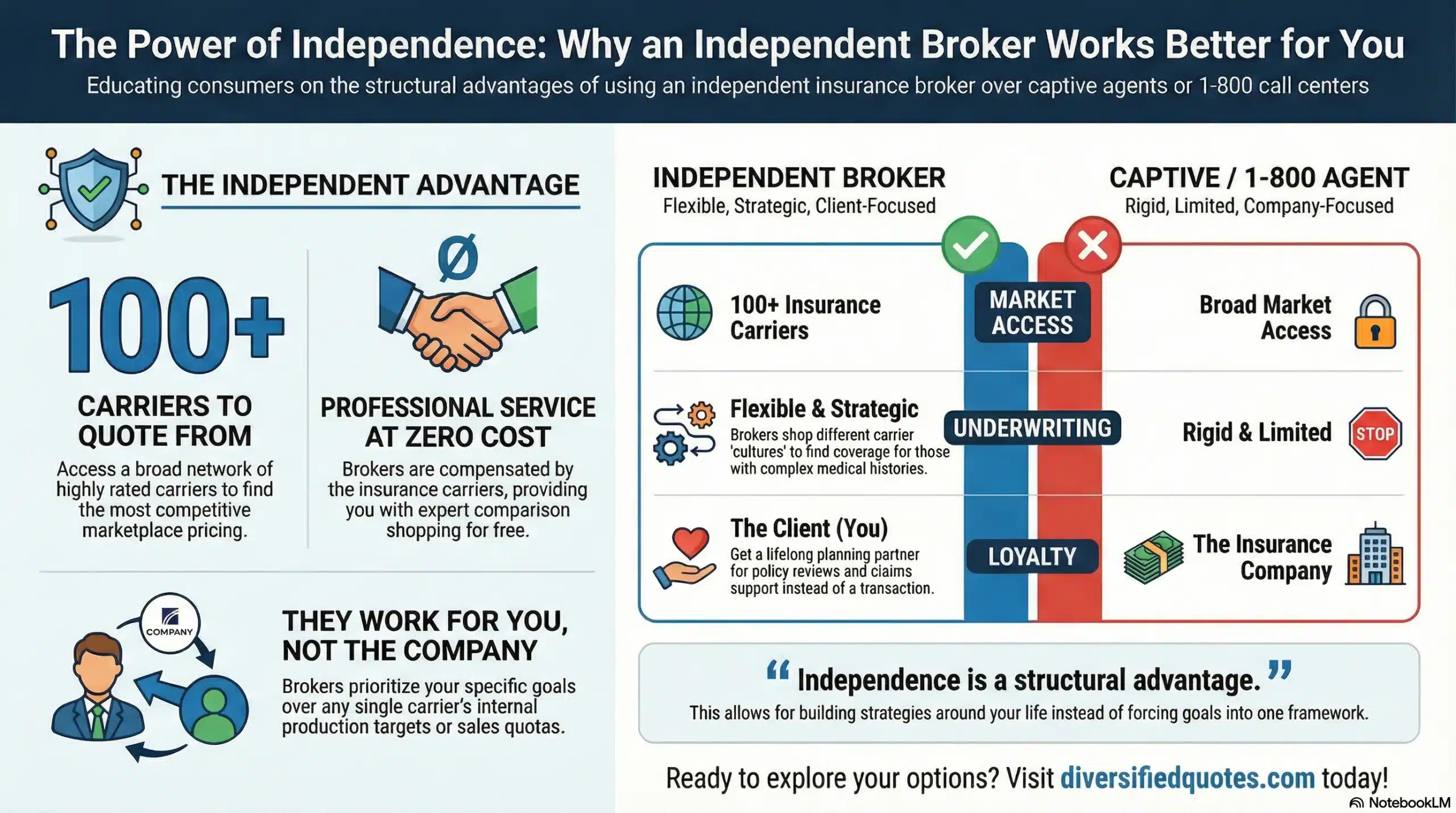
Diversified Insurance Brokers works with experienced Medicare specialists who can compare Medicare Advantage plans and Medicare Supplement options across multiple insurance companies for a specific beneficiary’s location, healthcare needs, provider preferences, and prescription drug usage. Because we are independent rather than captive to a single insurance company, our advisors can evaluate the available options objectively and help identify the plan that best fits the individual’s specific situation rather than being limited to one company’s product lineup. Our Medicare specialists can explain the practical differences between plan structures, help beneficiaries understand how switching rules affect long-term flexibility, review formulary coverage for current medications, and assist with enrollment at the appropriate time to avoid late enrollment penalties. To speak with a Medicare specialist or get help comparing options, request assistance through the contact options on this page or explore our full Medicare services.
About the Author:
Tonia Pettitt, CMIP©, (NPN 14374308), is a seasoned Medicare specialist with more than 40 years of hands-on experience guiding individuals and families through the complexities of Medicare planning. As a senior advisor with the nationally licensed independent agency Diversified Insurance Brokers, Tonia provides clear, dependable guidance across all areas of Medicare—including Medicare Advantage, Medicare Supplement (Medigap), and Part D prescription coverage. Leveraging active contracts with dozens of highly rated insurance carriers, she helps clients compare options objectively and secure the most suitable coverage for their health and budget.
Known for her patient, education-first approach, Tonia has built a reputation as a trusted resource for retirees seeking reliable, unbiased Medicare support. With four decades of experience across evolving Medicare laws, carrier changes, and plan structures, she brings unmatched insight to every client conversation—ensuring clients feel confident, protected, and fully prepared for each stage of their retirement healthcare journey.
Explore More Medicare Options: Browse our complete guide to Medicare Advantage vs Medicare Supplement — covering plan comparisons, supplement plans, Advantage plans & finding the best coverage.
Last Reviewed: August 25, 2026 |
Reviewed by: Tonia Pettitt, CMIP©
Medicare Specialist, Diversified Insurance Brokers, Inc. | NPN: 14374308 | Diversified Insurance Brokers, Inc. — Licensed in all 50 states
Fact Checked by: Jason Stolz, CLTC, CRPC, DIA, CAA
Chief Underwriter, Diversified Insurance Brokers, Inc. | NPN: 20471358 | Diversified Insurance Brokers, Inc. — Licensed in all 50 states
Did you find this content helpful? Leave us a Google review — it helps others find trustworthy guidance too.
Editorial Standards: Diversified Insurance Brokers maintains rigorous editorial standards to ensure accuracy, clarity, and independence in all content. Learn more about our editorial standards and commitment to transparency.
