
Understanding the Difference Between Term Life and Accidental Death Insurance
Understanding the Difference Between Term Life and Accidental Death Insurance
When it comes to protecting your family’s financial foundation, choosing the right type of life insurance is one of the most important decisions you can make. Many people compare term life insurance and accidental death insurance without fully understanding how differently these policies function. On the surface, both provide a death benefit. But beneath that similarity are major differences in coverage triggers, underwriting requirements, pricing structure, and long-term financial impact. Life insurance is not simply a product — it is a strategy designed to safeguard income, protect long-term goals, eliminate debt risk, and provide financial stability in moments that would otherwise create economic hardship. Families often face a mix of health risks, lifestyle exposures, and financial obligations, which is why understanding the distinctions between these two forms of coverage is essential. Choosing correctly — or combining them strategically — can eliminate gaps and create a more resilient protection plan.

See Real-Term Rates Side by Side
Life Insurance Quoter
Term Life vs. Accidental Death vs. Combined: At a Glance
| Feature | Term Life Insurance | Accidental Death Insurance | Combined Strategy |
|---|---|---|---|
| Causes of Death Covered | All causes during the term — illness, accident, cancer, heart disease, stroke, natural causes — subject to standard exclusions such as suicide in the first two years. | Covered accidents only — traffic crashes, falls, drowning, workplace injuries, exposure to elements. Illness and natural causes not covered. | All-cause coverage from the term policy plus an additional accidental death payout on top — both benefits pay simultaneously if death results from a covered accident. |
| Dismemberment Benefits | Not included — term life pays only at death. No benefit for surviving a serious accident with loss of limb or sensory function. | Yes — partial benefits on a defined schedule for loss of limb, sight, hearing, or speech while the insured is alive after a covered accident. | AD&D component provides living dismemberment benefits; term policy death benefit remains fully in force for any cause of death. |
| Medical Underwriting | Health evaluation required — exam may be needed for larger face amounts. Health history, family history, and lifestyle all affect eligibility and rate class. See what a life insurance exam involves. | No medical exam and typically no health questions. Age eligibility limits apply (usually 18–69). Cannot be declined for health reasons within eligible age range. | Term policy requires underwriting; AD&D component adds no additional exam requirements. Both can often be structured at the same time. |
| Premium Cost | Higher per dollar of coverage than accidental death — reflects broad all-cause coverage and health underwriting. A healthy 35-year-old can secure $500,000 in coverage for a low monthly premium. See how to get the best life insurance rates. | Very low — significantly cheaper than equivalent term coverage because the scope is limited to accidents only and no health underwriting is performed. | Combined cost remains lower than purchasing two standalone life policies, because the AD&D component is priced as a supplemental product rather than primary coverage. |
| Accessibility for Impaired Risk | Health history can restrict eligibility, increase premiums, or require rated or postponed coverage. Pre-existing conditions are a key factor. No-exam options available but at higher rates. | Fully accessible regardless of health history — no medical underwriting means pre-existing conditions have no effect on eligibility or premium within the age window. | For impaired-risk individuals: accidental death provides an immediately accessible layer while term life is pursued through alternative underwriting pathways. |
| Coverage Duration | Fixed term — typically 10, 20, or 30 years. Coverage ends at term expiration unless converted or renewed. Best matched to specific financial obligations with known timelines. | Term-based supplemental coverage with no cash value. Standalone policies typically renewed annually or for defined periods. | Term policy covers the financial obligation window; AD&D provides ongoing supplemental accident protection that can be maintained beyond the term if needed. |
| Primary Use Case | Core income replacement and debt protection. Foundation of any comprehensive life insurance strategy. See how much life insurance you actually need. | Supplemental accident-specific protection; coverage for individuals who cannot qualify for traditional life insurance; dismemberment living benefit. See how to qualify. | Comprehensive layered protection — all-cause death coverage from the term policy with accidental death amplification and living dismemberment benefits added at low incremental cost. |
Term Life Insurance — The Foundation of Financial Protection
Term life insurance is widely considered the foundation of most protection strategies because it provides broad coverage for a defined period of time — typically 10, 20, or 30 years. As long as premiums are paid and the insured passes away during the selected term, beneficiaries receive a tax-free lump sum. That benefit can replace income, cover daily living expenses, fund college education, pay off large debts, or eliminate a mortgage obligation through strategies similar to mortgage protection vs. term life insurance. The defining feature of term life is that it pays regardless of the cause of death — whether from illness, accident, or natural causes. Because it includes coverage for health-related deaths such as cancer, heart disease, or stroke, it provides comprehensive financial protection during the years income is most critical. This is especially important for parents, business owners, and households relying on one or two primary earners.
The statistics behind why term life is the foundation are clear. Heart disease and cancer together account for roughly half of all deaths in the United States each year. Accidents — the cause of death that accidental death insurance covers — account for approximately the fourth leading cause of death, representing a meaningful but minority share of total mortality. This means that for every person who dies in an accident, roughly eight to nine more die from illness. A policy that covers only accidental death therefore leaves the overwhelming majority of the most likely causes of premature death unprotected. For any family depending on a life insurance benefit to replace income or pay off debt, covering illness-related death is not optional — it is the primary risk the policy must address. Term life insurance does exactly that, and does it at competitive premiums for healthy applicants during the years when income replacement need is highest.
How Term Life Underwriting Works — And Why Health Matters
Term life insurance is medically underwritten — the carrier evaluates the applicant’s health history, family history, current health status, and lifestyle factors to determine eligibility and rate class. This underwriting process is the mechanism through which the carrier assigns each applicant to a risk tier that determines their premium. Rate classes typically include preferred plus (best available rates), preferred, standard plus, standard, and substandard (table-rated). The assigned rate class directly determines the monthly cost — two applicants purchasing identical $500,000 20-year term policies may pay premiums that differ by 50% to 200% based on rate class assignment. For most healthy applicants in their 30s and 40s, term life premiums are surprisingly affordable — often less than $30 to $60 per month for $500,000 in coverage — making the underwriting investment of time and effort clearly worthwhile relative to the protection received.
Some individuals prefer to explore options that avoid the underwriting process entirely. No-exam life insurance products offer simplified or guaranteed issue approval without a paramedical examination, though typically at higher premiums and lower available face amounts than fully underwritten policies. For applicants with health histories that complicate standard underwriting, working with an independent broker who can match the specific health profile to the most favorable carrier guidelines produces better outcomes than applying to a single carrier and accepting whatever decision comes back. Our resource on getting life insurance with health issues covers the strategies available for applicants facing underwriting challenges, including the use of accidental death coverage as a bridge while pursuing preferred underwriting pathways.
Accidental Death Insurance — The Supplemental Layer
Accidental death insurance, sometimes referred to as AD&D (Accidental Death and Dismemberment), operates under a much narrower scope than term life. It pays a benefit only if death results directly from a covered accident — car crashes, falls, certain workplace injuries, drowning, and other sudden external events. Because it excludes illness and natural causes, premiums are significantly lower and underwriting is typically minimal or nonexistent. This simplicity makes it appealing for individuals who want fast approval without medical exams. It can also provide additional protection for people working in physically demanding or hazardous industries, including those seeking life insurance for high-risk occupations.
The dismemberment component of AD&D coverage fills a gap that no life insurance policy can address: a serious accident that leaves the insured alive but permanently injured. If a transportation professional loses a hand in a workplace accident and survives, a term life policy pays nothing — because the insured is still living. An AD&D policy pays a partial benefit according to the defined benefit schedule, providing a lump sum that the insured can apply toward medical costs, rehabilitation, prosthetics, home modification, or income replacement during recovery. For workers in physically demanding industries — construction, mining, transportation, oil and gas — this living benefit is often as valuable as the death benefit itself. Our resource on life insurance for the mining industry illustrates how accidental death and dismemberment coverage integrates into the broader protection structure for hazardous environment workers, and business travel accident insurance covers a related specialized product for frequent travelers with elevated accidental death exposure.
Underwriting Scenarios — Matching Coverage to Health Profile
The underwriting dimension of this comparison is where many individuals make planning mistakes. A healthy 30-year-old with no medical history should prioritize fully underwritten term life insurance because they will qualify for preferred or preferred plus rates, maximizing the amount of coverage available per dollar of premium. For this person, accidental death insurance is an inexpensive supplement that adds incremental protection — not a substitute for the term life foundation. A 45-year-old with a history of controlled high blood pressure and elevated cholesterol may qualify for standard rate class on term life, making the premium higher but still entirely reasonable for the coverage provided — again, term life remains the foundation with AD&D as an optional supplement. A 55-year-old with a recent cancer diagnosis or significant cardiac history may face rated coverage, a declined application, or a deferred application period on term life insurance. In this scenario, accidental death insurance provides an immediately accessible layer of coverage at a defined premium while the individual pursues alternative life insurance pathways — no-exam products, graded benefit whole life, or simplified issue policies — that accommodate the health history. The key principle: accidental death insurance never replaces term life insurance for health-qualified individuals. It supplements it. For individuals who cannot currently qualify for traditional coverage, it provides a meaningful temporary bridge that keeps some protection in place while better options are pursued.
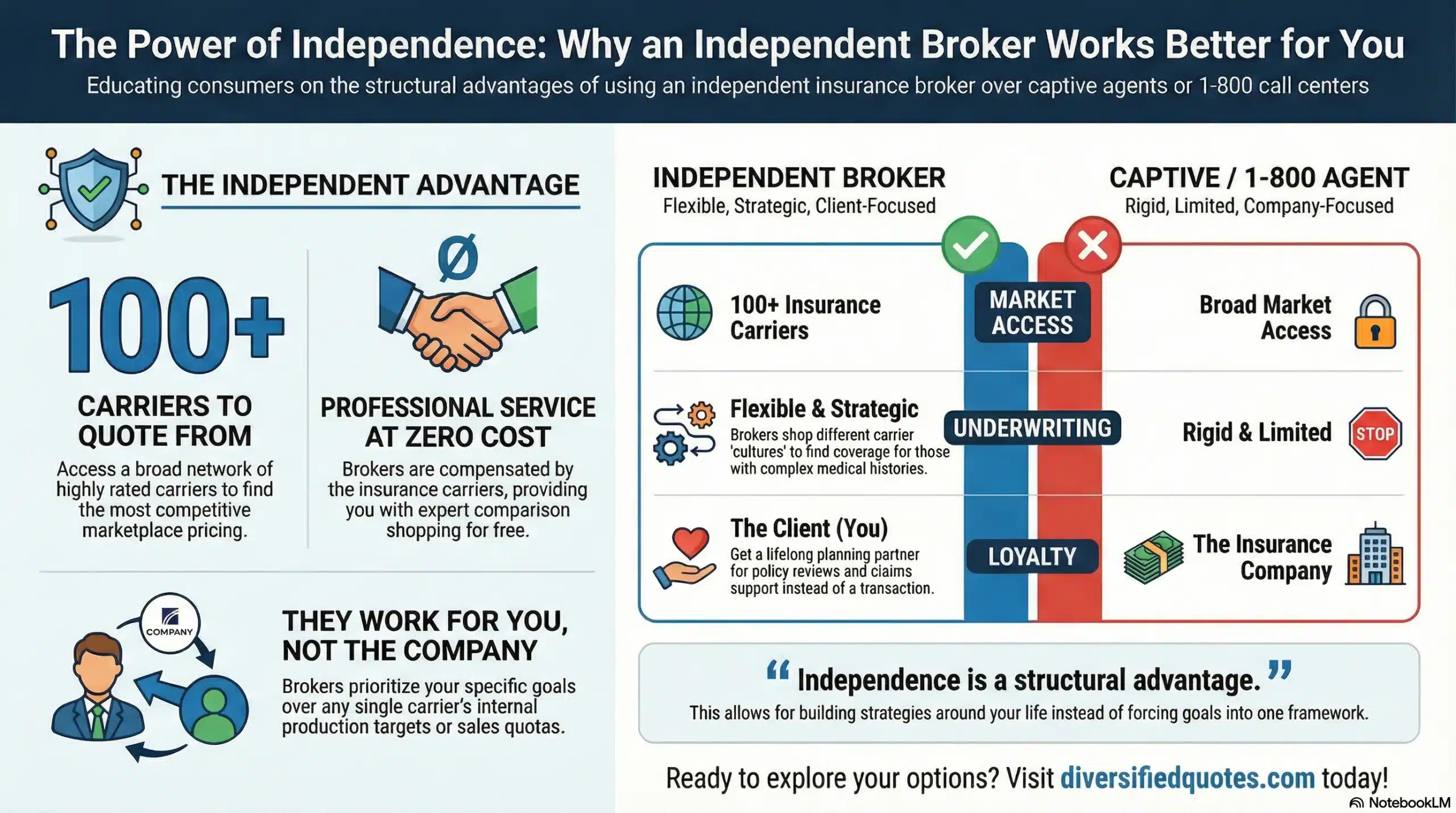
For individuals whose health histories present underwriting challenges, our resource on life insurance with pre-existing conditions walks through how specific conditions are evaluated across carriers, where favorable underwriting may be available, and how combining simplified issue life products with accidental death coverage creates a workable protection layer while broader coverage is secured. Working with an independent life insurance broker who has access to multiple carriers and underwriting guidelines is particularly valuable in this scenario — a broker who can only access one carrier’s product cannot find the most favorable underwriting outcome for a complex health profile.
The Cost Comparison — What You Actually Pay
Budget plays a significant role in life insurance decisions, and understanding the relative cost of each product type is essential for making an informed choice. For a healthy 35-year-old male non-smoker, a $500,000 20-year term life policy typically costs between $25 and $40 per month depending on the carrier and rate class. A healthy 35-year-old female non-smoker typically pays 20% to 30% less for the same coverage given actuarially longer life expectancy. These premiums represent extraordinary value — half a million dollars of all-cause death protection for roughly the cost of a few streaming subscriptions per month. An accidental death policy with the same $500,000 face amount would typically cost less than $15 to $20 per month for the same 35-year-old, reflecting the dramatically narrower coverage scope.
For younger families with mortgages, children, and growing financial responsibilities, the priority is almost always maximum term life coverage within the available budget — because it covers the highest-probability mortality risks at the most competitive rates. Accidental death insurance can then be added for a small incremental premium to provide the additional accidental death and dismemberment benefit. This layered approach — $500,000 term life plus $250,000 AD&D — can often be structured for less total monthly cost than a standalone $750,000 term life policy, while providing both broader coverage for all causes of death and an enhanced benefit specifically for the accidental death scenario. For individuals who smoke, understanding how underwriting affects the cost of term life and how the AD&D supplement compares is covered in our resource on life insurance for smokers.
Occupational Risk and the Case for Both Products Together
Many individuals choose to combine both types of policies for layered protection. Term life insurance provides broad income replacement coverage for any cause of death, while accidental death insurance adds an extra payout if death results from a qualifying accident. This strategy is particularly beneficial for individuals with occupational exposure — transportation professionals, construction workers, agricultural workers, utility line workers, or those in industries like mining and hazardous environments. For a construction worker with a $500,000 term life policy and a $300,000 AD&D supplement, a fatal worksite accident would pay both benefits — $800,000 total to the family — compared to the $500,000 the term life policy alone would provide. The additional $300,000 can be the difference between a family that maintains financial stability and one that loses the home or faces long-term income instability. The incremental premium for the AD&D supplement is typically small relative to this enhanced protection.
For workers in occupations with elevated travel requirements or offshore or remote assignments, life insurance for offshore oil workers and business travel accident insurance cover specialized product considerations where accidental death exposure is structurally higher than average. In these occupational profiles, the AD&D supplement is not a marginal addition — it is a meaningful component of a complete protection architecture.
Making the Decision — A Framework for Choosing
Ultimately, the decision is not about choosing one product over the other — it is about understanding their roles within a comprehensive plan. Term life insurance forms the core income replacement structure for all households that depend on earned income. Accidental death insurance enhances risk-specific exposure, adds a living dismemberment benefit, and is accessible to individuals who cannot currently qualify for traditional coverage. Together, they create a more complete financial safety net than either product provides alone.
The decision framework is straightforward. Start by determining the amount of income replacement and debt coverage needed if the primary earner dies — that calculation, which our resource on how much life insurance you need covers in detail, defines the required term life face amount. Then evaluate whether your health profile supports full underwriting at a competitive rate class, and if so, apply for the appropriate term life coverage as the foundation. Once the term life foundation is in place, evaluate whether the incremental cost of an AD&D supplement — as a standalone policy or as a rider on the term life policy — is worth the additional accidental death benefit and the living dismemberment coverage it adds. For most physically active adults, high-risk occupation workers, and frequent travelers, the answer is yes. For individuals who cannot currently qualify for term life due to health history, accidental death insurance provides an immediately accessible layer of meaningful coverage while traditional coverage is pursued through available pathways. Working with an independent life insurance broker who can compare carriers, evaluate underwriting options, and model the combined cost of layered coverage is the most efficient path to a protection strategy that addresses your actual risk profile without leaving gaps.
Ready to compare term life and accidental death options side by side?
Request a Personalized Review
Financial Protection Essentials
Explore life insurance options, accidental coverage, and protection strategies for individuals across all health profiles and risk levels.
Talk With an Advisor Today
Choose how you’d like to connect—call or message us, then book a time that works for you.
Schedule here:
calendly.com/jason-dibcompanies/diversified-quotes
Licensed in all 50 states • Fiduciary, family-owned since 1980
If I can only afford one policy right now, which should I choose — term life or accidental death insurance?
For the vast majority of individuals with dependents or financial obligations, term life insurance should be the priority if you can only choose one. The reason is straightforward: the overwhelming majority of premature deaths result from illness — heart disease, cancer, stroke, and other medical conditions account for the vast majority of deaths in the United States at all age groups. Accidental death insurance covers only the minority of deaths that result from accidents. A policy that covers only accidental death leaves the family unprotected against the most likely cause of financial hardship from an untimely death. Term life insurance covers all causes of death and is priced affordably for healthy applicants, making it the foundational product. The one exception where accidental death insurance may make more immediate sense is when the individual cannot currently qualify for term life due to health history — in that case, accidental death insurance provides accessible immediate coverage while traditional life insurance is pursued through alternative pathways. But for any health-qualified individual, term life is the clear first priority.
Does my employer’s group life insurance count as my term life coverage?
Group employer life insurance is a valuable benefit but has significant limitations that prevent it from serving as the sole life insurance protection for most households. The most critical limitation is portability: employer group life insurance ends when you leave the employer, retire, or are laid off — often at precisely the moment you are transitioning and most need stable coverage. If you leave an employer at age 55 with health conditions that now complicate individual underwriting, securing replacement coverage at affordable rates may be difficult or impossible. Individual term life insurance, by contrast, remains in force regardless of employment status for the full selected term, providing stable protection through job changes, career transitions, and early retirement. A second limitation is coverage amount: employer group life is typically one to two times annual salary — often $50,000 to $150,000 — which is rarely sufficient to replace income, pay off a mortgage, fund education, and provide long-term financial stability simultaneously. The general guidance: treat employer group life as a valuable baseline benefit but supplement it with individual term life insurance in an amount calibrated to your actual household income replacement and debt coverage needs. Accidental death coverage from the employer may also be available as a group benefit and can supplement the individual AD&D strategy similarly.
Can I add accidental death coverage to an existing term life policy, or do I need a separate policy?
Both options are available, and which is more appropriate depends on whether your existing term life policy offers rider options and whether the face amount you want for the AD&D component matches what is available as a rider. Many term life insurance policies offer an accidental death benefit rider — sometimes called an AD&D rider or accidental death rider — that can be added at policy issue for a small additional premium. This rider increases the death benefit specifically in the event of a covered accidental death, creating a double indemnity structure: the beneficiary receives both the base life policy death benefit and the rider death benefit simultaneously. Some riders also include a dismemberment benefit schedule for injuries that occur while the insured is alive. If your existing term policy was issued without an AD&D rider and the policy does not allow rider additions after issue, a standalone AD&D policy purchased separately provides the same incremental accidental death and dismemberment protection without requiring any changes to the existing term policy. The standalone approach also allows you to choose a different face amount for the AD&D component than what the existing policy’s rider structure permits — providing more flexibility to calibrate accidental death protection to your specific exposure level.
How does accidental death insurance handle deaths that involve both illness and accident — such as a car accident triggered by a health event?
This is one of the most commonly disputed areas in accidental death claims and deserves careful attention before relying on AD&D coverage in any scenario where the insured has underlying health conditions. Most AD&D policies require that death result “directly and independently of all other causes” from the covered accident. If an insured has a cardiac event while driving and crashes, the carrier may investigate whether the cardiac event caused the accident (in which case death resulted from illness, not from an accident, and the claim may be denied) or whether the crash caused fatal injuries that would not have been sustained without the accident (in which case the accident was the direct and independent cause of death and the claim should be paid). This distinction can be complex and is often the subject of claim disputes. Factors that influence the determination include the autopsy findings, medical records, toxicology results, the sequence of events established by accident reconstruction, and the specific policy language defining “accident” and “directly and independently of all other causes.” Individuals with significant underlying health conditions should understand this ambiguity before treating accidental death coverage as reliable protection for scenarios where a health event could plausibly be involved. For these individuals, comprehensive term life insurance that covers all causes of death is the more reliable foundation.
What term length should I select for term life insurance, and how does that interact with accidental death coverage?
The term length selection for life insurance should be driven by the timeline of the financial obligation you are protecting against, not by premium minimization. The most common framework: select a term that runs until the youngest child is financially independent (typically through college graduation), or until the mortgage is paid off, or until retirement savings have accumulated to a level that can sustain the household without income replacement — whichever is longest. For a 35-year-old with a 30-year mortgage and a newborn child, a 30-year term policy aligns both the mortgage payoff and the child’s financial independence with the policy expiration. For a 45-year-old with a 20-year mortgage and children already in their teens, a 20-year term may be sufficient. Accidental death coverage interacts with this decision as a supplement — not as a driver. Whether you need a 20-year or 30-year term life policy, the AD&D supplement can run alongside the term policy for the same period or be maintained independently based on your ongoing occupational risk exposure and personal preference. Some individuals maintain AD&D coverage beyond the expiration of their term life policy if they remain in physically demanding work or high-travel roles, keeping the accident-specific protection in place even after the primary income-replacement need has been addressed by retirement assets.
About the Author:
Jason Stolz, CLTC, CRPC, DIA, CAA and Chief Underwriter at Diversified Insurance Brokers (NPN 20471358), is a senior insurance and retirement professional with more than 25 years of real-world experience helping individuals, families, and business owners protect their income, assets, and long-term financial stability. As a long-time partner of the nationally licensed independent agency Diversified Insurance Brokers, Jason provides trusted guidance across multiple specialties—including fixed and indexed annuities, long-term care planning, personal and business disability insurance, life insurance solutions, Group Health, Travel Medical and Evacuation Insurance, and short-term health coverage. Diversified Insurance Brokers maintains active contracts with over 100 highly rated insurance carriers, ensuring clients have access to a broad and competitive marketplace.
His practical, education-first approach has earned recognition in publications such as VoyageATL, and contributions from his agency featured in Kiplinger and GoBankingRates— highlighting his commitment to financial clarity and client-focused planning. Drawing on deep product knowledge and years of hands-on field experience, Jason helps clients evaluate carriers, compare strategies, and build retirement and protection plans that are both secure and cost-efficient. Visitors who want to explore current annuity rates and compare options across multiple insurers can also use this annuity quote and comparison tool.
Browse More Resources: Return to our complete Supplemental, Hospital Indemnity & Critical Illness guide — covering hospital indemnity, accident insurance & critical illness coverage.
Last Reviewed: June 25, 2026 |
Reviewed by: Jason Stolz, CLTC, CRPC, DIA, CAA
Chief Underwriter, Diversified Insurance Brokers, Inc. | NPN: 20471358 | Diversified Insurance Brokers, Inc. — Licensed in all 50 states
Fact Checked by: Tonia Pettitt, CMIP©
Medicare Specialist, Diversified Insurance Brokers, Inc. | NPN: 14374308 | Diversified Insurance Brokers, Inc. — Licensed in all 50 states
Did you find this content helpful? Leave us a Google review — it helps others find trustworthy guidance too.
Editorial Standards: Diversified Insurance Brokers maintains rigorous editorial standards to ensure accuracy, clarity, and independence in all content. Learn more about our editorial standards and commitment to transparency.
