
Life Insurance for Kids
Life Insurance for Kids

Jason Stolz CLTC, CRPC, DIA, CAA
Life insurance for kids is one of those topics that many parents and grandparents quietly think about — but rarely discuss openly. It is not about assuming the worst. It is about planning wisely and understanding the specific, durable benefits that a well-designed child life insurance policy can provide across decades of the child’s financial life. At its core, child life insurance is about locking in insurability at the youngest possible age, creating a small but permanent foundation of guaranteed coverage, and in some cases building a flexible long-term asset that can later support milestones like college, a first home, or early career financial independence. At Diversified Insurance Brokers, Jason Stolz, CLTC, CRPC, DIA, CAA, approaches life insurance for children carefully and strategically — comparing multiple carriers and policy designs rather than defaulting to a single company solution, and helping families decide whether a child policy genuinely fits their financial priorities or whether the household’s protection dollars are better deployed elsewhere first.
The foundational principle that guides our approach to child life insurance is the same principle that guides all our financial protection planning: protect income first, protect family second, build flexibility third. In most households, the primary financial risk is the loss of a parent’s income — not a child’s. A child does not generate income that the household depends on, which means the income replacement function that drives the urgency of parent life insurance coverage does not apply in the same way to a child. Before evaluating whether a child policy makes sense, we almost always recommend confirming that parental coverage is in place and adequately sized, because inadequately insured parents represent a much more immediate and consequential financial vulnerability than an uninsured child. Once the parental protection foundation is secure, then we evaluate whether a modest permanent child policy fits comfortably and sustainably within the family’s budget and planning priorities. The term life insurance calculator provides a useful starting point for evaluating parental coverage needs before the child policy conversation begins.
Review Your Family’s Life Insurance Plan
Not sure whether a child policy makes sense — or whether your own coverage needs updating first? We’ll walk through both with you, compare options, and give you a clear recommendation.
Request a Family Insurance Review
Call 800-533-5969
See Real-Term Rates Side by Side
Life Insurance Quoter
Compare real-time life insurance quotes from top carriers.
Why Families Buy Life Insurance for Kids — The Four Primary Motivations
When families do choose life insurance for children, the decision typically reflects one or more of four distinct motivations that have different practical implications for how the policy should be structured, how much coverage is appropriate, and which product type best serves the goal. Understanding which motivation is driving the interest helps determine whether a child rider, a stand-alone whole life policy, or a more sophisticated permanent design is the appropriate tool.
The first and most frequently cited motivation is locking in future insurability. Health can change unpredictably throughout childhood and adolescence — conditions that develop during those years can significantly alter an individual’s life insurance underwriting outcomes for the rest of their life. Type 1 diabetes diagnosed at age 8 dramatically changes the underwriting picture at age 25 compared to a healthy 25-year-old. Congenital heart conditions identified in infancy or childhood create underwriting complexity that can persist indefinitely. Autoimmune disorders, neurological conditions, and serious chronic illnesses that first appear during childhood can make obtaining affordable life insurance as an adult substantially more difficult or in some cases impossible at standard rates. At Diversified Insurance Brokers, we work regularly with adults seeking life insurance with pre-existing conditions, and the premium differential between a standard-rate healthy applicant and a table-rated applicant with complex medical history can be very significant. A whole life policy issued in healthy childhood establishes permanent coverage at the healthiest classification the child will ever qualify for — and that coverage remains in force regardless of what health changes occur subsequently.
The second motivation is long-term structural cost efficiency. The premium rate on a whole life policy is set at issue based on the insured’s age and health classification and remains level for the life of the policy. A whole life policy issued on a one-year-old reflects the mortality assumptions for a one-year-old — the lowest-risk period of human life, corresponding to the lowest achievable premium rate for any given coverage amount. That premium stays level for the entire duration of the policy while cash value accumulates. Some families design these policies to be paid up in a defined period — 10 or 20 years — creating fully paid-up permanent coverage before the child reaches adulthood, so the child enters their adult financial life with an established permanent policy already owned and paid for on their behalf.
The third motivation is the financial flexibility that permanent life insurance’s cash value accumulation provides. Unlike education-specific savings vehicles, the cash value inside a permanent policy is not restricted to specific qualified uses. A 529 plan builds tax-advantaged savings for qualified education expenses, but using those funds for non-education purposes triggers taxes and penalties. Cash value inside a permanent life insurance policy can be accessed through policy loans for college, a first home down payment, business startup capital, or any other purpose without the same restrictions. Using life insurance to help fund college covers how these strategies work when structured specifically for education funding. Using indexed universal life for college funding covers the IUL-based approach for families who want index-linked growth alongside the insurance protection.
The fourth motivation is peace of mind. A modest $25,000 to $50,000 policy can relieve financial stress if tragedy occurs — covering final expenses, grief counseling, and time away from work — without adding financial stress to an already devastating situation.
Policy Structure Options — Child Rider vs. Stand-Alone Policy
| Structure | How It Works | Primary Advantages | Primary Limitations |
|---|---|---|---|
| Child Rider on Parent Policy | Add-on to a parent’s existing policy covering all household children under one rider premium; typically covers children through age 25 | Very low cost; covers multiple children; includes conversion privilege to permanent coverage at adulthood without medical underwriting | Limited coverage amounts (typically $10,000–$25,000 per child); no meaningful cash value; coverage ends when rider expires; tied to parent’s policy |
| Stand-Alone Whole Life | Permanent whole life policy owned on the child providing guaranteed death benefit, level premiums, and guaranteed cash value growth | Permanent coverage regardless of future health; guaranteed cash value; potential dividends; can be designed as limited-pay; coverage amount not capped by rider limits | Higher cost than rider; requires separate underwriting; cash value accumulation slow in early years relative to premium outlay |
| Indexed Universal Life (IUL) | Flexible premium permanent policy with cash value growth linked to a market index subject to caps and floors; premium flexibility over time | Potential for higher long-term cash value growth; premium flexibility; permanent death benefit; suitable for college or long-term accumulation goals | More complexity than whole life; requires active monitoring; above-floor projections non-guaranteed; must be designed to avoid MEC status |
| Simplified / Guaranteed Issue | Simplified or guaranteed underwriting with minimal health questions; limited coverage amounts; higher cost per dollar than fully underwritten products | Available when standard underwriting is complicated by health history; quick application; appropriate for specific health situations | Higher cost; lower coverage limits; graded benefit provisions common; should not be first choice for healthy children |
Whole Life Insurance for Children — How the Mechanics Work
A stand-alone whole life policy on a child is the most commonly recommended structure when the primary motivations are long-term insurability protection and cash value accumulation. Understanding how whole life insurance actually performs over time allows families to evaluate the product against realistic expectations rather than overpromised projections. How a whole life insurance policy works covers the mechanics in detail.
Whole life insurance on a child establishes a permanent death benefit that is guaranteed to remain in force for the child’s entire life as long as premiums are paid. The premium is set at policy issue based on the child’s age and health and does not increase as the child ages or if health conditions develop later. The policy builds cash value on a guaranteed schedule — a defined minimum amount accumulates each year regardless of investment market performance. At participating whole life carriers — those that issue policies eligible to receive annual dividends — the dividend allocation can enhance cash value growth above the guaranteed baseline. Dividends are not guaranteed but have been paid consistently by the strongest participating carriers across decades of varying economic environments. Whole life insurance with cash value growth covers how the accumulation component works specifically.
The limited-pay whole life design is particularly popular for child policies because it allows premiums to be completed within a defined period — commonly 10, 15, or 20 years — after which the policy is fully paid up and coverage remains in force for the child’s lifetime with no further premium obligations. A 20-pay whole life policy issued at birth would be fully paid up by the child’s 20th birthday, giving the adult child permanent guaranteed coverage with no ongoing cost at exactly the age when they are beginning to establish their own financial life.
The MEC Issue — Why Policy Design Matters
Families who want to maximize the cash value accumulation component of a child whole life policy must understand the Modified Endowment Contract rules that determine when the tax treatment of cash value distributions changes. A life insurance policy that receives premiums exceeding the IRS’s 7-pay test threshold in the first seven years becomes classified as a Modified Endowment Contract, at which point distributions including loans are taxed on a last-in-first-out basis and the 10% penalty that applies to pre-59½ retirement account distributions applies. For families who want to access cash value through tax-favored policy loans — one of the primary advantages of life insurance-based accumulation — designing the policy to remain below the MEC threshold is important. Understanding Modified Endowment Contracts covers the IRS framework and how policy design decisions affect MEC status. For more sophisticated strategies, the life insurance strategies the wealthy use provides context for how high-net-worth families structure permanent policies for tax-efficient accumulation.
Child Policies and Special Needs Planning
For families with children who have disabilities or special needs, the most consequential life insurance is often coverage on the parents — ensuring the special needs child’s long-term support is funded through a properly structured special needs trust if the parents die. Special needs life insurance planning and the special needs life insurance service cover this broader framework. Choosing a special needs trustee covers the governance dimension. For the child with special needs directly, a stand-alone whole life policy — if health conditions allow underwriting — can lock in insurability that adult underwriting might not produce. Gerber Life children’s whole life provides a simplified underwriting option for families where standard underwriting is complicated by the child’s health history. Life insurance for kids with diabetes covers the specific framework for children who have already been diagnosed before the coverage decision is made.
How Child Life Insurance Compares to Other Savings Vehicles
A 529 plan offers the most direct tax advantage for education savings — distributions for qualified education expenses are completely tax-free, making it the highest-efficiency vehicle for money that will definitely be used for education. The limitation is the restriction to qualified uses. Custodial investment accounts (UGMA/UTMA) offer unrestricted use but no special tax advantages and become the child’s property at majority. Child life insurance occupies a different category: insurance-based with guaranteed death benefit, tax-deferred cash value growth without contribution limits, access through policy loans without qualified withdrawal rules, and family control of the asset without automatic ownership transfer. The most disciplined approach for most families is to use the 529 for money specifically earmarked for education, and evaluate child life insurance separately based on its insurance and long-term flexibility value. How to use life insurance to fund a college savings plan covers coordination between these approaches in detail.
Get Personalized Guidance Before You Decide
We’ll compare rider vs. stand-alone options, show guaranteed projections, and explain the trade-offs clearly — so you can make a confident decision.
Schedule Your Child Policy Consultation
Prefer to call? 800-533-5969
Compare Term Life Insurance Lengths
Explore different term periods to find coverage that best matches your timeline and budget.
Talk With an Advisor Today
Choose how you’d like to connect—call or message us, then book a time that works for you.
Schedule here:
calendly.com/jason-dibcompanies/diversified-quotes
Licensed in all 50 states • Fiduciary, family-owned since 1980
Frequently Asked Questions: Life Insurance for Kids
Should I buy life insurance on my child?
The decision depends primarily on whether parental coverage is already in place and adequately sized — because the income replacement need that makes parental life insurance urgently necessary does not apply in the same way to a child. Once parental coverage is established, a child policy may make sense for one or more of four reasons: locking in insurability permanently at the child’s current health status before any health developments occur that could complicate adult underwriting; establishing permanent coverage at the lowest achievable premium rate based on the child’s young age; building a flexible cash value asset that can later be accessed for education, a home purchase, or other purposes; or providing a modest financial cushion to address the immediate costs if tragedy strikes. If the budget is constrained and parental coverage is not yet complete, prioritizing parental term coverage is almost always the more impactful use of protection dollars. If parental coverage is adequate and the budget accommodates a child policy without crowding out other financial priorities, a modest permanent child policy can be a genuinely useful long-term addition.
What kind of life insurance is best for a child?
The most appropriate structure depends on the primary motivation. A child rider on the parent’s policy is the simplest and least expensive option when the goal is modest coverage and a conversion privilege — it covers all household children under one premium and typically allows conversion to permanent coverage at the child’s adulthood without medical underwriting. A stand-alone whole life policy is the right choice when the goals include meaningful cash value accumulation, a larger guaranteed death benefit, or a paid-up policy design that eliminates future premiums before the child reaches adulthood. An indexed universal life policy may fit when the goal is maximum long-term accumulation with market index participation, and when the family is comfortable with the policy monitoring and performance variability that IUL requires. For families with health concerns about the child, simplified or guaranteed issue products from carriers like Gerber Life provide coverage when standard underwriting may not be accessible. Most families start with a child rider as a foundation and evaluate stand-alone permanent coverage separately based on their broader financial priorities.
How much life insurance should I buy on my child?
Child life insurance coverage amounts are not determined by income replacement (since the child has no income to replace) but by the combination of three factors: the amount needed to address immediate financial costs if the child dies, the amount desired as a permanent coverage base for the child’s adult life, and the cash value accumulation goal if the policy is designed for that purpose. For the peace-of-mind and final expense objective, $25,000 to $50,000 is a common starting range. For families building a meaningful permanent coverage foundation and cash value asset, $50,000 to $100,000 is a more common design range. Larger coverage amounts — $150,000 to $500,000 or more — are designed specifically for maximum cash value accumulation strategies that are often associated with more sophisticated planning approaches. The right amount is the one that fits comfortably within the household budget without crowding out parental coverage, emergency savings, or retirement contributions — the financial priorities that take precedence over a child policy.
Can I use child life insurance for college savings?
Yes — permanent life insurance cash value can be accessed through policy loans and used for college expenses, and this flexibility (money not restricted to qualified education uses) is one of the genuine advantages of life insurance relative to 529 plans. However, child life insurance is not a direct substitute for a 529 plan and should not be marketed or purchased as one. A 529 plan offers complete federal tax exemption on qualified education distributions — a significant advantage for money that will definitely be used for education — that life insurance cannot match. The life insurance advantage is flexibility: cash value can also fund vocational training, a business venture, a home down payment, or any other purpose without tax penalties for non-education use. The most disciplined approach for most families is to use the 529 for money specifically earmarked for education, and to evaluate child life insurance on its own merits as a permanent coverage and flexible asset vehicle separate from the education savings strategy.
What is the advantage of buying life insurance on a child early?
Buying life insurance on a child early provides three compounding advantages. First, the premium rate is set at the child’s age at issue and remains level for the life of the policy — a policy issued at age 1 carries a premium based on age-1 underwriting that does not increase as the child ages, making early purchase the most cost-efficient timing. Second, the cash value accumulation period is longest when the policy is purchased earliest — more years of tax-deferred compound growth produce a larger accumulated value at any future milestone than the same policy purchased later. Third and most importantly, early purchase locks in the child’s insurability at their current health status regardless of what health developments occur subsequently — a child who develops a significant medical condition after the policy is issued retains permanent coverage that no subsequent underwriting can take away. These advantages compound over time, making the earliest feasible purchase date the most strategically advantageous for all three objectives simultaneously.
About the Author:
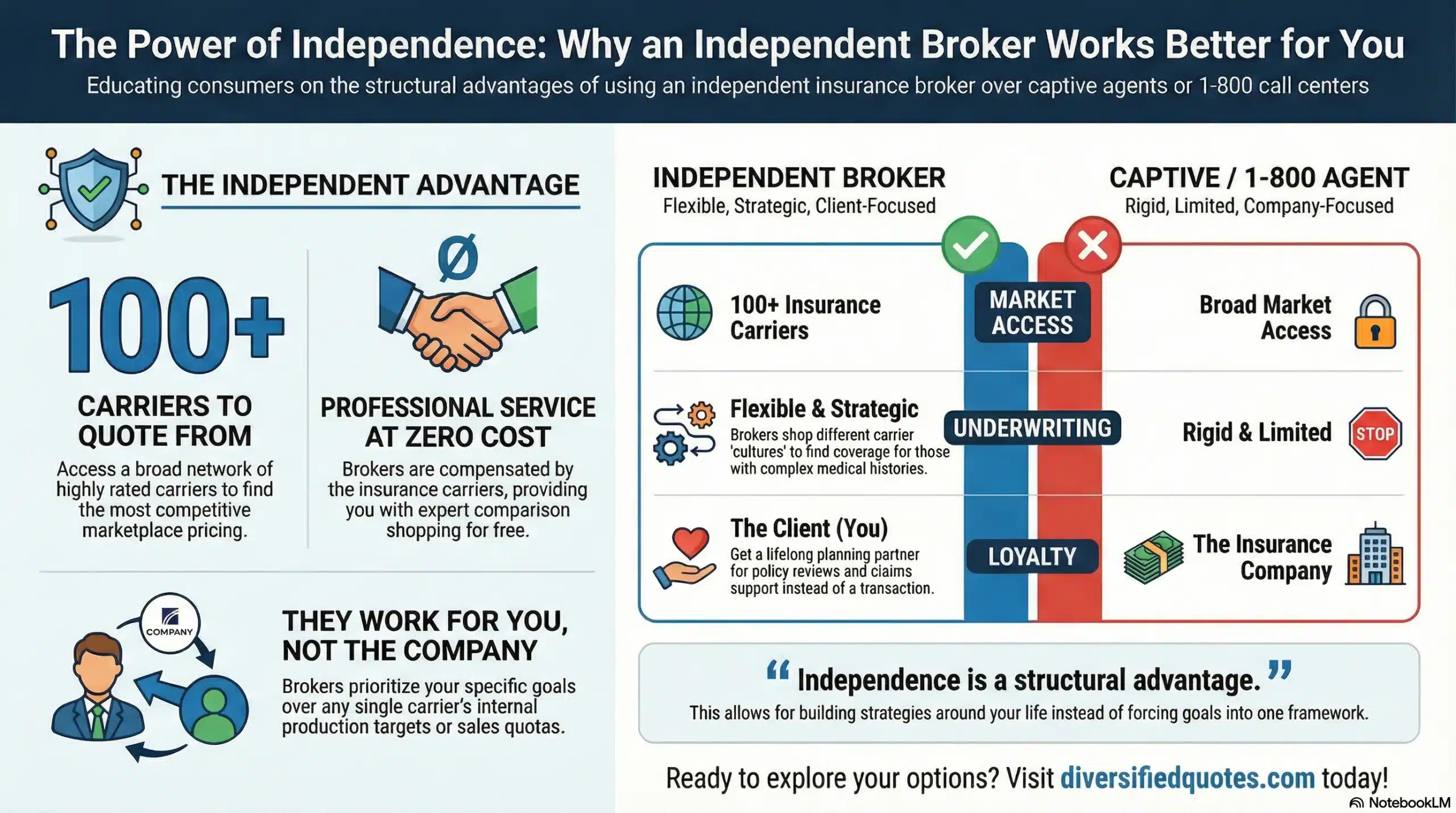
Jason Stolz, CLTC, CRPC, DIA, CAA and Chief Underwriter at Diversified Insurance Brokers (NPN 20471358), is a senior insurance and retirement professional with more than 25 years of real-world experience helping individuals, families, and business owners protect their income, assets, and long-term financial stability. As a long-time partner of the nationally licensed independent agency Diversified Insurance Brokers, Jason provides trusted guidance across multiple specialties—including fixed and indexed annuities, long-term care planning, personal and business disability insurance, life insurance solutions, Group Health, Travel Medical and Evacuation Insurance, and short-term health coverage. Diversified Insurance Brokers maintains active contracts with over 100 highly rated insurance carriers, ensuring clients have access to a broad and competitive marketplace.
His practical, education-first approach has earned recognition in publications such as VoyageATL, and contributions from his agency featured in Kiplinger and GoBankingRates— highlighting his commitment to financial clarity and client-focused planning. Drawing on deep product knowledge and years of hands-on field experience, Jason helps clients evaluate carriers, compare strategies, and build retirement and protection plans that are both secure and cost-efficient. Visitors who want to explore current annuity rates and compare options across multiple insurers can also use this annuity quote and comparison tool.
Explore More Life Insurance Options: Browse our complete guide to Life Insurance for Life Stage & Situational Needs — covering new parents, single parents, special needs children, and military service from 100+ carriers.
Last Reviewed: June 15, 2026 |
Reviewed by: Jason Stolz, CLTC, CRPC, DIA, CAA
Chief Underwriter, Diversified Insurance Brokers, Inc. | NPN: 20471358 | Diversified Insurance Brokers, Inc. — Licensed in all 50 states
Fact Checked by: Tonia Pettitt, CMIP©
Medicare Specialist, Diversified Insurance Brokers, Inc. | NPN: 14374308 | Diversified Insurance Brokers, Inc. — Licensed in all 50 states
Did you find this content helpful? Leave us a Google review — it helps others find trustworthy guidance too.
Editorial Standards: Diversified Insurance Brokers maintains rigorous editorial standards to ensure accuracy, clarity, and independence in all content. Learn more about our editorial standards and commitment to transparency.
