
Disability Insurance for Lithographers
As an Independent Disability Insurance Broker, we have access to exclusive discounts and negotiated pricing most captive agents can’t offer — see the full breakdown near the end of this page.
Disability Insurance for Lithographers

Jason Stolz CLTC, CRPC, DIA, CAA
Disability insurance for lithographers is income protection for a skilled trade that combines the precision demands of fine craftsmanship with the physical and chemical hazard exposures of industrial manufacturing — a combination that produces a disability risk profile most people significantly underestimate. Commercial lithographers and offset press operators spend their working lives standing on concrete floors for full shifts, operating large printing presses that generate sustained noise at levels documented to cause permanent hearing damage, handling organic solvents and chemical cleaning agents that carry respiratory and dermatological health risks with cumulative long-term exposure, and performing the sustained twisting, reaching, kneeling, and lifting that pressroom work requires across every production run. When a disabling condition — a back injury from repeated heavy lifting, a respiratory condition from sustained solvent exposure, occupational hearing loss, or any other medical event — prevents a lithographer from performing that work, income stops. For the significant number of lithographers whose employer group coverage is limited or absent, it stops without any meaningful institutional buffer behind it.
At Diversified Insurance Brokers, we help lithographers across every specialty and setting — commercial offset press operators, prepress technicians, fine art studio lithographers, packaging and label printers, and platemaking specialists — structure disability insurance coverage that reflects the genuine physical and chemical occupational risks of their work and fills the gaps that employer group plans consistently leave open. A well-structured individual policy provides portable, own-occupation income replacement from any qualifying disability — whether it originates from a musculoskeletal injury in the pressroom, a chemical exposure condition that develops over years of solvent contact, occupational hearing loss, or a medical event entirely unrelated to the press floor. Our resource on getting disability insurance when self-employed provides specific context for fine art lithographers and studio operators who work outside the employer benefit system entirely.
Get Disability Insurance Quotes for Lithographers
We compare carriers, explain occupational class ratings, and structure policies built for the real physical and chemical hazard profile of lithographic work.
Request Disability Insurance OptionsWhat Lithographers Actually Do — and Why the Hazard Profile Is Underappreciated
The public perception of lithography — particularly offset lithography, which accounts for approximately half of all printing done in the United States — tends to focus on the artistry of the output rather than the industrial conditions of the production environment. The reality of a commercial pressroom is a manufacturing environment operating heavy machinery generating sustained noise, chemical fumes, and physical demands that OSHA has specifically flagged for ergonomic intervention programs in the commercial lithography sector. A working lithographer or offset press operator begins each production run by preparing plates, loading paper stock that arrives in large skids requiring forklift or heavy manual handling, mixing and adjusting inks that include pigments, organic solvents, and chemical additives, and making precision adjustments to press equipment to achieve the color accuracy and registration quality that commercial print work requires.
Throughout a production run — which may last hours at a continuous pace — the lithographer monitors print quality through sustained close visual inspection that demands significant visual acuity and color discrimination, adjusts ink fountains and dampening systems that require reaching over and around press equipment in the awkward positions that industrial machinery imposes, and performs equipment cleaning using organic solvent-based cleaning agents at regular intervals. Press cleaning between jobs involves direct skin contact with solvents and chemical agents if protective equipment is not consistently used — and AIHA research on chemical exposure in the printing industry documents that solvent contact in lithographic pressrooms creates sustained dermatological and respiratory exposure across career-length timeframes. Job description data from actual lithographic press operator postings confirms the physical requirements that pressroom work imposes: twisting, turning, squeezing, grasping, reaching, reaching over equipment, kneeling, crawling, pulling, extended periods of sustained standing, and the ability to lift 50 pounds. These are the physical demands of an industrial trade, not a desk profession. Our resource on disability insurance for the woodworking industry provides useful cross-occupational context on how precision industrial trades with similar sustained physical and chemical hazard profiles are evaluated for disability coverage.
The Most Common Disabling Conditions for Lithographers
Musculoskeletal injuries — particularly back injuries — are the most prevalent disabling conditions for commercial lithographers and press operators, consistent with the occupational profile of a trade that requires sustained standing on concrete floors for full shifts, repeated bending and reaching over press equipment, and the lifting and positioning of paper stock, ink containers, and printing plates. OSHA’s own case records on the commercial lithography sector document ergonomic programs implemented specifically to address musculoskeletal injury rates — the Quad Graphics commercial lithography plant case study documented a 60 percent reduction in lost work days after implementing an ergonomics program, illustrating the baseline injury rate that the program was designed to address. Lumbar strain, disc herniation, and degenerative spinal conditions develop from the sustained postural demands and repetitive loading of pressroom work across an entire career. A back condition serious enough to prevent sustained standing, the physical reaching and positioning that press operation requires, and the lifting demands of handling paper stock and supplies can effectively end a lithographer’s ability to perform the core work of the trade.
Occupational hearing loss is a particularly significant long-term disability risk for pressroom lithographers that does not receive the attention it deserves in general disability planning conversations. AIHA and OSHA document that printing press operations generate noise at 85 to 90 decibels and above — levels that OSHA’s occupational noise exposure standard identifies as requiring mandatory audiometric monitoring and hearing protection programs. Cumulative noise-induced hearing loss at those exposure levels develops progressively and permanently across a pressroom career. A lithographer who develops hearing loss severe enough to affect the ability to monitor press performance, communicate with production teams, and respond to equipment alerts faces a genuine occupational disability that may not be immediately apparent as a disability insurance claim but is precisely the type of condition that own-occupation coverage addresses. Respiratory conditions from sustained exposure to organic solvents in lithographic inks and cleaning agents, ink mist inhalation during press operations, and paper dust in the pressroom represent a long-term chemical health exposure that the AIHA Exposure Profile for the printing industry specifically documents. Skin conditions from solvent contact — occupational dermatitis and chemical sensitization — are documented outcomes for pressroom workers with sustained direct skin exposure to cleaning solvents. Acute mechanical injuries from press equipment — cuts, crush injuries, and falls from press platforms — represent the most acute safety risk in the pressroom, with OSHA fatal incident records documenting a fatal fall from a printing press as one of the documented severe outcomes of commercial pressroom hazards. Our resource on disability insurance for the food processing industry provides useful parallel perspective on how industrial manufacturing occupations with similar sustained physical, noise, and chemical hazard profiles are evaluated and structured across carriers.
Why Employer Group Coverage Leaves Many Lithographers Underinsured
Most commercial lithographers work for printing companies, packaging manufacturers, or publishing operations as employees — employment structures that often provide some form of group disability benefit. But group coverage leaves material and predictable gaps that individual policies address. Employer group disability plans typically replace only 60 percent of base salary, which for a lithographer earning near the median of approximately $46,000 annually leaves a meaningful income gap that household fixed expenses — mortgage, utilities, food, insurance, and loan payments — do not adjust for automatically during a disability. Group plans also frequently exclude overtime pay and shift differentials that represent a meaningful share of total compensation for lithographers who work night or weekend shifts, leaving actual income replacement further below what the 60 percent figure implies.
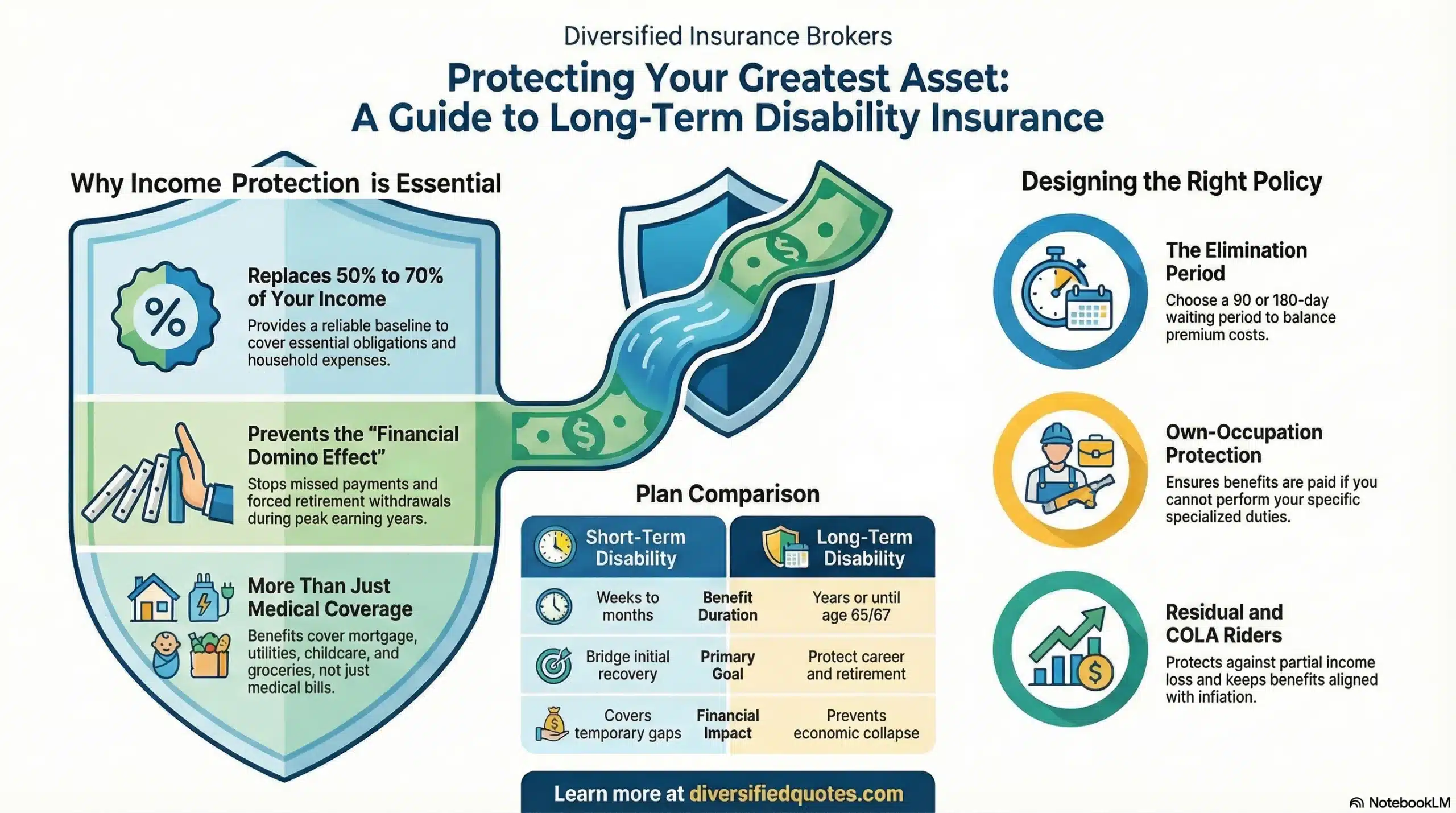
The most important gap in most employer group plans is the portability problem and the disability definition problem. Group coverage belongs to the employer — it ends when employment ends, when the printing plant closes or downsizes, or when the lithographer changes employers. Individual coverage applied for later in a career comes at higher premium and potentially with exclusions for back, respiratory, and hearing conditions that have accumulated in the medical record during years of pressroom work. Many group plans also weaken their disability definition after 24 months from an own-occupation standard to an any-occupation or modified standard — meaning that after two years, benefits can be denied to a lithographer who retains any capacity for unrelated sedentary work, regardless of their inability to perform pressroom duties. For the self-employed fine art lithographer operating an independent printmaking studio, no employer group plan exists at all — individual disability insurance is the entire safety net. Our resource on short-term vs. long-term disability insurance provides a practical framework for understanding how different coverage durations address the financial needs of different disability scenarios that lithographers face.
How Disability Insurance Carriers Classify Lithographers
Disability insurance carriers assign occupational class ratings that reflect the estimated disability risk of each profession. Lithographers are generally classified in lower to moderate occupational class tiers that reflect the physical demands of pressroom work, the chemical exposure profile of the trade, and the noise and machinery hazard environment of commercial printing operations. The specific classification a lithographer receives can vary meaningfully based on how their duties are described to underwriters — a prepress technician or digital platemaking specialist whose work is primarily computer-based and involves limited physical pressroom exposure may receive a more favorable classification than a press operator whose full shift involves sustained physical operation of large offset presses.
For fine art lithographers working in studio environments — where the physical demands are different in character from commercial pressrooms and where chemical exposure, while present, occurs at lower industrial scale — the duty profile description can also affect classification favorably when accurately presented. The distinction between commercial industrial lithography and fine art studio lithography is one that carriers evaluate differently, and presenting it accurately matters. Understanding how elimination periods work is particularly important for employed lithographers who have sick leave accrual — coordinating the elimination period with available employer sick leave can reduce the premium cost of individual coverage without creating a period of genuine financial vulnerability. For additional perspective on how industrial trade classifications are evaluated across carriers, our resource on disability insurance for the automobile industry illustrates how occupations combining machinery operation with chemical exposure and physical labor demands are structured for individual coverage.
Case Study — Commercial Offset Press Operator, Back Injury
Consider a commercial offset press operator earning $55,000 per year with an employer group disability plan that replaces 60 percent of base salary after a 90-day elimination period. After developing a lumbar disc herniation from the sustained physical demands of pressroom work — specifically from a combination of years of bending over press equipment and a single incident of heavy paper stock handling — this operator requires surgical intervention and a minimum of three months during which sustained standing, bending, and lifting are medically contraindicated. The table below illustrates why supplemental individual coverage matters even with employer group benefits in place.
| Scenario | Group Coverage Only | Group + Individual Supplement |
|---|---|---|
| Monthly Income Replacement | ~$2,750 (60% of $55K) after 90-day wait — $0 during the first 90 days beyond sick leave | Group benefit plus individual supplement with shorter elimination period, approaching 75–80% income replacement |
| 90-Day Elimination Gap | $0 from group plan during first 90 days if sick leave is exhausted | Individual policy with shorter elimination period begins benefits before group plan kicks in |
| Portability If Employment Changes | Coverage ends if printing plant closes, downsizes, or employment changes; new coverage subject to higher cost and back exclusion | Individual policy travels with the lithographer regardless of employer transitions |
| Disability Definition After 24 Months | Many group plans convert to any-occupation definition — benefits may be reduced or eliminated if lithographer can perform any sedentary work | Individual own-occupation policy maintains stronger definition for full benefit period |
| Annual Income Gap at 60% Replacement | ~$22,000 annual gap vs. pre-disability income — household obligations remain unchanged | Individual supplement closes the gap; budget remains stable through recovery |
Back injuries from the physical demands of pressroom work are among the most consistently documented disabling conditions in the commercial printing industry — OSHA’s documented ergonomic intervention programs in commercial lithography plants exist precisely because the injury rates justified them. Individual supplemental disability coverage for lithographers closes the income gaps, portability gaps, and definition gaps that group coverage leaves open. Our resource on disability insurance for movers and moving companies provides comparable case study context on how employed physical trade workers with industrial back injury risk manage the gaps between group coverage and genuine income protection.
Key Policy Features That Matter Most for Lithographers
The own-occupation definition of disability is the most important policy feature for lithographers — and its value is sharpened by the fact that many group plans weaken this definition after 24 months. Under an own-occupation definition, a policy pays benefits when a condition prevents the lithographer from performing the specific duties of their occupation — sustained pressroom standing, press operation and adjustment, chemical handling, and the physical and perceptual demands of quality lithographic work — regardless of whether they could theoretically perform some other type of unrelated sedentary work. A press operator whose back injury or respiratory condition prevents pressroom work may technically be capable of administrative duties, but an own-occupation policy recognizes the genuine inability to work as a lithographer and pays benefits accordingly. Without an own-occupation definition that holds through the full benefit period — not just the first 24 months — group and individual policies may fail the lithographer at exactly the point when long-term disability has become the defining reality. Our dedicated resource on own-occupation disability insurance explained covers how this definition operates in real claim scenarios across trade and industrial professions.
A residual disability rider is equally important for lithographers whose recovery may involve a gradual return to pressroom capacity. A lithographer recovering from back surgery may be able to return to lighter prepress or administrative duties while still unable to perform the full physical demands of operating a press — earning reduced income without being completely unable to work. A total-disability-only policy provides no benefits during this partial recovery period, even though income is substantially below normal. A residual disability rider pays proportional benefits based on the percentage reduction in earnings, providing continuous income support through the full recovery arc. Our resource on how residual disability benefits work covers the proportional mechanics. For lithographers evaluating long-term protection against permanent or extended disability, our resource on disability income insurance with a COLA rider explains how inflation protection preserves purchasing power across multi-year claim periods.
Income Documentation and Coverage Structuring for Lithographers
Employed lithographers in commercial printing operations have straightforward W-2 income documentation for disability insurance underwriting. The primary structuring questions for employed lithographers are how to size the individual supplemental policy to fill the gap between group coverage and actual income needs, how to coordinate elimination periods with available sick leave to minimize premium cost without creating financial vulnerability, and how to ensure the individual policy’s own-occupation definition holds for the full benefit period regardless of how the group plan’s definition may shift. For lithographers who work night shifts or weekend shifts that include differential pay, ensuring that total compensation — not just base salary — is accurately captured in the benefit amount is an important underwriting step that working with an experienced broker helps navigate.
Self-employed fine art lithographers operating independent studios face a different documentation picture: Schedule C net profit documentation, which may understate actual financial need when significant studio costs — press equipment maintenance, chemical and supply costs, studio lease, and professional membership fees — reduce net income below gross revenue. Our resource on how to get the best disability insurance rates covers what factors most significantly affect premium and how to structure an application to secure the most favorable available terms. For lithographers also thinking about how much coverage they actually need, our resource on how much disability insurance you need provides a practical framework for calibrating the right benefit amount alongside any existing group coverage.
Why Independent Broker Access Matters for Lithographers
Not every disability insurance carrier classifies lithographic and commercial printing occupational profiles equally. The physical and chemical hazard profile that commercial pressroom work involves leads some carriers to approach lithographer classifications with conservative restrictions — exclusion riders targeting back conditions, respiratory conditions, or hearing loss that substantially undermine the policy’s real protective value for exactly the scenarios most likely to produce a claim. Other carriers write commercial printing trade classifications more comprehensively when the health profile, duty description, and income documentation support a favorable underwriting outcome. Identifying which carriers offer the most comprehensive terms for a specific lithographer’s duty profile requires independent access to the full carrier marketplace.
At Diversified Insurance Brokers, we evaluate options across multiple carriers for every lithographer we serve. We understand how to present commercial pressroom and fine art studio duty profiles accurately to underwriters, how to coordinate individual and group coverage effectively, and how to structure policy provisions — own-occupation definitions, residual disability riders, elimination period selection, and benefit period — that produce genuinely comprehensive income protection rather than a policy that discovers its limitations at the moment of a real claim. Our resource on why independent disability insurance brokers matter explains the full value of independent carrier access for trade and industrial professionals navigating the disability insurance marketplace.
When to Apply for Coverage
The best time for a lithographer to apply for individual disability insurance is as early as possible in their career — before the occupational health conditions that pressroom work produces have accumulated in the medical record. Back conditions from sustained physical press operation, respiratory conditions from solvent exposure, and progressive hearing loss from pressroom noise levels all develop and become documented over the course of a printing career. Exclusion riders for these conditions, applied because they are already documented at the time of application, substantially reduce the practical protective value of any individual policy — particularly for a trade whose most probable disability scenarios involve exactly those structures and systems.
Applying at the beginning of a lithography career — or at the point of establishing an independent printmaking studio — secures comprehensive coverage that remains in force as occupational conditions develop in subsequent working years. That is exactly when comprehensive coverage matters most, and the timing advantage of applying early cannot be recaptured once conditions appear in the medical record. For lithographers who already have some documented occupational conditions and want to understand what coverage options remain available, our resource on disability insurance with preexisting conditions covers how underwriters approach existing health history. Our resource on is disability insurance worth it provides the financial framework for understanding how the income protection math works for trade professionals at every career stage.
Request Disability Insurance Quotes for Lithographers
We compare carriers, explain how commercial printing and lithographic work is classified, and structure policies that protect the income your career depends on.
Get Disability Insurance QuotesRelated Disability Insurance Pages
Financial Protection Essentials
Talk With an Advisor Today
Choose how you’d like to connect—call or message us, then book a time that works for you.
Schedule here:
calendly.com/jason-dibcompanies/diversified-quotes
Licensed in all 50 states • Fiduciary, family-owned since 1980
Disability Insurance for Lithographers — FAQs
More so than most people outside the industry realize. OSHA has specifically documented commercial lithography operations in its ergonomic intervention case studies — a Quad Graphics commercial lithography plant implemented an ergonomics program that reduced lost work days by 60 percent over four years, which illustrates the baseline injury rate the program was designed to address. Job posting requirements for lithographic press operators routinely specify the ability to twist, turn, kneel, crawl, reach over equipment, pull, and lift 50 pounds — the physical demands of an industrial manufacturing trade, not a studio art environment. Pressrooms generate sustained noise at 85 to 90 decibels and above, levels that OSHA’s occupational noise standard identifies as requiring mandatory audiometric monitoring. Organic solvents and chemical cleaning agents used in commercial lithographic operations carry documented respiratory and dermatological health risks with long-term cumulative exposure. The combination of physical, noise, and chemical hazard exposure produces a disability risk profile that is genuinely significant — and often underinsured because the profession’s craftsman identity can obscure its manufacturing-floor reality.
Group disability plans leave three consistent gaps that individual policies fill. The income gap: most group plans replace 60 percent of base salary, and for lithographers who work night or weekend shifts with differential pay, the actual replacement rate may be even lower because shift differentials are often excluded from group plan calculations. The portability gap: group coverage belongs to the employer and ends when employment ends — if your printing plant closes, downsizes, or you change employers, the group policy does not travel with you. Individual coverage applied for later comes at higher premium and potentially with exclusions for back, respiratory, and hearing conditions that have accumulated across pressroom years. The definition gap: many group plans transition from an own-occupation to a weaker any-occupation or modified any-occupation definition after 24 months, which can eliminate benefits for a lithographer who retains any sedentary work capacity even though they cannot perform pressroom duties. Individual own-occupation coverage holds the stronger definition for the full benefit period regardless of how the group plan’s definition shifts.
Yes — and this is a dimension of lithographer disability risk that is frequently overlooked in planning conversations. OSHA documents that printing press operations generate noise at levels that require mandatory hearing monitoring and protection programs. Cumulative noise-induced hearing loss develops progressively and permanently at sustained exposure levels of 85 decibels and above. For a lithographer whose professional work requires monitoring press performance auditorially, communicating with production teams, and responding to equipment and safety alerts, hearing loss severe enough to prevent those functions constitutes a genuine professional impairment. Under an own-occupation disability policy, the question is whether the condition prevents the specific duties of the lithographer’s profession — not whether it affects theoretical sedentary work capacity. A lithographer whose hearing loss prevents safe and effective pressroom work has a qualifying own-occupation disability claim regardless of their capacity for desk-based activity. The importance of applying before hearing conditions are documented in the medical record — rather than after years of pressroom noise exposure have produced documented audiometric deterioration — cannot be overstated for this reason.
The AIHA Exposure Profile for the printing and publishing industry specifically documents that lithographic operations involve sustained worker contact with organic solvents in inks and cleaning agents, mineral acids in platemaking processes, chromium compounds in plate coatings, and volatile organic compounds generated during press operation and cleaning. These exposures create two distinct disability risk pathways. Acute incidents — a chemical burn, a significant respiratory event from solvent inhalation in an inadequately ventilated pressroom — can produce immediate disabling conditions. Chronic cumulative exposure over a career produces the slower-developing conditions that are equally disabling and often more difficult to attribute to a single incident: occupational dermatitis that progresses from manageable skin irritation to a condition preventing chemical contact entirely, reactive airways dysfunction from accumulated solvent inhalation, and sensitization conditions that make return to the pressroom chemical environment medically impossible even after treatment. Individual disability insurance covers both acute and cumulative chemical exposure conditions as qualifying disabilities — unlike workers’ compensation, which struggles with cumulative-onset conditions that cannot be attributed to a single documented workplace incident.
The own-occupation disability definition is the most consequential feature in any policy for a lithographer, and the specific language of that definition — and how long it holds before potentially converting to a weaker standard — determines whether the policy actually functions as intended in a real claim. Under an own-occupation definition, benefits are paid when a condition prevents the lithographer from performing the specific physical and technical duties of their occupation: sustained pressroom standing, press operation and adjustment, ink and chemical handling, and the visual inspection and manual dexterity demands of quality lithographic work. Without this definition, an injured or ill lithographer who retains any capacity for sedentary administrative work could be denied benefits under a weaker any-occupation standard — even though their professional income, built on specific trade skills that sedentary work cannot replicate, has stopped entirely. The 24-month point at which many group plans convert their definition is the reason individual own-occupation coverage that holds its definition for the full benefit period is worth securing separately from whatever the employer’s group plan provides.
For self-employed fine art lithographers operating independent printmaking studios, disability insurance underwriting uses federal tax return documentation to establish the income basis for benefit calculations — typically Schedule C net profit over two to three years. The challenge is that Schedule C net income after deducting studio lease costs, press equipment maintenance, chemical and paper supplies, professional membership fees, and related business expenses may significantly understate the actual financial need during a disability, when household expenses continue at their pre-disability level regardless of what the tax return reflects after business deductions. Presenting the full financial picture to underwriters accurately — including how business deductions affect the net profit figure relative to actual cash needs — is an area where working with a broker who understands how to document creative professional and trade studio income produces better benefit amount outcomes than applying to a single carrier without that guidance. Fine art lithographers should also confirm that their policy’s disability definition is calibrated to the specific duties of their studio practice rather than to a generic “any artist” category that may not capture what printmaking actually requires.
It ends — and this is one of the most significant practical vulnerabilities of relying solely on employer group disability coverage in an industry where plant closures, mergers, and employment transitions are not uncommon realities. Group disability coverage is a benefit of the employment relationship, not a portable individual asset. When employment ends, coverage ends regardless of how long you held it or how much you may have contributed to premiums through payroll deduction. Applying for individual coverage after a plant closure or employment transition presents two problems: premiums are higher because you are older, and any occupational health conditions that have developed during your pressroom years — back conditions, respiratory symptoms, documented hearing deterioration — may result in exclusion riders that eliminate coverage for the most probable disability scenarios. The individual own-occupation policy secured early in a lithography career, when health is clean and no occupational conditions are documented, travels through every employment transition and remains in force regardless of what happens to the employer’s group plan. That portability is one of the most concrete financial benefits of individual coverage for trade workers in industries where employment stability varies.
For employed lithographers with sick leave accrual and a group disability plan that activates after a 90-day elimination period, coordinating the individual supplement policy’s elimination period with available employer benefits often produces the best combination of coverage and premium cost. A lithographer with strong sick leave reserves — 60 or more days of accumulated paid leave — may be able to accept a 60- or 90-day elimination period on an individual supplement without meaningful financial risk, because sick leave covers the gap between disability onset and when both employer and individual benefits begin. For an employed lithographer whose sick leave is limited or whose group plan has a longer elimination period, a 30- or 60-day elimination period on the individual policy ensures benefits arrive before household financial pressure becomes acute. For self-employed fine art lithographers with no employer sick leave and no group plan providing any income bridge, a 30- or 60-day elimination period is typically the right choice — the financial gap between disability onset and benefit arrival is entirely the lithographer’s to absorb from savings.
Having documented occupational health conditions does not automatically disqualify a lithographer from obtaining individual disability insurance — but it does affect the specific terms of coverage available. Underwriters evaluate existing conditions and typically make one of several determinations: standard coverage if the condition is well-managed, stable, and not currently symptomatic; an exclusion rider that specifically eliminates coverage for conditions related to the documented problem; or declined coverage if the condition is severe and currently active. For a lithographer with documented back history, an exclusion rider eliminating back-related disability coverage is a meaningful reduction in practical protection — since back conditions are among the most probable disability scenarios for pressroom workers. This is the most important reason to apply before these conditions are documented rather than after. For lithographers who already have documented conditions and want to understand what protection is still accessible, an independent broker evaluation across multiple carriers can identify which underwriters take the most favorable approach to your specific health profile — some carriers are more accommodating than others for conditions that are managed but documented.
An individual supplemental policy with a shorter elimination period than the group plan’s elimination period can specifically address the income gap between disability onset and when group benefits activate. Many employer group disability plans have 90-day elimination periods — meaning no benefits are paid for the first three months of disability beyond whatever sick leave is available. For a lithographer who exhausts sick leave before 90 days, that gap is a period of zero income from either employer or group disability sources. An individual supplement policy with a 30- or 60-day elimination period begins paying benefits before the group plan activates, creating continuous income coverage from early in the disability period rather than leaving a three-month hole. Structuring the individual supplement to address this gap — coordinating elimination periods deliberately rather than defaulting to the same 90-day period as the group plan — is one of the most practical and underutilized strategies for employed trade workers who want comprehensive coverage without overpaying for redundant protection.
About the Author:
Jason Stolz, CLTC, CRPC, DIA, CAA and Chief Underwriter at Diversified Insurance Brokers (NPN 20471358), is a senior insurance and retirement professional with more than 25 years of real-world experience helping individuals, families, and business owners protect their income, assets, and long-term financial stability. As a long-time partner of the nationally licensed independent agency Diversified Insurance Brokers, Jason provides trusted guidance across multiple specialties—including fixed and indexed annuities, long-term care planning, personal and business disability insurance, life insurance solutions, Group Health, Travel Medical and Evacuation Insurance, and short-term health coverage. Diversified Insurance Brokers maintains active contracts with over 100 highly rated insurance carriers, ensuring clients have access to a broad and competitive marketplace.
His practical, education-first approach has earned recognition in publications such as VoyageATL, and contributions from his agency featured in Kiplinger and GoBankingRates— highlighting his commitment to financial clarity and client-focused planning. Drawing on deep product knowledge and years of hands-on field experience, Jason helps clients evaluate carriers, compare strategies, and build retirement and protection plans that are both secure and cost-efficient. Visitors who want to explore current annuity rates and compare options across multiple insurers can also use this annuity quote and comparison tool.
Explore More Disability Insurance Options: Browse our complete guide to Disability Insurance for Trades, Construction & Industrial — covering contractors, electricians, plumbers, welders, roofers, machinists & skilled trades from 100+ carriers.
Last Reviewed: June 8, 2026 |
Reviewed by: Jason Stolz, CLTC, CRPC, DIA, CAA
Chief Underwriter, Diversified Insurance Brokers, Inc. | NPN: 20471358 | Diversified Insurance Brokers, Inc. — Licensed in all 50 states
Fact Checked by: Tonia Pettitt, CMIP©
Medicare Specialist, Diversified Insurance Brokers, Inc. | NPN: 14374308 | Diversified Insurance Brokers, Inc. — Licensed in all 50 states
Did you find this content helpful? Leave us a Google review — it helps others find trustworthy guidance too.
Editorial Standards: Diversified Insurance Brokers maintains rigorous editorial standards to ensure accuracy, clarity, and independence in all content. Learn more about our editorial standards and commitment to transparency.
