
Disability Insurance for Commercial Painters
As an Independent Disability Insurance Broker, we have access to exclusive discounts and negotiated pricing most captive agents can’t offer — see the full breakdown near the end of this page.
Disability Insurance for Commercial Painters

Jason Stolz CLTC, CRPC, DIA, CAA
Disability insurance for commercial painters is a financial protection that most painting contractors and professional painters never think to obtain — despite working in an occupation that the Bureau of Labor Statistics and OSHA consistently identify as carrying significant fall, chemical exposure, and musculoskeletal injury risks that routinely produce weeks to months of income-interrupting disability. Commercial painters apply coatings, finishes, and protective treatments to the interior and exterior surfaces of commercial buildings, industrial facilities, bridges, tanks, and infrastructure — working at heights on ladders and scaffolding, handling chemical coatings that contain solvents, pigments, and other hazardous substances, and performing the physically demanding surface preparation and application work that commercial painting requires. The Bureau of Labor Statistics reports a median annual wage of $48,660 for painters, construction and maintenance in May 2024, with the top 10% earning above $76,550 and experienced union commercial painters in major markets earning substantially above the median. A significant share of commercial painters are self-employed — working as independent contractors or small business owners whose disability produces immediate income cessation and, for business owners, simultaneous household financial and business financial pressure. At Diversified Insurance Brokers, we help commercial painters and painting contractors design disability coverage that reflects the specific physical hazards of their work, the income structure of construction trade employment, and the financial planning considerations of a profession where workers’ compensation covers only part of the income protection need. For foundational disability insurance context, our disability insurance services overview provides essential background, and our resource on disability insurance for high-risk occupations explains how underwriting approaches construction trade occupations with elevated physical risk profiles.
Protect Your Income as a Commercial Painter
Compare disability insurance options designed for commercial painters and painting contractors across employed and self-employed settings.
Request Disability Insurance OptionsQuestions? Call 800-533-5969
What Commercial Painters Do and Why Their Work Creates Real Disability Risk
Commercial painters are skilled trade professionals who apply protective and decorative coatings to the surfaces of commercial, industrial, and institutional buildings — work that encompasses far more than brushing paint on walls. Commercial painting work includes extensive surface preparation: pressure washing, sandblasting, grinding, and chemically stripping existing coatings; applying primers, sealers, coatings, and specialty finishes using brushes, rollers, and spray equipment; working at elevation on ladders, scaffolding systems, aerial lifts, and swing stages to reach the surfaces of commercial buildings and structures; and in industrial and infrastructure painting, applying protective coatings to bridges, storage tanks, pipelines, water towers, and industrial facilities where the physical demands and chemical exposures are among the most significant in the trade.
The physical scope of commercial painting work generates disability risks across multiple categories. Fall risk from working at elevation on ladders and scaffolding is the most acute physical hazard — falls from height are the leading cause of death in the construction industry overall, and commercial painters work at elevation as a routine feature of their job rather than as an occasional exception. Chemical exposure from the solvents, pigments, and other hazardous substances in commercial coating products creates occupational health risks including respiratory conditions, skin sensitization, and the long-term carcinogen exposure that has been documented in epidemiological research on painter populations. And the physical demands of sustained overhead work — applying coatings to ceilings, soffits, and high wall surfaces with arms raised above shoulder height for extended periods — generate the shoulder and cervical conditions that are documented occupational injuries in the painter workforce. Understanding each of these disability pathways in depth is essential for designing coverage that genuinely protects a commercial painter’s income.
Falls From Height: The Most Acute and Career-Threatening Hazard
Falls from ladders, scaffolding, aerial lifts, and elevated work platforms are the most severe acute disability risk for commercial painters — and the most common cause of fatal and disabling injuries in the construction trades that commercial painting is part of. According to OSHA, falls consistently account for the largest share of construction industry fatalities each year, and commercial painters face this hazard not occasionally but as a daily feature of their work on commercial building exteriors, multi-story interior spaces, and infrastructure projects. A painter applying exterior coatings to a five-story commercial building is working at elevation for the majority of every working day, supported by scaffolding systems or aerial lift equipment that must be set up, used, and dismantled correctly to prevent falls that can be fatal at these heights.
Even at lower elevations — ladder work on a single-story commercial building exterior, or scaffolding on a two-story structure — falls produce injuries that are among the most disabling in any construction trade. A fall from a 10-foot ladder produces injury energy comparable to a serious automobile accident, with orthopedic injuries to the spine, pelvis, lower extremities, and upper extremities that require surgical repair, months of rehabilitation, and in some cases produce permanent functional limitations that prevent return to physically demanding painting work. Traumatic brain injuries from head impact in a fall, even with helmet protection, can produce cognitive impairments that affect the technical judgment and safety awareness that painting work requires. Spinal fractures from fall landings can produce neurological consequences that range from temporary weakness to permanent disability.
For a commercial painter whose entire income depends on their physical ability to work at elevation with the full range of physical function that commercial painting requires, a serious fall injury is not merely a personal health challenge — it is a career-defining financial event. The disability period from a serious fall injury can extend from months to years, during which time the painter’s household financial obligations continue in full without the painting income that normally addresses them. Workers’ compensation provides partial wage replacement for work-related injuries, but workers’ comp benefits are typically capped at state weekly maximums that may be substantially below an experienced commercial painter’s actual earnings, and workers’ comp does not address disabilities that are not directly work-related. Individual disability insurance provides the income replacement gap that workers’ compensation leaves open, based on actual documented income rather than state benefit formulas. Our resource on own-occupation disability insurance explains how the policy definition must protect the specific physical demands of commercial painting work including the elevation work, physical surface preparation, and coating application that generate the income.
Chemical Exposure: Lead, Solvents, and Long-Term Occupational Disease Risk
Commercial painters face a chemical exposure profile that is among the most complex and consequential of any construction trade. The substances involved in commercial painting work — surface preparation chemicals, coating solvents, pigments, and specialty coatings — include multiple substances with documented occupational health consequences ranging from acute respiratory irritation to chronic neurological damage to elevated cancer risk.
Lead paint remains one of the most significant chemical hazards for commercial painters working on older structures. Buildings constructed before 1978 frequently contain lead-based paints on their interior and exterior surfaces, and commercial painters who disturb, remove, or repaint over lead paint during renovation or repainting work are exposed to lead dust and fumes that, with inadequate respiratory protection and contamination control, produce the lead poisoning — acute or chronic — that causes neurological damage, kidney dysfunction, and reproductive harm. OSHA’s Lead in Construction standard establishes protective requirements specifically for painters and other construction workers who disturb lead paint, reflecting the recognized severity of occupational lead exposure in renovation painting work. A commercial painter who develops occupational lead poisoning requiring medical treatment and work restriction has experienced a disability event that individual disability insurance addresses through income replacement during the treatment and recovery period.
Organic solvent exposure is a second significant chemical hazard in commercial painting. The organic solvents used in oil-based paints, lacquers, varnishes, and specialty industrial coatings — toluene, xylene, ketones, glycol ethers, and others — are absorbed through both inhalation and skin contact during painting application and equipment cleaning. Chronic occupational solvent exposure produces neurological effects including cognitive impairment, peripheral neuropathy, and in severe cases the occupational disease known as painter’s dementia or chronic toxic encephalopathy — a condition documented in the epidemiological literature on painter populations with long-term solvent exposure histories. The IARC and NIOSH have classified painters as a group with elevated cancer risk based on the accumulated epidemiological evidence of excess cancer incidence — particularly lung cancer, bladder cancer, and mesothelioma — in professional painter populations compared to unexposed control groups. This elevated long-term cancer risk is directly relevant to the value of disability insurance applied for early in a painting career, before any documented chemical exposure-related health findings complicate underwriting. Our resource on disability insurance with preexisting conditions explains why early application before any documented exposure-related health history is the optimal approach for commercial painters.
Musculoskeletal Injuries From Overhead Work and Physical Demands
The musculoskeletal demands of commercial painting are substantial and generate a high volume of the occupational injuries and disability events that affect painter careers. Overhead work — applying coatings to ceilings, high walls, soffits, and architectural features above shoulder height — requires sustained arm elevation above 90 degrees that generates the shoulder impingement, rotator cuff loading, and cervical spine loading that produces the upper extremity and neck conditions documented as prevalent occupational injuries in the painter workforce. A commercial painter who spends hours daily applying ceiling coatings with a roller or brush, or operating spray equipment with arms raised, accumulates the cumulative rotator cuff loading that over months and years of such work produces the rotator cuff tears, shoulder impingement syndrome, and cervical disc conditions that require treatment and in some cases surgical repair.
Knee conditions from sustained kneeling during floor preparation and baseboard work, lumbar conditions from bending and working in the confined and awkward postures that painting detailed architectural work requires, and wrist and hand conditions from the gripping demands of brush and roller work all add to the musculoskeletal injury profile of commercial painting careers. Research on construction trade workers with similar physical demands consistently documents elevated rates of musculoskeletal disorder compared to less physically demanding occupations, and commercial painters — with their combination of overhead work, ladder work, kneeling, and repetitive hand and wrist demands — accumulate this musculoskeletal loading across careers measured in decades.
A commercial painter whose shoulder condition prevents sustained overhead coating application — the core technical function of much commercial ceiling and exterior work — has experienced genuine occupational disability even when other physical functions remain intact. The residual disability rider is particularly important for painters whose musculoskeletal conditions limit but do not completely eliminate their ability to work — paying proportionately when income declines below normal levels due to limited hours or modified work capacity. Our resource on residual disability insurance benefits explained covers how proportionate benefits work for partial-capacity scenarios in construction trades.
Respiratory Hazards: Dust, Fumes, and Long-Term Lung Disease
Commercial painters face sustained respiratory hazard exposure from multiple sources across their working careers. Surface preparation by sanding, grinding, and sandblasting generates fine particulate dust — from drywall gypsum, silica-containing masonry products, wood, and existing coating materials — that, with inadequate respiratory protection, produces the cumulative lung loading that contributes to chronic obstructive pulmonary disease, silicosis, and other occupational respiratory conditions over career-length exposure. Industrial and infrastructure painters who apply coatings in confined or enclosed spaces face particular respiratory hazard from solvent vapor accumulation and inadequate ventilation that can produce acute solvent inhalation incidents as well as chronic respiratory sensitization with sustained exposure.
Isocyanate exposure — from two-component polyurethane coatings widely used in commercial and industrial painting for their durability and chemical resistance — is a particularly significant respiratory hazard. Isocyanates are the leading cause of occupational asthma in the industrialized world, and painters who apply isocyanate-based coatings without adequate respiratory protection face both the acute sensitization risk that can produce severe asthmatic reactions and the chronic respiratory sensitization that, once established, can prevent continued work with any isocyanate-containing product. A commercial painter who develops isocyanate-induced occupational asthma has experienced an occupational disability that may prevent continued work in the commercial and industrial painting environments where isocyanate coatings are routinely used — a disability that individual income replacement insurance addresses regardless of whether a workers’ compensation claim is filed or acknowledged. Our resource on disability insurance riders explained covers how occupational disease coverage is structured in disability policy terms.
Income Structure and the Financial Exposure of Disability
Commercial painter compensation varies significantly by market, employer type, union status, and specialization. The BLS median of $48,660 for painters in May 2024 reflects the full range from entry-level residential painters through experienced commercial and industrial painters, with the top 10% earning above $76,550. Union commercial painters in major metropolitan markets — operating under International Union of Painters and Allied Trades (IUPAT) collective bargaining agreements — can earn significantly above the BLS median, with experienced journeymen in high-cost markets earning $60,000 to $90,000 or more annually in base wages before overtime, shift differentials, and union benefit packages are included. Industrial painters who specialize in bridge coating, tank lining, pipeline coating, or other specialty infrastructure applications — work that requires specialized certification, greater physical demands, and higher chemical exposure — command premium compensation reflecting the additional skill and hazard involved, with experienced industrial painters in some markets earning $80,000 to $100,000 or more.
Self-employed painting contractors who operate their own painting businesses face the two-layer financial exposure that all construction trade business owners face: the personal income layer (household expenses that continue without revenue) and the business overhead layer (the fixed costs of operating a painting business — truck and equipment payments, insurance premiums, tool and supply costs, and any employee payroll — that continue whether or not the owner can work). A painting contractor who becomes disabled and cannot work loses both layers simultaneously, making the financial consequences of disability proportionally more severe than for an employed painter. Our resource on business overhead disability insurance explains how BOE coverage works alongside personal disability insurance for self-employed painting contractors, and our resource on disability insurance for the self-employed covers income documentation and policy design for independent contractors in the construction trades.
Employer Group Coverage Gaps for Employed Commercial Painters
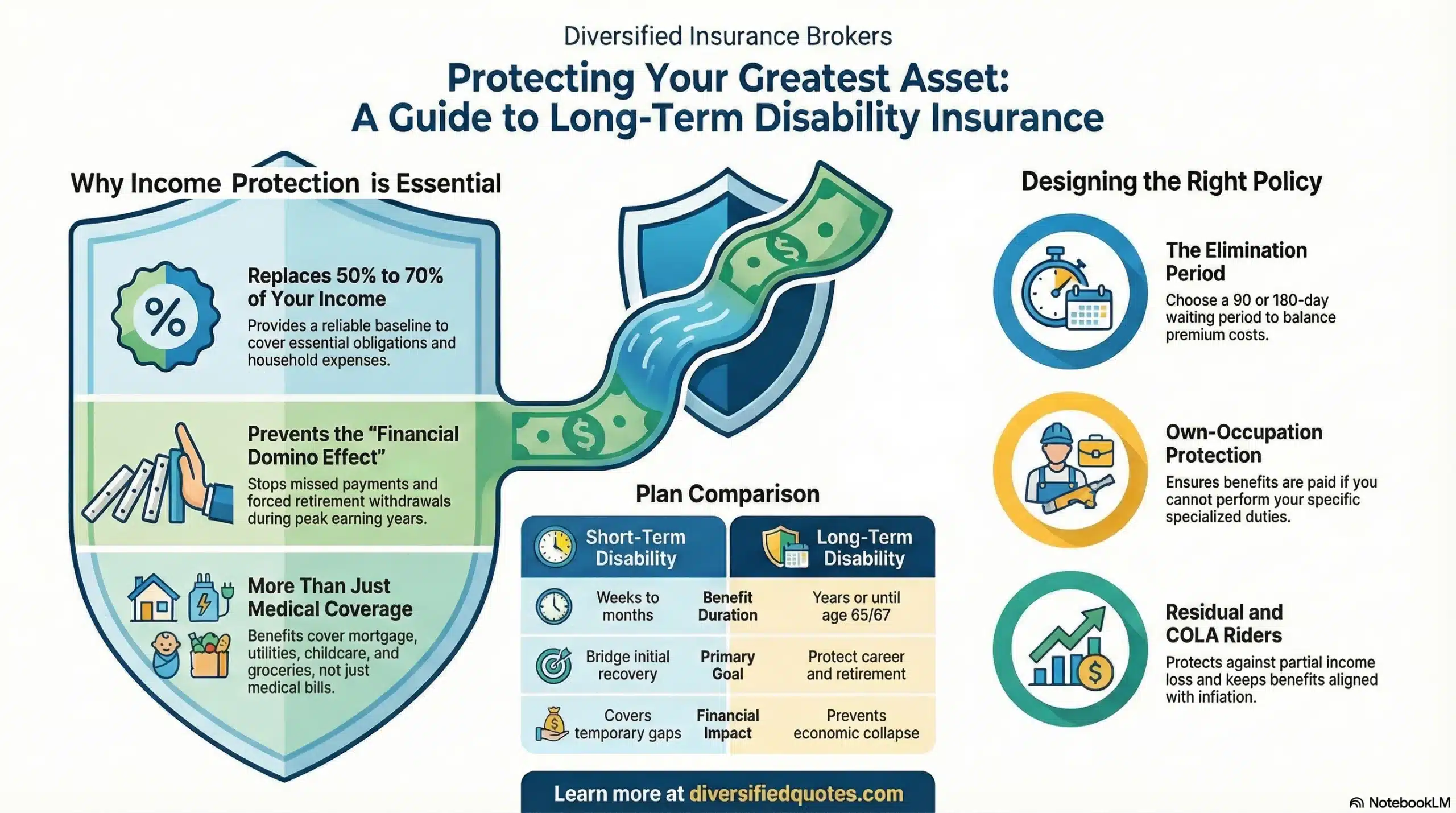
Commercial painters employed by larger painting contractors, construction companies, and building maintenance organizations typically receive employer group LTD coverage as part of their benefits package, and union painters may have access to union-negotiated disability benefits. However, these group coverage structures carry the systematic limitations that create real financial exposure gaps for construction trade workers. The 60% of base salary benefit cap excludes overtime pay that many commercial painters earn regularly, particularly during peak commercial construction seasons. The 24-month own-occupation to any-occupation definition transition creates the risk that a commercial painter with an ongoing shoulder condition or back injury might be denied benefits on the grounds that they retain theoretical capacity for sedentary or light-duty work — even when the specific physical functions of commercial painting work cannot be safely performed.
Group policies also end when employment ends, which is especially significant in the construction trades where work is project-based and employment relationships change more frequently than in office-based industries. A painter who loses their position or whose painting contractor employer goes out of business during a disability recovery period loses their group coverage at the same moment they most need it — adding administrative complexity to an already stressful situation. Individual disability insurance that is portable, maintains own-occupation coverage for the full benefit period, and follows the painter through employment changes is the standard of adequate income protection. Our resource on guaranteed issue group disability insurance explains group coverage structure and where individual coverage fills the consistent gaps. For painters with existing coverage who want an independent evaluation, our disability insurance second opinion service provides a carrier-neutral review.
When to Apply: Before the Occupational Health History Accumulates
The optimal time for a commercial painter to apply for disability insurance is as early in their painting career as possible — ideally upon completing an apprenticeship program or entering their first professional painting position, before years of ladder work, overhead application, and chemical exposure have produced any documented health history in medical records. The most important early-application reasons for commercial painters are parallel to those for other physically demanding construction trades: age-based premium locking, clean health history at the time of application, and the absence of the musculoskeletal findings, respiratory conditions, and chemical exposure history that accumulate across active painting careers and that complicate underwriting when they appear in medical records at the time of application.
A painter who applies at age 24 upon completing their apprenticeship obtains the lowest available lifetime premium at the cleanest health history point, before any shoulder conditions from overhead work, back conditions from ladder and physical work, or respiratory findings from coating exposure have been documented. A painter who applies at 40 after 15 years of commercial painting work faces substantially higher premiums and the potential for exclusion riders on conditions that have been treated or documented during those years. The future increase option purchased with an early policy allows coverage to expand as commercial painting career income grows — through journeyman advancement, supervisory roles, or business ownership — without new medical underwriting. Our resource on disability insurance for new professionals addresses early-career planning for construction trade workers, and our resource on how to get the best disability insurance rates explains all the factors that determine coverage quality and cost for construction trade applicants.
Get Disability Insurance Quotes for Commercial Painters
We compare options across carriers for painting contractors and commercial painters to find the right combination of coverage, definition strength, and value.
Request Disability Insurance OptionsQuestions? Call 800-533-5969
Financial Protection Essentials
Income protection resources and disability insurance planning tools for commercial painters and painting contractors.
Talk With an Advisor Today
Choose how you’d like to connect—call or message us, then book a time that works for you.
Schedule here:
calendly.com/jason-dibcompanies/diversified-quotes
Licensed in all 50 states • Fiduciary, family-owned since 1980
FAQs: Disability Insurance for Commercial Painters
What are the main disability risks for commercial painters?
Commercial painters face disability risks across four main categories. Falls from ladders, scaffolding, aerial lifts, and elevated platforms are the most acute and severe risk — falls are the leading cause of death and serious injury in the construction industry, and commercial painters work at elevation as a daily feature of their job rather than an occasional exception. A fall from a 10-foot ladder produces injury forces comparable to a serious vehicle collision, with orthopedic injuries to the spine, pelvis, and extremities that require surgical repair and months of rehabilitation.
Chemical exposure from lead paint in renovation work, organic solvents in coating products, and isocyanates in two-component polyurethane coatings represents the second major disability category — producing acute respiratory sensitization, chronic neurological effects from solvent exposure, and the elevated long-term cancer risk that epidemiological research has documented in professional painter populations. Musculoskeletal injuries from sustained overhead work — rotator cuff conditions, shoulder impingement, and cervical disc conditions from hours of arms-raised coating application — represent the highest-volume disability category. Respiratory disease from dust and fume inhalation during surface preparation and coating application rounds out the occupational health risk profile. Our resource on disability insurance for high-risk occupations explains how underwriting approaches construction trade disability risks.
Does workers’ compensation cover all disability scenarios for commercial painters?
No — workers’ compensation covers work-related injuries and occupational diseases but leaves significant income protection gaps that individual disability insurance must address. Workers’ comp income replacement typically covers only approximately two-thirds of pre-injury wages subject to state weekly benefit maximums that may be well below an experienced commercial painter’s actual earnings, particularly when overtime is a regular component of annual income. Workers’ comp does not cover disabilities that are not directly attributable to work — a painter who develops a disabling back condition from a combination of occupational and recreational activities, or who undergoes surgery for a condition that predates the current employment, receives no workers’ comp support for the income lost during recovery.
Individual disability insurance provides income replacement based on inability to work regardless of where or how the disabling condition arose — covering the painter’s income loss during any disability that prevents commercial painting work, whether work-related, non-work-related, or arising from a combination of occupational and non-occupational factors. The coordination of workers’ comp and individual disability insurance is straightforward: workers’ comp pays what it covers, individual disability insurance addresses the remainder of the income gap. Our resource on whether disability insurance is worth it provides the full value framework for evaluating this protection.
Why do self-employed painting contractors need both personal and business overhead disability coverage?
Self-employed painting contractors face two simultaneous financial crises when disability strikes. The first is personal — household financial obligations including housing, food, transportation, and family expenses that continue without income. The second is the business — the fixed costs of operating a painting business that continue regardless of whether the contractor can work: truck and equipment payments, commercial auto insurance premiums, general liability insurance, tools and supply costs, and any employee payroll if the contractor has workers. Personal disability insurance addresses the household income layer. Business overhead expense (BOE) disability insurance addresses the business cost layer — reimbursing qualifying fixed business expenses during a disability so the painting business can remain operational and survive the contractor’s recovery period rather than collapsing during it.
Without BOE coverage, a painting contractor who becomes disabled for 6 months may return to physical capability at the end of that period only to find that their business has accumulated debt, lost clients to competitors, and effectively dissolved during their absence. With BOE coverage, the fixed operating costs continue to be covered, the business relationship and reputation are maintained, and return to work means reactivating a functioning business rather than rebuilding from scratch. Our resource on business overhead disability insurance explains how these two coverage layers work together for self-employed painting contractors.
Is lead paint exposure covered under disability insurance for painters?
Yes — disability insurance covers the income consequences of lead paint exposure when that exposure produces a qualifying disability under the policy definition. A commercial painter who develops occupational lead poisoning requiring medical treatment and work restriction — whether from acute high-level exposure or chronic lower-level exposure during renovation painting work on older structures — has experienced a disability event that individual disability insurance addresses through income replacement during the treatment and recovery period. The coverage applies regardless of whether a workers’ compensation claim is filed or acknowledged by the employer, and regardless of the administrative timelines of any regulatory or legal process associated with the exposure.
The most important planning point is that coverage must be in place before the lead exposure-related health condition is documented. A painter who applies for disability insurance after a documented lead poisoning incident or elevated blood lead level will face underwriting scrutiny that may produce exclusion riders on lead-related conditions — eliminating coverage for the specific occupational disease that the exposure has already produced. Applying before any such documentation exists produces the most comprehensive coverage at the best available cost. Our resource on disability insurance with preexisting conditions explains how documented health history affects underwriting outcomes.
When is the best time for a commercial painter to apply for disability insurance?
The optimal time is as early as possible in the painting career — ideally upon completing an apprenticeship program or entering the first professional painting position, before years of ladder work, overhead application, and chemical exposure have produced any documented health history. A painter who applies at age 24 upon completing their apprenticeship obtains the lowest available lifetime premium at the cleanest health history point, with the broadest coverage terms and no exclusion riders limiting the conditions that commercial painting work is most likely to eventually produce.
Every year of active commercial painting work increases both the premium at future application age and the probability that documented health history — shoulder conditions from overhead work, back conditions from physical demands, respiratory findings from coating exposure — will appear in medical records and limit coverage options at a later application. The future increase option purchased with an early policy allows coverage to expand as painting career income grows through journeyman advancement, supervisory roles, or business ownership without new medical underwriting. Our resource on how to get the best disability insurance rates explains all the factors that determine coverage quality and cost for construction trade applicants.
About the Author:
Jason Stolz, CLTC, CRPC, DIA, CAA and Chief Underwriter at Diversified Insurance Brokers (NPN 20471358), is a senior insurance and retirement professional with more than 25 years of real-world experience helping individuals, families, and business owners protect their income, assets, and long-term financial stability. As a long-time partner of the nationally licensed independent agency Diversified Insurance Brokers, Jason provides trusted guidance across multiple specialties—including fixed and indexed annuities, long-term care planning, personal and business disability insurance, life insurance solutions, Group Health, Travel Medical and Evacuation Insurance, and short-term health coverage. Diversified Insurance Brokers maintains active contracts with over 100 highly rated insurance carriers, ensuring clients have access to a broad and competitive marketplace.
His practical, education-first approach has earned recognition in publications such as VoyageATL, and contributions from his agency featured in Kiplinger and GoBankingRates— highlighting his commitment to financial clarity and client-focused planning. Drawing on deep product knowledge and years of hands-on field experience, Jason helps clients evaluate carriers, compare strategies, and build retirement and protection plans that are both secure and cost-efficient. Visitors who want to explore current annuity rates and compare options across multiple insurers can also use this annuity quote and comparison tool.
Explore More Disability Insurance Options: Browse our complete guide to Disability Insurance for Trades, Construction & Industrial — covering contractors, electricians, plumbers, welders, roofers, machinists & skilled trades from 100+ carriers.
Last Reviewed: May 14, 2026 |
Reviewed by: Jason Stolz, CLTC, CRPC, DIA, CAA
Chief Underwriter, Diversified Insurance Brokers, Inc. | NPN: 20471358 | Diversified Insurance Brokers, Inc. — Licensed in all 50 states
Fact Checked by: Tonia Pettitt, CMIP©
Medicare Specialist, Diversified Insurance Brokers, Inc. | NPN: 14374308 | Diversified Insurance Brokers, Inc. — Licensed in all 50 states
Did you find this content helpful? Leave us a Google review — it helps others find trustworthy guidance too.
Editorial Standards: Diversified Insurance Brokers maintains rigorous editorial standards to ensure accuracy, clarity, and independence in all content. Learn more about our editorial standards and commitment to transparency.
