
Disability Insurance for Videographers
Disability Insurance for Videographers

Jason Stolz CLTC, CRPC, DIA, CAA
Videographers build careers on a precise combination of physical capability, technical expertise, and creative vision that produces income entirely dependent on their personal ability to work. Whether shooting weddings and events, producing corporate video content, creating documentary films, or working as a freelance commercial videographer, the work demands sustained physical presence — carrying and operating heavy camera systems, managing lighting rigs and tripods, spending hours in awkward positions to capture specific angles, traveling to locations, and frequently working in environments that carry their own physical risks. When an injury or illness prevents a videographer from performing this work, the financial consequences arrive immediately and completely — because for most videographers, there is no employer sick pay, no group long-term disability plan, and no safety net beyond whatever personal savings exist at the time.
According to the Social Security Administration, more than one in four of today’s 20-year-olds will become disabled before reaching retirement age, and roughly 90% of those disabilities are caused by illness rather than accidents, which means workers’ compensation offers no protection for most claims. For a freelance videographer earning $75,000 to $150,000 or more annually, the gap between that statistical reality and the average videographer’s actual disability protection — typically nothing — represents one of the most consequential financial planning blind spots in the creative professional community.
At Diversified Insurance Brokers, we help videographers, cinematographers, and creative professionals build disability income protection that reflects the variable income structure, self-employment documentation challenges, and specific occupational realities of their work. Our resource on disability insurance for the self-employed covers the foundational underwriting mechanics, and our resource on disability insurance for 1099 workers addresses the income documentation specifics for independent contractor creatives.
Disability Insurance for Videographers
Income protection built for the physical demands, variable earnings, and freelance realities of professional video production.
Request a Disability Insurance QuoteCall 800-533-5969
The Physical Reality of Professional Videography
Videography is far more physically demanding than most outsiders appreciate — and disability insurance carriers who classify it understand this clearly. A working videographer routinely carries camera systems, lens kits, batteries, lighting equipment, and audio gear that collectively weigh 30 to 80 pounds or more. Wedding and event videographers spend 8 to 14 hours on their feet, moving constantly, frequently in poor lighting, on uneven surfaces, or in outdoor environments with temperature, weather, and terrain challenges. Documentary and location videographers may work in genuinely hazardous environments — construction sites, emergency scenes, conflict zones, extreme weather events — where physical injury risk is meaningfully elevated above the general working population.
The physical demands extend beyond carrying equipment. Videographers frequently work in positions that create acute musculoskeletal strain: operating shoulder-mounted cameras for extended periods, crouching or lying prone for low-angle shots, reaching and twisting for elevated angles, and repeating these movements across entire shooting days with minimal recovery time between. Back injuries, shoulder injuries, knee injuries, and wrist and hand conditions from repetitive camera operation are the specific occupational health consequences of this physical profile — and they develop through the same combination of acute injury events and cumulative strain that produces musculoskeletal disability in physically demanding professions across industries.
There is also the vision dimension specific to this profession. Videographers depend on precise visual acuity for exposure assessment, focus accuracy, color grading, and the visual judgment that defines their professional output. An eye condition that reduces visual precision — early-stage macular degeneration, a traumatic eye injury, progressive vision loss from any cause — can end a videography career even when the person appears functional in most other respects. Under a properly structured own-occupation disability policy, this scenario pays. Under a weaker any-occupation definition, a videographer who can still “see well enough to work in some capacity” might have benefits denied despite a career-ending professional disability. Our resource on own-occupation disability insurance explains why this definitional distinction is so consequential for professional creatives.
Occupational Classification and the Freelance Carrier Challenge
Videographers who work primarily in studio or controlled environments — corporate video production, commercial shoots, post-production focused work — typically receive Class 3 or Class 4 occupational ratings from disability insurance carriers, reflecting the mixed physical and technical nature of the work. Videographers who regularly work on location, shoot events, operate in physically demanding or hazardous environments, or perform significant manual setup work may receive Class 2 or Class 3 ratings depending on how the carrier evaluates the duty profile. The specific classification can vary by carrier for the same videographer, making market comparison through an independent broker particularly valuable.
The freelance and self-employment structure that defines most videography careers creates specific underwriting challenges beyond occupational classification. Unlike salaried employees whose income documentation is straightforward W-2 verification, freelance videographers must document insurable income through Schedule C tax returns showing net self-employment income after business deductions for equipment, software, travel, and other legitimate business expenses. The insurable income calculation is based on net taxable income — not gross revenue — which means aggressive business expense deductions that minimize tax liability also reduce the documented insurable income available for benefit calculation.
The No-Safety-Net Reality
| Financial Obligation | Salaried Employee’s Reality | Freelance Videographer’s Reality |
|---|---|---|
| Sick leave during disability | Typically provided by employer | None — income stops immediately |
| Long-term disability plan | Group LTD through employer — typical 60% benefit | None unless personally purchased |
| Equipment costs during disability | Not applicable — employer-owned equipment | Loan payments, insurance, and storage continue |
| Business overhead during disability | Employer absorbs operating costs | Software subscriptions, website, professional dues continue |
| Client retainer stability | Salary continues regardless of productivity | Clients immediately reassign work; repeat business lost |
The table illustrates what most freelance videographers already know intuitively but rarely quantify: a disability is not just a health event — it is an immediate and total income event with cascading business consequences. The equipment loan that was manageable when earning $8,000 per month becomes unmanageable in month two of a disability. The clients who were recurring revenue become competitors’ clients after a few weeks of unavailability. The professional subscriptions — Adobe Creative Cloud, cloud storage, project management tools — continue billing while income has stopped entirely.
Individual disability insurance addresses the income dimension directly. For videographers with substantial business overhead, a separate business overhead expense (BOE) disability insurance policy reimburses eligible fixed business costs during a disability — keeping the professional infrastructure intact through a recovery period so the videographer returns to a functioning business rather than a collapsed one.
Variable Income and the Residual Rider
Videography income is rarely flat and predictable. Wedding season generates high income from April through October; winter months may be quieter. A multi-day commercial shoot produces high income that month; editing-focused months produce less. This variability makes the residual disability rider especially important for videographers, because partial disability — the ability to do some work but not full capacity — produces proportional income loss that a total disability threshold rarely captures accurately.
A videographer who injures their back and can edit and consult but cannot shoot for three months has lost the most productive portion of their income-generating capacity while retaining some working ability. Without a residual rider, this scenario produces nothing from a disability policy despite significant financial harm. With the residual rider, the proportional income reduction triggers proportional benefit payments — making the difference between a financially survivable recovery period and a financial crisis that forces premature return to physically demanding work before the injury has healed.
Key Policy Features for Videographers
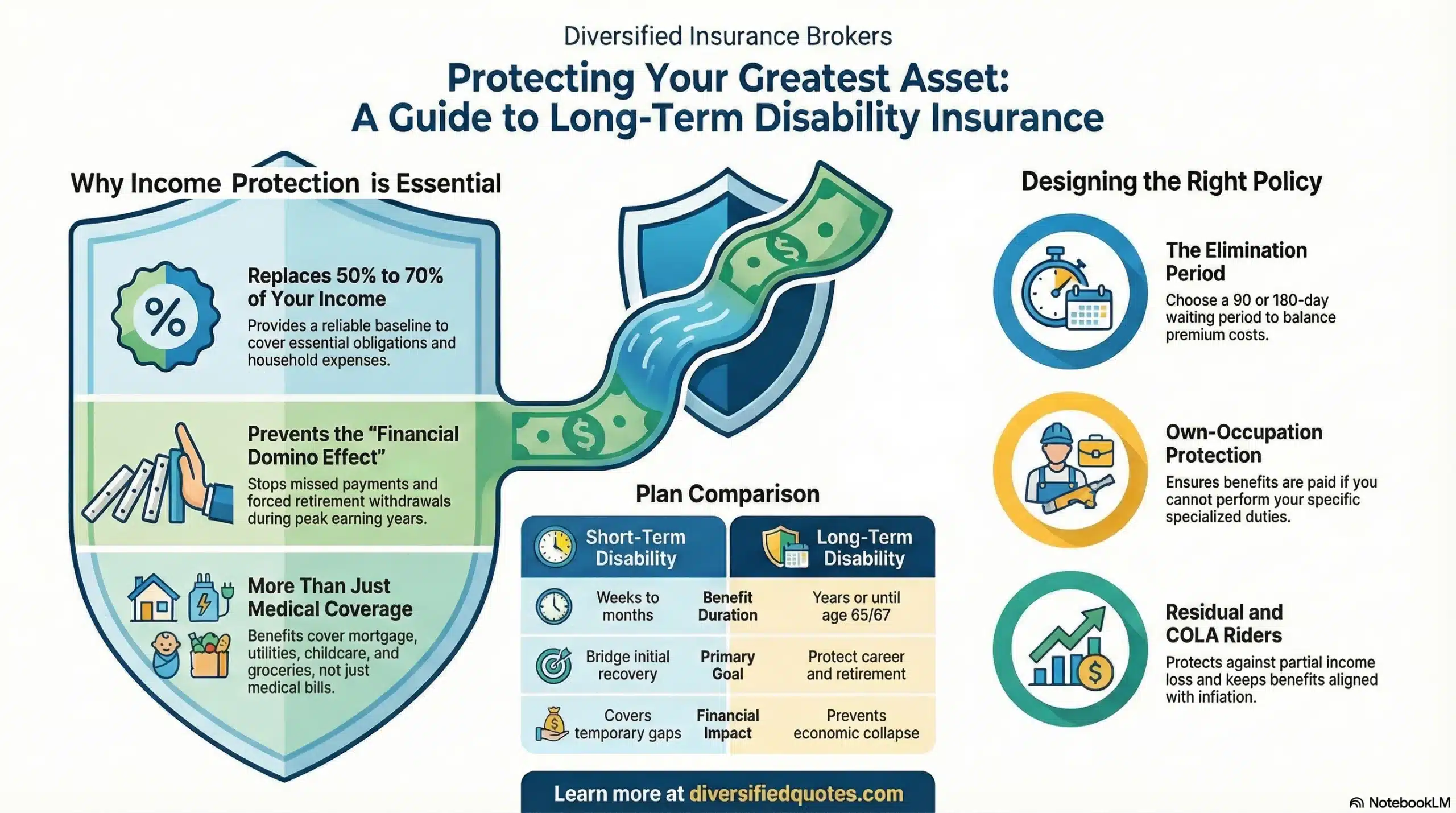
The own-occupation definition is the non-negotiable foundation. For a videographer, “unable to perform the material and substantial duties of their occupation” means unable to perform videography work specifically — not unable to work in any capacity whatsoever. A videographer with a career-ending hand tremor who can still work as a video editor or production coordinator should receive disability benefits from a true own-occupation policy because videography is what the policy insures. The non-cancelable, guaranteed renewable provision locks in the policy terms and premium rate permanently once issued — a videographer who purchases at age 30 with healthy underwriting retains those terms at age 45 regardless of any health changes in between.
The future increase option is particularly valuable for videographers whose careers and income are in a growth trajectory — allowing coverage to expand with income without new medical underwriting. The cost-of-living adjustment rider preserves benefit purchasing power during a potentially long-duration disability. And for videographers who are also building a production company with employees and overhead, the BOE policy addresses the business dimension that personal disability insurance does not cover. Our broader resource on disability insurance for the entertainment industry covers the full landscape of income protection options for creative industry professionals.
Build Income Protection That Matches Your Videography Career
We compare own-occupation policies across 100+ carriers for freelance videographers, cinematographers, and production professionals.
Compare Disability Options for VideographersCall 800-533-5969
Related Disability Insurance Pages
Talk With an Advisor Today
Choose how you’d like to connect—call or message us, then book a time that works for you.
Schedule here:
calendly.com/jason-dibcompanies/diversified-quotes
Licensed in all 50 states • Fiduciary, family-owned since 1980
FAQs: Disability Insurance for Videographers
Do freelance videographers need disability insurance?
Yes — and the case is stronger for freelance videographers than for most salaried workers. A salaried employee who becomes disabled typically has access to some combination of employer sick leave, short-term disability, and group long-term disability coverage. A freelance videographer has none of these by default. Income stops the moment work stops, while rent, equipment loan payments, software subscriptions, and other fixed costs continue at full rate regardless of whether the videographer is shooting. The Social Security Administration estimates that more than one in four of today’s 20-year-olds will become disabled before retirement age, with the majority of those disabilities caused by illness rather than accident — scenarios that workers’ compensation (which only covers workplace accidents) does not address at all. Individual disability insurance is the only protection mechanism that covers this full spectrum of risk for self-employed creative professionals.
What occupational class do videographers receive?
Videographer occupational classification varies by carrier and by specific work profile. Studio-based and commercial videographers whose work is primarily in controlled environments typically receive Class 3 or Class 4 ratings. Location videographers, event videographers, and those who regularly work in physically demanding or hazardous environments may receive Class 2 or Class 3 ratings. The classification determines both premium rates and available policy provisions — making carrier comparison through an independent broker particularly valuable for videographers, since the classification at one carrier may be a full class better than at another for the same duty description, producing meaningfully different premiums for identical coverage.
How is a freelance videographer’s income documented for disability underwriting?
Disability carriers calculate insurable income from documented net taxable income — typically two years of Schedule C tax returns showing net self-employment income after business deductions for equipment, software, travel, editing, and other legitimate business costs. The benefit calculation is based on net taxable income, not gross revenue, which means videographers who take full advantage of legitimate deductions to minimize tax liability also reduce the documented insurable income available for benefit calculation. Understanding this trade-off and timing applications strategically — during or shortly after years when net taxable income is at its highest sustainable level — produces the best available benefit amount. Our resource on disability insurance for the self-employed covers the documentation mechanics in full.
Can a back injury from shooting end a videography career?
Yes, and back injuries represent one of the most common disability risks for active videographers who regularly carry heavy equipment, work in awkward positions, and spend extended periods on physically demanding shoots. A back condition that prevents the physical demands of active camera operation — carrying and steadying camera systems, crouching, reaching, operating shoulder-mounted rigs — prevents the core income-generating work of a videographer regardless of whether the person can still perform sedentary tasks. Under a true own-occupation disability policy, this scenario pays benefits because videography work is what the policy insures. Under weaker any-occupation or modified own-occupation language, the same videographer might be denied because they can theoretically still work in some capacity.
About the Author:
Jason Stolz, CLTC, CRPC, DIA, CAA and Chief Underwriter at Diversified Insurance Brokers (NPN 20471358), is a senior insurance and retirement professional with more than 25 years of real-world experience helping individuals, families, and business owners protect their income, assets, and long-term financial stability. As a long-time partner of the nationally licensed independent agency Diversified Insurance Brokers, Jason provides trusted guidance across multiple specialties—including fixed and indexed annuities, long-term care planning, personal and business disability insurance, life insurance solutions, Group Health, Travel Medical and Evacuation Insurance, and short-term health coverage. Diversified Insurance Brokers maintains active contracts with over 100 highly rated insurance carriers, ensuring clients have access to a broad and competitive marketplace.
His practical, education-first approach has earned recognition in publications such as VoyageATL, and contributions from his agency featured in Kiplinger and GoBankingRates— highlighting his commitment to financial clarity and client-focused planning. Drawing on deep product knowledge and years of hands-on field experience, Jason helps clients evaluate carriers, compare strategies, and build retirement and protection plans that are both secure and cost-efficient. Visitors who want to explore current annuity rates and compare options across multiple insurers can also use this annuity quote and comparison tool.
Explore More Disability Insurance Options: Browse our complete guide to Disability Insurance for Technology, Science & Education — covering software developers, engineers, scientists, teachers, architects & researchers from 100+ carriers.
Last Reviewed: May 18, 2026 |
Reviewed by: Jason Stolz, CLTC, CRPC, DIA, CAA
Chief Underwriter, Diversified Insurance Brokers, Inc. | NPN: 20471358 | Diversified Insurance Brokers, Inc. — Licensed in all 50 states
Fact Checked by: Tonia Pettitt, CMIP©
Medicare Specialist, Diversified Insurance Brokers, Inc. | NPN: 14374308 | Diversified Insurance Brokers, Inc. — Licensed in all 50 states
Did you find this content helpful? Leave us a Google review — it helps others find trustworthy guidance too.
Editorial Standards: Diversified Insurance Brokers maintains rigorous editorial standards to ensure accuracy, clarity, and independence in all content. Learn more about our editorial standards and commitment to transparency.
