
Are Annuities Worth it
As an Independent Annuity Broker, we compare rates across 100+ carriers and 1,000 different annuities— not just one company’s product offerings — to find the best fit for your goals.
Are Annuities Worth it

Jason Stolz CLTC, CRPC, DIA, CAA
Are annuities worth it? For many retirees and pre-retirees, the answer is yes — but only when the annuity is solving a real retirement problem. The value of an annuity depends on your goals, timeline, liquidity needs, tax picture, and your comfort with market risk. Annuities are not one-size-fits-all products. When the fit is right, they can deliver outcomes that are difficult to reproduce with traditional investments alone: guaranteed lifetime income, protection from market losses, more predictable interest crediting, and the ability to build a pension-like income layer that can be budgeted around with confidence.
At Diversified Insurance Brokers, we help clients evaluate annuities with a simple lens: what problem are you trying to solve? Some people want to protect principal after decades of accumulation and cannot afford a major drawdown at the start of retirement. Others want to create a baseline retirement paycheck that cannot be outlived. Others want to reduce sequence-of-returns risk so they are not forced to sell investments in a down market. Still others want tax-deferred growth in a vehicle that feels more stable than a fully market-based account. In each case, the product only becomes “worth it” if it genuinely improves the plan — not if it just looks good on a sales illustration. Our foundational resource on what the benefits of annuities are covers the core value propositions across all annuity types, and our resource on Annuities 101 provides the foundational education for buyers who want to understand the landscape before evaluating specific products.
Find Out If an Annuity Improves Your Retirement Plan
Current Fixed Annuity Rates
Compare today’s best fixed annuity rates from top carriers.
Current Bonus Annuity Rates
See which annuities offer the highest upfront bonus today.
Request Personalized Quotes
Get customized annuity comparisons in plain English.
Lifetime Income Calculator
Model potential guaranteed income at different ages and premium levels. The goal is to see how a guaranteed income layer changes your retirement picture — not to find a perfect number on the first try.
💡 The calculator accepts premiums up to $2,000,000. If investing more, results increase in direct proportion — doubling the premium roughly doubles guaranteed income at the same age and options.
Why Many People Consider Annuities “Worth It”
Annuities are worth it when they solve retirement challenges that investment accounts alone cannot guarantee against. Investment accounts can grow, but they do not guarantee the timing of returns, they do not guarantee a stable paycheck, and they do not guarantee you will not be forced to sell during a market drawdown. Annuities are designed around contractual promises — either a guaranteed rate of interest, a guaranteed floor against loss, or a guaranteed income stream for a specified period or for life. The contractual guarantee is the core value that no investment return projection can replicate, because projections are estimates and contracts are obligations.
For a retiree, the most important mental shift is often from “total return” to “reliable cash flow.” If a household has enough guaranteed income to cover essential expenses, retirement feels manageable even during volatile years. If the household depends on portfolio withdrawals for essentials, volatility can create anxiety and force poor decisions — selling at depressed prices, abandoning long-term allocations, or simply spending less than planned out of fear. Annuities can anchor part of the plan in certainty, which reduces the behavioral pressure that market downturns create. Our resource on sequence-of-returns risk explains the mathematical and behavioral risk that a guaranteed income floor specifically addresses. Our guide on guaranteed income from annuities covers how the income guarantee functions across different annuity structures and what makes it structurally different from a portfolio withdrawal rate.
Longevity risk — outliving savings — is another major reason annuities can be worth it. People regularly underestimate how long retirement can last. A 65-year-old couple has a meaningful actuarial probability that one spouse lives into their 90s. A plan that looks sustainable over 20 years can become fragile over 30 — especially if markets are choppy and withdrawals are steady. When an annuity is structured for lifetime income, the insurer takes on the risk of the retiree living longer than expected. Our resource on whether annuities pay income for life explains the contractual basis for this longevity transfer, and our guide on pension replacement through guaranteed lifetime income covers how annuity income recreates the pension structure that most private-sector retirees no longer receive.
Types of Annuities and When Each Is Worth It
| Annuity Type | Core Value Proposition | Worth It When… | Not Worth It When… |
|---|---|---|---|
| Fixed Annuity (MYGA) | Declared guaranteed interest rate for a defined term; principal protection | Goal is predictable growth with no market exposure; “safe bucket” allocation needed | Near-term liquidity is needed; short time horizon conflicts with surrender schedule |
| Fixed Indexed Annuity (FIA) | Index-linked interest with a floor protecting against market loss years | Goal is some upside potential with downside protection; reducing portfolio volatility | Full market upside is the goal; short time horizon; high liquidity requirement |
| Income Annuity (SPIA/DIA) | Immediate or deferred guaranteed lifetime income; highest income per dollar | Goal is maximum guaranteed monthly income; no need for remaining principal access | Legacy planning requires accessible account value; near-term liquidity is a priority |
| FIA with GLWB Income Rider | Deferred guaranteed lifetime income with maintained account value access | Goal is both future guaranteed income AND some account value flexibility; long deferral timeline | Income is needed immediately; ongoing rider fees reduce the value if income election is long deferred |
Fixed Annuities: Worth It for Predictability and Principal Protection
Fixed annuities are often compared to CDs because they can offer a guaranteed interest rate for a set period. The differences that matter in retirement planning are tax deferral for non-qualified funds, insurance-based principal protection guarantees, and typically longer time horizons. Many fixed annuities are competitive relative to other conservative options when tax deferral is factored into the after-tax yield comparison. They are often worth it for people who want predictable interest, no market exposure, and a clear “safe bucket” inside a broader plan — particularly for the portion of a retirement portfolio that is serving a stability rather than growth function.
Fixed annuities can also reduce pressure on a bond portfolio. Some retirees use them to stabilize a portion of assets that would otherwise be in fixed income, particularly when interest-rate sensitivity and market volatility in bonds are concerns. The annuity is not a replacement for a complete diversified plan, but it can be an effective tool when the goal is predictable accumulation with defined rules. Our resource on what the best fixed annuities are covers current carrier comparisons for this category, and our current fixed annuity rates page provides real-time market context for evaluating competitive options.
Fixed Indexed Annuities: Worth It for Protected Upside Potential
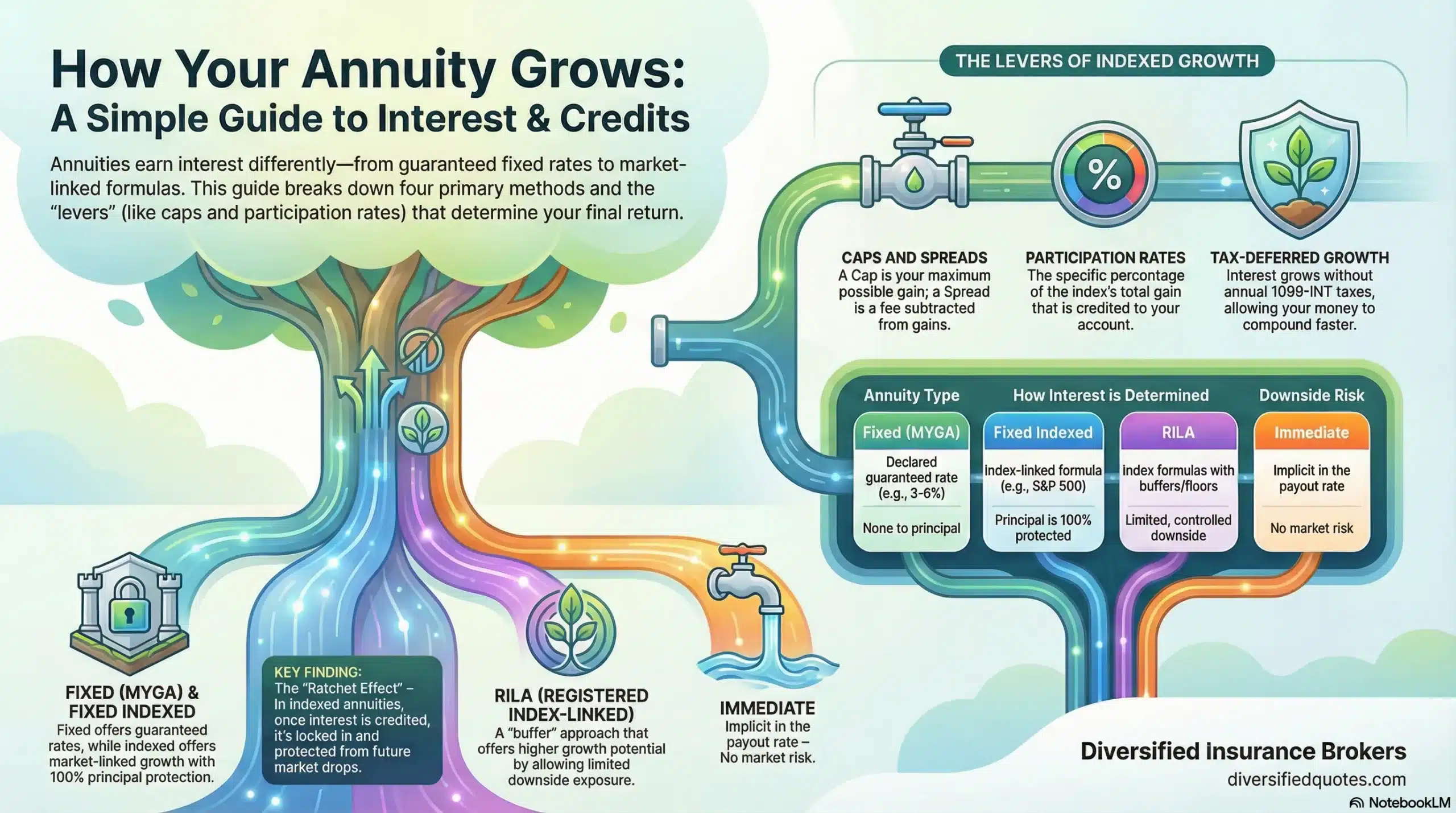
Fixed indexed annuities credit interest based on the performance of a market index, subject to contract limits — caps, participation rates, or spreads depending on the crediting method. The core feature is a floor that protects against negative market years: when the index declines, the annuity credits zero rather than a negative amount. This makes FIAs attractive for people who want a bridge between fully fixed and fully market-based — principal protection on the downside with a mechanism for capturing some market-linked growth during positive years.
FIAs can also be worth it when paired with lifetime income riders, transforming the annuity from an accumulation tool into part of the income plan. In that structure, the value comes from the combination: protected accumulation plus the option to activate guaranteed lifetime withdrawals later, while maintaining some account value access subject to contract rules. Our resource on the best fixed indexed annuities with lifetime income riders and our guide on the best fixed indexed annuities for income cover these combined designs specifically. For buyers evaluating whether the FIA income rider structure or direct annuitization better suits their goals, our resource on whether to annuitize or use an income rider and our guide on annuitization vs. lifetime withdrawals provide the comparative framework.
Income Annuities: Worth It for Paycheck Replacement
Income annuities — including SPIAs, DIAs, and annuities with lifetime income riders — are designed to solve one problem: creating reliable income that cannot be outlived. For retirees without a pension, this can be an enormous benefit. For couples, joint lifetime income can protect the surviving spouse and reduce the chance of an income cliff after the first death. If the primary retirement fear is running out of money, income annuities are often the most directly valuable type because they are purpose-built to remove longevity risk — not to manage it probabilistically, but to eliminate it contractually. Our resource on how a joint lifetime income annuity works covers the survivor structure for couples, and our guide on annuity for monthly retirement income covers designs optimized for consistent monthly cash flow. Our resource on the best immediate annuity for monthly income provides current market comparisons for the SPIA category specifically.
Some people evaluate income annuities by comparing them to a traditional portfolio withdrawal strategy. That comparison is most useful when done with honest assumptions. The portfolio withdrawal strategy relies on consistent returns and investor discipline during down markets. The annuity strategy replaces that uncertainty with a contract. Our resource on what the 4% rule is provides the portfolio withdrawal context that income annuity value is most frequently compared against. The question is not which strategy is objectively better — it is what combination produces the most stable and sustainable retirement for your specific household income, expense, and risk picture.
When Annuities Are Worth It — and When They Are Not
Annuities are often worth it when they match a clear objective. Principal protection, predictable growth, guaranteed lifetime income, longevity risk transfer, tax-deferred accumulation in a non-qualified account, stability for budgeting — these are the genuine problems annuities are built to address. When the annuity is addressing one of these specific needs, the cost-benefit calculus is typically favorable because the alternative — replicating the guarantee with market-based strategies — either requires assumptions that introduce the very risks the annuity eliminates, or requires large asset buffers that are themselves inefficient.
Annuities are often not worth it when the allocation conflicts with a meaningful near-term liquidity need, when the goal is short-term growth that does not match the product’s time horizon, or when the buyer is using an annuity for a job it was not designed to do. A conservative fixed annuity is not the right tool if the goal is aggressive growth. An income annuity is not the right tool if the priority is maximum account value accessible to heirs. A complex variable annuity is not the right tool if the goal is simple, predictable accumulation. Matching the product to the job eliminates most annuity regret. Our resource on the disadvantages of a lifetime income annuity covers the limitations honestly so buyers can evaluate both sides of the decision. Our resource on common annuity myths addresses the most frequent misconceptions that lead to both unnecessary rejection and inappropriate purchases.
It is also important to coordinate annuities with retirement account rules. If assets are in an IRA, understanding how RMDs interact with annuities affects how and when an annuity generates taxable income. In many cases, the right solution is about placement and timing — whether the annuity should be funded with qualified (pre-tax) or non-qualified (after-tax) funds, and how the resulting distribution tax treatment aligns with the household’s tax strategy. Our resources on how annuities are taxed, non-qualified annuity taxation, and the annuity exclusion ratio cover the tax mechanics for both qualified and non-qualified annuity funding scenarios.
Are Annuities Worth It for Income Planning?
For income planning, annuities can be extremely valuable because they convert uncertainty into a number that can be budgeted around. A lifetime income annuity or an income rider creates a monthly payment that continues even if the annuitant lives far longer than expected. That is especially valuable for households without pensions, for couples who want survivor protection, and for retirees who want to reduce the stress of managing withdrawals through volatile markets. Our resource on how Social Security and annuities work together covers the coordination framework for these two guaranteed income sources — often the most efficient approach to building a reliable essential-expense income floor. Our guide on pension alternatives explains the full menu of options for retirees trying to replicate the pension income floor that employer defined benefit plans once provided. For buyers transferring assets specifically to fund an income annuity, our resources on how to transfer an IRA to an annuity and how to transfer a retirement account to an annuity cover the mechanics of each funding approach.
Are Annuities Worth It for Inheritance Planning?
Annuities are not always the primary tool for legacy planning, but they can add value in specific scenarios. Some annuity structures include death benefit options or refund features — period-certain provisions guarantee minimum payments to beneficiaries if death occurs early, and cash refund designs ensure the total of all income payments received plus any beneficiary payment equals the original premium at minimum. For accumulation annuities, beneficiaries may receive the remaining account value subject to contract rules. Our resource on annuity beneficiary death benefits covers what heirs receive under different annuity designs and payout structures, and our guide on whether annuities have a death benefit clarifies the common misconception that annuities leave nothing to heirs. For non-qualified annuities that have been inherited, our resource on inherited non-qualified annuities covers the distribution rules beneficiaries must follow. Many retirees also find that guaranteed income reduces the need to pull from other accounts, which indirectly preserves portfolio assets for heirs — the annuity’s legacy contribution often shows up indirectly through reduced portfolio stress rather than through a direct death benefit.
The Cost of an Annuity vs. Its Worth: The Right Question to Ask
To decide whether an annuity is worth it, it helps to understand how costs and tradeoffs show up across different annuity types. Many fixed and indexed annuities do not charge an explicit annual management fee the way an investment account does. Instead, pricing is embedded in how interest is credited — through cap rates, participation rates, or spread adjustments that determine how much index performance the contract captures. Income riders add explicit annual charges, typically 0.75% to 1.25% of the benefit base or account value, in exchange for the lifetime income guarantee.
Our resource on how much an annuity costs helps put the decision in context. The better question is rarely “does this annuity have a fee?” The better question is “what guarantee am I receiving for that cost, and what would it cost to reproduce that guarantee in other ways?” For most retirees, replicating a true lifetime income guarantee through investments requires assumptions and risk management that may not be acceptable when the goal is stability rather than optimization. The annuity’s cost includes the surrender schedule, the income restrictions, and the embedded yield spread — but in exchange it delivers a contractual promise that no investment projection can match. If you have already received an annuity quote and want an independent evaluation of whether it represents competitive market value, our second opinion on your annuity quote service provides that assessment. For existing contracts that may no longer be serving the holder well, our annuity rescue plan covers the repositioning options available through 1035 exchanges.
Common Reasons People Regret Annuities — and How to Avoid Them
When people regret annuities, it is almost never because annuities are inherently bad products. It is because the annuity was mismatched to the buyer’s actual needs. The most common regret patterns are predictable and avoidable. Buying an annuity with a multi-year surrender schedule and then needing significant liquidity is the most frequent mismatch — the buyer’s real liquidity situation was not honestly assessed before the purchase. Buying for growth when the real goal was income — or buying for income when the household did not actually need more guaranteed income — creates a situation where the product features no one cares about consume cost and flexibility. Comparing illustrations that use different assumptions leads to “surprising” outcomes when reality diverges from the most optimistic projection.
These mistakes are avoidable with a structured decision process: define the annuity’s specific job in the retirement plan; size the allocation appropriately relative to total assets and liquid reserves; confirm near-term liquidity needs are fully covered outside the annuity; compare multiple carriers with consistent inputs using the same assumptions; and select a structure that matches income timing, survivor goals, and the tax dimension of the funding source. Our resource on common annuity objections addresses the most frequently raised concerns and how to evaluate them honestly. When the process is followed, annuities tend to be used as intended — as retirement infrastructure that delivers specific, defined outcomes — rather than as speculative or impulsive purchases.
Related Annuity Education Pages
Annuity pros and cons, income planning, tax mechanics, and retirement income resources from Diversified Insurance Brokers.
Financial Protection Essentials
Pension replacement tools, Social Security coordination, tax strategy, and retirement income resources from Diversified Insurance Brokers.
Talk With an Advisor Today
Choose how you’d like to connect—call or message us, then book a time that works for you.
Schedule here:
calendly.com/jason-dibcompanies/diversified-quotes
Licensed in all 50 states • Fiduciary, family-owned since 1980
FAQs: Are Annuities Worth It?
Are annuities worth it for retirement?
For many retirees, yes — when the annuity is solving a specific retirement problem that investment accounts cannot guarantee against. Annuities are worth it when they provide something the alternative cannot: guaranteed lifetime income that cannot be outlived, principal protection that does not depend on market conditions, or predictable cash flow that allows a household to budget around a fixed number rather than managing withdrawals under uncertainty. The value is specific to the problem being solved and the fit between the product’s design and the buyer’s actual goals and timeline.
The clearest “worth it” scenarios: a retiree without a pension who wants a baseline guaranteed paycheck; a couple who wants income to continue for the surviving spouse regardless of which one dies first; a pre-retiree who wants to protect accumulated savings from a market drawdown in the early retirement years when sequence-of-returns risk is highest; or anyone who wants to reduce the anxiety of managing retirement withdrawals through volatile markets. When the annuity directly addresses one of these problems, the tradeoffs — surrender schedule, liquidity constraints, embedded costs — are typically justified by the outcome. Our resource on what the benefits of annuities are covers the full value proposition across annuity types.
What are the main downsides of annuities?
The most significant downsides of annuities are reduced liquidity, complexity, and the risk of a product-goal mismatch. Reduced liquidity is the most commonly cited limitation: most annuities include surrender periods during which accessing more than the annual free-withdrawal allowance triggers surrender charges. For buyers who need significant flexibility or expect large near-term withdrawals, this constraint can be a meaningful problem. Complexity is the second challenge: annuity contracts can be difficult to evaluate and compare because costs are often embedded in crediting terms rather than stated as explicit fees, and the interaction between account value, income base, surrender value, and death benefit can be confusing.
Product-goal mismatch is the most avoidable downside: buying an income-focused annuity when the real goal was accumulation, or buying an accumulation product when the real need was income, leads to regret regardless of how well the product performed on its own terms. Our resource on the disadvantages of a lifetime income annuity covers the specific limitations of income-focused designs, and our guide on common annuity myths addresses the most frequent misconceptions that lead to both inappropriate purchases and unnecessary rejections of products that would otherwise be a good fit.
Are fixed annuities worth it?
Fixed annuities are worth it for people who want the simplest, most predictable form of annuity growth — a declared guaranteed interest rate for a defined term with principal protection. If the goal is to park a portion of assets in a stable, interest-bearing vehicle without market exposure, a fixed annuity is often the most direct tool for that objective. For retirees who want a “safe bucket” within a broader allocation — capital that cannot lose value and earns a known rate — fixed annuities compete favorably against CDs and bonds when tax deferral and current rate competitiveness are both considered.
Fixed annuities are less worth it for buyers whose primary goal is maximum growth or who need frequent access to funds that would be restricted by a surrender schedule. The fixed annuity’s value is its predictability — if that predictability is the objective, the surrender schedule is an acceptable trade-off. If flexibility and maximum growth are the priorities, other structures may be more appropriate. Our current fixed annuity rates page provides real-time market context for evaluating whether current fixed annuity yields are competitive relative to alternatives in today’s interest rate environment.
Are indexed annuities worth it?
Fixed indexed annuities are worth it for people who want a middle ground between full market exposure and fully fixed growth — the potential to earn some interest linked to market index performance while being protected from losing principal in negative index years. The key word is “potential”: indexed annuities are not designed to capture full market returns. They are designed to participate in some upside while eliminating downside — which can be an excellent structure for conservative-to-moderate investors in or near retirement who want some growth mechanism without the risk of significant loss at an inflection point when recovery time is limited.
Indexed annuities can also be worth it for the behavioral benefit of reduced volatility. Many retirees find that seeing a portfolio swing significantly after they stop working triggers anxiety and poor decisions — selling at depressed prices, abandoning long-term plans, or simplifying too aggressively. An indexed annuity allocation can provide a stable, non-fluctuating portion that reduces the emotional pressure on the rest of the portfolio. When paired with lifetime income riders, the value expands further — the protected accumulation phase leads to a future guaranteed income option. Our resources on the best fixed indexed annuities for income and the best fixed indexed annuities with lifetime income riders cover current market options in the income-oriented FIA category.
Do annuities pay income for life?
Yes — several annuity structures are specifically designed to guarantee income for life regardless of how long the annuitant lives. Single Premium Immediate Annuities (SPIAs) with a life-only or life-with-period-certain payout deliver guaranteed payments for the annuitant’s lifetime — if the annuitant lives 25 or 35 years after purchase, the payments continue without interruption. Deferred Income Annuities (DIAs) work similarly but with a delayed income start. Fixed indexed annuities with Guaranteed Lifetime Withdrawal Benefit (GLWB) riders provide guaranteed lifetime income while maintaining the account value as an accessible asset until it is depleted, at which point the insurer funds the continuing payments from its own resources.
The defining feature in all lifetime income structures is that the insurer — not the account balance — bears the longevity risk. The annuity does not run out of money when the account balance reaches zero; the insurer’s contractual obligation to continue payments survives the account depletion indefinitely. This is what distinguishes annuity income from portfolio withdrawal strategies: portfolio withdrawals produce income only as long as there are assets to draw from, while lifetime annuity income continues contractually for life. Our resource on whether annuities pay income for life covers the contractual mechanics behind this lifetime guarantee.
How do annuity costs affect whether they’re worth it?
Annuity costs appear in different forms depending on the product type. Fixed MYGAs typically have no explicit annual fee — the pricing is embedded in the declared interest rate and the yield the carrier earns on its general account. Fixed indexed annuities have pricing embedded in crediting terms (cap rates, participation rates, spreads) that determine how much index performance the contract captures; income riders add an explicit annual charge typically ranging from 0.75% to 1.25% of the benefit base or account value. Understanding how costs appear — rather than assuming either “no fee” or “high fee” generically — allows for an honest assessment of value received per dollar of cost.
The most useful cost evaluation question is not “does this annuity have fees?” but “what guarantee am I receiving for this cost, and what would it cost to reproduce that guarantee in other ways?” For most retirees, replicating a true lifetime income guarantee through investment strategies requires either accepting the probability of failure — running out of money — or maintaining such a large asset buffer that the opportunity cost exceeds the annuity’s embedded cost many times over. Viewed in that context, the cost of the annuity guarantee is often very efficient relative to the only genuine alternative. Our resource on how much an annuity costs provides the full cost breakdown across product types.
What is the biggest mistake people make when buying annuities?
The biggest and most common mistake is product-goal mismatch: buying an annuity that solves a different problem than the one the buyer actually has. This shows up in several specific patterns. Buying a complex income rider annuity when the primary need was simple stable accumulation with liquidity — the buyer pays for income features they do not need and accepts surrender constraints that do not fit their situation. Buying a conservative fixed annuity when the real concern was outliving savings — the fixed annuity provides no lifetime income guarantee, so the core fear is not actually addressed. Allocating too large a portion of assets to an annuity without maintaining adequate liquidity outside it — when a life event requires large funds, the buyer faces surrender charges that were avoidable with better sizing.
A secondary but very common mistake is comparing annuities using inconsistent assumptions — one illustration at an optimistic crediting rate, another at a conservative rate, making the “comparison” meaningless. The correct comparison uses identical assumptions across all products being evaluated, then evaluates the contract features and guarantees on equal terms. Our resource on common annuity objections covers the most frequently raised hesitations and how to evaluate each one honestly. Our second opinion on your annuity quote service evaluates whether an existing offer represents competitive market terms and whether the structure matches the buyer’s stated goals.
About the Author:
Jason Stolz, CLTC, CRPC, DIA, CAA and Chief Underwriter at Diversified Insurance Brokers (NPN 20471358), is a senior insurance and retirement professional with more than 25 years of real-world experience helping individuals, families, and business owners protect their income, assets, and long-term financial stability. As a long-time partner of the nationally licensed independent agency Diversified Insurance Brokers, Jason provides trusted guidance across multiple specialties—including fixed and indexed annuities, long-term care planning, personal and business disability insurance, life insurance solutions, Group Health, Travel Medical and Evacuation Insurance, and short-term health coverage. Diversified Insurance Brokers maintains active contracts with over 100 highly rated insurance carriers, ensuring clients have access to a broad and competitive marketplace.
His practical, education-first approach has earned recognition in publications such as VoyageATL, and contributions from his agency featured in Kiplinger and GoBankingRates— highlighting his commitment to financial clarity and client-focused planning. Drawing on deep product knowledge and years of hands-on field experience, Jason helps clients evaluate carriers, compare strategies, and build retirement and protection plans that are both secure and cost-efficient. Visitors who want to explore current annuity rates and compare options across multiple insurers can also use this annuity quote and comparison tool.
Explore More Annuity Options: Browse our complete guide to Annuities 101 — covering annuity education, planning guides, pros & cons, how to choose & buy from 100+ carriers.
Last Reviewed: May 20, 2026 |
Reviewed by: Jason Stolz, CLTC, CRPC, DIA, CAA
Chief Underwriter, Diversified Insurance Brokers, Inc. | NPN: 20471358 | Diversified Insurance Brokers, Inc. — Licensed in all 50 states
Fact Checked by: Tonia Pettitt, CMIP©
Medicare Specialist, Diversified Insurance Brokers, Inc. | NPN: 14374308 | Diversified Insurance Brokers, Inc. — Licensed in all 50 states
Did you find this content helpful? Leave us a Google review — it helps others find trustworthy guidance too.
Editorial Standards: Diversified Insurance Brokers maintains rigorous editorial standards to ensure accuracy, clarity, and independence in all content. Learn more about our editorial standards and commitment to transparency.
