
Disability Insurance for Longshoremen
As an Independent Disability Insurance Broker, we have access to exclusive discounts and negotiated pricing most captive agents can’t offer — see the full breakdown near the end of this page.
Disability Insurance for Longshoremen

Jason Stolz CLTC, CRPC, DIA, CAA
Disability insurance for longshoremen is income protection for one of the most physically hazardous occupations in the American economy — a profession that OSHA has specifically recognized with its own dedicated safety standard and fatal facts program, and that carries documented injury and fatality rates that place longshore and marine terminal work among the most dangerous trades in the country. Longshoremen, dock workers, and stevedores earn their living loading and unloading cargo ships using massive cranes, forklifts, straddle carriers, and heavy equipment in outdoor port environments that combine height exposure, heavy moving loads, constant vehicle traffic, all-weather conditions, and the cumulative physical demands of sustained cargo handling work. When a back injury, a fall, a crane accident, or any other disabling event prevents a longshoreman from performing that work — even temporarily — the financial consequences are immediate. For many longshoremen whose benefit package is built primarily around union health coverage and a pension, income replacement during disability is far less protected than the medical coverage that gets the most attention.
At Diversified Insurance Brokers, we help longshoremen and maritime cargo workers at ports across the country — registered full-time union longshoremen, casual dock workers, crane operators, lashers, hatch bosses, and dock clerks — structure disability insurance coverage that fills the gaps the Longshore and Harbor Workers’ Compensation Act and union benefit packages consistently leave open. A well-structured individual disability policy provides income replacement from any qualifying disability — whether it originates from an acute worksite injury covered under the LHWCA but inadequately compensating for lost income, a cumulative musculoskeletal condition that develops from years of heavy cargo work, or a medical event entirely unrelated to the waterfront. Our resource on is disability insurance worth it provides the financial framework for understanding exactly how income gaps compound during disability in ways that even strong union benefits cannot prevent without individual income replacement in place.
Get Disability Insurance Quotes for Longshoremen
We compare carriers, explain how longshore and maritime occupations are classified, and structure policies that fill the gaps union benefits and maritime workers’ comp leave open.
Request Disability Insurance OptionsWhat Longshoremen Actually Do — and Why the Hazard Profile Is Severe
Modern longshore work is built around the operation of specialized heavy equipment and the physical logistics of moving containerized cargo between ocean-going vessels and land transport — tasks that involve constant exposure to the injury hazards that OSHA’s dedicated longshoring standard addresses specifically. A working longshoreman’s shift involves directing and operating ship-to-shore gantry cranes that lift containers directly off vessels, working as lashers securing containers to ship decks and to each other with metal lashing bars, operating forklifts and straddle carriers across busy terminal yards with constant truck and equipment traffic, working in vessel holds and on deck platforms at significant heights, and performing the sustained physical cargo handling work that containerization has not eliminated — only redistributed into more equipment-intensive but still physically demanding forms. A full registered longshoreman may work extended shifts through any weather condition that the port schedules demand: loading and unloading at night, in heat, cold, rain, and wind, on wet vessel decks and crane platforms that represent the fall hazards OSHA has specifically identified as leading causes of longshore fatalities.
The physical demands of longshore work across a career are cumulative in ways that produce the musculoskeletal conditions most commonly associated with occupational disability in heavy physical trades. Lashing work involves repeated heavy manual handling of lashing bars and related hardware in confined spaces aboard vessels. Crane operators spend extended shifts in elevated operator cabs with sustained vibration and the postural loading that confined equipment seating creates. General cargo workers perform heavy lifting, repetitive physical exertion, and sustained outdoor labor across shifts that often extend well beyond standard hours when ship schedules demand. The combination of acute injury risk from working around massive loads and equipment, and cumulative disability risk from the physical demands of a longshore career, creates the disability exposure profile that individual income replacement insurance addresses — and that the LHWCA alone does not adequately cover. Our resource on disability insurance for heavy equipment operators provides useful parallel context on how occupations combining machinery operation with sustained physical labor and height exposure are evaluated for individual disability coverage.
The Most Common Disabling Conditions for Longshoremen
OSHA’s dedicated longshoring Fatal Facts program identifies the primary causes of fatal injuries in maritime cargo handling: workers struck by crane loads, falls from vessels and crane platforms, transportation incidents involving port equipment, and accidents involving improperly secured cargo that falls from cranes or topples from stacks. These catastrophic acute events represent the highest-severity end of the longshore disability risk spectrum — and the workers who survive them often do so with injuries requiring months of hospitalization, rehabilitation, and recovery, with permanent functional limitations that may prevent return to the physical demands of dock work. Falls from vessels, gangways, and crane platforms produce fractures, spinal injuries, and traumatic brain injuries. Crane-load struck-by events produce crush injuries, fractures, and internal injuries. These are not hypothetical scenarios — they are the documented injury patterns that OSHA’s longshoring program was specifically created to address.
Below the catastrophic level, back injuries represent the most prevalent disabling condition for longshoremen across a career, consistent with the occupational profile of any trade built around sustained heavy material handling. The repeated physical loading of lashing, heavy lift assistance, manual cargo handling, and the sustained vibration exposure of equipment operation produces lumbar disc conditions, herniation, and degenerative spinal disease across a longshore career in ways that are well-documented in occupational health research on maritime worker populations. Knee injuries develop from the sustained physical demands of working on uneven vessel decks, repeated ladder climbing, and the physical labor of lashing and cargo operations. Shoulder injuries from sustained overhead work and the mechanical demands of equipment operation are consistent occupational outcomes in longshore populations. Hearing loss from sustained port equipment noise — terminal yards are among the noisiest occupational environments in the country — represents a cumulative disability risk that develops progressively and permanently across a career at the waterfront. Respiratory conditions from cargo dust, chemical fumes from certain cargo types, and diesel exhaust from concentrated equipment traffic add long-term health exposure to the physical injury profile. For comparable context on how industrial trade occupations with severe acute and cumulative injury profiles are structured for disability coverage, our resource on disability insurance for the woodworking industry and disability insurance for movers and moving companies provide useful cross-occupational perspective.
Why the LHWCA and Union Benefits Don’t Fill the Income Gap
The Longshore and Harbor Workers’ Compensation Act — the federal maritime workers’ compensation framework that covers most longshoremen — provides medical benefits and lost wage compensation for work-related injuries. It is a more comprehensive and better-resourced framework than many state workers’ compensation systems, and it is specifically designed for the hazards of maritime cargo work. But it leaves the same structural gaps that all workers’ compensation systems leave — and for a longshoreman, those gaps can be financially devastating. The LHWCA covers only work-related injuries attributable to specific documented occupational incidents. It does not cover the lumbar disc condition that develops gradually from years of cumulative heavy lifting — because gradual-onset cumulative conditions are frequently difficult to attribute to a single documented workplace event. It does not cover any disability unrelated to the waterfront: the cardiovascular event, the cancer diagnosis, the neurological condition, or the off-the-job automobile accident that removes a longshoreman from work for months or years. It does not cover the full scope of income loss when partial disability reduces a longshoreman’s ability to work full shifts or full weeks — partial disability income replacement under workers’ compensation frameworks is frequently less generous than the differential actually creates in lost wages.
Union benefits — negotiated through the ILA on the East and Gulf Coasts and the ILWU on the West Coast — provide health, dental, vision, and pension benefits that are among the best available to blue-collar workers. But individual disability income replacement is not a feature of most union benefit packages in the way that health insurance is. A longshoreman who is disabled for four months due to a back surgery — even a work-related surgery covered under the LHWCA for medical costs — faces a lost-wage replacement calculation under the LHWCA that may not fully replace the overtime-inclusive income that an established longshoreman earns. For longshoremen whose total annual compensation including overtime reaches $120,000 or more, the income gap during disability can be severe. Our resource on what is the primary reason people buy disability insurance provides essential context on why individual coverage fills gaps that institutional programs — including workers’ compensation — consistently leave open for physical trade workers.
How Disability Insurance Carriers Classify Longshoremen
Disability insurance carriers assign occupational class ratings that reflect the estimated disability risk of each profession, and longshoremen are generally classified in the lower occupational class tiers that reflect the severe documented injury profile of maritime cargo work. The OSHA-specific longshoring standard and the documented fatal and nonfatal injury rates in port operations place longshore work in the physical hazard category that produces lower occupational class ratings and higher premium costs than desk-based professional occupations — which is accurate given the genuine severity of the occupational risk profile. Not every carrier will write longshore occupational classifications, and among those that do, coverage terms vary meaningfully based on how the specific role and duty profile are presented to underwriters.
A crane operator whose shift involves primarily equipment operation in an enclosed cab carries a different physical duty profile than a lasher whose work involves sustained manual physical labor aboard vessels. A dock clerk or manifest checker whose work is primarily administrative with limited physical field exposure occupies a different classification tier than a general cargo handler performing sustained heavy physical work. Presenting occupational duties accurately — including the specific role, the percentage of time in physically intensive activities versus supervisory or administrative functions, and the overall health picture — is an area where working with an experienced independent broker produces meaningfully better classification outcomes and access to coverage terms that single-carrier applications may not surface. Understanding how disability insurance elimination periods work is particularly relevant for longshoremen who need to understand exactly how long they can sustain household expenses without income replacement before benefits begin — especially when LHWCA wage replacement may provide partial coverage during the elimination window for work-related injuries.
Case Study — Registered Longshoreman, Back Injury During Cargo Operations
Consider a registered full-time longshoreman at a major East Coast port, earning $110,000 per year including regular overtime. After sustaining a serious lumbar disc herniation during a cargo operation — an injury covered under the LHWCA for medical treatment — this longshoreman requires surgical intervention and a minimum of four months of recovery during which the sustained physical labor, heavy lifting, and port environment that longshore work requires are medically contraindicated. The table below illustrates the financial stakes even with LHWCA coverage in place.
| Scenario | LHWCA + Union Benefits Only | LHWCA + Individual Disability Insurance |
|---|---|---|
| Medical Treatment | LHWCA covers medical costs for the work-related injury | LHWCA covers medical costs; individual policy covers income gap |
| Lost Wage Replacement | LHWCA provides two-thirds of average weekly wages — overtime-inclusive income may be understated in the calculation | Individual disability policy supplements LHWCA to approach full income replacement |
| 4-Month Income Gap | ~$36,667 gap between LHWCA benefit and pre-disability income at $110K annual earnings | Individual supplement closes the gap; household obligations remain stable |
| Coverage for Non-Work Disability | $0 — LHWCA covers only work-related events; off-the-job disability has no institutional income replacement | Individual disability insurance covers any qualifying disability regardless of origin |
| Return-to-Work Pressure | Income gap creates pressure for premature return to port work before surgical recovery — re-injury risk | Full recovery on medical timeline; return to longshore work when medically cleared |
Back injuries during cargo operations are among the most consistently documented disabling events for longshoremen, and the income gap between LHWCA wage replacement and actual pre-disability earnings is a real financial consequence that institutional coverage does not eliminate. Individual disability insurance for longshoremen addresses both the income gap on work-related injuries where the LHWCA falls short, and the full income replacement need for non-work disabilities where no institutional coverage exists at all. For additional context on how physical trade workers in high-hazard industrial occupations structure disability coverage alongside workers’ compensation, our resource on disability insurance for the automobile industry provides useful perspective on how physical workers with workers’ comp access still benefit materially from individual income replacement coverage.
Key Policy Features That Matter Most for Longshoremen
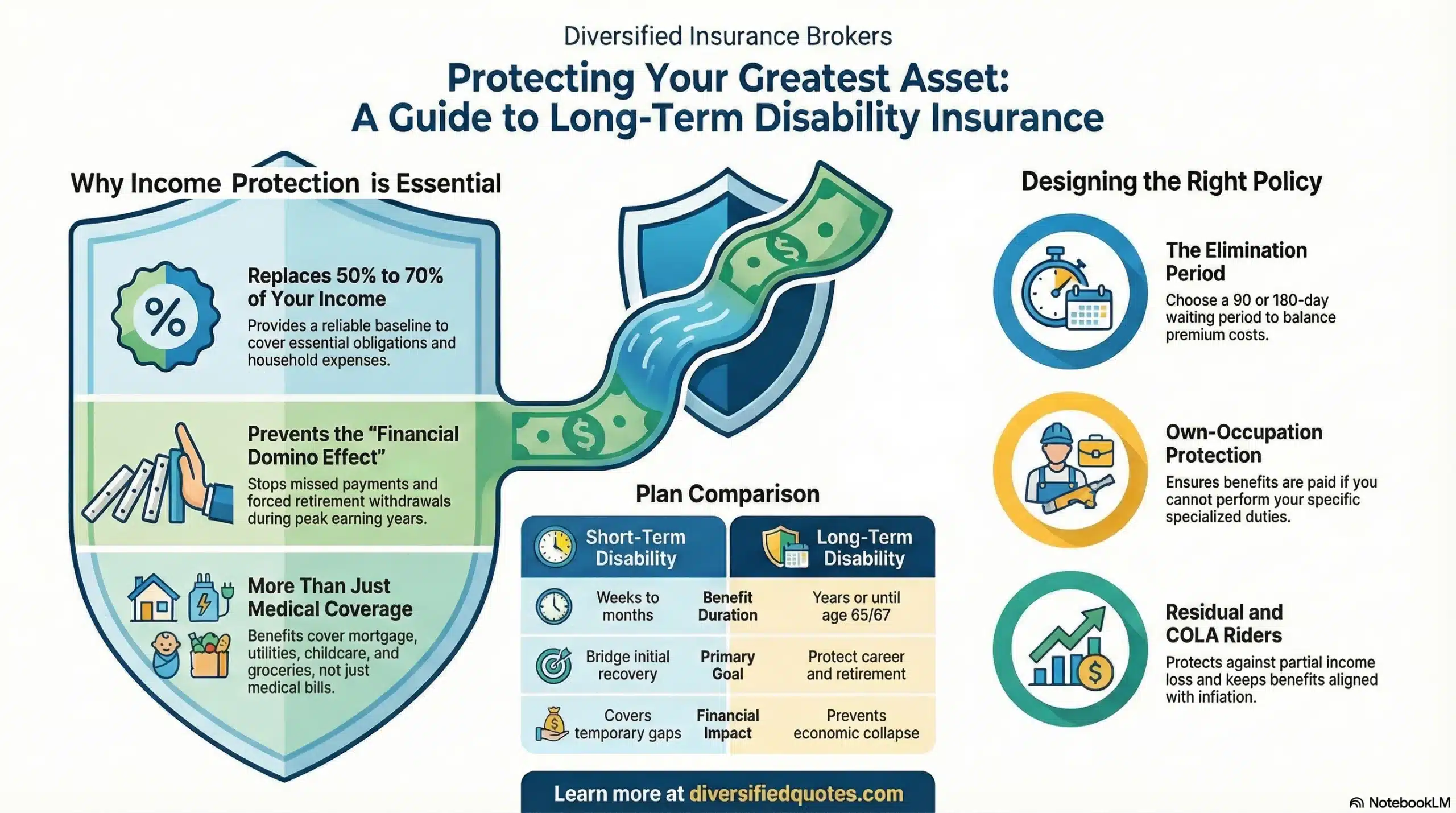
The own-occupation definition of disability is the most important policy feature for longshoremen — and for a profession defined by specific physical demands that sedentary work cannot replicate, the practical importance of this definition is acute. Under an own-occupation definition, a policy pays benefits when a condition prevents the longshoreman from performing the specific physical duties of their occupation — the sustained heavy cargo handling, equipment operation, vessel and crane platform work, and physical labor that port operations require — regardless of whether they could theoretically perform some other type of lighter or sedentary work. A longshoreman whose back surgery prevents return to the physical demands of the waterfront may technically be capable of administrative desk work, but an own-occupation policy recognizes the genuine inability to work as a longshoreman and pays benefits accordingly. Without an own-occupation definition, a policy would deny benefits to a disabled longshoreman who retains any capacity for unrelated sedentary activity — eliminating practical protection for exactly the scenarios most likely to occur. Our resource on own-occupation disability insurance explained covers how this definition operates in real claim scenarios across physical trade occupations.
A residual disability rider is equally important for longshoremen whose recovery may involve a gradual return to full work capacity. A longshoreman recovering from a back or knee injury may be able to return to lighter port duties — dock clerk work, supervision, or limited equipment operation — while still unable to perform the full physical labor demands of regular longshore assignments, earning reduced income without being completely unable to work. A total-disability-only policy provides no benefits during this partial recovery phase. A residual disability rider pays proportional benefits based on the percentage reduction in earnings, supporting continuous income from disability onset through full return to normal work. Our resource on how residual disability benefits work covers the proportional benefit mechanics. For longshoremen facing potential long-term or permanent disability, our resource on disability income insurance with a COLA rider explains how inflation protection maintains the purchasing power of the monthly benefit across years of claim payment.
Income Documentation and Coverage Structuring for Longshoremen
Longshoremen’s total annual compensation is often substantially higher than base wage rates suggest, because overtime pay and premium shift pay represent a significant and regular component of income for established port workers. Ensuring that the disability insurance benefit amount reflects actual total compensation — not just base hourly wages — is an important structuring step. Carriers base benefit amounts on documented income from tax returns and pay records, and working with a broker who understands how to present total compensation accurately for longshoremen whose income includes substantial overtime is important for securing a benefit amount that genuinely replaces the income a longshoreman actually earns.
For longshoremen who are Union members with existing group or union benefits, individual disability insurance is structured as a supplement that fills the income gap between LHWCA wage replacement and actual pre-disability income, provides coverage for non-work disabilities that the LHWCA does not touch, and delivers the portability that union membership-contingent benefits cannot provide across all circumstances. Our resource on how much disability insurance you need provides a practical framework for sizing the supplement correctly given existing LHWCA and union benefit coverage. For longshoremen who want to understand how short-term and long-term disability coverage interact in planning for different disability durations, our resource on short-term vs. long-term disability insurance covers how each addresses different phases of a disability event.
Why Independent Broker Access Matters for Maritime Workers
Not every disability insurance carrier writes longshore occupational classifications, and among those that do, coverage terms vary significantly based on the specific role description and the carrier’s approach to maritime cargo work. Some carriers apply conservative restrictions to longshore classifications — exclusion riders targeting back, knee, or hearing conditions that eliminate practical protection for exactly the disability scenarios most probable for a waterfront worker. Others write longshore professionals more comprehensively when the health profile and duty description support a clean underwriting outcome. Identifying the carriers whose underwriting guidelines produce the most favorable available terms for a specific longshoreman’s role and health history requires independent access to the full carrier marketplace.
At Diversified Insurance Brokers, we evaluate options across multiple carriers for every longshoreman and maritime cargo worker we serve. We understand how to present longshore role distinctions accurately to underwriters, how to document overtime-inclusive compensation for benefit amount calculations, and how to structure own-occupation definitions, residual disability riders, and elimination periods that coordinate effectively with LHWCA coverage to produce genuinely comprehensive income protection. Our resource on why independent disability insurance brokers matter explains the full value of this approach for physical trade workers in high-hazard occupations where carrier selection materially affects coverage quality.
Apply Early — Before the Waterfront Accumulates in the Medical Record
The best time for a longshoreman to apply for individual disability insurance is as early as possible in their career — before the back conditions, knee deterioration, shoulder problems, and hearing loss that a career at the waterfront produces have been documented in the medical record. Disability insurance premiums are based in part on age and health at the time of application, and younger applicants in good health secure the most comprehensive coverage at the most favorable rates. An exclusion rider eliminating back coverage — applied because a lumbar condition is already documented at application — is devastating for a longshoreman whose most probable disability scenarios involve exactly that part of the body.
Applying at the beginning of a longshore career — before the physical demands of cargo work have produced documented conditions — secures comprehensive coverage that remains in force and protects against those exact conditions as they develop in subsequent working years. For longshoremen who have already developed some documented occupational conditions, our resource on disability insurance with preexisting conditions covers what coverage options remain available. Our resource on does disability insurance require a medical exam covers the underwriting process so longshoremen know what to expect when applying.
Request Disability Insurance Quotes for Longshoremen
We compare carriers, explain how longshore work is classified, and structure policies that fill the gaps the LHWCA and union benefits leave open.
Get Disability Insurance QuotesRelated Disability Insurance Pages
Financial Protection Essentials
Talk With an Advisor Today
Choose how you’d like to connect—call or message us, then book a time that works for you.
Schedule here:
calendly.com/jason-dibcompanies/diversified-quotes
Licensed in all 50 states • Fiduciary, family-owned since 1980
Disability Insurance for Longshoremen — FAQs
The Longshore and Harbor Workers’ Compensation Act covers medical benefits and provides wage replacement for work-related injuries — but it has three significant gaps that individual disability insurance fills. First, the LHWCA covers only injuries directly attributable to documented work events. It does not cover the back condition that develops gradually from years of cumulative heavy cargo work, because gradual-onset conditions are difficult to attribute to a single documented incident. It does not cover any disability unrelated to the waterfront — a cardiovascular event, a cancer diagnosis, an off-the-job automobile accident, or any medical condition unrelated to a specific work event. Second, the LHWCA’s wage replacement formula — generally two-thirds of average weekly wages — may not fully replace the overtime-inclusive total compensation that an established longshoreman earns, leaving a real income gap even when LHWCA benefits are paid. Third, the LHWCA does not provide portable protection that continues if union membership lapses or employment status changes. Individual disability insurance addresses all three gaps: it covers any qualifying disability regardless of origin, can supplement LHWCA wage replacement to closer to actual income levels, and is portable regardless of employment or union status.
OSHA’s dedicated longshoring Fatal Facts program identifies the most severe injury scenarios: workers struck by loads falling from cranes, falls from vessel decks and crane platforms, transportation incidents involving port equipment, and accidents involving unstable cargo that topples or falls. These catastrophic events — which OSHA specifically targets with the 29 CFR Part 1918 longshoring standard — produce the fractures, spinal injuries, crush injuries, and traumatic brain injuries that can require months of hospitalization and result in permanent functional limitations that prevent return to longshore work. Below the catastrophic level, back injuries from sustained heavy cargo handling are the most prevalent disabling condition for longshoremen across a career, followed by knee injuries from physical port work, shoulder injuries from cargo operations and equipment use, and progressive occupational hearing loss from sustained exposure to port machinery noise. The combination of acute catastrophic injury risk and cumulative disability risk from career-long physical demands makes the longshore disability profile one of the most serious of any blue-collar occupation.
Union membership through the ILA or ILWU provides significant health, dental, vision, and pension benefits — among the best available to blue-collar workers. However, individual disability income replacement is not a standard feature of most longshoremen’s union benefit packages in the way that health insurance is. The union pension provides retirement income but is not a disability income replacement mechanism for workers years away from retirement age. The LHWCA provides wage replacement for work-related injuries but with the limitations described above. For many longshoremen, the practical reality is that union membership provides excellent health coverage and strong medical treatment access during a disability, but the income replacement gap — particularly for non-work disabilities, for gradual-onset cumulative conditions, and for the difference between LHWCA wage replacement and actual overtime-inclusive compensation — is left to individual planning. Confirming what specific disability income replacement, if any, your union benefit package includes is the starting point for determining how large an individual supplement you need.
This is one of the most important income documentation questions for longshoremen whose total annual compensation significantly exceeds their base wage rate due to overtime. Disability insurance carriers base benefit amounts on documented earned income from tax returns and pay records — and total W-2 compensation including overtime is includable in the income documentation that establishes the benefit amount. For a longshoreman who earns $80,000 in base wages but $110,000 or more total with regular overtime, sizing the disability benefit to base wages alone would leave a substantial income gap. Working with a broker who understands how to present total compensation accurately — and which carriers are most favorable in how they calculate benefit amounts for overtime-dependent earners — is an important step in securing a benefit amount that reflects actual financial need. The LHWCA wage replacement formula is based on average weekly wages including overtime, but its two-thirds replacement ratio still leaves a gap from actual total compensation that individual coverage can address.
The distinction matters primarily for income documentation and for what union or employer benefits exist alongside the individual policy. Registered full-time longshoremen have more consistent income documentation — regular W-2 compensation with established overtime patterns — and may have better access to whatever union benefit package applies to their registration status. Casual longshoremen whose income varies significantly based on dispatch assignment availability have more variable income documentation, which typically requires presenting two to three years of tax documentation to establish an average income basis for benefit calculations. Both casual and registered longshoremen share the same physical occupational hazard profile and the same need for individual disability coverage that extends beyond the LHWCA to cover non-work disabilities and cumulative conditions. For casual workers who may have less union benefit access and more variable income, individual disability insurance plays an even more foundational income protection role.
An own-occupation disability policy pays benefits when a condition prevents the insured from performing the specific duties of their own profession — regardless of whether they could theoretically perform different work. For a longshoreman, this means benefits are paid when conditions prevent the sustained heavy cargo handling, equipment operation, vessel and crane platform work, and physical port labor that longshore assignments require — even if the longshoreman could hypothetically perform sedentary desk or administrative work completely unrelated to their career. Without an own-occupation definition, a policy would only pay benefits if the insured could not perform virtually any gainful employment — which would deny benefits to a longshoreman whose back injury or knee condition prevents waterfront work while leaving some capacity for desk activity. For a worker whose career income is built entirely on specific physical capabilities that sedentary work cannot replace, the own-occupation definition is the difference between coverage that actually pays when needed and coverage that fails at exactly that moment.
Yes — individual disability insurance is available for longshoremen, though not every carrier writes maritime cargo work occupational classifications and coverage terms vary across those that do. The documented severity of the longshore injury profile places the occupation in lower occupational class tiers, which affects the premium cost and the specific policy features available. Some carriers apply exclusion riders to longshore classifications that eliminate coverage for the back, knee, or hearing conditions most likely to disable a waterfront worker — which substantially undermines the practical protective value of those policies. Other carriers write longshore occupational classifications more comprehensively when the health profile and specific role description support favorable underwriting. Identifying the carriers whose terms are most comprehensive for a specific longshoreman’s role and health history — and avoiding the carriers whose exclusion riders gut the policy’s real value — is the core reason working with an independent broker who has experience placing maritime worker occupational classifications produces better outcomes than applying to a single carrier directly.
The right elimination period depends on how long a longshoreman can realistically sustain household expenses from savings and available institutional income replacement — including whatever LHWCA wage replacement applies to a work-related injury. For a work-related injury covered under the LHWCA, wage replacement typically begins after a brief waiting period, providing some income bridge during the elimination period on an individual policy. A longshoreman with LHWCA wage replacement covering two-thirds of average wages, and some savings, may be able to accept a 60- or 90-day elimination period on an individual supplement without meaningful financial hardship during that window. For non-work disabilities not covered by the LHWCA — where no institutional income replacement exists at all — a 30- or 60-day elimination period may be more appropriate to avoid a financial gap between disability onset and benefit arrival. The right choice is also affected by how much overtime-dependent income the household budget depends on, since the LHWCA replacement formula and savings may cover less of actual financial need than they appear to at first calculation.
Yes — individual long-term disability insurance policies are specifically designed to pay benefits across extended and permanent disability periods. A longshoreman who sustains a spinal injury from a fall on a vessel, a crush injury from a crane-load accident, or a progressive condition that permanently prevents return to the physical demands of port work would receive monthly benefits for the full benefit period specified in the policy — which can be set to age 65 or to a shorter fixed benefit period depending on how the policy is structured. For permanent or long-term disability scenarios, the benefit period selection at the time of purchase directly determines how long income replacement continues. A policy with a five-year benefit period provides five years of monthly income; a policy with a benefit period to age 65 provides income through retirement age regardless of how long the disability lasts. For longshoremen whose career income significantly exceeds what a disability pension or LHWCA permanent partial disability award would replace, the benefit period selection is one of the most consequential choices in structuring comprehensive long-term protection.
The best time is as early as possible in a longshore career — ideally when first registered with a union and beginning regular waterfront work, before any occupational health conditions have appeared in the medical record. Premiums are lower for younger, healthier applicants, and the coverage terms available before occupational conditions develop are more comprehensive than what is available after back problems, knee deterioration, or hearing loss have been documented. The physical demands of longshore work accumulate in the medical record progressively across a career — back conditions, knee issues, and shoulder problems develop over years of heavy cargo work and appear as documented conditions that underwriters evaluate at any future application point. An exclusion rider removing back coverage from a longshoreman’s disability policy eliminates protection for the most probable disability scenario that waterfront work produces. Applying before those conditions are documented secures comprehensive coverage that continues protecting against them as they develop in subsequent working years. That timing advantage cannot be recaptured once conditions have appeared in the medical record.
About the Author:
Jason Stolz, CLTC, CRPC, DIA, CAA and Chief Underwriter at Diversified Insurance Brokers (NPN 20471358), is a senior insurance and retirement professional with more than 25 years of real-world experience helping individuals, families, and business owners protect their income, assets, and long-term financial stability. As a long-time partner of the nationally licensed independent agency Diversified Insurance Brokers, Jason provides trusted guidance across multiple specialties—including fixed and indexed annuities, long-term care planning, personal and business disability insurance, life insurance solutions, Group Health, Travel Medical and Evacuation Insurance, and short-term health coverage. Diversified Insurance Brokers maintains active contracts with over 100 highly rated insurance carriers, ensuring clients have access to a broad and competitive marketplace.
His practical, education-first approach has earned recognition in publications such as VoyageATL, and contributions from his agency featured in Kiplinger and GoBankingRates— highlighting his commitment to financial clarity and client-focused planning. Drawing on deep product knowledge and years of hands-on field experience, Jason helps clients evaluate carriers, compare strategies, and build retirement and protection plans that are both secure and cost-efficient. Visitors who want to explore current annuity rates and compare options across multiple insurers can also use this annuity quote and comparison tool.
Explore More Disability Insurance Options: Browse our complete guide to Disability Insurance for Transportation, Maritime & Hazardous Occupations — covering truck drivers, flight attendants, merchant marines, divers, chauffeurs & drivers from 100+ carriers.
Last Reviewed: June 8, 2026 |
Reviewed by: Jason Stolz, CLTC, CRPC, DIA, CAA
Chief Underwriter, Diversified Insurance Brokers, Inc. | NPN: 20471358 | Diversified Insurance Brokers, Inc. — Licensed in all 50 states
Fact Checked by: Tonia Pettitt, CMIP©
Medicare Specialist, Diversified Insurance Brokers, Inc. | NPN: 14374308 | Diversified Insurance Brokers, Inc. — Licensed in all 50 states
Did you find this content helpful? Leave us a Google review — it helps others find trustworthy guidance too.
Editorial Standards: Diversified Insurance Brokers maintains rigorous editorial standards to ensure accuracy, clarity, and independence in all content. Learn more about our editorial standards and commitment to transparency.
