
Disability Insurance for Cruise Ship Workers
As an Independent Disability Insurance Broker, we have access to exclusive discounts and negotiated pricing most captive agents can’t offer — see the full breakdown near the end of this page.
Disability Insurance for Cruise Ship Workers

Jason Stolz CLTC, CRPC, DIA, CAA
Disability insurance for cruise ship workers is an essential and frequently misunderstood form of income protection for one of the most internationally diverse, physically demanding, and legally complex employment populations in any industry. Whether you work as a navigation officer, an engine room engineer, a deck hand, a hospitality crew member, a chef or galley worker, an entertainment performer, a casino dealer, a spa technician, a medical officer, or in any of the dozens of other roles that keep a modern cruise ship operational — your income depends on your physical and cognitive capacity to perform your specific shipboard duties, and the legal framework that governs your employment in the event of disability is fundamentally different from the protections that land-based American workers rely on.
Cruise ship workers operate under maritime law rather than conventional employment law — a legal distinction that produces significant and often surprising gaps in the income protection that most crew members assume they have. The Jones Act, maintenance and cure provisions, and cruise line contractual disability payments all provide some baseline protection for work-related injury events — but each carries limitations that leave cruise ship workers far more financially vulnerable to disability than they typically realize. Understanding what maritime law actually provides, where its gaps are, and why individual disability insurance fills those gaps is essential financial planning for anyone building a career on the water.
At Diversified Insurance Brokers, we work with cruise ship crew members, maritime hospitality workers, and international seafarers to structure disability insurance coverage that addresses the real income protection gaps that maritime law leaves open — providing income replacement that cruise line contracts, maintenance and cure payments, and Jones Act remedies consistently fail to deliver for the full range of disability scenarios that cruise ship workers actually face.
Protect Your Income as a Cruise Ship Worker
Compare disability insurance options designed for cruise ship crew, maritime hospitality workers, entertainment staff, and all shipboard professionals.
Who Cruise Ship Workers Are and Why Their Disability Protection Needs Are Unique
Disability insurance for cruise ship workers must begin with a clear understanding of the extraordinary diversity of the cruise ship workforce and the specific legal framework that governs each worker’s rights in the event of disability. A modern large cruise ship employs between 1,000 and 2,500 crew members across a vast range of roles — from licensed deck officers and engine room engineers who qualify as seamen under maritime law to hospitality workers, entertainers, casino staff, spa technicians, and retail workers whose maritime law status may be different depending on the nature of their duties and their employment relationship with the cruise line.
Navigation crew — officers, deck hands, engine room personnel, and crew members whose duties are integral to vessel operation — typically qualify as seamen under the Jones Act, entitling them to maintenance and cure benefits and potential Jones Act negligence claims in the event of work-related injury. Hospitality, entertainment, casino, medical, and retail crew members occupy a more complex legal position — some qualify for Jones Act seaman status, others may fall under the Longshore and Harbor Workers’ Compensation Act (LHWCA), and still others may find themselves in a legal gray zone where their rights depend on the specific facts of their injury and employment relationship. This legal complexity is one reason why individual disability insurance is so important for cruise ship workers — it provides income replacement regardless of which legal framework applies and regardless of whether the cruise line’s legal obligations are ultimately enforced.
The international character of the cruise ship workforce adds another dimension to the disability planning challenge. Cruise ships frequently operate under flags of convenience — registered in countries like the Bahamas, Panama, or the Marshall Islands — which affects which legal protections apply and creates complexity around how disability claims are handled. Many cruise ship workers are citizens of countries in Southeast Asia, Eastern Europe, Central America, and the Caribbean who work for cruise lines headquartered in the United States or Europe, creating a multi-jurisdictional employment relationship whose disability protections may be governed by the employment contract as much as by any national law. Individual disability insurance owned by the crew member personally provides income protection that exists independently of these legal complexities — paying when a qualifying disability occurs regardless of what the cruise line’s legal obligations may or may not be. The multi-jurisdictional income protection challenge facing cruise ship workers has parallels in other internationally mobile professions, including professional divers and diving professionals managing disability risk across international maritime work environments.
What Maritime Law Actually Provides — And Where the Critical Gaps Are
Understanding what maritime law provides — and equally important, what it does not provide — is the essential foundation for appreciating why disability insurance for cruise ship workers is genuinely necessary rather than merely optional.
The Jones Act’s maintenance and cure provisions are the primary maritime law income protection mechanism for qualifying seamen. Maintenance payments cover the daily cost of food and shelter while the seaman is not aboard the vessel — historically documented at between $15 and $30 per day, a figure that has not kept pace with actual living costs in most American cities. Cure payments cover reasonable medical expenses related to the injury until the seaman reaches maximum medical improvement — the point at which a medical provider determines the condition can no longer improve. Maintenance and cure does not require proving fault or negligence — it applies simply based on the fact that injury occurred while the seaman was performing their duties.
The critical limitations of maintenance and cure are significant. Maintenance payments of $15 to $30 per day — approximately $450 to $900 per month — provide nowhere near the income replacement that most cruise ship workers need to sustain their household financial obligations during a disability recovery. Cure payments end at maximum medical improvement, which may occur long before the worker has regained the physical capacity needed to return to cruise ship duties. And maintenance and cure applies only to on-duty injuries — crew members who become disabled from natural illness, off-duty accidents, or conditions that develop gradually over time outside of a specific work-related injury event receive no maintenance and cure benefits at all.
Cruise line contractual disability payments — the lump-sum amounts that cruise employment agreements provide for permanent disability — are similarly limited. These payments are typically based on a percentage of the degree of permanent disability, are explicitly excluded for natural causes and off-duty incidents, and provide a one-time sum rather than ongoing income replacement. A cruise line lump-sum payment for a partial permanent disability may amount to months or at most a year or two of wage replacement — not the sustained income protection that a career-ending or career-limiting disability actually requires. This same inadequacy of employer-provided and legal framework protections is documented across other maritime occupational contexts, including the income gaps facing dock workers and maritime port workers whose employer coverage consistently falls short of genuine income protection.
The Real Occupational Hazards Facing Cruise Ship Workers
Cruise ships are complex industrial environments operating across thousands of square miles of open ocean — and the occupational hazards facing cruise ship workers are far more serious than the resort atmosphere presented to passengers suggests. The combination of heavy equipment operation, slip and fall risk from moving vessel decks, chemical and cleaning agent exposure in galleys and housekeeping operations, sustained physical demands across long contract periods with limited rest, infectious disease risk in densely populated shipboard environments, and the physical toll of sustained performance and service work across months-long contracts creates a meaningful occupational disability risk profile for workers across all shipboard departments.
Slip and fall injuries are the most prevalent acute injury category for cruise ship workers. Wet deck surfaces, unexpected vessel movement in seas, narrow passageways between equipment, galley and kitchen floor surfaces, and stairway falls in confined shipboard spaces all produce serious fall injuries that can require extended medical treatment and recovery — onboard and ashore. Back injuries from heavy equipment and supply handling are similarly prevalent, affecting galley workers, housekeeping crew, and cargo and deck workers who perform heavy physical tasks repeatedly across long contract periods. For workers in galley and food service roles, burn injuries from cooking equipment and scalds from steam and hot liquids are documented occupational hazards that can produce significant hand and arm injuries affecting the ability to return to food service work. The physical injury risk profile of shipboard food service and hospitality workers parallels that documented in shore-based food service, including the acute injury environment facing restaurant workers and servers managing physical injury risk in demanding service environments.
Entertainment staff — dancers, musicians, activity coordinators, and performers who work on cruise ship entertainment teams — face the occupational injury profile of their specific performance discipline applied across months of sustained shipboard performance without the recovery periods that shore-based performers typically have between engagements. A cruise ship dancer who performs multiple shows per week across a six to nine-month contract accumulates the same repetitive motion and acute injury risk that would apply to an equivalent period of intensive performance on shore — but without the seasonal breaks, training periods, or physical recovery time that professional performance careers typically incorporate. The sustained performance injury risk that cruise ship entertainers face is directly parallel to the occupational disability risks documented for other sustained performance professionals, including dancers and dance instructors managing sustained performance injury risk across professional careers.
Mental health and psychological conditions represent a meaningful disability risk for cruise ship workers who spend months at a time separated from family and support networks, living in confined shipboard quarters, working demanding schedules with limited personal time, and managing the psychological pressure of sustained performance of service or entertainment roles while isolated from normal social support. Anxiety, depression, and burnout conditions that develop during or as a result of shipboard employment can prevent continued cruise ship service — and they are explicitly excluded from most cruise line contractual disability provisions, which require injury rather than illness as the qualifying disability trigger. Individual disability insurance that covers mental health conditions regardless of their connection to a specific work event fills this critical gap for cruise ship workers whose psychological health is affected by the cumulative demands of shipboard employment. The mental health disability risk in sustained high-demand service roles is well-documented across other service-intensive professions, including dispatchers and sustained high-demand service professionals managing mental health occupational disability risk.
Why Individual Disability Insurance Fills the Gaps Maritime Law Leaves Open
Individual disability insurance for cruise ship workers provides income protection across all of the scenarios that maritime law, cruise line contracts, and maintenance and cure consistently fail to cover adequately. Unlike maritime remedies that apply only to qualifying work-related injury events, individual disability insurance covers disability from any cause — work-related or not, on-duty or off-duty, physical or psychological, acute or gradually developing — when the condition prevents the cruise ship worker from performing their occupational duties.
A cruise ship worker who develops a serious illness during a contract break at home receives no maintenance and cure benefits because the illness did not occur on the vessel. A crew member who sustains a serious off-duty injury during shore leave receives no Jones Act protection because the injury did not occur in the course of their duties. A performer who develops progressive joint or musculoskeletal conditions from the cumulative physical demands of sustained shipboard performance may find that no single event qualifies as a triggering injury under their employment contract. In all of these scenarios, individual disability insurance provides the income replacement that maritime law cannot.
For cruise ship workers who are self-employed entertainers, contractors, or independent service professionals rather than direct cruise line employees, the maritime law protections are even more limited — and individual disability insurance is the only meaningful income protection available. The self-employment income protection challenge facing independent cruise ship contractors is directly parallel to that confronting other self-employed maritime and hospitality professionals, and our resource on disability insurance for independent contractors and self-employed professionals provides essential context for cruise ship workers in this employment category.
Case Study: Cruise Ship Galley Worker Earning $42,000 Per Year
Consider a cruise ship galley worker employed under a nine-month contract earning $42,000 annually. During the third month of a contract, this worker sustains a serious back injury from a heavy equipment handling incident in the ship’s galley. After evacuation to a port-of-call medical facility and surgery, a six-month recovery is required during which the physical demands of galley work — heavy lifting, sustained standing, bending and reaching — are medically prohibited.
| Scenario | Maritime Law Only | With Individual Disability Insurance |
|---|---|---|
| Monthly Income During Recovery | $450–$900 maintenance payment | $1,750–$2,100 individual benefit + maintenance |
| 6-Month Total Income | $2,700–$5,400 total maintenance | $13,200–$18,000 combined |
| Medical Coverage | Cure covers treatment to maximum medical improvement | Individual income covers living expenses medical doesn’t address |
| Financial Outcome | $15–$30/day inadequate for household obligations in home country | Financial stability maintained throughout recovery period |
The maintenance payment gap is not a technicality — it is a documented and recurring financial hardship for cruise ship workers whose household obligations in their home countries far exceed the $15 to $30 per day that maritime law provides. Individual disability insurance supplements this inadequate baseline with genuine income replacement that reflects the worker’s actual earning capacity and financial need.
Disability Insurance for Cruise Ship Entertainment and Hospitality Staff
The entertainment and hospitality workforce aboard modern cruise ships includes disc jockeys, musicians, activity coordinators, comedians, magicians, spa technicians, fitness instructors, cosmetologists, beauticians, and a wide range of other performance and personal service professionals whose shipboard employment contracts may not qualify them for full Jones Act seaman status. For these workers — whose income depends on their specialized performance or service skills rather than navigation duties — individual disability insurance provides the income protection that their employment contracts and maritime law may not.
A cruise ship disc jockey whose hearing damage from sustained high-volume performance environments makes continued shipboard DJ work medically inadvisable has a genuine occupational disability that neither the cruise line’s lump-sum payment schedule nor maintenance and cure adequately addresses — because the condition developed gradually from cumulative acoustic exposure rather than from a single identifiable work event. Our page on disability insurance for disc jockeys and audio professionals covers the specific occupational hearing risk that applies to shipboard DJ professionals.
Cruise ship cosmetologists, beauticians, and spa technicians working in shipboard salon and wellness facilities face chemical exposure risks from the sustained use of hair treatment chemicals, nail products, and spa chemical compounds in enclosed shipboard spaces with variable ventilation. These workers share the chemical exposure disability risk documented among their shore-based counterparts — and their maritime employment status may provide less protection for gradually developing occupational illness than for acute injury events. Our resource on disability insurance for cosmetologists and salon professionals provides direct context on the chemical exposure disability risks that apply to shipboard beauty and wellness professionals.
Key Policy Features for Cruise Ship Worker Disability Insurance
Disability insurance for cruise ship workers should be structured with specific attention to the features that matter most for maritime employment and international seafaring careers. The own-occupation definition is foundational — paying benefits when a condition prevents the cruise ship worker from performing the specific duties of their shipboard role regardless of whether they could theoretically perform other land-based work. A galley worker whose back injury prevents heavy equipment handling may technically be able to perform a sedentary desk job ashore — an own-occupation policy recognizes the genuine inability to perform shipboard galley duties and pays accordingly. Our comprehensive resource on own-occupation disability insurance explained covers this critical definition in full detail for all shipboard occupational roles.
A residual disability rider is particularly important for cruise ship workers whose conditions may reduce rather than eliminate their ability to work at sea. A performer who can work limited shipboard schedules but cannot sustain the full performance demands of a cruise ship entertainment contract earns reduced income without being totally disabled. Our resource on how residual disability insurance benefits work covers how this partial benefit protection functions for workers with conditions that limit rather than eliminate occupational capacity.
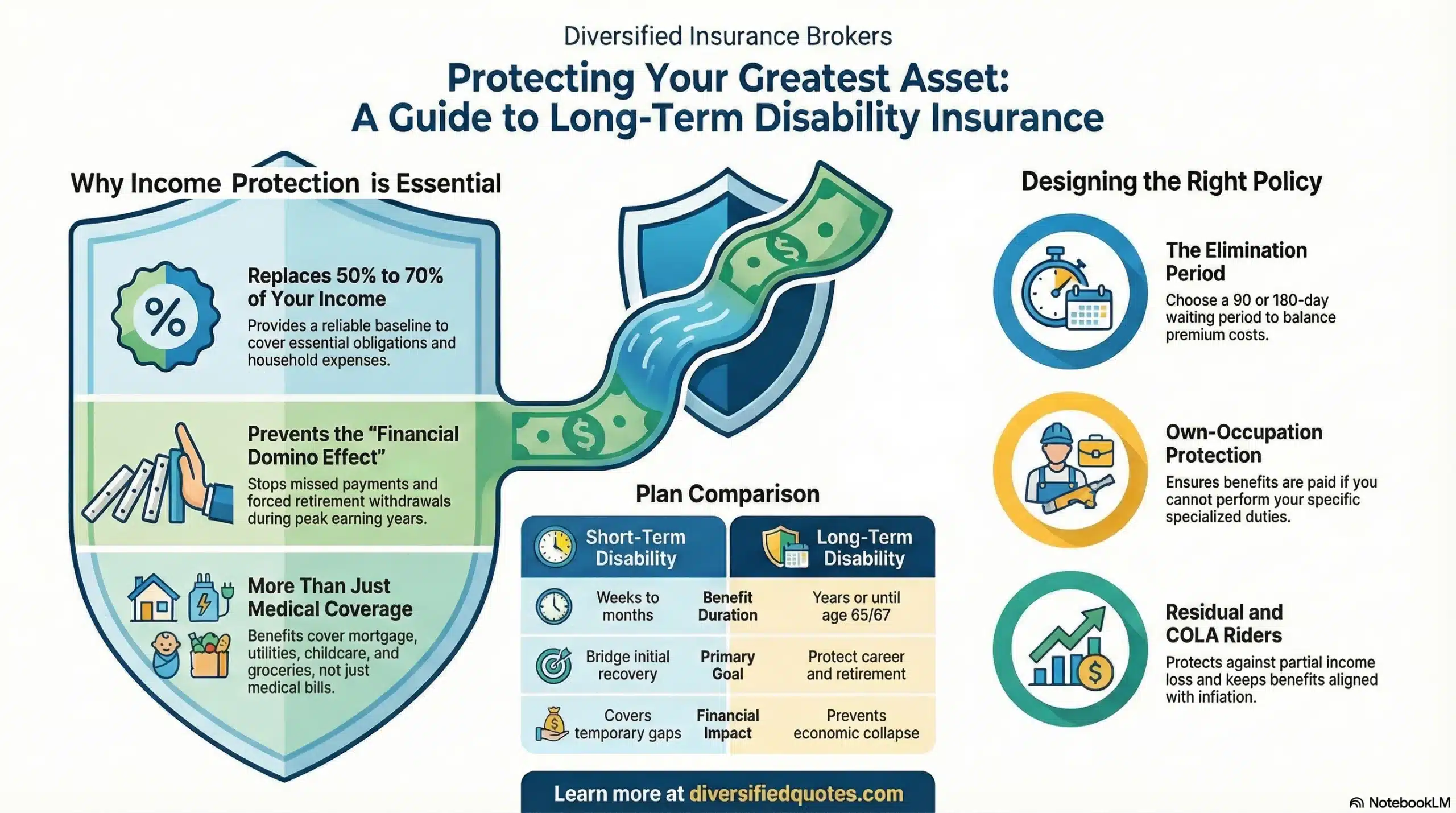
The elimination period — the waiting time before benefits begin — requires careful calibration for cruise ship workers whose between-contract periods create natural income gaps that affect how quickly disability benefit onset becomes financially critical. Our full guide on how disability insurance elimination periods work provides the framework for matching this decision to each cruise ship worker’s individual financial situation and contract structure. A cost-of-living adjustment rider preserves the real value of disability benefits across extended recovery periods — our resource on disability income insurance with a COLA rider explains how inflation protection works for extended claims. For workers exploring how short-term coverage bridges the initial income gap, our guide on how to buy short-term disability insurance provides useful context on the complete income protection picture.
Income Documentation for International Cruise Ship Workers
Income documentation for disability insurance underwriting presents a specific challenge for cruise ship workers whose compensation structures often include base wages, gratuity income, performance bonuses, and various allowances paid across international employment contracts. For US-citizen cruise ship workers whose foreign-earned income may receive special tax treatment, presenting income documentation that accurately reflects earning capacity and financial need requires broker experience with maritime and international employment income structures.
Non-US citizen cruise ship workers who live and work internationally face even greater income documentation complexity — their employment contracts may be denominated in foreign currency, their tax documentation may be from their home country rather than the United States, and the definition of insurable income may require specific carrier guidance to apply correctly. Despite these documentation challenges, individual disability insurance is obtainable for cruise ship workers who work with an experienced independent broker who understands how to navigate international employment income documentation. The income documentation challenge is a consistent feature of internationally mobile employment, shared with other professionals whose careers involve sustained work outside standard domestic employment structures, including workers managing complex employment and income structures without standard domestic protections.
Why Cruise Ship Workers Need an Independent Disability Insurance Broker
Disability insurance for cruise ship workers is a specialty placement that requires broker expertise in maritime employment structures, international income documentation, and the specific occupational classification nuances that apply to diverse shipboard roles. Standard retail disability insurance applications are not optimized for the maritime employment context, and a general insurance agent unfamiliar with Jones Act coverage gaps, maintenance and cure limitations, and the specific income structures of international maritime employment will not produce the most comprehensive available coverage for a cruise ship worker’s individual situation.
At Diversified Insurance Brokers, we understand the legal framework that governs maritime employment, the income protection gaps that maritime law leaves open, and the specific disability scenarios most likely to affect cruise ship workers across all shipboard departments. We evaluate options across multiple carriers for every cruise ship worker we serve and structure coverage that genuinely addresses the full scope of income protection need that maritime employment creates. Our dedicated resource on why independent disability insurance brokers matter explains the full value of this approach for workers whose employment context requires specialized expertise. And our broader resource on whether disability insurance is worth the investment provides the foundational financial case for coverage that applies with particular force to workers whose maritime law protections are as limited as those facing cruise ship crews.
Final Thoughts on Disability Insurance for Cruise Ship Workers
Cruise ship workers build careers at sea that require physical resilience, professional skill, and the willingness to spend months away from home in an international working environment that is demanding in ways that shoreside employment rarely matches. The legal framework that governs their income protection in the event of disability — maritime law, maintenance and cure, Jones Act remedies, and cruise line contractual provisions — provides a starting point that falls materially short of genuine income replacement in most disability scenarios.
Disability insurance for cruise ship workers fills the gaps that maritime law leaves open — providing income replacement when maintenance payments are inadequate, when off-duty conditions exclude maritime remedies, when gradually developing conditions do not qualify as triggering injury events, and when the psychological and cumulative physical consequences of sustained shipboard employment produce disability that cruise line contracts do not recognize. A well-structured individual disability policy provides the financial stability that allows a cruise ship worker to recover from any disabling event and return to the sea — or to transition ashore — from a position of financial strength rather than crisis.
Related Pages
Talk With an Advisor Today
Choose how you’d like to connect—call or message us, then book a time that works for you.
Schedule here:
calendly.com/jason-dibcompanies/diversified-quotes
Licensed in all 50 states • Fiduciary, family-owned since 1980
Disability Insurance for Cruise Ship Workers FAQs
Yes, cruise ship workers can obtain individual disability insurance, though the underwriting process requires specific attention to maritime employment income structures and international employment documentation. The occupational classification depends on the specific shipboard role — navigation crew and engine room personnel performing physically demanding duties may receive different classifications than entertainment, medical, or administrative crew whose work is more sedentary and office-based. Income documentation for international maritime employment — including base wages, gratuity income, contract allowances, and bonuses — requires a broker experienced with maritime and international employment income structures to present effectively to underwriters. Working with an independent broker who understands maritime employment is essential for cruise ship workers seeking disability insurance that accurately reflects their earning capacity and occupational risk profile.
Maintenance and cure is the primary maritime law income protection for qualifying seamen injured in the course of their duties. Maintenance covers the daily cost of food and shelter while the seaman cannot work aboard the vessel — historically paid at between $15 and $30 per day, or approximately $450 to $900 per month. Cure covers reasonable medical expenses related to the injury until maximum medical improvement is reached. Maintenance and cure applies regardless of fault and does not require proving employer negligence. However, the limitations are significant: $15 to $30 per day provides nowhere near adequate income replacement for most households, cure ends when medical improvement plateaus rather than when the worker has regained working capacity, and neither maintenance nor cure applies to off-duty injuries, natural illness, or conditions that develop gradually outside of a specific qualifying work-related injury event. Individual disability insurance supplements this inadequate baseline with genuine income replacement that reflects actual earning capacity.
No — and the limitations of Jones Act protection are more significant than most cruise ship workers realize. To qualify for Jones Act seaman status and the maintenance and cure rights it provides, a worker must be substantially connected to a vessel in navigation as a member of the vessel’s crew. Navigation crew, deck hands, and engine room personnel typically qualify. However, entertainment staff, casino dealers, spa technicians, retail workers, medical officers employed by third-party medical providers, and other hospitality and service crew may or may not qualify for seaman status depending on the specific facts of their employment relationship and duties. Those who do not qualify as seamen may fall under the Longshore and Harbor Workers’ Compensation Act instead, which has its own eligibility requirements and limitations. Individual disability insurance provides income protection that exists entirely independently of these legal framework questions — paying when a qualifying disability occurs regardless of which maritime law category applies to the worker’s specific employment situation. For a parallel on how complex legal frameworks leave income gaps for maritime workers, see our page on disability insurance for professionals navigating complex employment protection frameworks.
Several significant disability scenarios fall outside the protection of cruise line contracts and maritime law remedies. Natural illness — health conditions that develop from the worker’s own medical history rather than from a specific work-related injury event — is explicitly excluded from most cruise line contractual disability payments and from maintenance and cure, which requires a connection to an on-duty injury. Off-duty injuries sustained during shore leave, between contracts, or in the worker’s home country receive no maritime law protection. Gradually developing occupational conditions — cumulative back problems from years of heavy galley work, hearing damage from sustained entertainment performance, repetitive strain injuries from sustained service work — may not qualify as a specific triggering injury event under either Jones Act remedies or cruise line disability payment schedules. Mental health conditions from the psychological demands of sustained shipboard employment are typically excluded from cruise line contractual provisions. Individual disability insurance covers all of these scenarios — any cause of disability that prevents the worker from performing their occupational duties, regardless of where it occurred or how it developed. For more on how individual disability insurance covers gradually developing conditions, see our resource on disability insurance for workers with complex occupational disability risk profiles.
Slip and fall injuries are the most prevalent acute injury category for cruise ship workers — wet deck surfaces, moving vessel motion in seas, galley and kitchen floor surfaces, and stairway falls in confined shipboard spaces all produce serious fall injuries requiring extended recovery. Back injuries from heavy equipment and supply handling affect galley workers, housekeeping crew, and cargo and deck workers performing physically intensive tasks across long contracts. Burns and scalds from cooking equipment and steam affect galley and food service staff. Entertainment performers accumulate repetitive motion and overuse injuries from sustained performance schedules without the recovery periods that shore-based performance careers typically provide. Chemical exposure conditions develop among cosmetology, salon, and spa staff working with hair treatment chemicals and beauty products in enclosed shipboard spaces. Mental health conditions including depression, anxiety, and burnout develop from the sustained isolation and performance demands of extended shipboard contracts. Each of these categories requires individual disability insurance coverage because maritime law remedies provide limited and inconsistent protection across all of them.
Own-occupation disability insurance pays benefits when a condition prevents a cruise ship worker from performing the specific duties of their shipboard role — regardless of whether they could theoretically perform other land-based work. A galley worker whose back injury prevents heavy equipment handling may technically be able to perform a sedentary office job ashore — an any-occupation policy would deny benefits while an own-occupation policy recognizes the genuine inability to perform shipboard galley duties. A performer whose joint condition prevents the sustained physical performance demands of a shipboard entertainment contract may retain ability to do non-performance work — own-occupation coverage pays for the inability to perform their specific shipboard role. For cruise ship workers whose specialized skills, international employment context, and specific shipboard duties define their professional value, own-occupation coverage is the only definition that provides genuinely meaningful income protection.
Cruise ship workers typically work on fixed-length contracts — commonly six to nine months — separated by periods between contracts that may range from weeks to months. During between-contract periods, the worker receives no maintenance and cure, no cruise line disability payments, and no Jones Act protection because they are not actively employed on a vessel. If a cruise ship worker becomes disabled during a between-contract period from any cause, they have no maritime law income protection whatsoever — and if they planned to begin a new contract, that income does not materialize. Individual disability insurance covers disability occurring during between-contract periods just as it covers disability during active contracts — providing income replacement regardless of whether the worker is currently under a shipboard employment agreement. For disability insurance purposes, the elimination period selection should account for the between-contract income gap that cruise ship workers naturally experience, ensuring that disability benefits activate at an appropriate point given the worker’s typical contract-to-contract financial cycle. For parallel context on elimination period planning for contract-based workers, see our resource on disability insurance elimination period planning for contract and project-based professionals.
Residual disability coverage pays proportional benefits when a disabling condition reduces a cruise ship worker’s capacity without completely eliminating the ability to work. A performer who can take a shore-side engagement at limited capacity, a cook who can perform light food preparation duties but cannot manage the full physical demands of a cruise ship galley, or a hospitality worker who can manage partial duties but not the sustained physical service demands of a full shipboard schedule — all earn reduced income without being totally disabled. Without a residual rider, a total-disability-only policy pays nothing during this partial capacity period. A residual rider supplements reduced earnings proportionally throughout the return-to-full-capacity arc. For cruise ship workers whose conditions may produce gradual improvement allowing partial return to shipboard or shore-based work before full recovery, this rider ensures the disability policy provides continuous financial support across the entire recovery period rather than only at the extremes of total incapacity or complete return to duty.
The availability of individual disability insurance for non-US citizens working on cruise ships depends on several factors including the worker’s country of citizenship, their country of residence during off-contract periods, the currency in which they wish to receive benefits, and the specific carrier’s international underwriting guidelines. Some US disability insurance carriers do write policies for international maritime workers who have a qualifying US connection — US-flagged vessels, US-based cruise line employers, or US residency during off-contract periods. Other carriers focus exclusively on US residents and citizens. Non-US citizen cruise ship workers may also find disability insurance options through carriers in their home countries or through international marine crew insurance programs that include disability income components. Working with an independent broker who has experience placing coverage for internationally mobile maritime workers is essential for identifying which options are genuinely available for each individual’s specific citizenship, residency, and employment situation. For a parallel on income documentation complexity for international workers, see our page on disability insurance for internationally mobile service professionals.
The best time is before beginning a cruise ship career or during the early years of shipboard employment — before occupational health conditions from physical demands, chemical exposure, or the cumulative effects of sustained shipboard contract work have accumulated in the medical record. Disability insurance premiums are based in part on age and health status at the time of application, and younger cruise ship workers in good health secure the most comprehensive coverage at the most favorable rates. Back conditions, joint problems, hearing changes, and other occupational health outcomes that accumulate over cruise ship careers can result in exclusion riders or restricted terms if present at application. Applying early ensures comprehensive coverage is in place before these predictable occupational health consequences develop. For cruise ship workers who are also exploring how disability insurance fits within a broader financial plan, our resource on whether disability insurance is worth the investment provides useful foundational context.
An independent broker brings maritime employment expertise, international income documentation experience, and carrier access across the full marketplace to the disability insurance planning process for cruise ship workers. Standard retail disability applications are not designed for the legal complexity of maritime employment — the Jones Act coverage gaps, maintenance and cure limitations, international employment income documentation requirements, and the diverse occupational classification nuances of different shipboard roles all require specialized broker knowledge to navigate effectively. A captive agent representing a single carrier can only present that company’s approach, which may not be designed for maritime employment contexts at all. At Diversified Insurance Brokers, we evaluate the full competitive landscape for each cruise ship worker we serve, structure coverage that genuinely addresses the income protection gaps that maritime law leaves open, and identify the carriers whose guidelines most favorably accommodate the specific employment and income characteristics of each individual cruise ship worker’s situation.
About the Author:
Jason Stolz, CLTC, CRPC, DIA, CAA and Chief Underwriter at Diversified Insurance Brokers (NPN 20471358), is a senior insurance and retirement professional with more than 25 years of real-world experience helping individuals, families, and business owners protect their income, assets, and long-term financial stability. As a long-time partner of the nationally licensed independent agency Diversified Insurance Brokers, Jason provides trusted guidance across multiple specialties—including fixed and indexed annuities, long-term care planning, personal and business disability insurance, life insurance solutions, Group Health, Travel Medical and Evacuation Insurance, and short-term health coverage. Diversified Insurance Brokers maintains active contracts with over 100 highly rated insurance carriers, ensuring clients have access to a broad and competitive marketplace.
His practical, education-first approach has earned recognition in publications such as VoyageATL, and contributions from his agency featured in Kiplinger and GoBankingRates— highlighting his commitment to financial clarity and client-focused planning. Drawing on deep product knowledge and years of hands-on field experience, Jason helps clients evaluate carriers, compare strategies, and build retirement and protection plans that are both secure and cost-efficient. Visitors who want to explore current annuity rates and compare options across multiple insurers can also use this annuity quote and comparison tool.
Explore More Disability Insurance Options: Browse our complete guide to Disability Insurance for Transportation, Maritime & Hazardous Occupations — covering truck drivers, flight attendants, merchant marines, divers, chauffeurs & drivers from 100+ carriers.
Last Reviewed: June 7, 2026 |
Reviewed by: Jason Stolz, CLTC, CRPC, DIA, CAA
Chief Underwriter, Diversified Insurance Brokers, Inc. | NPN: 20471358 | Diversified Insurance Brokers, Inc. — Licensed in all 50 states
Fact Checked by: Tonia Pettitt, CMIP©
Medicare Specialist, Diversified Insurance Brokers, Inc. | NPN: 14374308 | Diversified Insurance Brokers, Inc. — Licensed in all 50 states
Did you find this content helpful? Leave us a Google review — it helps others find trustworthy guidance too.
Editorial Standards: Diversified Insurance Brokers maintains rigorous editorial standards to ensure accuracy, clarity, and independence in all content. Learn more about our editorial standards and commitment to transparency.
