
What Are the Benefits of Annuities
As an Independent Annuity Broker, we compare rates across 100+ carriers and 1,000 different annuities— not just one company’s product offerings — to find the best fit for your goals.
What Are the Benefits of Annuities

Jason Stolz CLTC, CRPC, DIA, CAA
Annuities are financial tools designed to provide stability, income security, and protection against some of the most significant financial risks retirees face. While many traditional investment strategies focus primarily on maximizing growth, annuities are often used to solve a different challenge: creating dependable income that can last throughout retirement.
For decades, retirement planning was relatively straightforward for many workers. Pension plans provided guaranteed lifetime income, Social Security benefits supplemented those payments, and personal savings filled the remaining gaps. Today, however, pensions have largely disappeared from the private sector. The Bureau of Labor Statistics reports that defined benefit pension coverage among private-sector workers has declined significantly over the past four decades as employers have shifted responsibility for retirement income planning to individuals. As a result, individuals are increasingly responsible for creating their own retirement income systems — a task that requires deliberate planning and often the use of tools specifically designed to solve the problems pensions once handled automatically.
This shift has led many retirees to explore strategies that can help replicate the stability that pensions once provided. Annuities are frequently used for this purpose because they can convert savings into predictable income streams. Instead of relying entirely on market performance to fund retirement expenses, annuities allow individuals to create contractual income payments backed by financially rated insurance companies. The benefits of annuities come from their unique structure as insurance contracts rather than pure investment vehicles — and understanding those benefits in concrete terms is the starting point for evaluating whether an annuity belongs in a retirement plan.
Compare Today’s Best Annuity Options
Current Fixed Annuity Rates
Compare today’s highest guaranteed fixed annuity rates from top insurance companies.
View Current RatesBonus Annuity Options
Explore annuities that offer upfront bonuses and long-term income potential.
View Bonus AnnuitiesRequest an Annuity Comparison
Submit our form to compare multiple annuity companies and products.
Annuity Quote FormLifetime Income Calculator
Use the calculator below to estimate how much guaranteed income an annuity could generate during retirement.
The Core Benefits of Annuities — An Overview
Annuities address a specific set of financial problems that most other financial products do not solve as directly or as contractually. Unlike stocks, bonds, or mutual funds, which fluctuate in value based on market conditions, many annuity contracts include guarantees designed to protect principal, provide predictable income, and support long-term financial security. The table below summarizes the primary benefits, what each one addresses, and which types of annuities provide it most directly.
| Benefit | What Problem It Solves | Most Relevant Annuity Types | Key Planning Consideration |
|---|---|---|---|
| Tax-Deferred Growth | Earnings in taxable accounts are reduced annually by taxes; tax deferral allows the entire balance to compound without annual reductions | Fixed, fixed indexed, and variable deferred annuities | Most valuable for high earners who have maxed other tax-advantaged accounts; withdrawals are taxed as ordinary income at distribution |
| Guaranteed Lifetime Income | Longevity risk — the possibility of outliving retirement savings — cannot be solved by a finite pool of assets alone; annuities transfer this risk to an insurer | SPIAs, DIAs, and FIAs with GLWB income riders | Guaranteed income continues for life even after the account value reaches zero; joint-life options extend coverage to a surviving spouse |
| Principal Protection | Market downturns can permanently reduce retirement savings when the portfolio is in distribution mode; principal protection prevents loss in down market years | Fixed annuities and fixed indexed annuities | Account value cannot decline due to market performance in down years; upside participation is limited but downside is eliminated |
| Sequence-of-Returns Protection | Early retirement losses combined with withdrawals permanently impair portfolio longevity even when long-term average returns are adequate | Fixed, fixed indexed, and income annuities used as a guaranteed floor | Guaranteed income from an annuity allows the remaining investment portfolio time to recover from downturns without forced selling |
| Estate and Legacy Planning | Assets passing through probate face delays, costs, and potential public disclosure; annuity death benefits transfer directly to named beneficiaries outside probate | All annuity types with named beneficiary designations | Beneficiary designations in annuity contracts supersede the will and bypass probate; death benefit options vary significantly by product design |
| Pension Replacement Income | The disappearance of defined benefit pensions from the private sector leaves most retirees without a guaranteed non-Social Security income floor | SPIAs, DIAs, and FIAs with lifetime income riders | The income structure mirrors a pension: a defined monthly amount for life, funded by accumulated savings rather than employer contributions |
Tax-Deferred Growth Advantage
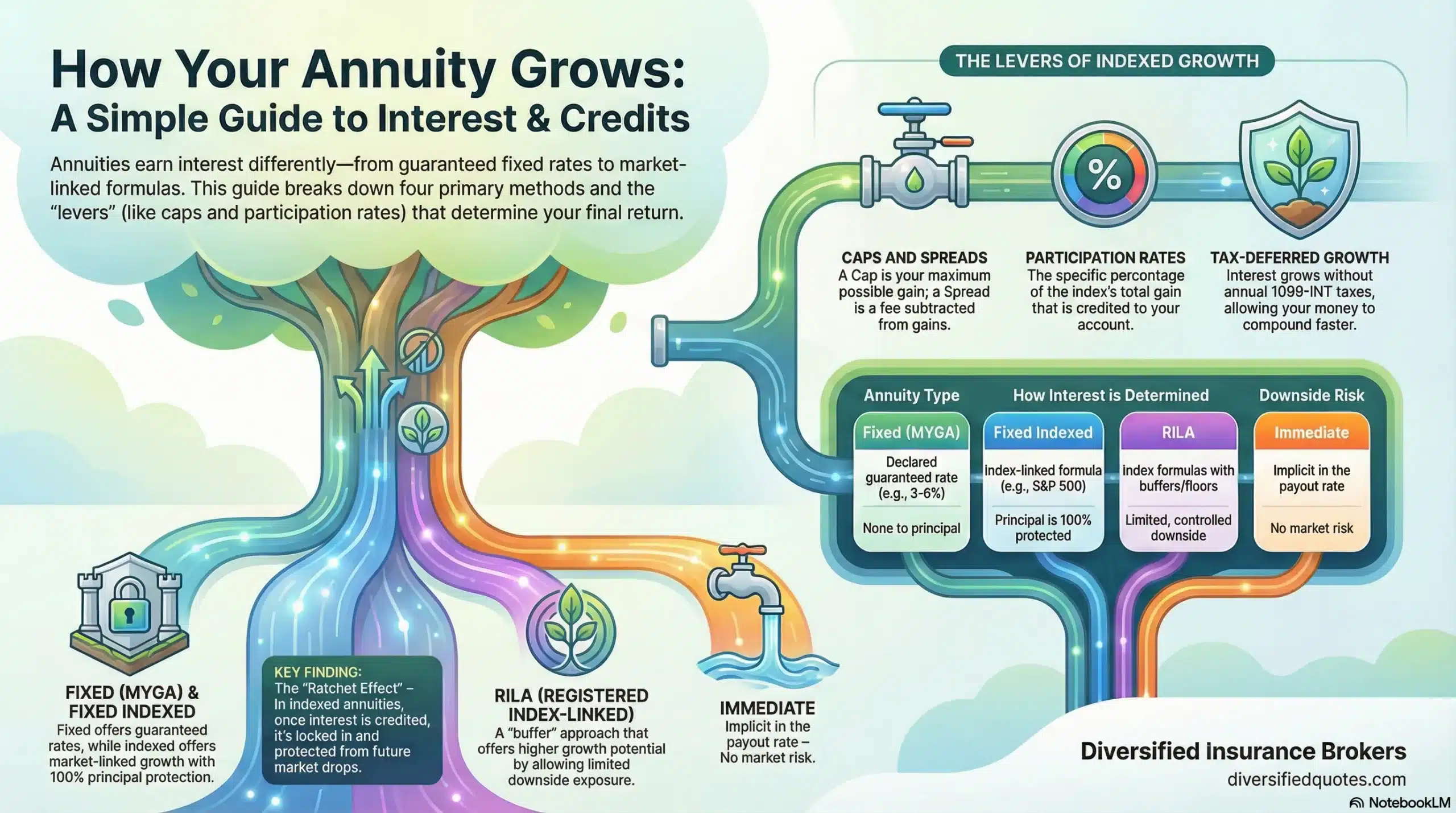
One of the most widely recognized benefits of annuities is tax-deferred growth. When funds are invested in taxable accounts, interest, dividends, and capital gains may be subject to taxes each year. These annual tax payments reduce the amount of money that remains invested and available to compound in subsequent years. Over long holding periods, this annual tax drag creates a meaningful gap between taxable and tax-deferred growth on the same underlying return.
Annuities allow earnings to accumulate without immediate taxation. Instead of paying taxes annually, taxes on interest and gains are generally deferred until withdrawals are taken from the contract. This allows the entire account value to continue compounding over time — including on amounts that would otherwise have been paid in taxes. The result is a larger accumulation base at the point when distributions begin, which can support higher income for a longer period.
For individuals who are saving for retirement over multiple decades, the impact of compounding is substantial. Even small differences in the annual amount remaining to compound can produce large differences in total account value after 20 or 30 years. High-income earners who have already maximized contributions to IRAs, 401(k) plans, and other tax-advantaged vehicles often find that annuities represent an attractive additional vehicle for tax-deferred accumulation, since annuities carry no IRS contribution limits — a meaningful distinction for those seeking to build significant retirement assets outside of contribution-capped accounts.
The tax deferral benefit is most valuable in situations where the investor expects to be in a lower tax bracket at the time of withdrawal than at the time of accumulation — which is a common situation for workers in peak earning years who anticipate lower taxable income in retirement. It is worth noting, however, that withdrawals from annuities are taxed as ordinary income rather than as capital gains, so careful coordination of annuity distributions with other taxable income sources is an important part of managing the overall tax outcome in the distribution phase.
Example: Tax-Deferred Annuity vs. Taxable Investment
The example below compares how a tax-deferred annuity and a taxable investment account might grow over time, assuming a 6.30% annual return on an initial $100,000 investment and a 30% tax rate on annual investment gains in the taxable account.
| Year | Tax-Deferred Annuity Value | Taxable Investment Value | Value Advantage |
|---|---|---|---|
| 1 | $106,300 | $104,410 | $1,890 |
| 5 | $135,685 | $126,133 | $9,552 |
| 10 | $184,104 | $159,095 | $25,009 |
| 15 | $249,748 | $200,736 | $49,012 |
| 20 | $338,975 | $253,379 | $85,596 |
Example assumes a 6.30% annual return and a 30% tax rate on investment gains in the taxable account. For illustrative purposes only. Actual results will vary based on tax situation, return rate, and product terms.
Guaranteed Lifetime Income
The ability to create guaranteed lifetime income is one of the most important reasons people choose annuities for retirement planning. Certain annuity contracts allow policyholders to convert accumulated savings into payments that continue for the rest of their lives — regardless of how long they live, regardless of what markets do, and regardless of whether the underlying account value is ever depleted. This contractual commitment to continue payments is a structural feature that no other commonly used financial product provides in the same form.
This benefit directly addresses longevity risk — the possibility that a person may outlive their retirement savings. Because annuity payments can be structured to continue for life, they provide a predictable income source that can help cover essential expenses such as housing, healthcare, and everyday living costs regardless of how many years pass. A portfolio of invested assets, regardless of how well it is managed, is finite — it can be depleted by a combination of market losses and ongoing withdrawals. A properly structured lifetime annuity converts that finite pool into an income guarantee that transfers the longevity risk to the insurance company rather than leaving the retiree exposed to it.
Many retirees coordinate annuity income with other guaranteed income sources as part of a layered income strategy. Social Security planning and annuity income decisions interact in meaningful ways — the timing of Social Security elections affects the gap that annuity income needs to fill, and the presence of guaranteed annuity income may provide the financial security needed to delay Social Security and maximize the lifetime benefit amount. Building a reliable guaranteed income floor from multiple sources reduces dependence on investment performance and provides a stable base from which the remainder of the retirement portfolio can pursue growth without the pressure of funding near-term expenses.
Protection From Market Volatility and Principal Loss
Another key benefit of many annuities is protection from market losses. Fixed annuities and fixed indexed annuities typically guarantee that the contract value cannot decline due to stock market downturns. In a fixed annuity, a declared interest rate applies regardless of what markets do. In a fixed indexed annuity, index credits are applied in positive years while a zero-percent floor prevents the account value from declining in negative years. The tradeoff — capped upside in exchange for no downside — is a deliberate structural feature designed specifically for retirement savings that cannot afford to absorb large losses.
This protection is especially valuable for individuals approaching retirement or already living on their savings. Market volatility creates significant uncertainty when retirement income depends heavily on portfolio performance. A major market decline in the years just before or just after retirement can force retirees to sell depreciated assets to fund withdrawals — locking in losses and permanently reducing the portfolio’s recovery potential. By allocating a portion of retirement assets to an annuity with principal protection, individuals reduce the portfolio’s vulnerability to this scenario and create a more predictable retirement income picture regardless of market conditions.
Many individuals also explore broader risk management strategies such as downside protection strategies in bear markets when evaluating how an annuity fits within a diversified retirement portfolio. The annuity is most effective as the protection and income layer — not the growth layer — within a plan that balances guaranteed security with ongoing investment potential.
Sequence-of-Returns Risk — The Retirement Timing Problem Annuities Solve
Sequence-of-returns risk is one of the most significant and least intuitive risks in retirement planning. It refers to the danger that the timing of investment losses — particularly losses that occur in the early years of retirement when withdrawals are being taken — can permanently impair the portfolio’s longevity even when the long-term average return looks adequate. A portfolio that loses 25% in its first two years of distribution requires a substantially larger subsequent recovery just to return to its starting point — and each year of continued withdrawals during the recovery period further reduces the capital base from which recovery must occur.
Annuities address sequence-of-returns risk directly by providing a guaranteed income floor that does not depend on portfolio performance. When guaranteed annuity income covers essential expenses — housing, healthcare, utilities, food — the retiree’s investment portfolio is not forced to liquidate assets at depressed values to meet those obligations. Instead, the investment portfolio can be held through market downturns and allowed to recover, because near-term income needs are already met by the annuity guarantee. This is the structural argument for using annuities as an income floor rather than relying entirely on a systematic withdrawal strategy from an investment portfolio. The sequence-of-returns risk framework explains in full why the timing of returns during the distribution phase matters as much as the average return, and why annuity income protection specifically addresses the vulnerability that systematic withdrawals create.
The broader investment portfolio — freed from the obligation of funding essential expenses in any market environment — can be positioned more aggressively for long-term growth without the behavioral and mathematical risks that come from being forced to sell in down markets. Many individuals also evaluate broader investment risk frameworks such as investment risk analysis to understand how market volatility affects retirement plans and how annuity income complements a risk-managed portfolio.
Pension Replacement — Building the Income Your Employer No Longer Provides
For most private-sector workers, the defined benefit pension that provided a guaranteed monthly income for life no longer exists. The shift from defined benefit to defined contribution plans over the past four decades transferred the burden of retirement income creation to individuals — along with all of the risks that pension funds were previously designed to absorb. Workers now bear longevity risk, investment risk, and sequencing risk that were previously managed institutionally. Annuities provide the tools to address each of these risks in a way that individual investment accounts fundamentally cannot.
The income structure of an annuity mirrors a pension: a defined monthly or annual payment for life, funded by a lump-sum premium rather than employer contributions. For individuals who spent their careers without access to a pension and are now approaching retirement with accumulated savings in 401(k) plans or IRAs, an annuity can convert that accumulation into a self-created pension — a reliable, predictable income source that continues regardless of longevity or market conditions. This is particularly relevant for those exploring how to turn savings into guaranteed lifetime income and those evaluating what pension alternatives exist for private-sector retirees who need an income guarantee but have no employer plan to provide it.
The decision of how much to allocate to annuity income versus how much to retain in an investment portfolio is a function of the income gap — the difference between guaranteed income from Social Security and any remaining pension, and the total income needed to cover essential retirement expenses. The annuity allocation should be sized to close that gap, not to absorb the entire retirement portfolio. Right-sizing the annuity allocation to the income objective ensures that the protection and predictability benefits are delivered without over-constraining the portfolio’s flexibility and growth potential for discretionary spending.
Estate and Legacy Planning Benefits
Annuities can also support estate planning goals in ways that are often overlooked in discussions focused primarily on income. Many contracts allow policyholders to designate beneficiaries who will receive remaining contract value after the owner’s death. Because these beneficiary designations are written into the annuity contract, the assets transfer directly to named beneficiaries outside the probate process — without the delays, costs, and potential public disclosure that probate can entail.
The specific death benefit available to beneficiaries depends on the annuity type and the stage of the contract at the time of death. During the accumulation phase, beneficiaries typically receive the contract’s account value or a defined death benefit amount, whichever is larger in some designs. After income begins under a GLWB rider, the death benefit is generally the remaining account value — which declines over time as income withdrawals and rider fees reduce it. Some carriers offer enhanced death benefit provisions that guarantee a minimum amount to beneficiaries regardless of account value depletion. Understanding how annuity beneficiary death benefits work under the specific contract being considered is an essential part of the legacy planning evaluation.
Some individuals combine annuity strategies with other protection tools such as life insurance with living benefits to build comprehensive financial plans that address both retirement income and legacy objectives simultaneously. An annuity provides the guaranteed income floor for the retiree while a life insurance policy provides the tax-free death benefit for beneficiaries — a structure that can produce more of both benefits than trying to achieve either objective from a single product. This separation of retirement income and legacy functions is a common framework in comprehensive retirement planning for households with defined income needs and defined legacy goals.
No Contribution Limits — A Meaningful Advantage for High-Accumulation Savers
One often-overlooked benefit of deferred annuities is the absence of IRS contribution limits. IRAs are subject to annual contribution limits that restrict how much can be deposited in any given year. 401(k) plans have higher limits but still cap annual contributions. Annuities have no such restrictions — a single premium of any amount can be placed into an annuity contract, subject only to the carrier’s administrative maximum. For high-income earners who have maximized all available contribution-limited accounts and still have after-tax savings they want to shelter from annual taxation, an annuity provides a vehicle for additional tax-deferred accumulation without artificial limits.
This feature is particularly relevant for business owners, professionals in peak earning years, and individuals who receive a large lump sum — from a business sale, inheritance, or other windfall — and want to deploy it into a tax-efficient long-term structure. The ability to place a substantial single premium into a deferred annuity and allow it to compound tax-deferred for 10 or 20 years before beginning distributions is a planning option that contribution-limited accounts simply do not provide at that scale.
Flexibility Within Structure — Living Benefit Riders and Income Options
Modern annuity designs offer considerably more flexibility than older products. Income riders allow the policyholder to elect when income begins rather than irrevocably committing to annuitization. Free withdrawal provisions allow access to a defined percentage of the contract value each year without surrender charges. Nursing home and terminal illness waivers provide penalty-free access to the full contract value in defined health-related circumstances. And in some indexed designs, the structure allows the account value to continue growing through index credits even after income withdrawals have begun — extending the life of the contract and the potential legacy value for beneficiaries.
For individuals approaching retirement, financial planning shifts from accumulation to income distribution — and annuities are specifically designed for that transition. Early in a career, the goal is typically to grow assets as much as possible. Later in life, the focus becomes ensuring those assets can provide reliable income for decades. The flexible structures now available in the market allow annuities to serve both phases — accumulating efficiently during the deferral period and distributing reliably during the income phase — within a single contract rather than requiring a separate product for each objective. This flexibility is what makes modern annuity designs meaningfully different from the rigid structures of earlier decades, and it is why evaluating current product designs rather than relying on older perceptions of how annuities work is important for anyone considering them.
Why Many Retirees Use Annuities
The benefits of annuities ultimately revolve around financial certainty during a phase of life when uncertainty is most costly. Retirement planning requires balancing growth opportunities with protection from risk. Annuities provide stability, tax advantages, and income guarantees that help retirees maintain financial security for decades — precisely because they are insurance contracts designed to manage specific financial risks rather than simply maximize returns. When used appropriately within a diversified retirement strategy, they can provide the income foundation that allows the rest of the portfolio to pursue growth without the pressure of funding every expense from a market-dependent account. The question is not whether annuities are universally appropriate — it is whether the specific benefits they provide solve the specific problems present in a given retirement plan, at the right allocation and in the right product design.
Related Pages
Financial Protection Essentials
Talk With an Advisor Today
Choose how you’d like to connect—call or message us, then book a time that works for you.
Schedule here:
calendly.com/jason-dibcompanies/diversified-quotes
Licensed in all 50 states • Fiduciary, family-owned since 1980
FAQs: What Are the Benefits of Annuities?
What is the primary benefit of an annuity in retirement planning?
The primary benefit that distinguishes annuities from other retirement tools is the ability to create guaranteed lifetime income — income that continues regardless of how long you live, regardless of what markets do, and regardless of whether the underlying account value is ever depleted. This directly addresses longevity risk, which is the possibility of outliving your savings. A portfolio of invested assets, however well-managed, is finite. A properly structured lifetime annuity transfers that longevity risk to an insurance company and converts a finite pool of savings into an income guarantee that cannot be outlived. This feature is structurally unique to annuities and is the core reason they occupy a distinct role in comprehensive retirement income planning alongside Social Security, investment portfolios, and other income sources.
How does tax-deferred growth in an annuity benefit me?
Tax deferral means that interest and earnings inside an annuity accumulate without being reduced by annual income taxes. In a taxable investment account, gains may be taxed each year, reducing the amount available to compound in subsequent years. In a deferred annuity, the full balance continues compounding — including on amounts that would otherwise have been paid in taxes. Over a 20-year period, this difference can compound to a meaningful advantage in total account value. The benefit is most significant for high-income earners in high tax brackets during accumulation who expect to be in a lower bracket during retirement distributions. One important consideration: withdrawals from annuities are taxed as ordinary income rather than at capital gains rates, so distribution planning — coordinating annuity withdrawals with other taxable income sources — matters for managing the overall tax outcome. Annuities also carry no IRS contribution limits, making them attractive for savers who have already maximized IRAs and 401(k) plans and want to continue building tax-deferred assets beyond those caps.
What is sequence-of-returns risk and how do annuities protect against it?
Sequence-of-returns risk is the danger that investment losses occurring in the early years of retirement — when withdrawals are being taken from the portfolio — can permanently impair the portfolio’s longevity even when long-term average returns appear adequate. A portfolio that declines significantly in its first two or three years of distribution must generate substantially larger subsequent returns just to recover its starting value — while continued withdrawals during the recovery period further reduce the capital base. This dynamic can exhaust a portfolio years sooner than average-return projections would suggest. Annuities protect against this risk by providing a guaranteed income floor that does not depend on portfolio performance. When guaranteed annuity income covers essential expenses, the investment portfolio is not forced to liquidate assets at depressed values to meet living costs. The portfolio can be held through downturns and allowed to recover, because the annuity guarantee handles near-term income needs regardless of market conditions. This is the structural argument for using annuities as a guaranteed income layer within a retirement plan rather than relying entirely on a systematic withdrawal strategy.
Do annuities protect my principal from market losses?
Fixed annuities and fixed indexed annuities typically include principal protection guarantees that prevent the account value from declining due to market downturns. In a fixed annuity, a declared interest rate applies regardless of what markets do — the account grows at the contractual rate and cannot decline. In a fixed indexed annuity, interest is credited based on the performance of an external index, but a zero-percent floor prevents the account value from declining in years when the index performs negatively. In exchange for this downside protection, upside participation is limited — cap rates and participation rates restrict how much of the index’s gain is credited in strong years. This trade-off — predictable protection in exchange for capped upside — is the defining feature of these products and is specifically designed for retirement assets where losing principal is more costly than missing some portion of market gains. Variable annuities, by contrast, invest in market subaccounts and can decline in value, so they do not carry the same principal protection guarantee.
Can an annuity replace a pension for private-sector workers?
Annuities are the closest functional equivalent to a defined benefit pension that is available to private-sector workers who lack employer-sponsored pension coverage. Like a pension, an annuity can convert a lump sum of accumulated savings into a guaranteed monthly or annual income payment that continues for life. The income structure is similar — a defined amount paid on a predictable schedule, funded by capital rather than employer contributions. The key differences are that the annuity is funded entirely by the individual rather than shared between employer and employee, and the income amount depends on the premium paid, the age at which income begins, the specific contract terms, and the carrier’s payout factors rather than years of service and final salary formulas. For individuals approaching retirement with accumulated savings in IRAs, 401(k) plans, or other accounts who want to replicate the income certainty that a pension provides, converting a portion of those savings to a guaranteed lifetime income annuity is a common and often effective strategy for building a personal pension equivalent.
How do annuities help with estate planning and passing assets to beneficiaries?
Annuities allow policyholders to name beneficiaries who receive the remaining contract value directly upon the owner’s death, bypassing the probate process. Because the beneficiary designation is a contractual provision rather than a testamentary document, the transfer does not require court oversight, does not incur probate costs, and is not subject to the delays that probate proceedings can create. For beneficiaries, this means faster, more direct access to the assets. For the estate, it means lower administrative costs and reduced public disclosure of assets. The amount available to beneficiaries depends on the annuity type and the contract stage at death — during the accumulation phase, beneficiaries typically receive the account value or a specified death benefit amount. Some products include enhanced death benefit provisions that guarantee a minimum to heirs even after income withdrawals have reduced the account value significantly. Coordinating annuity beneficiary designations with the broader estate plan — including wills, trusts, and other beneficiary-designated accounts — is an important step in ensuring that the overall estate plan functions as intended.
Are the benefits of annuities the same for everyone?
No — the value of each annuity benefit depends heavily on the individual’s specific situation, goals, and the role the annuity plays within the overall retirement plan. Tax deferral is most valuable for high-income earners in high current tax brackets. Principal protection is most valuable for individuals approaching or in retirement whose savings cannot absorb large losses. Lifetime income guarantees are most valuable for individuals with longevity in their family history or those who lack other guaranteed income sources beyond Social Security. Sequence-of-returns protection is most relevant for individuals who are beginning to take distributions and whose investment portfolio cannot afford to be forced to sell in down markets. Estate planning benefits are most relevant for individuals with clear legacy objectives and complex estate structures. The fact that no single benefit applies equally to everyone is why proper annuity evaluation starts with defining the specific objective the annuity is meant to serve, then selecting the product design and allocation that addresses that objective most efficiently.
About the Author:
Jason Stolz, CLTC, CRPC, DIA, CAA and Chief Underwriter at Diversified Insurance Brokers (NPN 20471358), is a senior insurance and retirement professional with more than 25 years of real-world experience helping individuals, families, and business owners protect their income, assets, and long-term financial stability. As a long-time partner of the nationally licensed independent agency Diversified Insurance Brokers, Jason provides trusted guidance across multiple specialties—including fixed and indexed annuities, long-term care planning, personal and business disability insurance, life insurance solutions, Group Health, Travel Medical and Evacuation Insurance, and short-term health coverage. Diversified Insurance Brokers maintains active contracts with over 100 highly rated insurance carriers, ensuring clients have access to a broad and competitive marketplace.
His practical, education-first approach has earned recognition in publications such as VoyageATL, and contributions from his agency featured in Kiplinger and GoBankingRates— highlighting his commitment to financial clarity and client-focused planning. Drawing on deep product knowledge and years of hands-on field experience, Jason helps clients evaluate carriers, compare strategies, and build retirement and protection plans that are both secure and cost-efficient. Visitors who want to explore current annuity rates and compare options across multiple insurers can also use this annuity quote and comparison tool.
Explore More Annuity Options: Browse our complete guide to Annuities 101 — covering annuity education, planning guides, pros & cons, how to choose & buy from 100+ carriers.
Last Reviewed: June 19, 2026 |
Reviewed by: Jason Stolz, CLTC, CRPC, DIA, CAA
Chief Underwriter, Diversified Insurance Brokers, Inc. | NPN: 20471358 | Diversified Insurance Brokers, Inc. — Licensed in all 50 states
Fact Checked by: Tonia Pettitt, CMIP©
Medicare Specialist, Diversified Insurance Brokers, Inc. | NPN: 14374308 | Diversified Insurance Brokers, Inc. — Licensed in all 50 states
Did you find this content helpful? Leave us a Google review — it helps others find trustworthy guidance too.
Editorial Standards: Diversified Insurance Brokers maintains rigorous editorial standards to ensure accuracy, clarity, and independence in all content. Learn more about our editorial standards and commitment to transparency.
