
Disability Income Insurance for Truck Drivers
As an Independent Disability Insurance Broker, we have access to exclusive discounts and negotiated pricing most captive agents can’t offer — see the full breakdown near the end of this page.
Disability Income Insurance for Truck Drivers

Jason Stolz CLTC, CRPC, DIA, CAA
Disability Income Insurance for Truck Drivers — Occupation Class, Underwriting Realities, and How to Build a Policy That Actually Pays
Truck drivers face a disability income protection challenge that most other professions do not: the connection between physical health, federal medical certification, and the ability to earn income is direct, binary, and subject to regulatory oversight that has nothing to do with how disabled an insurance carrier considers you to be. A driver who develops a back condition serious enough to prevent 10-hour shifts behind the wheel, or a cardiovascular event that produces a failed Department of Transportation medical examination, or a sleep apnea diagnosis that disqualifies them from commercial operation pending treatment compliance — each of these scenarios interrupts income immediately and completely, regardless of whether the driver could theoretically perform some other kind of work. The definition of disability in the policy the driver chooses determines whether that income interruption triggers a benefit or not. At Diversified Insurance Brokers, Jason Stolz, CLTC, CRPC, DIA, CAA works with commercial drivers across all employment structures — company drivers, regional drivers, and independent owner-operators — to evaluate disability income policies built for the physical demands, regulatory requirements, and income replacement math that applies specifically to CDL-dependent careers. How occupation classification works in disability insurance underwriting — specifically how carriers categorize truck driving relative to other occupations, what that classification means for policy terms and premium, and why the same physical limitation produces different benefit outcomes depending on which occupation class the carrier assigns — is the foundational context for understanding why disability insurance for truck drivers is not identical to disability insurance for any other profession.
The DOT Medical Certification Gap — Why Standard Disability Definitions Can Fail Truck Drivers
The Federal Motor Carrier Safety Administration requires commercial drivers operating vehicles above a defined weight threshold to hold a current DOT medical certificate, renewed every two years under standard conditions or more frequently for drivers with certain managed health conditions. The DOT physical evaluates cardiovascular function, vision, hearing, blood pressure, neurological status, and several other health dimensions — and a driver who fails or cannot complete the examination is federally disqualified from commercial operation until the underlying condition is resolved or an exemption is obtained. This regulatory framework creates a disability scenario that standard insurance definitions do not always address cleanly. A driver whose blood pressure reading disqualifies them from the DOT physical may not meet a strict “any occupation” disability definition — they are theoretically capable of working in a non-driving capacity. A driver recovering from back surgery who cannot sit for eight continuous hours but could manage a desk job may similarly fall outside an “any occupation” definition’s benefit trigger even though their CDL-dependent income has stopped entirely.
The policy definition that most directly protects against this gap is an own-occupation definition during the initial benefit period — typically the first two to five years of a disability — which pays benefits when the insured cannot perform the material duties of their specific occupation rather than requiring inability to perform any occupation. For a truck driver, the material duties of the occupation include the physical capacity to operate a commercial vehicle safely and to maintain the medical certification that legally permits that operation. A condition that ends that capacity triggers benefits under an own-occupation definition regardless of whether the driver could perform some other type of work. Long-term disability insurance — how the benefit period, the definition of disability, and the own-occupation versus any-occupation transition structure work together to determine what the policy actually pays across a multi-year disability — is the complete policy structure analysis that determines whether a truck driver’s coverage is genuinely protective or merely technically present. Assurity Life disability insurance is one of the carriers whose DI products Diversified Insurance Brokers accesses for physically demanding occupation classes — relevant for truck drivers evaluating specific carrier options in the impaired-risk or moderate-hazard occupation market.
Request Disability Insurance Quotes for Truck Drivers
We compare disability income options across multiple carriers — evaluating occupation class, definition of disability, benefit period, elimination period, and premium for your specific driving role and income level.
Occupation Class, Policy Terms, and What Truck Drivers Typically Qualify For
| Policy Dimension | Typical Range for Truck Drivers | Planning Implication |
|---|---|---|
| Occupation class | Most carriers classify commercial truck drivers in a moderate-to-higher hazard class — commonly Class 3 or Class 4 on a 1–5 or 1–6 scale depending on the carrier’s classification system; drivers with specialized hazardous cargo endorsements (HazMat, tanker, doubles/triples) may receive a higher hazard classification than standard long-haul drivers | Higher occupation class means higher premium per dollar of monthly benefit and may mean shorter maximum benefit periods than white-collar profession policies; comparison across carriers is important because occupation class assignment varies by carrier and the same driver may qualify for more favorable classification with one carrier than another |
| Benefit amount | Disability policies typically replace 60–70% of gross income up to a carrier-defined monthly maximum; carriers apply benefit limits based on occupation class and income documentation; owner-operators whose income varies year-to-year document income through tax returns, which may result in benefit amounts based on a two-year average rather than a single peak year | The benefit amount should be sized to cover essential household and business obligations during a disability — mortgage or rent, utilities, food, insurance, and for owner-operators any fixed vehicle and business costs that continue whether or not the driver is working; sizing the benefit too conservatively leaves a gap that personal savings must fill |
| Elimination period | Commonly 30, 60, 90, or 180 days; a longer elimination period reduces premium but requires the driver to fund expenses from personal savings during the waiting period before benefits begin; most truck drivers with limited liquid savings choose 30- or 60-day elimination periods despite the higher premium, while drivers with three to six months of savings may find 90-day elimination periods more cost-effective | The elimination period is the driver’s self-insured retention — it functions like a deductible in time rather than dollars; matching the elimination period to the actual savings cushion available prevents the most financially damaging scenario: a disability that eliminates income before benefits begin |
| Benefit period | Common benefit periods for truck driver occupation classes include 2-year, 5-year, and to-age-65 options; many carriers do not offer lifetime benefit periods for higher-hazard occupations; the to-age-65 benefit period provides the most comprehensive long-term protection and is the most valuable option for drivers who experience a permanent disability before retirement age | A 2-year benefit period provides meaningful short-to-medium term income replacement but leaves the driver unprotected if the disability extends beyond the benefit period; to-age-65 coverage is the most complete protection and typically the most cost-effective choice on a cost-per-year-of-coverage basis for drivers in their 30s and 40s who have multiple decades of earning years to protect |
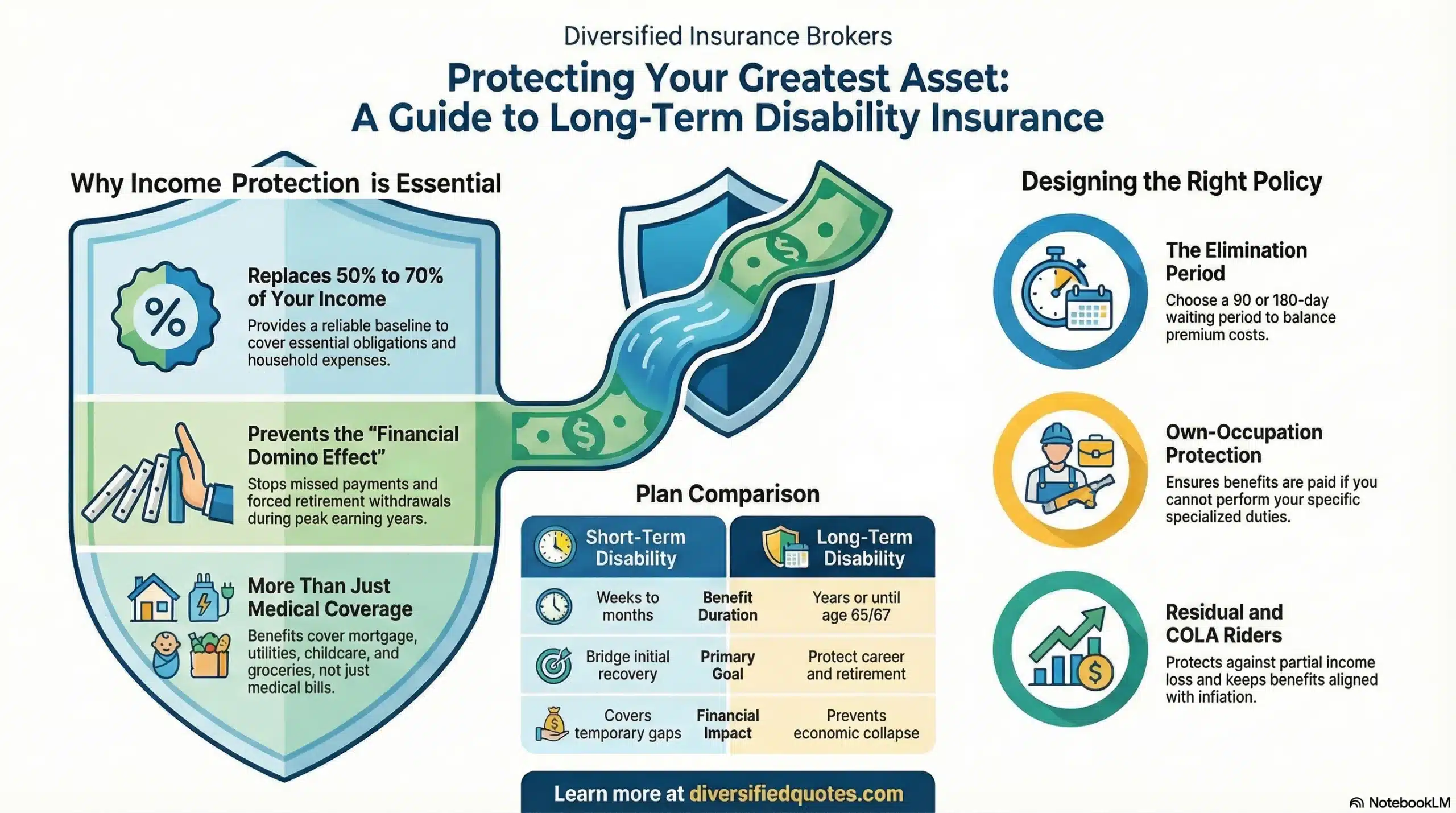
The four policy dimensions in the table define the structure of a disability income policy for truck drivers — and each is a decision point where the specific choice materially affects both the premium and the protection quality the policy provides. Accident-only disability income insurance is a lower-cost alternative for drivers who want some income protection but whose premium budget does not accommodate a full disability income policy — it pays benefits for disabilities resulting from accidents but not from illness or disease, which means it does not cover the majority of long-term disability causes but provides a partial solution at significantly lower cost. Disability income policies with cost-of-living adjustment riders address the inflation erosion problem for long-term disabilities — a fixed monthly benefit that was adequate when the policy was issued loses purchasing power over a 10- or 20-year disability, and the COLA rider increases the benefit annually to partially offset that erosion.
Owner-Operators — The Income Protection Calculation When the Truck Is the Business
Independent owner-operators face a disability income scenario that is financially more complex than company driver situations because the disability affects not just personal income but the business itself. A company driver who becomes disabled loses their paycheck but does not carry the ongoing fixed costs of truck ownership, insurance, and maintenance. An owner-operator who becomes disabled loses their driving income while their truck payment, commercial auto insurance, cargo insurance, fuel card balance, and maintenance reserves all continue as fixed obligations. The personal disability income policy replaces a portion of personal income. The business overhead dimension — the fixed costs of the trucking operation that continue during a disability — is a separate protection need that personal DI alone does not address. Disability insurance for independent contractors covers the complete protection landscape for non-W-2 workers whose income depends entirely on their personal ability to perform physical labor — the underwriting mechanics, the income documentation requirements, and the policy options that serve this employment structure most effectively. Disability insurance for 1099 workers addresses the specific documentation and underwriting path for drivers whose income flows through 1099 rather than W-2 — including how carriers evaluate variable income, seasonal earnings patterns, and deductible business expenses when calculating the insurable monthly benefit amount. Buy-sell disability insurance is relevant for owner-operators who are in partnership arrangements — if one partner becomes permanently disabled and can no longer drive, the buy-sell disability policy funds the partnership interest buyout on disability terms rather than requiring the remaining partner to absorb an inactive partner’s equity stake indefinitely. Disability income insurance for general contractors provides a parallel occupation comparison — contractors share the owner-operator’s self-employed income structure, physical demand exposure, and business overhead dimension, making the protection analysis directly comparable for drivers evaluating how their needs stack up against other physically demanding self-employed occupations.
Adjacent Occupation Comparisons — Related Driving and Transportation Professions
The disability income market for truck drivers shares underwriting characteristics with several adjacent transportation and physically demanding occupations, and understanding how carriers treat these related professions helps truck drivers calibrate their expectations for what the market will offer. Disability insurance for taxi and rideshare drivers — a transportation-dependent occupation with similar income disruption risk from physical disability — illustrates the product landscape for commercially licensed drivers whose income depends on vehicle operation. Bus drivers face CDL requirements and DOT medical certification demands that parallel commercial truck driver requirements — the disability income market for bus drivers is directly comparable to the truck driver market in terms of occupation class assignment and available policy terms. The automobile industry disability insurance market covers the broader transportation workforce that shares physical demand exposure with commercial driving. Heavy equipment operators are among the closest occupation parallels to truck drivers in terms of physical demands, regulatory licensing requirements, and the connection between physical capability and CDL or operator certification — the DI product landscape for heavy equipment operators provides a useful benchmark for truck driver policy terms and premium ranges. Mechanics and automotive service technicians share the physical demand profile and musculoskeletal injury exposure that defines the truck driver disability risk profile. Railroad industry disability insurance is the most direct occupational parallel — railroad workers are federally licensed transportation professionals with physical medical certification requirements whose disability income needs mirror commercial truck driver requirements in structure if not in specific regulation. Limo drivers represent the lower-hazard end of the CDL-dependent driving occupation spectrum — comparing what the market offers limo drivers versus long-haul commercial truck drivers illustrates how occupation class differences translate into premium and policy term differences even within the transportation occupational cluster. Movers and moving company workers share the combination of physical labor, lifting demands, and vehicle operation that characterizes commercial truck driving at the local delivery end of the trucking spectrum. Courier and parcel delivery workers — whose occupation involves vehicle operation, physical loading and delivery, and income dependency on sustained physical capability — provide the closest light-duty analog to heavy commercial truck drivers in the DI occupation classification system. Transportation dispatchers are frequently truck drivers who have transitioned to office roles and whose disability insurance needs reflect a much more favorable occupation class — relevant for drivers evaluating how their protection situation would change if a disability forced a career transition to a non-driving role within the transportation industry.
Tax Treatment, Benefit Taxability, and the Net Income Replacement Calculation
Whether disability benefits are taxable when received depends on how the premium was paid — a distinction that significantly affects the net income replacement the policy actually provides when a claim occurs. When the driver pays the premium with after-tax dollars, the disability benefits received are generally income-tax-free. When an employer pays the premium as an employer benefit, or when the premium is paid pre-tax through a cafeteria plan, the benefits received are generally taxable as ordinary income. For company drivers whose employer provides a group disability benefit and pays the premium as a business expense, any group DI benefits received during a disability are typically taxable — meaning the 60% benefit amount is further reduced by income tax to a net that may be closer to 40 to 45 cents on the dollar. For owner-operators who pay their own individual DI premium with after-tax personal income, the benefits are generally income-tax-free, which means the policy’s benefit amount is the actual take-home amount during the disability period. Whether disability insurance payments are taxable — the complete tax treatment analysis for individual policies, group policies, and employer-paid arrangements — is the tax planning context that determines whether a specific benefit amount actually replaces the income the driver needs or falls short after taxes. Disability insurance for high earners and business owners covers the benefit maximum constraints that apply for higher-income drivers and business owners — including how carriers cap benefit amounts relative to income and what options exist for supplementing group coverage with individual coverage when group benefit limits produce inadequate income replacement for higher-earning drivers. Disability insurance for professionals over age 65 addresses the increasingly relevant scenario of drivers who continue working past traditional retirement age and whose disability income protection needs extend beyond the age-65 benefit cutoff of many standard policies. Working with an independent disability insurance broker — rather than a single-carrier agent — gives truck drivers access to the full competitive market rather than one carrier’s specific product lineup, which is particularly valuable for physically demanding occupations where carrier appetite and occupation class assignment varies significantly across the market. Short-term health insurance is the adjacent protection product that addresses the healthcare coverage dimension during a disability — if a truck driver loses employer-sponsored health coverage during a prolonged disability, the health insurance gap represents a compounding financial risk that the disability income policy alone does not address. Life insurance with pre-existing conditions addresses the protection planning dimension for drivers whose health history — back conditions, hypertension, sleep apnea, prior accidents — complicates not just disability underwriting but also life insurance underwriting, and where the impaired-risk individual market provides options that the group benefit context cannot replicate. Whether life insurance is still needed in retirement addresses the protection planning transition that eventually applies to every truck driver who reaches the end of their driving career — when the CDL-dependent income risk that drove the disability insurance need has been replaced by retirement income sources that do not depend on physical capability. High-risk life insurance services cover the life insurance options for drivers whose health history or occupation classification complicates standard underwriting — relevant because the same health factors that affect disability underwriting often affect life insurance underwriting simultaneously.
Get Disability Income Quotes Designed for Truck Drivers
We compare options across multiple carriers — evaluating the definition of disability, occupation class, benefit period, elimination period, and how the policy handles DOT medical disqualification scenarios for your specific driving role and employment structure.
Talk With an Advisor Today
Choose how you’d like to connect—call or message us, then book a time that works for you.
Schedule here:
calendly.com/jason-dibcompanies/diversified-quotes
Licensed in all 50 states • Fiduciary, family-owned since 1980
FAQs: Disability Income Insurance for Truck Drivers
Does disability insurance cover a truck driver who fails a DOT physical?
Whether a failed DOT medical examination triggers a disability benefit depends on the specific policy’s definition of disability and the reason for the failed examination. A driver who fails the DOT physical due to an underlying illness or injury that also prevents them from performing other work may meet both the own-occupation and the any-occupation definition of disability. A driver who fails the DOT physical due to a specific condition — elevated blood pressure, a new sleep apnea diagnosis, a vision threshold failure — but who could theoretically perform non-driving work may meet the own-occupation definition during the initial benefit period but not the any-occupation definition if the policy transitions to an any-occupation standard after two or five years.
The practical planning implication is that truck drivers need policies with own-occupation definitions during the initial benefit period precisely because the DOT certification requirement creates an additional disability trigger beyond what the insurance carrier’s standard definition would recognize. A driver temporarily disqualified by a DOT physical failure may recover, pass the next examination, and return to driving — the disability was real and income-interrupting even if it was brief. Policies with shorter elimination periods and own-occupation definitions are better suited to capture these shorter but financially significant disability events than policies with longer elimination periods and broad any-occupation definitions that require more severe and prolonged inability to work before benefits begin.
Can an owner-operator get disability insurance if income varies year to year?
Yes — independent owner-operators can obtain individual disability income coverage, and carriers have underwriting processes specifically designed for self-employed applicants with variable income. The income documentation process for owner-operators typically requires two years of tax returns, from which the carrier calculates an average monthly net income as the basis for the insurable benefit amount. The monthly benefit offered is then a percentage of that average — typically 60 to 70% — subject to the carrier’s occupation class benefit maximums for truck drivers.
The challenge for owner-operators with fluctuating income is that the benefit amount is calculated from the documented average rather than from the best year. A driver who earned significantly more in the most recent year than in the prior year may find the two-year average produces a benefit amount that understates current income needs. In this situation, the optimal timing for applying is after a period of consistently documented income at the desired benefit level. Drivers who have recently expanded their operations, taken on more loads, or shifted from company driving to owner-operation should be aware that the income documentation requirement means the policy benefit may lag actual current income by one to two years. Maintaining consistent income documentation and filing complete, accurate tax returns is the most direct way to ensure the disability income benefit calculation reflects the actual financial need.
What health conditions most commonly disqualify truck drivers from getting disability insurance?
Disability insurance underwriting evaluates both the probability of a disabling event and the severity of any existing conditions that might shorten the benefit period or increase the claim likelihood. For truck drivers, several health conditions frequently produce underwriting complications: prior back surgeries or significant documented spinal conditions, cardiovascular events including heart attacks or stent procedures, poorly controlled hypertension, a current sleep apnea diagnosis without documented treatment compliance, obesity combined with other metabolic conditions, or a recent history of substance abuse. These conditions do not automatically disqualify a driver from all coverage, but they commonly result in rated premiums, benefit period limitations, or condition-specific exclusion riders that limit coverage for claims arising from the pre-existing condition.
The practical response to health-complicated underwriting is carrier comparison rather than resignation to no coverage. Different carriers apply different underwriting standards to the same health history — a condition that produces an exclusion rider at one carrier may result in a rated premium rather than an exclusion at another, and a rated premium rather than a decline at a third. Independent brokers who can access multiple carriers simultaneously are significantly better positioned to find the most favorable underwriting outcome for a driver with complex health history than a single-carrier agent who can only offer or decline within one company’s guidelines. Some drivers with complex health profiles may also find that accident-only disability coverage is available without health underwriting, providing partial protection where comprehensive DI is not accessible at reasonable rates.
How much disability coverage does a truck driver actually need?
The right benefit amount is determined by the household’s essential monthly expenses rather than by a generic percentage rule. A company driver should estimate the monthly obligations that continue during a disability — mortgage or rent, utilities, food, transportation, health insurance, debt payments, and family expenses — and size the disability benefit to cover those obligations. For most households, this produces a target of 60 to 70% of gross monthly income, which is also the typical carrier benefit maximum. If the carrier’s maximum for the driver’s occupation class falls below the household’s actual essential expense floor, the gap must either be accepted or addressed through supplemental coverage from a second carrier if the financial threshold and health status permit multiple policy applications.
Owner-operators should add business obligations to the personal expense calculation — or evaluate a separate business overhead disability policy that covers operating costs without reducing from the personal income replacement benefit maximum. Truck payments, commercial insurance premiums, trailer payments, and dispatcher fees all continue during a disability regardless of whether the driver is generating revenue. Separating the personal income replacement calculation from the business overhead calculation produces a more accurate picture of total disability income need and guides the policy design decision more precisely than treating the combined total as a single benefit request.
Does my trucking company’s group disability plan provide enough coverage?
Group disability plans provided through trucking employers typically have three limitations that make them insufficient as a standalone disability protection plan. First, the benefit amount is usually limited to 60% of base wage with a monthly maximum that may be lower than what the driver’s actual income would suggest — drivers who earn significant income through mileage-based pay, bonuses, or per-diem structures may find the base wage definition in the group plan understates their actual earnings. Second, most group plans define disability using an any-occupation standard after an initial period rather than protecting the specific CDL-dependent trucking occupation — a driver who becomes unable to truck but theoretically capable of a desk job may lose benefits under the group plan’s definition before they have recovered sufficient physical capacity to return to driving. Third, group disability coverage is tied to continued employment — if the driver changes employers, is laid off, or the company changes its benefit program at renewal, the coverage ends.
Individual disability income coverage addresses all three limitations: it documents and replaces actual income rather than a defined base wage, it can be structured with own-occupation definitions that protect the trucking occupation specifically, and it is portable across employers for the life of the policy. For company drivers who have access to a group plan, the most effective approach is typically to maintain the group plan for its employer-paid or subsidized cost while adding an individual policy that fills the benefit amount gap and provides the occupation-specific definition and portability that the group plan cannot provide.
What happens to my disability coverage if I move from company driving to owner-operator status?
The transition from company driver to owner-operator is a significant disability insurance event for two reasons. First, any group disability coverage provided by the prior employer terminates with the employment relationship — the driver enters owner-operator status without group disability coverage from the moment the employment ends, creating a coverage gap if an individual policy has not been obtained in advance. Second, the income documentation requirements for an individual policy as a new owner-operator may be limited in the first year, since carriers typically want two years of self-employment tax returns to document income accurately and set the benefit amount. A driver who becomes an owner-operator and applies for disability coverage in the first year of operation may receive a reduced benefit amount or a limited policy until the income history is fully established.
The optimal approach is to apply for individual disability income coverage before or immediately at the transition to owner-operator status — while still employed as a company driver with documented W-2 income history — so the policy is issued and in force before the employment relationship ends. This avoids the coverage gap and the income documentation limitation simultaneously. For drivers who are already established owner-operators, the documentation path through two years of tax returns is straightforward and should be completed as quickly as possible rather than deferred — each year without disability coverage is a year of full income exposure that savings alone may not be sufficient to weather.
About the Author:
Jason Stolz, CLTC, CRPC, DIA, CAA and Chief Underwriter at Diversified Insurance Brokers (NPN 20471358), is a senior insurance and retirement professional with more than 25 years of real-world experience helping individuals, families, and business owners protect their income, assets, and long-term financial stability. As a long-time partner of the nationally licensed independent agency Diversified Insurance Brokers, Jason provides trusted guidance across multiple specialties—including fixed and indexed annuities, long-term care planning, personal and business disability insurance, life insurance solutions, Group Health, Travel Medical and Evacuation Insurance, and short-term health coverage. Diversified Insurance Brokers maintains active contracts with over 100 highly rated insurance carriers, ensuring clients have access to a broad and competitive marketplace.
His practical, education-first approach has earned recognition in publications such as VoyageATL, and contributions from his agency featured in Kiplinger and GoBankingRates— highlighting his commitment to financial clarity and client-focused planning. Drawing on deep product knowledge and years of hands-on field experience, Jason helps clients evaluate carriers, compare strategies, and build retirement and protection plans that are both secure and cost-efficient. Visitors who want to explore current annuity rates and compare options across multiple insurers can also use this annuity quote and comparison tool.
Explore More Disability Insurance Options: Browse our complete guide to Disability Insurance for Transportation, Maritime & Hazardous Occupations — covering truck drivers, flight attendants, merchant marines, divers, chauffeurs & drivers from 100+ carriers.
Last Reviewed: June 9, 2026 |
Reviewed by: Jason Stolz, CLTC, CRPC, DIA, CAA
Chief Underwriter, Diversified Insurance Brokers, Inc. | NPN: 20471358 | Diversified Insurance Brokers, Inc. — Licensed in all 50 states
Fact Checked by: Tonia Pettitt, CMIP©
Medicare Specialist, Diversified Insurance Brokers, Inc. | NPN: 14374308 | Diversified Insurance Brokers, Inc. — Licensed in all 50 states
Did you find this content helpful? Leave us a Google review — it helps others find trustworthy guidance too.
Editorial Standards: Diversified Insurance Brokers maintains rigorous editorial standards to ensure accuracy, clarity, and independence in all content. Learn more about our editorial standards and commitment to transparency.
