
Disability Insurance for Arborists and Gardeners
As an Independent Disability Insurance Broker, we have access to exclusive discounts and negotiated pricing most captive agents can’t offer — see the full breakdown near the end of this page.
Disability Insurance for Arborists and Gardeners

Jason Stolz CLTC, CRPC, DIA
Disability insurance for arborists and gardeners is essential income protection for outdoor green industry professionals whose work ranges from one of the most statistically dangerous occupations in the American workforce to one of the most physically demanding year-round labor professions — and whose self-employment income structure leaves them almost entirely without institutional safety nets when a disabling injury or illness strikes. Whether you work as a certified arborist performing tree climbing, pruning, and removal operations, operate a tree service company with crews performing aerial and ground operations, work as a professional gardener or landscape maintenance worker providing residential and commercial grounds care, run a landscaping business with employees, or provide horticultural services as a self-employed sole proprietor — your income depends on your physical capacity to perform demanding outdoor work in conditions that carry documented and specific disability risks.
Published research and Bureau of Labor Statistics data document that tree workers have at least 15 times the all-industry fatality rate and nearly three times the all-industry non-fatal injury rate. Grounds maintenance workers — the BLS category that includes arborists and landscapers — experienced an average annual fatality rate of 19.1 per 100,000 full-time workers, compared to 3.8 across all private industries. Tree workers represent less than 0.05% of the U.S. workforce but may account for approximately 1.4% of all work-related fatalities. Falls from trees alone account for nearly 3% of all fatal falls in the United States across all industries. These figures describe not a marginally hazardous profession but one of the most genuinely dangerous labor occupations in the country.
At Diversified Insurance Brokers, we help arborists, tree service operators, professional gardeners, landscape maintenance workers, and green industry small business owners structure disability insurance coverage that reflects the genuine occupational hazards of tree and grounds work, the predominantly self-employed income structure of this industry, and the specific conditions most likely to interrupt or end an arborist’s or gardener’s career and income.
Protect Your Green Industry Income
Compare disability insurance options designed for arborists, tree service operators, professional gardeners, landscape maintenance workers, and green industry business owners.
The Documented Hazard Profile of Arborist and Tree Service Work
Disability insurance for arborists and gardeners begins with an honest accounting of what published research and government data confirm about the occupational hazard profile of tree work — because the disconnect between public perception and documented reality is large enough to leave most arborists chronically underinsured.
Research published in peer-reviewed arboriculture journals documents that the four leading fatal incident categories for arborists are climber falls, workers struck by a falling tree or branch, electrocution from contact with power lines, and incidents involving wood chipping machinery. Published analysis of 865 fatal and 441 nonfatal incidents in arboricultural operations documents that contact with objects and equipment accounted for 41.5% of fatal incidents — primarily from falling trees and branches — and falls to lower level accounted for 33.9% of fatal incidents. Falls from trees may account for nearly 3% of all fatal falls in the United States across all industries — an extraordinary statistic for an occupation that represents less than 0.05% of the workforce.
The non-fatal injury rate for tree workers is 239 injuries per 10,000 workers — nearly three times the all-industry non-fatal rate of 89 per 10,000. This means that in any given year, approximately one in every forty-two tree workers experiences an injury severe enough to require days away from work. Over a twenty-year arborist career, the cumulative probability of sustaining such an injury becomes substantial. For a self-employed arborist operating their own tree service business, even a single disabling injury event can produce immediate and catastrophic income consequences when there is no employer sick pay, no group disability plan, and no institutional safety net of any kind. The fatality and injury rate profile of arborist and tree service work places this occupation in the company of the most dangerous American professions, paralleling the documented hazard statistics in other extreme outdoor physical work contexts, including agricultural workers managing high-fatality rural outdoor occupational risk.
Falls From Height — The Defining Acute Disability Risk for Arborists
Falls from trees and aerial equipment represent the most frequently occurring fatal and nonfatal serious injury category for arborists — and for working arborists, falls from height represent the disability risk category that is most uniquely specific to their profession compared to all other outdoor labor occupations.
A certified arborist performing climbing operations may work at heights ranging from 20 to 100 feet or more above the ground, suspended in the canopy of a tree by climbing lines and harness systems that are technically sophisticated but that can fail from equipment malfunction, anchor failure, human error, or the sudden structural failure of a tree limb that was assessed as sound before the climb began. The consequences of a serious climbing fall — even from moderate heights — can produce traumatic brain injuries, spinal cord injuries, pelvic fractures, and multiple orthopedic injuries whose recovery timelines are measured in months and whose permanent functional consequences can be career-ending.
Aerial lift operations — where arborists work from bucket trucks and aerial work platforms — add additional fall exposure from elevated platforms that can tip, fail mechanically, or be struck by falling limbs during pruning operations. Non-fatal falls from aerial equipment produce the same spectrum of serious orthopedic injuries, spinal trauma, and traumatic brain injuries that climbing falls produce — and the non-fatal injury data confirms that many arborists who survive serious falls face extended recovery periods that eliminate all tree service income for weeks to months. The fall-from-height disability risk profile of arborists is the most acute and most specifically documented in any green industry occupation, paralleling the elevated work disability context of other high-altitude trade workers, including chimney sweepers and elevated structure workers managing fall-from-height disability risk.
Struck-By Incidents — Falling Trees, Branches, and Equipment
The struck-by object and equipment incident category accounts for the largest share of arborist fatal incidents — reflecting the specific and acute hazard of working in, on, and under trees where branches and entire trees can fail unexpectedly and with lethal force. Published review research documents that struck-by incidents accounted for 41.5% of fatal arboricultural operation incidents — the most common fatal incident category.
A falling tree or large branch carries enormous kinetic energy, and the crushing force of a tree striking a ground worker or a fellow crew member can produce fatal or catastrophic injuries with very little warning. Even smaller branches falling from significant heights develop terminal velocity sufficient to cause severe head and torso injuries. The directionality of tree failure — which can deviate unpredictably from the intended drop zone — creates struck-by risk for both climbers in the canopy and ground crew managing ropes, brush, and equipment around the base of the tree.
Wood chipper incidents — where workers are caught, pulled, or dragged into the chipping mechanism during brush disposal operations — represent one of the most devastating acute injury mechanisms in tree service work, accounting for approximately 12.9% of fatal incidents in published research. A chipper entanglement can produce instantaneous and catastrophic injuries to the hands, arms, and upper body that are career-ending in every practical sense. Even non-fatal chipper incidents typically produce permanent functional limitations in the limbs affected. The struck-by and machinery injury acute risk profile of tree service work reflects the same heavy equipment proximity hazard documented in other machinery-intensive outdoor industries, including construction workers managing struck-by and heavy equipment injury risk in outdoor labor environments.
Electrocution Risk — The Hidden Disability Hazard of Tree Work
Electrocution from contact with power lines is documented as one of the four primary fatal incident categories for arborists — and the specific intersection of tree trimming and removal work with the overhead power line infrastructure that runs through nearly every urban and suburban tree canopy creates a constant electrical hazard that is specific to arborist work in a way that other outdoor occupations do not face.
Trees in residential and commercial settings routinely grow into and around overhead electrical conductors — and trimming, removing, or working within falling distance of trees that contact or are adjacent to power lines creates the risk of direct contact electrocution, secondary arc flash injury, and the cardiac and neurological consequences of high-voltage electrical current passing through the human body. Non-fatal electrical injuries from power line contact can produce permanent peripheral nerve damage, chronic pain conditions, cardiac arrhythmias, and neuropsychological changes that prevent return to tree service work even when the initial electrical injury appears to have been survived without catastrophic physical trauma.
For arborists working without utility clearance, in jurisdictions where power lines are not adequately marked or mapped, or on emergency work following storm damage where standard safety protocols are compressed by urgency, the electrical hazard dimension of tree work creates acute disability risk that is difficult to fully mitigate. The electrical injury and disability risk that arborists face from power line proximity has direct parallels in other electrical exposure occupational contexts, including electricians managing occupational electrical hazard exposure and the income protection needs it creates.
Chainsaw and Power Tool Injuries — The Cumulative Acute Hazard
Chainsaw operation is the defining power tool of professional tree service work — and chainsaw injuries, while not the leading category in arborist fatality data, represent a significant source of serious non-fatal disabling injuries that can permanently alter or end a tree service career. A chainsaw operating at full throttle has a chain moving at approximately 60 to 80 feet per second, and contact with the chain produces lacerations of extreme severity — cutting through clothing, protective equipment, and tissue with a speed and depth that produces injuries to major blood vessels, nerves, tendons, and bones that can cause permanent loss of function even with immediate surgical intervention.
Kickback — the sudden upward rotation of the chainsaw bar when the chain tip contacts a solid object — is the most common mechanism of serious chainsaw injury, and it occurs with a speed that makes protective reaction essentially impossible once initiated. Published incident analysis documents chainsaw injuries to climbers in the tree canopy as a specific and particularly dangerous injury pattern, because the combination of the injury itself and the resulting loss of physical control at height creates a compound injury scenario where the chainsaw laceration is combined with the risk of a secondary fall.
Professional gardeners who use power tools — hedge trimmers, pole pruners, and brush cutters — face a lower-severity but still meaningful acute tool injury risk from blade contact and equipment kickback in ground-level maintenance work. Hand injuries from tool operation, including the fine motor damage that even moderate lacerations to the hand can produce, can directly impair the manual dexterity that precision horticultural and landscape work requires. The chainsaw and power tool acute injury profile of arborists and gardeners parallels the cutting equipment injury risk documented in other professional tool-intensive outdoor work contexts, including agricultural aviation and precision outdoor operators managing acute equipment injury risk in physically demanding operational environments.
Musculoskeletal and Overexertion Injuries — The Career-Wear Disability Risk
Beyond the acute and catastrophic injury categories that define arborist risk, both arborists and professional gardeners face significant musculoskeletal disability risk from the cumulative physical demands of sustained outdoor green industry work over a career. This career-wear disability risk is less dramatic than falls and chainsaw injuries but is statistically more prevalent and more likely to produce the graduated capacity reductions that eventually limit or end working capability in physically demanding outdoor labor professions.
For arborists, the sustained physical demands of climbing — the repetitive arm and shoulder work of ascending and repositioning in the tree canopy, the isometric loading of maintaining position while performing pruning cuts with heavy saws, and the impact forces absorbed through the musculoskeletal system during descents and repositioning — produce rotator cuff injuries, cervical spine conditions, elbow pathology, and hand and wrist conditions that accumulate over a climbing career. Research specifically documents that tree-worker fatalities disproportionately affect older workers, suggesting that the physical wear of sustained tree work over a career affects functional capacity in ways that increase risk as the career progresses.
For professional gardeners and landscape maintenance workers, the cumulative physical demands of sustained outdoor manual labor — digging, planting, hauling materials, sustained kneeling and crouching, hand tool operation across full workdays, and the loading of carrying equipment and materials — produce the lumbar spine conditions, knee pathology, and upper extremity overuse injuries that are documented as the most prevalent disability-producing conditions in landscape maintenance occupations. A professional gardener who develops severe knee osteoarthritis from years of sustained kneeling and crouching work may find the physical demands of their landscape maintenance practice progressively unsustainable — constituting a genuine occupational disability that an own-occupation disability policy specifically addresses. The musculoskeletal career-wear disability risk facing arborists and gardeners from sustained outdoor physical work is parallel to that documented in other sustained physically demanding agricultural and horticultural contexts, including bricklayers and masons whose career-long sustained physical demands produce comparable progressive musculoskeletal disability risk.
The Self-Employment Financial Vulnerability of Green Industry Professionals
The vast majority of arborists and professional gardeners operate as self-employed professionals — running their own tree service companies, independent gardening practices, or landscape maintenance businesses as sole proprietors or small partnership operations. This self-employment structure creates the most direct and acute version of the disability insurance need: when a disabling injury prevents work, income stops immediately and completely, while business fixed costs — truck and equipment payments, insurance premiums, tool and supply costs, and any employee payroll — continue regardless.
An arborist who is disabled by a serious fall and requires three months of surgical recovery and rehabilitation has three months of zero professional income while the truck payments, equipment loans, and any crew payroll obligations continue. A professional gardener who develops a serious knee or back condition requiring surgery has however many months of surgical recovery with no garden maintenance income while household and business financial obligations accumulate. Workers’ compensation — the primary institutional safety net for employed workers — typically does not cover self-employed sole proprietors who have not elected workers’ compensation coverage for themselves. Individual disability insurance is the only meaningful income protection available for this population.
The self-employment financial vulnerability that arborists and professional gardeners share with all self-employed physical trade operators is particularly acute in the green industry because the hazard level is so high and the industry is so dominated by small self-employed operations. Our resource on disability insurance for independent contractors and self-employed professionals provides essential planning context for arborists and gardeners managing income protection without any employer-provided safety net.
Case Study: Self-Employed Arborist Earning $82,000 Per Year
Consider a self-employed certified arborist operating a two-person tree service business, earning $82,000 annually in net business income. During a residential tree removal, a rigging failure causes an unexpected branch drop that strikes this arborist while on the ground, resulting in multiple fractures and a traumatic brain injury requiring seven months of recovery during which all tree service work is medically prohibited.
| Scenario | Without Disability Insurance | With Disability Insurance |
|---|---|---|
| Monthly Income During Recovery | $0 personal income | $3,400–$4,100 individual benefit |
| 7-Month Total Income | $0 | $23,800–$28,700 |
| Business Fixed Costs During Disability | Truck payment, equipment, insurance continue with zero revenue | Disability benefit plus BOE coverage addresses personal and business obligations |
| Financial Outcome | Savings depleted; business equipment at risk; financial crisis compounds recovery | Recovery on medical timeline; business preserved; return to service supported |
Struck-by incidents from falling branches during tree removal operations are documented as the most common fatal incident category for arborists — and non-fatal struck-by events causing serious orthopedic and traumatic brain injuries are a corresponding and predictable feature of the arborist occupational injury profile. Disability insurance for arborists and gardeners ensures that a career-disrupting struck-by event does not simultaneously become a financial catastrophe that pressures return to tree service before the brain and body are genuinely ready.
Business Overhead Expense Coverage for Tree Service and Garden Business Owners
Arborists and professional gardeners who operate their own tree service companies or garden maintenance businesses face the same dual disability financial exposure that affects all self-employed trade business owners — the loss of personal professional income and the continuation of business fixed costs that cannot be paused during a recovery period. Tree service equipment — chipper trucks, aerial lift equipment, climbing gear, and chainsaw inventory — represents significant ongoing loan and maintenance costs. Garden business owners carry truck payments, trailer and equipment costs, and potentially crew payroll obligations.
Business overhead expense insurance covers these fixed business costs during a disability period, preserving the tree service or garden maintenance operation, the equipment fleet, and the client base that took years to build. For an arborist who has invested tens of thousands of dollars in equipment and years in building a referral network and client roster, maintaining the business infrastructure during a recovery period is essential to any meaningful return to business operation after a serious injury. Personal disability income insurance and business overhead expense coverage address two distinct financial needs and are most effective when structured together for any green industry business owner.
Seasonal revenue concentration also affects business continuity planning for green industry professionals. Spring planting, fall cleanup, and storm season emergency tree work are periods of peak revenue for many arborists and gardeners — and a disability during these peak periods produces income losses that are disproportionately large relative to their duration and that cannot be recovered during slower winter months. The seasonal income and business continuity planning considerations for arborists and gardeners are parallel to those facing other seasonal outdoor trade business owners, including window cleaners and other seasonal outdoor service business operators managing the financial consequences of peak-season disability.
Key Policy Features for Arborist and Gardener Disability Insurance
Disability insurance for arborists and gardeners should incorporate specific policy provisions that address the extreme hazard profile of tree work, the physically demanding nature of garden maintenance, and the self-employment income structure of the green industry. The own-occupation definition is foundational — ensuring that an arborist who cannot perform the specific physical and technical demands of tree service work receives disability benefits regardless of theoretical capacity for other less physically demanding or less technically skilled work. Our comprehensive resource on own-occupation disability insurance explained covers how this definition protects arborist and gardener income from the conditions most likely to disable a working green industry professional.
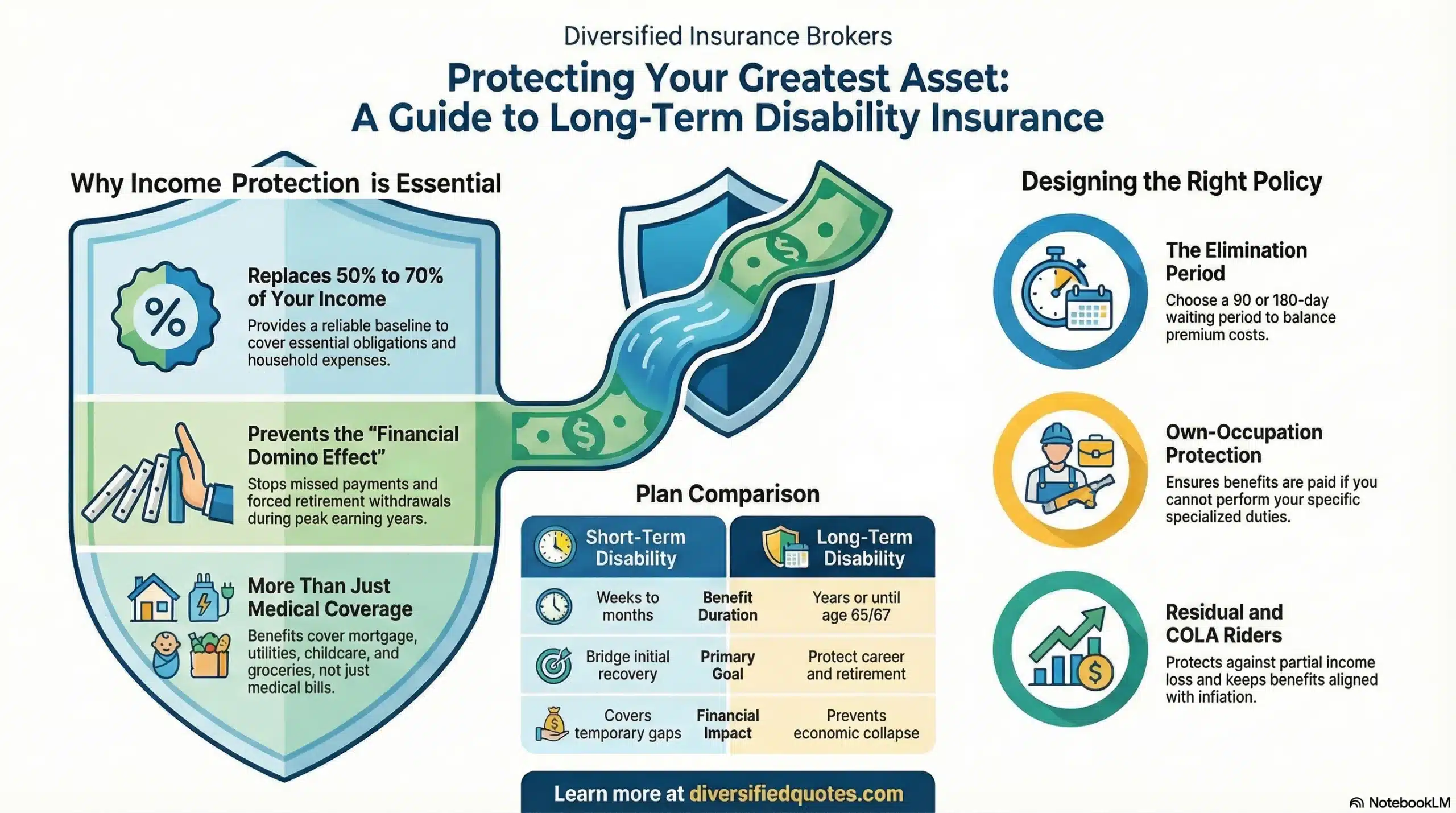
A residual disability rider is important for gardeners and arborists whose musculoskeletal conditions may reduce work capacity without eliminating it entirely — a gardener who can manage limited lighter maintenance work but cannot sustain full-day physical garden work earns reduced income without being totally disabled. Our resource on how residual disability insurance benefits work explains how partial disability coverage supports green industry professionals through graduated recovery. The elimination period should be calibrated to available financial reserves — our guide on how disability insurance elimination periods work provides the complete framework. A cost-of-living adjustment rider preserves real benefit value across extended disability periods — our resource on disability income insurance with a COLA rider explains this protection. For arborists and gardeners exploring short-term coverage options, our guide on how to buy short-term disability insurance covers the complete income protection picture.
Occupational Classification and Specialty Market Access
Arborist and tree service work presents one of the most significant occupational classification challenges in the disability insurance marketplace. The fatality rate statistics — 15 times the all-industry rate — place commercial tree service work in a hazard category that some standard retail disability insurance carriers decline to underwrite or underwrite only with significant restrictions. Other carriers with specific experience in outdoor manual trade and high-hazard occupational classifications write arborist disability insurance with terms that are genuinely meaningful for the hazard level involved.
Professional gardeners and landscape maintenance workers — whose ground-level work involves substantially lower acute fatal hazard risk than commercial tree service — typically receive more favorable occupational classifications that provide access to stronger own-occupation definitions and a broader range of supplemental riders at competitive premium rates. For arborists who also perform significant administrative or business management functions alongside field work, presenting the full duty profile to underwriters accurately and strategically is an important element of achieving the most favorable available classification. This classification complexity requires specialty broker expertise, paralleling the occupational classification challenges facing other extreme outdoor labor professionals, including aerial application and extreme outdoor operators managing specialty market disability insurance placement.
Why Arborists and Gardeners Need an Independent Disability Insurance Broker
Disability insurance for arborists and gardeners involves specialty market access considerations for tree service work, occupational classification distinctions between arborist and gardener roles, self-employment income documentation for Schedule C business income, and policy feature evaluation that requires independent broker expertise to navigate effectively. A standard retail disability insurance application is not optimized for the green industry occupational context, and a general insurance agent unfamiliar with tree service hazard classifications and green industry business income structures will not produce the most comprehensive available coverage.
At Diversified Insurance Brokers, we work with certified arborists, tree service business operators, professional gardeners, landscape maintenance workers, and green industry business owners across all operational scales to structure disability coverage that accurately reflects how green industry professionals earn, what injuries would actually prevent them from working, and what policy features provide the most meaningful financial protection for this high-hazard, predominantly self-employed professional population. Our dedicated resource on why independent disability insurance brokers matter explains the full value of this approach. For green industry professionals evaluating the foundational financial case for disability insurance, our resource on whether disability insurance is worth the investment provides the complete picture of what is at stake for a self-employed outdoor professional with 15 times the national fatality rate and no employer safety net.
Final Thoughts on Disability Insurance for Arborists and Gardeners
Arborists and professional gardeners contribute irreplaceable expertise to the health, safety, and beauty of the urban and suburban landscape — managing tree risks that protect homes and infrastructure, maintaining the horticultural environments that define community character, and providing the specialized knowledge and physical skill that keeping trees and landscapes healthy requires. The documented fatality and injury rates of this work reflect the genuine physical hazards accepted in performing it, and the predominantly self-employed structure of the green industry means that those hazards are faced without the institutional income protection that employed workers in other industries receive as a baseline.
Disability insurance for arborists and gardeners is the financial tool that ensures a tree fall, a chainsaw injury, a struck-by incident, or a career-long musculoskeletal condition does not also become a financial catastrophe. A well-structured policy provides the income replacement that allows a green industry professional to recover completely, preserves the business infrastructure that represents their professional and financial investment, and ensures that the decision about when to return to physically demanding tree and garden work is made based on genuine medical readiness rather than financial desperation.
Related Pages
Talk With an Advisor Today
Choose how you’d like to connect—call or message us, then book a time that works for you.
Schedule here:
calendly.com/jason-dibcompanies/diversified-quotes
Licensed in all 50 states • Fiduciary, family-owned since 1980
Disability Insurance for Arborists and Gardeners FAQs
Yes, arborists and professional gardeners can obtain individual disability insurance, though the occupational classification process — particularly for commercial tree service arborists whose hazard profile is among the most extreme in any labor occupation — requires specialized broker expertise. Professional gardeners and landscape maintenance workers whose work is ground-based typically receive favorable occupational classifications with access to strong own-occupation definitions and a broad range of supplemental riders. Commercial arborists who perform tree climbing, aerial lift work, and tree removal operations receive classifications that reflect the significantly elevated hazard profile of that work — and some standard retail carriers decline to write tree service disability coverage or write it only with significant limitations, while specialty market carriers with experience in high-hazard outdoor occupational classifications provide more meaningful coverage options. The most important planning considerations are selecting a carrier whose classification approach produces genuine own-occupation coverage for tree service duties, ensuring the benefit amount reflects actual business income, and including a residual disability rider for the musculoskeletal conditions that gradually develop over a climbing career. For context on disability insurance for other high-hazard outdoor trade occupations, see our page on disability insurance for crane operators and other high-hazard outdoor equipment workers.
Arborist and tree service work is among the most statistically dangerous occupations in the United States. Published research and Bureau of Labor Statistics data document that tree workers have at least 15 times the all-industry fatality rate. The non-fatal injury rate for tree workers is 239 per 10,000 workers — nearly three times the all-industry average of 89. Grounds maintenance workers (including arborists and landscapers) experienced an average annual fatality rate of 19.1 per 100,000 FTE, compared to 3.8 across all private industries — five times the national average. Tree workers represent less than 0.05% of the U.S. workforce but may account for approximately 1.4% of all work-related fatalities — a disproportionate fatality burden that reflects the genuine severity of arborist occupational hazards. Falls from trees alone account for nearly 3% of all fatal falls in the United States across all industries. Research reviewing 865 fatal arborist incidents identifies the four leading fatal categories as climber falls, struck by falling tree or branch, electrocution from power line contact, and wood chipper incidents. These statistics describe one of the genuinely most dangerous labor occupations in the country.
For arborists, falls from trees and aerial equipment represent the most severe acute disability risk — serious falls produce traumatic brain injuries, spinal cord injuries, pelvic fractures, and multiple orthopedic injuries with recovery timelines measured in months and potential permanent functional consequences. Struck-by incidents from falling trees and branches — documented as the most common fatal incident category in arborist research — produce serious blunt force trauma injuries. Chainsaw injuries from kickback produce severe lacerations to the hands, arms, and face that can cause permanent loss of fine motor function. Electrocution injuries from power line contact cause peripheral nerve damage, cardiac effects, and neuropsychological changes. For both arborists and gardeners, cumulative musculoskeletal conditions — rotator cuff injuries from climbing arm work, cervical and lumbar spine conditions from sustained physical loading, knee osteoarthritis from repeated kneeling — develop gradually over careers and produce the progressive functional limitations that eventually limit active tree and garden work capacity. Wood chipper entanglement incidents, while less frequent, produce the most catastrophic non-fatal injury outcomes. For context on how high-hazard outdoor labor disabilities are classified, see our resource on disability insurance for well drillers and other extreme outdoor labor workers.
Own-occupation disability insurance pays benefits when a disabling condition prevents an arborist from performing the specific duties of their tree service profession — climbing operations, aerial lift work, chainsaw operations, rigging and removal work — regardless of whether they could theoretically perform other less physically skilled or less hazardous work. Any-occupation coverage only pays if the arborist cannot perform virtually any gainful employment. A certified arborist whose traumatic brain injury from a fall prevents return to the cognitive precision and physical demands of active tree service work but who could theoretically perform sedentary desk work would receive no any-occupation benefits, while an own-occupation policy recognizes the genuine inability to perform arborist duties and pays accordingly. For an arborist who has invested years in developing the specialized physical skills, safety certifications, and technical knowledge of their profession — and whose entire income depends on the specific capacity to perform that work — the any-occupation definition provides almost no meaningful income protection for the most likely disability scenarios. Own-occupation coverage is the only definition that genuinely protects arborist professional income.
Yes, strongly. Arborist and garden business owners carry ongoing fixed costs — equipment loans on chipper trucks and aerial lifts, commercial vehicle payments, tool and equipment maintenance costs, business insurance premiums, and potentially crew payroll — that continue during a disability regardless of whether the owner can work. Personal disability income insurance replaces the owner’s professional income during a disability but does not cover these business costs, which must be funded from personal disability benefits or business reserves not intended to sustain a tree service or garden maintenance operation during the owner’s absence. Business overhead expense insurance covers these fixed operating costs during a disability period, preserving the equipment fleet, the business licenses, and the client base that the owner has built over years. For an arborist who has invested significantly in equipment and a client referral network, maintaining that business infrastructure during a recovery period is essential to returning to operation after a serious injury. For context on how business overhead expense coverage works for self-employed outdoor service business owners, see our page on disability insurance for self-employed hazardous trade operators managing business continuity during disability.
Residual disability coverage pays proportional benefits when a disabling condition reduces work capacity without completely eliminating the ability to work. A gardener recovering from knee surgery may be cleared for limited lighter maintenance work — planting, pruning low shrubs, advising clients — months before they can safely return to the full physical demands of sustained kneeling, digging, and heavy garden maintenance work. An arborist recovering from a shoulder injury may be able to supervise ground crew and manage business operations but cannot perform active climbing or aerial lift work. During these graduated return periods, income is significantly reduced without being fully eliminated. Without a residual disability rider, a total-disability-only policy pays nothing during this partial capacity period. A residual rider supplements reduced green industry income proportionally throughout the return to full working capacity, providing continuous financial support from disability onset through complete return to normal service operations. For both arborists and gardeners, whose most likely career-wear disability conditions produce gradual functional limitations rather than sudden total incapacity, the residual rider is essential for the disability policy to function as genuine income protection.
In most states, workers’ compensation does not automatically cover self-employed sole proprietor arborists and gardeners — it covers employees working for a business, not the business owner themselves. Some states allow self-employed workers to elect workers’ compensation coverage for themselves at additional cost, but even when elected, workers’ compensation provides only partial wage replacement for work-related injury events and excludes illness, off-duty injuries, and gradually developing occupational health conditions from career physical loading. For the vast majority of self-employed arborists and gardeners who have not elected workers’ compensation coverage, individual disability insurance is the only available income protection — covering disability from any cause regardless of how it developed, for the full benefit period, without the restrictions that workers’ compensation places on benefit eligibility and duration. For arborist and garden business owners with employees, workers’ compensation is required for those employees but still does not protect the owner’s personal income unless specifically elected.
Yes — individual disability insurance covers disability from any cause including acute tool injuries, when the condition meets the policy’s definition of disability. A chainsaw kickback injury that produces permanent nerve damage or tendon injury to the dominant hand — preventing the sustained precision tool operation and physical tree service work that arborist duties require — qualifies for disability benefits under a well-structured own-occupation policy. Even non-catastrophic chainsaw lacerations that produce partial functional limitations to hand or arm function, reducing but not eliminating work capacity, qualify for residual disability benefits under policies with a residual rider. The acute injury nature of chainsaw and power tool injuries — which typically produce immediate and complete work stoppage — makes the elimination period particularly relevant: a 30 or 60-day elimination period is more appropriate than a 90-day waiting period for arborists whose self-employment income stops on the first day of disability with no workers’ compensation bridge. For context on disability insurance covering acute tool and equipment injury events for self-employed trade operators, see our resource on disability insurance for manual labor professionals managing acute equipment injury coverage needs.
Self-employed arborists and gardeners with no employer sick pay and no workers’ compensation coverage for themselves face the sharpest version of the elimination period decision — their income stops completely on the first day of disability with no institutional bridge income of any kind. For these professionals, a 30 or 60-day elimination period is typically more appropriate than the 90-day period that employed workers with sick leave and workers’ compensation bridges can manage. The specific disability risk profile of arborists — where the most likely catastrophic disability events (serious falls, struck-by incidents, chainsaw injuries) produce immediate and complete income interruption — argues particularly strongly for a shorter elimination period that provides benefit access within weeks rather than months. For arborists and gardeners with stronger emergency financial reserves or a household with supplemental income from a partner, a 90-day elimination period may be financially manageable. The key question is whether available savings can sustain both household obligations and business fixed costs throughout the entire waiting period with zero professional income coming in.
The best time is as early as possible in a green industry career — ideally when first entering the profession or starting a business, before any occupational health consequences from tree climbing, chainsaw operation, fall incidents, or sustained outdoor physical labor have accumulated in the medical record. Disability insurance premiums are based in part on age and health status at the time of application, and younger arborists and gardeners in excellent health secure the most comprehensive coverage at the most favorable rates. Research specifically documents that tree-worker fatalities disproportionately affect older workers — suggesting that occupational injury risk and its health consequences accumulate with career experience and age. Shoulder conditions from sustained climbing work, spinal conditions from career physical loading, and any orthopedic injury history from prior incidents can result in exclusion riders if documented at application. Applying before these occupational health consequences develop ensures comprehensive coverage is in place when they eventually appear. The non-cancelable and guaranteed renewable provision locks in the early-career health rating for the policy’s entire duration, regardless of what occupational health developments occur during subsequent years of tree and garden work.
An independent broker with high-hazard outdoor occupational underwriting expertise is essential for arborists seeking commercial tree service disability coverage — because some standard retail disability carriers decline tree service coverage entirely, while specialty market carriers provide meaningful options that standard retail applications cannot access. For gardeners and landscape maintenance workers in more favorable occupational classifications, an independent broker can still compare occupational class assignments, own-occupation definition language, residual disability provisions, income documentation approaches for garden business Schedule C income, and premium structures across multiple carriers to identify the most comprehensive available coverage at the best available rate. At Diversified Insurance Brokers, we evaluate the full competitive landscape for every arborist and gardener we work with, identify carriers whose underwriting guidelines most favorably accommodate green industry occupational classifications at all hazard levels, and structure coverage genuinely calibrated to how green industry professionals earn, what conditions would actually prevent them from working, and what policy features provide the most meaningful financial protection for self-employed outdoor professionals managing income entirely through physical performance capacity.
About the Author:
Jason Stolz, CLTC, CRPC, DIA, CAA and Chief Underwriter at Diversified Insurance Brokers (NPN 20471358), is a senior insurance and retirement professional with more than 25 years of real-world experience helping individuals, families, and business owners protect their income, assets, and long-term financial stability. As a long-time partner of the nationally licensed independent agency Diversified Insurance Brokers, Jason provides trusted guidance across multiple specialties—including fixed and indexed annuities, long-term care planning, personal and business disability insurance, life insurance solutions, Group Health, Travel Medical and Evacuation Insurance, and short-term health coverage. Diversified Insurance Brokers maintains active contracts with over 100 highly rated insurance carriers, ensuring clients have access to a broad and competitive marketplace.
His practical, education-first approach has earned recognition in publications such as VoyageATL, and contributions from his agency featured in Kiplinger and GoBankingRates— highlighting his commitment to financial clarity and client-focused planning. Drawing on deep product knowledge and years of hands-on field experience, Jason helps clients evaluate carriers, compare strategies, and build retirement and protection plans that are both secure and cost-efficient. Visitors who want to explore current annuity rates and compare options across multiple insurers can also use this annuity quote and comparison tool.
Explore More Disability Insurance Options: Browse our complete guide to Disability Insurance for Agriculture, Natural Resources & Outdoor Industries — covering farmers, ranchers, fishermen, foresters, miners, oil & gas workers & outdoor industries from 100+ carriers.
Last Reviewed: May 3, 2026 |
Reviewed by: Jason Stolz, CLTC, CRPC, DIA, CAA
Chief Underwriter, Diversified Insurance Brokers, Inc. | NPN: 20471358 | Diversified Insurance Brokers, Inc. — Licensed in all 50 states
Fact Checked by: Tonia Pettitt, CMIP©
Medicare Specialist, Diversified Insurance Brokers, Inc. | NPN: 14374308 | Diversified Insurance Brokers, Inc. — Licensed in all 50 states
Did you find this content helpful? Leave us a Google review — it helps others find trustworthy guidance too.
Editorial Standards: Diversified Insurance Brokers maintains rigorous editorial standards to ensure accuracy, clarity, and independence in all content. Learn more about our editorial standards and commitment to transparency.
