
Disability Insurance for Exterminators
As an Independent Disability Insurance Broker, we have access to exclusive discounts and negotiated pricing most captive agents can’t offer — see the full breakdown near the end of this page.
Disability Insurance for Exterminators

Jason Stolz CLTC, CRPC, DIA, CAA
Disability insurance for exterminators is an essential but critically underutilized form of income protection for professionals who spend their working lives handling toxic chemical compounds in residential, commercial, and industrial environments. Whether you operate as a self-employed pest control operator running your own exterminating business, work as a licensed technician for a regional or national pest management company, specialize in fumigation, termite control, bed bug remediation, or rodent exclusion, or focus on wildlife and nuisance animal removal — your income depends entirely on your physical ability to perform demanding field work in environments that carry documented, serious occupational health risks every single day.
The pest control and extermination industry is one of the most chemically intensive service professions in the workforce. Exterminators apply, handle, and are exposed to insecticides, rodenticides, fungicides, fumigants, and other chemical compounds specifically formulated to be toxic to living organisms. The occupational health consequences of sustained daily pesticide exposure — acute poisoning events, chronic neurological damage, respiratory disease, and elevated cancer risk documented across multiple studies — create a disability risk profile that makes individual income protection not merely advisable but genuinely essential for anyone making their living in this field.
At Diversified Insurance Brokers, we work with exterminators, pest control operators, and pest management professionals to structure disability insurance coverage that reflects the real chemical hazards, physical demands, and income structure of the extermination profession. A properly designed policy protects against both acute poisoning events and the long-term occupational illnesses that develop gradually over years of pesticide exposure — and it does so in a way that is built around how exterminators actually earn and what conditions are most likely to interrupt that income.
Protect Your Income as an Exterminator
Compare disability insurance options designed for pest control operators, licensed exterminators, fumigation specialists, and pest management professionals.
What Exterminators Do and Why Disability Insurance Matters
Disability insurance for exterminators begins with a clear understanding of what pest control and extermination work actually involves — because the specific occupational demands and hazards of the profession define exactly which conditions are most likely to disable an exterminator and end or interrupt their income stream.
A working day for an exterminator involves driving a service vehicle between multiple client locations, preparing and mixing pesticide solutions according to label specifications, applying chemical treatments through sprayers, bait stations, dusters, and fumigation equipment, crawling into confined spaces including crawl spaces, attics, wall voids, and sub-slab areas to assess and treat infestations, inspecting and treating structures at heights using ladders, and managing client interactions and documentation between service calls. The work is physically demanding, chemically intensive, and performed in environments the exterminator cannot fully control.
Fumigation specialists face the most intense chemical exposure of any pest control specialty. Structural fumigation using sulfuryl fluoride or methyl bromide for termite or stored product pest control requires exterminators to work directly with compounds that are acutely toxic at low concentrations. Even with respiratory protection, fumigation specialists accumulate greater chemical exposure burden over a career than general pest control technicians. This elevated exposure profile creates a correspondingly elevated disability risk that individual income protection must address. The chemical exposure dimension of exterminator disability risk parallels the documented occupational disease risks facing other chemically intensive workers, including asbestos removal professionals managing toxic occupational exposure.
Pesticide Exposure — The Primary Long-Term Disability Risk for Exterminators
No discussion of disability insurance for exterminators is complete without a thorough examination of pesticide exposure and its documented health consequences for pest control workers. Exterminators are among the most consistently and heavily pesticide-exposed workers in any non-agricultural occupational setting, and the health consequences of that exposure are documented, serious, and capable of producing career-ending disability over the course of a working lifetime.
Acute pesticide-related illness and injury is a recognized and tracked occupational hazard in the pest control industry. In the pest control industry alone, nearly 3,900 non-fatal occupational injuries and illnesses were documented in a single recent year — and nearly half required days away from work. Acute pesticide exposure events produce a range of immediate health effects including skin irritation and chemical burns from dermal contact, eye damage from splash exposure, nausea, vomiting, and neurological symptoms from inhalation or dermal absorption of organophosphate or carbamate compounds, and in severe cases, acute respiratory failure, seizures, and cholinergic crisis from high-level exposure to the most toxic compound classes.
An acute poisoning event that produces significant neurological or respiratory damage can disable an exterminator from continuing field work immediately and permanently. Even events that resolve without lasting physical damage create documented evidence of chemical sensitivity that may affect future insurability and occupational capacity. For exterminators who experience a significant acute exposure event, the financial consequences without disability insurance in place are immediate and severe — particularly for self-employed pest control operators whose income ceases entirely when they cannot work the field.
Chronic pesticide exposure — the accumulation of lower-level chemical contact over years and decades of pest control work — carries a different but equally serious disability risk profile. Research on occupational pesticide exposure consistently identifies elevated risk of neurological disorders including Parkinson’s disease and other neurodegenerative conditions, respiratory diseases including occupational asthma and COPD, and various cancers associated with specific pesticide compound classes. These chronic exposure consequences develop gradually over a career, often without early warning symptoms, and may produce disabling conditions that emerge years or even decades after the period of heaviest exposure. This long-latency occupational disease pattern makes disability insurance for exterminators essential from the earliest years of a pest control career — well before the health consequences of cumulative exposure become apparent. The same long-term chemical exposure pattern affects other field service professionals including workers with sustained chemical occupational exposure.
Neurological Risk From Pesticide Exposure for Pest Control Workers
Among the most significant long-term disability risks for exterminators is the well-documented association between chronic occupational pesticide exposure and neurological health effects. The nervous system is particularly vulnerable to pesticide compounds — many of which are specifically designed to disrupt the neurological function of target organisms through mechanisms that also affect human neurological health at sufficient exposure levels.
Organophosphate pesticides, widely used in commercial and residential pest control applications, inhibit acetylcholinesterase — the enzyme responsible for clearing acetylcholine from nerve synapses. Acute high-level exposure produces the cholinergic toxidrome, including seizures, respiratory paralysis, and loss of consciousness. Chronic lower-level exposure to organophosphates has been associated in multiple research reviews with impaired cognitive function, memory difficulties, attention deficits, and mood disorders that can affect professional performance and quality of life long after direct exposure has ended.
The association between occupational pesticide exposure and Parkinson’s disease and other neurodegenerative conditions has been documented across multiple epidemiological studies of pest control workers and agricultural applicators. While research continues to refine the specific compounds and exposure levels involved, the weight of evidence supports a meaningful elevated risk for exterminators who spend careers in chemical contact. A progressive neurological condition that affects motor function, cognitive capacity, or both can end an exterminator’s ability to perform field work long before conventional retirement age — and individual disability insurance is the only financial tool that provides income replacement when this type of gradually developing occupational condition produces genuine career-ending disability. For exterminators who want to understand how own-occupation disability coverage protects against conditions that impair specific occupational function, our resource on own-occupation disability insurance explained is essential reading.
Respiratory Disease — A Documented Occupational Hazard for Exterminators
Respiratory conditions are among the most prevalent occupational health outcomes for exterminators and pest control technicians with sustained chemical exposure. Research on occupational pesticide exposure consistently identifies strong associations with respiratory disease — including occupational asthma, chronic bronchitis, and COPD — across multiple study populations of workers in pest control and agricultural pesticide application settings.
Exterminators regularly apply aerosol and spray formulations in enclosed indoor environments — crawl spaces, wall voids, basements, attics, and occupied structures — where airborne chemical concentrations can briefly reach levels sufficient to trigger respiratory sensitization in susceptible individuals. Once occupational asthma develops from pesticide exposure, continued work in chemical environments can exacerbate the condition even at exposure levels below those that originally triggered sensitization. In severe cases, an exterminator who develops occupational asthma may be unable to continue field pest control work in any chemical application capacity, constituting a genuine own-occupation disability that ends the career regardless of the exterminator’s overall physical health.
Fumigation specialists face the most acute respiratory risk in the pest control industry. Fumigant compounds including sulfuryl fluoride are acutely toxic to the respiratory system at elevated concentrations, and even properly protected fumigation workers accumulate lifetime respiratory exposure that can produce long-term lung health consequences. For pest control professionals whose careers involve sustained respiratory chemical exposure, disability insurance that covers occupational respiratory disease is not a peripheral consideration — it is a core component of income protection planning. A residual disability rider is particularly valuable for respiratory conditions that may limit work capacity without completely eliminating it, and our resource on how residual disability benefits work explains this important coverage feature in full detail.
Physical Injury Risks for Exterminators Beyond Chemical Exposure
While chemical exposure is the most distinctive and documented disability risk for exterminators, it is not the only occupational hazard that makes disability insurance for exterminators essential. The physical demands and environments of pest control work create meaningful acute injury risk that adds to the overall income protection exposure of working exterminators.
Confined space entry is a daily routine for many exterminators who must access crawl spaces, sub-slab areas, wall voids, and attic spaces to inspect and treat pest infestations. These environments present fall hazards, structural hazards, and exertion risks that can produce acute musculoskeletal injuries. A back injury sustained while crawling through a crawl space or lifting a heavy bag of rodenticide can require weeks or months of recovery during which field pest control work is not medically feasible.
Ladder use for elevated inspections and treatments, wildlife removal requiring physical restraint of animals, and vehicle accidents during the substantial driving component of most exterminator workdays all contribute to an acute injury risk profile that is meaningful across a pest control career. Bee and wasp stings — a documented occupational hazard for exterminators who treat stinging insect colonies — can produce severe anaphylactic reactions in sensitized individuals, and a single severe sting reaction can trigger sensitization that effectively ends an exterminator’s ability to work safely around stinging insects. The occupational injury risk that exterminators face in their daily field work is comparable to other physically active service trades, including well drillers facing physical field service hazards.
Case Study: Self-Employed Exterminator Earning $68,000 Per Year
Consider a self-employed pest control operator running a one-person residential and commercial exterminating business, earning $68,000 annually. After eleven years of regular pesticide application work, this exterminator develops occupational asthma with documented sensitization to pyrethroid compounds — the chemical class used in the majority of their residential treatments. The treating pulmonologist advises that continued exposure to pyrethroids will progressively worsen the condition and recommends cessation of pesticide application work.
| Scenario | Without Disability Insurance | With Disability Insurance |
|---|---|---|
| Monthly Income During Disability | $0 | $2,800–$3,700 |
| 12-Month Total Income | $0 | $33,600–$44,400 |
| Business Continuity | Client base lost, business forced to close | Income bridge supports planned career transition |
| Financial Outcome | Financial crisis, savings depleted, years of business equity lost | Financial stability maintained during career adjustment |
Occupational asthma from pesticide sensitization is a documented and recurring outcome in the pest control industry. It is precisely the type of gradually developing occupational illness that workers’ compensation rarely covers effectively and that individual disability insurance is specifically designed to address — providing income replacement when an occupational health condition ends or significantly impairs the ability to continue in the specific profession, regardless of whether other work is theoretically possible.
Workers’ Compensation vs. Individual Disability Insurance for Exterminators
Many exterminators, particularly those employed by pest control companies, assume that workers’ compensation provides adequate income protection in the event of a work-related injury or illness. This assumption creates significant and consequential financial vulnerability that only becomes apparent when a disability actually occurs. Understanding the difference between workers’ compensation and individual disability insurance for exterminators is one of the most important financial planning points for anyone in the pest control profession.
Workers’ compensation covers injuries and illnesses that are directly and demonstrably work-related — an acute pesticide exposure event on a job site, a fall from a ladder during a treatment, a confined space injury during a crawl space inspection. For these acute work-related events, workers’ compensation provides medical treatment coverage and approximately two-thirds of pre-injury wages during recovery. For self-employed exterminators who have not elected workers’ compensation coverage for themselves, even this baseline protection may be absent.
Workers’ compensation does not cover non-work-related disabilities of any kind. An exterminator who develops cancer, suffers a cardiovascular event, is injured in an off-duty automobile accident, or becomes disabled from any condition not directly connected to a specific workplace event receives no workers’ compensation benefit. Workers’ compensation also struggles to cover the gradually developing occupational diseases — neurological disorders from chronic pesticide exposure, progressive respiratory conditions, pesticide-related cancers — that develop over years of cumulative exposure without a single identifiable triggering work event. Individual disability insurance covers disability from any cause that meets the policy definition, making it the essential complement to workers’ compensation for every exterminator. Our full guide on how disability insurance elimination periods work provides context on how to structure the waiting period before benefits begin to match your specific financial situation.
Disability Insurance for Self-Employed Pest Control Operators
The majority of independent pest control operators — those who own and operate their own exterminating businesses without corporate employment — have no employer sick pay, no group disability plan, and no paid leave of any kind. When a disability prevents field work, income stops immediately and completely. The ongoing fixed costs of the business — vehicle payments, chemical inventory, licensing and insurance, equipment maintenance, and marketing — continue regardless of whether the owner can work the field.
Individual disability insurance is the only meaningful income replacement tool available to self-employed exterminators facing a disabling condition outside of the very limited SSDI system. Beyond personal income replacement, self-employed pest control operators should consider business overhead expense coverage as a companion product. A business overhead expense policy covers the fixed ongoing costs of the pest control operation during a disability period, preventing a temporary health event from producing permanent business closure due to inability to meet ongoing financial obligations while the owner recovers.
For self-employed exterminators documenting income for disability insurance underwriting, Schedule C net profit is the primary figure that carriers use. Pest control operators who aggressively deduct business vehicle costs, chemical inventory, equipment, and licensing reduce their reported net profit — and simultaneously reduce the income available to insure and the maximum benefit amount accessible under a disability policy. Working with an independent broker who understands how to present self-employment income documentation to underwriters effectively is essential for securing coverage that reflects actual earning capacity rather than the lowest year in a variable income history. The income documentation challenge facing self-employed exterminators is parallel to that of other self-employed trade professionals, including independent contractors navigating self-employment income underwriting.
Key Policy Features for Exterminator Disability Insurance
Disability insurance for exterminators should be structured with specific policy provisions that address the realities of pest control work — particularly the long-latency nature of occupational chemical disease and the self-employment income structure that characterizes much of the profession. The own-occupation definition of disability is foundational — it pays benefits when a condition prevents the exterminator from performing the specific duties of pest control work regardless of whether they could theoretically perform other types of work. For an exterminator whose respiratory condition prevents chemical pesticide application but who could technically perform desk work, an own-occupation policy recognizes the genuine occupational disability and pays accordingly.
A cost-of-living adjustment rider is particularly valuable for exterminators who may develop long-term or progressive occupational illnesses — neurological conditions, progressive respiratory disease, or occupational cancer — whose disabling consequences extend for years or decades. Without COLA protection, a monthly benefit adequate at the onset of disability loses real purchasing power over an extended claim period. Our resource on disability income insurance with a COLA rider explains how this inflation protection works and why it matters for the long-term disability scenarios most likely to affect exterminator careers.
The non-cancelable and guaranteed renewable provision is essential for exterminators who apply early in their careers — locking in premium rates and coverage terms regardless of how occupational health conditions may accumulate in the medical record over subsequent years of chemical exposure. An exterminator who secures a non-cancelable policy at 28 in excellent health has their rate locked in for the life of the policy, even if they develop chemical-related health findings at 45 that would affect a new application. This provision is among the most valuable features in any disability policy for professionals whose career involves long-term health exposure that is expected to accumulate over time.
Why Exterminators Need an Independent Disability Insurance Broker
Disability insurance for exterminators involves occupational risk factors — chemical exposure history, pesticide application as a primary job function, confined space work, and the chronic occupational disease risk profile of pest control work — that require careful carrier evaluation. Some disability insurance carriers decline pest control occupational classes entirely or impose exclusion riders on chemical exposure conditions that effectively eliminate the most relevant disability coverage for an exterminator’s actual risk profile.
At Diversified Insurance Brokers, we have the carrier access and occupational underwriting expertise to identify which companies write pest control and extermination occupational classes with comprehensive coverage and which impose restrictions that undermine policy value. We evaluate the full competitive landscape for each individual exterminator, structure coverage that addresses the chemical exposure and physical hazard dimensions of the profession, and navigate the income documentation requirements of self-employed pest control operators on behalf of each client. Our dedicated resource on why independent disability insurance brokers matter explains the full value of this approach for service and trade professionals whose occupational risk profile requires expertise beyond what a standard retail disability insurance application provides.
Final Thoughts on Disability Insurance for Exterminators
Exterminators and pest control professionals provide an essential service that protects public health, prevents property damage, and keeps communities safe from the diseases and destruction that pest infestations produce. The occupational price of that service — sustained daily pesticide exposure, documented neurological and respiratory health risk, physical field work demands, and the ever-present possibility of an acute chemical exposure event — creates a genuine and meaningful income protection need that workers’ compensation alone cannot address.
Disability insurance for exterminators is the financial tool that ensures a career-ending occupational illness or injury does not simultaneously produce a personal financial catastrophe. A well-structured policy — covering occupational chemical disease, acute injury, and any non-work-related disability — provides the income replacement that allows an exterminator to manage a health crisis from a position of financial stability rather than desperation. At Diversified Insurance Brokers, we are committed to helping every pest control professional secure that protection at the best available terms.
Related Pages
Talk With an Advisor Today
Choose how you’d like to connect—call or message us, then book a time that works for you.
Schedule here:
calendly.com/jason-dibcompanies/diversified-quotes
Licensed in all 50 states • Fiduciary, family-owned since 1980
Disability Insurance for Exterminators FAQs
Yes, exterminators and pest control professionals can obtain individual disability insurance. The occupation is classified in the lower physical labor and higher-risk occupational tiers by disability insurance carriers — reflecting the chemical exposure, physical field work demands, and elevated occupational illness risk of pest control work — which affects premium costs and the specific policy features available. Disability insurance for exterminators is obtainable from carriers experienced with chemically intensive service industry and trade occupational classifications, and the coverage provided is directly relevant to the real disability risks of the profession. Self-employed pest control operators face additional income documentation considerations in underwriting, making an experienced independent broker particularly important for securing coverage that accurately reflects earning capacity and responds effectively to the most likely disability scenarios facing pest control professionals.
The disability risk profile for exterminators spans both acute and chronic categories. Acute pesticide exposure events — dermal contact with concentrated compounds, inhalation of chemical vapors in confined treatment spaces, splash exposure to eyes or mucous membranes — can produce immediate and serious health effects including neurological symptoms, respiratory distress, and in severe cases, permanent organ damage that ends a pest control career. Chronic pesticide exposure over years and decades of occupational chemical contact creates documented elevated risk of neurological disorders including Parkinson’s disease, respiratory diseases including occupational asthma and COPD, and various pesticide-associated cancers. Physical injury risks from confined space entry, ladder use, wildlife handling, and vehicular accidents during the substantial driving component of pest control work add further disability exposure on top of the chemical hazard profile. Anaphylactic sensitization from bee or wasp stings is a meaningful career-ending risk for exterminators who treat stinging insect colonies. Our resource on own-occupation disability insurance explained covers how the policy definition protects against these specific occupational disability scenarios.
Yes. Individual disability insurance covers disability from any cause — including occupational illnesses resulting from pesticide exposure — when the condition meets the policy’s definition of disability. An exterminator who develops disabling occupational asthma, a pesticide-associated neurological condition, or a cancer linked to occupational chemical exposure qualifies for disability benefits under a well-structured individual policy when the condition prevents them from working. The critical planning implication is timing: applying for disability insurance before pesticide-related health conditions have been diagnosed and documented is essential. A documented occupational illness at the time of application may result in exclusion riders that eliminate coverage for the most relevant conditions. Securing comprehensive coverage while health is good protects against the chemical exposure consequences that may develop over subsequent years of pest control work — the same reason early application is critical for other chemically exposed professionals, including asbestos removal workers managing long-latency disease risk.
No, and the gaps in workers’ compensation coverage are significant for exterminators. Workers’ compensation covers injuries and illnesses that are directly and demonstrably work-related — an acute chemical exposure event on a job site, a ladder fall during a treatment, a physical injury in a crawl space. It does not cover non-work-related disabilities of any kind. An exterminator who develops cancer, suffers a cardiovascular event, or is injured off-duty receives zero workers’ compensation benefit. Workers’ compensation also struggles to cover gradually developing occupational diseases like neurological disorders or respiratory conditions from chronic pesticide exposure, where the disabling condition results from cumulative exposure over years rather than a single identifiable work event. Many self-employed pest control operators have not elected workers’ compensation coverage for themselves at all, leaving them entirely unprotected even for work-related acute events. Individual disability insurance fills all of these gaps, covering disability from any cause regardless of origin.
Own-occupation disability insurance pays benefits when a condition prevents an exterminator from performing the specific duties of pest control work — chemical application, confined space entry, field service operations — regardless of whether they could theoretically perform other types of work. Any-occupation coverage only pays if the insured cannot perform virtually any gainful employment. For an exterminator whose respiratory sensitization to pesticide compounds prevents chemical application work but who could technically perform desk work, an any-occupation policy would deny benefits. An own-occupation policy would recognize the genuine occupational disability and pay accordingly. This distinction is particularly consequential for exterminators because the most likely disabling occupational conditions — chemical sensitization, respiratory disease, neurological impairment — frequently prevent the specific chemical exposure work of pest control while leaving the exterminator theoretically capable of other employment.
Residual disability coverage pays proportional benefits when a disabling condition reduces earning capacity without eliminating the ability to work entirely. An exterminator whose respiratory condition or physical injury limits them to a reduced service schedule — perhaps ten client visits per week rather than their normal thirty — earns significantly reduced income without being totally disabled. Without a residual disability rider, a total-disability-only policy would provide nothing during this partial recovery period. A residual rider supplements reduced earnings proportionally throughout the return-to-work arc, ensuring continuous financial support from onset of disability through full return to normal work capacity. For exterminators recovering from physical injuries or managing progressive chemical exposure conditions that limit but do not eliminate field work capacity, this rider is essential. Our full guide on how residual disability benefits work covers this feature in detail.
Yes, strongly. Self-employed pest control operators who have ongoing fixed business costs — service vehicle payments, chemical inventory and supply costs, licensing and certification fees, equipment maintenance, and marketing expenses — should consider business overhead expense coverage alongside personal income replacement disability insurance. These fixed costs continue during a disability regardless of whether the owner can perform field service work, creating a financial burden on top of the loss of personal income. Business overhead expense insurance covers these fixed business costs during a disability period, preventing a temporary health event from forcing permanent closure of an established pest control business. For a self-employed exterminator who has spent years building a client base and local reputation, maintaining the business infrastructure during recovery has real financial value. Personal disability income insurance and business overhead expense coverage address two distinct financial needs and are most effective when structured together as a comprehensive protection plan.
A cost-of-living adjustment rider increases the monthly disability benefit amount annually during a claim period, typically tied to the Consumer Price Index or a fixed annual percentage. For exterminators who may experience long-term or permanent disability from a gradually developing occupational illness — progressive neurological disease from chronic pesticide exposure, advanced COPD, or occupational cancer — this rider is particularly important. A monthly benefit adequate at the onset of disability loses real purchasing power over a five or ten-year extended claim without COLA protection. The COLA rider preserves the real value of disability income over the full duration of an extended claim, which is a meaningful financial consideration for the chronic occupational disease scenarios most likely to produce long-term disability in pest control careers. Our resource on disability income insurance with a COLA rider explains this protection in full.
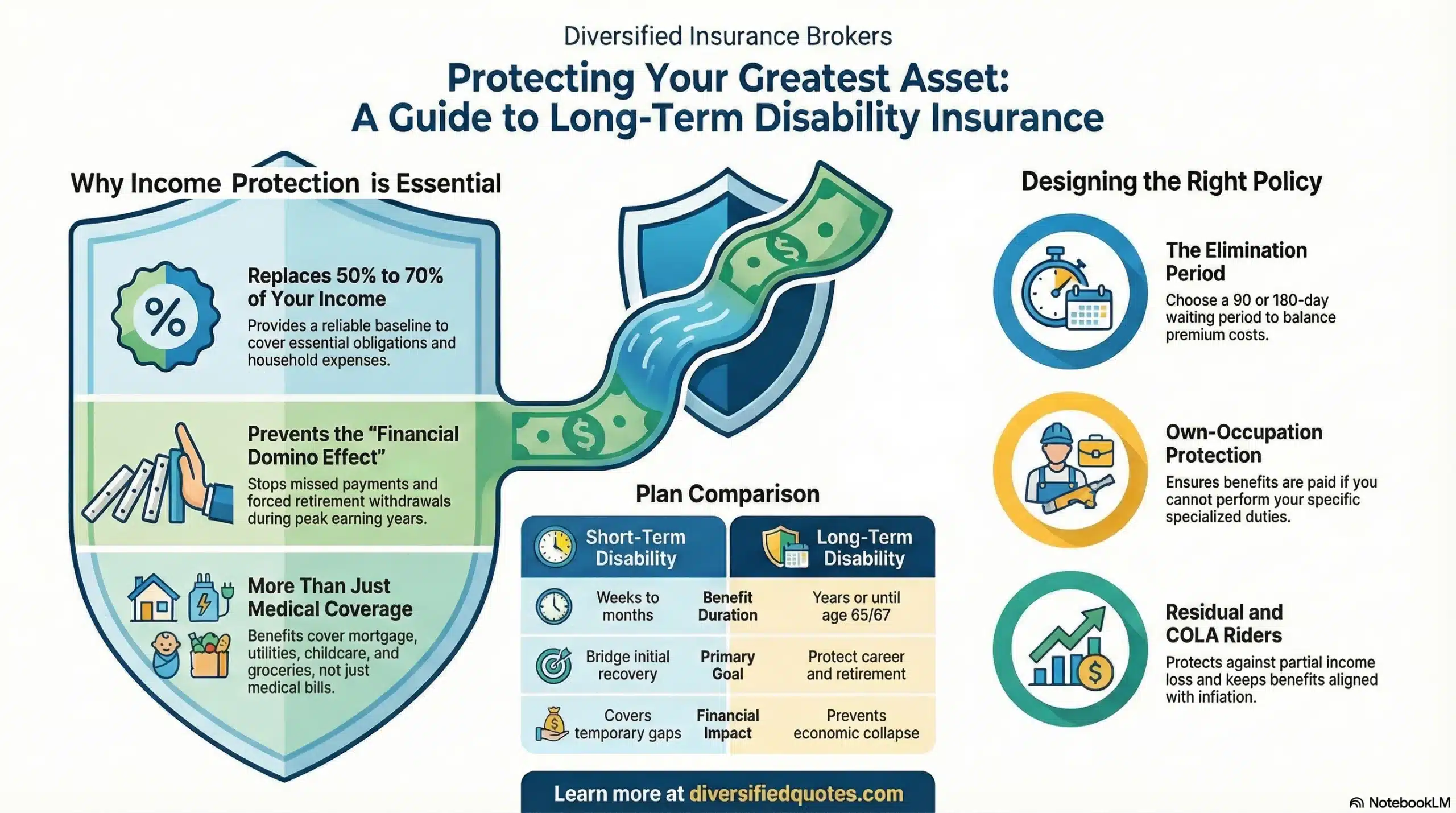
The elimination period — the waiting time between onset of disability and when benefits begin — should be calibrated to the exterminator’s available financial reserves and how quickly income loss would create genuine hardship. Self-employed pest control operators with no employer sick pay and limited emergency savings should consider a 30 or 60-day elimination period that provides faster benefit access, even at a higher premium cost. For a sole operator whose service income stops immediately when they cannot work the field, and who has ongoing vehicle, chemical, and business costs accumulating during the disability, a shorter waiting period before benefits begin can be critical financial protection. Pest control operators with stronger reserves may comfortably accept a 90-day elimination period to reduce premiums. Our full guide on how disability insurance elimination periods work provides the framework for making this decision based on your specific financial situation.
The best time is as early as possible in a pest control career — before occupational health conditions from chemical exposure, physical field work, or acute exposure events have accumulated in the medical record. This timing principle is especially critical for exterminators because the most serious long-term disability risks — neurological disorders from chronic pesticide exposure, progressive respiratory disease, and pesticide-associated cancers — develop gradually over years of occupational chemical contact without early symptoms. An exterminator who applies at the beginning of their career, before any pesticide-related health findings appear, secures the most comprehensive coverage at the most favorable rates. Waiting until mid-career — after documented respiratory findings, chemical sensitivity testing, or early neurological changes have appeared — significantly narrows available options and can result in exclusion riders or more restricted policy terms. The coverage secured early is the coverage in force when occupational health consequences eventually emerge.
An independent broker has access to multiple disability insurance carriers and can compare policy definitions, occupational class assignments, exclusion rider policies, rider availability, and premium structures across the full marketplace. For exterminators, carrier selection matters significantly because some carriers approach chemically intensive occupational classes with exclusion riders that eliminate coverage for chemical exposure conditions — the most relevant disability category for pest control professionals. A captive agent representing a single carrier can only present that company’s approach, regardless of whether it is the most favorable for an exterminator’s specific risk profile and self-employment income structure. At Diversified Insurance Brokers, we evaluate options across the full competitive landscape and structure coverage that reflects the actual chemical exposure and physical hazard risks of extermination work, without exclusions that undermine policy value at claim time. Our resource on why independent disability insurance brokers matter explains this value in full detail.
About the Author:
Jason Stolz, CLTC, CRPC, DIA, CAA and Chief Underwriter at Diversified Insurance Brokers (NPN 20471358), is a senior insurance and retirement professional with more than 25 years of real-world experience helping individuals, families, and business owners protect their income, assets, and long-term financial stability. As a long-time partner of the nationally licensed independent agency Diversified Insurance Brokers, Jason provides trusted guidance across multiple specialties—including fixed and indexed annuities, long-term care planning, personal and business disability insurance, life insurance solutions, Group Health, Travel Medical and Evacuation Insurance, and short-term health coverage. Diversified Insurance Brokers maintains active contracts with over 100 highly rated insurance carriers, ensuring clients have access to a broad and competitive marketplace.
His practical, education-first approach has earned recognition in publications such as VoyageATL, and contributions from his agency featured in Kiplinger and GoBankingRates— highlighting his commitment to financial clarity and client-focused planning. Drawing on deep product knowledge and years of hands-on field experience, Jason helps clients evaluate carriers, compare strategies, and build retirement and protection plans that are both secure and cost-efficient. Visitors who want to explore current annuity rates and compare options across multiple insurers can also use this annuity quote and comparison tool.
Explore More Disability Insurance Options: Browse our complete guide to Disability Insurance for Food, Hospitality, Arts & Entertainment — covering chefs, musicians, actors, bartenders, hospitality workers & entertainment professionals from 100+ carriers.
Last Reviewed: June 7, 2026 |
Reviewed by: Jason Stolz, CLTC, CRPC, DIA, CAA
Chief Underwriter, Diversified Insurance Brokers, Inc. | NPN: 20471358 | Diversified Insurance Brokers, Inc. — Licensed in all 50 states
Fact Checked by: Tonia Pettitt, CMIP©
Medicare Specialist, Diversified Insurance Brokers, Inc. | NPN: 14374308 | Diversified Insurance Brokers, Inc. — Licensed in all 50 states
Did you find this content helpful? Leave us a Google review — it helps others find trustworthy guidance too.
Editorial Standards: Diversified Insurance Brokers maintains rigorous editorial standards to ensure accuracy, clarity, and independence in all content. Learn more about our editorial standards and commitment to transparency.
