
Disability Insurance for Slaughterhouse Industries
As an Independent Disability Insurance Broker, we have access to exclusive discounts and negotiated pricing most captive agents can’t offer — see the full breakdown near the end of this page.
Disability Insurance for Slaughterhouse Industries

Jason Stolz CLTC, CRPC, DIA, CAA
Slaughterhouse and meat processing workers face one of the most documented and consistently elevated occupational injury and illness profiles in American industry. This is not a matter of industry perception — it is confirmed statistical reality backed by federal data. In October 2024, the U.S. Department of Labor’s Occupational Safety and Health Administration released expanded inspection guidance for animal slaughtering and processing establishments specifically because according to employer-reported data, meat and poultry workers suffer serious injuries at double the rate of other workers. More strikingly, in 2022, reported cases of occupational illness among workers in animal slaughtering and processing were six times higher than the average for all industries that year. For the hundreds of thousands of Americans who work in this sector, disability insurance is not an abstract financial planning concept — it is a practical necessity demanded by their occupational reality.
At Diversified Insurance Brokers, we help slaughterhouse and meat processing workers at every level — from production line workers and line supervisors to quality control staff and plant management — find disability income protection that reflects their actual occupational risk and addresses the specific challenges that workers in this industry face in the individual insurance market. Our resource on disability insurance for high-risk occupations provides the carrier market context, and our overview of disability insurance for the food processing industry covers the broader food production sector’s disability planning landscape.
Disability Insurance for Slaughterhouse and Meat Processing Workers
Income protection for an industry where workers face serious injuries at double the national rate — for every role from production line to plant administration.
Request a Disability Insurance Quote
Call 800-533-5969
The Occupational Hazard Profile — What the Federal Data Shows
OSHA’s October 2024 expanded inspection guidance for the animal slaughtering and processing industry identified the specific hazard categories driving the industry’s injury and illness rates: ergonomics and musculoskeletal disorders, occupational noise, hazardous energy and machine guarding failures, sanitation and cleanup operations, and chemical hazards including peracetic acid, ammonia, and chlorine. These hazard categories overlap and compound in ways that make the slaughterhouse work environment uniquely demanding from an occupational health perspective.
The musculoskeletal disorder (MSD) dimension is particularly significant for disability planning. Slaughtering and meat processing operations involve a high degree of repetitive and forceful upper limb movements and imply an elevated risk of work-related musculoskeletal disorders. The rate of nonfatal occupational injuries and illnesses for workers engaged in animal slaughtering is more than twice as high as the U.S. national average, and the number of cases with days away from work, job transfer, or restriction are almost three times the national average. Carpal tunnel syndrome, rotator cuff injuries, tendinitis, and chronic lower back conditions develop over production line careers through the sustained repetitive and forceful motions that line work demands — and these are precisely the gradual-onset conditions that are most likely to produce long-duration disability without a single identifiable acute injury event.
The noise and chemical exposure dimensions add additional cumulative health pathways. Processing environments involve sustained noise exposure from equipment, stunning operations, and high-pressure water systems that can exceed occupational noise standards. Chemical exposure from cleaning agents, hide preservation chemicals, and process-specific compounds creates respiratory and dermatological health risks that can produce disabling conditions over careers in facilities without consistently rigorous exposure controls.
Occupational Classification by Role
| Role | Primary Hazards | Occupational Class | Coverage Notes |
|---|---|---|---|
| Production Line Worker | Repetitive motion, sharp blades, cold/wet conditions, noise, heavy lifting | Class 1 | Most restricted individual market; group GI programs essential base layer |
| Floor Supervisor | Production floor presence; some manual oversight; less repetitive motion | Class 1–2 | Improved if supervision is primarily non-manual; document duty mix accurately |
| USDA Inspector / Quality Control | Floor inspection exposure; no regular processing work | Class 2 | Broader carrier access; better provisions available; full benefit period possible |
| Maintenance Technician | Equipment repair, chemical exposure, floor environment | Class 1–2 | Depends on specific equipment types and chemical exposure level |
| Plant Management / Administration | Office-based management; no regular floor or processing duties | Class 4–5 | Full range of provisions; most favorable terms; own-occupation to age 65/67 |
Why Workers’ Compensation Is Insufficient
Workers’ compensation provides a legal framework for compensating slaughterhouse workers injured on the job, but it has structural limitations that make individual disability insurance an essential complement rather than a substitute. The most fundamental limitation is the same that applies across all industries: workers’ compensation covers only work-related conditions. The full range of disabling medical conditions — cardiovascular disease, cancer, diabetes, mental health conditions unrelated to work — are entirely outside workers’ compensation coverage for slaughterhouse workers regardless of how physically demanding the job is.
Even for the occupationally linked conditions most common in meat processing — repetitive strain injuries, hearing loss, respiratory conditions — workers’ compensation claims for gradual-onset cumulative conditions face consistent causation challenges. Employers and their insurance carriers frequently contest whether a processing line worker’s carpal tunnel syndrome, rotator cuff injury, or back condition was caused by work rather than aging, recreational activities, prior conditions, or non-work factors. These disputes can delay or reduce benefits precisely when financial support is most urgent. Individual disability insurance does not require workplace causation — it covers any disabling condition from any cause — which eliminates the causation dispute and provides more reliable income protection for the gradual-onset conditions that are most prevalent in this industry.
The UFCW and Group Coverage Foundation
Many slaughterhouse and meat processing workers are represented by the United Food and Commercial Workers (UFCW), which negotiates disability benefits through collective bargaining agreements with major processors. Group disability coverage through union-negotiated plans provides a meaningful base layer that gives covered workers income protection they might not otherwise be able to access individually given Class 1 occupational limitations.
However, group plan benefit amounts are typically limited, and for workers who want to exceed the group plan ceiling with supplemental individual coverage, the individual market must be engaged thoughtfully given the occupational classification constraints. For Class 1 production workers whose individual market options are most restricted, guaranteed issue disability insurance through employer or association group programs provides coverage access without individual medical underwriting — particularly valuable for workers who have accumulated occupational health conditions that would complicate individual applications. Our resource on guaranteed issue group disability insurance explains these programs in full. For workers interested in accident-only coverage as an accessible lower-cost option in the most restricted occupational classes, our resource on accident-only disability income insurance describes this alternative structure.
Elimination Period Considerations for Hourly Workers
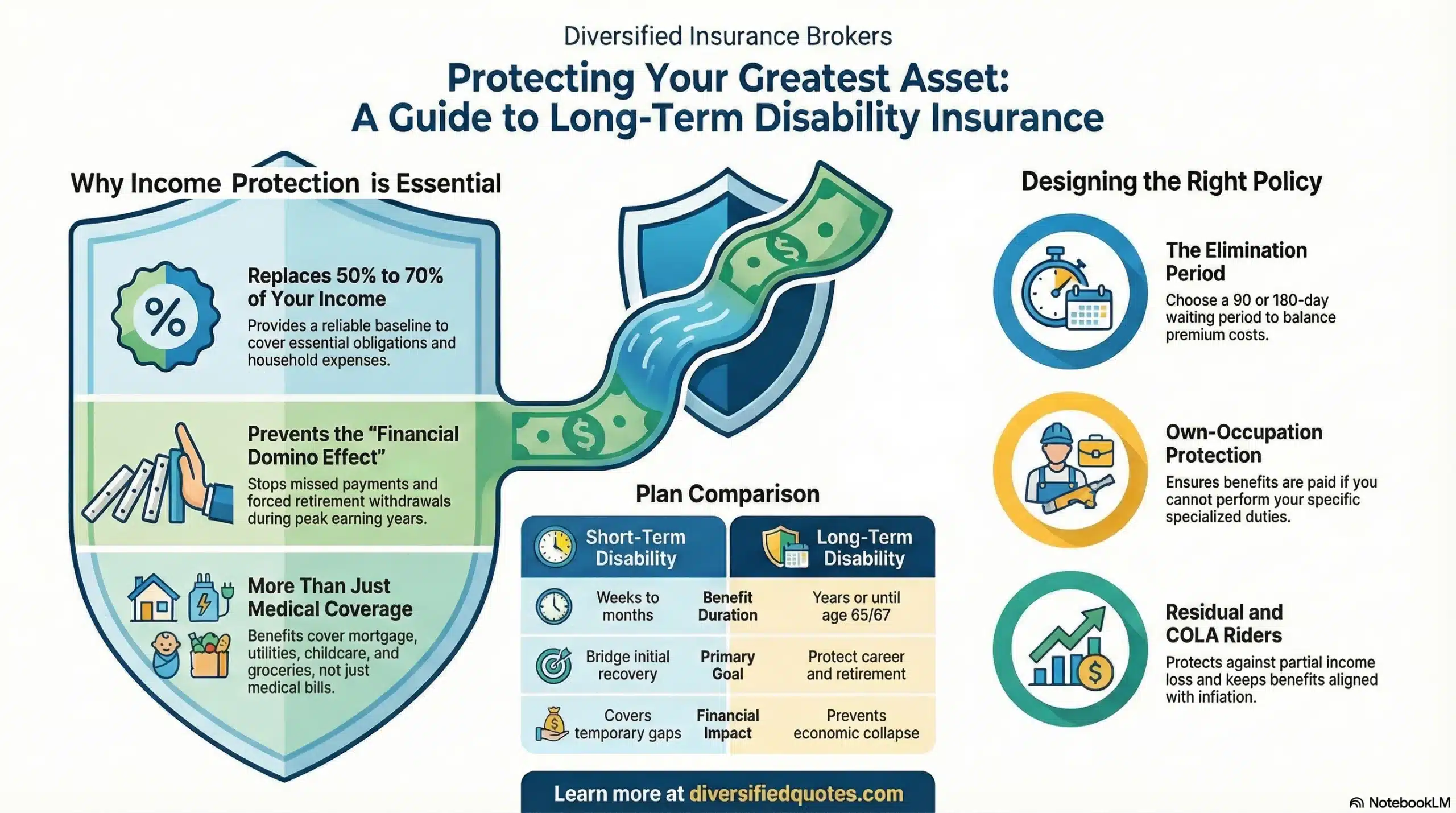
The elimination period — the waiting period between disability onset and first benefit payment — must reflect actual financial reserves rather than standard assumptions for slaughterhouse workers. Hourly wage workers with limited emergency savings may find a standard 90-day elimination period creates genuine financial hardship before disability benefits begin. A 60-day elimination period provides earlier protection at higher premium cost. Short-term disability coverage through the employer plan, if available, can bridge the gap during the first 60 to 90 days before long-term disability benefits begin regardless of which elimination period is chosen for the long-term policy.
The interaction between short-term disability coverage, long-term disability elimination periods, and any applicable workers’ compensation benefits should be understood before a claim begins rather than navigated in the middle of a disability event. Our resource on disability insurance elimination periods explained provides the framework for evaluating the right waiting period based on realistic reserves and available bridge coverage. For butchers and meat cutters specifically, our resource on disability insurance for butchers addresses the closely parallel occupational classification and coverage considerations for that role.
Find the Right Coverage for Your Role
We identify the strongest available individual and group coverage for slaughterhouse and meat processing workers at every occupational level.
Get Your Disability Insurance Quote
Call 800-533-5969
Related Disability Insurance Pages
Talk With an Advisor Today
Choose how you’d like to connect—call or message us, then book a time that works for you.
Schedule here:
calendly.com/jason-dibcompanies/diversified-quotes
Licensed in all 50 states • Fiduciary, family-owned since 1980
FAQs: Disability Insurance for Slaughterhouse Industries
What does the federal data say about injury rates in meat processing?
The data is unambiguous: according to employer-reported data, meat and poultry workers suffer serious injuries at double the rate of other workers. OSHA’s October 2024 expanded inspection guidance for animal slaughtering and processing establishments was released specifically because of this documented injury rate disparity. Additionally, in 2022, occupational illness cases among animal slaughtering and processing workers were six times higher than the all-industry average. The specific hazards driving these rates include ergonomics and musculoskeletal disorders from repetitive line work, occupational noise, hazardous energy and machine guarding failures, and chemical exposures including peracetic acid, ammonia, and chlorine. For workers in this industry, disability insurance is a practical financial necessity demanded by their documented occupational risk.
Why are repetitive strain injuries especially problematic for workers’ compensation claims in meat processing?
Because carpal tunnel syndrome, rotator cuff injuries, tendinitis, and chronic back conditions develop gradually over years of repetitive line work rather than from a single identifiable incident. Gradual-onset cumulative conditions are consistently contested in workers’ compensation claims, with employers and insurers frequently disputing whether the condition was caused by work versus aging, prior conditions, recreational activities, or non-work factors. These disputes can delay or reduce workers’ compensation benefits for extended periods. Individual disability insurance does not require workplace causation — it pays benefits for any disabling condition from any cause — which eliminates the causation dispute problem and provides income protection that workers can rely on regardless of how the condition developed. Research confirms that cases with days away from work, job transfer, or restriction in animal slaughtering are almost three times the national average, making this coverage gap consequential.
Can production line workers with Class 1 ratings get disability coverage?
Yes, though the individual market options are most constrained for Class 1 production workers and the approach requires strategic layering. The most accessible path combines group disability benefits from the employer or union plan (which provide coverage without individual underwriting barriers) with guaranteed issue disability programs through qualifying group or association structures, and whatever individual market supplemental coverage is available at the Class 1 rating. Not all standard market carriers write Class 1 food processing coverage — an independent broker with full market access is essential for identifying which carriers are most favorable and what benefit amounts and provisions they will offer. As role responsibilities increase toward supervisory, quality control, and technical functions, the individual market options improve significantly.
About the Author:
Jason Stolz, CLTC, CRPC, DIA, CAA and Chief Underwriter at Diversified Insurance Brokers (NPN 20471358), is a senior insurance and retirement professional with more than 25 years of real-world experience helping individuals, families, and business owners protect their income, assets, and long-term financial stability. As a long-time partner of the nationally licensed independent agency Diversified Insurance Brokers, Jason provides trusted guidance across multiple specialties—including fixed and indexed annuities, long-term care planning, personal and business disability insurance, life insurance solutions, Group Health, Travel Medical and Evacuation Insurance, and short-term health coverage. Diversified Insurance Brokers maintains active contracts with over 100 highly rated insurance carriers, ensuring clients have access to a broad and competitive marketplace.
His practical, education-first approach has earned recognition in publications such as VoyageATL, and contributions from his agency featured in Kiplinger and GoBankingRates— highlighting his commitment to financial clarity and client-focused planning. Drawing on deep product knowledge and years of hands-on field experience, Jason helps clients evaluate carriers, compare strategies, and build retirement and protection plans that are both secure and cost-efficient. Visitors who want to explore current annuity rates and compare options across multiple insurers can also use this annuity quote and comparison tool.
Explore More Disability Insurance Options: Browse our complete guide to Disability Insurance for Food, Hospitality, Arts & Entertainment — covering chefs, musicians, actors, bartenders, hospitality workers & entertainment professionals from 100+ carriers.
Last Reviewed: May 18, 2026 |
Reviewed by: Jason Stolz, CLTC, CRPC, DIA, CAA
Chief Underwriter, Diversified Insurance Brokers, Inc. | NPN: 20471358 | Diversified Insurance Brokers, Inc. — Licensed in all 50 states
Fact Checked by: Tonia Pettitt, CMIP©
Medicare Specialist, Diversified Insurance Brokers, Inc. | NPN: 14374308 | Diversified Insurance Brokers, Inc. — Licensed in all 50 states
Did you find this content helpful? Leave us a Google review — it helps others find trustworthy guidance too.
Editorial Standards: Diversified Insurance Brokers maintains rigorous editorial standards to ensure accuracy, clarity, and independence in all content. Learn more about our editorial standards and commitment to transparency.
