
Disability Insurance for Jockeys
As an Independent Disability Insurance Broker, we have access to exclusive discounts and negotiated pricing most captive agents can’t offer — see the full breakdown near the end of this page.
Disability Insurance for Jockeys

Jason Stolz CLTC, CRPC, DIA, CAA
Disability insurance for jockeys is income protection built around one of the most physically dangerous professional careers in sports — a career where income is entirely performance-based, where self-employment is the near-universal employment structure, and where the probability of a disabling injury over the course of a career is not a remote risk but a documented statistical reality. Professional jockeys earn their income by riding racehorses — animals weighing over 1,000 pounds — at speeds approaching 40 miles per hour, in tightly packed fields, with falls that produce fractures, concussions, and spinal injuries as routine occupational outcomes. When an injury prevents a jockey from riding, income stops completely. There is no employer providing sick pay, no group disability benefits, and no institutional safety net of any kind. The only financial protection available is what the jockey has personally arranged before the fall occurs. Understanding what is the primary reason people buy disability insurance begins with recognizing that for a jockey, the income-to-physical-risk ratio makes individual disability coverage not optional planning — it is the foundation of financial survival in a high-injury career.
At Diversified Insurance Brokers, we help professional jockeys — flat racing jockeys, jump racing and steeplechase jockeys, apprentice jockeys building their careers, and exercise riders transitioning to competitive riding — structure disability insurance coverage that reflects the genuine physical risks of racing and the self-employed income structure that governs how jockeys earn. A well-structured policy provides income replacement from any qualifying disability, whether it originates from a fall-related fracture, a concussion, a spinal injury, a chronic condition developing from years of extreme weight management, or a medical event entirely unrelated to the track.
Get Disability Insurance Quotes for Jockeys
We compare carriers, explain occupational class ratings, and structure policies built for the real physical risks and self-employed income structure of professional racing.
Request Disability Insurance OptionsWhat Jockeys Actually Do — and Why It Creates Extreme Disability Risk
The physical demands of professional jockeying extend far beyond the few minutes of a race itself. A working jockey’s day begins before dawn at the stable yard, exercising horses during morning workouts — galloping, breezing, and schooling horses for trainers across multiple mounts before the public ever sees a race. These morning exercise rides involve the same physical risks as competitive racing: falls, unseating incidents, and equipment failures occur during training as frequently as on race day. On race days, a competitive jockey may ride in six to ten races, each requiring sustained physical exertion in a crouched aerodynamic position that places enormous demand on the core, legs, hips, and back — maintaining precise balance and control over a thousand-pound animal at speeds approaching 40 miles per hour, often in a field of eight to twelve horses running within feet of each other.
The physical requirements of professional racing are compounded by the weight restrictions that define the sport. Jockeys must maintain a racing weight typically between 108 and 118 pounds for flat racing, which for most adult athletes requires sustained caloric restriction, regular use of saunas, exercise regimens designed to shed weight before weigh-in, and in many cases practices that carry serious long-term health consequences. The occupational health literature on jockeys documents elevated rates of eating disorders, chronic dehydration, bone density loss from sustained caloric restriction, and kidney stress from diuretic use — all consequences of the weight management demands the profession imposes. Jump racing and steeplechase jockeys face an even more extreme physical risk profile: racing over hurdles and fences at high speed, with fall rates documented at approximately one fall per twenty rides in jump racing versus one per 250 rides in flat racing, producing a disability risk profile that places jockeying among the highest-risk professional occupations in any sport. Our resource on disability insurance for high-risk occupations provides important context on how carriers evaluate extreme physical risk profiles and what coverage options remain available for athletes whose work involves documented elevated injury rates.
The Most Common Disabling Conditions for Jockeys
Fractures are the dominant acute disabling injury for professional jockeys, accounting for approximately 64 percent of career injuries documented in occupational health research on the profession. The collarbone and clavicle represent the most commonly fractured structure in horse racing falls — a direct impact to the shoulder girdle when a jockey is unseated at speed produces clavicular fractures with sufficient frequency that clavicle injury is sometimes described as an occupational hazard of the sport rather than a freak accident. Wrist fractures, rib fractures, and leg fractures follow similar patterns, typically occurring when a jockey falls from a horse at racing speed and makes contact with the track surface, the rail, or other horses. Research on Maryland jockeys found a fracture rate of 145 per 1,000 falls — meaning nearly one in seven falls produces a fracture requiring medical treatment and time away from riding. Fractured ribs, punctured lungs, and lacerated internal organs from high-impact falls represent the severe end of a fracture injury spectrum that can range from a six-week collarbone recovery to a career-altering spinal injury.
Head and neck trauma account for approximately 18.8 percent of documented jockey injuries, and concussions are a particularly significant occupational health concern for a profession where return-to-riding pressure — driven by the income consequences of being away from the track — creates real risk of riders returning before neurological recovery is complete. Spinal injuries from high-impact falls represent the most catastrophic end of the jockey injury spectrum, with the potential to produce permanent functional limitations that end a riding career entirely regardless of the jockey’s willingness to return. Soft tissue injuries — the most numerically common category — produce the shoulder, hip, and back conditions that accumulate across a career of repeated falls and sustained physical exertion, gradually limiting the strength and mobility that racing requires. The chronic occupational health consequences of weight management — bone density loss, nutritional deficiencies, cardiovascular stress from dehydration and diuretic use — represent a disability risk category that develops slowly and can produce medical conditions that prevent riding long after the acute fall risk of an active career has passed. Our resource on disability insurance for game wardens provides useful perspective on how high-physical-risk outdoor occupations are evaluated across carriers when the disability risk profile involves both acute injury and cumulative occupational health exposure.
Why Jockeys Have No Disability Safety Net
Professional jockeys are almost universally self-employed independent contractors. A jockey is nominated by a trainer to ride a specific horse, receives a mount fee — typically in the range of $35 to $50 per race — plus a percentage of prize money for finishing positions, and moves to the next engagement with no ongoing employment relationship. There is no employer providing health insurance beyond racetrack medical facilities, no sick pay, no group disability policy, and no salary that continues when a jockey cannot ride. The Jockeys’ Guild provides some basic benefits and advocacy for its members, but those benefits do not replace professional income during an extended disability. When a jockey breaks a collarbone and cannot ride for six to eight weeks, or sustains a concussion requiring a longer neurological rest period, or suffers a back injury requiring surgery and months of rehabilitation, the financial consequences are immediate and total — income stops on the day the injury occurs.
Workers’ compensation does not cover the self-employed jockey. The system is designed for employer-employee relationships, and a jockey receiving a mount fee under a trainer nomination is not an employee entitled to workers’ compensation benefits in most jurisdictions. Social Security Disability Insurance exists but requires demonstrating inability to perform virtually any gainful employment — a standard that would deny benefits to an injured jockey who could theoretically perform sedentary work, even if no jockey would consider that a functional substitute for a racing career and its income. The financial vulnerability of a jockey’s self-employed structure is compounded by the irregular nature of racing income: an established jockey who rides 1,000 races per year earns across a wide range of outcomes, and a disability that removes them from the mount rotation for weeks or months loses not just current income but the trainer relationships and ride opportunities that take years to build. Our resource on is disability insurance worth it provides the financial framework for understanding how income loss during disability accumulates into a crisis that savings rarely survive intact without income replacement.
How Disability Insurance Carriers Classify Jockeys
Disability insurance carriers assign occupational class ratings that reflect the estimated disability risk of each profession, and jockeys present one of the most challenging occupational classification profiles in the individual disability insurance marketplace. The combination of documented high fall rates, fracture frequency, head injury risk, and the extreme weight management health consequences that are specific to horse racing places jockey occupational classifications in the lower tiers that carriers reserve for high-physical-risk professions. Not all carriers will write jockey occupational classifications at all — the profession’s injury profile leads some carriers to decline coverage entirely, while others will write the occupation with specific exclusion riders or benefit limitations that reflect the documented risk.
The distinction between flat racing and jump racing matters significantly in the underwriting evaluation. Jump racing jockeys face documented injury rates substantially higher than flat jockeys — with fall rates roughly twelve times higher in jump racing — and carriers that distinguish between racing disciplines will typically approach jump jockey classifications more conservatively than flat racing classifications. Presenting occupational duties accurately to underwriters — including the racing discipline, the frequency of exercise riding versus race riding, the current stage of career, and the overall health picture — is an area where working with an experienced independent broker produces meaningfully better outcomes than applying to a single carrier directly. Our resource on how disability insurance elimination periods work provides essential context on how waiting period selection affects the financial planning implications of a disability for jockeys who need to understand exactly when benefits begin relative to when mount income stops. For additional perspective on how carriers approach physically extreme occupational classifications, our resource on disability insurance for the woodworking industry and disability insurance for cosmetologists provide cross-occupational context on how manual and physical trade classifications are structured across carriers.
Case Study — Professional Flat Racing Jockey, Clavicle Fracture
Consider an established professional flat racing jockey riding approximately 800 races per year and generating approximately $85,000 annually in mount fees and prize money percentages. After a starting gate incident — the most injury-prone phase of a race, accounting for over a third of all jockey injuries — this jockey sustains a fractured clavicle requiring surgical fixation and a minimum of eight weeks of recovery during which riding is medically contraindicated. The table below illustrates the financial difference disability insurance makes in this specific scenario.
| Scenario | Without Disability Insurance | With Disability Insurance |
|---|---|---|
| Monthly Income During Recovery | $0 | $3,500–$4,500 |
| 8-Week Income Total | $0 | $7,000–$9,000 |
| Trainer Relationships | Rides assigned to available jockeys during absence; relationships require rebuilding on return | Financial stability allows managed communication and planned return without desperation |
| Return-to-Work Pressure | Forced early return to riding before full surgical recovery; re-fracture and permanent injury risk | Full recovery supported on medical timeline without financial desperation |
| Agent and Licensing Costs | Jockey agent fees, licensing, and equipment costs continue regardless of riding status | Monthly benefit offsets ongoing professional fixed costs during recovery |
Clavicle fractures are among the most frequently documented acute injuries for professional jockeys — the shoulder girdle absorbs the direct impact of a fall from a horse at racing speed, and the clavicle is the structure most commonly fractured as a result. Research on jockey clavicle injuries confirms that most occur at the starting gate, during the most intense phase of a race. Disability insurance for jockeys ensures that this predictable occupational health event does not simultaneously become a financial emergency that forces premature return to riding before full surgical recovery — a pressure that creates real risk of re-fracture, permanent joint instability, and career-altering long-term damage. For additional perspective on how self-employed athletes and physical professionals manage income risk during disability recovery, our resource on disability insurance for the automobile industry provides useful context on how physically demanding self-employed professions with high acute injury risk are evaluated and structured.
Key Policy Features That Matter Most for Jockeys
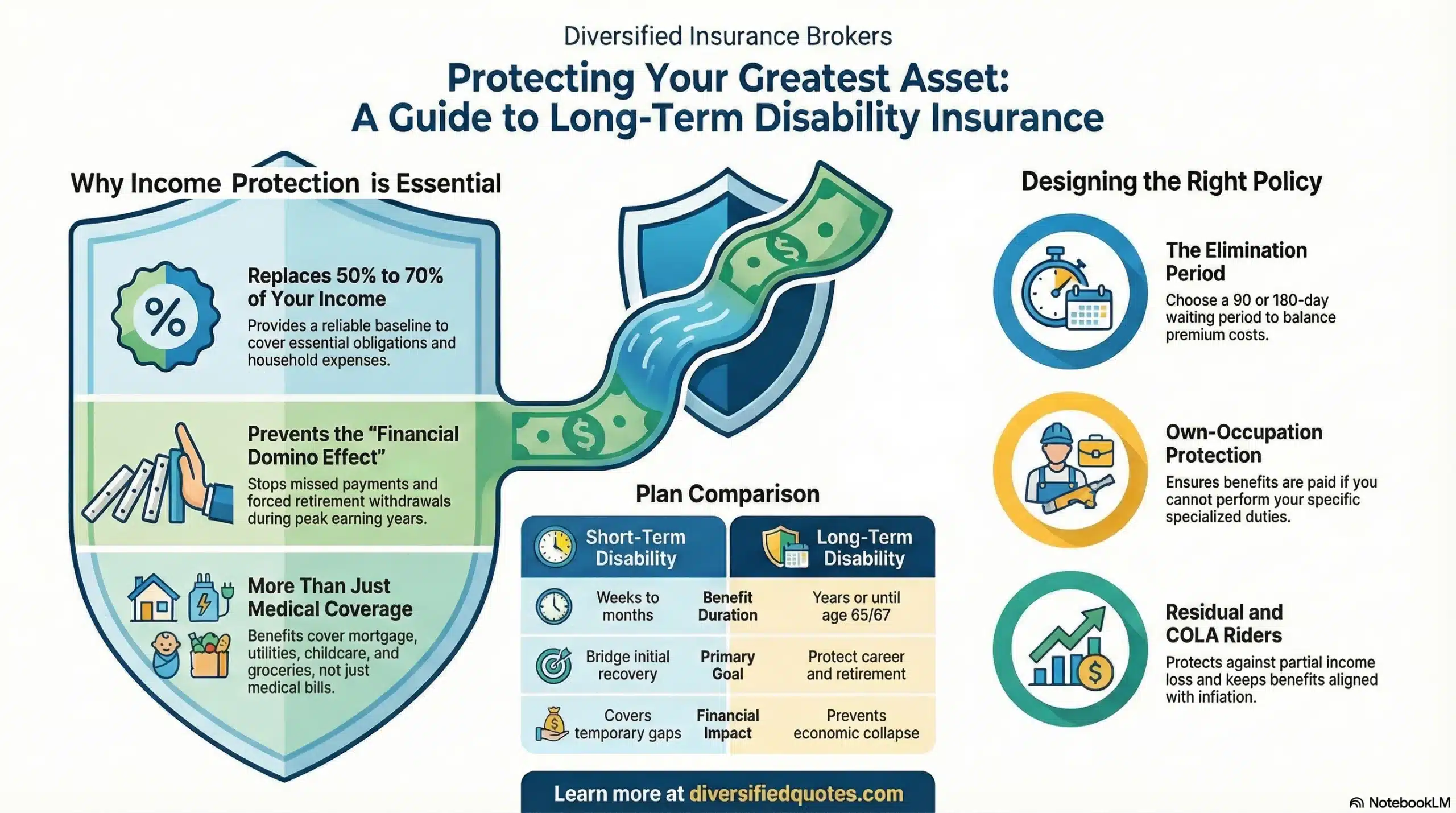
The own-occupation definition of disability is the most important policy feature for jockeys, and for a profession with a documented high physical risk profile, the stakes around this definition are acute. Under an own-occupation definition, the policy pays benefits when a condition prevents the jockey from performing the specific duties of their occupation — riding racehorses in competition and exercise — regardless of whether they could theoretically perform some other type of work. A jockey whose fractured clavicle or back injury prevents safe riding may technically be capable of performing a sedentary job, but an own-occupation policy recognizes the genuine inability to work as a jockey and pays benefits accordingly. Without an own-occupation definition, a policy would only pay benefits if the insured could not perform virtually any gainful employment — denying benefits to an injured jockey who retains any capacity for desk work, regardless of the income gap between desk work and a racing career. Our dedicated resource on own-occupation disability insurance explained covers exactly how this definition protects high-risk physical professionals in real disability scenarios and why the precise policy language matters more than almost any other feature.
A residual disability rider is equally critical for jockeys whose recovery may involve a gradual return to riding. A jockey recovering from a back injury or concussion may be cleared to ride exercise horses in the morning before being medically cleared for competitive racing — generating some income while still unable to perform at full professional capacity. A total-disability-only policy provides no benefits during this partial recovery period. A residual disability rider pays proportional benefits based on the percentage reduction in earnings, providing continuous financial support from the onset of disability through to full return to normal riding volume and competition. Our resource on how residual disability benefits work covers how proportional benefit calculations function in practice and why athletes rebuilding their competitive schedule gradually after injury need this protection across the entire recovery arc. A cost-of-living adjustment rider protects the purchasing power of the monthly benefit for jockeys facing long-term or permanent disability. Our resource on disability income insurance with a COLA rider explains when inflation protection produces the most meaningful long-term financial benefit.
Income Documentation and Professional Overhead for Jockeys
Because jockeys are self-employed independent contractors, disability insurance underwriting involves income documentation requirements that differ from W-2 employee applications. Carriers base benefit amounts on verified earned income using federal tax returns — typically two to three years of Schedule C net profit or 1099 income for self-employed applicants. For jockeys whose gross income varies significantly from year to year based on riding volume, career stage, and the competitive quality of the horses they are assigned, presenting income documentation accurately and in the most favorable light requires working with a broker who understands how jockey income is structured and how to document it effectively for underwriters.
Professional jockeys also carry meaningful ongoing occupational costs that continue during a disability regardless of whether they can ride: jockey agent fees that continue under ongoing representation agreements, racing license renewal fees across jurisdictions, equipment costs for saddles, helmets, protective vests, and boots that require maintenance and replacement, and travel costs for jockeys who compete at multiple tracks. These fixed professional costs represent a financial obligation on top of household expenses during any disability period. Our resource on disability business overhead expense coverage explains how self-employed professionals structure coverage for these ongoing fixed professional costs alongside personal income replacement disability insurance. For jockeys also evaluating how disability insurance fits within their overall financial protection planning, our resource on income protection insurance covers the full spectrum of tools available alongside individual disability coverage.
Why Independent Broker Access Matters for Jockeys
The jockey occupational classification is one where independent broker access to the full carrier marketplace is not a convenience — it is the determining factor in whether comprehensive coverage is available at all. Some carriers decline to write jockey occupational classifications entirely. Others will write the occupation but with exclusion riders covering the most probable injury scenarios — fractures, head injuries, or spinal conditions — that eliminate the practical protective value of the policy precisely when a jockey needs it most. Identifying the carriers whose underwriting guidelines are most favorable for professional jockeys, presenting occupational duty profiles and health history accurately, and structuring policy provisions that maximize both the disability definition and the benefit amount requires experience placing high-risk athletic occupational classifications across multiple carriers.
At Diversified Insurance Brokers, we evaluate options across multiple carriers for every jockey we serve. We understand how to present racing discipline, exercise riding versus competitive riding duty percentages, and career stage in ways that support the best available classification. We know how to structure own-occupation definitions, residual disability riders, and elimination period selection to produce genuinely comprehensive income protection for a profession where the gap between having adequate coverage and having none at the moment of injury is the difference between financial stability and financial crisis. Our resource on why independent disability insurance brokers matter explains the full value of this approach for professionals whose occupation requires expertise to place properly.
When to Apply for Coverage
The best time for a jockey to apply for disability insurance is as early as possible in their career — ideally during the apprentice or early professional stage, before injuries have accumulated in the medical record. Disability insurance premiums are based in part on age and health status at the time of application, and younger applicants in good health secure the most comprehensive coverage at the most favorable rates. For jockeys, this timing decision is especially consequential because falls and injuries accumulate across every season of racing: a jockey who has already sustained documented fractures, concussions, or back injuries faces exclusion riders for exactly those conditions when applying for coverage after the fact. An exclusion rider eliminating coverage for fractures is devastating for a jockey whose most probable disability scenario involves exactly that type of injury.
Applying during the apprentice stage — before competitive fall events are documented in the medical record — secures comprehensive coverage that remains in place as injuries inevitably accumulate in later racing years. That is exactly when comprehensive coverage matters most. For jockeys who have already developed some occupational conditions and are evaluating what coverage remains available, our resource on disability insurance with preexisting conditions covers how underwriters approach existing health history and what coverage options remain accessible. Our resource on how to buy disability insurance online provides practical guidance on the application process for self-employed athletes evaluating their options.
Request Disability Insurance Quotes for Jockeys
We compare carriers, explain how racing occupations are classified, and structure policies that protect the income your riding career depends on.
Get Disability Insurance QuotesRelated Disability Insurance Pages
Talk With an Advisor Today
Choose how you’d like to connect—call or message us, then book a time that works for you.
Schedule here:
calendly.com/jason-dibcompanies/diversified-quotes
Licensed in all 50 states • Fiduciary, family-owned since 1980
Disability Insurance for Jockeys — FAQs
Yes — professional jockeys can obtain individual disability insurance, though the occupation presents one of the most challenging classification profiles in the individual disability insurance marketplace. The documented high fall rates, fracture frequency, head injury risk, and chronic health consequences of extreme weight management practices place jockey occupational classifications in the lower tiers that carriers reserve for high-physical-risk professions. Not every carrier will write jockey classifications — some decline the occupation entirely, while others will offer coverage with specific exclusion riders or benefit limitations reflecting the documented injury risk. The key to securing the most comprehensive coverage available is working with an independent broker who has experience placing high-risk athletic occupational classifications across multiple carriers, presenting the specific racing discipline, duty profile, and health history accurately to identify the carrier whose underwriting guidelines are most favorable for a given jockey’s specific situation.
Fractures are the dominant acute disabling injury for professional jockeys, accounting for approximately 64 percent of career injuries in occupational health research on the profession. Clavicle and collarbone fractures are among the most frequently documented — a direct impact to the shoulder girdle when unseated at racing speed produces these injuries with sufficient regularity that they are considered an expected occupational hazard rather than a rare event. Wrist, rib, and leg fractures follow similar patterns from fall mechanics. Research has found a fracture rate of approximately 145 per 1,000 falls, meaning nearly one in seven falls produces a fracture requiring medical treatment and time away from riding. Head and neck trauma account for approximately 18.8 percent of documented jockey injuries — concussions are a significant concern given the pressure jockeys face to return to riding quickly. Spinal injuries from high-impact falls represent the most catastrophic outcome and can end a riding career permanently. The chronic occupational health consequences of weight management — bone density loss, nutritional deficiencies, cardiovascular stress from dehydration — represent a slower-developing disability risk category that can produce disabling conditions long after competitive riding has ended.
Own-occupation disability insurance pays benefits when a condition prevents the insured from performing the specific duties of their own occupation — regardless of whether they could theoretically perform different or lighter work. For a jockey, this means benefits are paid when injuries or conditions prevent safe, competitive riding — even if the jockey could hypothetically perform sedentary work completely unrelated to their profession. Without an own-occupation definition, benefits would only be paid if the insured could not perform virtually any gainful employment at all, which would deny benefits to an injured jockey who retains any capacity for desk work despite being unable to ride. For a professional whose entire career income depends on the ability to physically race horses — a skill set that has no sedentary substitute — the own-occupation definition is the most consequential single policy feature. The difference between own-occupation and any-occupation coverage for a jockey is essentially the difference between a policy that functions as intended and one that provides no practical benefit in the scenarios most likely to occur.
No — workers’ compensation is structured for employer-employee relationships, and professional jockeys who operate as self-employed independent contractors receiving mount fees from trainers are typically not covered by workers’ compensation at all. Even in jurisdictions where racetrack workers’ compensation programs exist, coverage is often limited to specific on-track incidents and does not address the full scope of jockey disability risk. Workers’ compensation does not cover gradual-onset conditions developing from cumulative physical demands, chronic conditions arising from weight management practices, or any disability unrelated to a specific documented workplace incident. Individual disability insurance covers disability from any cause regardless of origin — falls at the track, off-track accidents, medical conditions entirely unrelated to riding, and the chronic health consequences of weight management — providing comprehensive protection across the full range of events that could prevent a jockey from riding professionally.
Residual disability coverage pays proportional benefits when a disability reduces earning capacity without eliminating the ability to work entirely. A jockey recovering from a back injury or concussion may be medically cleared for exercise riding on horses before being cleared for competitive racing — generating some income while still unable to ride at full professional capacity. A total-disability-only policy provides no benefits during this partial recovery period, even though income is far below normal and a genuine disabling condition is still being managed. A residual disability rider pays a proportional benefit based on the percentage reduction in earnings, providing continuous income support from the onset of disability through to full return to normal riding volume and competitive engagement. For jockeys rebuilding their mount rotation and trainer relationships gradually after a disabling injury — rather than returning immediately to a full race schedule — this rider is essential protection across the entire recovery arc.
The appropriate benefit amount for a jockey is generally 60 to 70 percent of gross monthly earned income, which reflects the standard underwriting guideline most disability insurance carriers apply. For jockeys whose income comes from mount fees and prize money percentages rather than a salary, this is calculated based on net earned income from Schedule C or documented 1099 income — which can vary significantly from year to year depending on riding volume, career stage, and the caliber of horses assigned. The practical question is whether the benefit amount would actually cover household obligations during a disability: housing, insurance, food, transportation, and loan payments do not decrease because mount assignments have stopped. For jockeys whose income fluctuates between active seasons and quieter periods, or between injury recovery years and peak performance years, working with a broker who understands how to present variable income documentation accurately is an important step in securing a benefit amount that reflects genuine earning capacity rather than an anomalous low-income year.
The elimination period — the waiting period between disability onset and when benefits begin — is a critical planning decision for self-employed jockeys who have no employer sick pay and no institutional income buffer. Jockeys with limited cash reserves and income that stops immediately when they cannot ride should strongly consider a 30- or 60-day elimination period, which minimizes the financial gap between the day of injury and the arrival of monthly benefit payments. The shorter the elimination period, the higher the premium — but for a jockey whose income stops entirely on the day they are unseated, a 90-day wait without income replacement creates immediate household financial pressure. Jockeys with stronger savings, a working spouse covering household expenses, or other income sources may comfortably accept a 90-day elimination period to reduce the premium cost. The right choice depends entirely on how long the individual could realistically sustain household expenses from existing savings without income replacement beginning.
Yes — health history affects both eligibility and the specific terms of coverage offered, and for jockeys this dimension of underwriting is particularly significant. Disability insurance underwriting evaluates the full health picture alongside occupational risk: prior fractures, concussion history, back and spine conditions, shoulder injuries, and any documented chronic conditions from weight management practices — eating disorder history, bone density concerns, cardiac stress from dehydration. For jockeys who have already sustained documented fractures or head injuries, underwriters may apply exclusion riders eliminating coverage for those specific conditions or for the body parts most affected by prior racing injuries. An exclusion rider eliminating fracture coverage or head injury coverage is devastating for a jockey whose most probable future disability scenarios involve exactly those injuries. This is why applying as early as possible in a career — during the apprentice stage before competitive falls are documented — is the single most important timing decision available to any jockey evaluating disability coverage.
Yes — the distinction between flat racing and jump racing is meaningful in disability insurance underwriting, and carriers that distinguish between racing disciplines typically approach jump jockey classifications more conservatively. The documented injury rate difference is substantial: research shows approximately one fall per 20 rides in jump racing, compared to approximately one fall per 250 rides in flat racing — making jump racing roughly twelve times more likely to produce a fall per ride. Jump racing falls also occur at higher obstacle-related impact angles that can produce more severe fractures and spinal injuries than flat falls. Some carriers that will write flat racing jockey classifications will decline jump racing classifications entirely, or will offer coverage with more restrictive exclusion riders or lower available benefit amounts. For steeplechase and National Hunt jockeys in particular, independent broker access to the full carrier marketplace is essential — finding the carriers whose underwriting guidelines accommodate jump racing classifications comprehensively requires comparison across multiple carriers that a single-company application cannot provide.
The best time is as early as possible in a racing career — ideally during the apprentice stage, before competitive falls and injuries have been documented in the medical record. Disability insurance premiums are based in part on age and health status at the time of application, and younger, healthier applicants secure the most comprehensive coverage at the most favorable rates. For jockeys, this timing decision is especially consequential because the injury events most likely to trigger future exclusion riders — fractures, concussions, back injuries — occur throughout every season of competitive racing. A jockey who applies before any of these events are documented secures comprehensive coverage that continues to protect against exactly those injury types as they occur in subsequent racing years. Waiting until after injuries are documented almost always means purchasing a policy with exclusions for the most probable disability scenarios — which substantially undermines the practical value of having coverage at all. The timing advantage of applying early in a racing career cannot be recaptured once injuries have appeared in the medical record.
About the Author:
Jason Stolz, CLTC, CRPC, DIA, CAA and Chief Underwriter at Diversified Insurance Brokers (NPN 20471358), is a senior insurance and retirement professional with more than 25 years of real-world experience helping individuals, families, and business owners protect their income, assets, and long-term financial stability. As a long-time partner of the nationally licensed independent agency Diversified Insurance Brokers, Jason provides trusted guidance across multiple specialties—including fixed and indexed annuities, long-term care planning, personal and business disability insurance, life insurance solutions, Group Health, Travel Medical and Evacuation Insurance, and short-term health coverage. Diversified Insurance Brokers maintains active contracts with over 100 highly rated insurance carriers, ensuring clients have access to a broad and competitive marketplace.
His practical, education-first approach has earned recognition in publications such as VoyageATL, and contributions from his agency featured in Kiplinger and GoBankingRates— highlighting his commitment to financial clarity and client-focused planning. Drawing on deep product knowledge and years of hands-on field experience, Jason helps clients evaluate carriers, compare strategies, and build retirement and protection plans that are both secure and cost-efficient. Visitors who want to explore current annuity rates and compare options across multiple insurers can also use this annuity quote and comparison tool.
Explore More Disability Insurance Options: Browse our complete guide to Disability Insurance for Food, Hospitality, Arts & Entertainment — covering chefs, musicians, actors, bartenders, hospitality workers & entertainment professionals from 100+ carriers.
Last Reviewed: June 8, 2026 |
Reviewed by: Jason Stolz, CLTC, CRPC, DIA, CAA
Chief Underwriter, Diversified Insurance Brokers, Inc. | NPN: 20471358 | Diversified Insurance Brokers, Inc. — Licensed in all 50 states
Fact Checked by: Tonia Pettitt, CMIP©
Medicare Specialist, Diversified Insurance Brokers, Inc. | NPN: 14374308 | Diversified Insurance Brokers, Inc. — Licensed in all 50 states
Did you find this content helpful? Leave us a Google review — it helps others find trustworthy guidance too.
Editorial Standards: Diversified Insurance Brokers maintains rigorous editorial standards to ensure accuracy, clarity, and independence in all content. Learn more about our editorial standards and commitment to transparency.
