
Disability Insurance for Professional Gamblers and Poker Players
As an Independent Disability Insurance Broker, we have access to exclusive discounts and negotiated pricing most captive agents can’t offer — see the full breakdown near the end of this page.
Disability Insurance for Professional Gamblers and Poker Players

Jason Stolz CLTC, CRPC, DIA, CAA
Disability insurance for professional gamblers and poker players is a genuinely important and practically achievable income protection goal for a population whose work is entirely cognitive and analytical — and whose professional income depends entirely on the continued functioning of the brain, decision-making capacity, and sensory processing systems that professional gambling demands. Whether you play poker professionally on the tournament circuit or as a high-stakes cash game specialist, operate as a professional sports bettor with sophisticated analytical systems, play advantage casino games professionally, or generate full-time income from any form of skilled gambling that you pursue with the regularity, continuity, and businesslike conduct that the IRS requires to classify your activity as a trade or business — your income depends on cognitive capacities that a serious illness, neurological event, or psychological health disability can eliminate just as completely and just as permanently as a physical injury eliminates a manual worker’s income.
Professional gamblers are classified as self-employed by the IRS and report income on Schedule C — a legal and financial status that carries both the entrepreneurial advantages of professional self-employment and the acute financial vulnerability of a business whose entire income stream depends on one person’s continued cognitive performance capacity. When a disability prevents a professional gambler from playing, the income stops immediately and completely, while living expenses, travel commitments, and tournament buy-in obligations continue. There is no employer sick pay, no group disability plan, and no institutional safety net of any kind.
At Diversified Insurance Brokers, we help professional gamblers, professional poker players, advantage players, and professional sports bettors evaluate disability insurance options that reflect the cognitive nature of professional gambling work, the self-employment income documentation requirements specific to this profession, and the disability risks most relevant to professionals whose careers depend entirely on sustained cognitive and perceptual performance.
Protect Your Professional Gambling Income
Compare disability insurance options designed for professional gamblers, poker players, advantage players, and professional sports bettors.
The Occupational Classification Advantage for Professional Gamblers
One of the most practically important facts about disability insurance for professional gamblers and poker players is the occupational classification that this profession typically receives — and it is more favorable than most professional gamblers anticipate. Professional gambling is entirely cognitive, analytical, and sedentary work with no physical hazards, no manual labor components, and no occupational exposure to chemicals, heights, machinery, or any of the physical risk factors that produce elevated disability insurance classifications and premium rates in other occupations.
A professional poker player’s work consists of making analytically complex sequential decisions under uncertainty and psychological pressure, reading opponents, managing risk and variance across extended playing sessions, maintaining emotional discipline under adverse conditions, and applying a specialized body of probabilistic and game-theoretic knowledge to consistently extract positive expected value from competitive play. This is cognitively sophisticated, professionally skilled work — but it is not physically demanding, not hazardous, and not associated with any of the occupational injury or illness categories that drive unfavorable disability insurance classifications for manual and field-based occupations.
The disability risk for professional gamblers — as for all cognitive professionals — is centered on the conditions that impair the cognitive and perceptual functions that professional gambling performance depends on: neurological events including stroke and traumatic brain injury, serious mental health conditions including depression and anxiety disorders that impair the emotional regulation and decision-making that professional gambling requires, vision loss or serious vision impairment for gambling formats that require reading cards and player behavior, and any serious systemic illness that impairs sustained cognitive performance capacity. These are the same disability risk categories that affect other high-level cognitive and analytical professional practitioners, including professional day traders and financial market professionals whose entire income depends on sustained analytical and decision-making performance capacity.
The Income Documentation Challenge — The Most Significant Hurdle
The most significant practical challenge in disability insurance for professional gamblers and poker players is not occupational classification or coverage availability — it is income documentation. Disability insurance carriers base benefit amounts on verified earned income, and the income documentation requirements for professional gambling self-employment income are specific, demanding, and require both proper professional gambling tax filing status and meticulous record-keeping that satisfies carrier underwriting standards.
The threshold issue is professional gambler tax status. The IRS distinguishes between casual gamblers, who report winnings and losses under general income reporting rules and cannot net expenses against winnings, and professional gamblers, who file Schedule C and are treated as self-employed business operators. For disability insurance underwriting purposes, the professional gambling income documented on Schedule C as net self-employment income is the figure that can support a disability insurance benefit calculation. Casual gambling winnings reported on Schedule 1 do not constitute professional earned income for disability insurance purposes in the same way. A professional gambler must be able to demonstrate, through consistent Schedule C filing showing gambling as their primary trade or business, that their gambling activity constitutes genuine professional earned income rather than irregular recreational gambling proceeds.
Beyond Schedule C filing status, the income documentation requirements extend to the supporting records that substantiate the Schedule C figures. Tax Court case law specifically documents that meticulous contemporaneous record-keeping is the single most important factor in establishing professional gambler status — including daily logs of sessions, dates, venues, games played, results, buy-in amounts, and session outcomes. Disability insurance underwriters evaluating a professional gambler’s income claim want to see documented income histories that are consistent, verifiable, and clearly attributable to an ongoing professional practice conducted with regularity and continuity. The income documentation sophistication required for professional gambler disability insurance underwriting parallels that required for other high-complexity self-employment professional income structures, including professional securities traders and investment professionals managing complex self-employment income documentation for disability insurance purposes.
Income Volatility and the Variance Problem
Professional gambling income is inherently volatile — subject to variance that can produce dramatically different outcomes across weeks, months, or years even for highly skilled professionals whose long-term expected value is consistently positive. A professional poker player who averages $200,000 per year over a ten-year career may have individual years ranging from $40,000 to $450,000 depending on tournament results, cash game variance, and the inherent randomness in outcomes that skilled gambling cannot fully eliminate. This income volatility creates specific challenges for disability insurance benefit calculation that require thoughtful planning.
Disability insurance carriers typically base benefit amounts on recent documented income — often the most recent year or a multi-year average — and for professional gamblers whose income varies significantly year to year, the choice of which income period to base the application on can substantially affect the benefit amount available. A professional gambler who applies in a year following an above-average run produces a higher maximum benefit amount than one who applies following a below-average year, regardless of their true long-run earning capacity. Income averaging across multiple years may produce a more representative benefit calculation — and working with an independent broker who understands how to present multi-year gambling income history to underwriters most effectively is important for securing a benefit amount that reflects genuine long-run professional earning capacity rather than single-year variance.
The income volatility dimension also affects elimination period selection — a professional gambler with significant cash reserves who has managed gambling variance successfully over years can comfortably manage a longer elimination period, while one whose operating reserves are typically thin from supporting a high buy-in tournament schedule may need shorter elimination periods that provide faster benefit access when disability strikes. The income volatility and variance management planning considerations for professional gamblers parallel those facing other performance-based self-employed professionals, including economic and financial analysts managing performance-dependent variable self-employment income documentation for disability insurance.
The Cognitive Disability Risk Profile of Professional Gambling
Professional gambling is a cognitively intensive profession whose performance depends on a specific cluster of mental functions that are vulnerable to the same neurological, psychological, and systemic health conditions that affect all high-level cognitive practitioners. Understanding the specific cognitive disability risk profile of professional gambling is important both for selecting appropriate disability insurance coverage and for appreciating why own-occupation coverage — which protects the specific cognitive performance demands of professional gambling rather than merely the theoretical ability to perform any employment — is the essential policy feature for this profession.
Neurological events — stroke, transient ischemic attack, traumatic brain injury from accident, and progressive neurological disease — represent the most acute and severe cognitive disability risk for professional gamblers. Even modest neurological impairment can devastate the specific cognitive capacities that professional gambling performance depends on: the working memory loading of tracking pot odds, player histories, and board texture simultaneously; the executive function demands of real-time decision-making under time pressure; the inhibitory control required for disciplined bankroll management and loss avoidance; and the social cognition required for accurate opponent modeling. A professional poker player whose stroke produces even moderate cognitive changes may find that their edge in competitive play has been eliminated by those changes — constituting a genuine professional disability even if they retain the capacity for much less cognitively demanding work in other contexts.
Serious mental health conditions — major depression, generalized anxiety disorder, bipolar disorder — represent a specifically significant disability risk for professional gamblers because the emotional regulation, risk tolerance calibration, and decision-making quality that professional gambling performance requires are directly and measurably impaired by these conditions. A professional gambler whose major depression episode eliminates their ability to maintain the emotional discipline and analytical clarity that profitable professional play requires is genuinely disabled from their professional practice, even when the depression does not prevent all functioning. The cognitive and psychological disability risk facing professional gamblers is directly parallel to that affecting other high-level cognitive and analytical decision-making professionals, including financial planners and professional advisors whose performance depends on sustained cognitive and analytical capacity.
The Tax Environment and Its Implications for Professional Gamblers
The professional gambling landscape in the United States changed significantly with the passage of the One Big Beautiful Bill Act, signed in July 2025, which introduced a 90% cap on gambling loss deductions beginning in tax year 2026. Under previous rules, professional gamblers could deduct verified gambling losses up to the full amount of winnings. Under the new law, they can deduct only 90% of losses — meaning that a professional gambler who wins $100,000 and loses $100,000 in a tax year now faces taxable income of $10,000 despite breaking even economically. The change has meaningfully altered the financial calculus for high-volume professional gamblers who operate near break-even margins, with at least one prominent professional player publicly describing it as forcing a significant reduction in tournament play and event selection.
For disability insurance planning, this new tax environment has an important implication: the relationship between gross gambling activity and net taxable income for professional gamblers has become more complex, and the net Schedule C income figure on which disability insurance benefit amounts are based may be a less accurate representation of professional gambling economic activity in a high-variance year than it was under previous tax rules. A professional gambler who had a below-average year in which their 90%-capped loss deductions produced unusual taxable income relative to actual economic outcomes needs a multi-year income averaging approach to benefit calculation even more than before. Working with an experienced independent broker who understands professional gambling income documentation in the current tax environment is more important than ever for securing coverage that reflects genuine professional earning capacity.
Case Study: Professional Poker Player Earning $180,000 Per Year
Consider a professional poker player who has consistently filed Schedule C for the past six years, documenting average net annual gambling income of $180,000 from a combination of tournament poker and high-stakes cash games. This player sustains a stroke at age 42 — not uncommon for competitive athletes under sustained performance stress — that produces persistent cognitive deficits in working memory and executive function that eliminate the analytical precision required for high-level professional poker play.
| Scenario | Without Disability Insurance | With Disability Insurance |
|---|---|---|
| Monthly Income During Recovery | $0 — no employer, no sick pay, no group plan | $7,500–$9,000 individual benefit |
| 12-Month Total Income | $0 | $90,000–$108,000 |
| Own-Occupation Protection | N/A — no coverage in place | Cognitive impairment preventing professional play qualifies as occupational disability |
| Long-Term Financial Outcome | Rapid savings depletion; potential need to attempt play below cognitive capacity | Financial stability during rehabilitation; return to play decision made on medical readiness |
Stroke and neurological events represent genuine disability risks for cognitively intensive professionals under sustained competitive performance pressure. Disability insurance for professional gamblers ensures that a neurological disability event does not simultaneously produce a financial catastrophe that forces premature return to high-stakes play before cognitive recovery is genuine.
The Staking and Backing Structure — What It Means for Income Documentation
Many professional poker players operate under staking or backing arrangements — financial relationships in which a backer or staking entity provides tournament buy-in capital in exchange for a percentage of winnings. These arrangements are standard in professional poker and have specific implications for income documentation, disability insurance underwriting, and benefit calculation that require specific planning attention.
A poker player who operates under a full backing arrangement — receiving all buy-in capital from a staker in exchange for 50% to 70% of winnings — has a gross tournament result that overstates their actual personal income, since a substantial portion of any winning must be paid to the backer. The player’s actual earned income is the percentage of winnings they retain after satisfying the backing agreement, net of expenses. For disability insurance purposes, the insurable income is the player’s actual retained earnings — which must be clearly documented through the Schedule C net income figure and the underlying financial records supporting it.
The backing arrangement also affects what a disability actually costs financially — if a backed player is disabled and cannot play, the backing arrangement typically provides no income since no play is occurring. The player’s personal disability insurance benefit need is based on their own net income from gambling rather than gross tournament results, and structuring the benefit calculation to reflect actual retained earnings rather than gross event results is an important accuracy consideration that requires experienced broker guidance. The staking and backing income structure parallel in professional gambling to the complex income allocation structures facing other financial performance professionals, including actuaries and professional analysts managing complex income structures in disability insurance planning.
Mental Health Coverage — A Critical Policy Provision for Professional Gamblers
For professional gamblers, the mental health coverage provisions of any disability insurance policy deserve specific and careful evaluation before purchase — because serious mental health conditions represent a meaningful occupational disability risk for professionals whose performance depends on sustained emotional regulation, decision-making quality under pressure, and the psychological resilience that managing high-stakes variance over a career requires.
Many individual disability insurance policies include mental health disability benefits but limit them to 24 months even when the base policy would otherwise pay to retirement age. For a professional gambler whose career may be ended or significantly curtailed by serious depression, bipolar disorder, or an anxiety condition that eliminates the emotional discipline that professional gambling performance demands, a 24-month mental health benefit limitation may provide materially inadequate protection. At Diversified Insurance Brokers, we specifically evaluate mental health benefit period provisions and identify carriers offering full benefit period mental health coverage when structuring disability insurance for professional gamblers. The mental health coverage evaluation priority for professional gamblers parallels that for other high-performance cognitive professionals under sustained stress, including high-stress professional operators managing psychological health disability risk in cognitive performance roles.
Key Policy Features for Professional Gambler Disability Insurance
Disability insurance for professional gamblers should be structured with specific policy provisions that address the cognitive nature of professional gambling work, the self-employment income structure of gambling as a trade or business, and the specific disability conditions most likely to affect professional gambling performance capacity. The own-occupation definition is the most important policy provision — ensuring that a professional gambler who cannot perform the specific cognitive, analytical, and decision-making duties of their professional gambling practice receives disability benefits regardless of theoretical capacity for other less cognitively demanding or less performance-intensive work. Our comprehensive resource on own-occupation disability insurance explained covers how this definition protects professional income from the conditions most likely to impair professional gambling performance capacity.
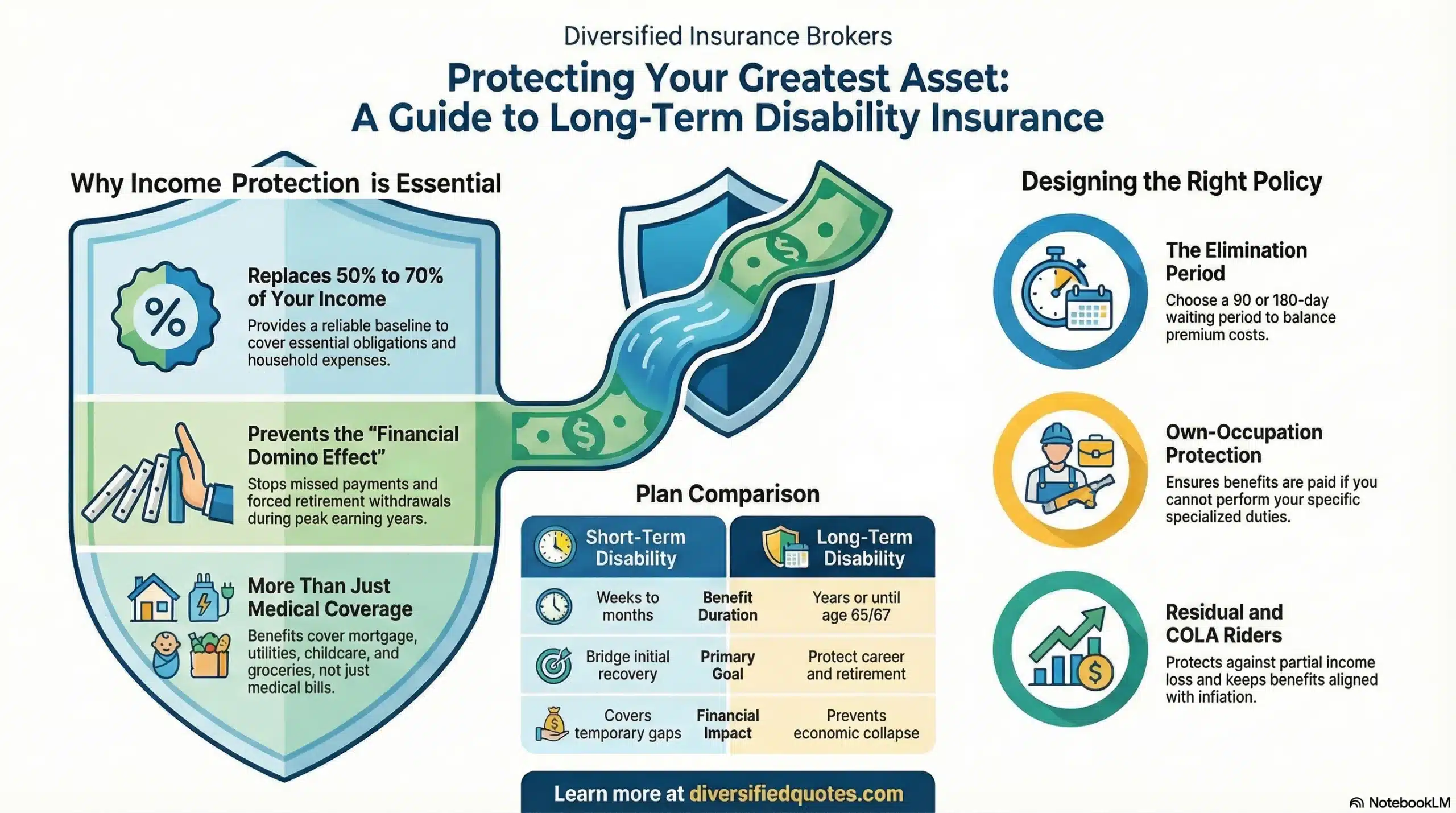
A residual disability rider is important for professional gamblers whose conditions may reduce performance capacity without eliminating it entirely — a gambler who can play lower stakes or shorter sessions but cannot maintain the sustained high-level performance that their professional income depends on earns reduced income without being totally disabled from gambling activity. Our resource on how residual disability insurance benefits work explains how partial disability coverage supports professional gamblers through graduated performance capacity reductions. The elimination period should be calibrated to available financial reserves — our guide on how disability insurance elimination periods work provides the complete framework. A cost-of-living adjustment rider preserves real benefit value across extended disability periods — our resource on disability income insurance with a COLA rider explains this protection. For professional gamblers exploring short-term coverage options, our guide on how to buy short-term disability insurance covers the complete income protection picture.
Why Professional Gamblers Need an Independent Disability Insurance Broker
Disability insurance for professional gamblers requires expertise in self-employment income documentation for gambling trade-or-business status, knowledge of which carriers will underwrite professional gambling income most favorably, understanding of how to present variable gambling income histories for benefit calculation, and experience with mental health coverage evaluation for cognitive performance professionals — all of which require independent broker expertise rather than a standard retail application process.
Professional gambling is not a standard occupational category in most carrier classification guides. Different carriers approach the professional gambling income documentation requirement differently, and some carriers who would otherwise write coverage for a cognitively based self-employment profession are unfamiliar with how to evaluate gambling Schedule C income or how to confirm the consistency and professional status of gambling earnings. An experienced independent broker who has navigated professional gambling disability insurance placements can identify the carriers most receptive to this income type, present the documentation most effectively, and structure coverage that genuinely reflects the professional gambler’s earning capacity and disability risk profile. Our dedicated resource on why independent disability insurance brokers matter explains the full value of this approach. And our resource on whether disability insurance is worth the investment provides the foundational financial case for coverage that applies with particular force to self-employed professionals with no employer safety net.
Final Thoughts on Disability Insurance for Professional Gamblers and Poker Players
Professional gambling is a legitimate and recognized trade or business under IRS standards — one that requires sophisticated analytical skill, sustained cognitive performance, emotional discipline, and the specialized probabilistic and game-theoretic expertise that distinguishes genuine professionals from recreational participants. The professionals who practice it full-time deserve the same quality of income protection planning that other self-employed cognitive professionals access — and with the right broker guidance, the right income documentation, and the right policy structure, that protection is genuinely achievable.
Disability insurance for professional gamblers — built around an own-occupation definition that protects gambling professional income from the cognitive and neurological conditions most likely to impair it, comprehensive mental health benefit period coverage, a residual disability rider for the graduated performance capacity reductions that many health conditions produce, and benefit amounts calibrated to genuine multi-year professional gambling earnings — provides the financial security that ensures a cognitive disability event does not also become a financial catastrophe for professionals who have invested years developing their craft.
Related Pages
Talk With an Advisor Today
Choose how you’d like to connect—call or message us, then book a time that works for you.
Schedule here:
calendly.com/jason-dibcompanies/diversified-quotes
Licensed in all 50 states • Fiduciary, family-owned since 1980
Disability Insurance for Professional Gamblers and Poker Players FAQs
Yes — professional gamblers and poker players can obtain individual disability insurance, though the application process requires specific documentation and carrier selection expertise that makes working with an experienced independent broker essential. The occupational classification that professional gambling receives is actually favorable relative to many other self-employed professions — because gambling is entirely cognitive and sedentary work with no physical hazards, no manual labor component, and no occupational chemical or physical risk exposure. The disability insurance underwriting challenges specific to this profession are primarily about income documentation rather than occupational hazard classification. A professional gambler must demonstrate consistent Schedule C self-employment income from gambling as a recognized trade or business — with the meticulous session records, multi-year tax return history, and income documentation that supports a meaningful benefit calculation. Carriers who will underwrite professional gambling income exist in the marketplace, and an independent broker with experience in this income type can identify which ones are most receptive and present the documentation most effectively. For context on disability insurance for other cognitive self-employment professionals with complex income documentation, see our page on disability insurance for independent analytical and technical professionals managing self-employment income documentation.
The income documentation requirements for professional gambler disability insurance are specific and demanding — and meeting them requires both proper IRS tax filing status and the meticulous record-keeping that establishes professional gambling as a genuine trade or business. At the foundation, a professional gambler needs multiple years of Schedule C tax returns showing gambling as a self-employed trade or business with consistent net income — not recreational winnings reported on Schedule 1. Most carriers want to see at least two to three consecutive years of Schedule C gambling income filings to establish the consistency and regularity that confirms ongoing professional status rather than a single fortunate year. Beyond the tax returns, supporting records should include contemporaneous gambling logs documenting session dates, venues, games, buy-in amounts, and results — the detailed records that Tax Court cases have confirmed are the most important factor in establishing professional gambler status. Bank statements showing deposits consistent with reported income, W-2G forms for qualifying tournament results, and any additional documentation confirming the businesslike conduct of gambling activities all strengthen the income documentation package. The professional gambler’s documented average net income over multiple years — rather than a single best year — is typically the most appropriate basis for the benefit calculation, given the inherent variance in gambling outcomes.
The disability risk profile for professional gamblers is centered entirely on conditions that impair the cognitive, perceptual, and psychological performance capacities that professional gambling demands. Neurological events represent the most acute and severe disability risk — stroke, transient ischemic attack, traumatic brain injury from an accident, and progressive neurological conditions can all produce cognitive impairments in working memory, executive function, processing speed, and decision-making quality that fundamentally eliminate professional gambling performance capacity even when physical function remains largely intact. Serious mental health conditions — major depression, bipolar disorder, severe anxiety — represent a significant ongoing disability risk because the emotional regulation, loss discipline, and decision-making quality that professional gambling profitability requires are directly and measurably impaired by these conditions. Vision conditions severe enough to prevent reading cards or table elements affect professional gamblers in formats that depend on visual information processing. Serious chronic illness — cancer treatment, cardiac disease, autoimmune conditions — can impair the sustained cognitive performance that extended professional play sessions require. The cognitive disability risk profile for professional gamblers is closely parallel to that for other high-level analytical decision-making professionals, including scientific researchers and analytical professionals managing cognitive performance disability risk.
Own-occupation disability insurance pays benefits when a disabling condition prevents performing the specific duties of a professional gambler’s practice — the analytical decision-making, probabilistic reasoning, opponent modeling, bankroll management, and sustained cognitive performance under competitive pressure that professional gambling requires — regardless of whether the person could theoretically perform other less cognitively demanding or less performance-intensive work. Any-occupation coverage only pays if the professional gambler cannot perform virtually any gainful employment. A professional poker player whose stroke produces persistent working memory and executive function deficits that eliminate their ability to maintain a competitive edge in high-stakes play but who could theoretically perform simple administrative work would receive no any-occupation benefits — while an own-occupation policy recognizes the genuine inability to practice as a professional gambler at their prior income level and pays accordingly. For professional gamblers who have invested years developing the specialized analytical skills and pattern recognition that generate their professional edge, own-occupation coverage is the only definition that genuinely protects professional gambling income from the cognitive conditions most likely to impair it.
Many individual disability insurance policies cover mental health conditions including major depression, bipolar disorder, and serious anxiety disorders when they prevent performing occupational duties — and for professional gamblers, mental health coverage is a particularly important policy provision to evaluate carefully before purchase. Mental health conditions directly impair the emotional regulation, disciplined risk management, and decision-making quality that professional gambling performance depends on — meaning that a serious depression or anxiety episode does not merely affect general quality of life but specifically and measurably impairs the professional capacity that generates gambling income. The most critical planning consideration is the mental health benefit period: many policies limit mental health disability benefits to 24 months even when the base policy would otherwise pay to age 65. For a professional gambler whose career could be ended or curtailed by serious depression or another mental health condition, a 24-month limitation may provide materially inadequate protection. At Diversified Insurance Brokers, we specifically evaluate mental health benefit period provisions and identify carriers offering full benefit period mental health coverage when structuring disability insurance for professional gamblers and other cognitive performance professionals.
Gambling income variance — the year-to-year fluctuation in professional gambling results that even highly skilled professionals cannot fully eliminate — creates a specific challenge for disability insurance benefit calculation that requires thoughtful income presentation. Disability insurance carriers base benefit amounts on verified documented income, and for a professional gambler whose annual net income varies from $80,000 to $320,000 across different years depending on variance, the single-year income figure most recently documented on a tax return may substantially under- or overstate their true long-run earning capacity. A multi-year average of documented Schedule C net income from gambling is typically the most accurate representation of genuine professional earning capacity for benefit calculation purposes — and working with an independent broker who understands how to present gambling income history across multiple years for benefit calculation is important for securing a benefit amount that reflects the actual financial protection need rather than a single unrepresentative year’s result. The new 90% gambling loss deduction cap beginning in 2026 adds additional complexity to the income averaging question, as the tax calculation mechanics now mean that some tax years will reflect taxable income that diverges more significantly from actual economic outcomes than under previous rules.
Residual disability coverage pays proportional benefits when a disabling condition reduces professional gambling performance capacity and income without completely eliminating the ability to play. A professional poker player recovering from a neurological event may be able to participate in lower-stakes play where the cognitive demands are less severe, or to play shorter sessions before cognitive fatigue compromises decision quality, while being unable to sustain the high-level performance that their primary income sources — high-stakes cash games, major tournament events — require. During this period of reduced performance capacity, gambling income is significantly reduced without being fully eliminated. Without a residual disability rider, a total-disability-only policy pays nothing during this partial capacity period. A residual rider supplements reduced gambling income proportionally throughout the graduated return to full professional performance capacity, providing continuous financial support from the onset of disability through complete recovery of the analytical edge that professional gambling income depends on. For professional gamblers whose most common disabling conditions — neurological recovery, mental health treatment, serious illness — typically produce gradual cognitive function improvement rather than sudden binary recovery, the residual rider is essential for the disability policy to function as genuine income protection. For context on residual coverage for cognitive performance professionals, see our page on disability insurance for analytical and technical professionals requiring comprehensive partial disability coverage.
The One Big Beautiful Bill Act, signed in July 2025, introduced a significant change to the taxation of professional gamblers beginning in tax year 2026: gambling loss deductions are now capped at 90% of gambling winnings, rather than being fully deductible up to the amount of winnings as under previous rules. For professional gamblers who operate at high volumes with relatively thin margins — winning 51% to 55% of their activity — this change means that a break-even or near-break-even year now generates taxable income despite no actual economic gain, because 10% of winnings cannot be offset by losses. A professional gambler who wins $400,000 and loses $400,000 now owes income tax on $40,000 in “income” despite having made nothing. The practical consequence has been reported as forcing some professional players to reduce their volume, avoid the largest buy-in events, and shift their activity to protect against tax liability that now accompanies certain high-volume low-margin play strategies. For disability insurance planning purposes, this change adds additional complexity to income documentation and benefit calculation, since the new tax mechanics mean that some tax years will reflect Schedule C taxable income that diverges more from actual economic outcomes than previously — making multi-year income averaging and careful documentation more important than ever.
Elimination period selection for professional gamblers should account for the complete absence of any employer-provided bridge income — there is no sick pay, no group disability plan, and no workers’ compensation for self-employed professional gamblers — and for the size of their available personal financial reserves relative to ongoing living expenses and any gambling-related financial obligations. Professional gamblers with substantial cash reserves — the financial discipline of managing gambling variance typically produces meaningful savings buffers among successful professionals — may comfortably manage a 90-day elimination period. Professional gamblers whose operating model involves significant buy-in capital deployment that limits available personal liquid reserves should evaluate 30 or 60-day elimination periods that provide faster benefit access. The specific nature of gambling income — which can be relatively lumpy and irregular even for successful professionals — means that the elimination period decision should be made with the full household financial picture in view, including any investment assets, real estate equity, and other financial resources available to sustain the household during the waiting period before benefits activate. The goal is matching the elimination period to genuine financial capacity rather than the minimum premium option, which is the same principle that applies to all self-employed professionals without institutional bridge income.
The best time for a professional gambler to apply for disability insurance is as early as possible in their professional gambling career — after establishing a minimum of one to two years of documented Schedule C income from gambling that confirms professional status, but as early in that window as possible before any health conditions have developed. Disability insurance premiums are based in part on age and health status at the time of application, and younger professional gamblers in excellent health secure the most comprehensive coverage at the most favorable rates. Any documented history of mental health treatment — depression, anxiety, or other conditions — can result in exclusion riders or restricted terms if documented at application, making early application before these conditions appear in the medical record particularly important for professional gamblers whose careers create sustained psychological stress. Cardiovascular risk factors, neurological history, and other conditions that affect cognitive performance capacity can similarly result in exclusion riders if documented at application. The non-cancelable and guaranteed renewable provision locks in the early-career health rating for the policy’s entire duration. A future increase option rider secured early allows benefit amounts to grow with documented gambling income as the career and earning capacity develop, without requiring new medical underwriting when health conditions may have changed. For context on the timing rationale for early disability insurance application for self-employed cognitive professionals, see our page on disability insurance for scientific and analytical professionals managing early career coverage decisions.
An independent broker with experience placing disability insurance for non-standard self-employment professions is essential for professional gamblers, because professional gambling is not a standard occupational category in most carrier classification guides and different carriers approach gambling Schedule C income documentation very differently. Some carriers who would otherwise write coverage for a cognitively based self-employment profession decline professional gambling income or require documentation standards they are unfamiliar with how to evaluate — while others who have experience with this income type can process it efficiently and offer meaningful coverage. The differences between carriers in how they classify gambling self-employment income, how they handle multi-year averaging of variable gambling results, and how they evaluate mental health benefit period provisions produce meaningfully different real-world outcomes for the same professional gambler’s application. At Diversified Insurance Brokers, we evaluate the full competitive marketplace for professional gambling disability insurance, identify carriers whose underwriting is most receptive to gambling Schedule C income documentation, navigate the income averaging and documentation presentation most effectively, specifically evaluate mental health coverage provisions for the full benefit period, and structure coverage that genuinely reflects each professional gambler’s actual earning capacity and disability risk profile.
About the Author:
Jason Stolz, CLTC, CRPC, DIA, CAA and Chief Underwriter at Diversified Insurance Brokers (NPN 20471358), is a senior insurance and retirement professional with more than 25 years of real-world experience helping individuals, families, and business owners protect their income, assets, and long-term financial stability. As a long-time partner of the nationally licensed independent agency Diversified Insurance Brokers, Jason provides trusted guidance across multiple specialties—including fixed and indexed annuities, long-term care planning, personal and business disability insurance, life insurance solutions, Group Health, Travel Medical and Evacuation Insurance, and short-term health coverage. Diversified Insurance Brokers maintains active contracts with over 100 highly rated insurance carriers, ensuring clients have access to a broad and competitive marketplace.
His practical, education-first approach has earned recognition in publications such as VoyageATL, and contributions from his agency featured in Kiplinger and GoBankingRates— highlighting his commitment to financial clarity and client-focused planning. Drawing on deep product knowledge and years of hands-on field experience, Jason helps clients evaluate carriers, compare strategies, and build retirement and protection plans that are both secure and cost-efficient. Visitors who want to explore current annuity rates and compare options across multiple insurers can also use this annuity quote and comparison tool.
Explore More Disability Insurance Options: Browse our complete guide to Disability Insurance for Food, Hospitality, Arts & Entertainment — covering chefs, musicians, actors, bartenders, hospitality workers & entertainment professionals from 100+ carriers.
Last Reviewed: June 8, 2026 |
Reviewed by: Jason Stolz, CLTC, CRPC, DIA, CAA
Chief Underwriter, Diversified Insurance Brokers, Inc. | NPN: 20471358 | Diversified Insurance Brokers, Inc. — Licensed in all 50 states
Fact Checked by: Tonia Pettitt, CMIP©
Medicare Specialist, Diversified Insurance Brokers, Inc. | NPN: 14374308 | Diversified Insurance Brokers, Inc. — Licensed in all 50 states
Did you find this content helpful? Leave us a Google review — it helps others find trustworthy guidance too.
Editorial Standards: Diversified Insurance Brokers maintains rigorous editorial standards to ensure accuracy, clarity, and independence in all content. Learn more about our editorial standards and commitment to transparency.
