
Axonic Trailhead Fixed Indexed Annuity – Market Growth with Downside Protection and Flexible Terms
As an Independent Annuity Broker, we compare rates across 100+ carriers and 1,000 different annuities— not just one company’s product offerings — to find the best fit for your goals.
Axonic Trailhead Fixed Indexed Annuity – Market Growth with Downside Protection and Flexible Terms
At Diversified Insurance Brokers, we understand that retirement planning is rarely about chasing the highest possible return. For most of the individuals and families we serve, the real objective is far more practical: grow assets responsibly, protect principal from market downturns, maintain meaningful access to liquidity when needed, and preserve the flexibility to create lifetime income later. The Axonic Trailhead Fixed Indexed Annuity, issued by AmFirst Insurance Company and distributed by Axonic Insurance Services, is designed precisely around that balance of opportunity and protection. It is a product built for clients who want market-linked growth potential without direct exposure to stock market losses — and it brings with it the institutional backing of Axonic Capital, a $4.3 billion alternative asset management firm with deep expertise in structured credit and systematic fixed income that launched its insurance platform in January 2024. AmFirst Insurance Company, the issuing carrier, has operated since 1998 and holds an A– (Excellent) rating from AM Best, reflecting over two decades of claims-paying history and adequate capitalization. In October 2025, Axonic Insurance secured a $210 million preferred equity investment from LuminArx Capital Management and Deutsche Bank — one of the larger insurance platform funding events of that year and a meaningful endorsement of the platform’s financial trajectory. That institutional foundation matters when selecting a product where the carrier’s ability to fulfill long-term obligations is part of the value proposition.

The Trailhead is a single-premium deferred fixed indexed annuity available in 5-, 7-, and 10-year surrender periods, offering a choice of market-linked crediting strategies alongside a traditional fixed account option for clients who prefer complete predictability within the same contract. Unlike a traditional fixed annuity that credits a single declared rate for the full term, the Trailhead links interest crediting to the performance of external indices including the S&P 500 Index, S&P 500 Dynamic Intraday TCA Index, DB Foresight X-Asset 10 Index, and Nasdaq-100 Volatility Control 7% Index. The core principle across all indexed strategies is consistent: you participate in a defined portion of positive index performance when markets rise, and you are completely shielded from negative index returns when markets fall. Your principal cannot decline due to index performance — that contractual floor is what defines the fixed indexed annuity structure and what makes it distinct from direct market participation. For a comprehensive explanation of how indexed crediting works in practice, our guide on how does a fixed indexed annuity work covers the mechanics in plain language. The Trailhead also includes a Market Value Adjustment (MVA) feature — a provision that allows AmFirst to offer more competitive participation rates by adjusting contract values for surrenders above the free withdrawal amount based on interest rate movements since the contract’s issue date, which can work in the contract owner’s favor when rates decline and against them when rates rise. Understanding the MVA before funding is important context for any client who may need liquidity access beyond the penalty-free withdrawal provision.
Axonic Trailhead Fixed Indexed Annuity: Key Product Features at a Glance
| Product Feature | Details |
|---|---|
| Issuing Carrier | AmFirst Insurance Company — AM Best rating: A– (Excellent). In operation since 1998. Issuing carrier for all Axonic Insurance products. |
| Distributor | Axonic Insurance Services, subsidiary of Axonic Capital — $4.3B AUM alternative asset manager specializing in structured credit, commercial real estate, and systematic fixed income. Launched insurance platform January 2024. $210M preferred equity raise from LuminArx and Deutsche Bank completed October 2025. |
| Product Type | Single-premium deferred fixed indexed annuity (FIA). Not a variable annuity — no direct market investment, no SEC registration required. |
| Surrender Period Options | 5-year, 7-year, or 10-year surrender charge schedules. Surrender charges and MVA apply to withdrawals exceeding the free withdrawal amount during the surrender period. |
| Minimum / Maximum Premium | Minimum: $20,000. Maximum: $1,000,000 without prior company approval. Higher amounts may be accepted with company review. |
| Principal Protection | Contract value cannot decline due to negative index performance. Zero is the floor — interest credited is never negative due to index losses. |
| Crediting Term Options | One-year and two-year crediting terms available depending on strategy. Allocations can be reallocated at each term renewal based on current options and the policyholder’s preferences. |
| Index Strategy Options | S&P 500 Index; S&P 500 Dynamic Intraday TCA Index; DB Foresight X-Asset 10 Index (Deutsche Bank proprietary); Nasdaq-100 Volatility Control 7% Index. Fixed account option also available for guaranteed declared rate growth. |
| Crediting Method | Caps, participation rates, or spread rate depending on the strategy selected. Interest earned at end of each crediting term is locked in and cannot be lost in subsequent terms due to market declines. |
| Free Withdrawal Provision | Up to 10% of contract value annually after the second contract year without surrender charges. No penalty-free withdrawals in the first contract year. MVA may still apply depending on policy terms — verify at purchase. |
| Market Value Adjustment (MVA) | Applies to surrenders and excess withdrawals during the surrender period. MVA can be positive (if rates have fallen since issue) or negative (if rates have risen since issue). Allows carrier to offer more competitive index participation rates. |
| Waiver Provisions | Surrender charge and MVA waivers may be available for qualifying nursing home confinement or terminal illness diagnosis. Subject to state availability and specific contract terms. |
| Income Rider Availability | The Trailhead FIA is primarily an accumulation-focused product. Income rider availability is subject to product design and state approval — not available in all states. Verify current availability for your state at time of application. |
| Qualified Account Compatibility | Can be funded with non-qualified (after-tax) savings or qualified accounts including Traditional IRA, Roth IRA, SEP IRA, and 401(k) rollovers. Tax treatment differs by funding source. |
| Tax Treatment | Interest grows tax-deferred until withdrawal. Non-qualified funds taxed on LIFO basis (earnings first). Qualified accounts follow IRA/qualified plan rules. Withdrawals before age 59½ may incur a 10% IRS early withdrawal penalty in addition to ordinary income tax. |
| State Availability | Available in most states. California restrictions apply — certain riders and features may not be available. Verify current state approvals before applying. |
| Interest Boost Feature | A one-time Interest Boost credit may be applied at the end of the initial crediting term on select product versions (e.g., Trailhead 7). Built into product structure — no action required. Should be evaluated in context of full surrender charge schedule and MVA before drawing conclusions about overall yield. |
How the Crediting Strategies Work in Practice
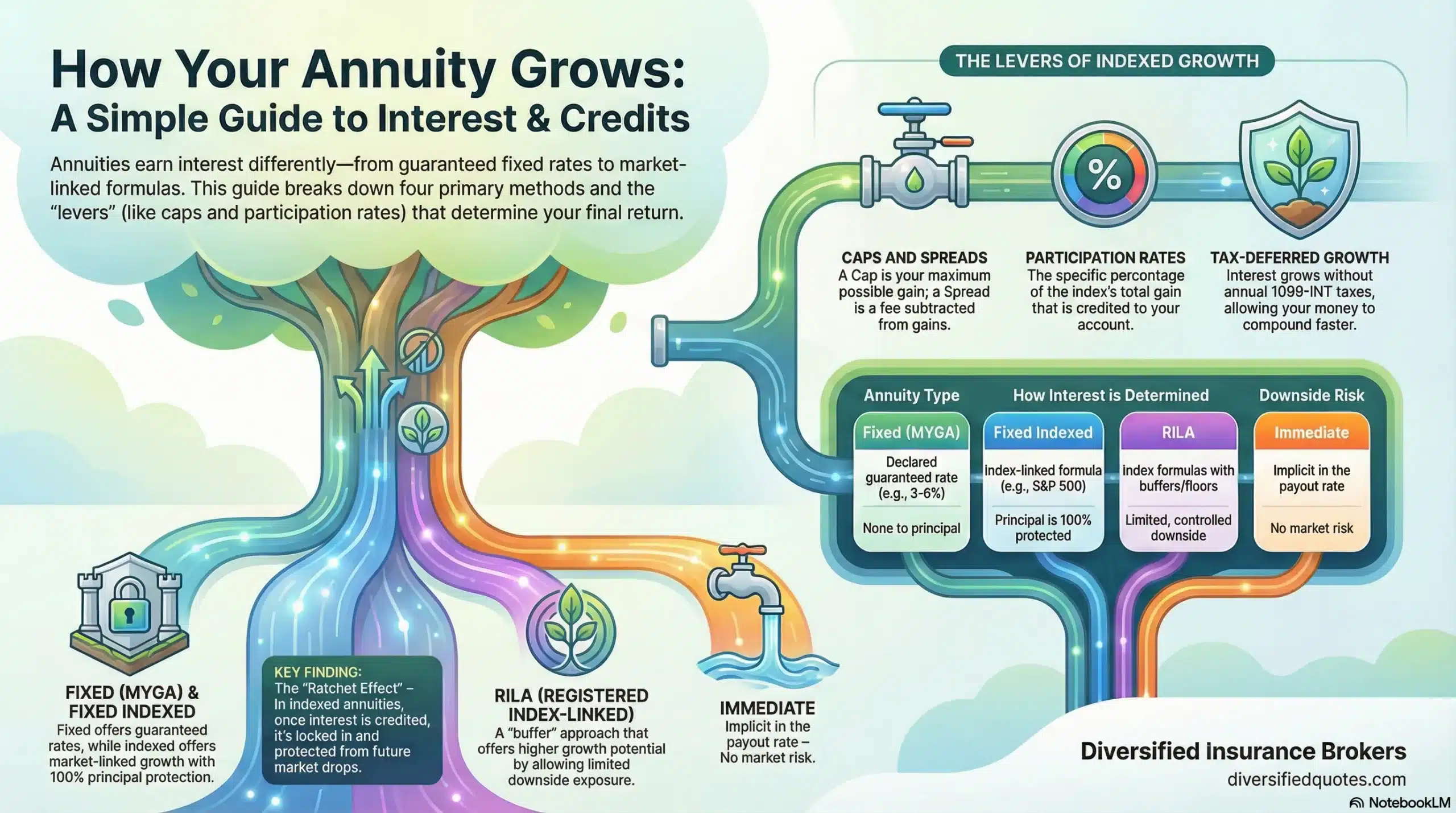
The Trailhead’s indexed crediting strategies are the mechanism through which your contract value can grow beyond a fixed declared rate — and understanding how each strategy works is essential to making an informed allocation decision at purchase and at each annual or biennial renewal. Every indexed strategy is defined by three potential limiting parameters: a cap rate, a participation rate, or a spread rate. A cap rate is the maximum interest that can be credited in a single term regardless of how much the index actually gained — if the index rises 18% and the cap is 10%, you receive 10%. A participation rate defines the percentage of index gains you receive without a cap — a 50% participation rate on a 20% index gain credits 10% interest. A spread is subtracted from index gains — if the index gains 15% and the spread is 3%, you receive 12%. Different strategies use different mechanisms, and the Trailhead offers a range of strategies allowing clients to choose the approach that best fits their growth expectations and risk profile. The fixed account option operates outside the indexed framework entirely, crediting a declared rate for the full term — useful for clients who want certainty on a portion of their allocation without subjecting any amount to index-linked variability in terms of the crediting outcome.
The proprietary and volatility-controlled indices available within the Trailhead — the S&P 500 Dynamic Intraday TCA Index, the Deutsche Bank DB Foresight X-Asset 10 Index, and the Nasdaq-100 Volatility Control 7% Index — are designed differently from their parent benchmarks in ways that affect how caps and participation rates are structured. Volatility-controlled indices algorithmically adjust their equity exposure to maintain a target volatility level, which tends to produce smoother return profiles than the underlying index but also dampens participation in strong up-markets. The practical effect is that these strategies often carry higher participation rates or more favorable crediting terms than a simple S&P 500 annual point-to-point strategy, because the carrier’s hedging cost for smoother indices is lower. The tradeoff is that in strong bull-market years, the volatility control mechanism may reduce the index gain on which your credit is calculated — even if the underlying Nasdaq-100 or S&P 500 advanced more. Understanding this tradeoff is important for clients evaluating which strategy to allocate to, and it is one of the discussions our team walks through during the proposal process. Our guide on index annuity crediting methods covers the mechanics of caps, spreads, participation rates, and point-to-point calculations in greater depth. For clients evaluating how this compares to other indexed products, our overview of fixed indexed annuity pros and cons covers the structural advantages and limitations of the FIA category broadly.
Liquidity, Surrender Terms, and Waiver Provisions
Liquidity is one of the most frequently misunderstood dimensions of annuity planning, and the Trailhead’s provisions are worth understanding clearly before funding. The contract does not lock your money completely — after the second contract year, you may withdraw up to 10% of the contract value annually without incurring surrender charges. That 10% free withdrawal allowance can be meaningful for clients who want a predictable source of supplemental income or who want a cushion for unexpected expenses during the surrender period without fully surrendering the contract. In the first contract year, no penalty-free withdrawals are available, which is an important constraint for clients who may have near-term cash needs. Withdrawals that exceed the penalty-free allowance during the surrender period are subject to both a surrender charge and, depending on interest rate conditions since issue, a Market Value Adjustment — both of which can meaningfully reduce the amount received. The surrender charge schedule declines annually over the 5-, 7-, or 10-year term until it reaches zero at maturity, at which point the full account value is available without any charge or adjustment. Our resource on annuity surrender charges explained covers how surrender schedules function across products and what to consider when matching a term to your planning horizon.
Beyond the penalty-free withdrawal provision, the Trailhead includes waiver provisions for qualifying events that may expand access to the contract value under hardship conditions. Nursing home confinement and terminal illness diagnoses are the most common waiver triggers — under qualifying circumstances, surrender charges and MVA may be waived, allowing broader access to the accumulated value precisely when it may be most needed. These provisions are subject to specific definitions, waiting periods, and state approval, so verifying the exact terms for your state before purchase is important. The contract can also be structured to provide death benefit access to named beneficiaries, avoiding probate and providing a direct transfer of the account value — typically the greater of the accumulated contract value or the premium paid, depending on the specific contract terms. For clients whose planning includes legacy considerations alongside accumulation, our resource on annuity beneficiary death benefits covers how annuity death benefits are structured and taxed for heirs.
Ensure you are receiving the absolute top rates
Current Fixed Annuity Rates
Compare today’s best fixed annuity rates from top carriers.
Current Bonus Annuity Rates
See which annuities offer the highest upfront bonus today.
Request an Annuity Quote
Submit our annuity request form to get personalized rate options.
Lifetime Income Calculator
Use our calculator to see how much guaranteed income your annuity can provide.
Premium Funding Sources, Tax Deferral, and How the Trailhead Compares to CDs
The Trailhead accepts a minimum single premium of $20,000 and a maximum of $1,000,000 without prior company approval — a range that accommodates a broad spectrum of clients, from individuals repositioning a maturing CD or savings account to those consolidating multiple smaller retirement accounts into a single tax-deferred vehicle. The product is compatible with both non-qualified after-tax savings and qualified retirement accounts including Traditional IRAs, Roth IRAs, SEP IRAs, and 401(k) and 403(b) rollovers, making it applicable across the full range of client funding situations. For clients executing a direct IRA rollover or transfer from an existing annuity, the mechanics and potential tax implications depend on the account type and the transfer structure — our resources on how to transfer an IRA to an annuity and how to transfer a CD into an annuity cover the process for the most common funding scenarios.
The comparison to CDs is one of the most common conversations we have with clients evaluating the Trailhead. On the surface, both products share important characteristics: principal protection, defined terms, and predictable access to funds. But the differences are meaningful. A CD credits a fixed interest rate and that interest is taxed annually as ordinary income, regardless of whether the client takes a distribution. The Trailhead grows tax-deferred — no income taxes are due on credited interest until the client takes a withdrawal, which can meaningfully enhance long-term compounding for clients who do not need the income currently. A five-year CD at a competitive rate produces a predictable outcome, but every dollar of interest earned is subject to annual taxation in the year it is credited. A Trailhead contract over the same five years allows the full credited interest to compound without annual tax drag. For clients in higher marginal brackets or those with a longer planning horizon before income is needed, that tax-deferred compounding advantage can produce meaningfully more after-tax wealth than a taxable CD of comparable yield. Additionally, the Trailhead’s indexed upside potential — uncapped or cap-limited participation in positive index years — means the ceiling on growth is higher than any fixed CD rate, while the floor remains the same: your principal is not at risk due to negative index performance. You can compare current CD alternatives in the context of annuity options using our fixed annuities vs. CDs comparison and our overview of current fixed annuity rates.
Income Planning, Tax Considerations, and Who the Trailhead Is Best Suited For
The Trailhead is fundamentally an accumulation vehicle — it is designed to grow contract value efficiently during the years before income is needed. It does not currently include a built-in guaranteed lifetime income rider as a standard feature, which distinguishes it from some competing FIA products that bundle accumulation and income into a single contract with an attached rider. Clients whose primary objective is guaranteed lifetime income starting immediately or within a short window may find that products with built-in income riders are a better structural match for that specific goal. Clients whose primary objective is disciplined, tax-deferred accumulation with principal protection and market-linked upside over a defined 5-, 7-, or 10-year horizon — with the option to annuitize or convert to income at the end of the accumulation phase — will find the Trailhead’s structure well-aligned with that use case. For clients evaluating whether a product with a built-in income feature is more appropriate, our resources on fixed indexed annuity with income rider and best fixed indexed annuities for income provide a comparative framework. The Lifetime Income Calculator above can also help illustrate how a given premium amount might translate into future income under a variety of annuity structures.
Tax treatment within the Trailhead follows standard deferred annuity rules. Interest credited within the contract accumulates tax-deferred until withdrawn — no annual 1099 is generated for interest credited to the contract value during accumulation. For non-qualified funding, withdrawals are taxed on a last-in, first-out basis, meaning interest earnings are treated as distributed before the return of premium cost basis, making the earnings subject to ordinary income tax first. For qualified funding — IRA, 401(k) rollover, SEP IRA — the entire distribution is generally subject to ordinary income tax because the cost basis is pre-tax. Withdrawals taken before age 59½ are also subject to a 10% IRS early withdrawal penalty in addition to ordinary income taxes on the taxable portion, regardless of whether surrender charges have expired. Understanding these tax mechanics before funding is essential to ensuring the Trailhead fits your broader financial plan — our detailed resource on how are annuities taxed covers the full framework, and we strongly recommend coordinating with your tax advisor before executing any annuity transaction.
The clients for whom the Trailhead is most clearly well-suited share a set of common characteristics: they have a defined accumulation horizon of five to ten years before income is needed; they want principal protection that eliminates the risk of loss from market downturns while preserving participation in positive market years; they have savings or retirement account assets currently sitting in lower-growth vehicles — CDs, money markets, or fixed-rate products — where the tax-deferred compounding advantage of an FIA could produce meaningfully better outcomes; and they do not need immediate liquidity beyond the 10% annual free withdrawal provision. Pre-retirees between ages 50 and 65 repositioning a portion of retirement assets away from market volatility as they approach distribution represent the most common Trailhead client profile. For clients evaluating whether their overall situation calls for an FIA, a MYGA, or a combination approach, our resources on fixed annuities vs. fixed indexed annuities and are annuities a good investment in retirement provide the broader context for making that determination. For clients who want to compare the Trailhead against other leading FIA products currently available, completing our personalized comparison request below is the most efficient path to a side-by-side analysis tailored to your premium amount, timeline, and objectives.
If you would like to compare the Axonic Trailhead Fixed Indexed Annuity with other indexed and fixed annuities available in your state — including cap rates, participation rates, surrender durations, and projected scenarios — we invite you to complete our secure Monday annuity form. Our team will prepare a personalized comparison tailored to your deposit amount, timeline, and income objectives: Request Your Personalized Annuity Comparison.
Related Pages
Explore additional annuity and retirement planning resources.
Financial Protection Essentials
Explore additional insurance solutions and retirement planning strategies.
Talk to an Advisor or Request Your Annuity Quote
Ready to explore this annuity in more detail—or compare it with other carriers to see if even higher rates are available? With guaranteed income, principal protection, and long-term growth potential on the line, making the right choice is essential. The experienced advisors at Diversified Insurance Brokers will guide you through the options and design a strategy tailored to your retirement goals.
Schedule here:
calendly.com/jason-dibcompanies/diversified-quotes
Licensed in all 50 states • Fiduciary, family-owned since 1980
Frequently Asked Questions: Axonic Trailhead Fixed Indexed Annuity
Who issues the Axonic Trailhead and how financially strong is the carrier?
The Trailhead Fixed Indexed Annuity is issued by AmFirst Insurance Company, which has operated since 1998 and holds an A– (Excellent) financial strength rating from AM Best — the insurance industry’s most widely recognized independent rating agency. An A– rating indicates strong claims-paying ability and a solid balance sheet relative to policy obligations. Axonic Insurance Services, the product’s distributor, is a subsidiary of Axonic Capital, a $4.3 billion alternative asset management firm specializing in structured credit and systematic fixed income that launched its insurance platform in January 2024. In October 2025, Axonic Insurance completed a $210 million preferred equity investment from LuminArx Capital Management and Deutsche Bank — a significant institutional endorsement that strengthened the surplus position behind AmFirst’s policy obligations. For clients evaluating the carrier relationship in more depth, our resource on the company provides additional context.
Can I lose money in the Axonic Trailhead due to market losses?
No — your principal cannot decline due to negative index performance. The contractual floor is zero: in any crediting term where the linked index produces a negative return, no interest is credited, but your existing contract value is not reduced as a result of that market loss. This is one of the defining characteristics of the fixed indexed annuity structure and what distinguishes it from variable annuities or direct market investment. Interest that has already been credited in prior terms is also locked in — it cannot be lost in subsequent terms if markets decline. The only ways your contract value can be reduced are through withdrawals (including those that trigger surrender charges and MVA) or certain administrative fees if applicable. For clients who want a deeper explanation of this protection mechanism, our guide on do you lose your principal in an indexed annuity covers the floor guarantee in detail.
What is a Market Value Adjustment and how does it affect the Trailhead?
A Market Value Adjustment is a provision that adjusts the amount you receive on surrenders or excess withdrawals based on the movement of interest rates since the contract was issued. If interest rates have risen since you purchased the annuity, the MVA will typically reduce your withdrawal or surrender value — because the carrier can now invest at higher rates, making your contract’s existing rate structure less favorable to sell back early. Conversely, if rates have fallen since issue, the MVA will typically increase the amount you receive on surrender. The MVA is not a penalty in itself — it is a mechanism that allows AmFirst to offer more competitive participation rates and caps within the indexed strategies than would otherwise be possible, because the carrier can price the product with greater confidence that clients will not exit early simply because rates improve. The practical implication for clients: if you are considering a Trailhead purchase, understand that accessing funds beyond the 10% annual free withdrawal during the surrender period exposes you to both the stated surrender charge and a potentially unfavorable MVA if rates have risen. Our resource on annuity surrender charges explained covers how surrender schedules and MVAs interact across different market environments.
What are the differences between the 5-, 7-, and 10-year Trailhead options?
The three surrender period options — 5, 7, and 10 years — represent different tradeoffs between commitment duration, liquidity flexibility, and growth potential. Longer surrender periods typically allow the carrier to offer more favorable crediting terms — higher caps, higher participation rates, or lower spreads — because the carrier has a longer runway to manage the hedging costs associated with the indexed strategies. A 10-year Trailhead will generally offer more competitive index participation than a 5-year Trailhead, all else equal. The tradeoff is commitment: during the longer surrender period, early withdrawals above the 10% annual free withdrawal amount are subject to surrender charges and MVA. The right term depends on your planning horizon — how long before you expect to need access to this money for income or other purposes — and your tolerance for the liquidity constraints of the longer terms. Clients who have a clear 10-year runway before income is needed, and who want to maximize accumulation potential during that window, are often well-served by the longer term. Clients who are closer to income needs or who value the optionality of a shorter commitment should evaluate the 5- or 7-year term, accepting somewhat less favorable crediting terms in exchange for the shorter obligation period.
Can I fund the Trailhead with an IRA rollover or 401(k) transfer?
Yes — the Trailhead can be funded with qualified retirement account assets including Traditional IRAs, Roth IRAs, SEP IRAs, and 401(k) or 403(b) rollovers. The mechanics differ depending on the account type and the transfer structure. A direct trustee-to-trustee transfer from an existing IRA to an IRA-qualified annuity is the cleanest approach from a tax perspective — no withholding, no 60-day rollover deadline, and no risk of the distribution being treated as taxable income. A 60-day indirect rollover is also possible but carries more execution risk. For 401(k) assets from a former employer, a direct rollover to an IRA annuity avoids mandatory withholding and the 60-day clock. Tax treatment within the contract follows the rules of the underlying account type — a Traditional IRA annuity distributes fully taxable income when withdrawn; a Roth IRA annuity can distribute tax-free income if the Roth qualifications are met. Our resources on how to transfer an IRA to an annuity and the 401(k) rollover process cover the mechanics of each transfer type in detail. Always coordinate with your tax advisor before executing any rollover to ensure the transaction is structured correctly for your situation.
How are the engineered and volatility-controlled indices different from the S&P 500?
The S&P 500 Index is a straightforward market-cap-weighted index of 500 large U.S. companies, and its performance is what most people picture when they think of “stock market returns.” The engineered and volatility-controlled indices available within the Trailhead — including the S&P 500 Dynamic Intraday TCA Index, the Deutsche Bank DB Foresight X-Asset 10 Index, and the Nasdaq-100 Volatility Control 7% Index — are constructed differently with the goal of producing smoother, less volatile return profiles. Volatility-controlled indices algorithmically reduce equity exposure and shift toward lower-volatility assets when market turbulence increases, targeting a specific annualized volatility level. The practical effect is a return profile that doesn’t capture the full upside of a strong bull market year — the vol-control mechanism reduces equity allocation precisely when markets are rising sharply. In exchange, the smoother profile allows the insurance carrier to offer higher participation rates, because its cost to hedge a less volatile index is lower. The tradeoff requires careful consideration: in a year when the Nasdaq-100 gains 30%, the Nasdaq-100 Volatility Control 7% Index might gain considerably less if the volatility of that rally triggered de-allocation. However, in choppy, sideways, or modestly positive markets, the controlled index may participate more fully. Understanding which index strategy fits your expectations for the next crediting term is part of the annual reallocation discussion our team has with clients at each renewal point.
How does the Trailhead compare to a CD for a conservative saver?
Both a CD and the Trailhead protect your principal from loss and provide defined-term accumulation — but they differ in ways that matter meaningfully for longer-horizon savers. A CD credits a fixed interest rate and that interest is taxed annually as ordinary income in the year it is credited, regardless of whether you withdraw it. The Trailhead grows tax-deferred — no taxes are due on credited interest until you take a distribution — which allows the full credited interest to compound without annual tax drag. For a client in a 22% or higher marginal bracket holding a $100,000 CD at a competitive rate, the annual tax on credited interest meaningfully reduces the effective after-tax compounding rate compared to the same credited rate inside a tax-deferred annuity contract. The Trailhead also offers indexed upside potential — in years when the chosen index performs positively, crediting may exceed what any fixed CD rate could provide, while the zero floor ensures the downside is equivalent to a CD in a negative year (no credited interest, but no loss of principal). The tradeoff relative to a CD is liquidity: a CD typically allows early withdrawal for a modest interest penalty, while the Trailhead’s surrender charges and MVA create a more significant early exit cost. For clients with a clear multi-year horizon and no expected need for the full principal, the Trailhead’s tax-deferral and indexed upside can produce better outcomes than a comparable CD.
Does the Trailhead include a guaranteed lifetime income rider?
The Trailhead Fixed Indexed Annuity is primarily structured as an accumulation vehicle — it is designed to grow contract value efficiently over a defined term rather than to generate immediate guaranteed lifetime income. A built-in guaranteed lifetime income rider is not a standard feature of the core Trailhead product, which distinguishes it from some competing FIA products that combine accumulation and a guaranteed income floor in a single contract. Income rider availability on Trailhead products is subject to product design, state approval, and may vary by version — clients should verify current availability for their specific state and contract version at the time of application. Clients whose primary objective is guaranteed lifetime income beginning soon should compare the Trailhead’s accumulation-focused structure against products with built-in income riders using our resources on fixed indexed annuity with income rider and best fixed indexed annuities for income. Clients who want to accumulate during the Trailhead’s term and then convert to income through annuitization at maturity can use the Lifetime Income Calculator above to estimate what that conversion might produce based on current rates and their accumulated value.
About the Author:
Jason Stolz, CLTC, CRPC, DIA, CAA and Chief Underwriter at Diversified Insurance Brokers (NPN 20471358), is a senior insurance and retirement professional with more than 25 years of real-world experience helping individuals, families, and business owners protect their income, assets, and long-term financial stability. As a long-time partner of the nationally licensed independent agency Diversified Insurance Brokers, Jason provides trusted guidance across multiple specialties—including fixed and indexed annuities, long-term care planning, personal and business disability insurance, life insurance solutions, Group Health, Travel Medical and Evacuation Insurance, and short-term health coverage. Diversified Insurance Brokers maintains active contracts with over 100 highly rated insurance carriers, ensuring clients have access to a broad and competitive marketplace.
His practical, education-first approach has earned recognition in publications such as VoyageATL, and contributions from his agency featured in Kiplinger and GoBankingRates— highlighting his commitment to financial clarity and client-focused planning. Drawing on deep product knowledge and years of hands-on field experience, Jason helps clients evaluate carriers, compare strategies, and build retirement and protection plans that are both secure and cost-efficient. Visitors who want to explore current annuity rates and compare options across multiple insurers can also use this annuity quote and comparison tool.
Explore More Annuity Options: Browse our complete guide to Best Fixed Indexed Annuity Products — covering individual fixed indexed annuity product reviews from top-rated carriers from 100+ carriers.
Last Reviewed: October 18, 2026 |
Reviewed by: Jason Stolz, CLTC, CRPC, DIA, CAA
Chief Underwriter, Diversified Insurance Brokers, Inc. | NPN: 20471358 | Diversified Insurance Brokers, Inc. — Licensed in all 50 states
Fact Checked by: Tonia Pettitt, CMIP©
Medicare Specialist, Diversified Insurance Brokers, Inc. | NPN: 14374308 | Diversified Insurance Brokers, Inc. — Licensed in all 50 states
Did you find this content helpful? Leave us a Google review — it helps others find trustworthy guidance too.
Editorial Standards: Diversified Insurance Brokers maintains rigorous editorial standards to ensure accuracy, clarity, and independence in all content. Learn more about our editorial standards and commitment to transparency.
