
Best Annuities for 401k Rollover
As an Independent Annuity Broker, we compare rates across 100+ carriers and 1,000 different annuities— not just one company’s product offerings — to find the best fit for your goals.
Best Annuities for 401k Rollover

Jason Stolz CLTC, CRPC, DIA, CAA
A 401(k) is one of the best accumulation vehicles available during working years — automatic contributions, employer matching, and long-term tax-deferred compounding make it the centerpiece of retirement savings for most Americans. But a 401(k) is built for one job: accumulation. Retirement is a different job entirely. The question stops being “how do I grow this account” and becomes “how do I convert this account into reliable income without taking unnecessary risk, triggering avoidable taxes, or running out of money if retirement lasts longer than expected.” An annuity — specifically, the right type of annuity matched to the right rollover objective — is one of the most effective tools for converting accumulated 401(k) savings into structured retirement income. At Diversified Insurance Brokers, Jason Stolz, CLTC, CRPC, DIA, CAA evaluates 401(k) rollover options across 100+ carriers — comparing annuity types, income structures, timing strategies, and the specific trade-offs that determine whether a given annuity is the best fit for a specific rollover objective. Our resource on what to do with a 401(k) after retirement covers the complete decision framework for 401(k) distribution planning — the annuity rollover being one strategy within a broader set of options that includes systematic withdrawals, investment account conversion, and hybrid approaches that combine guaranteed income with liquid growth assets.
The most important concept in any 401(k)-to-annuity rollover is that “best annuity” is not a universal answer — it is a context-specific answer. The annuity type that is best for a 62-year-old who wants income starting in two years is fundamentally different from the annuity that is best for a 67-year-old who wants income starting immediately, which is in turn different from the structure that is best for a 58-year-old who wants to reduce market exposure but will not need income for another decade. The rollover decision must begin with defining what job the 401(k) funds need to do in the retirement income plan — and then matching the annuity structure to that job rather than selecting a product based on marketing descriptions or rate comparisons alone. Our resource on pre-retirement checklist covers the planning decisions that most directly affect 401(k) rollover timing and strategy — including the income gap analysis, Social Security timing decisions, and healthcare cost planning that together determine how much of the 401(k) should be committed to guaranteed income versus kept flexible.
Ensure you are receiving the absolute top rates
Current Fixed Annuity Rates
Compare today’s best fixed annuity rates from top carriers.
Current Bonus Annuity Rates
See which annuities offer the highest upfront bonus today.
Request an Annuity Quote
Submit our annuity request form to get personalized rate options.
Lifetime Income Calculator
Use our calculator to see how much guaranteed income your 401(k) rollover can generate as an annuity — based on your age, premium amount, and income start date.
Annuity Types for 401k Rollover — Matching Structure to Goal
The most useful starting point for a 401(k)-to-annuity rollover comparison is a clear map of annuity types to the specific retirement goals each serves best. Most consumers encounter annuities through product-first descriptions — “a fixed indexed annuity is an annuity that…” — but the more useful frame is goal-first: “If my goal is X, which annuity structure best serves that goal?” The table below provides that mapping for the five most common annuity structures used in 401(k) rollover planning.
| Annuity Type | Primary Goal in Rollover Context | Key Benefit | Main Trade-off | Best Rollover Scenario |
|---|---|---|---|---|
| Multi-Year Guaranteed Annuity (MYGA) Fixed rate for a defined term; CD-like but tax-deferred |
Safe, predictable accumulation with guaranteed rate; often used as bond replacement inside rollover | Fixed rate locked for full term — no market exposure, no crediting formula complexity, fully predictable accumulation outcome | Surrender period limits liquidity; rate is locked in at purchase (cannot benefit from rate increases); no index-linked upside potential | Retiree wants to de-risk a portion of 401(k) from market volatility, has 3–10 year horizon before income needed, or wants a laddered rate structure |
| Fixed Indexed Annuity — Accumulation Focus Index-linked crediting with principal protection; no income rider |
Principal protection with index-linked growth potential; accumulate without direct market risk | Zero-percent floor prevents index losses from reducing principal; credited interest in positive index years can exceed MYGA rates; no annual fee in base contract | Cap rates, participation rates, or spreads limit how much of a strong index year is credited; cap rates can reset at renewal; surrender period typically 7–10 years | Retiree wants more upside potential than a MYGA but cannot afford direct market exposure; plans to activate income or access funds after the surrender period |
| Fixed Indexed Annuity with Income Rider FIA base plus guaranteed lifetime withdrawal benefit rider |
Guaranteed lifetime income alongside principal protection and index-linked accumulation | Income base grows at a guaranteed rollup rate during deferral; payout begins when income is activated and continues for life regardless of account value | Annual rider fee (0.75%–1.5%) reduces accumulation; income base is separate from account value; income design must be understood before purchase to set accurate expectations | Retiree wants guaranteed lifetime income starting in 2–10 years; wants to maintain some account control and access alongside income guarantee; concerned about longevity risk |
| Single Premium Immediate Annuity (SPIA) Premium converts immediately to structured income; payments begin within 1–12 months |
Maximum guaranteed income per premium dollar for immediate or near-immediate income need | Typically produces the highest monthly income per dollar of any annuity structure; simple mechanics; income can be structured for single life, joint life, period certain, or installment refund | Typically irrevocable once purchased — limited or no access to principal after annuitization; no account value to leave to heirs beyond any period-certain guarantee; death benefit design must be selected at purchase | Retiree wants highest possible guaranteed income now; income gap is significant and immediate; life expectancy is a primary consideration for income design |
| Deferred Income Annuity (DIA) Premium purchased now; income begins at a future date (typically 2–30 years out) |
Lock in future guaranteed income now at favorable rates; hedge against longevity risk in later retirement years | Deferral increases the payout per premium dollar relative to immediate income; allows near-term assets to remain liquid while securing future income certainty | Limited or no liquidity during the deferral period; if the annuitant dies before income begins, some contracts return premium to beneficiaries but not the growth; income start date must be chosen carefully | Retiree has adequate near-term income but wants to guarantee later-life income (ages 75–85); concerned about very long retirement; wants to reduce the investment portfolio’s longevity burden |
| Bonus Annuity (FIA with Premium Enhancement) Upfront bonus applied to premium or income base at contract issue |
Maximize starting account value or income base with premium enhancement; effective when rollover premium is larger and income activation is planned within the bonus vesting period | Upfront bonus increases starting balance — can meaningfully enhance income base value at income activation; some bonus contracts also offer higher income payout rates | Bonus vesting schedules may require the full surrender period to realize the full bonus; longer surrender periods (8–12 years) typically accompany bonus products; bonus may apply to income base only, not account value | Rollover is large; income is planned to start within the bonus vesting window; retiree is comfortable with the longer surrender period and wants maximum income base growth from day one |
The table’s most important distinction for most 401(k) rollover evaluations is between the FIA with income rider and the SPIA. The FIA with income rider maintains account control and some liquidity during the accumulation phase while building toward guaranteed lifetime income — appropriate for retirees who want flexibility alongside the income guarantee. The SPIA produces more income per premium dollar but eliminates account access and principal flexibility — appropriate for retirees who prioritize maximum income efficiency and are comfortable with the irrevocable structure. The correct choice depends on how much the retiree values account access versus income maximization. Our resource on lifetime income planning covers the full framework for building a retirement income floor from 401(k) and other retirement assets.
Why Retirees Roll a 401(k) Into an Annuity
A 401(k) inside an employer plan is a powerful accumulation vehicle with real limitations as a retirement distribution engine. Investment menus are typically limited to a selection of mutual funds curated by the plan sponsor — often without the option to allocate to guaranteed income or principal-protected vehicles that are most relevant once distributions begin. Distribution flexibility may be restricted to specific options the plan administrator permits. Beneficiary designations and plan rules govern what happens to the account on death, often without the flexibility of individual account design. And the account remains subject to the plan’s future decisions — changes to plan fees, investment menus, or plan termination — throughout the retirement years.
Rolling the 401(k) into an IRA first, and then into an annuity, resolves all of these limitations simultaneously. The rollover provides complete control over investment structure, distribution design, beneficiary arrangement, and carrier selection. For retirees who specifically need an income floor — a guaranteed baseline of predictable monthly income that does not depend on market performance — the rollover into a qualified annuity is the most direct path to creating that structure from employer plan assets. Our resource on sequence of returns risk covers the retirement income vulnerability that makes an income floor from an annuity most valuable — the risk that a major market decline in the early years of retirement permanently damages the portfolio’s income capacity even if long-term average returns are adequate.
How a 401(k)-to-Annuity Rollover Actually Works
The cleanest and most commonly used method is a direct rollover — the 401(k) plan administrator transfers funds directly to the receiving IRA custodian or annuity carrier without the funds passing through the retiree’s personal account. When executed as a direct rollover, no mandatory withholding applies, no taxable distribution is triggered, and no 60-day redeposit deadline is created. The tax-deferred status of the 401(k) funds is fully preserved throughout the transfer. Our resource on how to roll over a 401(k) into a guaranteed annuity covers the step-by-step process — including the specific paperwork sequence, how to confirm the receiving contract is properly titled as a qualified IRA annuity, and why the payee line on the disbursement documentation determines whether the transfer is treated as direct or indirect. A more detailed breakdown of the mechanics is also available in our resource on how to transfer a 401k to an annuity, which covers the same process with additional detail on the timeline, carrier coordination, and documentation steps.
Most retirees do not need to roll over the entire 401(k) into an annuity — and in most cases, a partial rollover is the more appropriate approach. The typical framework is to identify the income gap — the difference between essential monthly expenses and guaranteed income sources like Social Security and pension — and size the annuity rollover to fill that gap. The remaining 401(k) balance can be rolled into a traditional IRA and kept in a diversified investment structure for growth, discretionary spending, and inflation protection. This division — guaranteed income for essentials, investments for growth and flexibility — is the retirement income architecture that produces the most resilient long-term outcome for most retirees.
MYGAs — The Conservative Growth Option for Rollover Assets
For retirees who are not yet ready for a specific income structure but want to move 401(k) funds away from direct market exposure, a multi-year guaranteed annuity provides the simplest and most transparent alternative. The MYGA credits a fixed interest rate for the selected contract term — typically 2 to 10 years — with no market index involvement, no crediting formula complexity, and a fully predictable accumulation outcome. The rate is locked in at purchase and does not change within the guarantee period. At maturity, the contract can be renewed at a new rate, partially withdrawn, fully surrendered, or converted to a different annuity structure. Our resource on best MYGA annuity rates provides the current rate comparison across top carriers — the starting point for evaluating whether a MYGA’s fixed-rate approach is competitive with other tax-deferred alternatives for the specific rollover term. For retirees who want to compare the bonus-enhanced alternative, our resource on highest bonus FIA rates covers the bonus-enhanced product options alongside the accumulation credit mechanics that differentiate them from standard MYGAs and FIAs. A comprehensive view of current rates across both fixed and bonus structures is available at current annuity rates.
Fixed Indexed Annuities — Principal Protection With Upside Potential
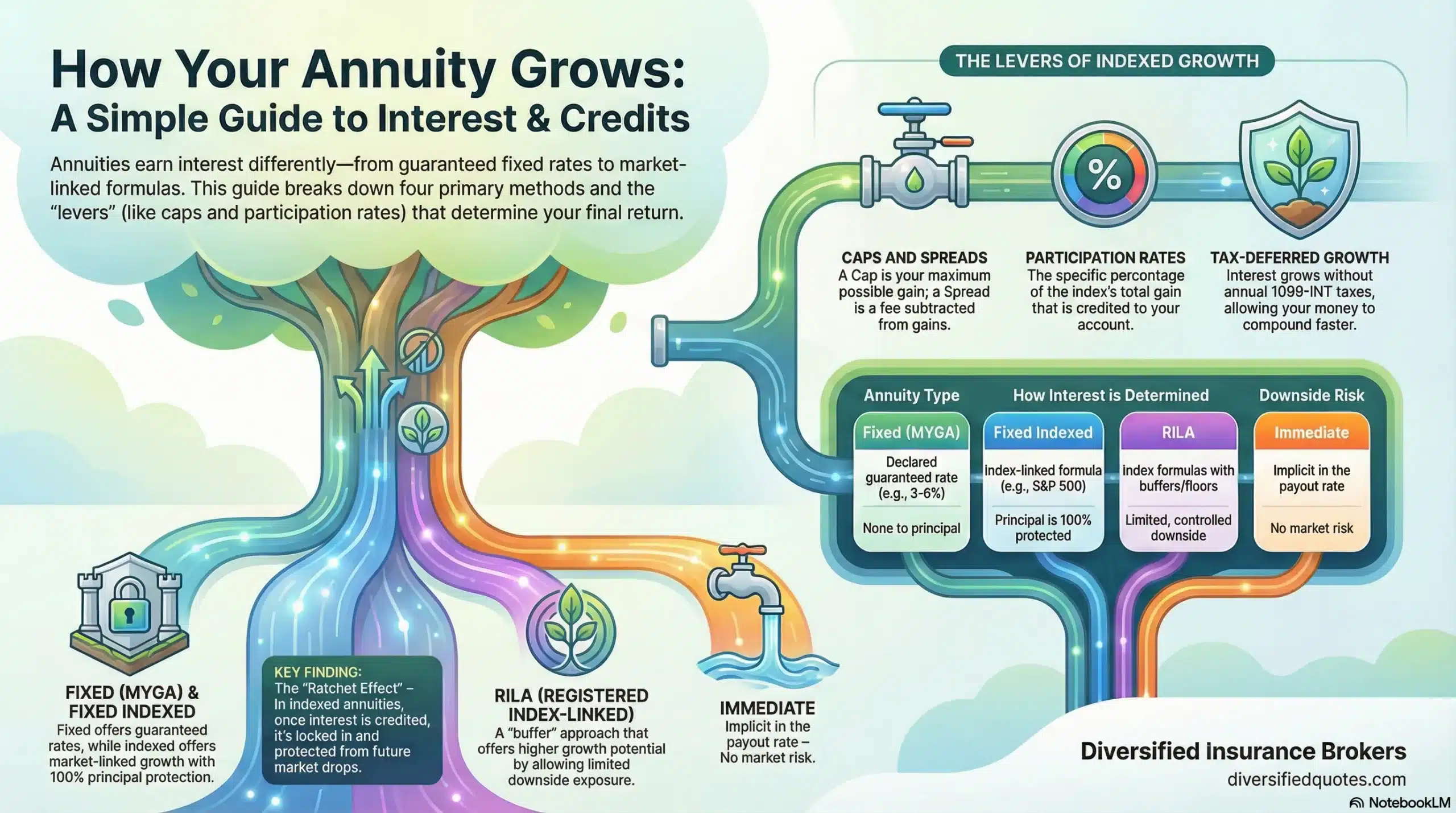
For retirees who want more than a fixed rate but are not willing to accept direct market risk on the portion of the 401(k) designated for stability, a fixed indexed annuity occupies the middle ground. The FIA uses an index crediting formula — typically involving cap rates, participation rates, or spreads applied to the performance of an external index like the S&P 500 — to determine the credited interest in each contract period. The most important feature is the floor: in years when the index declines, the FIA credits zero rather than a negative number, protecting the account value accumulated from prior credited interest and original principal from index-driven losses. Our resource on how a fixed indexed annuity works covers the crediting mechanics in plain language — cap rates, participation rates, spreads, and the annual point-to-point calculation that determines how much of a positive index year is credited to the account. For 401(k) rollover planning, the FIA is most appropriate for the portion of the rollover designated for medium-term stability — assets that are not needed for immediate income but will be converted to income or distributed over a 5–15 year horizon.
When a guaranteed lifetime income feature is added to an FIA through an income rider, the product becomes a dual-purpose tool: principal protection during the accumulation phase combined with lifetime withdrawal certainty during the income phase. Our resource on what is a GLWB covers the guaranteed lifetime withdrawal benefit mechanics — the income base, rollup rate, payout rate, and the withdrawal structure that determines how much guaranteed income is produced for life. For income-focused 401(k) rollover evaluations, the GLWB comparison across carriers is the most consequential analytical step — because the rollup rate that grows the income base during deferral and the payout rate that determines the annual withdrawal amount together determine whether the rollover produces the income it was intended to create.
SPIAs and DIAs — When Immediate or Deferred Income Is the Primary Objective
Single premium immediate annuities are the purest income conversion tool — a premium deposited once converts into a structured income stream that begins within the first year. The SPIA produces more guaranteed income per premium dollar than any other annuity structure because every dollar in the premium pool is committed to income production rather than split between income and accumulation. The most common use in a 401(k) rollover context is covering a specific monthly income gap — the difference between Social Security income and essential monthly expenses — with a permanent, unconditional income stream. Sizing the SPIA precisely to this gap, rather than using it for the entire rollover, allows the remaining rollover funds to stay invested in growth-oriented structures.
Deferred income annuities serve the specific need of later-life income certainty — locking in a future income stream that begins at a specific age (often 75, 80, or 85) at a payout rate higher than what is available for immediate income. For retirees whose current income is adequate but who are concerned about the possibility of an extremely long retirement depleting their portfolio, a DIA addresses that longevity risk specifically and efficiently — committing a modest premium today in exchange for a guaranteed income that cannot be outlived if the retiree reaches the selected start age. This structure is sometimes called “longevity insurance” precisely because it insures against the financial risk of outliving the portfolio rather than against the risk of dying early.
Bonus Annuities — When the Premium Enhancement Changes the Math
Bonus annuities apply an upfront premium enhancement — typically 5–15% of the deposited premium — to the account value, income base, or both at the time of purchase. For large 401(k) rollovers where income is planned to begin within the bonus vesting period, the bonus can meaningfully increase the starting income base and therefore the guaranteed lifetime income the annuity produces. Our resource on bonus annuity pros and cons covers the full evaluation framework — including how bonus vesting schedules work, when the bonus produces a genuine economic advantage versus when it is offset by other contract trade-offs, and how to compare a bonus annuity against a non-bonus alternative for the same income objective. Bonus annuities typically carry longer surrender periods — 8 to 12 years — to account for the upfront enhancement cost, and the decision should be made in the context of whether the longer commitment matches the retiree’s realistic income timeline and liquidity expectations.
Partial Rollover vs. Full Rollover — The Right Sizing Decision
The rollover sizing decision is as important as the product selection decision — and for most retirees, a partial rollover is the approach that produces the most resilient long-term outcome. The framework that works consistently across different retirement profiles is to define the income floor gap first: identify essential monthly expenses, subtract guaranteed income sources (Social Security, pension, any existing annuity income), and use the remaining gap as the target for the annuity rollover. The rollover premium is then sized to produce the income needed to close that gap at the intended income start date. Everything above that amount stays in an IRA or other investment account for growth, flexibility, and liquidity.
For retirees evaluating how long their remaining 401(k) balance might sustain withdrawals after a partial annuity rollover, our resource on how long a Solo 401(k) will last in retirement covers the sustainability analysis framework that applies to any 401(k) balance — estimating how long the invested portion can sustain a specific monthly withdrawal rate under different return and inflation assumptions. This type of analysis is the complement to the annuity income calculation: together, they tell the retiree whether the total income plan — annuity income plus portfolio withdrawals — is likely to sustain the retirement for the expected duration. Our companion resource on what to do with a Solo 401(k) after retirement covers the distribution framework for Solo 401(k) plans specifically — a common account type for self-employed individuals and small business owners who often have larger rollover balances than traditional employer plan participants and who have the same rollover-to-annuity options available as standard 401(k) holders.
Tax Planning Around the Rollover
A correctly executed direct rollover from a 401(k) to a qualified IRA annuity preserves the tax-deferred status of the retirement savings without triggering any current-year tax event. The funds remain “qualified money” subject to ordinary income tax when distributed, subject to required minimum distributions when the account owner reaches the applicable RMD age, and subject to the standard early distribution penalty for withdrawals before age 59½. Our resource on required minimum distributions covers the RMD rules that apply to qualified annuities specifically — including how most annuity contracts accommodate RMD withdrawals within the free withdrawal provision, how income rider payments may satisfy part of the annual RMD obligation, and the planning steps that prevent RMD compliance from creating unexpected tax events in the retirement income plan.
The most consequential tax planning opportunity in the rollover context is not the rollover itself but the distribution sequencing strategy in the years immediately surrounding the rollover. For many retirees, the years between retirement and the onset of Social Security — or between retirement and the RMD start age — represent a window of relatively low taxable income. This window is often the most favorable period for Roth conversion of some portion of the traditional 401(k) balance, converting pre-tax dollars to Roth at lower marginal rates before Social Security income and RMDs compress the available low-bracket space. The annuity portion of the rollover is typically the portion committed to guaranteed income production; the Roth conversion consideration applies to the portion that will remain in an IRA for flexible distribution and legacy purposes.
Liquidity, Surrender Schedules, and the Right Sizing Framework
The surrender period is the most commonly misunderstood feature of an annuity rollover — and the concern is legitimate, though manageable with thoughtful planning. Most annuities allow annual penalty-free withdrawals of up to 10% of the account value, which in a well-designed rollover plan is sufficient for most near-term income needs. Our resource on annuity surrender charges explained covers how the surrender schedule works — the declining charge percentage, what happens when a withdrawal exceeds the free provision, and how the market value adjustment (where applicable) can affect the net surrender value during the surrender period. The practical resolution to the liquidity concern is not to avoid annuities but to size the annuity rollover to an amount that genuinely does not need to be fully liquid — keeping emergency reserves and near-term spending capital in accessible IRA or investment accounts and committing only the income-floor portion of the rollover to the annuity’s surrender structure.
Get a Side-by-Side 401(k) Rollover Comparison
We map your income timeline, identify the income floor gap, and compare conservative growth options, lifetime income structures, and blended strategies across 100+ carriers — in one clear view with real numbers.
Request a Rollover ComparisonHigh-Payout Scenario Pages
Reference pages for perspective on what different 401(k) rollover premium sizes can produce as guaranteed annuity income.
Retirement Income Planning
Income floor strategy, retirement savings sustainability, and best-fit retirement income annuity resources.
Annuity Education and Next Steps
Annuity category comparisons, immediate income structures, and Social Security coordination resources.
Financial Protection Essentials
Retirement income protection, children’s savings tools, travel medical coverage, group health plan guidance, and disability resources for specialized occupations.
Talk With an Advisor Today
Choose how you’d like to connect—call or message us, then book a time that works for you.
Schedule here:
calendly.com/jason-dibcompanies/diversified-quotes
Licensed in all 50 states • Fiduciary, family-owned since 1980
FAQs: Best Annuities for 401k Rollover
Is rolling over a 401(k) into an annuity taxable?
No — when completed as a direct rollover, the transfer from a 401(k) to a qualified IRA annuity is not a taxable event. A direct rollover moves funds from the employer plan directly to the receiving annuity carrier without the funds passing through the account owner’s possession, preserving the tax-deferred status of the retirement savings throughout the transfer. No mandatory withholding is triggered, no 60-day redeposit deadline is created, and no taxable distribution event is reported to the IRS. The tax-deferred status of the 401(k) funds continues inside the qualified IRA annuity exactly as it did inside the employer plan. Taxes apply when income or withdrawals from the annuity begin — those distributions are taxed as ordinary income in the year received, at whatever marginal rate applies at that time. The annuity structure does not change the tax character of the funds; it changes the distribution structure, guaranteed income features, and principal protection that determine how the funds are deployed during retirement.
Can I roll over only part of my 401(k)?
Yes — a partial rollover is not only permitted but is the approach most appropriate for most retirees. Employer plans typically allow partial distributions that can be rolled into an IRA or annuity while the remaining balance stays in the plan or is rolled into a different vehicle. The most common partial rollover approach is to identify the income floor gap — the monthly income needed beyond Social Security and other guaranteed sources — and size the annuity rollover specifically to generate that income. The remaining 401(k) or IRA balance stays in a diversified investment account for growth, flexibility, and liquidity. This segmentation — guaranteed income for essentials, investments for growth and discretionary needs — produces the most resilient retirement income architecture for most households because it assigns each pool of assets to the job it is best suited for rather than forcing the entire retirement balance to serve multiple incompatible purposes simultaneously.
What annuity is best for lifetime income from a 401(k) rollover?
The best annuity for lifetime income from a 401(k) rollover depends on when income is needed and how much account control the retiree wants to maintain alongside the income guarantee. For retirees who want the highest guaranteed income per dollar and are comfortable with a largely irrevocable structure, a single premium immediate annuity (SPIA) typically produces the most monthly income for a given premium. For retirees who want guaranteed lifetime income but also want to maintain some account flexibility and access, a fixed indexed annuity with a guaranteed lifetime withdrawal benefit rider provides lifetime income certainty alongside some remaining account value — though at a slightly lower income level per dollar than a SPIA because the income rider must balance the income guarantee against the account’s continued existence. For retirees who do not need income for 5–15 years but want to lock in future income certainty, a deferred income annuity can be purchased now at a lower cost per future income dollar because the deferral period allows the premium to grow before income begins. The right structure depends on the specific income start date, the importance of liquidity, and whether joint-life income for a surviving spouse is part of the planning objective.
How does a 401(k) rollover to an annuity compare to keeping it invested?
Keeping the 401(k) invested and taking systematic withdrawals is the most common retirement distribution approach and works well when the retiree has sufficient assets, a disciplined withdrawal plan, and the emotional resilience to maintain withdrawals through market downturns without panic selling. The primary risk of the fully invested approach is sequence of returns risk — the specific vulnerability that makes early-retirement market declines permanently more damaging than later-retirement declines, because the combination of portfolio losses and ongoing withdrawals reduces the account’s ability to participate in the eventual recovery. An annuity rollover addresses this specific risk for the portion of assets allocated to essential income — removing the dependency on market performance for the income floor that covers non-negotiable monthly expenses. The practical comparison is not “annuity versus investing” but “which portion of the retirement balance is most appropriately committed to guaranteed income structure versus growth-oriented investment.” For most retirees, the answer involves both — an annuity for the income floor portion and investments for the growth and flexibility portion.
What happens to my annuity if I die early?
The outcome of an early death on a 401(k) rollover annuity depends on the specific death benefit provisions built into the contract at purchase. For fixed and fixed indexed annuities that have not been annuitized, the remaining account value at death typically passes to named beneficiaries — outside probate, as a direct beneficiary distribution — subject to ordinary income tax on the gain portion. The account value available to beneficiaries is the balance in the account at the time of death, less any rider fees or charges that have been assessed. For income riders with specific death benefit provisions, some contracts guarantee a return of premium or a minimum death benefit if death occurs before a certain income payout threshold is reached. For single premium immediate annuities (SPIAs), the death benefit depends on the income option selected at purchase — life only provides no further benefit to heirs if the annuitant dies after the income start date, while life with period certain guarantees payments to beneficiaries for the remaining period-certain term if the annuitant dies during that window, and installment refund structures guarantee the full premium is returned in payments if the annuitant dies before the cumulative income payments equal the original premium. Beneficiary planning and death benefit structure should be evaluated before any annuity rollover is finalized.
How do RMDs apply to an annuity purchased with a 401(k) rollover?
Required minimum distributions apply to qualified IRA annuities exactly as they apply to any Traditional IRA account — the same RMD age thresholds, the same life expectancy calculation methodology, and the same ordinary income tax treatment on distributions. The 401(k) rollover funds retain their qualified status inside the IRA annuity, and RMDs must begin when the account owner reaches the applicable RMD age (currently 73 under SECURE 2.0). For accumulation-phase annuities, most carriers accommodate RMD withdrawals within the contract’s annual free withdrawal provision — typically 10% of the account value — which prevents the mandatory annual distribution from triggering a surrender charge as long as the RMD amount falls within the free withdrawal allowance. For income rider designs where the annuity is already making guaranteed lifetime withdrawal benefit payments, those payments may satisfy part or all of the annual RMD obligation depending on the payment amount relative to the calculated RMD. Confirming how the specific annuity contract handles RMD compliance — and coordinating the RMD schedule with the overall income plan — is an essential step in any 401(k) rollover annuity design.
What common misunderstandings should I avoid about 401(k) annuity rollovers?
Several misunderstandings repeatedly affect 401(k) annuity rollover decisions. The first is assuming that all annuities are expensive — many fixed and fixed indexed annuities have no explicit annual fee in the base contract; the carrier’s margin is embedded in the crediting formula rather than charged as a separate line item. Fees only apply when optional riders (income guarantees, enhanced death benefits) are added. The second is assuming that rolling into an annuity means missing all market growth — most retirees who use annuities keep growth-oriented investment accounts alongside them; the annuity covers the income floor while investments cover growth and flexibility. The third is assuming the rollover process is complicated or risky — a direct rollover is straightforward when the paperwork is handled correctly and the receiving contract is properly titled as a qualified annuity. The complication risk comes from indirect rollovers (where funds pass through the retiree’s personal account) and from titling errors, not from the concept of rolling over. The fourth is underestimating the importance of timing — the rollover and income decisions are most favorable when planned early, before the specific products and rates that work best for the retirement timeline become relevant. Planning early allows carrier comparison, income timeline modeling, and Social Security coordination that cannot be done effectively in the week before retirement.
About the Author:
Jason Stolz, CLTC, CRPC, DIA, CAA and Chief Underwriter at Diversified Insurance Brokers (NPN 20471358), is a senior insurance and retirement professional with more than 25 years of real-world experience helping individuals, families, and business owners protect their income, assets, and long-term financial stability. As a long-time partner of the nationally licensed independent agency Diversified Insurance Brokers, Jason provides trusted guidance across multiple specialties—including fixed and indexed annuities, long-term care planning, personal and business disability insurance, life insurance solutions, Group Health, Travel Medical and Evacuation Insurance, and short-term health coverage. Diversified Insurance Brokers maintains active contracts with over 100 highly rated insurance carriers, ensuring clients have access to a broad and competitive marketplace.
His practical, education-first approach has earned recognition in publications such as VoyageATL, and contributions from his agency featured in Kiplinger and GoBankingRates— highlighting his commitment to financial clarity and client-focused planning. Drawing on deep product knowledge and years of hands-on field experience, Jason helps clients evaluate carriers, compare strategies, and build retirement and protection plans that are both secure and cost-efficient. Visitors who want to explore current annuity rates and compare options across multiple insurers can also use this annuity quote and comparison tool.
Explore More Annuity Options: Browse our complete guide to Bonus Annuity Pros and Cons — covering bonus annuity comparisons, 401k rollovers, Roth conversions & tax strategies from 100+ carriers.
Last Reviewed: May 29, 2026 |
Reviewed by: Jason Stolz, CLTC, CRPC, DIA, CAA
Chief Underwriter, Diversified Insurance Brokers, Inc. | NPN: 20471358 | Diversified Insurance Brokers, Inc. — Licensed in all 50 states
Fact Checked by: Tonia Pettitt, CMIP©
Medicare Specialist, Diversified Insurance Brokers, Inc. | NPN: 14374308 | Diversified Insurance Brokers, Inc. — Licensed in all 50 states
Did you find this content helpful? Leave us a Google review — it helps others find trustworthy guidance too.
Editorial Standards: Diversified Insurance Brokers maintains rigorous editorial standards to ensure accuracy, clarity, and independence in all content. Learn more about our editorial standards and commitment to transparency.
