
Life Insurance for ADHD
Life Insurance for ADHD

Jason Stolz CLTC, CRPC, DIA, CAA
Life insurance for ADHD is approved in the majority of cases, and many applicants with Attention-Deficit/Hyperactivity Disorder qualify for standard or even preferred rate classes when the diagnosis is well-managed, treatment is documented, and comorbid conditions are limited or absent. The most important thing to understand about life insurance for ADHD is that underwriters do not make decisions based on the diagnosis label alone. They make decisions based on behavioral stability, medication compliance, coexisting psychiatric or medical history, driving record, and the overall picture of how well the applicant has managed their condition over time. A well-prepared application for life insurance for ADHD — submitted to the right carrier — can produce competitive coverage at rates that genuinely reflect the applicant’s overall health profile rather than a reflexive penalty for the diagnosis.
ADHD is not considered a high-mortality condition by insurance underwriters. The diagnosis itself does not carry the same actuarial weight as conditions that directly affect cardiovascular function, organ health, or longevity. What underwriters are actually evaluating when they review an application for life insurance for ADHD is a set of secondary and tertiary factors: Does the applicant demonstrate consistent, responsible management of the condition? Are there coexisting mental health diagnoses that add complexity to the risk profile? Is the driving record clean, or does it reflect the impulsivity that can sometimes accompany untreated or poorly managed ADHD? Has treatment been consistent and stable over time, or has the applicant cycled through multiple medications with frequent dosage changes and gaps in care? These are the questions that determine life insurance for ADHD outcomes — not the diagnosis itself.
At Diversified Insurance Brokers, we help ADHD applicants navigate this underwriting landscape by matching their specific profile to the carriers whose guidelines produce the most favorable outcomes for their combination of treatment history, comorbid conditions, and overall health. The difference between submitting to the right carrier and the wrong one for life insurance for ADHD can be the difference between a standard rate and a significant premium increase — or between approval and a decline that then has to be disclosed on future applications. Our broader resource on life insurance with pre-existing conditions covers the overarching framework for how health history affects underwriting across a range of conditions, and our high-risk life insurance service covers complex cases where multiple underwriting factors intersect.
Get ADHD-friendly life insurance quotes from carriers that evaluate the full picture.
We match your profile to the right carrier — not the closest available option.
How Underwriters Actually Evaluate Life Insurance for ADHD
The underwriting evaluation for life insurance for ADHD follows a structured process that looks beyond the ICD-10 diagnostic code and into the specific details of how the condition presents, how it has been treated, and what the applicant’s behavioral and medical history looks like in context. Understanding this process helps applicants prepare the right documentation, set realistic expectations about rate classification, and avoid the most common mistakes that produce unnecessarily unfavorable outcomes.
The evaluation typically begins with the diagnosis history: when was the ADHD diagnosed, by what type of clinician, and how has treatment evolved over time? A childhood diagnosis that was managed appropriately through adolescence and into adulthood — with consistent medical follow-up, stable medication, and no behavioral incidents that required legal or psychiatric intervention — is viewed very differently than a recent adult diagnosis made during a period of significant life instability. The timeline and trajectory of the ADHD diagnosis and treatment history tells underwriters a story about how the applicant manages their health and their life more broadly.
Treatment consistency is one of the most important positive signals in an application for life insurance for ADHD. When an applicant has seen the same prescribing physician or psychiatrist for several years, maintained a stable medication regimen without frequent changes, and attended follow-up appointments consistently, the underwriter sees evidence of discipline and self-management. Conversely, a history of multiple prescribers, frequent medication switches, long gaps in treatment, or periods without care suggests a less controlled picture that increases underwriting conservatism. The medical records tell this story clearly, which is why preparation and documentation matter.
The scope of inquiry for life insurance for ADHD also extends to the driving record, employment history, financial stability, and whether any legal or criminal history exists. These factors are relevant because ADHD — particularly when untreated — can manifest in behavioral patterns that increase actuarial risk in ways the diagnosis alone does not capture. A clean driving record, stable employment, and no financial derogatory history strengthen an ADHD application significantly. Our resource on what a life insurance exam involves covers the information carriers typically gather during the underwriting process, and understanding it helps applicants know what will be reviewed before the first request for records arrives.
Life Insurance for ADHD: Underwriting Scenarios and Likely Outcomes
Because underwriting outcomes for life insurance for ADHD vary significantly depending on the specific facts, the most useful reference framework is a scenario-based one that maps common applicant profiles to their likely rate classification outcomes. The table below provides that reference for the most common ADHD applicant scenarios.
| ADHD Profile | Comorbid Conditions | Driving Record | Treatment Status | Likely Underwriting Outcome |
|---|---|---|---|---|
| Childhood diagnosis, stable adult management | None or mild/controlled | Clean | Stable medication, consistent follow-up | Standard to Preferred — competitive rates likely |
| Adult-diagnosed, well-managed | Mild anxiety (treated, stable) | Clean or minor violations | Consistent treatment 12+ months | Standard — some carriers may offer preferred |
| ADHD with controlled depression | Depression (stable, no hospitalization) | Clean | Stable treatment for both conditions | Standard to Table rating — carrier-dependent |
| ADHD with multiple MVOs or DUI | None significant | Multiple violations or DUI in past 3–5 years | Otherwise stable | Table rating or postpone — driving record drives outcome |
| ADHD with prior psychiatric hospitalization | Prior inpatient psychiatric care (2+ years ago) | Clean | Stable post-discharge, consistent treatment | Table rating — postpone may apply if recent |
| ADHD with recent treatment instability | Multiple medication changes in past 12 months | Variable | Treatment recently initiated or changed | Postpone 6–12 months; reapply after stability established |
| ADHD with history of substance abuse | Substance abuse in remission (2+ years) | Clean | Documented sobriety and ongoing support | Table rating to possible standard — carrier-dependent |
The table above is a directional reference — actual underwriting outcomes depend on the specific carrier, the applicant’s complete medical file, and the way the application is framed and submitted. The most important lesson from the table is that life insurance for ADHD outcomes are determined far more by the secondary factors — comorbid conditions, driving record, treatment stability — than by the ADHD diagnosis itself. Our resource on flat extras in life insurance explains one of the pricing mechanisms carriers may use when they want to rate a case without moving the base rate class, which can be relevant for ADHD applicants with specific complicating factors.
ADHD Subtypes and Their Relevance to Life Insurance Underwriting
ADHD is not a monolithic diagnosis. The DSM-5 recognizes three presentations: predominantly inattentive, predominantly hyperactive-impulsive, and combined presentation. For most life insurance underwriting purposes, the subtype distinction is less important than the severity, management, and behavioral consequences of the condition — but it can be relevant in specific contexts, particularly when the application narrative is being prepared.
The predominantly inattentive presentation — sometimes informally called “ADD” in older literature — is often associated with academic and occupational challenges related to focus and organization rather than behavioral impulsivity. Applicants with this presentation who have a clean driving record, stable employment, and no significant psychiatric comorbidities are often the strongest candidates for life insurance for ADHD at standard rates. The inattentive presentation has less direct connection to the risk factors — impulsive behavior, driving incidents, substance experimentation — that underwriters most frequently penalize.
The predominantly hyperactive-impulsive presentation carries more potential for underwriting scrutiny because the behavioral dimensions of impulsivity are the ones most likely to appear in driving records, legal history, and occupational stability patterns. Applicants with this presentation who have a clean behavioral record — no driving violations, no legal history, stable employment — are demonstrating through their actual record that the diagnosis has been managed effectively, which is the most powerful argument available in an underwriting submission. The record speaks louder than the diagnostic label.
The combined presentation — which is the most common — involves both inattentive and hyperactive-impulsive features. Underwriting outcomes for the combined presentation track the same factors as the other subtypes: the diagnosis label matters less than the behavioral and medical history it has produced.
ADHD Medications and Life Insurance: What Underwriters Actually Think
One of the most persistent misconceptions about life insurance for ADHD is that taking stimulant medication — methylphenidate products like Ritalin and Concerta, or amphetamine products like Adderall and Vyvanse — will trigger an automatic decline or rate increase. This is not accurate. Stable, consistent medication use is generally viewed neutrally or even positively by underwriters, because it demonstrates that the applicant is actively managing the condition under physician supervision rather than leaving it unaddressed.
What medication review actually focuses on in life insurance for ADHD underwriting is the pattern of use rather than the fact of use. Stable dosing for a year or more, with the same prescriber and consistent follow-up appointments, tells a story of responsible management. Frequent dosage changes, multiple prescribers within a short period, repeated trials of different medications, or long gaps between prescriptions tell a different story — one of unstable management that underwriters find more difficult to assess. The goal in preparing an ADHD application is to present a clear, documented picture of consistent and responsible treatment.
Non-stimulant medications for ADHD — such as atomoxetine (Strattera), guanfacine (Intuniv), or clonidine — are evaluated on the same basis. The medication type itself rarely drives underwriting decisions. What matters is the treatment consistency, the prescriber relationship, and the clinical picture the records support.
Cardiovascular monitoring is occasionally relevant for applicants on stimulant medications. Some insurers will ask for blood pressure readings or ECG results for older applicants who have been on stimulants long-term, because stimulant medications can have cardiovascular effects in some individuals. For most applicants in good overall cardiovascular health, this inquiry resolves without issue. For applicants who have cardiovascular concerns alongside ADHD treatment, the cardiovascular picture may be the more significant underwriting consideration.
Comorbid Conditions That Most Affect Life Insurance for ADHD Outcomes
The single factor that most frequently moves a life insurance for ADHD application from a straightforward approval to a more complex underwriting conversation is the presence of significant comorbid mental health conditions. ADHD rarely exists entirely in isolation in clinical populations — anxiety disorders, depressive disorders, learning disabilities, sleep disorders, and in some cases bipolar disorder or substance use history are found alongside ADHD at elevated rates. Each of these comorbidities is evaluated independently, and their presence alongside an ADHD diagnosis requires a more layered underwriting approach.
Anxiety disorders that are well-controlled with medication and/or therapy, without hospitalization or functional impairment, are generally not the primary obstacle in life insurance for ADHD cases. Many carriers are accustomed to underwriting mild-to-moderate anxiety, and when treatment is documented, stable, and effective, the combined ADHD-anxiety profile can still produce standard or near-standard outcomes with the right carrier. Our resource on life insurance for depression covers how carriers evaluate common mental health comorbidities that appear alongside ADHD, and the underwriting framework there applies equally to anxiety-ADHD combinations.
Depression presents a more variable picture depending on severity, treatment history, and whether there has been any history of suicidal ideation or attempts. ADHD combined with controlled, stable, mild-to-moderate depression — particularly depression with no hospitalization history and no recent suicidal ideation — is an underwriting situation many carriers handle at standard rates. ADHD combined with a history of inpatient psychiatric care, recent suicidal ideation, or treatment-resistant depression requires more careful carrier matching, and some carriers will postpone applications until a defined period of stability has been achieved.
Substance use history — including alcohol, cannabis, or stimulant misuse — is one of the most significant complicating factors for life insurance for ADHD. The association between ADHD and substance use disorders is clinically established, and underwriters are aware of it. Applicants with a history of substance abuse need to demonstrate meaningful sobriety — typically two or more years of documented, clean sobriety with ongoing support if applicable — before traditional underwriting becomes straightforwardly available. Applicants whose substance history is more recent may need to consider alternative coverage structures while building the sobriety record that enables standard underwriting. Our resource on guaranteed issue life insurance covers options available when traditional underwriting is not immediately accessible.
Why the Driving Record Is Critical in Life Insurance for ADHD Applications
Driving record review is a standard part of life insurance underwriting for all applicants, but its importance is amplified in life insurance for ADHD cases because underwriters know that impulsivity — a core feature of ADHD for many individuals — can manifest in driving behavior. Motor vehicle reports (MVRs) are ordered for most applicants and reviewed carefully, particularly when ADHD is disclosed.
A clean driving record with no violations in the past three to five years is one of the strongest supporting factors in any life insurance for ADHD application. It demonstrates that whatever the diagnostic history, the applicant’s behavioral patterns in a high-risk context — operating a vehicle — have been responsible and controlled. This behavioral evidence is more persuasive to an underwriter than any physician’s letter characterizing the ADHD as mild or well-managed, because the record is objective and externally verified.
Conversely, a driving record with multiple recent speeding violations, reckless driving citations, or a DUI within the past five years creates a significant underwriting complication for life insurance for ADHD applicants — sometimes more significant than the ADHD itself. A single minor violation in the past three years is generally not outcome-determinative. Multiple violations, or any alcohol-related driving offense, will draw heavy scrutiny and may result in a table rating or postponement regardless of how well-documented the ADHD treatment history is.
For applicants with recent driving incidents, the most effective strategy is to allow enough time to pass that the violations age off the most recent look-back period, establish clean driving habits going forward, and reapply when the driving record supports a more favorable narrative. In some cases, we can identify carriers whose MVR guidelines are slightly more forgiving for specific violation types, which is another dimension of carrier matching that matters for life insurance for ADHD cases involving driving history complications.
How to Prepare the Strongest Life Insurance for ADHD Application
Preparation is the most controllable variable in a life insurance for ADHD application. The underwriting outcome is determined partly by facts that are already fixed — diagnosis history, past medical records, prior driving violations — but it is also shaped significantly by how the application is structured, what documentation is provided, and which carrier receives it. Optimizing the controllable factors produces better outcomes.
The first preparation step is gathering a clear, current medical record from the prescribing physician or treating psychiatrist. This record should document the diagnosis, the treatment course, current medication and dosing, and — explicitly — that the condition is stable and well-controlled with no recent exacerbations, hospitalizations, or treatment gaps. A physician’s letter that says only “patient has ADHD and takes medication X” is less useful than a record that says “ADHD has been stable on current regimen for 3 years, with consistent follow-up every 6 months; no psychiatric hospitalizations; no significant behavioral incidents; driving and employment records reflect well-managed condition.” Specificity helps underwriters make accurate classifications rather than conservative assumptions.
The second preparation step is obtaining and reviewing your own driving record before submitting the application. In most states, you can request your MVR directly from the state DMV. Knowing exactly what violations appear — and their dates — allows you to select carriers whose look-back periods and violation tolerance align with your record. Some carriers use a 3-year MVR window; others use 5 years. If a violation occurred 3.5 years ago, a carrier with a 3-year window sees a clean record while a carrier with a 5-year window does not. This distinction can make a meaningful difference in the rate class offered.
The third step is honest, complete disclosure of all medications and treatment history. Life insurance applications ask specifically about psychiatric medications and diagnoses, and any omission that is later discovered can result in policy rescission. Full disclosure — presented alongside documentation that contextualizes the history favorably — produces better long-term outcomes than partial disclosure that leaves the underwriter to fill gaps with conservative assumptions. Our resource on what a life insurance exam involves covers the information carriers typically collect so applicants can prepare accordingly.
Timing Your Application for Life Insurance for ADHD
Timing is one of the most underappreciated strategic factors in life insurance for ADHD applications. Because underwriting evaluates the recency and stability of treatment, the timing of the application relative to medication changes, treatment transitions, or recent psychiatric events can significantly affect outcomes.
The most favorable timing for a life insurance for ADHD application is a period of demonstrated stability — typically defined as 12 or more consecutive months on the same medication regimen, with no dosage changes, no new psychiatric diagnoses, no gaps in care, and no behavioral incidents. When this stability window exists, the medical record tells a clear story of managed care, and underwriters have the documentation they need to make a favorable classification.
Applicants who recently started a new medication, recently changed prescribers, recently received an additional diagnosis, or recently had a psychiatric episode are generally better served by waiting until a clear stability period is established before applying. Applying during a transitional or unstable period — even with favorable long-term history — produces conservative outcomes because the underwriter cannot confirm that the current treatment plan is durable. The cost of waiting six to twelve months for stability is almost always lower than the cost of an adverse underwriting classification that follows the applicant through years of premium payments.
Age at application also matters in the standard way for life insurance: younger applicants pay lower premiums, all else equal. For ADHD applicants who are considering when to apply, the combination of age and stability timing should both inform the decision. An applicant who is 35, recently changed medications, and is currently stable on the new regimen might be best served by applying in six months at 35 versus waiting until full stability is established and applying at 36. The premium difference from one year of age is typically modest; the underwriting difference from establishing a documented stability period can be significant.
Policy Types Available for Life Insurance for ADHD Applicants
Term life insurance is the most commonly pursued structure for life insurance for ADHD applicants and typically provides the most coverage per premium dollar. Term policies deliver level premiums for a defined period — 10, 20, or 30 years — and are widely used for income replacement, mortgage protection, family security during child-rearing years, and business coverage. For ADHD applicants at standard or near-standard rate classes, term life is both accessible and affordable.
Permanent life insurance — whether traditional whole life or indexed universal life — is also available to many ADHD applicants who qualify for traditional underwriting. Permanent coverage provides lifelong protection, builds cash value, and does not expire at the end of a term. For applicants who want coverage designed to remain in force indefinitely — for estate planning purposes, business continuation, or as a guaranteed death benefit regardless of future health changes — permanent coverage is the appropriate structure.
The ability to convert term to permanent coverage at a future date without new medical underwriting is particularly valuable for ADHD applicants. An applicant who purchases a 20-year term policy today may find that their health profile has changed by year 10 or year 15 in ways that would complicate new underwriting. The conversion option preserves the ability to establish permanent coverage using the original health classification — regardless of how the applicant’s health changes over the intervening years. Confirming that the term policy includes a conversion option and understanding the conversion window is an important planning step for ADHD applicants who anticipate long-term coverage needs.
When Guaranteed Issue Life Insurance Is the Right Starting Point
For a subset of ADHD applicants — those with recent psychiatric instability, active substance abuse, or very recent treatment initiation — traditional fully underwritten life insurance may not be immediately accessible at reasonable rates. In these situations, guaranteed issue life insurance can provide meaningful interim protection while the applicant builds the stability record needed for traditional underwriting.
Guaranteed issue policies do not require medical underwriting — approval is guaranteed for applicants who meet basic eligibility criteria (typically age and residency). The trade-off is that guaranteed issue policies typically have smaller face amounts, higher premiums relative to the death benefit, and graded benefit provisions during the first two or three years of the policy. The graded benefit means that if the insured dies during the graded period from a non-accidental cause, the beneficiary receives a return of premiums paid rather than the full death benefit.
For most ADHD applicants, guaranteed issue is not the permanent solution — it is a bridge to traditional underwriting. The strategy is to obtain guaranteed issue coverage for immediate family protection needs, continue building treatment stability and behavioral record, and then transition to traditional fully underwritten coverage when the profile supports favorable classification. This two-stage approach ensures the family is never completely unprotected while the more advantageous coverage structure is developed.
Why Carrier Selection Determines Life Insurance for ADHD Outcomes
Life insurance for ADHD outcomes are carrier-dependent in a way that many applicants do not realize until they have received multiple different quotes or decisions from different companies for what appears to be the same application. Two carriers reviewing identical medical records, the same driving history, and the same ADHD profile can reach different underwriting conclusions — because their internal guidelines, risk appetites, and mental health underwriting philosophies genuinely differ.
Some carriers take an expansive, nuanced view of mental health conditions. They recognize that well-managed ADHD without significant comorbidities and without behavioral consequences does not materially affect longevity risk, and they price accordingly. Other carriers apply more conservative guidelines to any psychiatric diagnosis, regardless of severity or management quality, and consistently rate ADHD cases higher than the underlying risk profile warrants. Submitting an application to a conservative carrier is not a neutral decision — it produces a rating that may accurately represent that carrier’s guidelines while failing to represent the applicant’s actual risk profile as other carriers would evaluate it.
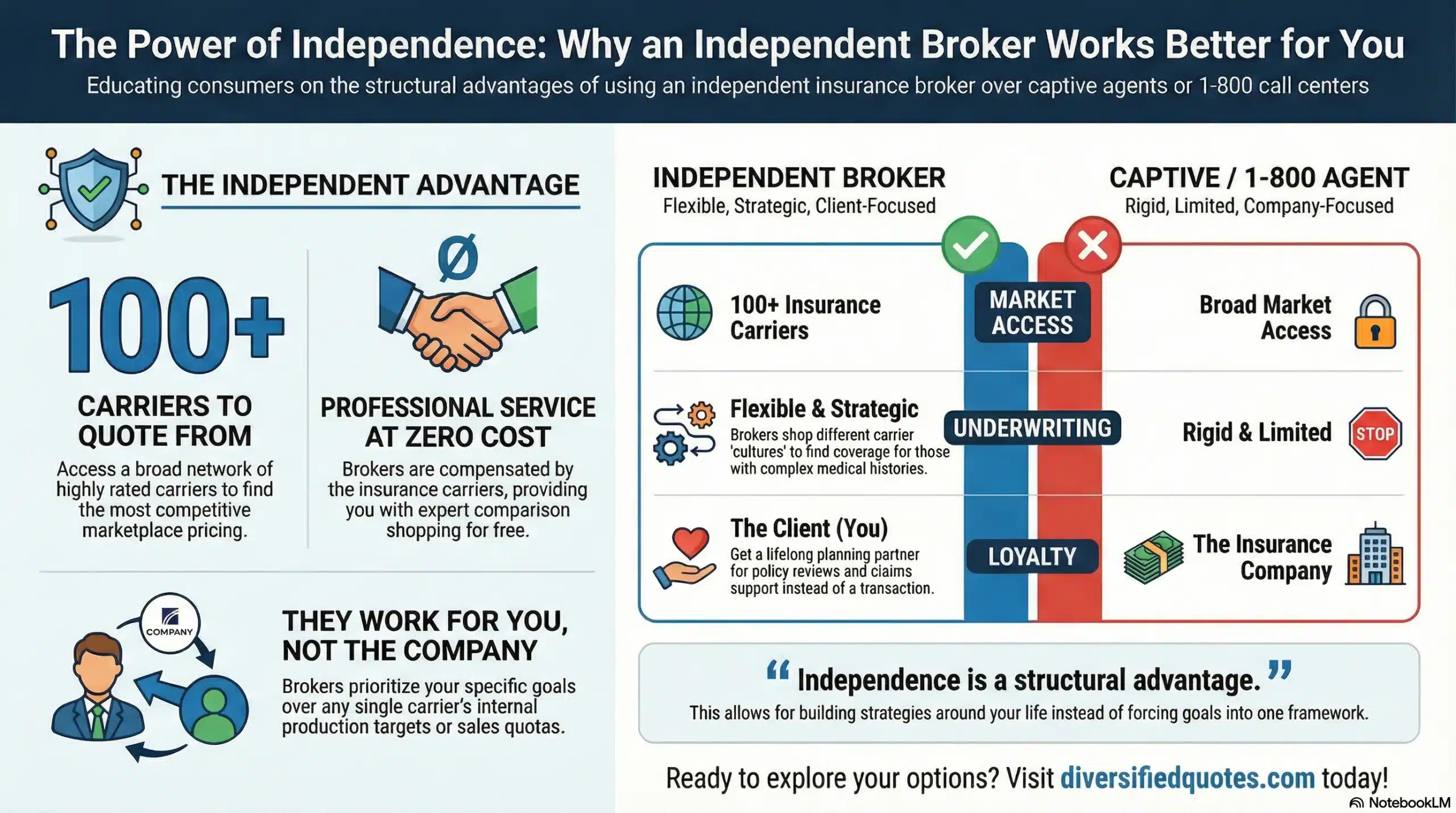
An independent broker with access to over 100 carriers and specific experience in mental health underwriting can match an ADHD applicant’s profile to carriers whose guidelines align with the facts of the case. This pre-screening process prevents the scenario where a declined application or unfavorable rating from an ill-matched carrier becomes part of the applicant’s permanent MIB record, which future carriers can access. Our resource on the best independent life insurance broker explains the structural advantages of this approach, and our second opinion on life insurance quotes service is available for applicants who have already received an unfavorable result and want to understand whether better options exist elsewhere.
Disability Insurance Alongside Life Insurance for ADHD
Many individuals applying for life insurance for ADHD should also evaluate disability insurance as a parallel coverage priority. ADHD can create occupational challenges — difficulties with sustained focus, organizational demands, deadline management — that can affect income stability in ways that disability insurance addresses. While life insurance protects the family against the financial consequences of premature death, disability insurance protects the individual and family against the financial consequences of being unable to work due to physical or mental health conditions.
Disability insurance underwriting for ADHD follows different guidelines than life insurance underwriting, but the same principle applies: stable, well-managed ADHD with no recent complications is more insurable than an unstable or complex history. Some disability insurers will accept ADHD at standard rates with a mental/nervous exclusion — excluding claims caused by psychiatric conditions while covering physical disability claims — while others will underwrite mental health coverage for well-documented, stable ADHD cases. Our resource on disability insurance services covers the full range of income protection options, and our disability income insurance for nurses resource illustrates how occupation-specific factors intersect with health history in disability underwriting for demanding professional roles.
See Real-Term Rates Side by Side
Life Insurance Quoter
Related Pages for Pre-Existing Condition Underwriting
Explore how carriers evaluate mental health history, chronic conditions, and health-related underwriting across different life insurance applications.
Life Insurance for Depression
Life Insurance for High A1C Diabetics
High-Risk Life Insurance Solutions
Guaranteed Issue Life Insurance
What Is a Flat Extra in Life Insurance?
Converting Term to Permanent Life Insurance
Get a 2nd Opinion on Your Life Insurance Quote
Financial Protection Essentials
Coordinate life insurance with disability coverage, income planning, and long-term financial protection strategies.
Compare Term Life Insurance Lengths
Explore different term periods to find coverage that best matches your timeline and budget.
Talk With an Advisor Today
Choose how you’d like to connect—call or message us, then book a time that works for you.
Schedule here:
calendly.com/jason-dibcompanies/diversified-quotes
Licensed in all 50 states • Fiduciary, family-owned since 1980
Frequently Asked Questions: Life Insurance for ADHD
Can you get life insurance with ADHD?
Yes. Life insurance for ADHD is approved in the majority of cases, and many applicants qualify for standard or even preferred rate classes when the diagnosis is well-managed, medication is stable, and comorbid conditions are limited. ADHD is not considered a high-mortality condition by life insurance underwriters. The diagnosis label itself carries less weight in the underwriting evaluation than the secondary factors — behavioral history, driving record, treatment consistency, and coexisting mental health conditions — that the diagnosis may or may not have produced.
The most important determinant of life insurance for ADHD approval outcomes is the overall profile: how long treatment has been stable, what the driving record looks like, whether any psychiatric hospitalizations have occurred, and whether comorbid conditions are present and controlled. Applicants with well-documented, consistently managed ADHD and clean behavioral records regularly secure competitive coverage from multiple carriers. Our resource on life insurance with pre-existing conditions provides the broader underwriting framework.
Does ADHD medication affect life insurance approval or pricing?
Stable, consistent medication use for ADHD is generally viewed neutrally or positively by underwriters — not negatively. The fact that an applicant takes medication demonstrates active management of the condition under physician supervision, which underwriters interpret as responsible health behavior. What medication review actually evaluates is the pattern: stable dosing with the same prescriber for a year or more reads as controlled management, while frequent medication changes, multiple prescribers, or long gaps between prescriptions reads as unstable management.
Neither stimulant medications (methylphenidate, amphetamine-based products) nor non-stimulant medications (atomoxetine, guanfacine) trigger automatic rate increases or declines. For older applicants on long-term stimulants, some carriers may request cardiovascular screening, but this resolves without issue for most applicants in good overall cardiovascular health.
What comorbid conditions most affect life insurance for ADHD outcomes?
The comorbid conditions that most frequently affect life insurance for ADHD underwriting outcomes are depressive disorders, anxiety disorders, substance use history, and prior psychiatric hospitalization. Mild to moderate anxiety or depression that is well-controlled with stable treatment — and without hospitalization or suicidal ideation history — often does not prevent standard rate approval with the right carrier. More significant psychiatric history, including inpatient hospitalization or recent suicidal ideation, typically produces either a table rating or a postponement until stability is established.
Substance use history is the most significant complicating factor. The association between ADHD and substance use disorders is clinically documented, and underwriters are aware of it. Applicants with substance abuse in their history need to demonstrate meaningful sobriety — typically two or more years — before traditional underwriting becomes straightforwardly accessible.
Why does the driving record matter so much for ADHD life insurance applications?
Underwriters review driving records for all life insurance applicants, but the driving record carries amplified significance for ADHD applicants because impulsivity — a core feature of the condition for many — can manifest in driving behavior. A clean driving record is one of the strongest positive signals available in an ADHD application because it demonstrates through objective evidence that the condition has been managed effectively in a high-risk behavioral context. Multiple recent speeding violations, reckless driving citations, or a DUI within the past five years create significant underwriting complications that can produce table ratings or postponements independent of how well-documented the ADHD treatment history is.
For applicants with recent driving incidents, the most practical strategy is to allow time for the violations to age out of the look-back period, establish a clean record going forward, and reapply when the driving history supports the narrative of responsible, managed behavior.
What is the best way to prepare a life insurance application for ADHD?
Three preparation steps consistently improve life insurance for ADHD outcomes. First, gather current, specific medical records from the treating physician or psychiatrist — records that explicitly document treatment stability, current medication, consistent follow-up, and absence of recent complications. Generic records that simply confirm the diagnosis are far less useful than records that tell the stability story clearly. Second, review your own motor vehicle report before applying so you know exactly what the carrier will see and can select carriers whose look-back windows align favorably with your record. Third, be comprehensive in disclosing all medications and treatment history — full disclosure, presented alongside documentation that contextualizes the history favorably, produces better outcomes than gaps that underwriters fill with conservative assumptions.
The fourth step — which many applicants overlook — is working with an independent broker who can pre-screen across carriers and identify which companies have underwriting guidelines most aligned with your specific ADHD profile. Submitting to the wrong carrier first produces a declined application that must then be disclosed to future carriers, which is an avoidable complication.
Is there an optimal time to apply for life insurance with ADHD?
The most favorable timing for a life insurance for ADHD application is a period of documented stability — typically 12 or more consecutive months on the same medication regimen, with the same prescriber, consistent follow-up appointments, and no recent behavioral incidents, psychiatric events, or treatment changes. During this stability window, the medical record presents a clear, consistent picture that allows underwriters to make accurate classifications rather than conservative assumptions.
Applicants who recently changed medications, recently initiated treatment, recently received an additional psychiatric diagnosis, or recently had a significant behavioral event are generally better served by waiting until a new stability period is established. The cost of waiting 6 to 12 months is almost always lower than the premium cost of an adverse classification that follows the applicant for the duration of the policy.
What if I was declined for life insurance because of ADHD?
A decline from one carrier does not mean life insurance for ADHD is permanently unavailable. Different carriers apply significantly different underwriting guidelines to mental health conditions, and a decline from a conservative carrier often reflects that carrier’s specific guidelines rather than a universal assessment of the applicant’s insurability. Many applicants who were declined by one carrier have been approved at standard rates by a more mental-health-friendly carrier with the same application facts.
When a decline has occurred, the application history including the decline must be disclosed to future carriers. This makes the strategy of working with an independent broker before any application especially valuable — pre-screening prevents the scenario where a poorly matched first submission creates a disclosure burden that complicates future applications. Our second opinion on life insurance quotes service can evaluate whether better options exist after an unfavorable result.
Can I get disability insurance if I have ADHD?
Yes, in many cases. Disability insurance underwriting for ADHD follows different guidelines than life insurance underwriting, and outcomes depend significantly on the same factors: treatment stability, comorbid conditions, and occupational history. Some disability insurers will offer coverage with a mental/nervous limitation — which excludes claims caused by psychiatric conditions while covering claims caused by physical disability — while others will underwrite mental health coverage for well-documented, stable ADHD cases. Our resource on disability insurance services covers the options available for individuals with health histories that require careful carrier matching.
About the Author:
Jason Stolz, CLTC, CRPC, DIA, CAA and Chief Underwriter at Diversified Insurance Brokers (NPN 20471358), is a senior insurance and retirement professional with more than 25 years of real-world experience helping individuals, families, and business owners protect their income, assets, and long-term financial stability. As a long-time partner of the nationally licensed independent agency Diversified Insurance Brokers, Jason provides trusted guidance across multiple specialties—including fixed and indexed annuities, long-term care planning, personal and business disability insurance, life insurance solutions, Group Health, Travel Medical and Evacuation Insurance, and short-term health coverage. Diversified Insurance Brokers maintains active contracts with over 100 highly rated insurance carriers, ensuring clients have access to a broad and competitive marketplace.
His practical, education-first approach has earned recognition in publications such as VoyageATL, and contributions from his agency featured in Kiplinger and GoBankingRates— highlighting his commitment to financial clarity and client-focused planning. Drawing on deep product knowledge and years of hands-on field experience, Jason helps clients evaluate carriers, compare strategies, and build retirement and protection plans that are both secure and cost-efficient. Visitors who want to explore current annuity rates and compare options across multiple insurers can also use this annuity quote and comparison tool.
Explore More Life Insurance Options: Browse our complete guide to Life Insurance for Mental Health & Substance Use — covering depression, PTSD, ADHD, bi-polar disorder, and substance use from 100+ carriers.
Last Reviewed: June 14, 2026 |
Reviewed by: Jason Stolz, CLTC, CRPC, DIA, CAA
Chief Underwriter, Diversified Insurance Brokers, Inc. | NPN: 20471358 | Diversified Insurance Brokers, Inc. — Licensed in all 50 states
Fact Checked by: Tonia Pettitt, CMIP©
Medicare Specialist, Diversified Insurance Brokers, Inc. | NPN: 14374308 | Diversified Insurance Brokers, Inc. — Licensed in all 50 states
Did you find this content helpful? Leave us a Google review — it helps others find trustworthy guidance too.
Editorial Standards: Diversified Insurance Brokers maintains rigorous editorial standards to ensure accuracy, clarity, and independence in all content. Learn more about our editorial standards and commitment to transparency.
