
What is an IRA Annuity?
As an Independent Annuity Broker, we compare rates across 100+ carriers and 1,000 different annuities— not just one company’s product offerings — to find the best fit for your goals.
What is an IRA Annuity?

Jason Stolz CLTC, CRPC, DIA, CAA
An IRA annuity is an annuity contract held inside an Individual Retirement Account — a structure that combines the tax rules of the IRA with the contractual guarantees of the annuity to create a retirement savings vehicle with features that neither component provides on its own. The IRA is the tax container: it controls when distributions are taxable, what contribution limits apply, how required minimum distributions work, and whether the account qualifies for tax-deferred or potentially tax-free treatment. The annuity is the product inside that container: it provides the specific contractual guarantees — fixed interest rates, principal protection, structured income options, defined surrender schedules, and withdrawal provisions — that distinguish annuity ownership from holding mutual funds, ETFs, or CDs inside the same IRA.
At Diversified Insurance Brokers, we help retirees and pre-retirees evaluate IRA annuities through the lens of what role they actually need to fill in a retirement plan, rather than through the lens of which carrier or product happens to be marketed most aggressively at any given moment. An IRA annuity used correctly can stabilize a portion of retirement savings, reduce sequence-of-returns risk, create a reliable income floor, or serve as a CD alternative with more competitive yields. The key in every case is selecting the right annuity type for the specific job the IRA portion needs to do — and confirming that the contract’s surrender schedule, free-withdrawal provisions, and income timeline match the buyer’s actual planning situation. For current rate comparisons to frame the evaluation, our resource on current annuity rates provides the marketplace context across annuity categories.
Ensure you are receiving the absolute top rates
Current Fixed Annuity Rates
Compare today’s best fixed annuity rates from top carriers.
Current Bonus Annuity Rates
See which annuities offer the highest upfront bonus today.
Request an Annuity Quote
Submit our annuity request form to get personalized rate options.
Lifetime Income Calculator
Use our calculator to estimate how much guaranteed income your IRA annuity could provide.
What an IRA Annuity Is — and What It Is Not
Understanding what an IRA annuity actually is requires clarity on what each component does independently. The IRA — whether a Traditional IRA or a Roth IRA — is an account structure established under federal tax law that provides specific tax treatment for retirement savings. The IRA itself is not an investment. It is a container that holds investments and controls how those investments are taxed. Most people are familiar with IRAs that hold mutual funds, ETFs, stocks, or bonds. An IRA annuity is simply the same IRA container holding an annuity contract instead of (or in addition to) those more conventional investments.
The annuity is the product inside the IRA container. It provides the contractual features that distinguish it from other IRA investments: a guaranteed interest rate for a defined term (in the case of a MYGA), principal protection with index-linked growth potential (in the case of a fixed indexed annuity), or guaranteed lifetime income payments (in the case of an income annuity or a fixed indexed annuity with an income rider). These contractual guarantees are what people are actually purchasing when they fund an IRA annuity — certainty about a portion of retirement outcomes that conventional market-based investments cannot provide.
What an IRA annuity is not: it is not a special new type of IRA created by the insurance company. It is still your IRA. The IRA’s rules — contribution limits, rollover provisions, required minimum distribution requirements, beneficiary rules, and tax treatment — all apply exactly as they would for any other IRA investment. The annuity adds its own contractual layer on top of those IRA rules, which is why both layers need to be understood and coordinated before purchase.
It is also not true that putting an annuity inside an IRA creates “double tax deferral.” The tax deferral of the IRA annuity comes entirely from the IRA wrapper — it is the same tax deferral that applies to any other IRA investment. A non-qualified annuity (one held outside an IRA, funded with after-tax money) has its own tax-deferred accumulation under different IRS rules. Our resource on non-qualified annuities covers the non-IRA annuity structure for comparison, and our resource on non-qualified annuity taxation covers the after-tax funding tax mechanics.
Traditional IRA Annuity vs. Roth IRA Annuity
The most important distinction in IRA annuity planning is whether the IRA holding the annuity is a Traditional IRA or a Roth IRA, because this determines the tax treatment of all future distributions — and tax treatment affects whether an annuity’s guaranteed income is as valuable in practice as it appears in the pre-tax projection.
A Traditional IRA annuity is the most common structure. Contributions to a Traditional IRA are typically made with pre-tax or tax-deductible money, and the account grows tax-deferred until distributions are taken. When distributions are taken from a Traditional IRA annuity — whether as regular withdrawals, annuitized income, or required minimum distributions — they are generally taxable as ordinary income in the year received. The guaranteed monthly income that a Traditional IRA annuity produces is therefore gross income before tax, and the after-tax income depends on the recipient’s marginal tax rate, Medicare premium surcharge thresholds, Social Security taxation thresholds, and other income-related factors. Our resource on qualified annuity taxation covers the tax mechanics that apply to Traditional IRA annuities in detail, and our broader resource on how annuities are taxed in retirement covers the full tax context across qualified and non-qualified structures.
A Roth IRA annuity places annuity guarantees inside the Roth structure, where qualified distributions are tax-free rather than taxable. This means that guaranteed income payments from a Roth IRA annuity — after the five-year seasoning period and age requirements are met — can be received without adding to taxable income. For retirees who have accumulated meaningful Roth balances and want to create a guaranteed income stream that does not push them into higher tax brackets, trigger Medicare premium surcharges (IRMAA), or increase the taxable portion of Social Security benefits, a Roth IRA annuity can be structurally more valuable than an equivalent Traditional IRA annuity at the same gross income level. Our resource on how a Roth IRA works covers the Roth account structure, and our resource on how to transfer a Roth IRA to an annuity covers the specific transfer mechanics for Roth IRA annuity funding. For households exploring the broader Roth conversion strategy that can create the Roth balance to fund a Roth IRA annuity, our resource on how to use a Roth conversion with an annuity for tax-free retirement income covers the full integration of those two strategies.
Types of IRA Annuities: Choosing the Right Product for the Job
Four primary annuity types are commonly used inside IRAs, and each is designed for a different retirement planning objective. Selecting the right type requires starting with the job the IRA portion needs to do — not with the product that has the most attractive headline feature. The table below maps each annuity type to its core mechanics, principal protection approach, primary purpose, and ideal planning horizon.
IRA Annuity Types: Key Differences at a Glance
| Annuity Type | How Interest Works | Principal Protection | Primary Purpose | Ideal IRA Use Case |
|---|---|---|---|---|
| MYGA (Multi-Year Guaranteed) | Fixed declared rate for entire guarantee period; compound interest | Full — no market exposure | Predictable accumulation; CD alternative inside IRA | Stabilizing IRA assets for defined period; bridging to income start date |
| Fixed Indexed Annuity (FIA) | Index-linked credits (caps/participation); zero floor in negative index years | Full from market loss; surrender charges still apply | Protected growth potential; optional income rider for lifetime income | Long-term IRA deferral with upside potential; future income planning |
| Traditional Fixed Annuity | Declared interest rate that renews periodically; minimum rate guarantee | Full — no market exposure | Conservative accumulation; simplicity | Simple IRA stabilization; buyers wanting minimal complexity |
| Immediate Income Annuity (SPIA) | N/A — single premium exchanged for guaranteed income starting immediately | N/A — contract converts to income stream | Guaranteed income starting now; pension-like paycheck from IRA | Retirees needing IRA income to begin immediately; RMD satisfaction |
| Deferred Income Annuity (DIA) | N/A — premium deferred to specific future income start date | N/A — converts at income start date | Guaranteed income starting at a defined future age | Longevity insurance; locking in income floor for late retirement |
MYGAs Inside an IRA: The CD Alternative
The multi-year guaranteed annuity (MYGA) is the most conceptually straightforward IRA annuity type, and the one most commonly compared to certificates of deposit. When you fund a MYGA inside your IRA, you deposit a premium, select a guarantee period (typically two to seven years), and earn a fixed declared interest rate for the entire guarantee period. The interest compounds within the contract, and at the end of the guarantee period you receive the fully accumulated value — a completely predictable outcome that does not depend on market performance.
The primary reason to consider a MYGA inside an IRA versus a CD held in an IRA (which is also possible) is rate competitiveness. In many market environments, MYGA rates at top carriers have significantly exceeded CD rates at commercial banks for equivalent holding periods — particularly for buyers with larger deposits who qualify for premium-banded rate structures. Because both the MYGA and the IRA CD produce tax-deferred accumulation inside the IRA (the tax deferral is a function of the IRA, not the investment), the comparison comes down to rate, contract terms, and liquidity provisions.
One critical difference is the MYGA’s surrender schedule: most MYGAs have surrender charges during the guarantee period that apply to withdrawals beyond a defined annual free-withdrawal amount. For IRA holders who need regular distributions or must take required minimum distributions, confirming that the MYGA contract’s free-withdrawal provisions allow RMD withdrawals without surrender charges is an essential pre-purchase step. Most MYGAs designed for IRA funding include RMD-compatible withdrawal provisions, but the specific contract language should always be confirmed before purchase. Our resource on best MYGA annuity rates covers the current marketplace, and our resource on RMDs after SECURE 2.0 covers the required minimum distribution rules that any IRA holder must coordinate with their annuity’s withdrawal provisions.
Fixed Indexed Annuities Inside an IRA: Protected Growth Potential
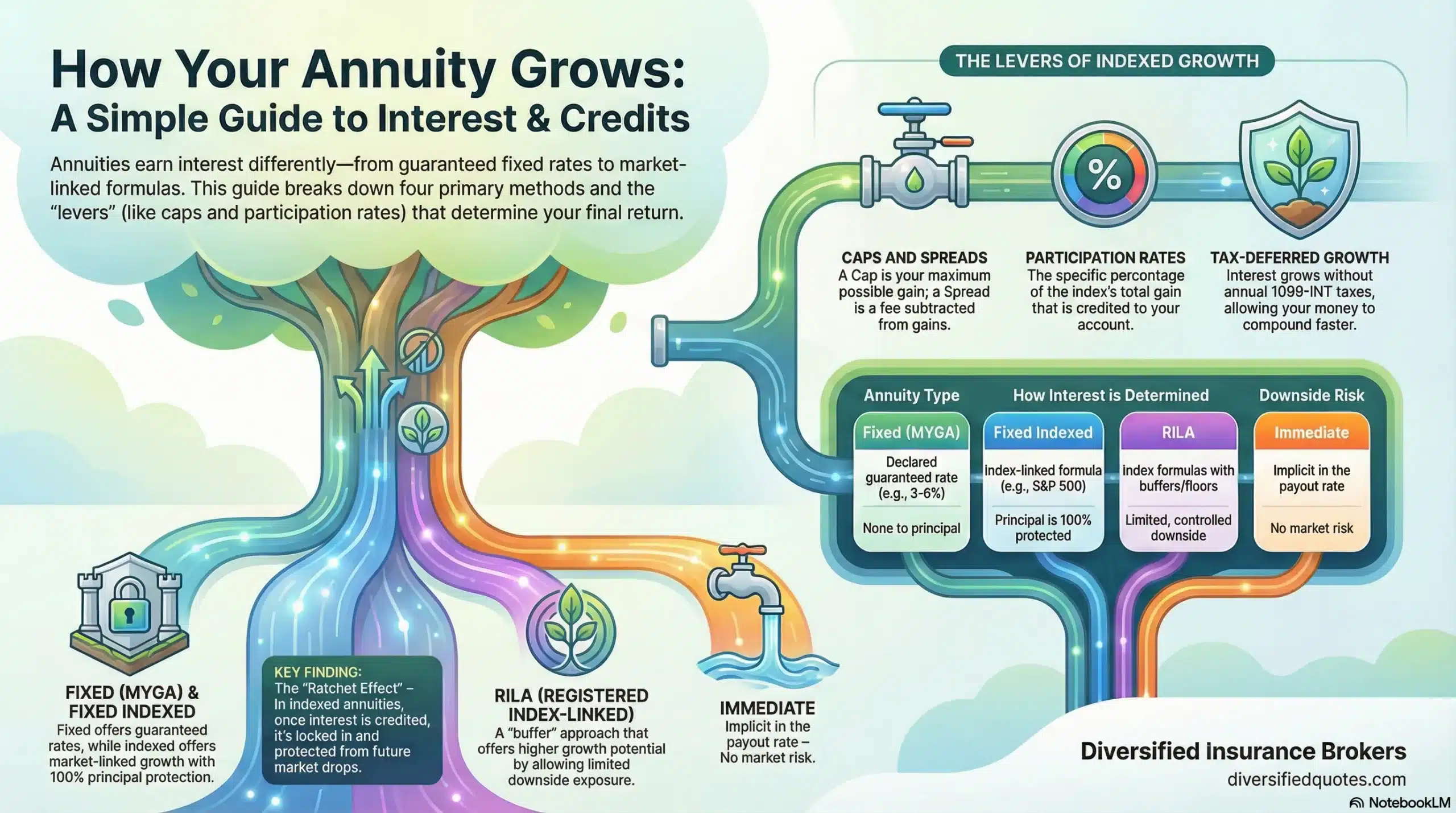
The fixed indexed annuity (FIA) is the most commonly sold annuity type inside IRAs for buyers who want more growth potential than a MYGA or fixed annuity provides, while maintaining principal protection against direct market losses. A FIA inside an IRA credits interest based on the performance of an external index — most commonly the S&P 500 or similar benchmarks — subject to contractual parameters that cap the upside but also create a zero floor that prevents negative index years from reducing the account value.
The distinction that matters most in FIA evaluation is that the index is used as a measurement tool rather than direct ownership. The FIA does not hold index investments — it measures index performance over a crediting period and uses that measurement to calculate interest credits, subject to caps, participation rates, or spreads defined in the contract. In years when the index performs positively, interest is credited up to the applicable parameter. In years when the index performs negatively, no interest is credited and no principal is lost. This zero-floor protection is the defining feature that makes FIAs appealing to conservative IRA holders who want some exposure to equity-like upside without accepting full downside risk. Our resource on how a fixed indexed annuity works covers the crediting mechanics in detail.
Many FIAs designed for IRA use also include optional guaranteed lifetime withdrawal benefit (GLWB) income riders that create a guaranteed income framework. When an income rider is added, the FIA simultaneously functions as a potential accumulation vehicle and a future income planning tool — the income base grows during the deferral period at a guaranteed roll-up rate, and when income is activated, guaranteed withdrawals continue for life regardless of how the account value behaves. For buyers whose IRA income strategy involves activating a guaranteed income stream at a specific future age, FIA income riders can be powerful tools. Our resource on how annuity income riders work covers the income rider mechanics, and our resource on whether income riders have fees covers the fee structure that should always be evaluated alongside income projections. For buyers wanting to understand how different annuity types earn interest across categories, our resource on how annuities earn interest provides the foundational context.
Income Annuities Inside an IRA: Guaranteed Paychecks From Your IRA
For retirees who want to convert a portion of their IRA into guaranteed monthly income rather than managing ongoing withdrawals from a fluctuating account balance, income annuities inside an IRA provide the most direct solution. An immediate income annuity (SPIA) inside an IRA converts a single premium into a guaranteed income stream that begins within one to twelve months of purchase — the contractual conversion of savings into a pension-like paycheck that continues for the buyer’s lifetime, for a defined period, or for both.
The income from a Traditional IRA SPIA is fully taxable as ordinary income when received, because the entire IRA balance represents pre-tax contributions and deferred earnings. From a Required Minimum Distribution perspective, a properly structured income annuity inside an IRA can satisfy RMD obligations through the ongoing payments, though the specific structuring requires attention to ensure the annuity’s payment structure meets the IRS’s minimum distribution requirements. Our resource on whether annuitization satisfies RMDs covers this specific coordination requirement that IRA holders must address before purchasing an income annuity inside an IRA.
A deferred income annuity (DIA) inside an IRA works similarly but delays the income start date to a specified future age. The buyer deposits a premium today and contractually locks in income that begins at a specified future date — for example, age 80 or 85. This structure is sometimes called “longevity insurance” because it hedges the financial risk of living significantly longer than expected, providing guaranteed income in the later retirement years when other assets may have been substantially depleted. For IRA holders concerned about outliving their assets, a DIA can create certainty about late-retirement income at a fraction of the cost of funding that income with a larger SPIA today. Our resource on what a deferred income annuity is covers the DIA structure in detail.
Tax Treatment of IRA Annuities: What You Need to Know
The tax treatment of an IRA annuity is determined primarily by the type of IRA holding it — Traditional or Roth — rather than by the annuity itself. This distinction affects every aspect of how the annuity performs in a retirement plan, from the value of guaranteed income to the efficiency of the overall withdrawal strategy.
For Traditional IRA annuities, all distributions — whether taken as systematic withdrawals, annuitized income, or RMD-driven payments — are generally taxable as ordinary income in the year received. The tax rate that applies depends on the recipient’s total taxable income in that year, which is why Traditional IRA annuity income should be modeled in the context of other income sources: Social Security benefits (which may be up to 85 percent taxable depending on combined income), pension income, capital gains, and any other distributions. The cumulative income picture determines the effective tax rate on each dollar of Traditional IRA annuity income, and tax-efficient withdrawal sequencing can make a meaningful difference in after-tax outcomes over a retirement period. Our resource on qualified annuity taxation covers the specific tax rules that apply to Traditional IRA annuity distributions.
For Roth IRA annuities, qualified distributions — made after the five-year seasoning period and after the account holder has reached age 59½ — are generally received tax-free. This creates a structurally more valuable income stream for recipients in higher tax brackets or those who are concerned about future tax rate increases, because the guaranteed income from a Roth IRA annuity does not increase taxable income and therefore does not affect Social Security taxation thresholds, Medicare premium surcharge (IRMAA) calculations, or the marginal tax rate applicable to other income. The after-tax value of Roth IRA annuity income at a given gross rate can substantially exceed the after-tax value of Traditional IRA annuity income at the same gross rate for buyers in meaningful tax brackets.
One important planning nuance: unlike Traditional IRAs, Roth IRAs are generally not subject to required minimum distributions during the original owner’s lifetime. This means a Roth IRA annuity does not create the same RMD coordination obligations that a Traditional IRA annuity does, providing more flexibility in timing income activation.
Funding an IRA Annuity: Rollovers, Transfers, and Contributions
IRA annuities can be funded through three primary mechanisms: direct rollovers from employer retirement plans, IRA-to-IRA transfers, and regular IRA contributions. The choice among these mechanisms affects the process, timeline, and tax implications of establishing the IRA annuity.
The most common funding source for larger IRA annuities is a rollover from a former employer retirement plan — a 401(k), 403(b), pension, or similar plan. When an employee leaves a job or retires, they often have the option to roll the employer plan balance into an IRA. Placing that rollover into an annuity creates an IRA annuity funded with the entire rollover amount in a single transaction. A direct rollover — where the plan balance is transferred directly from the plan trustee to the IRA custodian without the account holder ever receiving the funds — avoids both income tax withholding and the 60-day rollover requirement. Our resource on what a direct rollover is covers the mechanics, and our resource on best annuities for a 401(k) rollover covers the product comparison framework for buyers specifically positioning rollover assets into an annuity.
IRA-to-IRA transfers move an existing IRA balance from one IRA custodian to another — in this case, from a non-annuity IRA to an annuity carrier that will hold the IRA. Unlike rollovers, direct IRA transfers have no 60-day limit and are not subject to the once-per-year rollover limitation. This makes direct transfer the most commonly used mechanism when an existing IRA owner wants to reposition IRA assets from mutual funds or CDs into an annuity. The process is handled administratively between the sending and receiving institutions and does not require the account holder to take possession of the funds.
RMD Coordination With IRA Annuities
Required minimum distributions are one of the most important practical considerations for any IRA annuity holder with a Traditional IRA. Under current law (incorporating SECURE 2.0 provisions), most IRA holders must begin taking RMDs at age 73, with the annual distribution amount calculated based on the prior year’s account balance and an IRS life expectancy factor. For IRA annuity holders, RMD coordination involves confirming that the annuity contract allows distributions that satisfy the RMD without triggering surrender charges, and structuring the policy to be compatible with the ongoing RMD calendar.
Most annuity contracts designed for IRA use include specific RMD accommodation provisions — typically allowing penalty-free withdrawals up to the RMD amount, calculated as a percentage of the contract value, without counting toward the surrender charge calculation. However, the specific mechanics vary by contract, and the specific contract language should always be reviewed before purchase rather than assumed. An annuity that looks ideal based on headline rate or income features can create unexpected friction if its RMD provisions do not align well with the buyer’s distribution needs.
For IRA holders who own income annuities (SPIAs or annuitized contracts) inside a Traditional IRA, the ongoing income payments typically satisfy RMD obligations for the portion of the IRA that has been annuitized, provided the annuity contract meets the IRS’s minimum distribution standards for annuitized contracts. Our resources on RMDs after SECURE 2.0 and whether annuitization satisfies RMDs cover the specific rules and calculations involved in both scenarios. For IRA holders who have inherited annuity assets, our resource on whether inheritance affects RMDs covers the additional distribution rules that apply to inherited IRA annuities.
Why People Use IRA Annuities and When It Makes Sense
The primary reasons people use IRA annuities typically come down to three retirement planning problems that annuities address more directly than conventional IRA investments can. The first is the sequence-of-returns problem — the risk that a market decline in the early years of retirement, when ongoing withdrawals are depleting the portfolio, permanently impairs portfolio longevity even if markets eventually recover. By allocating a portion of IRA assets into a vehicle with principal protection and defined crediting mechanics, retirees can reduce their dependence on market timing for essential income needs, allowing the remainder of the portfolio to be managed with a longer effective time horizon.
The second problem is the income floor gap — the difference between what Social Security and any pension income provides and what the retiree needs to cover essential monthly expenses like housing, utilities, food, and healthcare. For the many retirees who have no pension or a modest pension, Social Security alone may not cover essential expenses, and relying on portfolio withdrawals to bridge the gap creates ongoing vulnerability to market volatility. An IRA annuity structured for income can provide the guaranteed monthly amount needed to close that gap — creating a reliable income floor that remains stable regardless of what the financial markets do. Our resource on how Social Security and annuities work together covers the income-coordination framework that most effectively combines these two guaranteed income sources.
The third problem is portfolio longevity — the risk of outliving retirement savings. For retirees with meaningful longevity (family history of living into the 90s, or younger retirees planning a 30-year retirement horizon), the risk that investment withdrawals eventually exhaust the portfolio is real and consequential. A guaranteed lifetime income annuity addresses this directly by creating a contractual obligation for the insurance carrier to continue payments regardless of how long the retiree lives — eliminating the longevity risk that portfolio-based income strategies cannot fully resolve. Our resource on how long your IRA will last in retirement covers the portfolio longevity modeling that informs this decision, and our resource on how to use an annuity in retirement and our resource on how to get an annuity for retirement income cover the practical deployment process.
Key Benefits and Real-World Tradeoffs
The benefits of an IRA annuity are most meaningful when evaluated against the specific planning problem being solved rather than in the abstract. Predictable outcomes — the ability to know what a defined portion of IRA assets will produce regardless of market conditions — have genuine value for retirees whose spending stability depends on predictable income. Principal protection from direct market loss reduces the behavioral risk of panic-selling during market downturns. Guaranteed lifetime income eliminates longevity risk for the portion of the portfolio allocated to the annuity. And the contractual structure of an annuity can reduce the emotional decision-making that produces poor investment outcomes during market volatility by creating a known, stable component in an otherwise uncertain retirement financial picture.
The tradeoffs deserve equal clarity. Liquidity and surrender schedules are the most common source of IRA annuity regret — buyers who choose a product with a long surrender period based on an attractive rate, without fully evaluating whether their timeline actually supports that commitment, encounter friction when their circumstances change. Most annuities allow annual penalty-free withdrawals of 10 percent of the account value, and most include RMD accommodation provisions, but withdrawals beyond those amounts during the surrender period trigger surrender charges. Our resource on annuity free withdrawal rules covers these provisions in full detail and should be reviewed for any specific contract before purchase.
For FIAs, the upside potential is limited by design — caps, participation rates, or spreads determine how much of any positive index period actually reaches the contract. This limitation is the structural exchange for the zero floor, and whether the exchange is worthwhile depends on the specific parameters, the buyer’s return expectations, and the role the FIA plays in the overall IRA allocation. The FIA is not designed to outperform a fully invested equity portfolio — it is designed to provide a better risk-adjusted outcome than pure equity exposure for the conservative portion of the retirement portfolio. For a comprehensive treatment of FIA misconceptions, our resource on fixed indexed annuity myths is a useful corrective to common misunderstandings. And for buyers who want to compare IRA annuity performance against what their existing IRA would produce if left as-is, the retirement income calculator at our retirement income calculator page provides useful projection context.
A Practical Example of an IRA Annuity in Retirement Planning
Consider a 67-year-old with $300,000 in a Traditional IRA that she is rolling over from a former employer’s 401(k). Social Security covers her essential monthly housing and food expenses, but not healthcare costs or discretionary spending. She wants to reduce market volatility for this portion of assets, create predictable income, and not worry about managing the balance during market downturns. She places the $300,000 into a fixed indexed annuity with an income rider, defers income for two years to allow the income base to grow through the roll-up credit, then begins guaranteed monthly withdrawals at age 69. The withdrawals are taxable as ordinary income from her Traditional IRA, coordinated with her Social Security income to manage her overall tax bracket.
The value of this structure is not that the FIA outperforms any particular investment benchmark — it is that the monthly income is guaranteed for life regardless of what the S&P 500 does between now and her 90th birthday, and she no longer has to monitor or manage that portion of her retirement portfolio. The rest of her financial picture — emergency reserves, any remaining investment accounts — can be managed separately for growth and liquidity without the pressure of needing the FIA balance to perform on any specific schedule. Our resource on how to use a Roth conversion with an annuity for tax-free retirement income covers how this planning picture looks different if the IRA had been converted to a Roth before funding the annuity, and our resource on what a backdoor Roth IRA is covers an alternative Roth funding strategy for high-income earners.
Compare IRA Annuity Options for Your Situation
We compare rates and income scenarios side by side based on your state, age, timeline, and goals — Traditional IRA or Roth, accumulation or income focus.
Related Pages: IRA Annuity Planning Resources
Continue researching IRA annuity types, tax treatment, rollover mechanics, and retirement income strategy.
How Annuities Are Taxed in Retirement
Best Annuities for a 401(k) Rollover
RMDs After SECURE 2.0
Does Annuitization Satisfy RMDs?
How to Transfer a Roth IRA to an Annuity
Roth Conversion With an Annuity for Tax-Free Income
How Long Will My IRA Last in Retirement?
How Do Annuity Income Riders Work?
Financial Essentials: Annuity Rates and Tools
Explore current annuity rate comparisons, income calculators, and educational resources for IRA annuity planning.
Talk With an Advisor Today
Choose how you’d like to connect—call or message us, then book a time that works for you.
Schedule here:
calendly.com/jason-dibcompanies/diversified-quotes
Licensed in all 50 states • Fiduciary, family-owned since 1980
FAQs: IRA Annuities
What is an IRA annuity?
An IRA annuity is an annuity contract held inside an Individual Retirement Account. The IRA is the tax container — it controls when distributions are taxable, what contribution limits apply, how required minimum distributions work, and whether the account qualifies for tax-deferred or potentially tax-free treatment. The annuity is the product inside that container, providing contractual guarantees — fixed interest rates, principal protection, structured income options, defined surrender schedules, and withdrawal provisions — that distinguish it from mutual funds, ETFs, or CDs held in the same IRA.
An IRA annuity is not a special new type of IRA created by the insurance company. It is still your IRA, following all standard IRA rules. The annuity simply determines what investment vehicle holds the IRA assets and what contractual features apply to those assets. The tax deferral of an IRA annuity comes entirely from the IRA wrapper — not from the annuity itself. People choose an annuity inside an IRA for the contractual guarantees (fixed rate, principal protection, or guaranteed income), not for additional tax benefits beyond what the IRA already provides.
Do I get double tax deferral by putting an annuity inside an IRA?
No. This is one of the most common misunderstandings about IRA annuities. Tax deferral inside an IRA annuity comes from the IRA — not from the annuity. Any investment held inside an IRA (mutual funds, ETFs, CDs, or annuities) enjoys the same tax-deferred treatment. Placing an annuity inside an IRA does not create any additional or “double” tax deferral beyond what the IRA already provides.
The primary reason to hold an annuity inside an IRA is for the contractual guarantees the annuity provides — a fixed rate for a defined period (MYGA), principal protection with indexed growth potential (FIA), or guaranteed lifetime income (income annuity or income rider). Those guarantees are what buyers are actually purchasing. If tax deferral alone were the goal, any IRA investment would achieve it equally. The annuity’s value in an IRA comes from what it does beyond providing tax deferral.
Non-qualified annuities (held outside an IRA, funded with after-tax money) do provide their own tax deferral on accumulated earnings — that is a feature of the annuity contract itself under non-IRA rules. But inside an IRA, that distinction does not apply because the IRA already handles all the tax deferral.
What kinds of annuities are commonly used inside IRAs?
Four primary annuity types are commonly used inside IRAs, each serving a different planning objective. Multi-year guaranteed annuities (MYGAs) provide a fixed declared interest rate for a defined guarantee period — the most common CD alternative inside an IRA. Fixed indexed annuities (FIAs) credit interest based on an index performance measurement with a zero floor protecting against negative index years — providing principal protection with some growth potential. Traditional fixed annuities credit a declared rate that renews periodically, with a minimum rate guarantee. And income annuities (immediate or deferred) convert a premium into guaranteed lifetime or period-certain income payments.
Many FIAs also offer optional income rider features that create a guaranteed lifetime income framework alongside the accumulation mechanics, making them a combined accumulation and income planning tool. The right type depends on the specific retirement planning job the IRA portion needs to do: a MYGA for near-term stabilization and predictable growth; a FIA for longer-term principal-protected growth or future income planning; an income annuity for immediate or future pension-like cash flow from the IRA balance.
Can I roll over a 401(k) or 403(b) into an IRA annuity?
Yes. Rolling over an employer retirement plan into an IRA annuity is the most common way to fund a larger IRA annuity in a single transaction. When you leave a job or retire, you typically have the option to roll your 401(k), 403(b), or other qualified plan balance into an IRA. Choosing an annuity as the IRA investment creates an IRA annuity funded with the rollover amount. A direct rollover — where the funds transfer directly from the plan trustee to the receiving IRA annuity carrier, without passing through your hands — avoids income tax withholding and the 60-day rollover requirement.
The process for a direct rollover into an IRA annuity involves: selecting the annuity product and carrier; completing the annuity application; and submitting rollover paperwork to the former employer’s plan administrator directing the balance to the IRA annuity. The plan administrator sends the funds directly to the annuity carrier, which establishes the IRA annuity with the rollover amount. Our resource on best annuities for a 401(k) rollover covers the product comparison framework for rollover-funded IRA annuities.
How do required minimum distributions work with an annuity inside a Traditional IRA?
If your annuity is inside a Traditional IRA, you must take required minimum distributions beginning at age 73 (under current SECURE 2.0 rules), regardless of the annuity’s surrender schedule. The annual RMD amount is calculated based on the prior year-end account value divided by an IRS life expectancy factor. For IRA annuities, the RMD calculation uses the contract’s account value as the prior year-end balance.
Most annuity contracts designed for IRA use include RMD accommodation provisions — typically allowing annual withdrawals up to the RMD amount without triggering surrender charges, even if that amount exceeds the contract’s standard free-withdrawal limit. Confirming these provisions in writing before purchase is essential, because not all annuity contracts handle RMDs identically and a contract that creates friction around RMD withdrawals can become problematic when you reach the RMD starting age.
For IRA holders who annuitize their contract (convert it to a stream of income payments), the ongoing income payments from a properly structured annuity can satisfy RMD obligations for the annuitized portion of the IRA. The annuity must meet the IRS’s minimum distribution standards for annuitized contracts, which govern how income payments must be structured to satisfy RMDs. Our resources on RMDs after SECURE 2.0 and whether annuitization satisfies RMDs cover these requirements in full.
Are IRA annuities liquid?
IRA annuities have two layers of access rules: the IRA’s rules and the annuity contract’s rules. The IRA layer generally allows distributions at any time, but imposes a 10 percent early distribution penalty for withdrawals before age 59½ unless a qualifying exception applies. The annuity contract layer imposes its own surrender schedule — a period during which withdrawals beyond the annual free-withdrawal amount trigger surrender charges that reduce the distribution amount.
Most annuity contracts include an annual penalty-free withdrawal provision — typically 10 percent of the account value per year beginning in the second contract year — that allows some liquidity during the surrender period without charge. RMD-compatible withdrawal provisions also allow mandatory minimum distributions to be taken without surrender charges. But withdrawals beyond these provisions during the surrender period will incur charges, and in some contracts a market value adjustment (MVA) may additionally affect surrender values in rising-rate environments.
The practical implication is that IRA annuities are appropriate for the portion of IRA assets that does not need to be fully liquid during the surrender period. Aligning the annuity’s surrender schedule to the buyer’s actual holding intention is one of the most important pre-purchase decisions. Our resource on annuity free withdrawal rules covers the specific mechanics of how free-withdrawal provisions work across different contract designs.
Can I use an annuity inside a Roth IRA?
Yes. A Roth IRA annuity places annuity guarantees inside the Roth tax structure, where qualified distributions are generally received tax-free rather than taxable. For retirees in meaningful tax brackets, the after-tax value of Roth IRA annuity income can be substantially higher than the after-tax value of Traditional IRA annuity income at the same gross income level — because Roth distributions do not add to taxable income and therefore do not trigger Social Security taxation thresholds, Medicare premium surcharges (IRMAA), or additional marginal tax rates on other income sources.
Funding a Roth IRA annuity can be accomplished through regular Roth IRA contributions (subject to income limits and annual limits), through Roth conversions of existing Traditional IRA balances, or through direct transfer of an existing Roth IRA balance into an annuity. Our resource on how to transfer a Roth IRA to an annuity covers the transfer mechanics specifically, and our resource on how to use a Roth conversion with an annuity for tax-free retirement income covers the broader Roth conversion strategy.
Unlike Traditional IRAs, Roth IRAs are generally not subject to required minimum distributions during the original owner’s lifetime, which means a Roth IRA annuity does not create the same RMD coordination complexity as a Traditional IRA annuity — providing more flexibility in timing income activation and managing the contract throughout the holding period.
When does an IRA annuity make the most sense?
An IRA annuity makes the most sense when a specific retirement planning problem requires the contractual guarantees an annuity provides — and when the contract’s surrender schedule and withdrawal provisions align with the buyer’s actual planning timeline and liquidity needs. Three scenarios recur most consistently. The first is when market volatility creates behavioral risk — when the prospect of a significant portfolio decline in early retirement could lead to panic decisions that permanently impair the portfolio’s longevity. A stable IRA annuity removes part of the portfolio from that behavioral risk and allows the rest to be managed more patiently.
The second is when guaranteed income is the goal and the Social Security benefit alone does not cover essential monthly expenses. An IRA annuity structured for income — whether through an income rider FIA, an immediate annuity, or a deferred income annuity — can create the predictable monthly income layer that closes the gap between Social Security and the household’s actual baseline spending needs. This income-floor approach reduces dependence on market performance for essential expenses and can significantly improve retirement confidence.
The third is when predictable accumulation for a defined period serves the household’s planning timeline better than market-based accumulation. A retiree who knows they will not need a specific portion of their IRA for five or seven years, and who wants that portion to grow predictably rather than with market volatility, often finds a MYGA inside the IRA the most appropriate tool for that specific holding period. The predictability supports planning confidence, the competitive fixed rate supports accumulation, and the tax deferral within the IRA context allows the full compound growth to build uninterrupted.
About the Author:
Jason Stolz, CLTC, CRPC, DIA, CAA and Chief Underwriter at Diversified Insurance Brokers (NPN 20471358), is a senior insurance and retirement professional with more than 25 years of real-world experience helping individuals, families, and business owners protect their income, assets, and long-term financial stability. As a long-time partner of the nationally licensed independent agency Diversified Insurance Brokers, Jason provides trusted guidance across multiple specialties—including fixed and indexed annuities, long-term care planning, personal and business disability insurance, life insurance solutions, Group Health, Travel Medical and Evacuation Insurance, and short-term health coverage. Diversified Insurance Brokers maintains active contracts with over 100 highly rated insurance carriers, ensuring clients have access to a broad and competitive marketplace.
His practical, education-first approach has earned recognition in publications such as VoyageATL, and contributions from his agency featured in Kiplinger and GoBankingRates— highlighting his commitment to financial clarity and client-focused planning. Drawing on deep product knowledge and years of hands-on field experience, Jason helps clients evaluate carriers, compare strategies, and build retirement and protection plans that are both secure and cost-efficient. Visitors who want to explore current annuity rates and compare options across multiple insurers can also use this annuity quote and comparison tool.
Explore More Annuity Options: Browse our complete guide to Common Annuity Myths — covering annuity mechanics, rules, fees, riders, cap rates & participation rates explained from 100+ carriers.
Last Reviewed: June 19, 2026 |
Reviewed by: Jason Stolz, CLTC, CRPC, DIA, CAA
Chief Underwriter, Diversified Insurance Brokers, Inc. | NPN: 20471358 | Diversified Insurance Brokers, Inc. — Licensed in all 50 states
Fact Checked by: Tonia Pettitt, CMIP©
Medicare Specialist, Diversified Insurance Brokers, Inc. | NPN: 14374308 | Diversified Insurance Brokers, Inc. — Licensed in all 50 states
Did you find this content helpful? Leave us a Google review — it helps others find trustworthy guidance too.
Editorial Standards: Diversified Insurance Brokers maintains rigorous editorial standards to ensure accuracy, clarity, and independence in all content. Learn more about our editorial standards and commitment to transparency.
