
Travel Medical and Evacuation from Japan
Travel Medical and Evacuation from Japan

Jason Stolz CLTC, CRPC, DIA, CAA
Planning a trip to Japan is one of the more rewarding travel decisions a person can make — Tokyo’s layered neighborhoods from Shibuya and Shinjuku to Yanaka and Shimokitazawa, Kyoto’s temple gardens and machiya townhouses, Osaka’s street food culture along Dotonbori, the hot spring towns of the Japanese Alps from Hakone to Kinosaki, Hiroshima’s sobering history and contemporary resilience, the powder snow and bear-watching of Hokkaido’s national parks, the ancient pilgrimage routes of the Kumano Kodo and Shikoku, and the bullet train journeys that stitch all of it together across a country whose geographic diversity exceeds its small map footprint. Japan is also one of the world’s most organized, safe, and medically capable countries — a destination where serious crime is rare, food safety standards are high, and the national healthcare system provides a level of care that most developed-country visitors find genuinely comparable to what they expect at home. But even in one of the world’s most travel-friendly countries, unexpected medical situations happen to visitors who did not expect them: gastrointestinal illness after a raw seafood exposure, ankle sprains on Kyoto’s uneven stone temple pathways, heat exhaustion during a high-mileage summer sightseeing day, altitude illness near Mount Fuji, ski injuries at Niseko, flu caught on a crowded Shinkansen, and acute flare-ups of conditions that are otherwise well-managed at home but encounter new triggers in Japan’s food, climate, and activity environment.
That is why travel medical insurance and emergency medical evacuation coverage matter for Japan even when the destination’s healthcare system is strong. The question is rarely whether Japan has capable hospitals — it does, particularly in major metropolitan areas. The real issues are practical ones: navigating care in a system where English proficiency among medical staff is variable, understanding which facility is appropriate for the specific situation at hand, managing the point-of-service payment requirements that Japan’s hospitals commonly apply to foreign visitors outside the national insurance system, and knowing what to do — and who to call — when a situation escalates beyond what the initial care point can manage. At Diversified Insurance Brokers, we help travelers compare travel medical and evacuation plans for Japan so that coverage matches the trip’s length, the traveler’s ages, health history, and planned activities — whether that is urban multi-city travel, winter ski resorts, rural hiking and pilgrimage routes, or study abroad. For a foundational explanation of how travel medical plans are structured, our guide to travel medical insurance covers the core categories. For travelers evaluating emergency-focused designs specifically, our resource on emergency travel health insurance explains the key distinctions. For U.S. citizens evaluating plan options for Japan specifically, our resource on emergency travel medical insurance for U.S. citizens covers the relevant plan structures and what they are designed to address.
Compare Travel Medical & Evacuation Options for Japan
Match coverage to your dates, ages, and itinerary — compare plan designs side by side.
Get a Travel Medical QuoteWhy Travel Medical Coverage Still Matters in Japan
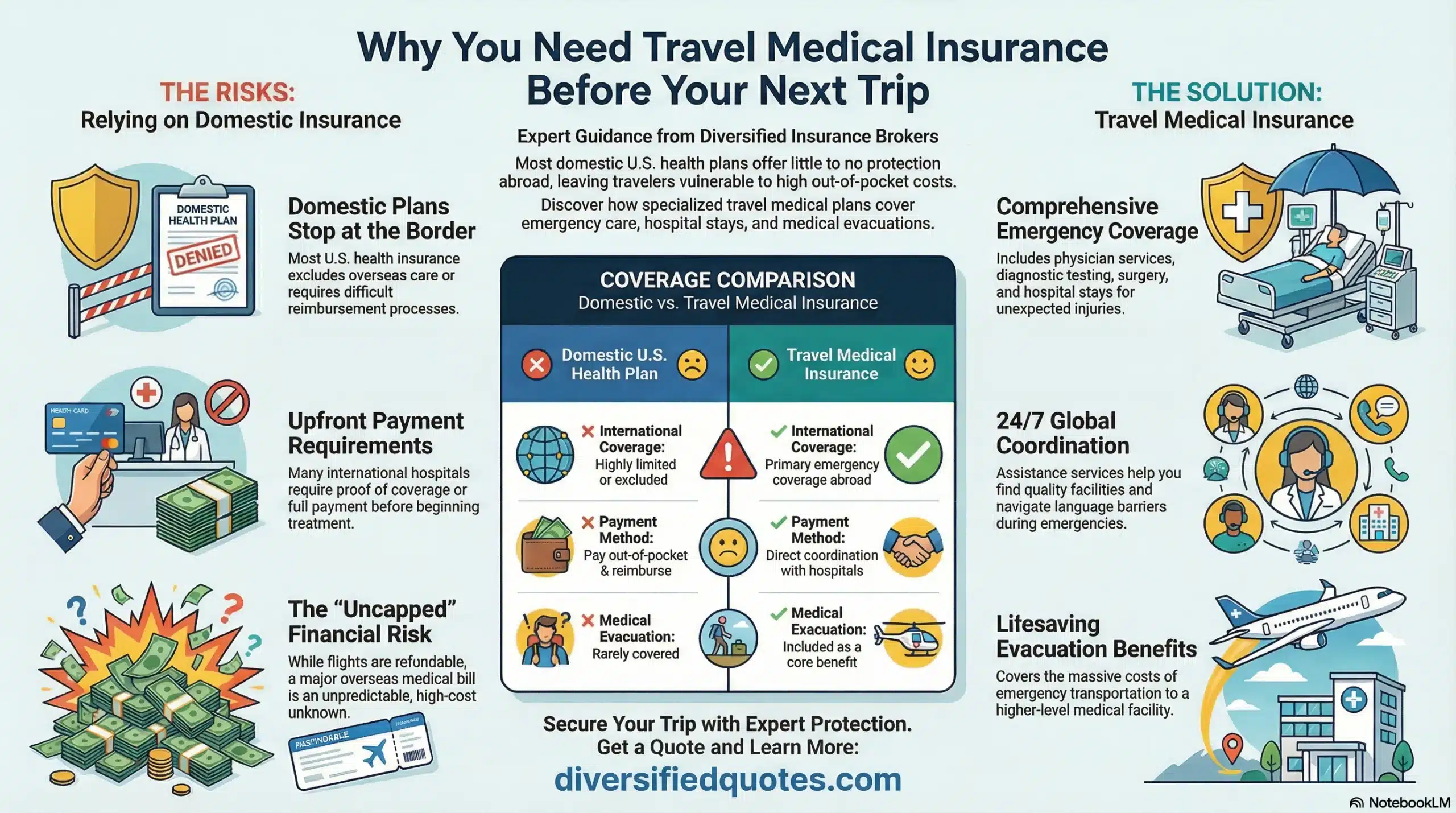
Japan’s healthcare infrastructure is genuinely excellent in major metropolitan areas — Tokyo, Osaka, Kyoto, Sapporo, Fukuoka, and Nagoya all have hospitals that provide a standard of care comparable to what most Western travelers expect from advanced medical systems. The practical issues that drive the value of travel medical coverage in Japan are not about hospital quality but about the specific friction points that foreign visitors encounter in a system designed primarily for Japanese national health insurance holders. Japanese hospitals and clinics commonly require payment at the point of service for foreign visitors who are not enrolled in the national system — meaning that a serious emergency room visit or inpatient admission can require a significant payment while the visit is ongoing, before reimbursement from any insurance is received. Even when the clinical care is excellent and the eventual reimbursement is complete, managing large upfront payments in a foreign currency during a medical emergency is a source of significant stress that travel medical coverage with direct billing or payment guarantee support directly reduces.
English proficiency among medical staff varies significantly across Japan’s healthcare system — major urban hospitals including Tokyo Medical and Surgical Clinic, St. Luke’s International Hospital in Tokyo, and a small number of international clinics in Tokyo and Osaka provide English-language services specifically for foreign visitors, but most of Japan’s broader hospital network operates primarily in Japanese. Navigating which facility is appropriate for a specific situation — whether the presentation calls for an urgent care clinic, an emergency room, a specialist hospital, or an overnight observation admission — is not intuitive in an unfamiliar system under medical stress. The 24/7 assistance service included in quality travel medical plans removes that uncertainty by providing real-time guidance on which facility is most appropriate, coordinating admission, and communicating with providers when language creates barriers. For travelers evaluating how to compare plan structures intelligently rather than by premium price alone, our resource on how to get the best travel medical insurance rates covers the key variables that affect cost and how to optimize coverage relative to the traveler’s actual risk profile.
Japan Travel Medical: Coverage Priorities by Itinerary Type
| Japan Itinerary Type | Practical Medical Challenge | Most Important Coverage Feature | Key Planning Consideration |
|---|---|---|---|
| Multi-city touring — Tokyo / Kyoto / Osaka | Point-of-service payment at Japanese hospitals; language navigation for facility selection; high daily step count creating fatigue and injury risk on uneven terrain; fast-moving itineraries with little schedule margin for disruption | Assistance team for facility navigation and language support; direct billing or payment guarantee where available; documentation collection guidance before moving to next city; responsive 24/7 support for schedule-constrained travelers | Collect all documentation before leaving each city — itemized bills, clinical notes, payment receipts — since Shinkansen schedules often move travelers quickly to the next destination the following day |
| Ski resorts — Niseko / Furano / Hakuba | Orthopedic injury risk from ski and snowboard falls; remote resort locations relative to major hospitals; determination of whether air or ground transport is appropriate after serious injury; assessment of fitness to fly after injury | Activity coverage confirmation for skiing and snowboarding; evacuation capability from resort to Sapporo or Tokyo hospital; assistance team experience with ski injury management and transport assessment; limits adequate for orthopedic surgery costs | Confirm plan explicitly covers skiing and snowboarding; some plans treat ski resort injuries differently; Niseko area hospitals are significantly limited — serious events route to Sapporo or further |
| Rural hiking and pilgrimage routes | Kumano Kodo, Shikoku pilgrimage, Nakasendo, and mountain trails place travelers hours from meaningful medical infrastructure; heat in summer, slippery paths in rain, and altitude on volcanic peaks create genuine injury and illness risk | Evacuation from rural Japan to nearest appropriate hospital; altitude illness coverage for Mount Fuji and alpine route travelers; trail injury coverage; assistance team capable of coordinating rural Japan routing | Rural Japan has fewer international clinic options and greater language barriers than Tokyo or Osaka — the assistance team’s facility navigation role is more important, not less, in rural settings |
| Study abroad / extended stay | Multi-month stays in Japanese university environments; accumulating medical probability over extended time; prescription medication management across Japanese pharmacy systems; potential need for ongoing mental health support in adjustment period | Coverage structure appropriate for extended stay — not just emergency protection; pre-existing condition terms for conditions students manage routinely; prescription coverage and refill coordination; mental health benefit availability | Standard short-term travel medical plans may be insufficient for multi-month study abroad stays — comparison with longer-duration international medical plans is the right evaluation step |
Emergency Medical Evacuation for Japan Travel
Many travelers assume evacuation coverage is only relevant for developing countries with limited healthcare infrastructure — a reasonable assumption that does not fully account for how evacuation decisions are actually made. Evacuation from Japan is not frequently required for medical events that occur in Tokyo, Osaka, or other major metropolitan areas where the nearest appropriate hospital provides the required level of care within the Japanese system. The scenarios where evacuation becomes operationally relevant for Japan travel are those where the patient’s location, clinical condition, or specific care requirement creates a gap between what is locally accessible and what the situation demands. A serious ski injury at Niseko where the nearest orthopedic surgery capability is in Sapporo — and where the patient’s specific injury benefits from a particular specialist — may require coordinated transport that the assistance team arranges. A serious event on a rural hiking trail in Shikoku or on the Nakasendo route where the nearest appropriate hospital is hours away by ground may require medical transport coordination. A condition that requires medically supervised repatriation to the United States for definitive care and long-term recovery — where the patient cannot safely travel independently but the clinical situation does not require continued inpatient care in Japan — is another scenario where evacuation benefits provide real operational value even in a country with strong healthcare. Our resource on emergency medical evacuation insurance covers how evacuation benefits are structured and what “medical necessity” typically means within the authorization process. For the broader international travel health coverage framework, our guide to international travel health coverage covers how multi-country and extended-itinerary plans are structured.
Get Coverage Set Before Departure
Compare plans and choose coverage before you travel — when you can compare benefits calmly and match coverage to your itinerary.
Compare Plans & PricingPre-Existing Conditions, Older Travelers, and Extended Stays
Pre-existing conditions are one of the most practically important plan details to evaluate before a Japan trip — especially for travelers managing hypertension, diabetes, asthma, prior cardiac events, autoimmune conditions, or recurring gastrointestinal issues. Japan is a high-walking, high-activity destination for most visitors, and travelers whose conditions could plausibly flare under physical exertion, dietary changes, jet lag, or climate adjustment should treat the pre-existing condition language as a priority review item rather than fine print. Plans define pre-existing differently — stability windows, look-back periods, and timing rules relative to when the policy was purchased all affect eligibility — and the correct approach is to review the specific plan’s definition rather than assuming that a comprehensive-sounding description covers the specific condition profile. For travelers who are also evaluating Japan alongside other long-haul destinations in the same trip planning cycle, our pages on travel medical and evacuation from Australia and travel medical and evacuation from Vietnam provide Asia-Pacific comparison context for how coverage priorities differ across the region.
Japan is a consistently popular destination for older travelers and multi-generational family trips, and age meaningfully changes how coverage should be evaluated. Even a minor medical issue can require more testing, more observation time, and more extensive follow-up for older travelers than for younger ones — and the financial exposure of inpatient care at a Japanese private hospital is meaningful at any age but more consequential for events that are likely to require extended observation or specialist consultation. The assistance team’s responsiveness and capability is as important as the nominal benefit limit for older travelers, because the decisions that need to be made quickly — which facility is most appropriate, whether specialist transfer is warranted, whether supervised transport home makes clinical sense — are exactly the decisions where experienced case management adds the most value. For multi-country itineraries combining Japan with destinations where infrastructure is significantly different — Africa, the Middle East, or South America — the coverage should be structured for the most demanding destination on the itinerary. Our pages on travel medical and evacuation from Spain and travel medical and evacuation from Sweden cover destinations commonly combined with Japan in longer European-Asia itineraries and how coverage priorities shift across different developed-country environments. For additional travel medical resources covering a broad range of travel scenarios and plan structures, our short-term and travel medical resource library covers the full spectrum of plan types and traveler profiles.
Related Travel Medical Pages
Related Destination Pages
Talk With an Advisor Today
Choose how you’d like to connect—call or message us, then book a time that works for you.
Schedule here:
calendly.com/jason-dibcompanies/diversified-quotes
Licensed in all 50 states • Fiduciary, family-owned since 1980
Travel Medical and Evacuation from Japan — FAQs
Japan has excellent hospitals, particularly in major urban centers, but travelers consistently encounter practical challenges that domestic insurance does not address well: up-front payment requests at Japanese facilities, reimbursement paperwork in a language context unfamiliar to foreign visitors, difficulty navigating care pathways without English-speaking guidance, and limited ability to identify the appropriate facility quickly for a specific situation. Travel medical coverage is designed to address these access and logistics challenges rather than simply cover medical costs. A responsive assistance team that can locate appropriate care, coordinate payment or reimbursement processes, and guide documentation collection often produces more practical value during a real claim than the nominal benefit limit on the policy. For most Japan travelers, the benefit of travel medical coverage is fewer logistical surprises when something unexpected happens — not just reimbursement after the fact.
Evacuation coverage focuses on medically necessary transport and coordination when the level of care available locally is not adequate for your situation, or when continuing travel is unsafe without supervised transport. For Japan specifically, evacuation scenarios most commonly arise from ski injuries at mountain resorts, serious accidents in rural areas, situations requiring specialist care not available at the nearest facility, or cases where medically supervised repatriation home is recommended after initial stabilization. The determination of whether evacuation is medically necessary is made through the plan’s assistance team and medical review process — not by the traveler unilaterally. This is important to understand because evacuation arranged independently, without following the insurer’s coordination process, may not be reimbursable regardless of medical necessity. Having evacuation coverage means having a structured process and a coordinating team available when those decisions need to be made quickly and under stress.
Yes — ski and winter mountain travel meaningfully changes the coverage calculus for a Japan trip. Ski injuries in destinations like Niseko or Hakuba can escalate from a simple fall into a multi-step event involving imaging, orthopedic specialist evaluation, a determination of whether flying is safe, and potentially a recommendation for supervised transport rather than commercial flight home. In those situations, evacuation benefits and assistance coordination become as important as the medical benefit limit. You should also verify that the plan’s activity coverage includes recreational skiing or snowboarding, as some plans exclude certain high-risk activities by endorsement. For ski-focused itineraries, selecting a plan with meaningful evacuation limits and a strong assistance team — not just the lowest premium — is the appropriate approach because the scenarios that occur in ski environments are exactly the ones where evacuation and coordination capability matter most.
No — these are distinct products that cover different categories of risk. Travel medical insurance is primarily about emergency medical care and evacuation during the trip itself — it responds when you get sick or injured abroad and need treatment, transport coordination, or assistance services. Trip cancellation and interruption insurance covers prepaid trip costs — flights, hotels, tours — when covered events prevent you from departing as planned or force you to cut the trip short. Some comprehensive travel plans include both types of coverage in a single policy, while others separate them. For travelers primarily concerned about medical emergencies and evacuation logistics during a Japan trip, travel medical coverage is the foundational protection. Trip cancellation coverage is a separate decision based on how much non-refundable trip cost is at risk if something prevents travel or forces early return.
Pre-existing conditions are among the most important coverage details to evaluate before any international trip, and Japan is no exception. Plans define pre-existing conditions differently — some use a 60-day look-back period, others use 180 days or more — and eligibility for coverage of pre-existing condition events can depend on stability requirements specifying that no treatment, medication changes, or symptom changes occurred during the look-back window. Some plans offer an “acute onset of pre-existing conditions” benefit that covers sudden unexpected emergencies related to an existing condition, even if the underlying condition is technically pre-existing. Others exclude pre-existing conditions entirely. If you are traveling with a known health history — hypertension, diabetes, asthma, cardiac history, autoimmune conditions — reading the plan’s specific pre-existing condition language before purchasing is not optional. Assuming coverage applies without verifying against the exact plan definition is one of the most common and costly mistakes travelers make during plan selection.
It depends on the plan and the specific facility or situation. Many Japanese hospitals and clinics expect payment at the time of service, particularly for foreign visitors without Japanese national health insurance cards. In those situations, you may pay out of pocket and then submit documentation for reimbursement after returning home. Some travel medical plans include assistance coordination services that can work with facilities to arrange billing directly in certain situations, reducing the need for up-front payment — but this is facility-dependent and not guaranteed. The most important preparation for any Japan medical situation is to have your insurance information readily accessible, contact the plan’s assistance line as soon as you are able after receiving care, and collect complete documentation at the facility before leaving — itemized bills, clinical notes, diagnostic results, and proof of payment. Documentation collected on-site is substantially easier to work with than paperwork retrieved after departure.
If it is a genuine emergency, get care immediately without delaying for insurance paperwork. Emergency medical care always takes priority over claims coordination. Once you are stable, or if the situation is urgent but not immediately life-threatening, contact the plan’s 24/7 assistance line as soon as it is practical. The assistance team can help you identify the appropriate facility for your situation, provide guidance on what documentation to collect, and in some cases coordinate logistics or payment arrangements with the facility. Having the assistance line number saved in your phone before departure — not buried in a policy PDF you would need to search — is one of the simplest and most effective forms of trip preparation. Keep your insurance ID and certificate number accessible alongside the assistance contact information.
Many travel medical plans are designed for multi-country international travel and will cover you across multiple destinations when the plan is structured correctly and all travel dates are reflected accurately. The key is confirming the plan’s geographic territory explicitly — most international plans specify a broad coverage territory such as “worldwide” or “worldwide excluding [country]” rather than restricting to a single named country. If your itinerary includes Japan plus South Korea, Taiwan, Southeast Asia, or other destinations, verify that all countries on the itinerary are within the plan’s covered territory and that your policy period covers the full date range. If you change countries frequently or have a variable itinerary, assistance team responsiveness and a clear understanding of how to reach the assistance line from any country become even more operationally important than for a simple single-country trip.
For most travelers, yes — even short trips can generate unexpected medical situations, and the cost of a single urgent care visit, imaging series, or ER evaluation in Japan can easily exceed the cost of a travel medical policy for the same trip. Beyond the direct cost protection, the assistance services included in most travel medical plans provide operational value that is difficult to quantify in advance: guidance on which facility is appropriate, help with documentation, translation support in some cases, and a clear process for handling claims. For travelers who are older, managing ongoing health conditions, or traveling with a busy itinerary that has limited tolerance for disruption, the case for coverage is even stronger. The premium cost of a short-trip travel medical plan is typically modest enough that the financial protection question almost answers itself — the more substantive planning question is which plan design provides the right combination of benefits for the specific trip.
No — travel medical coverage is designed specifically for emergency and unexpected medical needs during international travel. It is not a replacement for domestic health insurance and typically does not cover routine care, preventive services, or treatment for conditions that are not sudden and unexpected. Your U.S. health insurance remains your primary domestic coverage and handles ongoing care, routine visits, and non-emergency treatment at home. Travel medical coverage fills the gap that exists when you are outside your domestic insurance network and facing an unexpected medical situation abroad. The two types of coverage serve different purposes and operate in different contexts — travel medical is specifically built for the international travel scenario, not as a substitute for comprehensive domestic coverage. Travelers who have no U.S. health insurance should not rely on travel medical coverage as a replacement — it is a supplemental, trip-specific product with defined benefit parameters rather than comprehensive health coverage.
About the Author:
Jason Stolz, CLTC, CRPC, DIA, CAA and Chief Underwriter at Diversified Insurance Brokers (NPN 20471358), is a senior insurance and retirement professional with more than 25 years of real-world experience helping individuals, families, and business owners protect their income, assets, and long-term financial stability. As a long-time partner of the nationally licensed independent agency Diversified Insurance Brokers, Jason provides trusted guidance across multiple specialties—including fixed and indexed annuities, long-term care planning, personal and business disability insurance, life insurance solutions, Group Health, Travel Medical and Evacuation Insurance, and short-term health coverage. Diversified Insurance Brokers maintains active contracts with over 100 highly rated insurance carriers, ensuring clients have access to a broad and competitive marketplace.
His practical, education-first approach has earned recognition in publications such as VoyageATL, and contributions from his agency featured in Kiplinger and GoBankingRates— highlighting his commitment to financial clarity and client-focused planning. Drawing on deep product knowledge and years of hands-on field experience, Jason helps clients evaluate carriers, compare strategies, and build retirement and protection plans that are both secure and cost-efficient. Visitors who want to explore current annuity rates and compare options across multiple insurers can also use this annuity quote and comparison tool.
Explore More Travel Medical Insurance Options: Browse our complete guide to Europe, Asia & Pacific Travel Medical Insurance — covering medical evacuation coverage for Europe, Asia, Australia & Pacific destinations.
Last Reviewed: June 18, 2026 |
Reviewed by: Jason Stolz, CLTC, CRPC, DIA, CAA
Chief Underwriter, Diversified Insurance Brokers, Inc. | NPN: 20471358 | Diversified Insurance Brokers, Inc. — Licensed in all 50 states
Fact Checked by: Tonia Pettitt, CMIP©
Medicare Specialist, Diversified Insurance Brokers, Inc. | NPN: 14374308 | Diversified Insurance Brokers, Inc. — Licensed in all 50 states
Did you find this content helpful? Leave us a Google review — it helps others find trustworthy guidance too.
Editorial Standards: Diversified Insurance Brokers maintains rigorous editorial standards to ensure accuracy, clarity, and independence in all content. Learn more about our editorial standards and commitment to transparency.
