
Travel Medical and Evacuation from Holland
Travel Medical and Evacuation from Holland

Jason Stolz CLTC, CRPC, DIA, CAA
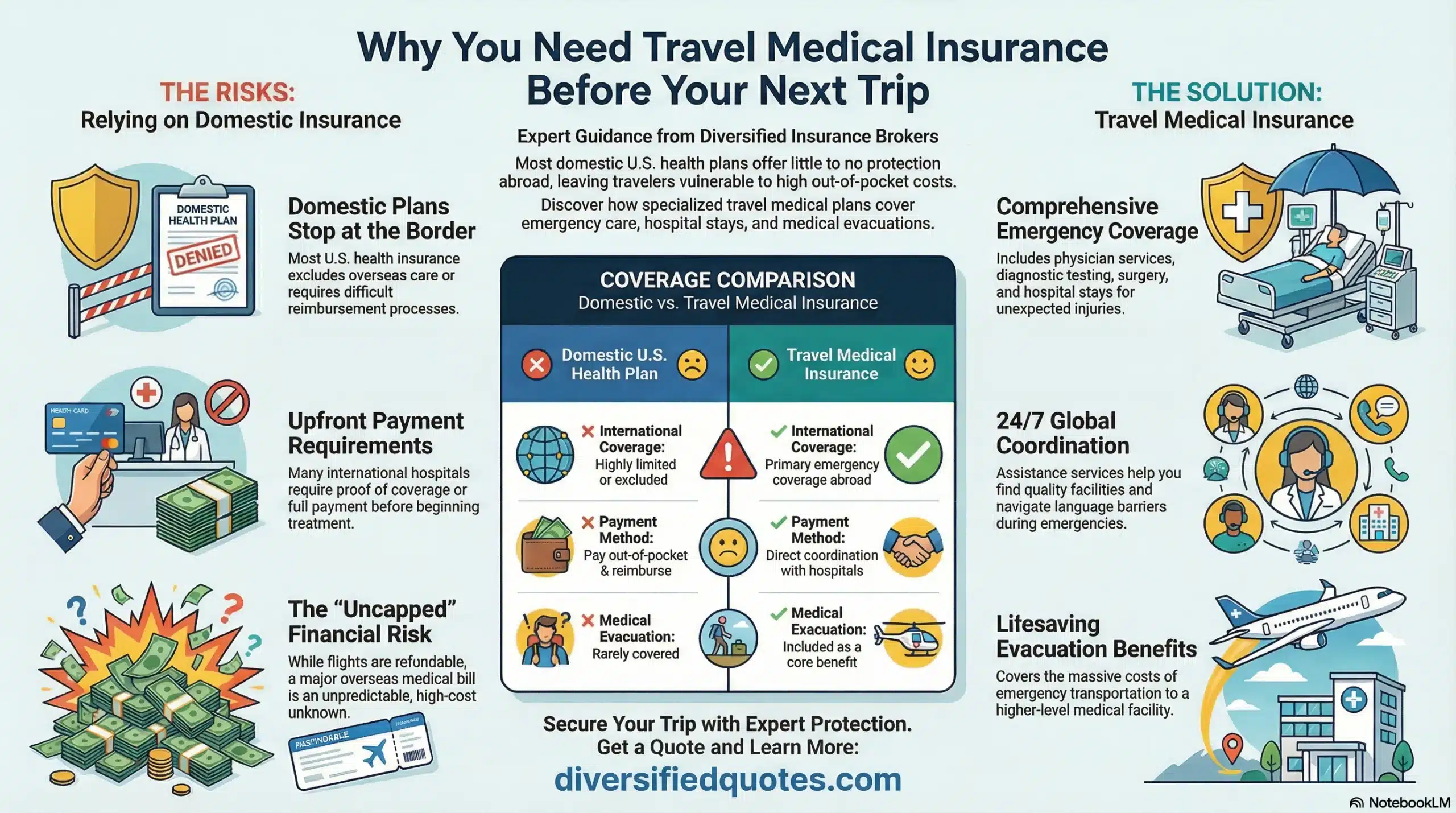
Travel medical and evacuation coverage from Holland (the Netherlands) is designed for one simple reality: even in a country with excellent hospitals and efficient emergency care, a traveler’s access and billing can look very different than a resident’s. Many U.S. health plans provide limited or no benefits outside the United States, and even when out-of-network claims can be submitted later, travelers can still face large upfront costs, confusing documentation requirements, or care coordination delays at the exact moment they need to focus on getting better. Travel medical insurance helps cover eligible emergency treatment, while medical evacuation coverage helps coordinate and pay for transport when the best care is not where you are.
If you’re traveling to Amsterdam, Rotterdam, The Hague, Utrecht, or smaller cities and rural areas across the Netherlands, the goal is not to predict an emergency — it’s to keep one event from turning into a financial and logistical crisis. A strong plan can help with emergency room care, hospitalization, imaging, prescriptions, urgent physician visits, and the coordination services that matter when you’re in a different healthcare system and need help fast. If you’re building a travel protection strategy more broadly, start with the fundamentals on our main travel medical insurance guide, then return here to tailor coverage to Holland-specific realities including how care is accessed, how bills are presented, and how evacuation decisions are made when language, location, or capacity constraints become factors.
Get a Travel Medical Quote for the Netherlands
Compare travel medical + evacuation options for your exact dates, ages, and coverage goals.
Why You Still Need Travel Medical Coverage in Holland
The Netherlands is one of the best places in Europe to receive high-quality medical care — yet that doesn’t automatically mean your trip is financially protected. “Good healthcare” and “covered healthcare” are not the same thing for travelers. Your U.S. health insurance may treat international care as out-of-network, reimburse only a small portion, require pre-authorization you can’t obtain in an emergency, or exclude certain types of care abroad altogether. Travel medical insurance is built to close those gaps by paying eligible emergency costs during the trip using trip-based coverage rules that are easier to align with short-term travel needs.
Holland is also a place where travelers often stay active: walking-heavy itineraries, cycling, canal-side streets, day trips, museums, and regional travel to nearby countries. Those activities increase the odds of common events — sprains, fractures, infections, dehydration, allergic reactions, asthma flares, or unexpected abdominal pain — where fast access to care and predictable coverage rules matter. Our overview of emergency travel health insurance explains how these plans typically approach urgent needs during travel, including how assistance teams help navigate next steps when you’re in an unfamiliar healthcare system. For travelers evaluating evacuation coverage specifically, our resource on emergency medical evacuation insurance explains what evacuation actually covers and how coordination works in practice — context that helps set accurate expectations before buying.
| Holland Itinerary / Traveler Type | Practical Medical Consideration | Key Coverage Priority | Evacuation Scenario |
|---|---|---|---|
| Amsterdam / Rotterdam / The Hague — city tourism | Strong hospital access in all three cities including Amsterdam UMC and Erasmus MC Rotterdam; care as a foreign visitor billed privately; upfront payment or deposit common for non-EHIC visitors; English widely spoken among clinical staff | Financial protection against Dutch private billing rates; direct billing or payment guarantee support; assistance team for navigating GP vs. emergency room decisions in the Dutch care pathway; documentation collection guidance | Intra-Netherlands transfer for rare specialist events; medically supervised repatriation to U.S. when prolonged recovery makes home-country follow-up medically appropriate |
| Cycling tours — Amsterdam, tulip fields, IJsselmeer | Cycling injury risk from canal-side road surfaces, cobblestones, and high traffic density in urban areas; orthopedic presentations most common; some plans treat cycling differently than walking — activity coverage confirmation essential | Explicit cycling coverage confirmation before purchase; orthopedic imaging and evaluation cost protection; assistance team guidance for nearest orthopedic-capable facility from rural cycling route locations | Ground transport to nearest regional hospital for serious cycling injuries; Amsterdam or Rotterdam for complex orthopedic events; fitness-to-fly assessment before departure if injury occurs near the end of the trip |
| Multi-country Europe — Holland plus Germany / Belgium / France | High-volume train travel between countries; medical event can occur in any country on the itinerary; healthcare billing and access structures differ between Netherlands, Germany, Belgium, and France; coverage territory must match all planned destinations | Geographic territory confirmation covering all countries on itinerary before purchase; consistent benefit levels regardless of which country a medical event occurs in; assistance team with multi-country European operational capability | Repatriation routed from whichever European country the traveler is in at time of serious event; plan’s assistance team manages cross-border coordination regardless of event location |
| Senior travelers / 65+ | Walking-intensive Amsterdam itineraries and cycling day trips create cardiovascular and fall risk for older travelers; minor events more likely to require extended observation, specialist consult, or imaging; pre-existing condition prevalence higher; walking cobblestone streets creates fall and ankle injury risk | Higher emergency medical limits for extended observation and specialist costs; pre-existing condition language explicit review before purchase; lower deductible for travelers likely to use the plan for outpatient visits; real-time assistance coordination rather than reimbursement-only structure | Medically supervised repatriation when recovery duration makes home-country follow-up appropriate; family coordination support when U.S.-based family is managing logistics remotely from home |
| Students / study abroad — Leiden, Delft, Utrecht universities | Semester or longer stays accumulate medical probability well beyond short-trip exposure; Dutch university health services available for enrolled students but with limits; prescription management across Dutch pharmacy system; mental health needs increase over extended stays | Coverage structure appropriate for semester or longer duration; outpatient access for non-emergency needs; prescription coordination support; mental health benefit availability; interaction between Dutch student health registration and plan terms reviewed before enrollment | Repatriation for serious events requiring home-country specialist follow-up; coverage continuity across breaks and travel outside the Netherlands during the academic year |
| Digital nomads / extended stays — remote work | Open-ended or multi-month stays without defined return date; Dutch 90-day Schengen visitor limit creates structural planning question for longer-stay remote workers; accumulating medical probability over extended time; prescription supply and continuity management | Coverage structure with extension capability or that matches actual stay duration; outpatient access for day-to-day needs beyond emergency-only protection; plan renewal or conversion options if stay extends; prescription documentation and continuity support | Repatriation flexibility when home-country return is medically preferred; coverage that functions across potential destination changes if the traveler moves from the Netherlands to another European country mid-stay |
What Travel Medical Insurance Typically Covers During a Netherlands Trip
Travel medical coverage is primarily focused on eligible emergency and urgent medical expenses while outside your home country. While plan language varies by carrier and product, coverage commonly includes emergency room treatment, physician services, diagnostic testing, imaging, hospitalization, and certain prescriptions tied to the covered event. Some plans also include ancillary benefits that become important when a medical event disrupts your trip — like assistance services, coordination, translation support, or help locating an appropriate facility quickly.
In the Netherlands, the practical value often shows up in how quickly you can move from “I need help” to “I’m in the right place getting care.” Travelers frequently underestimate the friction that occurs when they’re unfamiliar with local systems, don’t know which facility is appropriate, or aren’t sure how to document everything properly for claims. A good plan can reduce that friction by connecting you to an assistance team that can help locate care, communicate clinical information, and clarify what to save for reimbursement. If you’re traveling at older ages, our guide to travel medical insurance for seniors breaks down how to think about benefit limits, pre-existing condition provisions, and assistance-driven logistics in a way that matches real-world risk for travelers whose needs differ from a 30-year-old on a weekend trip. For an explanation of related logistical benefits that often accompany travel medical plans, our resource on travel lodging and related travel benefits covers the practical extras that matter when a medical event disrupts your itinerary.
How Medical Evacuation Works in Real Life
Medical evacuation coverage is often misunderstood because people imagine only one scenario: a helicopter or private jet rushing someone home. In reality, evacuation benefits are typically designed to support medically appropriate transport to the nearest suitable facility, or to a facility that can provide a higher level of care when necessary. These benefits are usually triggered by medical necessity determinations and are commonly coordinated through an assistance team that helps manage logistics with treating physicians and local providers.
For a Netherlands trip, evacuation becomes relevant in a few common situations: a serious injury needing a specialty center; a complex condition where transfer is recommended for continuity of care; a traveler who is stable but needs medically supervised transport; or an event occurring outside a major metro area where the nearest facility isn’t equipped for the situation. In those cases, evacuation coverage can be the difference between a coordinated plan and a confusing, expensive scramble. One of the most practical questions to ask is how the plan coordinates care — evacuation coverage can look similar on paper across plans, but operational differences matter significantly. Our resource on international travel health coverage helps identify which plan structure fits your travel style and risk profile when comparing options across carriers.
Who Should Consider Higher Limits for Holland Trips
Many travelers assume that because Holland is “safe and modern,” lower coverage limits are always sufficient. The right limit depends on how you travel, your age, your health history, and whether your itinerary includes multi-country movement. A traveler who is older, traveling solo, traveling for a longer duration, or managing chronic conditions — even stable ones — often benefits from stronger coverage limits not because the Netherlands is risky, but because the consequences of one event are higher for that traveler’s specific situation.
Travelers who are highly mobile — multiple train transfers, day trips, biking, or a packed itinerary — face higher odds of mid-trip disruption from something “ordinary” like an injury, infection, or unexpected flare-up. If you’re combining your Netherlands trip with other European destinations, ensure your coverage territory and timing rules match your full itinerary. For travelers combining Holland with countries that may have different healthcare access levels or where evacuation decisions might be more complex, reviewing plans that provide consistent coverage across all destinations is especially important. For travelers living a flexible lifestyle — remote work, longer stays, or frequent multi-country movement — our overview of travel insurance for digital nomads covers plan structures built for that reality, including extension options and the practical “what if something changes” considerations that come up in real-world extended travel.
Common Gaps to Watch For Before You Buy
Travel medical plans are powerful when you match plan rules to your trip. The most common problems happen when travelers buy quickly and only later discover certain scenarios are excluded or limited. Some plans define pre-existing conditions strictly and require specific time windows — others provide coverage for acute onset of a pre-existing condition under certain conditions. Some plans have specific rules around sports and activities, especially for cycling-heavy travel, adventure excursions, or structured athletic events. Benefit sub-limits are easy to miss if you only look at the headline medical maximum.
Another common gap is assuming “evacuation” automatically means “return to the U.S.” Many plans focus on transport to the nearest appropriate facility, and return to home country may be subject to medical necessity and coordination rules. That’s not bad — often it’s exactly what you need — but expectations should match the contract before you’re in a situation where you need to rely on it. For travelers traveling as part of a group — students, sports teams, or organized travel — coverage design may look different than what you’d pick as an individual traveler. Plans can vary widely on supervision, activity coverage, and how assistance is coordinated when multiple travelers are involved. Our resource on travel medical for youth sports provides a perspective on how plan rules and real-world logistics intersect for group travel situations.
How to Choose the Right Plan Without Overbuying
A smart way to choose a plan is to begin with your “worst reasonable day” rather than your best. If you had an unexpected ER visit and needed follow-up care, would your plan meaningfully reduce financial exposure? If you had a serious event that required transfer to a higher-level facility, would your evacuation benefit be sufficient and coordinated through an assistance team that can actually execute? Those questions usually lead to the right structure faster than focusing on premium alone.
Next, match benefits to your real itinerary. If you’ll be in major cities with short transit time to large hospitals, evacuation triggers may be less likely to involve long-distance within-country transport — but specialty care needs can still matter. If you’ll be moving frequently, visiting smaller towns, or crossing borders, you want a plan with clear territory rules and effective assistance. If you’ll be active — biking, hiking, or organized excursions — pay close attention to activity definitions and exclusions. Finally, choose a plan that fits how you want to handle claims: some travelers prefer coordination where the assistance team arranges services, while others are comfortable paying out of pocket and pursuing reimbursement. Neither is inherently better, but one is typically better for the way you travel. For a broader framework comparing how to evaluate plan design across different trip types and destinations, our resource on international travel health coverage provides useful structure for the comparison process.
If You Need Care in Holland: The Simple Process That Prevents Problems Later
If you have a true emergency, seek care immediately — health and safety always come first. For urgent but non-emergency needs, using the plan’s assistance resources can save time and reduce confusion because the assistance team can help direct you to an appropriate facility and explain what documentation you’ll likely need. When you receive care, keep everything you can: itemized bills, proof of payment, discharge notes, diagnostic results, and physician instructions. Documentation is the difference between a smooth reimbursement process and a frustrating one.
Also be mindful of timing. Some benefits operate based on the trip dates you select and plan issuance rules — which is why purchasing coverage as soon as travel dates are firm is wise rather than waiting until the last minute. When a traveler is hospitalized, the value of assistance services often increases significantly: coordinating family communication, understanding next steps, or arranging transport can be harder when you’re dealing with a foreign healthcare system without your normal support network. A good plan reduces that “non-medical friction” that tends to show up in real emergencies and can be as disorienting as the medical situation itself.
Who Gets the Most Value From Travel Medical + Evacuation for Holland
Most travelers benefit from travel medical coverage, but the value is strongest for specific profiles. Older travelers benefit because the likelihood of needing care increases with age even when health is stable. Travelers with pre-existing conditions benefit because even stable conditions can flare due to travel stress, sleep disruption, time zone changes, or routine disruptions. Families benefit because pediatric urgent care needs can appear quickly and disrupt an itinerary in ways that are hard to manage without support. Travelers combining Holland with multiple countries benefit because the “where do we go for care” question becomes more complex when the itinerary changes frequently or includes destinations with different healthcare access levels.
Even younger healthy travelers increasingly find that the real value is the combination of protection and coordination. If you get sick, get injured, or need help finding care quickly, you want a simple system that works the way you expect — without trying to navigate an unfamiliar healthcare system independently while managing a medical situation. That’s why travelers increasingly treat travel medical coverage as a basic part of trip planning rather than an optional add-on. For travelers comparing coverage across multiple European destinations including Holland, our destination pages for Algeria, Egypt, Kenya, Senegal, and Cuba provide destination-specific context on how coverage needs vary by location.
Compare Travel Medical + Evacuation Options
Run quotes for Holland travel dates and choose coverage limits that match your itinerary and risk.
Financial Protection Essentials
Travel medical planning resources for international trips, evacuation coverage, senior travelers, and group travel situations.
Related Travel Medical Pages
Talk With an Advisor Today
Choose how you’d like to connect—call or message us, then book a time that works for you.
Schedule here:
calendly.com/jason-dibcompanies/diversified-quotes
Licensed in all 50 states • Fiduciary, family-owned since 1980
FAQs: Travel Medical and Evacuation from Holland
Holland has excellent medical care, but “good healthcare” and “covered healthcare” are not the same thing for travelers. Most U.S. domestic health insurance plans provide limited or no benefits outside the United States — and even plans that do provide some international coverage may treat care abroad as out-of-network, reimburse only a portion of costs, require pre-authorization that isn’t practical to obtain in an emergency, or impose benefit limits that leave meaningful out-of-pocket exposure. Travel medical insurance is built specifically for this gap: it covers eligible emergency expenses using trip-based coverage rules and connects you to an assistance team that can help you locate appropriate care, coordinate next steps, and clarify what documentation is needed for your claim. The quality of Dutch hospitals doesn’t reduce the financial and logistical complexity you face as a visitor who isn’t part of the national insurance system — which is why travel medical coverage remains valuable even in high-quality healthcare environments like the Netherlands.
Travel medical coverage is primarily designed to pay eligible treatment costs incurred during your trip — hospital care, urgent care visits, diagnostic testing, imaging, prescriptions, and physician services related to a covered emergency or urgent event. Medical evacuation coverage is a separate but complementary benefit that helps with transportation when you need to be moved to a different facility for medically appropriate care. Evacuation coverage typically covers transport to the nearest suitable facility when your current location doesn’t have the specialized care required, or medically supervised return to your home country when that is determined to be medically appropriate and necessary. The two benefits address different problems: travel medical handles the cost of care where you are, while evacuation handles the problem of getting you to the right place for care when those two things don’t align. In practice, having both together — rather than travel medical alone — ensures that the “where do I get the right care” logistics are covered alongside the treatment costs themselves.
Coverage under a travel medical plan generally applies throughout the Netherlands regardless of where you are within the country — the coverage territory is typically the country as a whole rather than specific cities or areas. However, access to certain types of specialized care can vary by location, and a smaller town may not have the same specialist availability as Amsterdam or Rotterdam. This is where the plan’s assistance services become particularly valuable: the assistance team can help you identify the nearest appropriate facility for your specific situation, provide guidance on whether a transfer to a larger center might be appropriate, and help coordinate care when you’re not in a major metro area. The coverage applies — but the practical experience of accessing the right care efficiently is where a good assistance team makes a meaningful difference for travelers outside major urban centers.
Every travel medical plan defines pre-existing conditions differently, and the provisions can vary significantly across carriers. The most important things to evaluate if you’re traveling with a known health history are: how the plan defines a pre-existing condition (some plans use a “look-back” period of 60, 90, or 180 days before the effective date); whether the plan includes an “acute onset of a pre-existing condition” benefit that may cover sudden unexpected flare-ups of stable conditions; and any timing rules tied to plan purchase and effective dates. Some plans are more generous in how they approach stable, controlled conditions, while others exclude pre-existing condition events more broadly. The best approach is to review the certificate wording for the specific plan you’re evaluating rather than assuming coverage based on the plan’s general description. If this is a primary consideration for your trip, comparing plans side by side with an advisor who understands how each carrier treats common pre-existing conditions can help identify the most favorable coverage option for your specific health history.
Travel medical plans are typically effective based on the trip start date you select and the plan’s issuance and payment rules — there is generally no multi-day waiting period comparable to what you might see with some other insurance products. However, some plan benefits may have specific conditions or limitations tied to when coverage begins, and the exact effective date mechanics vary by carrier and product. This is one reason why purchasing coverage as soon as your travel dates are firm is advisable rather than waiting until the last minute before departure. If you purchase the plan immediately after making non-refundable trip deposits, you may also qualify for time-sensitive benefits related to pre-existing conditions or “cancel for any reason” coverage in trip protection products that are separate from travel medical. For travel medical specifically, the key is to confirm the exact effective date mechanics in the certificate of coverage for your chosen plan so you understand precisely when your protection begins.
If it’s a genuine emergency, seek care immediately — health and safety always come first and no administrative step should delay emergency treatment. For urgent but non-emergency situations, contacting the plan’s assistance team before or as soon as possible after seeking care is advisable. The assistance team can help direct you to a facility appropriate for your specific situation, explain what documentation to collect during the visit, clarify whether services are covered under your plan terms, and in some cases arrange direct billing with the provider so you don’t need to pay everything out of pocket and pursue reimbursement later. During any care encounter, collect as much documentation as you practically can: itemized invoices, proof of payment, discharge summaries, diagnostic results, and any prescription information. Documentation collected at the time of service is significantly easier to work with than attempting to reconstruct it after returning home — and complete documentation is what makes a smooth claims process possible versus a delayed or complicated one.
If you pay for care out of pocket during your Netherlands trip and later pursue reimbursement, the process typically involves submitting a claim to the insurance carrier with documentation of the expenses and the covered event. The documentation that matters most includes: itemized bills or invoices from the provider showing the specific services rendered and their costs; proof of payment showing you actually paid the amounts claimed; any clinical documentation from the provider including discharge notes, diagnosis information, and treatment summaries; and your policy information including your certificate or policy number and effective dates. Submit claims promptly after returning home rather than waiting extended periods, and follow the carrier’s specific claim submission instructions — which may include specific forms, specific supporting documentation requirements, or submission through an online portal. If your plan includes an assistance team that can help with claims coordination, using that resource can simplify the process. Good documentation collected at the time of service makes the difference between a routine claim and a complicated one.
For most travelers, yes — even on short trips to a high-quality healthcare environment like the Netherlands. The calculation is straightforward: the premium for a short-trip travel medical plan is typically modest, while the out-of-pocket cost of even a single emergency room visit, imaging study, or overnight hospitalization as an uninsured visitor can be substantial. The financial protection alone often justifies the cost, but the value of assistance services — help locating care, coordinating your situation, and providing a point of contact when you’re dealing with an unfamiliar system — adds meaningful practical value beyond the benefit limits. Short trips can create just as much unexpected exposure as longer trips from any individual event: a fall on a cobblestone street, a food reaction, an acute illness, or an accident cycling around Amsterdam creates the same financial and logistical complexity on day two as on day fourteen. The brevity of the trip doesn’t reduce the consequences of the event if it happens.
No. Travel medical insurance is specifically designed for eligible emergency and urgent medical expenses that occur during your trip outside your home country — it is not a replacement for domestic health coverage and does not cover routine care, ongoing treatment, or the kinds of healthcare you would seek through your regular health plan at home. Think of it as a travel-specific supplement that addresses the coverage gap created by most U.S. domestic health insurance plans providing limited or no benefits internationally. When you return home, your regular domestic health insurance resumes its normal role, and any ongoing treatment related to a travel medical event would typically transition to coverage under your domestic plan. Some travelers make the mistake of assuming their domestic plan covers them internationally because it technically mentions “out of network” benefits — but the practical coverage, benefit levels, pre-authorization requirements, and claim processes for international care under most domestic U.S. health plans are significantly more limited and cumbersome than purpose-built travel medical coverage.
Yes. Many travel medical plans cover travel across multiple countries during a single trip as long as your coverage dates and the plan’s coverage territory rules match your full itinerary. If you’re combining Holland with other European destinations — Belgium, Germany, France, or elsewhere — choose a plan explicitly designed for multi-country or international travel rather than a narrowly defined single-destination plan that might create coverage ambiguity when you cross a border. When reviewing plans for a multi-country trip, confirm that all of your destinations fall within the plan’s covered territory, that the effective dates span your entire travel period including any time in transit between countries, and that the plan’s definition of “trip” accommodates your full itinerary rather than applying only to a portion of it. If your Europe trip includes destinations with meaningfully different healthcare access levels — such as combining the Netherlands with countries that have less developed medical infrastructure — make sure your evacuation coverage territory and benefit limits are appropriate for the highest-risk destination on your itinerary, not just the primary destination.
About the Author:
Jason Stolz, CLTC, CRPC, DIA, CAA and Chief Underwriter at Diversified Insurance Brokers (NPN 20471358), is a senior insurance and retirement professional with more than 25 years of real-world experience helping individuals, families, and business owners protect their income, assets, and long-term financial stability. As a long-time partner of the nationally licensed independent agency Diversified Insurance Brokers, Jason provides trusted guidance across multiple specialties—including fixed and indexed annuities, long-term care planning, personal and business disability insurance, life insurance solutions, Group Health, Travel Medical and Evacuation Insurance, and short-term health coverage. Diversified Insurance Brokers maintains active contracts with over 100 highly rated insurance carriers, ensuring clients have access to a broad and competitive marketplace.
His practical, education-first approach has earned recognition in publications such as VoyageATL, and contributions from his agency featured in Kiplinger and GoBankingRates— highlighting his commitment to financial clarity and client-focused planning. Drawing on deep product knowledge and years of hands-on field experience, Jason helps clients evaluate carriers, compare strategies, and build retirement and protection plans that are both secure and cost-efficient. Visitors who want to explore current annuity rates and compare options across multiple insurers can also use this annuity quote and comparison tool.
Explore More Travel Medical Insurance Options: Browse our complete guide to Europe, Asia & Pacific Travel Medical Insurance — covering medical evacuation coverage for Europe, Asia, Australia & Pacific destinations.
Last Reviewed: June 18, 2026 |
Reviewed by: Jason Stolz, CLTC, CRPC, DIA, CAA
Chief Underwriter, Diversified Insurance Brokers, Inc. | NPN: 20471358 | Diversified Insurance Brokers, Inc. — Licensed in all 50 states
Fact Checked by: Tonia Pettitt, CMIP©
Medicare Specialist, Diversified Insurance Brokers, Inc. | NPN: 14374308 | Diversified Insurance Brokers, Inc. — Licensed in all 50 states
Did you find this content helpful? Leave us a Google review — it helps others find trustworthy guidance too.
Editorial Standards: Diversified Insurance Brokers maintains rigorous editorial standards to ensure accuracy, clarity, and independence in all content. Learn more about our editorial standards and commitment to transparency.
