
Fixed Indexed and Income Annuity Rates
As an Independent Annuity Broker, we compare rates across 100+ carriers and 1,000 different annuities— not just one company’s product offerings — to find the best fit for your goals.
Fixed Indexed and Income Annuity Rates

Jason Stolz CLTC, CRPC, DIA, CAA
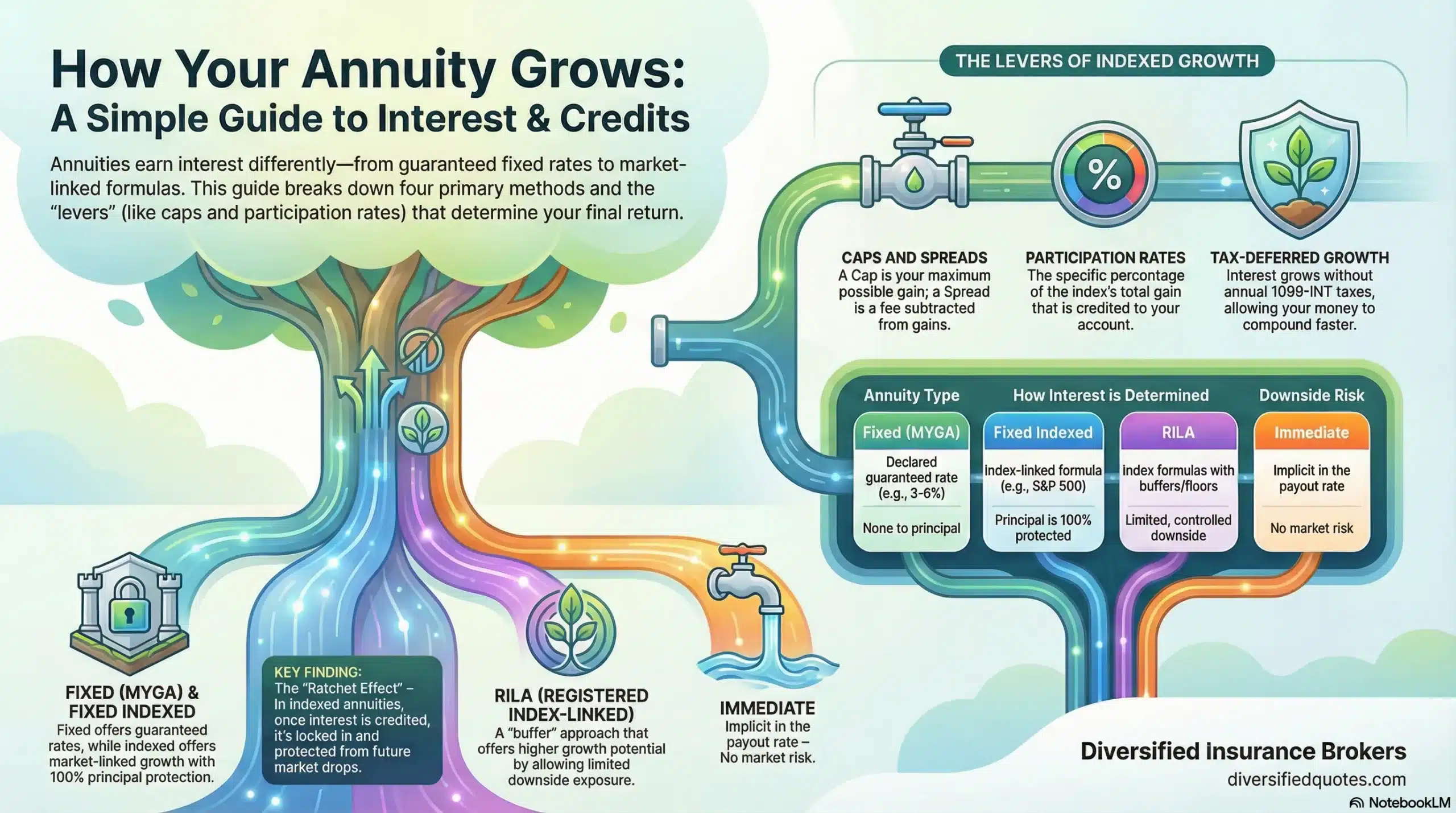
When people search for fixed indexed and income annuity rates, they are trying to answer a practical retirement question: what can these products realistically deliver, and how do I compare them honestly? The challenge is that “rates” mean fundamentally different things depending on whether you are looking at a fixed indexed annuity or an income annuity. A fixed indexed annuity does not publish a single interest rate the way a bank CD does — it offers a set of crediting terms (caps, participation rates, spreads, and fixed account options) that determine how interest is calculated based on index movement. An income annuity is different again: it is not primarily an accumulation product, and its “rate” is better understood as a payout level — how much guaranteed monthly income a given premium can generate at a specific age with a specific set of payout options. Conflating these two concepts leads to comparisons that produce misleading conclusions.
At Diversified Insurance Brokers, Jason Stolz, CLTC, CRPC, DIA, CAA helps retirees and pre-retirees compare both categories through the same lens: outcomes, trade-offs, and planning fit. The right starting point for any annuity evaluation is identifying what job the product needs to do in the retirement plan — protected accumulation with some market-linked upside potential, a guaranteed lifetime income floor to cover essential expenses, or a combination that builds an income layer while preserving some account flexibility. Our resource on how a fixed indexed annuity works covers the complete FIA product structure, and our resource on guaranteed income from annuities covers how income annuity structures translate premium into lifetime payments.
Ensure you are receiving the absolute top rates
Current Fixed Annuity Rates
Compare today’s best fixed annuity rates from top carriers.
Current Bonus Annuity Rates
See which annuities offer the highest upfront bonus today.
Request an Annuity Quote
Submit our annuity request form to get personalized rate options.
Lifetime Income Calculator
Model how different premiums and income start ages translate into guaranteed monthly income — then compare structures side by side.
Fixed Indexed and Income Annuity Rates — Key Terms Defined
The most common source of confusion in fixed indexed and income annuity comparison is applying the same vocabulary to products that use fundamentally different mechanics. A buyer who hears “rate” and imagines a single number equivalent to a bank yield will misread both a FIA crediting term and an income annuity payout factor. The table below defines the terms that actually drive outcomes in each product type — showing what each term means, which products it applies to, and what practical question it helps answer before any commitment is made.
Sample rates for illustrative comparison. Actual premiums depend on carrier, plan level, state, and underwriting details.
| Term | What It Is | Applies To | How It Affects Your Outcome | Key Question to Ask |
|---|---|---|---|---|
| Cap Rate | The maximum credited interest for a given crediting period regardless of how much the index gains | Fixed Indexed Annuity (FIA) | Sets the ceiling on credited interest in positive index periods — a 10% cap on a 20% index gain credits only 10%; a 10% cap on a 5% index gain credits 5% | Is this cap guaranteed for the full term or only for the first year? What has the carrier’s renewal cap history been? |
| Participation Rate | The percentage of measured index movement credited to the account — typically used without a cap | Fixed Indexed Annuity (FIA) | A 60% participation rate on a 15% index gain credits 9%; the same rate on a 5% gain credits 3% — the participation percentage scales with the index, unlike a cap | Is the participation rate subject to an additional cap or spread? Is the rate guaranteed or subject to annual reset? |
| Spread | A margin subtracted from the measured index return before interest is credited | Fixed Indexed Annuity (FIA) | A 3% spread on a 10% index gain credits 7%; a 3% spread on a 4% gain credits 1%; a 3% spread on a 2% gain credits 0% — spreads disproportionately reduce small gains | At what index return level does the spread produce a meaningful net credit? Is the spread level subject to annual reset? |
| Declared Fixed Account Rate | A guaranteed interest rate credited to the fixed account allocation within an FIA or on a standalone MYGA contract | FIA (fixed allocation bucket) and MYGA | Provides a predictable non-index-linked credit for the period declared — the “certainty” option within an FIA or the full basis of a MYGA | Is the declared rate guaranteed for the full contract term or the next crediting year only? What has renewal history looked like? |
| Payout Rate / Income Factor | The percentage applied to the income base at income start to determine the annual guaranteed withdrawal amount | FIA with GLWB income rider / Income annuity (SPIA or DIA) | A 5% payout factor on a $300,000 income base produces $15,000 per year ($1,250/month); higher payout factors are available at older income start ages | Is the payout factor a percentage of the income base (which may differ from account value) or the account value itself? Does it apply to single or joint life? |
| Rollup Rate (Income Base Growth) | The contractual rate at which the income base grows each year during the deferral period — separate from account value | FIA with GLWB income rider / Deferred Income Annuity (DIA) | A 6% rollup on a $200,000 income base deferred for 10 years produces an income base of approximately $358,000 — when the payout factor is applied to this larger base, it produces significantly more monthly income than if income started immediately | Is the rollup rate simple or compound? Does the rollup continue past the first 10 years, or does it cap? Is there an annual rider fee deducted from account value during deferral? |
| Renewal / Reset Terms | The process by which crediting terms (caps, participation rates, spreads, declared rates) are revised at the beginning of each new crediting period | FIA (most crediting strategies) / MYGA (at term expiration) | A contract with a strong initial cap may renew at a lower cap in future years — the carrier has discretion within contractual minimums; renewal history is a meaningful input in carrier evaluation | What contractual minimum exists for each crediting term? What has this carrier’s renewal track record been relative to competitors at renewal? |
The table’s most practically important row for most buyers is the renewal and reset terms row — because the initial crediting terms that appear in a product illustration may not reflect what the carrier will declare in years two through seven of the contract. A carrier that shows an attractive initial cap but has a history of reducing caps significantly at renewal is not the same product as a carrier with a modestly lower initial cap and a stronger renewal track record. Initial-year crediting terms are part of the comparison, but they are not the complete comparison. Our resource on what is an annuity cap rate covers how to evaluate caps as part of a complete product comparison, and our resource on index annuity crediting methods covers how the crediting method interacts with caps, participation rates, and spreads to produce the actual credited interest outcome in different market environments.
What “Rates” Mean for a Fixed Indexed Annuity
A fixed indexed annuity is built around a core promise: your account value is protected from direct market losses, and interest is credited based on how a reference index performs over defined crediting periods. Instead of publishing one declared rate like a savings account, an FIA offers a menu of crediting strategies. Each strategy has its own combination of index, measurement method, and growth control — and those elements together determine how much interest is credited when the index performs positively and what happens (zero credit, not negative) when the index performs poorly.
The most common crediting structures are annual point-to-point with a cap (compares the index level at the start and end of a one-year period; credits the gain up to the cap), monthly averaging (averages monthly index readings and compares to the starting level), and monthly sum (sums individual monthly capped gains and losses for the year). Each method produces different results in different market environments — which is why a single cap number is insufficient to evaluate an FIA without knowing which crediting method that cap applies to. Our resource on index annuity crediting methods covers these structural differences in full, and our resource on what is an annuity spread rate covers how the spread control mechanism works differently from a cap in the same crediting formula.
The fixed account bucket within an FIA is the exception to the index-linked crediting discussion: it functions more like a traditional declared-rate annuity for the portion of the premium allocated there. Some buyers use the fixed account as a conservative anchor alongside index-linked strategies, creating a hybrid allocation within a single contract. Our resource on best MYGA annuity rates covers the standalone fixed-rate annuity market — a useful starting point for understanding what the fixed account option competes against in the broader rate environment, and whether the certainty of a standalone MYGA might serve better than an FIA’s fixed bucket depending on the planning objective.
Why Caps and Participation Rates Are Not the Whole Story
The mistake most buyers make when evaluating fixed indexed and income annuity rates is treating the headline crediting term — the cap, the participation rate, or the payout factor — as the primary or only comparison variable. It is one variable in a framework of several, and focusing on it exclusively produces comparisons that fail to reflect the actual product experience over the contract’s full life.
The surrender charge schedule is a dimension that is frequently underweighted in initial comparisons but becomes critically important if circumstances change during the holding period. A FIA with a highly attractive cap but a 10-year surrender period is a fundamentally different commitment than the same cap on a 7-year contract — and the difference is not a minor technicality if a life event requires liquidity access before the surrender period ends. Our resource on annuity surrender charges explained covers how surrender charge schedules are structured, how they decline over the contract term, and what the actual dollar cost of an early surrender would be under different scenarios. Our resource on annuity free withdrawal rules covers the annual penalty-free withdrawal provisions that allow limited liquidity access without triggering surrender charges — which are the practical liquidity tool most buyers use during the surrender period.
The income rider fee is the second most commonly overlooked dimension in FIA comparison. Many buyers evaluate an FIA’s crediting terms and income potential without accounting for the annual rider fee — typically 0.5–1.5% of the income base annually — that is deducted from account value if the optional income rider is elected. This fee creates a drag on account value accumulation during the deferral period that is not visible in the crediting term comparison. For buyers who are purchasing an FIA specifically for its income rider, evaluating the net outcome — the monthly income amount produced after accounting for rider fees throughout the deferral period — is the correct comparison rather than the gross rollup rate and payout factor in isolation. Our resource on roll-up rate vs. payout rate covers this distinction — how the rollup rate during deferral and the payout factor at income start interact to produce actual monthly income, and why both are necessary inputs to the income comparison.
Income Annuity Rates — Understanding Payout Levels, Not Just Interest
Income annuities — including Single Premium Immediate Annuities (SPIAs) and Deferred Income Annuities (DIAs) — are designed around a fundamentally different objective than FIAs. Rather than growing an account value through interest crediting, they convert a lump-sum premium into a guaranteed payment stream. The “rate” concept for an income annuity is best understood as a payout level: how much monthly income a given premium produces at a specific age with a specific set of payout options. Our resource on what is a GLWB covers the guaranteed lifetime withdrawal benefit rider that allows some FIA contracts to function similarly to an income annuity in their distribution phase — relevant context for understanding how FIA income riders differ structurally from pure income annuity contracts.
The payout level for an income annuity is determined by three primary variables: the premium amount, the age at income start (older ages produce higher payout percentages because the expected payment duration is shorter), and the payout option selected. A single-life payout produces higher monthly income than a joint-life payout because the carrier expects to make fewer payments. Adding a period-certain provision (payments guaranteed for at least 10 or 20 years regardless of death) or a cash refund feature (returning unused premium to beneficiaries) reduces the monthly amount because the carrier is underwriting additional guarantees beyond pure lifetime income. Our resource on how a GLWB works covers how the income distribution mechanics work for FIA income riders — the closest structural parallel to a standalone income annuity within a combined accumulation-and-income product.
The reason income annuities can produce strong pension-like payments is not simply an interest rate effect — it is the combination of current interest rate conditions and mortality pooling. Mortality pooling means that policyholders who die earlier than expected effectively subsidize the income payments of policyholders who live longer than expected. This is the mechanism that allows a lifetime income annuity to pay more per dollar than a systematic withdrawal from an investment account could sustain with the same level of certainty — and it is the structural feature that makes income annuities specifically valuable for longevity protection. Our resource on sequence of returns risk covers why guaranteed income sources that cannot be depleted by market performance are structurally different from portfolio withdrawals — the context that explains why payout levels and interest rates are not directly comparable concepts even when both are expressed as percentages.
What Drives Fixed Indexed and Income Annuity Rates — And Why They Change
Both FIA crediting terms and income annuity payout levels are influenced by broader interest rate conditions, though through different mechanisms. When interest rates rise, insurance carriers earn more on their bond portfolios — the primary investment backing fixed and indexed insurance products. Higher portfolio yields translate into more budget for the options that support index-linked crediting in FIAs (enabling higher caps or participation rates) and into higher payout levels for income annuities (because the income stream is partly priced on the yield the carrier can earn on the premium invested). When rates fall, the reverse applies: FIA crediting terms typically compress and income annuity payout levels decline for the same age and premium.
This interest rate sensitivity means that comparing today’s products against products available two or three years ago requires adjusting for the rate environment — a higher payout level from a 2023 product may reflect a higher rate environment at that time, not a superior product design. It also means that locking in a product in a favorable rate environment — before rates decline — can permanently secure better crediting potential or a higher guaranteed income amount than would be available later. The timing dimension is one of the reasons buyers who are approaching retirement often benefit from moving faster on income annuity decisions than they might on purely accumulation-focused products, where time in the market compounds value regardless of the specific purchase date.
Product competition is the second major driver of crediting term variability across FIAs. Different carriers price FIA crediting terms based on their own portfolio characteristics, operational efficiency, and competitive strategy. A carrier that wants to gain market share may declare more aggressive initial caps; a carrier with a conservative capital management philosophy may maintain tighter caps but have a stronger renewal track record. This competitive variation means that the same index, the same crediting method, and the same contract structure can produce materially different caps, participation rates, or payout factors across carriers at any given time — which is the structural argument for independent multi-carrier comparison rather than evaluating a single carrier’s offering in isolation. Our resource on fixed indexed annuity myths debunked covers the most common misconceptions about how FIA rates are set and how they behave over time — including the belief that the highest initial cap is always the best FIA.
Building the Right Comparison — Fixed, Bonus, Indexed, and Income Side by Side
The most productive comparison framework for fixed indexed and income annuity rates starts with identifying the planning objective — accumulation, income, or a combination — and then selecting the product structure that serves that objective before comparing carriers within that structure. Comparing a standalone MYGA against a FIA income rider against a SPIA is a category-level comparison that requires understanding what each structure gives up relative to the others, not just which one shows the most attractive number in a one-dimensional comparison.
For buyers who want the cleanest possible baseline before evaluating more complex structures, a MYGA comparison provides the “no complexity” reference point: a declared guaranteed rate for a defined term, principal protection, and a surrender schedule that is straightforward to evaluate. Once the MYGA baseline is established, the question becomes whether the additional complexity of indexed crediting — with its variable annual outcomes and renewal risk — produces enough expected advantage over the MYGA’s guaranteed rate to justify the trade-off in predictability. Our resource on bonus annuity comparison covers how upfront premium bonuses interact with FIA crediting and surrender terms — the additional dimension that bonus product designs introduce into an already multi-variable comparison. Our resource on are annuities a good investment covers the comprehensive value framework for evaluating annuity products against alternatives — including the interaction between guaranteed interest crediting, income protection, and long-term tax deferral that distinguishes annuities from other fixed-income vehicles.
For buyers whose primary goal is retirement income, our resource on pension alternative covers how private income annuities serve the same pension-like function for retirees without defined benefit plan access — and why the monthly income comparison between a pension fund’s offer and the competitive private market often produces a meaningful difference in favor of independently purchased income annuities when the lump sum is taken and shopped across carriers. Our resource on annuity beneficiary death benefits covers how death benefit provisions interact with the income comparison — a critical dimension for buyers whose planning priorities include both lifetime income maximization and beneficiary protection.
Liquidity, Beneficiaries, and the Dimensions That Change the “Best Rate” Answer
The most common trap in fixed indexed and income annuity rate comparison is optimizing for one dimension — the highest cap, the most attractive rollup rate, or the largest monthly income — while ignoring the dimensions that determine whether the chosen structure actually serves the planning goals over the full contract period. Liquidity requirements, beneficiary priorities, and tax treatment all affect what “best” means for a specific household at a specific point in retirement planning.
Liquidity requirements are the most frequently misjudged dimension in FIA comparison. Many buyers focus on the headline crediting terms and the income potential while underweighting the surrender period implications for their specific timeline and cash flow situation. A household that may need access to $50,000 within four years should not commit that amount to a 10-year FIA — regardless of how attractive the crediting terms appear — because the surrender charge on an early withdrawal could make the effective yield negative. The free-withdrawal provision allows limited annual access without surrender charges, but it does not solve the problem of needing the full amount before the surrender period ends. Matching the surrender period to the actual holding horizon the household can genuinely commit to is the single most important liquidity decision in FIA evaluation. Our resources on annuity free withdrawal rules and annuity surrender charges explained cover both dimensions of this liquidity framework. Our resource on current annuity rates provides the competitive rate landscape across fixed, bonus, and indexed structures for buyers ready to move from framework to specific product evaluation.
Compare Fixed Indexed and Income Annuity Rates for Your Situation
We pull FIA crediting terms, income payout comparisons, and MYGA baselines from 100+ carriers side by side — with surrender terms and rider costs visible so the comparison reflects actual outcomes rather than headline numbers.
Related Rates & Comparisons
Current rates, MYGA baselines, bonus structure comparisons, and FIA myths to evaluate alongside crediting terms.
Related Income Planning & Rules
Income design, withdrawal mechanics, beneficiary outcomes, spread rates, and comprehensive annuity evaluation resources.
Financial Protection Essentials
Crediting method guides, cap rate analysis, rollup vs. payout mechanics, FIA structure resources, and retirement income planning tools.
Talk With an Advisor Today
Choose how you’d like to connect—call or message us, then book a time that works for you.
Schedule here:
calendly.com/jason-dibcompanies/diversified-quotes
Licensed in all 50 states • Fiduciary, family-owned since 1980
FAQs: Fixed Indexed and Income Annuity Rates
What do “rates” mean for a fixed indexed annuity vs. an income annuity?
The word “rates” means different things for each product type, and conflating them produces misleading comparisons. For a fixed indexed annuity, “rates” refers to crediting terms — the caps, participation rates, spreads, and declared fixed account options that determine how interest is credited based on index movement. An FIA does not publish a single declared interest rate the way a savings account does; its effective yield in any given year depends on the specific crediting strategy elected, the measured index movement during that period, and how the growth control (cap, participation rate, or spread) limits or shapes the credited amount. For an income annuity, “rates” is better understood as payout level — how much guaranteed monthly income a given premium produces at a specific age with specific payout options. The payout level reflects current interest rate conditions, the annuitant’s age, whether income is single-life or joint-life, and what death benefit provisions are included. Comparing an FIA’s crediting terms directly against an income annuity’s payout level as if they are the same type of number is a common error that prevents accurate product evaluation. Our resource on index annuity crediting methods covers FIA crediting mechanics in full.
Are fixed indexed annuity crediting terms guaranteed for the entire contract?
Generally no — and this is one of the most important distinctions between what a product illustration shows at contract issue and what the actual credited interest may be over the contract’s full life. Most FIA crediting terms (caps, participation rates, spreads, and declared fixed account rates) are declared for specific periods — often one year for many strategies — and can be revised by the carrier at each reset based on interest rate conditions, competitive strategy, and the carrier’s own operational considerations. The contract typically includes a minimum floor for each crediting term below which the carrier cannot go — often 0% floor for index strategies and a low declared minimum for fixed account options — but the carrier has discretion to set terms anywhere above those contractual minimums at each reset. This means the initial crediting terms visible in an illustration are not a commitment to those same terms throughout the surrender period. Evaluating the carrier’s renewal track record alongside initial terms is a more complete comparison approach. Our resource on what is an annuity cap rate covers how caps are set and why renewal history matters in the complete cap evaluation.
What is an income annuity payout rate and what determines it?
An income annuity payout rate — more accurately called a payout level or income factor — is the percentage applied to the premium or income base to determine the annual guaranteed withdrawal or payment amount. For a SPIA (immediate annuity), it reflects the monthly income produced per dollar of premium deposited. For a FIA with a GLWB income rider, it is the percentage applied to the income base at the chosen income start age to determine the annual guaranteed withdrawal amount — which the carrier pays even if the account value depletes to zero. Payout levels are determined by four primary variables: age at income start (older ages produce higher percentages because the expected payment period is shorter), whether income covers one life or two (joint-life produces lower payouts because payments are expected to last across two lifetimes), what payout option is selected (life-only, period certain, cash refund), and current interest rate conditions at the time the contract is issued. The payout level increases meaningfully with deferral — an income rider’s guaranteed withdrawal percentage is typically higher for a 70-year-old starting income than for a 62-year-old starting income with the same income base — which is one of the primary arguments for purchasing income features before they are needed rather than at the moment income must begin. Our resource on roll-up rate vs. payout rate covers how these two dimensions interact in GLWB income rider design.
How do caps, participation rates, and spreads differ from each other?
All three are growth controls applied to measured index movement in a fixed indexed annuity, but they work differently and produce different credited interest outcomes at different levels of index performance. A cap sets a ceiling — the maximum credit regardless of how high the index gain is. A 10% cap on a 20% index gain credits 10%; a 10% cap on a 5% gain credits 5%. The cap is most limiting in strong market years and irrelevant in weak years. A participation rate credits a defined percentage of the measured gain without an absolute ceiling. A 60% participation rate on a 20% gain credits 12%; the same rate on a 5% gain credits 3%. A spread subtracts a defined margin from the gain before crediting. A 3% spread on a 10% gain credits 7%; a 3% spread on a 4% gain credits 1%; a 3% spread on a 2% gain credits 0%. Spreads disproportionately reduce the credit in modest-gain years. These three mechanisms reflect different approaches to structuring the carrier’s options budget — each produces different outcomes in different market environments, and the same index in the same year can produce meaningfully different credits under a cap strategy versus a participation strategy versus a spread strategy. Comparing FIAs across these different control types requires running scenarios in multiple market environments to see which structure produces the best expected credit for the likely market patterns during the holding period.
Do income annuities pay more than portfolio withdrawals?
Income annuities can produce higher sustainable lifetime payments per dollar than systematic portfolio withdrawals because they incorporate mortality pooling — the mechanism where policyholders who die earlier than expected effectively subsidize the payments of those who live longer. This is structurally different from a portfolio withdrawal, where each dollar comes from the actual account balance and no pooling subsidy exists. The result is that a lifetime income annuity can pay a higher annual amount than the commonly cited 4% safe withdrawal rule from an investment portfolio — and unlike portfolio withdrawals, the guaranteed payment continues regardless of how long the annuitant lives and regardless of market performance. The trade-off is reduced liquidity: the premium committed to a pure income annuity is typically no longer accessible as a lump sum after annuitization. Our resource on sequence of returns risk covers the structural advantage of guaranteed income versus portfolio withdrawals specifically in the retirement income planning context — where market timing interacts with the withdrawal rate to create a permanent impairment risk that guaranteed income eliminates for the portion of expenses it covers.
What is a rollup rate in an FIA income rider, and how does it affect my income?
A rollup rate is the contractual rate at which the income base — the notional figure used to calculate guaranteed withdrawals — grows each year during the deferral period before income starts. The income base and the account value are separate concepts: the account value reflects actual credited interest and deductions (including rider fees); the income base grows at the contractual rollup rate regardless of index performance. Rollup rates are typically expressed as a simple or compound annual percentage, commonly in the range of 5–8% depending on the carrier and product. The income base matters because the guaranteed withdrawal amount is calculated by applying the payout factor to the income base — not the account value — at the time income starts. This means that even in years when the account earns 0% credited interest, the income base continues to grow at the rollup rate, preserving the income potential for future distribution. The critical questions about any rollup rate are: Is it simple (adds a fixed dollar amount each year) or compound (compounds annually for larger growth)? Does it continue past a defined period (often 10 years) or cap at a maximum? And what is the annual rider fee deducted from account value throughout deferral — because that fee creates a drag on accumulation that partially offsets the income base growth. Our resource on roll-up rate vs. payout rate covers these mechanics in full with the calculation framework that shows how the two variables combine to produce actual monthly income.
Do fixed indexed annuities have fees?
It depends on whether an optional income rider is included. A base FIA contract — without an income rider — typically has no explicit annual product fee. The carrier’s cost of providing the 0% floor and index-linked crediting is recovered through the spread between what the carrier earns on its investment portfolio and the option budget it allocates to the index-linked crediting strategy. This spread is not listed as a fee on the contract; it is embedded in the crediting structure. If an optional income rider (GLWB or other guaranteed lifetime benefit) is added, an annual rider fee — typically 0.5–1.5% of the income base or account value — is deducted from the account value throughout the holding period. This fee is explicitly stated in the rider terms and creates a real drag on accumulation during the deferral period. For buyers evaluating an FIA for income purposes, comparing products on a net-of-fee basis — showing the actual monthly income produced after accounting for rider fees over the deferral period — is the correct comparison approach rather than comparing gross rollup rates and payout factors without the fee offset. The rider fee conversation is directly tied to whether the income guarantee is worth its cost for the specific planning objective.
Can I access my money after purchasing an annuity?
Most annuities provide penalty-free access to a defined percentage of the account value each year — commonly 10% of the contract value annually — without triggering surrender charges. This free-withdrawal provision is the primary liquidity tool available during the surrender period, and it is explicitly defined in the contract terms. Withdrawals above the free-withdrawal amount during the surrender period trigger surrender charges — percentage penalties that decline each year of the contract until reaching zero at the end of the surrender period. For example, a 7-year surrender schedule might start at 7% in year 1 and decline by 1 percentage point per year until reaching 0% in year 7 and beyond. Full access to the account value without any penalty is available after the surrender period ends. Some contracts also include nursing home waiver or terminal illness waiver provisions that allow penalty-free access under qualifying healthcare circumstances even during the surrender period. For income annuities (SPIAs or DIAs), the liquidity picture is different — most pure income designs do not provide ongoing account access after the annuitization or deferral commitment is made, though period-certain and cash refund provisions protect against total loss of premium if death occurs early. Our resource on annuity free withdrawal rules and our resource on annuity surrender charges explained cover the complete liquidity framework for both accumulation and income annuity structures.
What is the fastest way to get realistic rate estimates for my situation?
The Lifetime Income Calculator above provides the fastest preliminary estimate for income scenarios based on your age and premium amount. For FIA crediting term comparisons, the most direct path is to request carrier-level illustrations from an independent broker with access to the full market — because FIA terms are not publicly listed in the same way MYGA rates are, and the carrier and product combination that produces the best outcome for a specific age, state, and planning objective requires comparing illustrations with consistent assumptions. The comparison should include: FIA crediting term scenarios (with and without income rider) for the selected index options and surrender period, MYGA baseline rates for the same term length, and income annuity payout levels for the target income start age. Starting with the MYGA baseline establishes the no-complexity reference point; comparing indexed and income structures against that baseline makes the trade-offs visible and anchors the decision in outcomes rather than features. Our resource on current annuity rates provides the current rate landscape across fixed, bonus, and indexed structures for buyers beginning the comparison process.
About the Author:
Jason Stolz, CLTC, CRPC, DIA, CAA and Chief Underwriter at Diversified Insurance Brokers (NPN 20471358), is a senior insurance and retirement professional with more than 25 years of real-world experience helping individuals, families, and business owners protect their income, assets, and long-term financial stability. As a long-time partner of the nationally licensed independent agency Diversified Insurance Brokers, Jason provides trusted guidance across multiple specialties—including fixed and indexed annuities, long-term care planning, personal and business disability insurance, life insurance solutions, Group Health, Travel Medical and Evacuation Insurance, and short-term health coverage. Diversified Insurance Brokers maintains active contracts with over 100 highly rated insurance carriers, ensuring clients have access to a broad and competitive marketplace.
His practical, education-first approach has earned recognition in publications such as VoyageATL, and contributions from his agency featured in Kiplinger and GoBankingRates— highlighting his commitment to financial clarity and client-focused planning. Drawing on deep product knowledge and years of hands-on field experience, Jason helps clients evaluate carriers, compare strategies, and build retirement and protection plans that are both secure and cost-efficient. Visitors who want to explore current annuity rates and compare options across multiple insurers can also use this annuity quote and comparison tool.
Explore More Annuity Options: Browse our complete guide to Current Annuity Rates — covering current fixed, bonus, MYGA & income annuity rates by term from top carriers from 100+ carriers.
Last Reviewed: May 28, 2026 |
Reviewed by: Jason Stolz, CLTC, CRPC, DIA, CAA
Chief Underwriter, Diversified Insurance Brokers, Inc. | NPN: 20471358 | Diversified Insurance Brokers, Inc. — Licensed in all 50 states
Fact Checked by: Tonia Pettitt, CMIP©
Medicare Specialist, Diversified Insurance Brokers, Inc. | NPN: 14374308 | Diversified Insurance Brokers, Inc. — Licensed in all 50 states
Did you find this content helpful? Leave us a Google review — it helps others find trustworthy guidance too.
Editorial Standards: Diversified Insurance Brokers maintains rigorous editorial standards to ensure accuracy, clarity, and independence in all content. Learn more about our editorial standards and commitment to transparency.
