
Disability Insurance for Hematologist
As an Independent Disability Insurance Broker, we have access to exclusive discounts and negotiated pricing most captive agents can’t offer — see the full breakdown near the end of this page.
Disability Insurance for Hematologist

Jason Stolz CLTC, CRPC, DIA, CAA
Disability insurance for hematologists is income protection for one of medicine’s most demanding and most highly compensated specialties — a career that requires approximately a decade of post-undergraduate training before independent practice begins, generates annual income in the $450,000 to $600,000 range at established career stages, and depends entirely on the sustained cognitive performance, clinical judgment, and professional capacity to practice that any serious medical condition requiring extended recovery can remove. Hematologists and hematologist-oncologists diagnose and treat blood disorders, hematologic malignancies, and lymphatic system conditions — working with patients who have leukemia, lymphoma, multiple myeloma, sickle cell disease, hemophilia, and the full spectrum of blood and bone marrow pathology. When a disability prevents a hematologist from practicing — whether from a neurological event affecting cognitive function, a psychiatric condition from the documented emotional demands of oncology care, a musculoskeletal condition, or any other medical event requiring extended absence — the income loss is immediate and the career consequences are compounded by the professional reality that hematology-oncology practices cannot simply pause while a physician recovers.
At Diversified Insurance Brokers, we help hematologists and hematologist-oncologists at every career stage — from residents and fellows entering the specialty to mid-career physicians building practices to senior hematologists at peak earning years — structure disability insurance coverage that reflects the income a decade-plus of medical training produces and that provides the own-specialty protection that a hematologist’s specific professional capabilities deserve. A well-structured policy provides income replacement from any qualifying disability, with a disability definition calibrated to the specific clinical and cognitive demands of hematology practice rather than a generic any-occupation standard that would leave a practicing hematologist unprotected in exactly the scenarios most likely to matter. Our resource on disability insurance for high-income professionals provides essential context on how coverage is structured and sized for physicians whose incomes exceed standard individual policy benefit thresholds.
Get Disability Insurance Quotes for Hematologists
We work with the leading physician disability carriers, explain own-specialty definitions, and size policies appropriately for hematologist-oncologist income levels.
Request Disability Insurance OptionsWhy Disability Insurance Is a Critical Financial Planning Tool for Hematologists
The case for comprehensive disability insurance is stronger for physicians than for almost any other professional category — and within medicine, hematologists occupy a position where the financial stakes of an unprotected disability are particularly acute. The path to hematology-oncology practice requires four years of medical school, three years of internal medicine residency, and two to three years of hematology-oncology fellowship — approximately a decade from medical school entry to the first year of independent practice. During that training period, most physicians accumulate educational debt exceeding $200,000 while earning resident and fellow compensation that does not cover the lifestyle expenses of adult professional life. By the time a hematologist reaches practice, they are typically in their early to mid-thirties with a financial position that reflects years of deferred earnings and accumulated debt, not the high-income professional who existed for a decade before they started practicing.
The income that hematology-oncology practice generates — averages of $469,000 to $496,000 annually at mid-career with experienced practitioners and private practice partners earning $520,000 to $600,000 and above — represents the financial payoff on that decade of training investment. A disability that removes a hematologist from practice at any point before the retirement years is not merely an income interruption; it is the elimination of the financial foundation on which every other life and financial plan rests. Mortgage obligations, family expenses, educational costs, retirement savings that need to be rebuilt after years of training-phase under-saving, and the debt service on medical education loans that continue regardless of whether the physician is practicing — all of these continue during a disability, while income stops. Our resource on what is the primary reason people buy disability insurance provides the foundational framework for understanding how this income-stops-obligations-continue dynamic creates the financial crisis that physician disability without income replacement produces. For hematologists also evaluating how disability insurance fits alongside broader wealth planning, our resource on disability insurance for high earners and business owners covers how income protection integrates into the comprehensive financial picture at high-income levels.
The Disability Risks That Matter Most for Hematologists
Hematologists and hematologist-oncologists face disability risks that span both the cognitive demands of a highly specialized medical practice and the occupational health exposures specific to a specialty that works intensively with blood products, chemotherapy agents, and immunocompromised patient populations. On the cognitive and psychiatric side — which represents the most statistically significant disability risk for physicians across specialties — hematology-oncology carries a documented burnout and emotional burden that reflects the nature of treating patients with life-threatening blood cancers and serious hematologic disorders. Published research on physician burnout consistently identifies oncology among the specialties with the highest burnout rates, reflecting the sustained emotional engagement of managing complex cancer treatment plans, delivering difficult prognoses, and supporting patients and families through the most challenging medical experiences. A serious depressive episode, an anxiety disorder, or burnout-related condition that prevents the sustained cognitive performance, clinical judgment, and patient-facing engagement that hematology practice requires is a clinically significant disability even when physical function is fully preserved.
Neurological and cardiovascular events — stroke, cardiac events, and neurological conditions that affect cognitive function, memory, or processing speed — represent the most acute disability scenarios for physicians in demanding high-responsibility careers. A stroke that impairs the analytical precision required to interpret complex hematologic diagnostic data, formulate treatment plans for patients on chemotherapy, or perform procedures like bone marrow biopsies is professionally disabling in ways that may be permanent. Musculoskeletal conditions — including back and neck problems from the sustained sedentary work of extensive charting (survey data from hematologist-oncologists indicates significant home charting time), and repetitive procedure-related strain — produce physical disability that can prevent the procedural components of hematology practice even when cognitive function remains intact. Occupational exposure risks specific to hematology include needle stick injuries and infectious disease exposure from working with blood products and immunocompromised patients whose infections can be severe; chemical exposure considerations for physicians involved in chemotherapy preparation or administration; and radiation exposure for hematologists who perform certain imaging-guided procedures. Our resource on disability insurance for physicians provides comprehensive context on how the full spectrum of physician disability risks — cognitive, psychiatric, physical, and occupational — is addressed through well-structured individual coverage.
The Own-Specialty Disability Definition — Why It’s Everything for Physicians
For hematologists, the disability definition in an individual policy is not a technical detail — it is the feature that determines whether the policy provides real protection or merely the appearance of it. The strongest disability definition available for physicians is an own-specialty or own-occupation definition that pays benefits when a condition prevents the hematologist from performing the material and substantial duties of their specific specialty, regardless of whether they could perform other medical work or other work altogether. This definition protects a hematologist who can no longer safely practice hematology-oncology — perhaps due to a hand tremor that prevents bone marrow procedures, a cognitive condition that prevents complex treatment planning, or a psychiatric condition that prevents the sustained patient-facing engagement the specialty requires — even if they could theoretically function in a lower-acuity clinical role or a non-clinical medical advisory position.
The contrast with weaker disability definitions is stark and financially consequential. An any-occupation definition would deny benefits to a hematologist who could theoretically perform any gainful work — including non-clinical roles that bear no relationship to a hematologist’s professional income or the decade of training that produced it. A modified own-occupation definition that converts to an any-occupation standard after 24 months of disability — common in many employer group plans — provides the stronger own-specialty protection only for the first two years, then potentially eliminates benefits for a physician with a long-term condition who has adapted to some partial function. The physician disability insurance market has specifically designed own-specialty definitions for exactly this reason, recognizing that a cardiologist who can no longer safely perform cardiac procedures, a surgeon who loses hand function, and a hematologist-oncologist who can no longer safely manage chemotherapy patients all face genuine professional disability that weaker definitions would deny. Our dedicated resource on own-occupation disability insurance explained covers how this definition protects physicians across different disability scenarios and why the specific policy language matters more than almost any other feature in a physician disability policy.
Group Coverage Through a Hospital or Practice — What It Covers and What It Doesn’t
Most employed hematologists — working for hospital systems, academic medical centers, or physician groups — have access to employer-provided group disability coverage as part of their benefits package. This coverage provides a baseline but leaves three consistent gaps that individual own-specialty policies address. The benefit amount gap is the most financially significant for high-income physicians: group plans typically cap benefits at 60 percent of base salary, frequently with an absolute monthly maximum — often $10,000 or $15,000 per month — that represents a fraction of a practicing hematologist’s actual monthly income. A hematologist earning $480,000 annually generates approximately $40,000 per month in income; a group plan capping at $15,000 per month replaces less than 40 percent of actual income while household obligations continue at their full pre-disability level. Productivity bonuses, performance pay, and research income that supplement base salary are frequently excluded from group plan calculations entirely, widening the income gap further.
The portability gap affects hematologists through career transitions that are common in medicine: changing from a hospital-employed position to private practice, moving between health systems, transitioning to academic medicine, or shifting to part-time practice. Group disability coverage ends when the employment relationship ends. Individual coverage applied for later in a career — after a decade of practice has potentially produced documented health conditions — comes at higher premium and potentially with exclusion riders for conditions that have developed in the intervening years. The definition gap matters because many group plans convert from an own-occupation to an any-occupation or modified standard after 24 months, weakening protection precisely when long-term disability is confirmed. Our resource on disability insurance for financial planners provides useful parallel context on how high-income cognitive professionals navigate the gap between employer group coverage and genuine income protection through supplemental individual policies.
Case Study — Hematologist-Oncologist, Neurological Event
Consider a hematologist-oncologist in a hospital-employed position five years into practice, earning $490,000 annually with a group disability plan that replaces 60 percent of base salary to a maximum of $15,000 per month after a 90-day elimination period. After sustaining a stroke that produces cognitive processing and fine motor impairments preventing safe continuation of hematology-oncology practice for a minimum of six months — and with uncertain long-term prognosis — this physician faces a financial situation the group plan partially addresses but does not resolve. The table below illustrates the gap.
| Scenario | Group Coverage Only | Group + Individual Supplement |
|---|---|---|
| Monthly Income Replacement | $15,000 (group plan cap) vs. $40,833 actual monthly income — 37% replacement rate | $15,000 group + individual supplement approaching 70–75% total income replacement |
| Annual Income Gap | ~$309,000 annual gap between group benefit and pre-disability income | Individual supplement reduces gap to manageable range; household budget remains stable |
| Medical Education Debt Service | Loan payments continue regardless of income replacement level | Higher combined benefit covers debt service obligations during recovery |
| Disability Definition at Month 25 | Group plan may convert to any-occupation definition — benefits potentially reduced or eliminated if physician can perform any work | Individual own-specialty policy maintains stronger definition for full benefit period regardless of group plan changes |
| Portability if Position Changes | Coverage ends with employment; new coverage subject to post-disability health history exclusions | Individual policy travels with the physician regardless of employment transitions |
The income gap between a typical group plan benefit cap and the actual monthly income of a practicing hematologist-oncologist is one of the most significant underinsurance problems in physician financial planning. For a physician who has spent a decade in training and is in the most productive earning years of their career, the $309,000 annual gap illustrated above represents far more than a budget inconvenience — it represents the elimination of the retirement savings contributions, debt paydown, and household financial stability that the entire decade of training was designed to produce. Our resource on is disability insurance worth it provides a direct financial framework for understanding how benefit amount sizing affects real household outcomes across the full duration of a disability event.
Key Policy Features That Matter Most for Hematologists
Beyond the own-specialty disability definition, several policy features are particularly important for hematologists at different career stages. Non-cancellable and guaranteed renewable provisions ensure that the carrier cannot change the policy terms, increase the premium, or cancel the policy as long as premiums are paid — locking in the terms secured at the time of purchase regardless of subsequent health changes, practice changes, or underwriting environment shifts. For a physician who may practice for 25 to 30 years after securing coverage, the non-cancellable guarantee is the feature that makes the coverage reliable across an entire career rather than subject to renegotiation at any point when the physician’s health history or specialty changes. Our resource on disability insurance riders explained covers the full range of policy provisions and riders that physician disability policies commonly include and how each affects real-world claim outcomes.
The future increase option — also called a guaranteed insurability rider — is among the most valuable features available to hematologists in the early and mid-career stages. This rider allows the physician to increase the monthly benefit amount at specified intervals without new medical underwriting, regardless of health changes since the original policy was issued. A hematologist who purchases coverage during fellowship on a resident income and whose practice income grows from $400,000 to $550,000 over seven years can increase the benefit amount to reflect the higher income without the risk of exclusion riders for conditions that have developed in the intervening years. Without this rider, every future coverage increase requires full underwriting at the then-current health status — potentially with exclusions for conditions that have emerged during practice years. Our resource on the disability insurance future insurability rider explains exactly how this provision works and why it is particularly valuable for physicians early in high-income careers. A residual disability rider provides important protection for hematologists who may return to partial practice before reaching full clinical capacity — our resource on how residual disability benefits work covers the proportional mechanics that apply when a physician reduces patient volume or practice scope during recovery.
Coverage During Residency and Fellowship — A Critical Planning Window
The residency and fellowship years represent one of the most important and most frequently missed planning windows for disability insurance for hematologists. Most accredited residency and fellowship programs participate in Guaranteed Standard Issue (GSI) disability insurance programs — arrangements through which a carrier agrees to offer coverage to all eligible residents and fellows without individual medical underwriting, regardless of pre-existing health conditions, at the time of training. This means a resident or fellow who has developed a chronic condition, a mental health history, or any documented health concern that would produce exclusion riders or declined coverage in an individual application can often secure own-specialty physician disability coverage through a GSI program without those conditions being excluded.
The GSI policy secured during training is then portable — it belongs to the physician, not the training program — and can often be increased using future increase options as income grows through practice years without additional underwriting. For physicians who emerge from training with any health history that would affect individual underwriting, the GSI program is the most comprehensive coverage they may ever be able to secure. Even for physicians in excellent health, securing coverage during fellowship at the younger applicant age locks in a lower premium and the strongest available terms before the demands of practice — long hours, high stress, potential chemical and infectious exposure in hematology-oncology — contribute to the health history that future applications would underwrite. Our resource on disability insurance for doctors in residency covers the GSI program mechanics and the specific planning steps that residents and fellows should take to maximize coverage access at this unique window.
Private Practice Hematologists — Business Overhead Considerations
For hematologists in private practice or as physician-partners in group practices, disability planning must address both personal income replacement and the business overhead that a clinical practice generates. A hematology-oncology private practice carries significant fixed costs that continue during a physician’s disability regardless of whether patient revenue is being generated: office and infusion suite lease costs, medical malpractice insurance premiums that must be maintained even during absence, clinical staff salaries and benefits, medical equipment payments, electronic health record subscription costs, and billing and administrative function costs. A personal disability income policy replaces the physician’s household income. A business overhead expense policy covers the fixed operating costs that keep the practice viable during the disability period so the physician returns to a functioning practice rather than a financial obligation that has collapsed.
For private practice hematologists with partnership equity, the planning question extends further: what happens to the physician’s practice ownership stake during a disability, and does the practice agreement contain provisions for disability-related buyout or income continuation that require separate insurance structuring? Our resource on business overhead expense disability coverage covers how these policies work and how they coordinate with personal income replacement disability insurance for physician practice owners. For hematologists evaluating how much individual coverage to secure and how to coordinate it with any existing group coverage, our resource on how much disability insurance you need provides the sizing framework that applies at physician income levels.
Why Independent Broker Access Matters for Physician Disability Insurance
The physician disability insurance market is served by a small number of carriers that specialize in physician occupational classifications and that offer the own-specialty definitions, non-cancellable provisions, and benefit amounts calibrated for physician income levels that the standard individual disability market does not provide. Identifying the carriers whose policy language is strongest for the specific clinical demands of hematology-oncology practice, whose benefit limits accommodate the income a hematologist-oncologist generates, and whose underwriting approaches a specific physician’s health profile most favorably requires both access to the specialist physician disability carrier marketplace and the expertise to evaluate policy language differences that matter significantly in real claims but are not obvious from brochure summaries.
At Diversified Insurance Brokers, we work with the leading physician disability insurance carriers and have experience structuring coverage for physicians at every career stage — from residency and fellowship GSI applications through private practice partnership coverage. We understand how to maximize the benefit amount available within individual carrier limits and across multiple carriers when no single policy can reach the benefit amount a hematologist’s income requires, how to coordinate individual and group coverage effectively to eliminate underinsurance gaps without creating redundancy, and how to structure future increase options and policy provisions that keep coverage appropriately calibrated as a hematologist’s career and income grow. Our resource on why independent disability insurance brokers matter explains the full value of independent access to the physician disability market for medical professionals whose income and coverage needs require specialist expertise to address properly.
When to Apply — The Earlier, The Better for Physicians
For hematologists, the timing of disability insurance application is one of the highest-impact financial planning decisions of a medical career. The optimal window is during fellowship training — before any conditions developed during the high-pressure residency and fellowship years are documented in the medical record, at the youngest available applicant age, and when GSI program access may be available. Premiums are set at the time of application and locked in for non-cancellable policies regardless of subsequent health changes — a physician who applies during fellowship at 31 in excellent health locks in a premium rate that remains constant regardless of what their health history looks like at 45. The physician who applies at 45 pays a substantially higher premium for a shorter remaining career coverage period, and potentially faces exclusion riders for health conditions that have accumulated across 15 years of demanding medical practice.
For hematologists who are already in practice and have not yet secured comprehensive individual coverage, the urgency of applying before any additional health conditions appear in the medical record is real. Our resource on disability insurance with preexisting conditions covers what options remain available for physicians with existing documented health history and how underwriters approach that history. Our resource on how to choose the right disability insurance policy provides the feature-by-feature evaluation framework that guides physicians through the carrier and policy selection process to secure the strongest available individual coverage for their specific situation.
Request Disability Insurance Quotes for Hematologists
We work with the leading physician disability carriers, structure own-specialty coverage, and size benefit amounts for hematologist-oncologist income levels.
Get Disability Insurance QuotesRelated Disability Insurance Pages
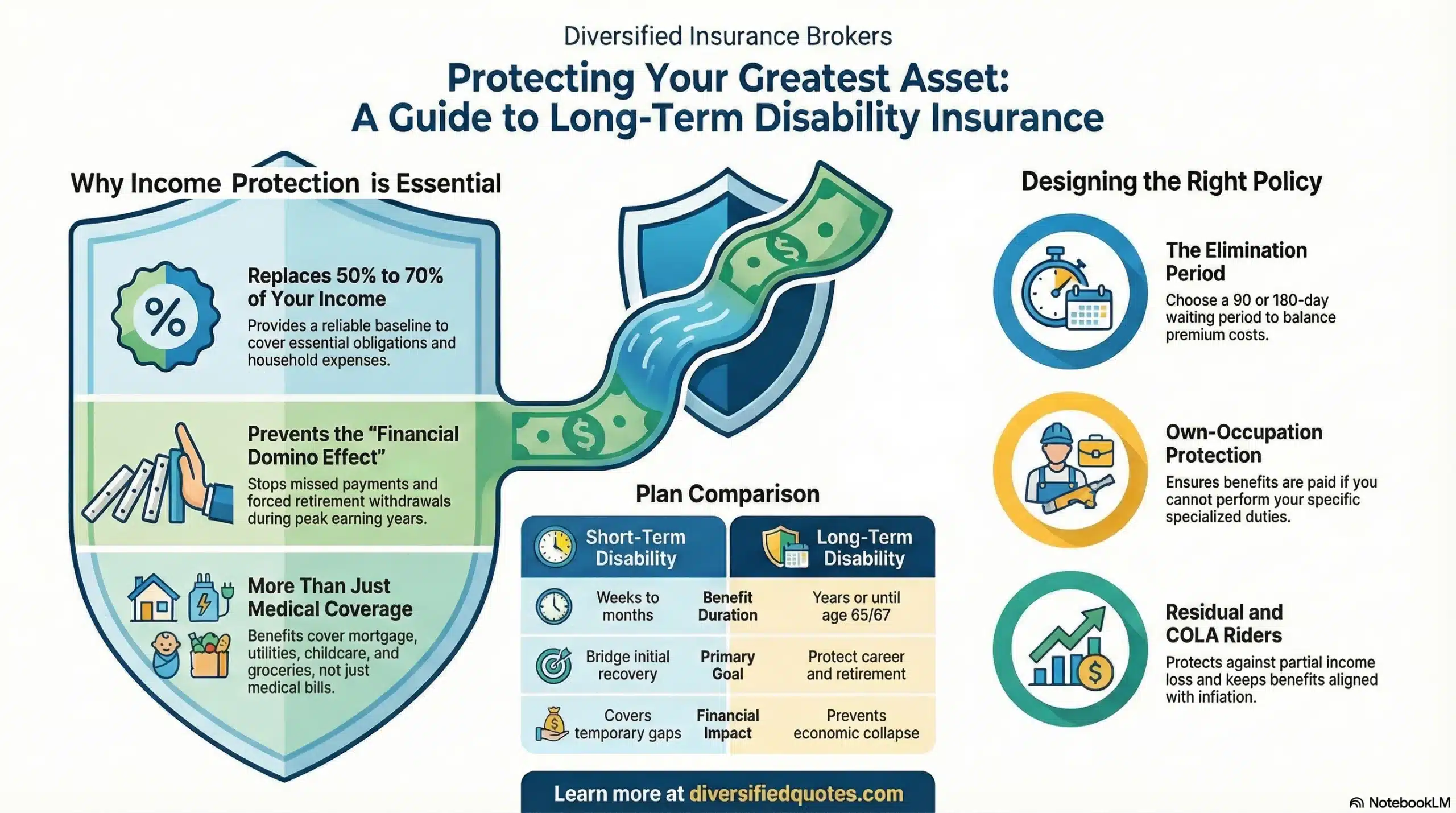
Talk With an Advisor Today
Choose how you’d like to connect—call or message us, then book a time that works for you.
Schedule here:
calendly.com/jason-dibcompanies/diversified-quotes
Licensed in all 50 states • Fiduciary, family-owned since 1980
Disability Insurance for Hematologists — FAQs
The income itself is precisely why individual disability insurance is so critical — and why the stakes of being underinsured are higher for hematologists than for most professionals. A hematologist-oncologist earning $490,000 annually generates roughly $40,000 per month in income that supports a household built around a high-earning physician’s financial reality: mortgage, family expenses, retirement savings that need to accelerate after a decade of deferred saving during training, and medical education debt service that continues regardless of whether the physician is practicing. If disability stops that income for even six months, the financial damage is severe. If it stops it for years, the consequences extend across every financial plan the income was supposed to support. Individual disability insurance — specifically an own-specialty policy sized to approach the physician’s actual income rather than a fraction of it — is the mechanism that ensures a hematologist’s household financial plan survives a disability that the physician’s medical training cannot prevent and cannot predict.
An own-specialty disability definition pays benefits when a medical condition prevents the insured from performing the material and substantial duties of their specific medical specialty — hematology-oncology — regardless of whether they could perform other medical work or other professional work altogether. For a hematologist, this means benefits are paid when conditions prevent safe and effective practice as a hematologist: managing complex blood cancer treatment plans, interpreting bone marrow biopsy results, administering or overseeing chemotherapy protocols, maintaining the cognitive precision that complex hematologic diagnostics require, or the procedural function that hematology-specific procedures involve. A hand tremor that prevents safe bone marrow procedures, a cognitive impairment from a neurological event, or a psychiatric condition that prevents the sustained clinical judgment and patient-facing engagement hematology practice requires would all qualify as own-specialty disabilities — even if the physician could theoretically function as a medical reviewer, a consultant, or in some administrative capacity. Weaker definitions that convert to any-occupation standards after 24 months, or that pay only if the physician cannot perform any medical work, can deny benefits in exactly the clinical scenarios a hematologist is most likely to face. The own-specialty definition is non-negotiable in well-structured physician disability insurance.
Almost certainly not — and the gap between what group coverage provides and what a hematologist’s actual income requires is one of the most significant underinsurance problems in physician financial planning. Group plans typically cap monthly benefits at $10,000 to $15,000 per month — often the maximum regardless of salary — which for a physician generating $40,000 per month in income represents a 37 to 62 percent replacement rate, not the 70 to 80 percent that disability insurance is designed to achieve. Productivity bonuses and performance pay that are common in hematology-oncology compensation are typically excluded from group plan calculations entirely, widening the real replacement rate further. Group coverage also ends when employment ends — a significant vulnerability for physicians whose careers involve transitions between practice settings — and many group plans convert from an own-occupation to a weaker any-occupation definition after 24 months. Individual own-specialty coverage supplements the group plan to bring total income replacement toward functional levels, holds its stronger definition for the full benefit period, and is portable through every career transition.
The disability scenarios most likely to affect a hematologist are primarily medical rather than injury-related, reflecting the knowledge-worker and clinical nature of the profession. Burnout and psychiatric conditions — clinical depression, anxiety disorders, and the burnout-related conditions that published research consistently identifies as prevalent in oncology — can prevent the sustained cognitive performance, clinical judgment, and emotionally demanding patient engagement that hematology-oncology requires for clinically significant periods. Neurological events including stroke can produce cognitive, processing, or fine motor impairments that prevent safe hematology practice even when the physician survives the event. Cardiovascular conditions from a high-stress career environment can require extended recovery and in some cases prevent the demanding clinical schedule hematology-oncology typically involves. Musculoskeletal conditions from the extensive charting time that survey data shows hematologist-oncologists dedicate — often at home — and from procedure-related repetitive strain produce physical disability that may prevent the procedural components of practice. Serious illness — including the cancers that hematologists treat in their patients — can require extended treatment and recovery that removes a physician from active practice for months or longer. The breadth of this disability risk profile across medical, cognitive, and psychiatric causes is why comprehensive own-specialty coverage that covers disability from any qualifying cause is essential.
During training — ideally during fellowship, and ideally through a Guaranteed Standard Issue program if one is available at the training program. The GSI window is uniquely valuable because it allows coverage to be secured without individual medical underwriting, meaning conditions that have developed during the demanding residency and fellowship years do not produce exclusion riders or declined applications. A fellow who has managed anxiety or depression during training, who has a documented back condition, or who has any health history that would affect individual underwriting can often secure comprehensive own-specialty physician disability coverage through GSI without those conditions being excluded. For fellows in excellent health, the fellowship application secures the lowest available premium at the youngest available application age, with the strongest available terms, locked in for a non-cancellable policy regardless of what the next three decades of demanding hematology-oncology practice add to the medical record. The coverage secured during fellowship scales upward through future increase options as income grows, without additional underwriting at each increase point. No subsequent application window offers all of these advantages simultaneously — the GSI program during fellowship is the most comprehensive coverage access most physicians will ever have.
Individual physician disability insurance carriers typically limit benefits to a percentage of documented income — generally targeting 60 to 70 percent of monthly gross income — and most individual policies from a single carrier cap somewhere in the range of $10,000 to $20,000 per month depending on the carrier and the policy form. For a hematologist earning $490,000 annually, a 60 to 70 percent replacement target produces a monthly benefit need of approximately $24,500 to $28,600 — a figure that exceeds the benefit limit of most individual carrier policies. Reaching that level requires either stacking multiple individual policies from different carriers or selecting carriers that offer higher benefit limits specifically for physicians. The coordination of multiple individual policies alongside any existing group coverage — ensuring total benefits approach the target replacement percentage without exceeding what carriers will collectively issue — is one of the most technically specific aspects of physician disability insurance planning, and it is where working with a broker who understands physician disability market dynamics produces meaningfully better outcomes than applying to a single carrier directly.
The future increase option — also called a guaranteed insurability rider — allows the policyholder to increase the monthly disability benefit at specified contract dates or life events without submitting to new medical underwriting. The increase is available based on income documentation alone, regardless of health changes since the original policy was issued. For a hematologist who applies during fellowship earning resident-level compensation and secures a policy with a future increase option, the rider allows increasing the benefit as income grows from fellowship stipend to first-year attending salary to mid-career hematologist-oncologist compensation — without the risk that conditions developed during those years (burnout, back problems, any documented health change) produce exclusion riders on the increased coverage. Without this rider, every coverage increase requires full underwriting at the then-current health status. The physician who applies at 31 with a future increase option and exercises it at 38 gets the increase at 31-year-old health status terms, not 38-year-old terms. For a specialty where income grows dramatically from fellowship through peak practice years, the future increase option is the mechanism that keeps coverage appropriately calibrated to actual income without the underwriting risk of reapplying after years of demanding medical practice.
Yes — and for a private practice or group practice hematologist-oncologist with meaningful fixed monthly operating costs, business overhead expense coverage is one of the most important financial protection tools alongside personal income replacement disability insurance. A hematology-oncology private practice carries substantial fixed costs that continue during a physician’s disability: office and infusion suite lease payments, medical malpractice insurance premiums that must be maintained even during absence to cover tail exposure on prior practice, clinical staff salaries and benefits for nurses, medical assistants, and administrative personnel, electronic health record and practice management system costs, medical equipment payment obligations, and billing and compliance function costs. A personal disability income policy replaces the physician’s household income. A business overhead expense policy covers the fixed costs that keep the practice viable — so the physician returns after recovery to a functioning clinical operation rather than a set of accumulated obligations that have collapsed the practice during the absence. For hematologists with partnership equity stakes, the business overhead and practice continuation planning intersects with partnership agreement provisions in ways that benefit from coordinated planning across both disability coverage types.
Burnout itself is not a clinical diagnosis that automatically triggers disability benefits — but the clinical conditions that burnout produces often do. When burnout progresses to a clinically diagnosable condition — major depressive disorder, generalized anxiety disorder, or another psychiatric diagnosis that meets DSM criteria — and when that condition produces documented functional impairment that prevents the physician from performing the material and substantial duties of their specialty, an own-specialty disability claim is supported by the clinical record. For a hematologist-oncologist whose psychiatrically disabling condition prevents the sustained cognitive performance, patient-facing engagement, and clinical judgment that managing complex blood cancer patients requires, the own-specialty policy pays benefits on the functional impairment — not on the label of the underlying condition. Published research consistently identifies oncology among the highest burnout prevalence specialties in medicine, reflecting the sustained emotional and cognitive demands of the work. This documented occupational reality makes comprehensive own-specialty coverage that includes psychiatric conditions without unusual limitations particularly important for hematologist-oncologists evaluating disability policy options.
Group disability coverage through a hospital employer ends when the employment relationship ends — typically with a grace period of 30 to 60 days. At that point, COBRA-style continuation may be available for a limited period, but the group coverage does not convert to a permanent individual own-specialty policy in most cases. A hematologist who transitions from hospital employment to private practice and relies on group coverage faces a coverage gap at exactly the career transition point when income is typically growing and financial obligations are largest. The individual own-specialty policy secured earlier — during fellowship or early in the hospital-employed career — is the protection that travels through this transition and every subsequent one, providing continuous own-specialty coverage regardless of employment structure, practice setting, or specialty scope changes. For hematologists approaching a practice transition without existing individual coverage, applying before the transition — while still in excellent standing with the current employer’s health plan and before the stress of practice startup has contributed to health history — is the most important timing decision available. The premium and terms available before any transition-related health impacts are consistently better than what is available after.
About the Author:
Jason Stolz, CLTC, CRPC, DIA, CAA and Chief Underwriter at Diversified Insurance Brokers (NPN 20471358), is a senior insurance and retirement professional with more than 25 years of real-world experience helping individuals, families, and business owners protect their income, assets, and long-term financial stability. As a long-time partner of the nationally licensed independent agency Diversified Insurance Brokers, Jason provides trusted guidance across multiple specialties—including fixed and indexed annuities, long-term care planning, personal and business disability insurance, life insurance solutions, Group Health, Travel Medical and Evacuation Insurance, and short-term health coverage. Diversified Insurance Brokers maintains active contracts with over 100 highly rated insurance carriers, ensuring clients have access to a broad and competitive marketplace.
His practical, education-first approach has earned recognition in publications such as VoyageATL, and contributions from his agency featured in Kiplinger and GoBankingRates— highlighting his commitment to financial clarity and client-focused planning. Drawing on deep product knowledge and years of hands-on field experience, Jason helps clients evaluate carriers, compare strategies, and build retirement and protection plans that are both secure and cost-efficient. Visitors who want to explore current annuity rates and compare options across multiple insurers can also use this annuity quote and comparison tool.
Explore More Disability Insurance Options: Browse our complete guide to Disability Insurance for Physicians & Medical Specialists — covering physicians, surgeons, anesthesiologists, radiologists, podiatrists & medical specialists from 100+ carriers.
Last Reviewed: June 8, 2026 |
Reviewed by: Jason Stolz, CLTC, CRPC, DIA, CAA
Chief Underwriter, Diversified Insurance Brokers, Inc. | NPN: 20471358 | Diversified Insurance Brokers, Inc. — Licensed in all 50 states
Fact Checked by: Tonia Pettitt, CMIP©
Medicare Specialist, Diversified Insurance Brokers, Inc. | NPN: 14374308 | Diversified Insurance Brokers, Inc. — Licensed in all 50 states
Did you find this content helpful? Leave us a Google review — it helps others find trustworthy guidance too.
Editorial Standards: Diversified Insurance Brokers maintains rigorous editorial standards to ensure accuracy, clarity, and independence in all content. Learn more about our editorial standards and commitment to transparency.
