
Disability Insurance for Pathologists
As an Independent Disability Insurance Broker, we have access to exclusive discounts and negotiated pricing most captive agents can’t offer — see the full breakdown near the end of this page.
Disability Insurance for Pathologists

Jason Stolz CLTC, CRPC, DIA, CAA
Disability insurance for pathologists is income protection for a physician specialty that sits at the diagnostic foundation of modern medicine — interpreting the tissue specimens, cytology samples, laboratory findings, and molecular markers that determine cancer diagnoses, guide surgical decisions, and establish the definitive conclusions that every other specialty depends on to treat patients well. Pathologists earn average annual compensation of approximately $327,000 to $370,000 across multiple compensation databases, with Marit community physician salary data showing a median of $370,000 and subspecialty variation ranging from $289,000 for blood banking and transfusion medicine to $460,000 for dermatopathology. They complete four years of medical school and four-to-five years of pathology residency — anatomic pathology, clinical pathology, or combined AP/CP training — with many pursuing additional fellowship training in subspecialties including surgical pathology, cytopathology, neuropathology, dermatopathology, forensic pathology, hematopathology, or molecular pathology. The overwhelming majority of pathologists are employed — by hospital systems, academic medical centers, reference laboratories, and independent pathology groups — rather than owning independent practices. When a disability removes a pathologist from diagnostic practice — a neurological or cognitive condition affecting the diagnostic accuracy that tissue interpretation demands, a visual condition affecting microscopy, burnout progressing to clinical psychiatric disorder, or any other medical event requiring extended recovery — income stops and the clinical gap the specialty cannot easily fill becomes apparent.
At Diversified Insurance Brokers, we help pathologists across every subspecialty and employment setting — hospital-employed general pathologists, academic pathologists with combined clinical and research responsibilities, community and reference laboratory pathologists, forensic pathologists, and pathology subspecialty fellows in the final phase of training — structure disability insurance coverage that reflects the cognitive and clinical demands of diagnostic pathology and provides own-specialty income protection calibrated to the training investment and practice income their pathology career represents. Our resource on disability insurance for physicians provides the foundational physician disability planning framework that all pathologist disability planning builds from.
Get Disability Insurance Quotes for Pathologists
We work with the leading physician disability carriers, structure own-specialty definitions for pathology, and size policies for the income and employment structure your training has built.
Request Disability Insurance OptionsWhat Pathologists Do — and Why Cognitive Precision Defines the Disability Risk
The pathologist’s professional work is the diagnostic decision-making process that modern medicine depends on but rarely makes visible to patients. When a surgeon sends a frozen section to determine intraoperative margins, the pathologist’s immediate reading determines whether more tissue is removed. When a clinical team needs to know whether a lymph node biopsy contains lymphoma and what type, the pathologist’s histologic evaluation and immunohistochemical interpretation is the answer. When a patient’s abnormal Pap smear requires follow-up, the cytopathologist’s evaluation of the cervical sample establishes the clinical next step. The pathologist works largely unseen by patients but is present in every significant diagnostic decision that clinical medicine makes — and the diagnostic accuracy that pathology requires means that cognitive precision is not merely professionally important but directly affects patient outcomes in ways that make impairment especially consequential.
The cognitive demands of pathology are specialized and high. Anatomic pathology requires the pattern recognition built over years of training to distinguish between hundreds of histologic entities, recognize subtle cellular changes indicating malignancy at the earliest stages, apply immunohistochemistry and molecular diagnostics appropriately, and generate diagnostic reports that are simultaneously accurate, complete, and clinically useful. Clinical pathology requires the laboratory medicine expertise to oversee the analytical validity of test results across chemistry, hematology, microbiology, blood bank, and transfusion medicine. Subspecialty pathology — neuropathology, dermatopathology, forensic pathology, hematopathology — requires the additional specialized pattern recognition that fellowship training develops. Any condition impairing the sustained cognitive precision, visual acuity for microscopic examination, or the analytical judgment that diagnostic pathology requires is professionally disabling in ways that matter not just financially but clinically. Our resource on own-occupation disability insurance explained covers how the own-specialty definition protects physician specialists whose cognitive and diagnostic precision is the core of their professional value.
The Cognitive and Sensory Disability Risks Most Specific to Pathology
Pathology’s disability risk profile is dominated by cognitive and sensory impairment risks rather than the physical risks that characterize surgical and procedural specialties. Neurological events — stroke, traumatic brain injury, or progressive neurological conditions including multiple sclerosis or early-onset cognitive decline — represent the most acutely disabling scenarios for a pathologist whose professional value rests on sustained diagnostic accuracy, pattern recognition, and the cognitive performance that complex tissue interpretation requires. A neurological event impairing processing speed, working memory, or the visual-cognitive integration that histologic pattern recognition demands can be professionally disabling at levels of impairment that would not prevent most ordinary daily activities — because the standard of diagnostic accuracy in pathology is absolute. A pathologist who is 90 percent accurate on tumor classification is professionally impaired in a specialty where diagnostic conclusions directly affect surgical and treatment decisions. Any impairment of the sustained cognitive precision required for safe diagnostic sign-out constitutes a genuine own-specialty disability.
Visual changes represent a second pathology-specific disability risk. The sustained microscope work of anatomic and cytopathology depends on the pathologist’s ability to focus, discriminate fine cellular detail, and maintain the visual attention that hours of slide interpretation demand. The evolution of digital pathology — where whole-slide imaging is replacing or supplementing glass slide microscopy — is shifting demands toward sustained computer screen use, creating the neck, back, and upper extremity conditions associated with prolonged computer-based clinical work alongside the ergonomic risks of traditional microscope posture. Psychiatric conditions — major depressive disorder or anxiety disorders emerging from the sustained diagnostic pressure, medicolegal exposure from diagnostic responsibility, and burnout documented in high-volume pathology environments — represent a third disability risk pathway that individual own-specialty coverage must address for pathology’s professional scenario. Most disability policies apply a 24-month duration limit to psychiatric claims — reviewing this specific provision carefully is important for pathologists evaluating coverage. Our resource on disability insurance riders explained covers the policy provisions that shape how cognitive and psychiatric disability claims are handled under physician disability policies.
AI and Diagnostic Technology — Why Protecting Current Income Matters Now
Pathology is among the physician specialties most directly engaged with the transformative potential — and the professional uncertainty — of artificial intelligence in diagnostic medicine. AI-assisted image analysis, machine learning algorithms for histologic classification, and computational pathology tools are moving from research settings into clinical practice with increasing speed. The professional implications for working pathologists are genuinely uncertain and actively debated within the specialty: some analyses suggest AI will augment pathologist efficiency and enable fewer pathologists to handle larger diagnostic volumes; others suggest deeper disruption to certain aspects of diagnostic pathology over a longer time horizon.
This uncertainty does not change the immediate financial planning imperative for practicing pathologists — it heightens it. A pathologist whose disability occurs in the next 5 to 15 years is affected by the current value of their diagnostic expertise. Disability insurance protects that current income value regardless of how the specialty’s competitive landscape evolves. Protecting the income that a decade or more of medical school and residency training has made possible — now, at its current level, through comprehensive own-specialty coverage — is the appropriate financial planning response to professional uncertainty rather than a reason to defer coverage decisions. Our resource on is disability insurance worth it provides the financial framework for understanding how the income-stops-obligations-continue dynamic during disability makes comprehensive individual coverage a planning priority regardless of specialty-level uncertainty about future roles.
Group Coverage for Employed Pathologists — The Structural Gaps
The majority of pathologists are employed rather than self-employed, and most have access to employer group disability benefits through their hospital, health system, academic institution, or pathology group. These group plans provide a meaningful baseline but leave structural gaps that matter at pathologist income levels. The income gap at the $327,000 to $370,000 compensation range: a group plan with a $15,000 monthly cap leaves a pathologist earning $350,000 annually — approximately $29,167 per month — with approximately $14,167 per month in unprotected income while student loan payments, mortgage, and household expenses continue at full pre-disability levels. Over a full disability year, this gap approaches $170,000. The definition gap: many group plans convert from own-specialty to any-occupation or modified definitions after 24 months, threatening benefits for a pathologist with a long-term cognitive condition who retains general work capacity but cannot safely perform diagnostic pathology. The portability gap: group coverage ends when employment ends — a pathologist transitioning between hospital systems, moving from academic to community practice, or joining a private pathology group loses group coverage at each transition.
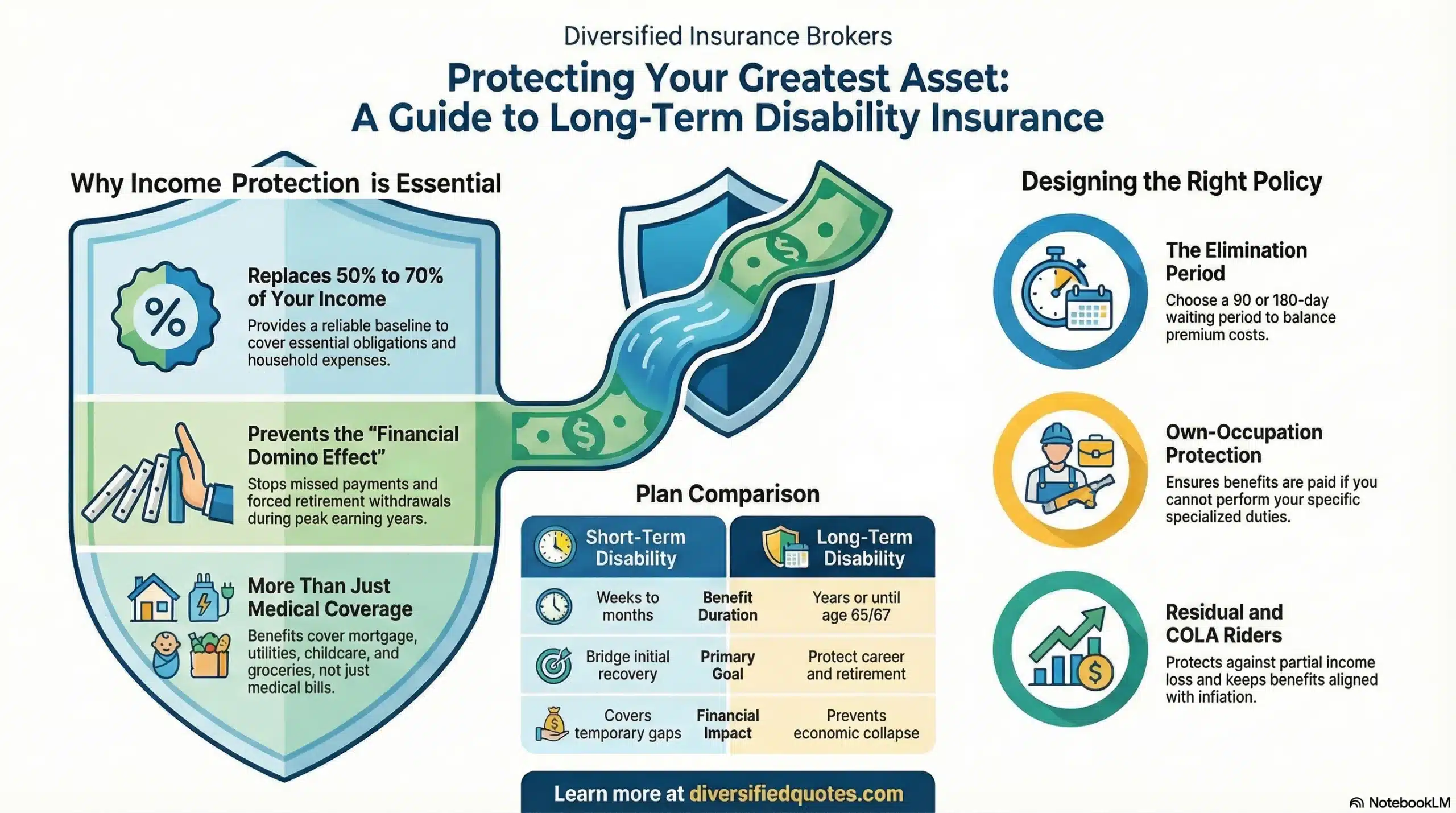
Individual own-specialty disability insurance supplements these gaps and provides portable, non-cancellable protection that travels through every career transition. Our resource on how much disability insurance you need provides the framework for calculating the right supplement amount given existing group coverage and actual monthly household obligations. Our resource on short-term vs. long-term disability insurance covers how different coverage durations address different disability scenarios for employed physicians at every career stage.
Case Study — Pathologist, Neurological Event Affecting Diagnostic Accuracy
Consider a hospital-employed anatomic pathologist seven years into independent practice, earning $355,000 annually with a group disability plan replacing 60 percent of base salary capped at $15,000 per month after a 90-day elimination period. Following a posterior cortical stroke affecting visual processing and cognitive integration, this pathologist’s neuropsychological evaluation documents processing speed and visual-cognitive performance below the threshold required for safe diagnostic sign-out. The pathologist retains general daily function, can communicate normally, and could theoretically perform many ordinary activities — but cannot safely perform the sustained histologic pattern recognition and diagnostic decision-making that pathology practice requires.
| Scenario | Group Coverage Only | Group + Individual Own-Specialty Supplement |
|---|---|---|
| Monthly Income During Disability | $15,000 (group cap) vs. $29,583 actual monthly income — 51% replacement rate | $15,000 group + individual supplement approaching 75–80%; loan payments and household obligations covered |
| Annual Income Gap | ~$176,000 annual gap; medical school loan payments continue in full alongside household expenses | Individual supplement closes the gap; financial stability maintained through extended recovery |
| Definition at Month 25 | Group plan converts to any-occupation — pathologist who retains general cognitive capacity risks losing benefits despite inability to safely perform diagnostic sign-out | Individual own-specialty policy maintains stronger definition through full benefit period |
| Portability | Group coverage ends at next employer transition; new application faces neurological history underwriting | Individual policy secured before stroke is portable through every subsequent career transition |
A posterior cortical stroke affecting histologic pattern recognition is precisely the disability scenario the own-specialty definition is designed to capture and that any-occupation definitions would miss — the pathologist with preserved general function but impaired specialized diagnostic cognitive capacity has experienced a genuine professional disability that individual own-specialty coverage recognizes as disabling. Our resource on how residual disability benefits work covers how proportional benefits function for pathologists who can perform some reduced diagnostic work during recovery while still unable to manage full sign-out responsibility.
Key Policy Features for Pathologists
The own-specialty definition, non-cancellable and guaranteed renewable provisions, and the future increase option are the most critical policy features for pathologists. The future increase option is particularly important for pathology residents and fellows whose income will grow substantially from training stipend levels to attending compensation — allowing benefit amounts to track that income growth without new medical underwriting. Non-cancellable provisions lock in policy terms for the full benefit period regardless of what the demanding years of diagnostic pathology practice add to the medical record. A residual disability rider provides proportional income protection when a pathologist can perform some reduced diagnostic activity while unable to manage a full sign-out load — relevant for recovery scenarios where limited diagnostic work is medically appropriate before full return. For pathologists seeking protection against inflation across a long-term disability, our resource on disability income insurance with a COLA rider explains how inflation protection maintains benefit purchasing power across extended claim periods.
The Residency Window — When to Apply
The optimal application window for pathologists is during residency — when ACGME-accredited pathology residency programs participate in GSI programs offering physician own-specialty disability coverage without individual medical underwriting. A pathology resident who applies during residency secures non-cancellable own-specialty coverage at the youngest available application age, with the future increase option available to grow benefits as attending compensation develops following training. The cognitive and visual conditions most specifically threatening to pathology practice — neurological events, visual acuity changes — are unpredictable at any career stage, but the coverage secured before any such conditions appear in the medical record provides comprehensive protection through the full professional career. Our resource on disability insurance for doctors in residency covers the GSI program mechanics and the specific steps for pathology residents to take before completing training. For pathologists who have completed training without securing individual coverage, our resource on why disability insurance matters even when young and healthy provides the financial case for applying before any conditions appear in the medical record.
Why Independent Broker Access Matters for Pathologist Coverage
The physician disability insurance market serves pathologists through a small number of specialty carriers offering own-specialty definitions, non-cancellable provisions, and benefit amounts calibrated for physician income levels. For pathologists at the $327,000 to $370,000 compensation range, individual carrier benefit limits may be achievable in a single policy or may require supplemental coordination depending on the carrier and the specific income level. Identifying the carrier whose own-specialty language most clearly captures the cognitive and diagnostic demands of pathology practice — and whose underwriting approach is most favorable for a specific pathologist’s health history and subspecialty — requires independent access to the full physician disability carrier marketplace. At Diversified Insurance Brokers, we work with the leading physician disability carriers and understand how to structure own-specialty pathology coverage at every career stage and employment setting. Our resource on why independent disability insurance brokers matter explains the full value of this approach for physician specialists whose coverage needs require expertise to address properly.
Related Disability Insurance Pages
Talk With an Advisor Today
Choose how you’d like to connect—call or message us, then book a time that works for you.
Schedule here:
calendly.com/jason-dibcompanies/diversified-quotes
Licensed in all 50 states • Fiduciary, family-owned since 1980
Disability Insurance for Pathologists — FAQs
Pathology’s disability risk profile is dominated by cognitive and sensory risks rather than the physical risks that characterize surgical specialties. The most acutely disabling scenario is a neurological event — stroke, traumatic brain injury, or progressive neurological condition — that impairs the visual-cognitive integration and pattern recognition that histologic diagnosis requires. Pathology demands a standard of diagnostic accuracy that is absolute: a pathologist who is 90 percent accurate on tumor classification is professionally impaired in a specialty where diagnostic conclusions directly affect surgical and treatment decisions. Any neurological impairment reducing the processing speed, visual acuity, or cognitive precision required for safe diagnostic sign-out constitutes a genuine professional disability even when general daily function appears preserved. Visual conditions affecting the sustained near-vision demands of microscopy and digital whole-slide imaging represent a second pathology-specific risk. Psychiatric conditions — major depressive disorder or anxiety disorders from the sustained diagnostic pressure, medicolegal exposure from diagnostic responsibility, and burnout in high-volume pathology environments — represent a third disability risk pathway. And ergonomic conditions from sustained microscope and computer work — neck and upper back conditions from prolonged forward head posture — accumulate across the pathologist’s career in ways that may eventually limit the sustained work postures the job requires. Individual own-specialty disability insurance covers qualifying disability from any of these causes regardless of origin.
An own-specialty definition pays benefits when a condition prevents the pathologist from performing the material and substantial duties of diagnostic pathology — histologic pattern recognition, cytopathology interpretation, immunohistochemical and molecular diagnostic oversight, laboratory medicine supervision, and the sustained cognitive precision that accurate diagnostic sign-out requires — regardless of whether the pathologist could theoretically perform other types of work. A neurological condition impairing the visual-cognitive processing that histologic diagnosis demands constitutes a genuine own-specialty disability even when the pathologist can perform most daily activities, because the standard of cognitive precision in pathology is higher than what general daily life requires. Without this definition, a group plan converting to any-occupation after 24 months could deny benefits to a pathologist who retains general cognitive capacity but cannot safely perform diagnostic work — eliminating benefits at exactly the point when long-term cognitive impairment is most clearly established as career-altering rather than temporary. This is the scenario that matters most for pathologists: a condition that leaves the physician functional in daily life but unable to meet the specific cognitive and analytical standard that diagnostic pathology demands.
Group disability plans leave three consistent gaps for pathologists that individual own-specialty supplemental coverage addresses. The income gap is the most financially significant: most group plans replace 60 percent of base salary with monthly benefit caps of $10,000 to $15,000 per month. For a pathologist earning $355,000 annually — approximately $29,583 per month — a group plan capping at $15,000 per month leaves approximately $176,000 per year in unprotected income while medical school loan payments, mortgage, and household expenses continue at full pre-disability levels. The definition gap matters equally: many group plans convert from own-specialty or own-occupation to any-occupation definitions after 24 months, potentially denying benefits to a pathologist with a long-term cognitive condition who retains some general work capacity but cannot safely perform diagnostic pathology. The portability gap affects every pathologist who changes employers: group coverage ends when employment ends, and new individual coverage applied for later faces health history accumulated during prior diagnostic years. Individual own-specialty coverage purchased early in the career addresses all three gaps simultaneously and travels through every subsequent employment transition.
The rise of digital pathology and AI-assisted diagnostic tools creates professional uncertainty for pathologists that is real and actively discussed within the specialty — but it does not change the immediate financial planning imperative. A pathologist whose disability occurs in the next 5 to 15 years is affected by the current value of their diagnostic expertise, which is substantial: $327,000 to $370,000 in average annual compensation representing years of medical school and residency investment. Disability insurance protects that current income value regardless of how the specialty’s competitive landscape evolves. Additionally, the shift from traditional glass slide microscopy to digital whole-slide imaging platforms is changing the physical ergonomic demands of pathology practice — from sustained binocular microscope posture toward sustained computer screen use that creates its own pattern of neck, back, and upper extremity demands. This ergonomic transition does not eliminate musculoskeletal disability risk for pathologists; it shifts which specific postures and structures accumulate occupational stress across a career. The appropriate response to professional and technological uncertainty in pathology is to protect current income comprehensively now — not to defer planning until the specialty’s future role becomes clearer, because the disability that occurs before that clarity arrives has the same financial consequences regardless of the industry’s trajectory.
The standard underwriting target is 60 to 70 percent of gross monthly earned income, with individual and group plan benefits combined toward that target. For a pathologist earning $355,000 annually — approximately $29,583 per month — the total monthly replacement target is approximately $17,750 to $20,708. If an existing group plan provides $15,000 per month, the individual supplement targeting the gap would need to provide approximately $2,750 to $5,708 per month to reach the replacement target. For pathologists earning at the higher subspecialty compensation levels — dermatopathologists averaging $460,000, for example — the total replacement target is correspondingly higher and may require a larger individual supplement or multi-policy coordination. The benefit calculation should explicitly account for medical school educational debt — commonly $200,000 to $300,000 or more — whose monthly loan service obligations continue during disability and must be covered by benefits alongside housing costs and household expenses. Ensuring that total combined monthly benefits cover every actual monthly obligation rather than approximating from a percentage calculation is the practical planning goal that produces genuinely adequate protection at pathologist income levels.
Yes — and they are worth evaluating explicitly when selecting disability coverage. Pathology practice carries documented sources of sustained occupational stress: the medicolegal exposure from diagnostic responsibility, where a missed or erroneous diagnosis can result in significant professional and legal consequences; the high diagnostic volume that many hospital and reference laboratory environments demand; the often limited patient contact that some pathologists experience as professionally isolating; and the general physician burnout exposure that affects every specialty. When burnout progresses to clinically diagnosable psychiatric conditions — major depressive disorder, anxiety disorders, or others meeting DSM criteria — the resulting functional impairment can prevent the sustained concentration and diagnostic precision that pathology sign-out requires, constituting a genuine own-specialty disability. Most individual disability policies apply a 24-month duration limit to benefits arising from mental and nervous conditions, regardless of how long the disabling condition persists or how severe it is. Reviewing this specific provision carefully — understanding how the policy defines mental and nervous conditions, whether conditions with documented organic etiology are excluded from the limitation, and what the maximum benefit duration is for psychiatric claims — is an important step in selecting physician disability coverage for any specialty where burnout and psychiatric disability risk is meaningfully present.
Forensic pathologists — who practice in medical examiner and coroner offices, government agencies, and academic forensic medicine programs — carry a disability risk profile that includes some dimensions not present in hospital or laboratory-based clinical pathology. Forensic pathology involves direct examination of deceased individuals, often in circumstances involving trauma, decomposition, or infectious hazard that create biological and chemical exposure risks beyond what anatomic pathology in a hospital setting typically involves. The emotional demands of forensic practice — repeated exposure to homicide, suicide, accident, and pediatric death scenes and cases — create psychiatric and burnout risks that are documented in forensic medicine professional literature. Forensic pathologists employed by medical examiner offices typically receive government employment benefits that may include group disability coverage with different structures than hospital or health system group plans. Individual own-specialty disability insurance supplements these benefits with portable, non-cancellable coverage whose own-specialty definition captures forensic pathology’s specific clinical duties. The occupational classification for forensic pathologists is the same physician-equivalent tier as other pathology subspecialties — reflecting the primarily cognitive, examination-based, and professional nature of the work regardless of the specific setting. Working with an independent broker who understands how to accurately present forensic pathology duties to underwriters produces the most comprehensive available coverage terms for this subspecialty.
During pathology residency — ideally in the first year or two, before any health conditions that can develop during the demanding years of diagnostic training have been documented in the medical record. Most ACGME-accredited pathology residency programs participate in Guaranteed Standard Issue programs through which major physician disability carriers offer comprehensive own-specialty coverage to all eligible residents without individual medical underwriting. The GSI window is particularly important for pathologists because the cognitive and visual conditions most specifically threatening to pathology practice — neurological events, visual acuity changes — are unpredictable but consequential if they appear in the medical record before coverage is secured. The non-cancellable policy issued during residency travels through every subsequent career transition: from residency to fellowship, from academic to community pathology, from one hospital system to another. The future increase option available during residency allows benefit amounts to grow from stipend income to the $300,000 to $370,000 and above attending compensation range without additional medical underwriting. For pathologists who have completed training without securing comprehensive individual coverage, applying now — before additional health conditions appear in the medical record — is the most important available planning action. The medical school investment in a pathology career represents 8 to 12 years of training; protecting the income that investment generates for the subsequent 25 to 30 years of practice is a planning priority from the first day of residency.
About the Author:
Jason Stolz, CLTC, CRPC, DIA, CAA and Chief Underwriter at Diversified Insurance Brokers (NPN 20471358), is a senior insurance and retirement professional with more than 25 years of real-world experience helping individuals, families, and business owners protect their income, assets, and long-term financial stability. As a long-time partner of the nationally licensed independent agency Diversified Insurance Brokers, Jason provides trusted guidance across multiple specialties—including fixed and indexed annuities, long-term care planning, personal and business disability insurance, life insurance solutions, Group Health, Travel Medical and Evacuation Insurance, and short-term health coverage. Diversified Insurance Brokers maintains active contracts with over 100 highly rated insurance carriers, ensuring clients have access to a broad and competitive marketplace.
His practical, education-first approach has earned recognition in publications such as VoyageATL, and contributions from his agency featured in Kiplinger and GoBankingRates— highlighting his commitment to financial clarity and client-focused planning. Drawing on deep product knowledge and years of hands-on field experience, Jason helps clients evaluate carriers, compare strategies, and build retirement and protection plans that are both secure and cost-efficient. Visitors who want to explore current annuity rates and compare options across multiple insurers can also use this annuity quote and comparison tool.
Explore More Disability Insurance Options: Browse our complete guide to Disability Insurance for Physicians & Medical Specialists — covering physicians, surgeons, anesthesiologists, radiologists, podiatrists & medical specialists from 100+ carriers.
Last Reviewed: June 8, 2026 |
Reviewed by: Jason Stolz, CLTC, CRPC, DIA, CAA
Chief Underwriter, Diversified Insurance Brokers, Inc. | NPN: 20471358 | Diversified Insurance Brokers, Inc. — Licensed in all 50 states
Fact Checked by: Tonia Pettitt, CMIP©
Medicare Specialist, Diversified Insurance Brokers, Inc. | NPN: 14374308 | Diversified Insurance Brokers, Inc. — Licensed in all 50 states
Did you find this content helpful? Leave us a Google review — it helps others find trustworthy guidance too.
Editorial Standards: Diversified Insurance Brokers maintains rigorous editorial standards to ensure accuracy, clarity, and independence in all content. Learn more about our editorial standards and commitment to transparency.
