
Disability Insurance for Speech Pathologists
As an Independent Disability Insurance Broker, we have access to exclusive discounts and negotiated pricing most captive agents can’t offer — see the full breakdown near the end of this page.
Disability Insurance for Speech Pathologists

Jason Stolz CLTC, CRPC, DIA, CAA
Disability insurance for speech pathologists is an essential financial protection for a master’s-level clinical profession experiencing some of the fastest job growth in healthcare — 15% projected from 2024 to 2034 according to the Bureau of Labor Statistics — while simultaneously confronting documented and growing challenges with burnout, compassion fatigue, and the occupational health consequences of high-caseload clinical practice across demanding settings ranging from acute hospital care to school-based services to skilled nursing facilities. Speech-language pathologists — also commonly called speech therapists — hold a master’s degree and complete a supervised clinical fellowship before obtaining licensure, invest 6 to 7 years in their professional education, and carry the student debt obligations that graduate-level clinical education generates. The BLS reports a median annual wage of $95,410 for speech-language pathologists in May 2024, with SNF and hospital-based SLPs earning $100,000 to $106,500 — income that reflects the graduate-level training, clinical complexity, and patient impact that distinguishes this profession, and that deserves equally serious income protection against the disability risks that SLP careers present. At Diversified Insurance Brokers, we help speech-language pathologists across all practice settings design disability coverage that reflects their specific occupational risk profile, practice structure, and financial planning needs. For foundational context before examining speech pathology-specific considerations, our disability insurance services overview provides the essential framework, and our resource on why people buy disability insurance explains the core protection logic that applies to clinicians at every income level.
Protect Your Income as a Speech Pathologist
Compare disability insurance options designed for SLPs across school-based, medical, and private practice settings.
Request Disability Insurance Options
Questions? Call 800-533-5969
What Speech-Language Pathologists Do and the Disability Risks Their Work Creates
Speech-language pathologists assess, diagnose, and treat the full spectrum of communication and swallowing disorders across all ages and settings — from children with developmental language delays, articulation disorders, autism spectrum communication profiles, and childhood stuttering through adults recovering from stroke-related aphasia, traumatic brain injury communication disorders, voice conditions, and dysphagia (swallowing dysfunction) in the medical setting. The range of conditions SLPs treat and the range of settings they practice in create a disability risk profile that is more multidimensional than many realize.
In medical settings — hospitals, acute care, inpatient rehabilitation, SNFs, and home health — SLPs manage some of the most clinically complex communication and swallowing cases in healthcare. Hospital-based SLPs evaluate and treat post-stroke aphasia patients who may have lost the ability to communicate entirely, traumatic brain injury patients navigating complex cognitive-communication deficits, head and neck cancer patients who have lost or significantly compromised swallowing function following surgery or radiation, and neurologically impaired patients whose swallowing dysfunction creates life-threatening aspiration risk. The emotional weight of working with patients who have lost the most fundamental human capacity — the ability to communicate — and with families navigating the grief and adjustment of a loved one’s catastrophic communication loss, accumulates across a career of medical SLP practice in ways that generate compassion fatigue and secondary traumatic stress at documented rates.
In school-based settings — where ASHA reports approximately 49.6% of SLPs practice — speech pathologists manage large, diverse caseloads serving children with the full range of communication needs, navigate the administrative demands of individualized education programs (IEPs) and evaluation documentation, coordinate with teachers, psychologists, and families, and carry the specific emotional burden of working with children whose developmental progress is visible and meaningful but whose improvement timelines are often slow and uncertain. School-based SLPs consistently report among the highest burnout indicators in the profession — driven by caseload pressure, documentation demands, the challenge of providing adequate services within constrained school schedules, and the isolation of being the only SLP specialist at many individual schools.
Burnout: The Primary Disability Risk for Speech Pathologists
Burnout is the most prevalent and professionally most significant disability risk for speech-language pathologists across all practice settings — and it is increasingly well-documented in the SLP-specific literature as a genuine occupational health challenge that produces real career disruption and income loss rather than merely a workplace dissatisfaction issue. ASHA’s own research on school-based SLP workforce conditions from the 2024 Schools Survey identifies large, dynamic caseloads, demanding workloads, and work environment conditions that generate overwhelming occupational stress as defining characteristics of school-based SLP practice. Research published in peer-reviewed journals has documented high occupational stress and burnout rates among school-based SLPs, finding that workload manageability and access to social support are the primary predictors of burnout severity.
In medical settings, compassion fatigue — the progressive emotional and physical exhaustion from sustained immersion in patients’ suffering, catastrophic loss of function, and end-of-life communication — represents a distinct and documented occupational health pathway. A medical SLP who has spent years facilitating communication between dying patients and their families through augmentative systems, managing the grief of stroke patients who will never speak normally again, and helping patients with progressive neurological conditions like ALS communicate as their disease advances carries an emotional burden that, without adequate processing and recovery, produces the secondary traumatic stress and compassion fatigue that eventually impairs clinical function. When these conditions reach clinical severity — major depression, anxiety disorder, PTSD-spectrum conditions that impair the cognitive function, emotional presence, and clinical judgment that SLP practice requires — they constitute genuine disability that disability insurance with appropriate mental health coverage must address.
The mental health benefit period limitation — present in most group LTD policies and some individual policies — is therefore particularly important to evaluate for SLPs, because burnout and compassion fatigue represent their most realistic disability pathway and policies that cap mental health benefits at 24 months may fail exactly when long-duration mental health recovery is most needed. Our resource on disability insurance riders explained covers how mental health provisions are structured across different policy types, and our resource on why working with an independent disability insurance broker matters explains how carrier-specific knowledge of mental health provisions drives better coverage outcomes for allied health professionals in high-burnout settings.
Voice Disorders: A Distinctive and Career-Specific Disability Risk
Speech-language pathologists face an occupational health hazard that is unique among healthcare professionals: occupational voice disorders from the sustained high-volume voice use that clinical practice requires. SLPs who treat patients with voice disorders — a common practice area — teach vocal techniques, model correct voice use, and engage in vocal cueing and demonstration across therapy sessions. School-based SLPs who work in noisy classroom environments, with large groups, and across an entire school day of voice-intensive interaction carry particularly high occupational voice loading. Medical SLPs who speak clearly and audibly for patients with hearing loss or cognitive impairment must sustain elevated vocal output throughout their clinical days.
Occupational voice disorders — including vocal nodules, vocal polyps, vocal fold hemorrhage, and muscle tension dysphonia from chronic vocal overuse — are documented occupational health conditions in professionals who use voice intensively in their work. For an SLP whose entire clinical function is delivered through voice communication with patients, a voice disorder that significantly impairs vocal capacity directly impairs professional performance. An SLP who develops vocal fold nodules severe enough to require voice rest, surgical intervention, and extended speech therapy recovery cannot deliver face-to-face clinical services during that period — income stops, and disability insurance must provide the replacement income that sustains the household through treatment and recovery.
Ironically, the SLP who treats voice disorders is also highly knowledgeable about the conditions that may eventually disable them — knowledge that creates awareness of the risk but does not prevent cumulative occupational vocal loading from producing pathology over time. This parallel with physical therapists who develop musculoskeletal conditions from the physical demands of treating musculoskeletal patients is a distinctive feature of this profession’s disability risk landscape. Our resource on own-occupation disability insurance explains how the definition must protect the specific clinical communication functions of SLP practice — including the voice-dependent delivery of therapy services — rather than just the generic ability to work in healthcare.
Musculoskeletal Demands and Physical Injury Risk
While often perceived as a purely cognitive and communication-based profession, speech-language pathology involves meaningful physical demands in medical settings that generate musculoskeletal injury risk. Medical SLPs performing instrumental swallowing evaluations — modified barium swallow studies and flexible endoscopic evaluations of swallowing — work in clinical environments that require sustained procedural postures, equipment manipulation, and in some cases direct physical support of patients during the evaluation. SLPs in rehabilitation settings assist patients with position changes, support patient participation in therapy activities, and work in the same patient handling environments that physical and occupational therapists navigate.
Home health SLPs face the ergonomic challenges of providing therapy in patient homes — environments not designed for clinical work — requiring therapy delivery from whatever seating is available, without proper height-adjustable equipment, and often in cramped or physically awkward spaces. The musculoskeletal consequences of sustained adapted postures in home health settings, while less acute than the physical demands of physical therapy, nonetheless contribute to the occupational injury burden that makes disability insurance necessary for SLPs across all practice settings.
Income Structure and Financial Exposure Across SLP Settings
Speech-language pathologist income varies significantly by practice setting in ways that make specific income documentation important for disability insurance planning. The BLS median of $95,410 in May 2024 represents the full-spectrum average — school-based SLPs typically earn $76,000 to $86,000 on academic-year contracts (sometimes higher with 12-month conversion), hospital-based SLPs earn around $100,990, SNF-based SLPs earn the highest medians at approximately $106,500, and private practice SLPs in full-fee or insurance-billing models can earn $130,000 or more depending on caseload and market.
Approximately 90 to 91% of SLPs enter practice with student loan debt from their master’s program — typically $60,000 to $120,000 or more depending on program type and prior undergraduate debt. This educational debt creates the same compound financial pressure that makes disability insurance especially urgent: income loss during disability does not pause loan service obligations, creating simultaneous income cessation and debt service demand that depletes savings rapidly and creates long-term financial damage extending well beyond the disability period itself. Our resource on whether disability insurance is worth it provides the value framework, and our resource on how much disability insurance you need helps translate income and debt obligations into appropriate benefit amounts.
Private Practice SLPs: Two-Layer Disability Exposure
Speech-language pathologists who own private practices face the same two-layer financial exposure from disability that all healthcare practice owners face — personal income replacement plus practice overhead protection. A private practice SLP who cannot see clients has immediate income cessation while office lease, malpractice insurance, billing service fees, and other fixed overhead costs continue. Business overhead expense (BOE) disability insurance addresses this practice cost layer separately from personal income replacement, giving the practice owner time to restructure operations or hire coverage rather than facing compound financial collapse. Our resource on disability business overhead expense coverage explains how this separate policy works, and our resource on getting disability insurance when self-employed covers the income documentation and coverage design considerations for independent SLP practice.
Designing a Disability Policy for Speech Pathologists
Effective disability insurance for SLPs integrates the profession’s burnout risk, voice disorder exposure, and practice-setting income variation into coverage designed around what would actually protect the SLP’s financial life during a realistic disability event.
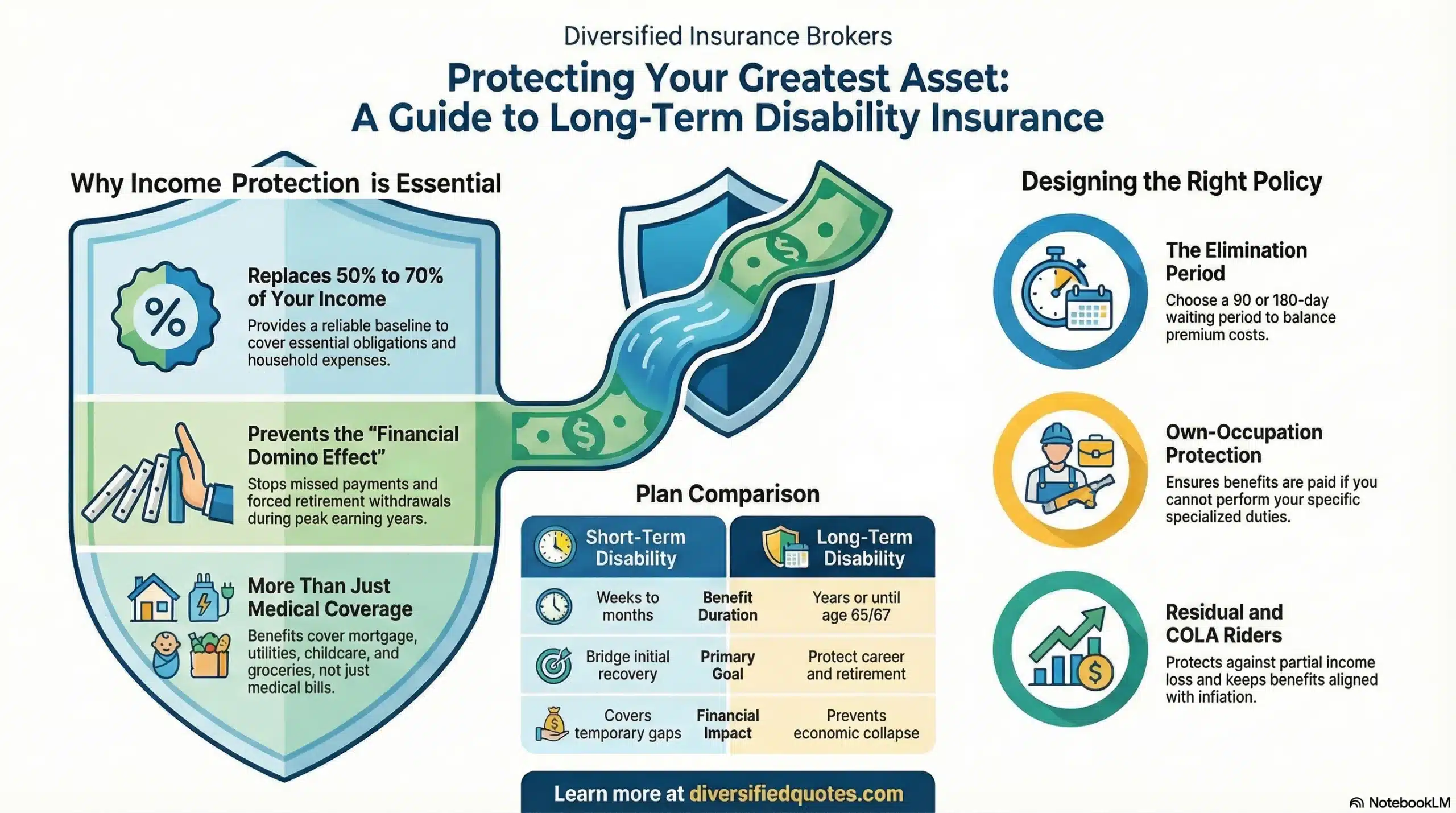
The own-occupation definition must apply for the full benefit period and protect the specific clinical functions of SLP practice — including voice-dependent therapy delivery. Mental health coverage must carry no 24-month benefit period limitation. The benefit amount should reflect actual documented total income including school district contracts, healthcare productivity bonuses, and private practice revenue. The elimination period should reflect actual financial reserves — our resource on disability insurance elimination periods explained provides the calibration framework. The residual disability rider addresses partial disability scenarios — an SLP on voice rest who can conduct teletherapy but not in-person sessions has experienced a real income reduction that residual coverage supports proportionately. Our resource on residual disability insurance benefits explained covers how this works. The future increase option allows coverage to expand as SLP income grows through experience and specialty development without new underwriting. Our resource on disability insurance future insurability riders covers how this protection works. For SLPs with existing coverage, our disability insurance second opinion service provides an unbiased independent review.
When to Apply
The optimal time for an SLP to apply for disability insurance is during their clinical fellowship year or immediately upon licensure — before clinical practice has produced documented voice conditions, burnout treatment history, or musculoskeletal conditions that complicate underwriting. An SLP who applies during their clinical fellowship at age 25 and one who applies at age 40 after 15 years of practice may face meaningfully different premium levels and the older applicant may have documented occupational health history that generates exclusion riders. Our resource on disability insurance for new professionals addresses the specific considerations for SLPs at career entry, and our resource on how to get the best disability insurance rates explains all the factors that determine coverage quality and cost across the market.
Get Disability Insurance Quotes for Speech Pathologists
We compare options across carriers for SLPs in all settings to find the right combination of mental health coverage, own-occupation definition, and value.
Request Disability Insurance Options
Questions? Call 800-533-5969
Financial Protection Essentials
Income protection resources and disability insurance planning tools for speech-language pathologists and allied health professionals.
Talk With an Advisor Today
Choose how you’d like to connect—call or message us, then book a time that works for you.
Schedule here:
calendly.com/jason-dibcompanies/diversified-quotes
Licensed in all 50 states • Fiduciary, family-owned since 1980
Frequently Asked Questions: Disability Insurance for Speech Pathologists
Speech-language pathologists face several overlapping disability risk categories that reflect the diverse demands of their practice settings. Burnout and compassion fatigue are the most prevalent risks — ASHA’s 2024 Schools Survey identified large, demanding caseloads and work environment conditions generating high occupational stress for school-based SLPs, while medical SLPs face secondary traumatic stress from sustained immersion in patients’ catastrophic communication and swallowing losses. When these conditions progress to clinical major depression or anxiety disorder that impairs clinical function, they constitute genuine disability that mental health coverage must address.
Voice disorders from sustained clinical voice use represent a distinctive and profession-specific disability risk — vocal nodules, polyps, and muscle tension dysphonia can impair or eliminate the voice-dependent therapy delivery that defines SLP clinical practice. In medical settings, physical demands of patient handling, instrumental swallowing evaluation work, and home health ergonomic challenges generate musculoskeletal injury risk. Our resource on whether disability insurance is worth it provides the framework for evaluating protection relative to these documented risk pathways at every income level in the SLP profession.
Yes — disability insurance covers the income consequences of a voice disorder when that disorder produces a qualifying disability under the policy definition. An SLP who develops vocal fold nodules or vocal fold hemorrhage requiring voice rest, surgical intervention, and extended recovery cannot deliver in-person therapy services during that period — income stops, and a disability policy covering illness or injury-related inability to perform occupational duties provides income replacement. The key is that the policy definition must specifically protect the material duties of speech-language pathology practice, including the voice-dependent delivery of clinical services that is the core of what SLPs do.
Under a true own-occupation definition, an SLP who cannot perform their specific clinical duties due to a voice disorder receives benefits even if they could theoretically perform non-voice-intensive work. Under an any-occupation standard, the same SLP might be denied benefits because they retain capacity for some other type of employment. Confirming the own-occupation definition applies for the full benefit period — not just the first 24 months — is the most important policy evaluation step for SLPs whose voice-dependent clinical function makes this the most profession-specific disability pathway in the field. Our resource on own-occupation disability insurance explains how this definition works in real claim scenarios.
Yes — practice setting meaningfully affects both the disability risk profile and the coverage design that best addresses it. School-based SLPs have the highest documented burnout rates in the profession and typically receive employer benefits including group disability coverage, but at compensation levels that fall below medical settings and with the same group policy limitations — 24-month own-occupation to any-occupation transition, benefit cap at 60% of base salary, and non-portable coverage that ends with school employment. Medical SLPs in hospitals and SNFs face the highest emotional burden from compassion fatigue and secondary traumatic stress, and earn the highest salaries in the profession — making the income gap from a mental health disability both most financially significant and most likely to be under-covered by standard group policies.
Private practice SLPs face maximum financial exposure — immediate income cessation when they cannot see clients, combined with ongoing practice overhead that continues regardless of clinical revenue. For this group, both personal disability insurance and business overhead expense (BOE) coverage are needed. School-based SLPs on academic-year contracts should ensure their benefit amount reflects their actual compensation structure, which may include a summer supplement or 12-month conversion. Our resource on disability business overhead expense coverage explains BOE insurance for private practice SLPs, and our resource on guaranteed issue group disability insurance explains how employer group coverage works for school-based and medical-employed SLPs.
Given that burnout and compassion fatigue are the primary disability risk pathways for many SLPs, mental health coverage provisions are among the most critical policy comparison points. Two provisions matter most. First, confirmation that mental health conditions — major depression, anxiety disorder, secondary traumatic stress, burnout-progression-to-clinical-condition — are covered under the disability definition when they produce functional impairment preventing the performance of professional duties. Second, confirmation that the policy does not apply a 24-month benefit period limitation to mental and nervous condition claims.
Most employer group LTD policies apply this 24-month limitation as standard — which means an SLP whose clinical burnout produces disabling major depression may find group benefits terminated at exactly 24 months when recovery may require 3 to 4 years of treatment. Individual disability insurance that does not apply this limitation, confirmed explicitly in the policy contract language, is the essential protection for SLPs whose most realistic disability pathway runs through mental health conditions. Our resource on disability insurance with preexisting conditions explains why applying before any burnout treatment documentation exists is the optimal approach for SLPs in high-stress settings.
Student loan debt makes disability insurance more urgent for SLPs, not less — because a disability that stops clinical income does not stop loan service obligations. The master’s degree plus clinical fellowship pathway that produces an SLP license typically generates $60,000 to $120,000 or more in educational debt for most graduates, with private program debt at the higher end. An SLP who becomes unable to practice — whether from burnout, voice disorder, or physical condition — faces simultaneous income loss and continuing monthly loan payments, creating financial pressure that depletes savings rapidly and creates damage extending well beyond the disability period itself.
Disability insurance that replaces a meaningful percentage of income during the disability period preserves the financial foundation that makes both loan service and household maintenance possible during recovery. This makes early-career SLPs with high debt-to-income ratios among the most motivated purchasers of disability coverage — particularly those with shorter elimination periods that bring benefits sooner before financial pressure becomes acute. Our resource on disability insurance elimination periods explained helps calibrate the elimination period to actual financial circumstances, and our resource on disability insurance for new professionals addresses the planning considerations for SLPs managing both new career income and significant educational debt.
The optimal time for an SLP to apply for disability insurance is during their clinical fellowship year or immediately upon obtaining licensure — before clinical practice has produced documented voice conditions, burnout treatment history, or musculoskeletal conditions that complicate underwriting. This early application timing matters for two reasons specific to the SLP disability risk profile. First, applying before any burnout treatment has been documented produces mental health coverage without limitations that might apply if depression or anxiety has been previously treated. Second, applying before vocal conditions have appeared in medical records produces coverage without voice disorder exclusion riders.
A clinical fellow applying at age 25 and an experienced SLP applying at age 42 may face meaningfully different premiums for identical coverage — the older applicant paying significantly more annually, locked in for every remaining year of their career. The future increase option purchased with an early policy allows coverage to expand as SNF, hospital, or private practice income grows above the entry-level SLP salary without new underwriting. Our resource on why young healthcare professionals need disability coverage addresses the timing argument, and our resource on how to get the best disability insurance rates explains all the factors that determine coverage quality and cost.
About the Author:
Jason Stolz, CLTC, CRPC, DIA, CAA and Chief Underwriter at Diversified Insurance Brokers (NPN 20471358), is a senior insurance and retirement professional with more than 25 years of real-world experience helping individuals, families, and business owners protect their income, assets, and long-term financial stability. As a long-time partner of the nationally licensed independent agency Diversified Insurance Brokers, Jason provides trusted guidance across multiple specialties—including fixed and indexed annuities, long-term care planning, personal and business disability insurance, life insurance solutions, Group Health, Travel Medical and Evacuation Insurance, and short-term health coverage. Diversified Insurance Brokers maintains active contracts with over 100 highly rated insurance carriers, ensuring clients have access to a broad and competitive marketplace.
His practical, education-first approach has earned recognition in publications such as VoyageATL, and contributions from his agency featured in Kiplinger and GoBankingRates— highlighting his commitment to financial clarity and client-focused planning. Drawing on deep product knowledge and years of hands-on field experience, Jason helps clients evaluate carriers, compare strategies, and build retirement and protection plans that are both secure and cost-efficient. Visitors who want to explore current annuity rates and compare options across multiple insurers can also use this annuity quote and comparison tool.
Explore More Disability Insurance Options: Browse our complete guide to Disability Insurance for Nursing, Therapy & Allied Health — covering nurses, therapists, dental hygienists, pharmacists, lab techs & allied health professionals from 100+ carriers.
Last Reviewed: June 8, 2026 |
Reviewed by: Jason Stolz, CLTC, CRPC, DIA, CAA
Chief Underwriter, Diversified Insurance Brokers, Inc. | NPN: 20471358 | Diversified Insurance Brokers, Inc. — Licensed in all 50 states
Fact Checked by: Tonia Pettitt, CMIP©
Medicare Specialist, Diversified Insurance Brokers, Inc. | NPN: 14374308 | Diversified Insurance Brokers, Inc. — Licensed in all 50 states
Did you find this content helpful? Leave us a Google review — it helps others find trustworthy guidance too.
Editorial Standards: Diversified Insurance Brokers maintains rigorous editorial standards to ensure accuracy, clarity, and independence in all content. Learn more about our editorial standards and commitment to transparency.
