
Disability Insurance for Toxicologists
As an Independent Disability Insurance Broker, we have access to exclusive discounts and negotiated pricing most captive agents can’t offer — see the full breakdown near the end of this page.
Disability Insurance for Toxicologists

Jason Stolz CLTC, CRPC, DIA, CAA
Toxicologists — scientists who study the effects of substances on living organisms, working in pharmaceutical companies, regulatory agencies, contract research organizations, environmental consulting firms, forensic laboratories, academic institutions, and government public health agencies — build careers on a combination of advanced scientific credentials, technical laboratory expertise, and the specialized knowledge that takes years of education and research experience to develop. Their work ranges from bench laboratory research involving direct handling of potentially hazardous chemicals to expert testimony, regulatory consultation, and research administration roles that are primarily office-based and knowledge-worker in character. The disability risk profile, the occupational classification, and the optimal insurance strategy all vary meaningfully depending on which end of that spectrum a given toxicologist works.
What toxicologists across all work settings share is the financial reality of knowledge-intensive career investment. A toxicologist who spent eight to twelve years in undergraduate study, graduate programs, postdoctoral research, and professional credentialing to reach an earning level of $80,000 to $200,000 or more annually has an enormous human capital investment that disability insurance protects. OSHA’s laboratory standard (29 CFR 1910.1450) governs occupational exposure to hazardous chemicals in laboratory settings and establishes the regulatory framework acknowledging that laboratory workers — including toxicologists — face occupational health risks from chemical exposure that require ongoing monitoring and protection. A disability that interrupts this career early — through illness, injury, or occupational exposure consequence — produces financial damage that is compounded by the specialized nature of the work and the length of time required to re-enter the field after an extended absence.
At Diversified Insurance Brokers, we help toxicologists across every career setting design disability income protection that reflects their specific occupational classification, their employment structure, and the provisions most important for protecting specialized scientific careers. Our resources on own-occupation disability insurance and disability insurance for white-collar professionals provide foundational context for knowledge-intensive professionals evaluating disability coverage.
Disability Insurance for Toxicologists
Income protection for scientists whose specialized knowledge, laboratory skills, and professional credentials represent years of career investment.
Request a Disability Insurance QuoteCall 800-533-5969
The Occupational Risk Profile Across Toxicology Roles
Toxicology is not a single occupational risk profile — it spans a wide range of work settings and hazard exposures that disability carriers evaluate distinctly. Understanding where a specific toxicologist falls on this spectrum is essential for accurate occupational classification and appropriate policy design.
Laboratory-based toxicologists who work directly with chemical compounds, biological samples, radiological materials, or other hazardous substances in a bench research setting face occupational chemical exposure risk governed by OSHA’s laboratory hazardous chemicals standard. OSHA’s laboratory standard establishes requirements for work with select carcinogens, reproductive toxins, and substances with high degrees of acute toxicity in designated laboratory areas. While modern laboratory safety protocols significantly reduce acute exposure events, chronic low-level chemical exposure, repetitive laboratory motions producing musculoskeletal strain, and the specific eye and vision demands of microscopy and analytical instrumentation work all represent genuine occupational health risks over laboratory careers. Laboratory accidents — chemical spills, equipment failures, autoclave incidents, sharps injuries in biological toxicology work — represent the acute injury dimension of laboratory disability risk.
Toxicologists working in regulatory roles at agencies like the FDA, EPA, OSHA, or CPSC, and those working in pharmaceutical company regulatory affairs, clinical safety, or drug safety functions, typically work in office-based environments that are less physically demanding but equally cognitively intensive. Their disability risk profile is dominated by the same cognitive and mental health dimensions that affect all knowledge-intensive professionals working under sustained deadline pressure and regulatory scrutiny. Forensic toxicologists who work in medical examiner offices, crime laboratories, and legal support roles have specific occupational exposures including biological specimen handling and the psychological demands of sustained engagement with traumatic death investigation contexts.
Occupational Classification by Toxicology Role
| Toxicology Role | Work Environment | Typical Occupational Class | Notes |
|---|---|---|---|
| Bench Research Toxicologist | Laboratory — direct chemical and biological specimen handling | Class 3–4 depending on specific chemical exposures and carrier | Exposure to hazardous substances reduces class relative to pure office work |
| Regulatory Toxicologist (FDA, EPA, pharma) | Office-based — review, analysis, advisory | Class 4–5 | Most favorable classification; full own-occupation provisions available |
| Forensic Toxicologist | Laboratory — biological specimen handling; some field work | Class 3–4 | Biological exposure; psychological demands from forensic context |
| Environmental Toxicologist / Field Consultant | Mixed field and office — environmental site assessment | Class 3–4 depending on field exposure intensity | Field chemical exposure adds risk relative to office-only roles |
| Academic / Research Faculty Toxicologist | Mixed laboratory and office; supervisory oversight of lab | Class 3–5 depending on direct laboratory involvement | Senior faculty with primarily supervisory roles may access higher class |
Why Own-Occupation Definition Matters for Specialized Scientists
Toxicologists have invested years in developing a highly specific technical and scientific expertise that cannot be replicated in a different professional context — and the own-occupation definition in a disability policy determines whether that investment is protected or exposed at claim time. A toxicologist who develops a chronic neurological condition from cumulative occupational chemical exposure that impairs the cognitive precision and sustained concentration required for accurate toxicological analysis has experienced a genuine professional disability — even if they could theoretically still perform some other form of work. Under true own-occupation language, benefits pay because toxicological work is what the policy insures. Under any-occupation language, the same toxicologist who could theoretically work as a general administrator or in a non-scientific role might have benefits denied despite a career-ending functional impairment in their specific scientific discipline.
The same principle applies to laboratory-specific physical impairments. A toxicologist who develops a fine motor condition affecting pipetting accuracy, handling of precision analytical equipment, or the manual dexterity required for specific laboratory procedures has experienced a career-affecting disability that own-occupation language addresses. The disability may not prevent all work — but it prevents the specific technical laboratory work that defines a bench research toxicologist’s professional function. Our resource on disability insurance for Geologists and our broader overview of disability insurance for white-collar professionals provide additional context for knowledge-intensive scientific professionals.
Group Coverage Through Employers and Institutions
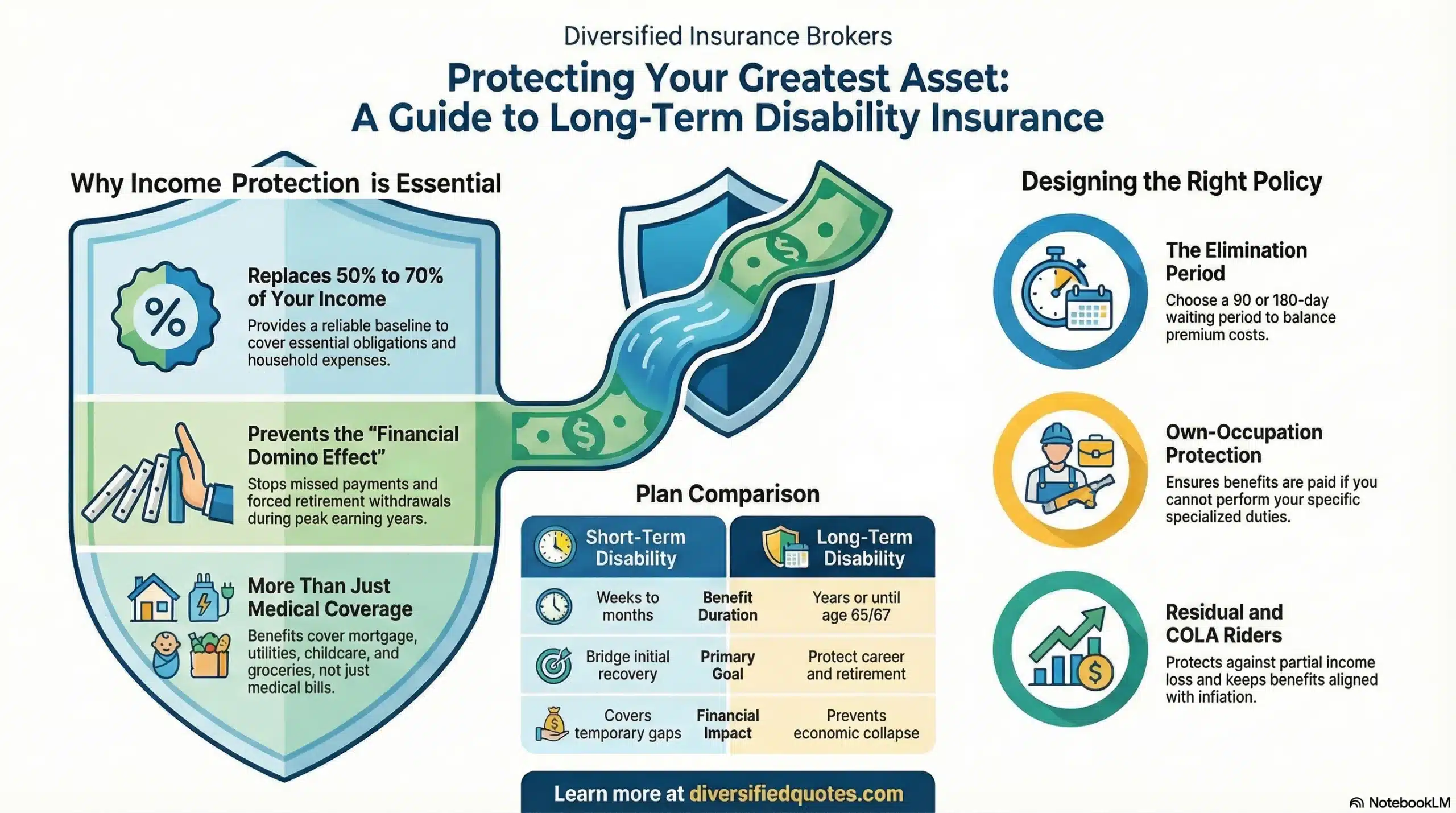
Toxicologists employed by pharmaceutical companies, government agencies, universities, or contract research organizations typically have access to employer-sponsored group long-term disability coverage as part of their benefits package. This group coverage provides a meaningful base layer of income protection — but for senior toxicologists with higher incomes, it typically falls short of full income replacement due to group plan benefit caps that may be set well below the senior scientist’s actual salary. A toxicologist earning $150,000 annually whose group LTD plan caps at $8,000 per month receives approximately 64% income replacement at the cap — below the 60-70% full income replacement target, and declining in real percentage terms as salary grows above the cap threshold.
Individual disability insurance supplements the group coverage to close the gap, providing the additional monthly benefit needed to reach full income replacement. The individual policy also provides portability that employer-provided group coverage does not — it travels with the toxicologist through career changes, transitions from academic to industry roles, and any employment shifts that might otherwise result in coverage gaps. Our resource on high income disability insurance addresses the layering strategy for professionals whose total income protection needs exceed what single-source group coverage provides.
Protect Your Scientific Career and Income
We compare own-occupation policies for toxicologists in laboratory, regulatory, forensic, environmental, and academic settings across 100+ carriers.
Compare Disability Options for ToxicologistsCall 800-533-5969
Related Disability Insurance Pages
Talk With an Advisor Today
Choose how you’d like to connect—call or message us, then book a time that works for you.
Schedule here:
calendly.com/jason-dibcompanies/diversified-quotes
Licensed in all 50 states • Fiduciary, family-owned since 1980
FAQs: Disability Insurance for Toxicologists
What occupational class do toxicologists receive?
Toxicologist occupational classification varies significantly by specific role and work setting. Regulatory toxicologists working in office-based advisory and review roles at pharmaceutical companies or government agencies typically receive Class 4 or Class 5 ratings — among the most favorable available. Bench research toxicologists who directly handle hazardous chemicals and biological specimens in laboratory settings typically receive Class 3 or Class 4 ratings, reflecting the occupational exposure dimension of laboratory work. Forensic toxicologists and environmental toxicologists with field exposure may receive similar Class 3–4 ratings depending on exposure intensity and carrier evaluation. Accurate representation of the specific duty mix — what percentage of work is laboratory versus office-based versus field — at application produces the most accurate and favorable available classification.
Does group LTD coverage from a pharmaceutical employer provide adequate disability protection?
For many toxicologists, particularly those with higher incomes or significant career investment, employer group LTD coverage alone is inadequate for two primary reasons. First, most group LTD plans cap monthly benefits at $8,000 to $15,000 — which falls short of full income replacement for senior toxicologists earning $120,000 or more annually. Second, employer group LTD coverage is not portable — it ends when employment ends, meaning a career transition, layoff, or move to a startup or consulting role eliminates the group coverage at exactly the moment when new individual coverage applications require full medical underwriting review. Individual disability insurance supplements group coverage to close the benefit gap and provides portable protection that travels through any career change.
Why does own-occupation coverage matter specifically for toxicologists?
Toxicology requires a highly specific technical and scientific expertise involving precise laboratory techniques, specialized analytical knowledge, and regulatory understanding that cannot be replicated in a different professional context. A disability that impairs the cognitive precision, sustained concentration, fine motor capability, or specific technical skills that toxicological work demands — whether from chemical exposure consequences, neurological conditions, or other sources — represents a genuine professional disability even when other forms of work remain theoretically possible. True own-occupation language pays benefits because toxicological work is what the policy insures. Any-occupation language could deny the same claim if some other employment remains theoretically feasible, despite the career-ending nature of the specific functional impairment.
About the Author:
Jason Stolz, CLTC, CRPC, DIA, CAA and Chief Underwriter at Diversified Insurance Brokers (NPN 20471358), is a senior insurance and retirement professional with more than 25 years of real-world experience helping individuals, families, and business owners protect their income, assets, and long-term financial stability. As a long-time partner of the nationally licensed independent agency Diversified Insurance Brokers, Jason provides trusted guidance across multiple specialties—including fixed and indexed annuities, long-term care planning, personal and business disability insurance, life insurance solutions, Group Health, Travel Medical and Evacuation Insurance, and short-term health coverage. Diversified Insurance Brokers maintains active contracts with over 100 highly rated insurance carriers, ensuring clients have access to a broad and competitive marketplace.
His practical, education-first approach has earned recognition in publications such as VoyageATL, and contributions from his agency featured in Kiplinger and GoBankingRates— highlighting his commitment to financial clarity and client-focused planning. Drawing on deep product knowledge and years of hands-on field experience, Jason helps clients evaluate carriers, compare strategies, and build retirement and protection plans that are both secure and cost-efficient. Visitors who want to explore current annuity rates and compare options across multiple insurers can also use this annuity quote and comparison tool.
Explore More Disability Insurance Options: Browse our complete guide to Disability Insurance for Physicians & Medical Specialists — covering physicians, surgeons, anesthesiologists, radiologists, podiatrists & medical specialists from 100+ carriers.
Last Reviewed: May 18, 2026 |
Reviewed by: Jason Stolz, CLTC, CRPC, DIA, CAA
Chief Underwriter, Diversified Insurance Brokers, Inc. | NPN: 20471358 | Diversified Insurance Brokers, Inc. — Licensed in all 50 states
Fact Checked by: Tonia Pettitt, CMIP©
Medicare Specialist, Diversified Insurance Brokers, Inc. | NPN: 14374308 | Diversified Insurance Brokers, Inc. — Licensed in all 50 states
Did you find this content helpful? Leave us a Google review — it helps others find trustworthy guidance too.
Editorial Standards: Diversified Insurance Brokers maintains rigorous editorial standards to ensure accuracy, clarity, and independence in all content. Learn more about our editorial standards and commitment to transparency.
