
What to do if Nobody Will Insure You for Life Insurance
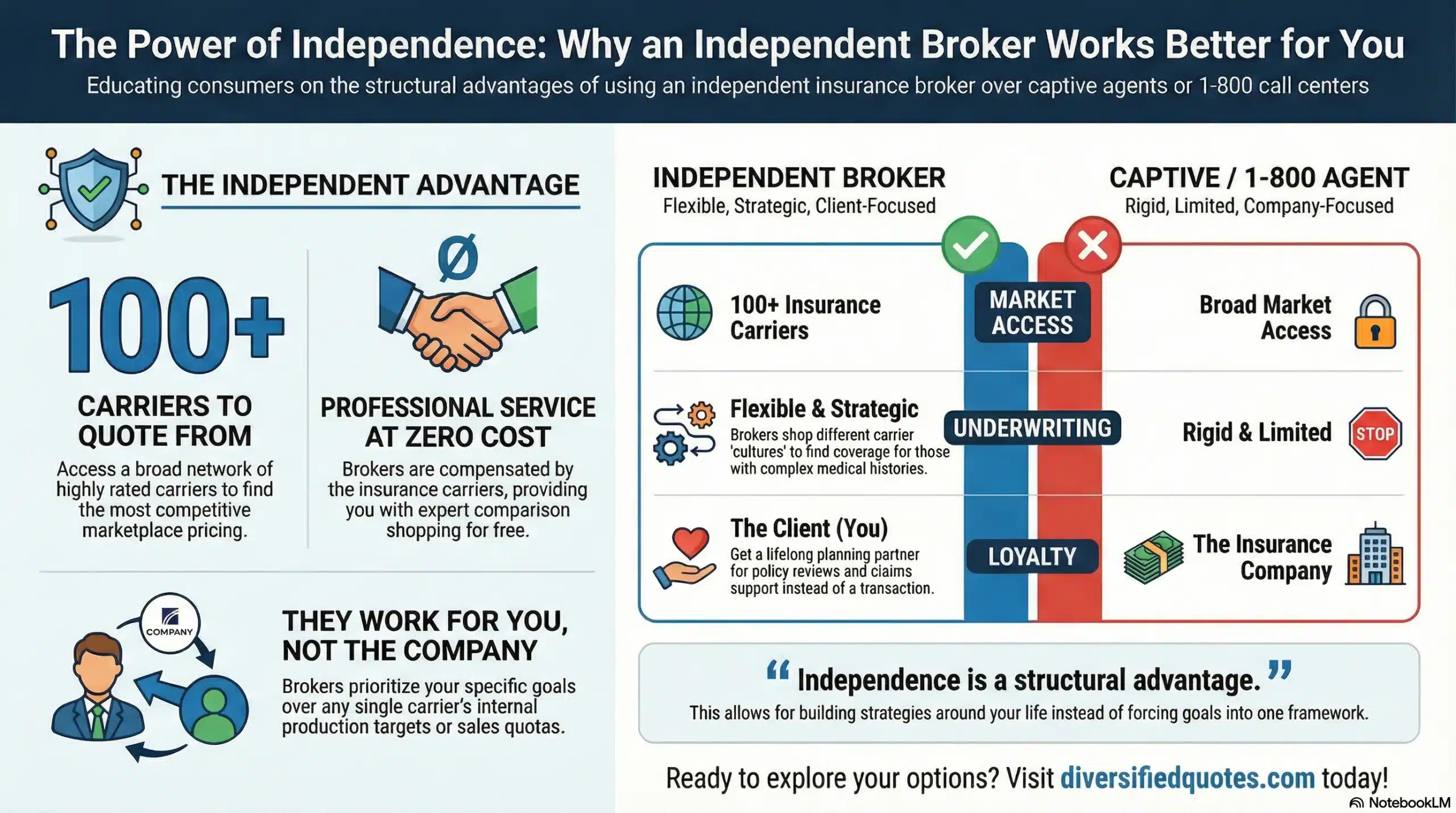
As an Independent Life Insurance Broker, we compare rates across 100+ carriers and prescreen every application before submission.
What to do if Nobody Will Insure You for Life Insurance

Jason Stolz CLTC, CRPC, DIA, CAA
What should you do if nobody will insure you for life insurance? First, don’t assume you’re permanently uninsurable. “Declined” usually means one of three things: the carrier you applied to doesn’t like your specific risk profile, the application was presented in a way that triggered unnecessary red flags, or the coverage amount, product type, or underwriting class you requested didn’t match what you realistically qualify for right now. The solution is rarely “give up.” The solution is almost always “rebuild the strategy” — because carrier appetites differ, underwriting philosophies differ, and case presentation matters more than most people realize.
At Diversified Insurance Brokers, we help people nationwide who have been declined, postponed, rated heavily, or flat-out told “no” by online quote tools or a single carrier. We see the same pattern repeatedly: people try one application path, it goes poorly, and then they assume every insurer will respond the same way. That’s not how underwriting actually works. This page is built for the person who feels stuck — maybe you have a medical condition, maybe your build is outside the “normal” range, maybe you’re on certain medications, maybe you have a complicated history, maybe you’re a non-citizen with international travel or visa complexity, or maybe you work in a category that gets misunderstood. We’re going to walk you through what to do next, step by step, so you can move from “nobody will insure me” to a realistic plan that gets you covered — even if it’s not the exact policy you originally expected. If you want a baseline reference on the market and how pricing changes by age and risk class, the best life insurance rates page helps you understand what “normal” looks like so you can tell when you’re dealing with a specific risk issue versus a general market reality.
Been Declined or Told “No” for Life Insurance?
Tell us what happened and why you think you were declined. We’ll identify the issue, the best carrier lane, and the next step that gives you the highest odds of approval.
| Situation | Most Likely Root Cause | What NOT to Do Next | Best First Move |
|---|---|---|---|
| Declined by one carrier | Carrier appetite mismatch — your profile doesn’t fit that company’s guidelines, not necessarily the broader market | Re-apply to the same carrier or apply randomly to others without a strategy | Identify what triggered the decline and match to a carrier with the right appetite for your specific risk profile |
| Declined by multiple carriers | Case presentation issues, missing documentation, or a condition requiring more stability time — plus a growing decline history that complicates re-applications | Submit more applications without addressing the root cause — each additional decline makes the next one harder | Stop all applications; design the case correctly with full documentation before the next and best submission |
| Postponed (not declined) | Something in the file is too recent, incomplete, or unclear for underwriting to assess risk accurately right now | Treat it like a decline and give up, or apply to another carrier while the same open issue exists | Complete the requested follow-up, gather documentation, and re-submit when the stability window is met |
| Rated heavily (high table offered) | Carrier has placed you in a substandard risk class — may reflect the actual risk or may reflect a conservative carrier that prices this profile poorly | Accept the first rating without shopping the case to other carriers who may evaluate the same profile more favorably | Shop the case to carriers with more favorable appetite for your specific risk class before accepting the offer |
| Online tool said “doesn’t qualify” | Automated filters are designed to avoid complexity — they reject anything outside a narrow simplified profile regardless of actual underwriting outcome | Assume the automated result reflects the full market and stop pursuing coverage | Bypass automated tools entirely and work directly with a broker who can present the full case to underwriting |
| Medical condition — stable and treated | Carrier evaluated the diagnosis label broadly rather than your specific current status, stability, and treatment quality | Apply broadly without gathering stability documentation or identifying carriers with favorable appetite for your specific condition | Document current stability, treatment consistency, and follow-up; target carriers known to evaluate your condition favorably |
| Medical condition — recent or unstable | Underwriting cannot adequately assess risk until more time passes with consistent treatment and documented stability | Keep applying and accumulating declines while the underlying stability problem remains unresolved | Accept interim coverage for now; focus on improving the file for a targeted re-application when stability windows are met |
| Residency or visa complexity | Documentation profile doesn’t fit the standard application structure — carrier cannot verify identity or residency through its normal process | Use simplified or automated application funnels not designed to handle documentation complexity | Target carriers experienced with your specific visa category and documentation structure through a broker who knows that lane |
| Occupation or industry flagged | Intake process misclassified or over-simplified the occupational risk — actual underwriting may evaluate it more favorably with clear presentation | Assume the classification is permanent or attempt to minimize the occupation on future applications | Present the occupation clearly and completely to carriers whose guidelines are appropriate for your actual job category |
Step 1: Confirm What “Nobody Will Insure You” Actually Means
Before you take your next step, you need clarity on which situation you’re actually in — because the right solution depends on the accurate diagnosis of the problem, not a generalized fear that the market is closed. People use the phrase “nobody will insure me” to describe situations that are fundamentally different from each other and require completely different responses.
If you applied to one company and were declined, that is the most common scenario and the most fixable. One carrier’s “no” is frequently another carrier’s “maybe” or “yes,” especially when the case is presented correctly and targeted to the right underwriting appetite. If you used an online quote tool and it said you don’t qualify, that is not the same as the market declining you — many automated tools are designed to reduce the chance of a carrier reviewing a complex file, so they filter aggressively at the front end. The automated path not wanting to deal with nuance is not the same as underwriters across the market rejecting your profile. If you applied multiple times and have multiple declines, this is where you need to stop submitting random applications immediately. Repeated declines can reduce your options because your application history becomes part of the underwriting story when you apply again. You need a plan and a disciplined approach so the next move is your best move rather than another entry in a growing decline file. And if you were not declined but rated heavily or offered a small amount, that is a different problem than a flat decline — sometimes the right solution is better carrier matching, sometimes it’s a different product design, sometimes it’s reducing the amount and building coverage in layers, but it is still a solvable planning problem rather than a closed door.
Once you correctly identify which situation you are actually in, you can choose an approach that improves your odds rather than repeating a path that has already failed.
Step 2: Understand the Most Common Reasons People Get Declined
Underwriting is primarily about two things: probability and uncertainty. If the probability of an early claim is too high for the premium class you want, the carrier will rate the policy heavily or decline it. If the case is uncertain — unclear diagnosis, incomplete follow-up, inconsistent records, ongoing symptoms, recent tests not finished — the carrier may postpone or decline until the picture is clearer. Neither of these is permanent in most cases, and neither means the entire market will respond the same way.
Serious medical history or an active condition is one of the most common decline drivers. Cancer histories, certain cardiac events, uncontrolled diabetes, liver disease, advanced kidney impairment, severe autoimmune disorders, neurological conditions, COPD, and other complex conditions often require carrier-specific matching rather than broad market application. Some carriers are more conservative, others are more nuanced, and timing and stability matter as much as the diagnosis label. Build and metabolic risk is another frequent issue — height and weight, sleep apnea severity, A1C trends, blood pressure control, and medication profiles can shift outcomes dramatically. Many people assume “my build declined me” but it is often build combined with another factor, and even when build is the primary issue, carrier differences can produce meaningfully different outcomes. Mental health history including hospitalizations, recent medication changes, or certain diagnoses can lead to postponements, and the time since last event and stability indicators often matter as much as the diagnostic label itself. Tobacco, nicotine, and substance use can change underwriting classes even with occasional use, and inconsistent disclosure on applications can create larger problems than the behavior itself. Occupational and avocational risk — certain jobs and hobbies that trigger additional underwriting questions — can become unnecessarily negative if those questions aren’t answered clearly and completely. And documentation, identity, and residency complexity can produce what are essentially “paperwork declines” for non-citizens and people with complex travel or visa patterns, declines that have nothing to do with health and everything to do with the carrier’s documentation requirements not being met through the standard application process.
The biggest misconception people carry into this conversation is that the diagnosis label alone is the reason for the decline. In reality, carriers decline because of severity, recency, stability, missing documentation, or uncertainty. The solution is usually to reduce uncertainty and present stability — and that is a manageable goal for most people who approach it methodically.
Step 3: Stop Random Applications and Switch to a Case Design Approach
If you’ve already had trouble, the worst move is to keep applying carrier after carrier hoping something sticks. That path usually increases your decline count and reduces your leverage with the remaining market. A smarter approach is to treat your application like a case file that needs to be designed correctly before it’s submitted anywhere.
Case design means choosing the right type of policy for your specific situation, the right coverage amount, the right term length or product structure, and the right underwriting lane — before a single application goes out. Sometimes the right case design means starting with a smaller amount to get coverage in force and then revisiting increases later when the file looks stronger. Sometimes it means splitting coverage into layers so you can get the protection your family needs at the lowest blended cost across different carriers. Sometimes it means one carrier for a specific coverage amount at a specific risk class, and a different carrier for a supplemental layer that evaluates the same profile more favorably for a different product design.
Case design also includes presenting the risk in a way that is complete, consistent, and easy for underwriting to understand and approve. This is not about hiding information — it is about clarity, which includes accurate dates, a clear treatment history, stable follow-up documentation, and a file that tells a coherent story of current health status rather than a story of uncertainty and questions. This is also where independent broker access becomes most valuable. When a case is complex, the difference between a broker with access to 40 carriers and a captive agent with access to one is often the difference between an approval and another decline. The mechanics of why that access matters and how independent brokers navigate that market are explained at how insurance brokers get paid — the core takeaway is that the right match between risk profile and carrier appetite can change a decline into an approval without changing anything about the applicant’s actual health.
Step 4: Choose the Right Product Lane
When someone is struggling to qualify, the default instinct is almost always “I just want term life.” Term is excellent when you qualify cleanly — it is the most efficient cost-per-dollar-of-coverage product when underwriting cooperates. But when underwriting is difficult, forcing everything into a term application often produces the worst outcomes. Other product structures can offer different underwriting flexibility and solve planning goals that term alone does not address.
Permanent insurance can sometimes provide more favorable underwriting outcomes in specific risk categories, and it solves a concern that term leaves open: what happens if the person outlives the term and then cannot get new coverage later because their health has changed further. For families where the fear of being uninsurable in the future is as significant as the current coverage need, permanent coverage at a lower face amount may provide more meaningful long-term security than the maximum term amount available today. Short-pay permanent designs — where premium payments are completed in a defined number of years rather than stretched over a lifetime — can be useful for people who want long-duration coverage without indefinite premium obligations. The concept is explained clearly at limited pay life insurance explained, and for some families who struggle with traditional term approvals, a permanent structure that front-loads premium and eliminates ongoing payment pressure can be a more stable long-term solution if it fits the budget and goals. Return-of-premium term can be a fit when the applicant qualifies, wants term coverage, but objects psychologically to the idea of paying decades of premium for protection that expires without value if never needed. It costs more than standard term and is not right for everyone, but for applicants where the psychological commitment to the product matters as much as the coverage math, term life insurance with return of premium explains how it works and who it typically benefits. The goal in all cases is not to force a specific product onto the situation — it is to find the lane that offers the best approval odds for the specific risk profile and the best real-world protection for the family that depends on the outcome.
Step 5: If Your Issue Is Medical, Specialize the Strategy
One of the most consistent failure points in difficult underwriting situations is treating a specific medical condition as if it is “one size fits all” from a coverage strategy standpoint. Most conditions have a broad spectrum of severity, control quality, complication history, and treatment response — and underwriters price severity, stability, and control more heavily than they price the diagnostic label alone. When the case is presented without clarity on those specifics, underwriting defaults to assuming the more adverse end of the spectrum because the documentation doesn’t tell them otherwise.
The right strategy when medical complexity is the issue almost always involves three steps: first, clarify what the underwriter is actually worried about with your specific condition; second, collect the minimum documentation that establishes current stability and active management; and third, target carriers whose underwriting appetite aligns specifically with your condition’s current status and severity profile rather than broadcasting to the market broadly. The condition-specific pages at life insurance for IgA nephropathy and life insurance for Behcet’s disease illustrate this principle across two very different and often misunderstood conditions. Even if neither is your condition, the pattern they demonstrate is universal: what underwriters care about is current status, active treatment, stable follow-up, absence of active complications, and documented management — not the name of the condition on the problem list.
Step 6: If Your Issue Is Residency or Documentation, Fix the Process
Sometimes people are declined not because of anything related to their health but because the carrier cannot verify identity, residency, or documentation through its standard underwriting process. This is especially common for non-citizens, visa holders, and people whose residency or travel history doesn’t fit cleanly into the fields a standard application was designed to accommodate. The problem is a process mismatch, not a risk rejection — and the solution is targeting carriers that are experienced and comfortable with the specific documentation profile rather than applying broadly and hoping one of the standard applications can accommodate the complexity. The page on life insurance for H1B visa holders covers this dynamic specifically, and the core principle applies across visa categories and residency situations: the coverage is usually available, but it requires a targeted approach through the right carrier channel rather than the most automated and simplified application funnel.
Step 7: If Your Issue Is Occupation or Industry, Carrier Matching Is the Solution
Some people are told “no” not because their actual risk profile is uninsurable but because a call center intake process or an automated screening tool has labeled them incorrectly or applied the most conservative possible interpretation to their occupation or industry. Underwriting is designed to evaluate actual risk accurately — but the process breaks down when the person’s job or industry is complex, uncommon, or stigmatized, because intake processes aren’t always built for nuance. The right response when occupation is the issue is not to hide or minimize the actual work — it is to ensure the case reaches underwriters who can evaluate the risk correctly, with complete and clear facts presented in a format that answers the questions the underwriters are actually trying to answer. The page on life insurance for adult entertainment workers demonstrates this principle in one of the most frequently mishandled occupational categories — but the concept applies equally to high-risk trades, certain legal industries, unconventional employment structures, and any work where a standard intake form produces an inaccurate risk picture.
Get a Baseline Quote — Then We Build the Approval Plan
If your situation is relatively straightforward, the tool below can be a useful starting point for understanding market rates and coverage options. If you have already been declined or you know your situation has complexity, treat this as a reference point only — the real leverage in a difficult case comes from choosing the right product, the right carrier, the right coverage amount, and submitting the right version of the case the first time rather than running more application attempts without a strategy.
See Real-Term Rates Side by Side
Life Insurance Quoter
We’ll Tell You Why You Were Declined — and What to Do Next
Most declines are fixable with better carrier matching, better documentation, or a smarter product structure. We’ll map the next best move for your specific situation.
Step 8: Make Sure You’re Choosing a Financially Strong Company
When someone has been declined, there is a natural temptation to swing to the other extreme and accept coverage from the first carrier willing to say yes regardless of financial strength. That urgency is understandable, but long-term reliability matters for a product whose core promise can be a decade or more in the future. Life insurance is a financial commitment that can last 20, 30, or 40 years — the carrier’s ability to fulfill its obligations at claim time matters, and that’s what financial ratings are designed to evaluate. The difference between “cheap coverage” and “reliable coverage” is worth understanding before you commit, and what does an insurance company’s AM Best rating mean provides a clear, practical explanation of the rating language consumers most frequently encounter — what the letter grades mean, what they measure, and what threshold represents meaningful financial strength for a long-duration commitment like life insurance.
Step 9: If You Truly Cannot Qualify Right Now, Build a Two-Track Plan
Sometimes the honest reality is that you may not be eligible for traditional individually underwritten life insurance today at the price and amount you want. That does not mean you stop building protection for your family. It means you build a two-track plan that creates coverage now while simultaneously improving the file for the future.
Track One is getting the best coverage you can qualify for in your current situation. That may mean a smaller face amount than you ultimately want. It may mean a different product structure than you originally intended. It may mean accepting a rated premium temporarily while the risk profile stabilizes. The goal on Track One is to avoid leaving your family with zero protection while you work the longer plan — because some protection, even imperfect protection, is almost always better than none during the gap period. Track Two is intentionally improving the file so you can re-shop later. For many people, “uninsurable right now” is a timing problem rather than a permanent condition. A diagnosis needs more time with stable, documented treatment. A metabolic marker needs to show consistent improvement. A medication needs to demonstrate its intended control. Follow-up appointments need to be completed so the record shows active management rather than drift. Documentation needs to reflect stability and positive trajectory rather than uncertainty and open questions. When the file genuinely improves, the market often opens again — and sometimes opens significantly, because a case that looked uncertain 12 months ago with incomplete follow-up looks straightforwardly approvable 12 months later with a clean treatment record behind it.
The key is intentionality. If you keep applying randomly between now and then, you build a decline history that makes the eventual re-shop harder. If you plan — accept interim coverage, improve the file deliberately, and time the re-application correctly — you build an approval path with a defined endpoint.
What If You’re Declined for Life Insurance but Still Need Income Protection?
When life insurance is difficult to obtain, it is worth separating the life insurance problem from the income protection problem — because disability coverage addresses a different but equally important financial risk. Disability is statistically far more likely during working years than premature death, and a disability that removes income for months or years creates the same financial catastrophe for a family that a death benefit is designed to prevent. A disability plan does not replace life insurance, but it can prevent the same household financial collapse that families are trying to avoid when they seek life coverage in the first place.
If you are actively working, understanding what a strong disability plan looks like and how pricing varies by occupation and benefit structure is a useful parallel exercise while working the life insurance problem. Best disability insurance rates covers how individual disability coverage is structured and priced. If traditional disability underwriting creates friction due to health history or occupational classification, there are also guaranteed-issue group designs that provide a baseline coverage layer when individual underwriting is not available or is prohibitively expensive. Guaranteed issue group disability insurance explains how these designs work and who benefits from them. Neither disability product is a replacement for life insurance — they solve different risks. But for a family that is facing friction in the life insurance market, ensuring that income is also protected is a parallel track that makes the household more financially resilient regardless of how long the life insurance process takes to resolve.
Get a Clear “Yes/No” Plan Instead of Another Guess
If you’ve been declined, the next application should be the best one — not another random attempt. We’ll outline the strategy that gives you the highest odds of approval.
What to Gather Before You Ask for Help
If you want the fastest possible path to a solution, gather a few items before you submit your case for review. You do not need extensive documentation at this stage — the goal is to reduce the initial back-and-forth by having the basics ready. Start with your age, state, desired coverage amount, desired term length if you are thinking term, current height and weight, nicotine status, your current medications with approximate dosing, and a short list of major diagnoses with the approximate dates they were established. If you have already been declined, include the carrier name if known, the approximate date of the decline, and any reason they provided. If the outcome was a postponement or a request for more information rather than a flat decline, include exactly what was requested — because that often tells us more about the specific underwriting concern than the decline reason itself. That single step — arriving with clarity rather than a vague sense that “things went wrong” — dramatically accelerates the next conversation because it lets us match the case correctly to the right carrier and product design rather than starting from a blank slate.
Final Takeaway
If nobody will insure you for life insurance, it almost always means you’ve been forced into a bad process — not that the market is permanently closed. A disciplined, case-designed approach consistently beats random application attempts. Correct carrier selection beats brand loyalty and convenience. Clear, stable documentation beats uncertainty. And if your current profile is genuinely not eligible for traditional underwriting today, a two-track plan — interim coverage now, improve the file for later — is almost always the smarter choice over giving up and leaving your family unprotected during the gap. The path forward exists for most people. The difference is how intentionally you approach it.
Related Pages
More underwriting guidance, carrier research, and alternative protection options.
Talk With an Advisor Today
Choose how you’d like to connect—call or message us, then book a time that works for you.
Schedule here:
calendly.com/jason-dibcompanies/diversified-quotes
Licensed in all 50 states • Fiduciary, family-owned since 1980
Frequently Asked Questions: What to Do If Nobody Will Insure You for Life Insurance
If I was declined by one company, does that mean all companies will decline me?
No — and this is the most important thing to understand after a single decline. Life insurance underwriting is not standardized across carriers. Different insurance companies have different risk appetites, different guidelines for specific medical conditions, different tolerance for build or metabolic risk, and different philosophies about how much weight to give specific diagnoses or histories. A carrier that declines a type 2 diabetic with a recent A1C of 7.8 may be the same carrier that readily approves a hypertension case; a carrier that approves controlled diabetes conservatively may decline the same hypertension case because of different internal guidelines. The mismatch between one carrier’s appetite and your specific profile is the most common reason people are declined — and it is almost never a true reflection of what the entire market will do when the case is presented to the right carrier through the right channel. The professional value of working with an independent broker who has access to multiple carriers is precisely this matching function. One decline tells you that one carrier passed; it tells you very little about the other 30 or 40 carriers that didn’t see your case.
Will having multiple life insurance declines permanently hurt my chances?
Multiple declines create a more complex situation, but they do not permanently close the market. What they do create is a paper trail — through the MIB (Medical Information Bureau) and through prescription history databases — that subsequent underwriters will see when they review a new application. That history is not automatically disqualifying, but it does mean your next application will be reviewed with awareness that previous carriers declined, and the underwriter will want to understand why. This is exactly why you should stop submitting random applications if you’ve already accumulated declines. The next submission needs to be designed to address the most likely underwriting concerns directly, to present the strongest version of your current health profile, and to target carriers whose appetite is well-matched to your specific situation. A strategically prepared case can still get approved after multiple declines — but it requires understanding what each previous decline was really responding to rather than just submitting again and hoping for a different result.
What medical conditions are most commonly associated with life insurance declines?
The conditions most commonly associated with declines or heavy ratings include advanced or recently treated cancer, significant cardiac events (particularly within recent years), poorly controlled diabetes with complications, severe obesity combined with other metabolic risk factors, end-stage or significantly impaired organ function (kidney, liver, lung), certain neurological conditions including ALS and Parkinson’s with progression, active substance use disorders, recent psychiatric hospitalizations, and serious HIV cases depending on treatment and stability. But the presence of any of these in your history is not an automatic lifetime decline from all carriers — it is a reason to approach the market strategically rather than broadly. Stability of the condition, quality and consistency of treatment, time elapsed since the most acute episode, absence of complications, and carrier-specific appetite for the risk category all dramatically affect what the actual market outcome will be. Many people with conditions on this list have found coverage when the application was prepared and targeted correctly.
Should I try to hide health information to improve my chances of getting approved?
No — and this approach creates the worst possible outcome for your family. Life insurance policies include a contestability period, typically two years from the policy issue date, during which the carrier can investigate any claim and rescind the policy if material misrepresentation is discovered. If you conceal a health condition, secure approval, pay premiums for 18 months, and then die — the carrier will investigate the claim, find the concealed condition in your medical records, and may deny the claim that your family is depending on. The policy becomes worthless exactly when it needs to pay. Beyond the claim risk, misrepresentation on a life insurance application can constitute insurance fraud. The correct approach is to present your actual health situation accurately and completely, and to direct that accurate and complete presentation to carriers whose underwriting appetite can accommodate your real risk profile. That combination — honesty plus strategic carrier selection — is consistently more effective than concealment, and it produces coverage that will actually pay when the time comes.
What’s the difference between being declined, postponed, and rated?
These three outcomes require different responses and have different implications for your next move. A decline means the carrier is unwilling to offer coverage at any price for the coverage amount and type you requested — though this is typically within a specific risk category and does not mean every carrier will respond the same way. A postponement means the carrier is interested in covering you but cannot make a final decision yet — typically because something in the file is unclear, incomplete, or too recent for the underwriter to evaluate risk accurately. Postponements are time-limited and often resolve when additional documentation arrives, when more time passes with a stable condition, or when requested follow-up is completed. A rating means the carrier will offer coverage but at a higher premium than the standard class — typically expressed as a multiple of the standard rate or as a flat extra charge. Ratings can range from modest to significant, and the right response depends on the size of the rating and whether better carrier matching could produce a more favorable class elsewhere. Understanding which of these you actually received is the first step toward the correct next action, because the strategies for each are meaningfully different.
Is there any type of life insurance that doesn’t require medical underwriting?
Yes — guaranteed issue life insurance does not require medical underwriting. These policies accept applicants within specific age ranges regardless of health history, with the only common exclusions being suicide within a defined period and sometimes a graded benefit structure in the first two years where the death benefit is limited to a return of premium plus interest rather than the full face amount. The tradeoff is significant: guaranteed issue policies carry substantially higher premiums than traditionally underwritten policies for the same face amount, and they are typically limited to modest coverage amounts — usually between $5,000 and $25,000 at the high end. They serve an important role for people who genuinely cannot qualify for traditional underwriting and need some coverage in force, particularly for final expense planning. But they should be understood as a coverage layer of last resort rather than a primary income replacement tool. For most people who feel they cannot get traditional coverage, a proper case design and carrier matching process produces better outcomes than defaulting immediately to guaranteed issue — the guaranteed issue path typically represents the highest cost for the least coverage, and it is worth exhausting strategic options in the traditional underwriting market first.
How long should I wait before re-applying after a decline?
The answer depends entirely on what drove the decline. If the decline was due to a condition that requires more time with stable treatment — a recent cancer diagnosis, a recent cardiac event, a newly started psychiatric medication — waiting until the underwriting guidelines’ stability windows have been met makes the re-application substantially stronger. Applying again immediately after a decline driven by recency simply produces another decline and adds another entry to your application history. If the decline was due to missing or incomplete documentation, the re-application should happen as soon as the documentation gap is resolved — sometimes that is weeks, not months. If the decline was due to carrier appetite mismatch rather than a genuine underwriting problem with your health profile, re-application to a different, better-matched carrier can happen relatively quickly. The key principle is that the re-application should be triggered by a genuine change in the underlying situation — more time, better documentation, better carrier matching — not by impatience. Re-applying without a specific reason to expect a different outcome almost always produces the same outcome.
Can I get life insurance if I have a history of cancer?
Yes — many cancer survivors qualify for life insurance, often with standard or mildly rated premiums, depending on the type of cancer, the stage at diagnosis, the treatment received, the time elapsed since treatment completion, and the absence of recurrence. Low-risk cancers with favorable prognosis — basal cell skin carcinoma, early-stage thyroid cancer, certain early-stage breast cancers — can often be approved with minimal impact. Higher-risk cancers or recently completed treatments require more time since treatment completion and clean follow-up records before the market opens favorably. The waiting period after treatment — sometimes called the “survival window” — varies by cancer type and stage, and it is one of the most carrier-specific variables in life insurance underwriting. One carrier may require five years post-treatment for a specific diagnosis while another may consider the case after three years with strong follow-up documentation. This is exactly the kind of situation where working with a broker who understands carrier-specific cancer underwriting guidelines produces meaningfully different outcomes than applying broadly and hoping. The most important inputs for a cancer survivor’s application are accurate diagnosis and staging information, treatment dates, treatment type, and clean follow-up records showing no recurrence.
About the Author:
Jason Stolz, CLTC, CRPC, DIA, CAA and Chief Underwriter at Diversified Insurance Brokers (NPN 20471358), is a senior insurance and retirement professional with more than 25 years of real-world experience helping individuals, families, and business owners protect their income, assets, and long-term financial stability. As a long-time partner of the nationally licensed independent agency Diversified Insurance Brokers, Jason provides trusted guidance across multiple specialties—including fixed and indexed annuities, long-term care planning, personal and business disability insurance, life insurance solutions, Group Health, Travel Medical and Evacuation Insurance, and short-term health coverage. Diversified Insurance Brokers maintains active contracts with over 100 highly rated insurance carriers, ensuring clients have access to a broad and competitive marketplace.
His practical, education-first approach has earned recognition in publications such as VoyageATL, and contributions from his agency featured in Kiplinger and GoBankingRates— highlighting his commitment to financial clarity and client-focused planning. Drawing on deep product knowledge and years of hands-on field experience, Jason helps clients evaluate carriers, compare strategies, and build retirement and protection plans that are both secure and cost-efficient. Visitors who want to explore current annuity rates and compare options across multiple insurers can also use this annuity quote and comparison tool.
Explore More Life Insurance Options: Browse our complete guide to Guaranteed Issue, No Exam & High-Risk Education — covering guaranteed issue policies, no-exam coverage, and table ratings from 100+ carriers.
Last Reviewed: June 20, 2026 |
Reviewed by: Jason Stolz, CLTC, CRPC, DIA, CAA
Chief Underwriter, Diversified Insurance Brokers, Inc. | NPN: 20471358 | Diversified Insurance Brokers, Inc. — Licensed in all 50 states
Fact Checked by: Tonia Pettitt, CMIP©
Medicare Specialist, Diversified Insurance Brokers, Inc. | NPN: 14374308 | Diversified Insurance Brokers, Inc. — Licensed in all 50 states
Did you find this content helpful? Leave us a Google review — it helps others find trustworthy guidance too.
Editorial Standards: Diversified Insurance Brokers maintains rigorous editorial standards to ensure accuracy, clarity, and independence in all content. Learn more about our editorial standards and commitment to transparency.
