
Final Expense Insurance for Veterans
Final Expense Insurance for Veterans

Jason Stolz CLTC, CRPC, DIA, CAA
At Diversified Insurance Brokers, we help veterans and their families secure final expense insurance that provides dependable protection for burial, funeral, and end-of-life costs. While VA benefits can help with some expenses, they often do not cover everything — leaving a gap that can put real financial pressure on a spouse, children, or other loved ones who are already managing the emotional weight of a loss. Final expense insurance exists to close that gap with a cash benefit paid directly to your beneficiary, available quickly, and usable however your family needs it most.
We compare plans from over 100 top-rated carriers to find the most affordable coverage available, and we focus heavily on options that can be issued with no medical exam and, when health allows, immediate coverage without a waiting period. Veterans bring a unique combination of service history, potential health considerations from their time in service, and existing benefit structures that require thoughtful planning. This guide covers all of it — from VA burial benefit gaps and SGLI/VGLI dynamics to common service-connected conditions and how to choose the right final expense structure for your specific situation.
Get Your Final Expense Insurance Quote
Compare rates for veterans and find first-day coverage options in minutes.
Final Expense Insurance Calculator
Why Veterans May Still Need Final Expense Insurance
Many veterans assume their final expenses will automatically be covered by VA benefits. In reality, VA burial benefits can be meaningful but are often limited — and they may not cover the full cost of a funeral, cremation, burial, or the other expenses families face in the first days after a loss. The VA burial allowance for eligible veterans covers only a portion of actual costs in most cases, and families typically encounter a combination of expenses — funeral home fees, transportation, viewing and memorial services, casket or urn, cemetery fees, and service-related costs — that together far exceed what federal benefits provide.
Final expense insurance is commonly used as “gap coverage” that ensures funds are available immediately, so your family can follow your wishes without needing to take on debt, liquidate savings, or make painful compromises because of cost. The benefit is paid directly to your named beneficiary — typically within days of the claim being filed — and can be used wherever the need is greatest. That might mean covering the funeral home invoice first, reimbursing family members for travel, paying down remaining medical bills, or simply giving a surviving spouse some breathing room while practical decisions are being made. Understanding what burial insurance is and who needs it is the right starting point for any veteran evaluating whether a final expense policy adds genuine value alongside their existing benefits.
What VA Burial Benefits Typically Do — and Don’t — Cover
For eligible veterans, the VA may provide a burial allowance, a plot or interment allowance, and in some cases the option of burial in a national cemetery at no cost. These benefits are genuinely valuable and can meaningfully reduce the financial burden on surviving families. But understanding what they cover — and equally important, what they do not — is essential for accurate financial planning.
The VA burial allowance for veterans who die of non-service-connected causes is a fixed dollar amount that has not kept pace with actual funeral costs in most metropolitan areas. A full-service funeral with burial today routinely costs $10,000 to $15,000 or more in many parts of the country. Understanding how much a funeral actually costs in today’s environment helps establish a realistic picture of how large the gap between VA benefits and actual expenses can be. Cremation, while less expensive, still involves funeral home fees, urns, memorial service costs, and potentially transportation that add up quickly.
The VA plot allowance covers the cost of a burial plot in a private cemetery — not a national cemetery, where burial is provided at no cost to eligible veterans. National cemetery burial is a meaningful benefit, but eligibility is not universal, and geographic proximity matters: a national cemetery that is hours from where a veteran lived may not be the family’s practical choice. Transportation costs, service fees, and other family expenses still apply regardless of where burial occurs. The most important planning insight is that VA benefits, while helpful, are rarely sufficient on their own to cover the full range of expenses a family will face — which is precisely the gap that final expense insurance is designed to fill.
The Real Cost of a Veteran’s Funeral Today
The cost of a veteran’s funeral — even one that uses available VA benefits to their maximum — is typically higher than most families anticipate until they are actually in the planning process. Funeral home basic services cover planning, staff coordination, permits, death certificates, and administrative paperwork — these charges apply regardless of whether burial or cremation is chosen, and they typically represent $2,000 to $3,500 or more before any merchandise or service add-ons.
Transportation includes transfer from the place of death to the funeral home and, if the veteran is being buried at a national cemetery at a distance, the cost of transporting remains. Vehicle and driver services for the processional, limousine transportation for immediate family, and other logistical costs add further to the bill. Memorial or viewing services — facility fees, staff, printed materials, livestreaming for family members who cannot attend in person, floral arrangements, and service add-ons — can add several thousand dollars depending on the family’s preferences.
The casket or urn represents one of the largest single cost categories for families, with casket prices ranging from approximately $1,000 for a basic model to $5,000 or more for premium options. Cremation containers and urns can also vary significantly. Cemetery-related fees for opening and closing the grave, setting a marker or headstone, and perpetual care are separate from the purchase price of a burial plot and can represent an additional $1,500 to $3,000 in some locations. When all of these components are added together, families typically need between $10,000 and $20,000 or more to cover a full-service funeral without any portion coming out of the estate or being covered by advance arrangements — which is why most veterans choose coverage in the $10,000 to $25,000 range to provide adequate protection across a range of service choices.
Understanding Final Expense Whole Life Insurance
Final expense insurance is not a separate category of insurance in a legal or regulatory sense — it is a small whole life insurance policy specifically designed and marketed for end-of-life expense coverage. Understanding the key features of whole life insurance helps clarify why it is the standard structure for this type of coverage and why it differs meaningfully from term life insurance for this specific purpose.
Whole life insurance provides permanent coverage that does not expire as long as premiums are paid. For final expense planning, this permanence is the critical feature: a term policy might expire at age 80 or 85, leaving the insured with no coverage at precisely the time it would be needed most. A whole life policy remains in force for life, ensuring the benefit is always available regardless of how long the insured lives. Our resource on final expense whole life insurance covers the product structure, underwriting options, and benefit designs in detail.
Premiums on a final expense whole life policy are typically designed to remain level for the life of the contract. They will not increase due to age, health changes, or market conditions. The death benefit is similarly fixed at the amount chosen at the time of purchase and does not decrease over time in a level benefit policy. This combination of fixed premiums and guaranteed benefits makes final expense whole life insurance particularly well suited to retirees and veterans on fixed incomes who need predictability. For those comparing this structure to a term life alternative, our resource on final expense life insurance versus term life insurance covers the key structural trade-offs for different situations and budgets.
Level, Graded, and Guaranteed Issue: Which Type Fits?
Final expense policies are generally structured in one of three ways, each suited to different health profiles and planning objectives. Understanding which structure applies to a given veteran’s situation is the first step toward finding the most appropriate coverage at the best available price.
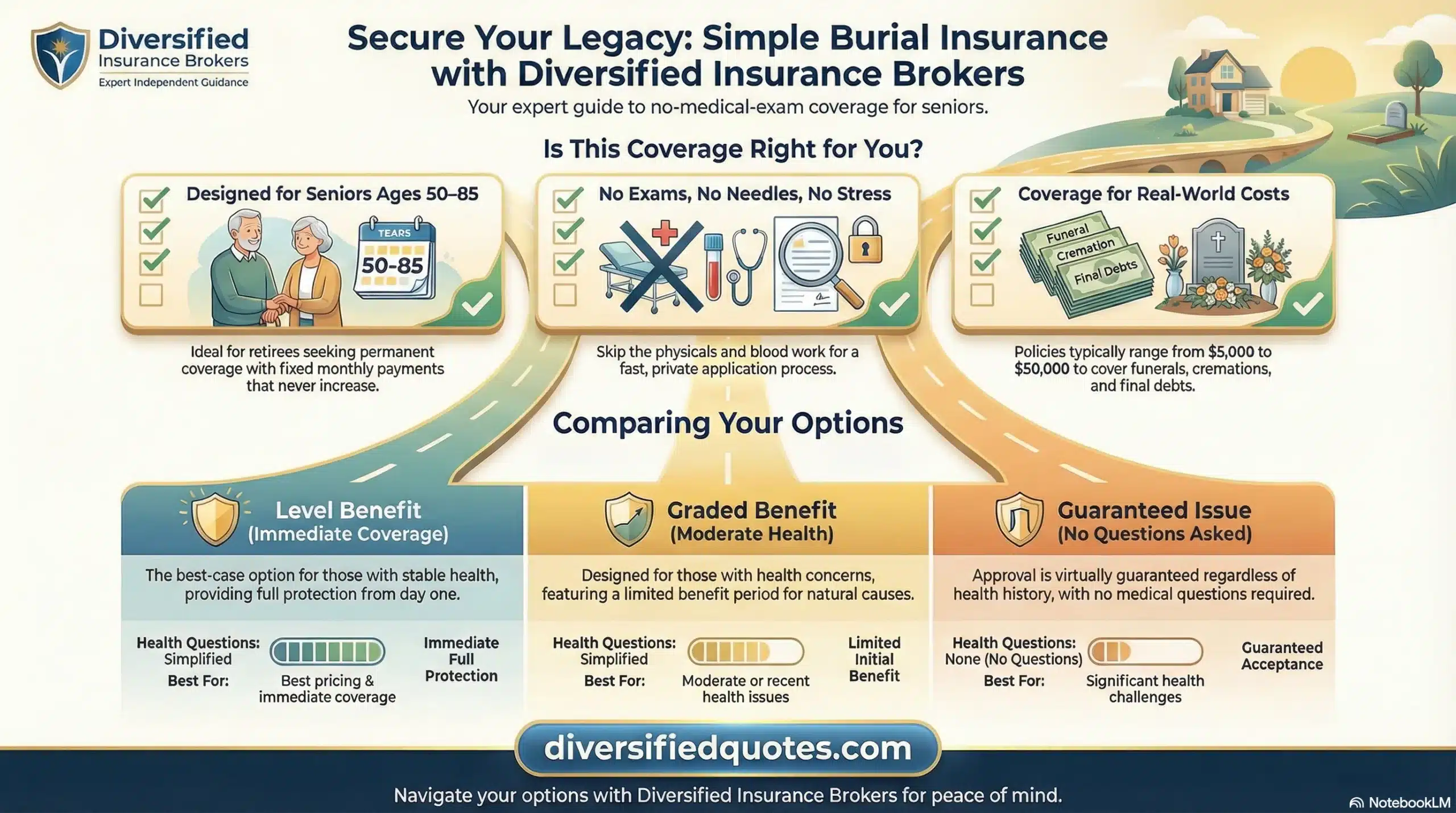
Level benefit policies provide the full death benefit from day one for both natural and accidental death. These are the most valuable and typically the most affordable per dollar of coverage, because the insurer is accepting the full mortality risk immediately upon policy issuance. To qualify for a level benefit policy, the applicant typically must answer health questions and demonstrate that no disqualifying conditions exist in their history. Many veterans with stable health conditions — even those with some chronic issues — can qualify for level benefit coverage after shopping across multiple carriers, since underwriting standards vary significantly from one insurer to the next. Our resource on the best burial insurance with immediate coverage covers which carriers currently offer the most accessible immediate coverage options.
Graded benefit policies provide the full death benefit for accidental death immediately but limit non-accidental death benefits during an initial waiting period — typically two years. During that waiting period, the policy typically pays back all premiums paid plus interest if the insured dies from natural causes. After the waiting period, the full benefit applies for all causes. Graded policies are appropriate for veterans who have health conditions that disqualify them from level benefit coverage but who still want coverage that will eventually provide full protection. The waiting period is the trade-off for broader health acceptance.
Guaranteed issue policies accept all applicants within the eligible age range — typically 45 to 85 — with no health questions and no medical examination. Coverage is guaranteed regardless of health history. The trade-off is a graded benefit period (usually two years for natural causes) and generally higher premiums per dollar of coverage compared to level or graded policies. For veterans with very serious health conditions — recent cancer diagnoses, organ transplants, or other conditions that disqualify them from even graded underwriting — guaranteed issue may be the only available option for private insurance coverage. Our guide to guaranteed issue burial insurance covers which carriers offer the most favorable guaranteed issue terms and how to minimize the impact of the graded period through proper planning.
Common Service-Connected Conditions and Coverage Options
Veterans carry a range of health conditions that may have originated from or been worsened by their military service. While these conditions are recognized by the VA as service-connected and may qualify the veteran for disability compensation, they do not automatically disqualify the veteran from private final expense insurance. The reality is that underwriting standards vary enormously across carriers, and a condition that one insurer treats as a disqualifying factor may be fully acceptable — or even classifiable at preferred rates — by another.
PTSD is one of the most common service-connected conditions among veterans, particularly those who served in combat roles. For final expense insurance purposes, PTSD is treated differently by different carriers: some accept it without restriction if it is managed and stable, others apply a graded benefit structure, and some may have specific exclusions or waiting periods. Our dedicated resource on life insurance for veterans with PTSD covers the underwriting landscape in detail and identifies which carriers are most likely to offer favorable terms for this specific condition. Similarly, our resource on life insurance for PTSD more broadly provides additional context for how this diagnosis is treated across the insurance marketplace.
Diabetes is another frequently encountered condition among the veteran population, particularly among older veterans. Type 2 diabetes with stable management through oral medication is often acceptable for level benefit coverage at many carriers, while poorly controlled diabetes or insulin-dependent type 2 with complications may require graded or guaranteed issue options. Our resources on life insurance for diabetes and specifically burial insurance for people with diabetes cover the underwriting distinctions that apply to different presentations of this condition.
Heart conditions — including history of heart attack, heart disease, atrial fibrillation, and high blood pressure — are common among older veterans and require nuanced underwriting analysis. A veteran who had a heart attack five years ago and has been medically stable since may qualify for level or graded benefit coverage with certain carriers, while a veteran who had a recent cardiac event may face stricter limitations. Our resources on burial insurance for people with heart conditions and life insurance for high blood pressure are useful references for veterans navigating these underwriting considerations. For veterans with COPD or other respiratory conditions common among those exposed to burn pits, deployment toxins, or certain military occupational specialties, our resource on life insurance for COPD covers available options and carrier-level underwriting approaches.
Cancer survivors represent another significant segment of the veteran population, particularly among Vietnam-era veterans who may have been exposed to Agent Orange. Many carriers will consider cancer survivors for coverage depending on the type of cancer, time since treatment ended, and current remission status. Our resource on burial insurance for cancer survivors covers this group specifically, and our guide on life insurance for cancer survivors provides a broader view across carrier acceptability thresholds for different cancer types and treatment histories.
Immediate Coverage Matters — and Here Is Why
A major reason families choose final expense whole life insurance is the ability to secure a policy that provides immediate protection for both natural and accidental death causes if the applicant qualifies. Not every plan offers first-day coverage, and eligibility depends on health and carrier guidelines, but it is often possible to find level benefit options that protect the family right away without a two-year graded period for natural causes.
The importance of immediate coverage becomes most apparent when insurance is purchased later in life or when a health event occurs after the policy is in force. If a veteran purchases a graded benefit policy and passes away from natural causes within the two-year waiting period, the family typically receives only a return of premiums rather than the full death benefit. For veterans who are older or whose health situation is less stable, waiting for level coverage to become available from one carrier while a graded option from another is offered simultaneously is a meaningful comparison to make before committing. Our resource on burial insurance with no waiting period covers the carriers and underwriting criteria most likely to produce immediate coverage for veterans across different health profiles.
Coverage Amounts: Finding the Right Number
Most veterans choose final expense coverage between $10,000 and $25,000, with the right amount depending on the family’s specific funeral preferences, geographic location (since funeral costs vary significantly by region), and whether other resources — VA benefits, savings, or other life insurance — will also contribute to covering costs. A veteran who expects VA burial benefits to cover cemetery costs and who anticipates a simple service might be well served by $10,000 to $12,000 in final expense coverage. A veteran who wants to ensure a full-service funeral with no out-of-pocket contribution from family members and who lives in a high-cost urban area might need $20,000 to $25,000 or more.
Our resource on how much burial insurance you need provides a framework for calculating the right coverage amount based on your specific plans and location. The burial insurance calculator available on our site can help model how different coverage amounts and premium options interact based on age and health profile. It is also worth noting that coverage amounts for final expense policies typically do not require medical justification — you can select the amount that aligns with your estimated needs rather than having coverage dictated by income or asset calculations as might apply in other life insurance categories.
Control and Choice for Your Family
One of the most valuable aspects of final expense insurance is the flexibility it provides to families at an extraordinarily difficult time. VA burial benefits, while meaningful, come with their own administrative process — eligibility determinations, required documentation, and in some cases reimbursement structures that mean families pay first and receive repayment later. Final expense insurance pays a cash benefit directly to your named beneficiary, with no requirement that the money be used in any particular way or that the beneficiary provide an accounting of how it was spent.
That flexibility means your family can use the benefit exactly where it is needed most: paying the funeral home immediately to prevent placement of the remains on hold, covering airfare for family members traveling from out of state, handling remaining medical bills that survived the policyholder, making final mortgage or rent payments, or simply providing a surviving spouse with financial stability during the weeks of adjustment that follow a loss. Understanding what burial insurance covers — and equally important, what it does not restrict — helps veterans appreciate why this flexible cash benefit is so often preferred over pre-paid funeral arrangements or dedicated funeral savings accounts.
For veterans who want to compare all available approaches, our resource on burial insurance versus a pre-paid funeral covers the financial trade-offs, flexibility differences, and portability considerations that distinguish these two common planning approaches.
What About SGLI and VGLI?
Many service members are familiar with Servicemembers’ Group Life Insurance (SGLI), which provides low-cost life insurance coverage during active duty. SGLI typically ends within 120 days of separation from service, at which point eligible veterans can convert to Veterans’ Group Life Insurance (VGLI) without a health examination. VGLI can be a helpful transitional option, but it carries significant limitations that many veterans do not fully appreciate until later in life.
The most consequential limitation of VGLI is premium escalation with age. VGLI premiums increase in five-year age brackets, meaning coverage that was affordable at age 40 may become substantially more expensive at age 60, 65, or 70 — precisely the years when many veterans are on fixed incomes and least able to absorb premium increases. VGLI is also term coverage rather than permanent, meaning it does not build cash value and terminates if premiums are not maintained. Many veterans find that adding a small permanent final expense whole life policy — with level premiums that will not increase — provides a more stable foundation for end-of-life planning than relying solely on VGLI as they age.
The layered approach — maintaining VGLI during earlier retirement years for larger coverage amounts while adding a final expense whole life policy for the permanent, inflation-stable core — is a practical strategy that allows veterans to benefit from both structures. As VGLI premiums increase with age, the veteran can reduce the VGLI amount or let it lapse with confidence that the permanent final expense policy remains in force at a known premium. Our resource on life insurance for military members and veterans covers the full range of coverage options available across different service statuses and career stages.
Can Veterans Have Both VA Benefits and Final Expense Insurance?
Yes — and this is one of the most common and effective approaches for veteran families. VA benefits and private final expense insurance are not mutually exclusive, and receiving VA burial benefits does not affect eligibility for, or the payout from, a private final expense policy. Many veterans use this layered approach deliberately: VA benefits reduce certain costs, and the final expense policy provides immediate cash that fills the gap and eliminates the wait for reimbursement.
For example, a veteran who qualifies for VA cemetery burial at a national cemetery saves the cost of the burial plot but still faces funeral home fees, transportation, memorial service costs, and family travel expenses. A $15,000 final expense policy can cover those remaining costs entirely, allowing the family to use VA cemetery benefits without any financial stress. When the two sources of benefit work together, families typically have more control over the service they arrange and more flexibility in how they honor the veteran’s wishes than they would with either resource alone.
Advantages of Final Expense Insurance for Veterans
The advantages of final expense whole life insurance for veterans center on simplicity, predictability, and the specific financial protection that these policies provide for an expense category that nearly every family faces. Most final expense plans are designed for simplified approval using health questions rather than medical examinations — the underwriting is straightforward, the decisions are typically made quickly, and coverage can often begin within days of application. For veterans with complex health histories who have experienced difficulty qualifying for traditional life insurance in larger amounts, final expense policies from specialized carriers often provide a viable path to meaningful coverage.
Premiums on final expense policies are typically level — meaning they are designed to remain the same for the life of the contract regardless of age changes or health changes after the policy is issued. This predictability is particularly valuable for veterans on fixed pension or Social Security income, where unexpected increases in a monthly obligation can create genuine financial hardship. The permanent nature of whole life coverage means there is no expiration date — the policy remains in force as long as premiums are paid, providing protection regardless of how long the insured lives. Our resource on whole life insurance for people on fixed income covers the specific options and carriers best suited to this financial profile.
For veterans who are also considering their options across the broader burial insurance marketplace, our resource on the best burial insurance available today and our guide specifically focused on burial insurance for seniors provide a current market overview across carriers, underwriting tiers, and benefit structures. Veterans with specific budget constraints may also find our resource on affordable burial insurance for low-income seniors useful for identifying carriers with the most competitive rates at lower coverage amounts.
How Fast Are Claims Paid?
Final expense insurance claims are generally processed efficiently by carriers specifically because these policies are designed for this use case. Once the insurer receives the completed claim form and a certified copy of the death certificate — typically within a few days to a few weeks after a death — many carriers process the claim and issue payment within five to ten business days. This speed is one of the defining practical advantages of final expense insurance over other benefit sources that may involve more complex administrative processing.
The speed of claim payment matters most in the immediate aftermath of a death, when funeral homes and cremation providers typically require payment before services begin. Families who can provide the funeral home with evidence of a life insurance policy — or who have named the funeral home directly as a partial beneficiary — can often make arrangements without needing to front the cost from savings or credit cards. Even when the beneficiary is a family member rather than the funeral home directly, the quick payment turnaround means reimbursement comes rapidly after upfront costs are paid.
Beneficiary designation is a critical part of the policy setup that directly affects how smoothly this process goes. Naming a clearly identified beneficiary — with current contact information and a relationship clearly documented — eliminates the most common delays in claim processing. Our resource on burial insurance quotes and planning covers the full setup process, including beneficiary designation best practices. And for veterans who want to ensure their beneficiary designations across all policies are coordinated and current, our resource on the complete burial insurance service overview provides a framework for reviewing all end-of-life insurance arrangements as a unified plan.
Special Forces, Combat Veterans, and High-Risk Service History
Veterans who served in special operations forces, combat roles, or other high-risk military occupational specialties sometimes assume that their service history will negatively affect their ability to obtain civilian life or burial insurance. In most cases, this assumption is incorrect. For final expense insurance purposes, the relevant underwriting factors are current and recent health status — not occupational history. What matters is whether the veteran has conditions that affect their current mortality risk, not the fact that they once served in dangerous roles.
Our resource on life insurance for special forces veterans addresses this directly, clarifying what underwriting factors actually apply to veterans of elite military units and what types of coverage are available. For veterans who are also concerned about how other high-risk activities — hunting, motorsports, or recreational pursuits — might affect coverage, our guide on life insurance for high-risk occupations provides a broader framework for understanding how occupation and activity history interacts with life insurance underwriting.
Planning: Coordinating Final Expense Insurance With Your Overall Benefits
Final expense insurance is most effective when it is evaluated as one component of a veteran’s complete end-of-life financial plan rather than as a standalone product decision. That complete plan should account for VA burial benefits — both the allowances available and the eligibility conditions that apply — as well as any existing life insurance coverage from VGLI, employer policies, or other personal policies, savings or investment assets that might contribute to funeral costs, and the preferences and financial capacity of the surviving family members who will handle arrangements.
When all of these components are evaluated together, the right final expense coverage amount, benefit structure, and carrier selection become much clearer. A veteran with significant VA benefits and a still-active VGLI policy might need only a small final expense policy to fill a specific gap. A veteran whose VGLI coverage is becoming prohibitively expensive due to age-based premium increases might benefit from replacing a portion of that coverage with a permanent final expense policy at a fixed premium. A veteran with no other coverage and limited savings might need a more comprehensive final expense policy that fully funds a dignified service without any family contribution. Our guide on how to get the best burial insurance rates provides practical guidance on how to shop this market effectively, and our broader resource on burial insurance for veterans covers the full planning framework from the burial insurance perspective specifically.
We will compare final expense insurance options for veterans nationwide and confirm whether you can secure no waiting period coverage today.
Related Pages
Explore more final expense, burial insurance, and veteran coverage resources.
Financial Protection Essentials
Retirement planning, international travel protection, transplant underwriting, and critical illness coverage resources.
Talk With an Advisor Today
Choose how you’d like to connect—call or message us, then book a time that works for you.
Schedule here:
calendly.com/jason-dibcompanies/diversified-quotes
Licensed in all 50 states • Fiduciary, family-owned since 1980
FAQs: Final Expense Insurance for Veterans
What is final expense insurance for veterans?
Final expense insurance for veterans is a small whole life insurance policy designed specifically to cover funeral, burial, cremation, and other end-of-life costs. It provides a fixed death benefit — typically between $5,000 and $25,000 — paid directly to the named beneficiary upon the insured’s death. The benefit is a tax-free cash payment that can be used for any purpose, giving families the flexibility to pay funeral home bills, cover family travel, handle remaining medical costs, or provide financial stability for a surviving spouse.
Unlike term life insurance, which expires after a defined period, final expense whole life insurance is permanent — it remains in force for life as long as premiums are paid. Premiums are typically fixed at issue and do not increase with age or health changes after the policy is established. For veterans on fixed pension or Social Security income, this predictability is one of the most important practical advantages of these policies. Our resource on final expense life insurance provides a comprehensive overview of product structures, carriers, and eligibility considerations.
How does final expense insurance differ from VA burial benefits?
VA burial benefits and final expense insurance serve related but distinct roles in end-of-life financial planning. VA benefits — including the burial allowance, plot allowance, and national cemetery burial option — are government benefits for eligible veterans that offset specific categories of cost. Final expense insurance is private coverage that pays a cash benefit directly to the beneficiary, without restriction on how the funds are used or any requirement to document specific expenses.
The practical differences are significant. VA benefits may involve reimbursement processes, eligibility determinations, and administrative timelines. A final expense insurance claim typically results in cash payment to the beneficiary within days to weeks of submitting the claim and death certificate — immediately available for funeral home invoices that often come due before any reimbursement could arrive. VA benefits may also fall short of covering the full cost of a funeral in the veteran’s area, leaving a gap that final expense insurance is specifically designed to fill. Understanding what burial insurance covers in terms of permitted uses helps clarify why the flexibility of private coverage is so valuable alongside the more restricted VA benefit structure.
Can I have both VA burial benefits and a final expense policy?
Yes — and this layered approach is among the most common and financially effective strategies for veteran families. VA burial benefits and private final expense insurance operate completely independently. Receiving VA benefits does not reduce the payout from a private policy, and having a private policy does not affect eligibility for VA benefits. Many veterans use the two sources together: VA benefits reduce or eliminate cemetery costs at a national cemetery, while the final expense policy funds funeral home services, transportation, memorial events, and family expenses.
The layered approach provides the greatest certainty because it does not depend on any single source of funding covering everything. If VA benefits are delayed or cover less than expected, the private policy benefit is already in place and payable independently. If VA benefits cover more than anticipated, the private policy benefit gives the family additional financial flexibility rather than being an excess resource. For veterans researching how these two benefit streams coordinate in practice, our resource on burial insurance specifically for veterans covers the coordination strategies in detail.
Do I need a medical exam to get final expense insurance?
Not usually. Final expense policies are among the most accessible life insurance products because they are specifically designed for simplified underwriting. Most final expense plans use a set of yes/no health questions — typically covering major conditions diagnosed or treated within the past two to five years — and make coverage decisions based on those answers without requiring a physical examination, blood work, or other medical testing. Decisions are often made within days of application, and coverage can begin shortly after approval and first premium payment.
For veterans whose health history makes even simplified underwriting difficult, guaranteed issue options exist that require no health questions at all — acceptance is guaranteed for all applicants within the eligible age range. These policies typically include a two-year graded benefit period for natural causes, after which the full benefit applies. Our resource on burial insurance with no medical exam covers the full spectrum of no-exam options across carriers, and our guide to guaranteed issue burial insurance provides a complete overview of the guaranteed acceptance option for veterans who need it.
What if I have a VA disability rating or service-connected conditions?
A VA disability rating does not automatically disqualify a veteran from private final expense insurance. The underwriting process for final expense insurance focuses on current and recent health status — specifically whether the applicant has conditions that materially affect their mortality risk — not on whether a condition has been formally recognized by the VA as service-connected. Many veterans with disability ratings for conditions like PTSD, musculoskeletal injuries, hearing loss, and controlled chronic conditions qualify for level or graded benefit coverage at competitive rates.
The key is shopping across multiple carriers, because underwriting standards vary significantly. A condition that disqualifies an applicant from one carrier’s level benefit tier may be fully acceptable at another carrier. Veterans with more serious service-connected conditions — advanced cardiovascular disease, active cancer, recent major cardiac events — may need graded benefit or guaranteed issue options, but coverage remains accessible in most cases. Our dedicated resource on life insurance for veterans with PTSD covers the most common service-connected mental health condition specifically. For veterans with high blood pressure — another common service-connected condition — our guide on burial insurance for people with heart conditions addresses carrier-level options for this group.
What is the difference between level, graded, and guaranteed issue policies?
Level benefit policies provide the full death benefit from day one for both natural and accidental causes of death. These represent the most comprehensive coverage and typically the lowest cost per dollar of benefit. To qualify, the applicant must answer health questions and demonstrate that no disqualifying conditions exist in their history. Many veterans with stable health histories — even those with some chronic conditions — can qualify for level benefit coverage after shopping across carriers.
Graded benefit policies provide immediate full coverage for accidental death but limit non-accidental death benefits during an initial waiting period, typically two years. If the insured dies from natural causes during the waiting period, the policy typically returns all premiums paid plus interest. After the two-year period, the full benefit applies for all causes. Graded policies accept applicants with more significant health histories who cannot qualify for level coverage. Guaranteed issue policies accept all applicants with no health questions and guarantee coverage, but include a graded period for natural causes and typically carry higher premiums per dollar of coverage than level or graded options. Our resource on burial insurance with no waiting period covers which structures and carriers offer the most accessible path to immediate full coverage.
Can I qualify if I use tobacco or have chronic conditions?
Often yes, though tobacco use typically results in higher premiums and some chronic conditions may affect which benefit tier is available. Tobacco use is one of the most common factors that elevates final expense insurance premiums, and carriers vary significantly in how they define and price tobacco use — some use a 12-month tobacco-free window, others use a 24-month window, and some treat different tobacco products differently. Comparing rates across carriers is particularly important for tobacco users because the premium difference between carriers can be substantial.
Chronic conditions vary widely in their underwriting impact. Controlled conditions that have been stable for several years — type 2 diabetes managed with oral medication, treated high blood pressure, mild COPD — are often acceptable for level or graded benefit coverage at many carriers. Active cancer, recent hospitalizations for cardiac events, or conditions requiring nursing home-level care may require guaranteed issue options. The most important step is working with an independent broker who can shop across multiple carriers simultaneously rather than presenting the applicant’s health history to a single insurer. Our resources on burial insurance for cancer survivors and burial insurance for stroke survivors address two of the most commonly encountered chronic condition scenarios specifically.
What happens to SGLI or VGLI when I separate from service?
SGLI coverage ends within 120 days of separation from active duty. Veterans who want to maintain coverage after separation can convert to VGLI without a medical examination if they apply within the required window. VGLI is a valuable transitional coverage option, but its age-based premium escalation structure creates a planning consideration that many veterans do not encounter until premiums have increased significantly in their 60s and 70s.
Because VGLI premiums increase in five-year age brackets and the coverage is term rather than permanent, many veterans find that supplementing or eventually replacing a portion of VGLI coverage with permanent final expense whole life insurance provides better long-term stability. The permanent policy’s fixed premium eliminates the escalation risk, the coverage remains in force regardless of future health changes, and the benefit amount is specifically calibrated for the funeral and end-of-life cost purpose where certainty matters most. Our resource on life insurance for military members covers the SGLI-to-VGLI transition and civilian coverage alternatives in a coordinated framework.
How much final expense coverage should a veteran choose?
The right coverage amount depends on the veteran’s funeral preferences, geographic location, existing benefit sources, and how much of the cost the family should have to contribute — if any. For veterans who want to ensure their family is completely protected with no out-of-pocket contribution, the coverage amount should be set to cover the full expected cost of the service, minus any VA benefits the family can reliably expect to receive. For veterans in high-cost metropolitan areas with preferences for a full-service funeral, that amount might be $20,000 to $25,000 or more. For veterans planning a simple cremation with minimal service, $8,000 to $12,000 might be appropriate.
It is also worth considering that funeral costs increase with inflation, which means a coverage amount that feels adequate today may fall short in five or ten years if arranged as a prepaid amount but not indexed for inflation. The flexibility of a private final expense policy — where the benefit is paid in cash and the family makes purchasing decisions at the time of need — means the money is spent at actual future market prices rather than locked into today’s prepaid arrangement. Our resource on how much burial insurance is needed provides a framework for calculating the right amount based on your specific circumstances, and the burial insurance calculator can model premium costs at different coverage levels based on age and health profile.
Can I name a funeral home as beneficiary?
In many cases, yes. Some families choose to name a funeral home directly as the beneficiary — or as a partial beneficiary — so that the funeral home can receive payment directly from the insurer rather than waiting for the family to file a claim and forward funds. This approach can simplify the payment process and ensure the funeral home bill is covered without the family needing to front costs from their own accounts during an already stressful period.
Other families prefer to name a spouse, child, or other trusted individual as the full beneficiary and let that person handle all financial arrangements after the death. This preserves more flexibility for the family but requires them to manage the cash receipt and funeral home payment themselves. Some policies also allow assignment of a portion of the benefit to a funeral home while the remainder goes to a family beneficiary — a structure that covers the funeral directly while still leaving some funds available for the family’s other needs. Reviewing beneficiary designation options with your advisor at the time of application ensures the policy is set up to produce the outcome your family will actually need. Our resource on burial insurance planning and quotes covers the setup process including beneficiary considerations.
About the Author:
Jason Stolz, CLTC, CRPC, DIA, CAA and Chief Underwriter at Diversified Insurance Brokers (NPN 20471358), is a senior insurance and retirement professional with more than 25 years of real-world experience helping individuals, families, and business owners protect their income, assets, and long-term financial stability. As a long-time partner of the nationally licensed independent agency Diversified Insurance Brokers, Jason provides trusted guidance across multiple specialties—including fixed and indexed annuities, long-term care planning, personal and business disability insurance, life insurance solutions, Group Health, Travel Medical and Evacuation Insurance, and short-term health coverage. Diversified Insurance Brokers maintains active contracts with over 100 highly rated insurance carriers, ensuring clients have access to a broad and competitive marketplace.
His practical, education-first approach has earned recognition in publications such as VoyageATL, and contributions from his agency featured in Kiplinger and GoBankingRates— highlighting his commitment to financial clarity and client-focused planning. Drawing on deep product knowledge and years of hands-on field experience, Jason helps clients evaluate carriers, compare strategies, and build retirement and protection plans that are both secure and cost-efficient. Visitors who want to explore current annuity rates and compare options across multiple insurers can also use this annuity quote and comparison tool.
Explore More Burial Insurance Options: Browse our complete guide to Guaranteed Issue Burial Insurance — covering no medical exam, no waiting period & immediate coverage burial insurance options from top carriers.
Last Reviewed: May 20, 2026 |
Reviewed by: Jason Stolz, CLTC, CRPC, DIA, CAA
Chief Underwriter, Diversified Insurance Brokers, Inc. | NPN: 20471358 | Diversified Insurance Brokers, Inc. — Licensed in all 50 states
Fact Checked by: Tonia Pettitt, CMIP©
Medicare Specialist, Diversified Insurance Brokers, Inc. | NPN: 14374308 | Diversified Insurance Brokers, Inc. — Licensed in all 50 states
Did you find this content helpful? Leave us a Google review — it helps others find trustworthy guidance too.
Editorial Standards: Diversified Insurance Brokers maintains rigorous editorial standards to ensure accuracy, clarity, and independence in all content. Learn more about our editorial standards and commitment to transparency.
