
Group Health Insurance for Private Schools
As an Independent Group Health Insurance Broker, we compare fully insured, level-funded, and self-funded options across carriers to find the lowest cost coverage for your business.
Group Health Insurance for Private Schools

Jason Stolz CLTC, CRPC, DIA, CAA
Group health insurance for private schools sits at the intersection of institutional finance, talent competition, and employee wellbeing — three forces that pull in different directions when budgets are tight and expectations are high. Private schools operate in a uniquely demanding benefits environment: they compete for the same teachers and administrators that public schools and corporate employers recruit, but without the benefit of state-run health pools, large-employer market leverage, or tax-funded budget flexibility. Every dollar spent on group health coverage comes directly from tuition revenue, endowment, or restricted operating funds, which means plan design and funding structure decisions carry real institutional weight. A poorly structured plan that renews at double-digit increases year after year will eventually force difficult tradeoffs between mission investment and employee compensation. A well-structured plan that provides genuinely competitive benefits at sustainable cost creates the stable, predictable environment that lets faculty focus on students rather than on out-of-pocket risk.
The private school benefits landscape has changed meaningfully over the past several years. Rising healthcare inflation has pushed the cost of traditional fully insured plans higher at every renewal cycle, and the gap between what private schools can absorb and what educators expect has narrowed. At the same time, alternative funding structures — particularly level-funded plans that combine predictable monthly payments with performance-based refund potential — have become accessible at smaller group sizes than they once were, creating a genuine opportunity for schools that previously had no practical alternative to the fully insured market. The result is a more complex, more nuanced decision environment for school leadership, one that rewards schools who engage with the comparison process seriously rather than accepting each renewal as an inevitable cost increase.
At Diversified Insurance Brokers, we work with private schools nationwide — from small independent elementary schools with a handful of full-time staff to larger K-12 institutions with complex multi-campus staffing models. Our role is to translate the technical landscape of group health funding structures, carrier networks, plan designs, and participation requirements into practical decisions that fit each school’s actual situation — its employee count, budget cadence, staffing mix, and benefit culture. This page covers everything school leadership needs to evaluate group health insurance intelligently: the plan structures available, the specific considerations that make private school benefits different from standard small-employer plans, and the strategic levers that produce better outcomes over time. For the eligibility context that frames these decisions, our resource on minimum employees for group health insurance covers the qualification thresholds that determine what structures are available at different staffing levels.
Compare Group Health Options for Your School
We evaluate your staff size, budget, and priorities and present plan structures side-by-side with clear cost, network, and renewal tradeoffs. No obligation.
Request School Benefits OptionsWhy Group Health Benefits Are a Strategic Asset for Private Schools
The teacher shortage and the competition for qualified administrators has made employee benefits a front-line competitive tool in private education. Private schools that offer comprehensive, stable, genuinely valuable health coverage are better positioned to recruit from the same talent pool as public schools — which typically offer state-managed benefit programs — and private sector employers, who can often match or exceed salary. Private schools that offer inadequate or unstable benefits face a structural disadvantage in that competition that compounds over time as experienced educators choose to work elsewhere, forcing the school to repeatedly invest in hiring and onboarding rather than building institutional depth.
The financial case for well-structured benefits extends beyond direct recruitment. Turnover is expensive — the combination of search fees, interim coverage, onboarding time, and reduced classroom effectiveness during the transition period carries real institutional cost. Schools that maintain lower turnover through competitive benefits and a stable work environment recapture that investment over time in the form of experienced faculty who deliver better student outcomes and represent the school more credibly to prospective families. Parents evaluating private schools are increasingly sophisticated about the relationship between faculty stability, administrative culture, and educational quality — and a school with consistently high staff retention signals exactly the kind of stability that families seek.
The Unique Operating Environment of Private Schools
Private schools operate under constraints that don’t apply to most small employers in other industries, and those constraints shape how group health insurance decisions should be made. Tuition-driven revenue creates a budget cadence that is fundamentally different from month-to-month commercial revenue: income is concentrated at the beginning of the academic year, and operating budgets are typically set on an annual cycle that makes mid-year benefit cost increases particularly disruptive. A group health renewal that increases premiums significantly mid-year forces either an unplanned budget revision or a reduction in another operating category — both of which create institutional friction that a properly structured plan should prevent.
Staffing models at private schools are also more complex than a standard small business. Most schools employ a mix of full-time faculty, part-time faculty (including adjunct or specialist instructors who teach one or two courses), coaching and extracurricular staff who may have completely different employment terms, administrative support staff, and in some cases maintenance or food service employees with different compensation structures. Each of these employee categories may have different benefit eligibility under the school’s plan — and the definition of eligibility, waiting period, and contribution structure for each category must be intentional rather than default, because errors in eligibility management create compliance risk and employee relations problems that are difficult to unwind after the fact.
Nonprofit governance adds another layer of institutional context. Most private schools operate as nonprofit organizations with boards of trustees who have fiduciary responsibility for the school’s financial health. Benefit decisions — particularly those involving alternative funding structures like self-funded or level-funded plans — may require board-level discussion and approval, which means the decision process must allow time for governance review rather than rushing to a renewal deadline. Schools that begin renewal review early enough to include board-level briefing and decision-making typically navigate alternative funding transitions more successfully than those attempting to complete the process in the final weeks before a renewal date.
Plan Structure Comparison for Private Schools
| Feature | Fully Insured | Level-Funded | Self-Funded |
|---|---|---|---|
| Who bears claims risk | Insurance carrier assumes all claims risk | School bears claims risk up to stop-loss cap; carrier covers excess | School bears claims risk up to stop-loss cap; stop-loss carrier covers excess |
| Monthly payment structure | Fixed premium — same amount every month regardless of claims | Fixed monthly payment — predictable like fully insured | Variable — actual claims plus fixed admin and stop-loss components |
| Claims transparency | Limited — school typically does not see claims data | Good — school sees plan performance reports | Full — school has complete visibility into claims utilization |
| Surplus / refund potential | No — carrier retains any surplus from favorable claims experience | Yes — surplus refund or credit if claims run below projection | Yes — school directly benefits from favorable claims experience |
| Renewal predictability | Can be volatile — renewal is based on pooled market experience plus school’s own claims | Better than fully insured — renewal is driven more directly by the school’s own plan performance | Most directly tied to school’s own experience — reward for healthy utilization |
| Administrative complexity | Lowest — carrier manages most administrative functions | Moderate — some additional reporting and oversight required | Higher — school manages more administrative responsibilities with TPA support |
| Minimum group size (general) | Smallest groups qualify — typically 2+ eligible employees | Often accessible at 10–25+ employees depending on carrier and state | Typically 50+ employees for meaningful self-funding; some at 25+ with strong demographics |
| Best fit for | Very small schools; schools new to offering benefits; those prioritizing administrative simplicity | Small-to-mid-size schools wanting cost control and predictability without full self-funding complexity | Mid-to-larger schools with stable demographics and governance capacity for active plan management |
These general parameters reflect market norms across most states. Specific minimums, structure availability, and carrier options vary by state, carrier, and group demographics. Our resource on what is self-funded group health insurance covers the self-funding structure in full detail, and our guide on pros and cons of self-funded health plans covers the tradeoffs systematically for employers evaluating a structural transition.
Fully Insured Plans — The Starting Point and Its Limitations
Fully insured group health plans are the default starting point for most private schools because they are the most familiar, the most administratively straightforward, and the most accessible for smaller groups. Under a fully insured arrangement, the school pays a fixed monthly premium to the insurance carrier, and the carrier assumes all financial responsibility for employee claims. The school’s cost is known and fixed — the premium — and the carrier handles claims processing, network management, compliance documentation, and member services. For a school administrator managing multiple priorities simultaneously, this simplicity has genuine value.
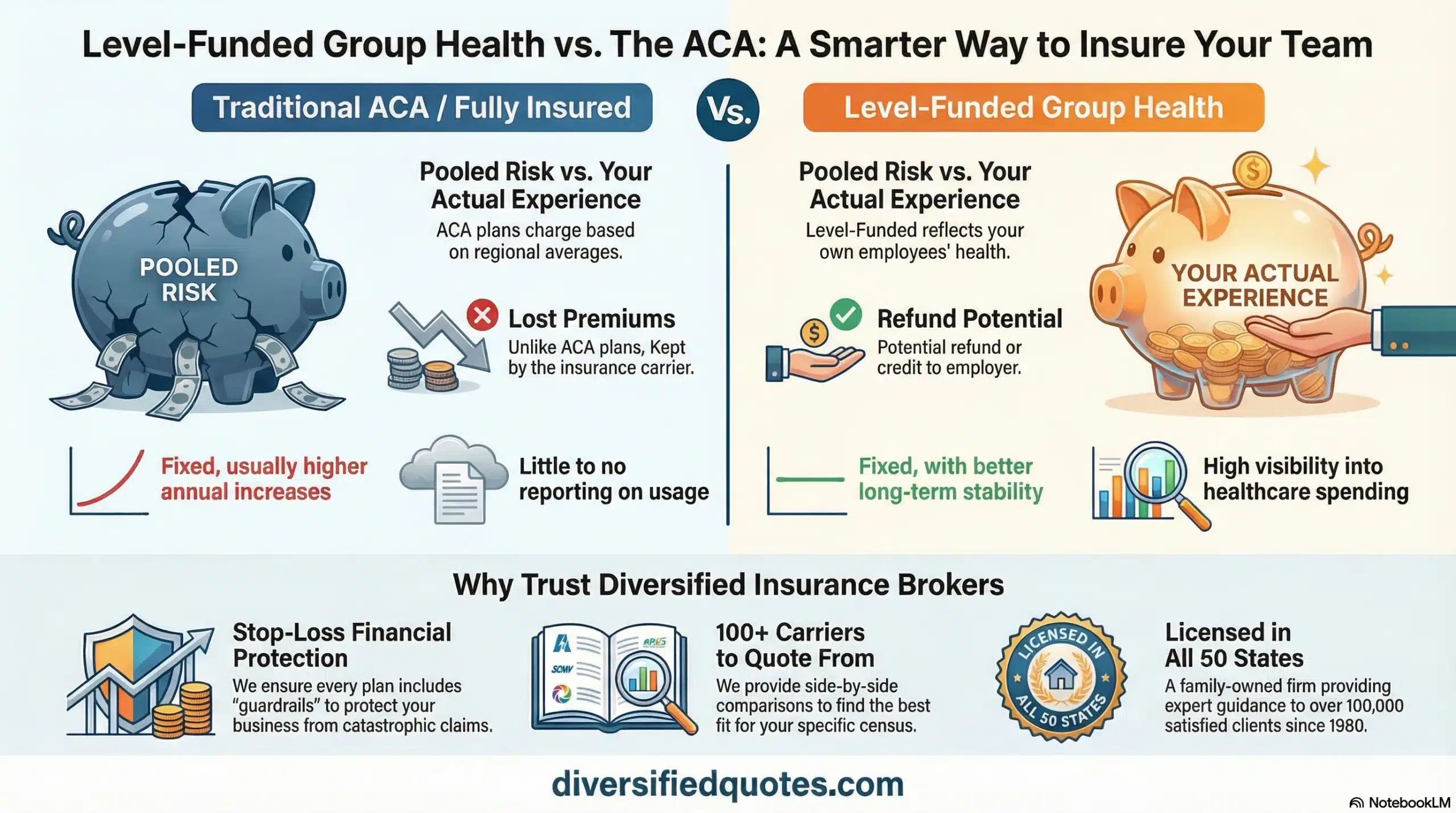
The limitations of fully insured plans become most visible at renewal. Fully insured premiums are set based on a combination of the school’s own claims experience and the carrier’s broader pooled market experience. When healthcare costs rise — as they have consistently across the market — the carrier passes those increases through in the form of premium adjustments at renewal. Fully insured schools typically have limited ability to understand what specifically drove an increase, limited ability to negotiate based on their own claims performance, and no mechanism to benefit from a year where their employees used less care than projected. The surplus that results from a favorable claims year disappears into the carrier’s broader pool rather than returning to the school. This asymmetry — the school bears the full cost of adverse experience through premium increases, but does not benefit from favorable experience — is the structural problem that alternative funding models address.
Level-Funded Plans — The Strategic Middle Path for Most Private Schools
Level-funded health plans have emerged as the most compelling option for many private schools in the 10-to-100 employee range — the size tier where fully insured plans are accessible but where the structural disadvantages of full insurance have become most visible in recurring large renewal increases. A level-funded plan maintains the predictable monthly payment structure of a fully insured plan — the school knows its cost per month at the beginning of the plan year — while introducing three features that change the economic relationship significantly: stop-loss protection that caps the school’s exposure if claims are unusually high, surplus refund provisions that return a portion of the monthly payment if claims run below projection, and claims reporting that gives the school genuine visibility into what is driving plan utilization.
The surplus potential is the most immediately appealing feature for school administrators and boards accustomed to group health insurance as a pure cost. In a favorable claims year — a year where the school’s employees use significantly less care than the funding formula projected — the school may receive a meaningful credit or refund at year-end. That surplus reflects the fact that the school paid into the plan based on projected claims, and actual claims were lower. Rather than disappearing into a carrier’s pool, the favorable experience returns to the school. This creates an incentive alignment that is entirely absent in traditional fully insured arrangements: the school now has a direct financial interest in supporting employee wellness, encouraging appropriate care-seeking behavior, and designing the plan to encourage cost-effective utilization decisions. Our resource on why group level funding works covers this incentive structure in detail for employers evaluating the transition from fully insured.
Self-Funded Plans — Transparency and Long-Term Cost Control for Larger Schools
Self-funded health insurance — where the school pays employee claims directly rather than paying premiums to a carrier to absorb the risk — has historically been associated with large employers because of the cash-flow requirements and administrative complexity involved. That association is partially outdated. With the right stop-loss structure protecting against catastrophic individual claims, and a capable Third-Party Administrator (TPA) managing day-to-day claims processing and compliance, self-funded plans can be appropriate for private schools with stable demographics and sufficient scale to absorb the variability in monthly claims costs.
The primary advantages of self-funding for schools that qualify are transparency and cost control. A self-funded plan gives school leadership complete visibility into what the employee population is actually spending on healthcare — which diagnoses are driving utilization, which services are being used heavily, whether the employee population’s care patterns suggest opportunities for wellness investment or benefit design adjustment. This information is genuinely valuable for managing the plan intelligently over multiple years. The cost control advantage comes from the combination of that transparency — knowing what to manage — with the direct connection between the school’s own claims experience and its renewal cost. A school that implements wellness initiatives, designs the plan to encourage appropriate utilization, and manages vendor relationships actively can produce meaningfully better cost outcomes under a self-funded structure than under the pooled market dynamics of fully insured pricing.
Participation and Contribution Requirements — The Two Operational Gates
Group health insurance for private schools, like all employer-sponsored group plans, operates within a framework of participation and contribution requirements that determine whether the plan is eligible for coverage and sustainable at renewal. Participation requirements dictate the minimum percentage of eligible employees who must enroll in the plan. Contribution requirements dictate the minimum percentage of the employee-only premium that the employer must pay. Both requirements exist to prevent adverse selection — the situation where only the sickest or highest-cost employees enroll while healthier employees opt out, which would produce an enrolled population with significantly above-average claims and unsustainable premiums.
Private schools often face particular participation challenges because many faculty and staff members have coverage available through a spouse or domestic partner’s employer-provided plan. When employees with spousal coverage decline the school’s plan, the participation rate falls — and if it falls below the carrier’s threshold (typically 70% of eligible employees who don’t have other qualifying coverage), the plan may be subject to special enrollment restrictions or non-renewal. Managing participation requires both design strategy — making the plan competitive enough with spousal coverage that employees choose the school’s plan — and documentation discipline, ensuring that employees who decline coverage because they have other qualifying coverage are properly documented as waiving for coverage reasons rather than simply declining. Our resource on the minimum employees for group health insurance page covers the full eligibility and participation framework that applies to these decisions.
Plan Design Choices That Educators Actually Value
Private school faculty and staff bring specific benefit priorities that differ somewhat from a typical commercial employer workforce. Provider access is frequently the most-cited concern — educators who have established relationships with specific physicians, specialists, or pediatricians for their families are often unwilling to change those relationships for a narrower network that might reduce premium cost. A plan that saves the school 15% on premiums but drives two or three senior faculty members away because their family’s longstanding specialists are out of network is not actually achieving a favorable outcome. Understanding the provider access preferences of the employee population — through a benefits survey, enrollment data review, or direct conversation with leadership — is an important input to network selection.
Family coverage affordability is the second major concern for private school educators, many of whom have younger families. The cost of adding dependents to an employer-sponsored plan has risen significantly as healthcare costs have increased, and schools that ask employees to bear the full cost of dependent coverage may find that the effective compensation package is significantly less competitive than the base salary and benefits summary might suggest. The contribution strategy — how the school splits premium costs with employees, and whether any subsidy is offered for dependent coverage — directly affects both the competitiveness of the school’s overall compensation package and the plan’s participation rate. A school that contributes meaningfully toward dependent premiums can often recruit and retain faculty who would otherwise need to factor the family coverage cost into their employment decision.
High-deductible health plans paired with Health Savings Accounts have become an increasingly popular plan design for private school employees because they offer a mechanism for managing the cost of the plan while giving employees a tax-advantaged account for healthcare expenses. When the school makes an employer contribution to employee HSAs at plan enrollment — a strategy that can replace a portion of the deductible in the employee’s pocket — the HDHP/HSA structure can be genuinely appealing to employees who understand it. The challenge is that many employees initially perceive high-deductible plans as “taking away” coverage rather than restructuring how coverage works, which makes communication and education critical to successful adoption. A tiered plan design that offers both an HDHP/HSA option and a traditional lower-deductible option gives employees meaningful choice while allowing the school to manage aggregate premium cost across the enrolled population.
Budget Predictability and Renewal Stability — The Multi-Year Goal
For private school administrators and boards, the most damaging version of group health planning is the annual surprise — the renewal notice that arrives in late fall projecting a 15% to 25% premium increase that hasn’t been budgeted and arrives too late in the year to meaningfully adjust the operating budget without disrupting other programs. This scenario is not inevitable, but it is the predictable outcome of a reactive renewal process where the school accepts the carrier’s first renewal offer, has no alternative carrier comparison to create negotiating leverage, and has no visibility into what drove the increase. The antidote to the annual surprise is a proactive renewal strategy that begins early — typically four to six months before the renewal date — gathers complete and accurate plan data, compares the renewal across multiple carriers and potentially across plan structures, and produces a decision that the school has time to implement correctly and communicate to employees without urgency-driven errors.
Renewal stability over multiple years is the real goal — not necessarily the lowest premium in any single year, but the most defensible and predictable cost trend over a three- to five-year horizon. Schools that chase the lowest premium available in any given year, switching carriers and plan structures frequently, often find that the short-term savings are offset by employee disruption, network access changes, and the administrative cost of repeated implementation. Schools that build a stable, well-structured plan and make modest, consistent design adjustments over time — adjusting the contribution strategy, deductible levels, or network tier to absorb modest cost increases without dramatic disruption — typically produce better multi-year outcomes for both the school’s budget and the employee experience.
Staffing Complexity — Part-Time Faculty, Coaches, and Split-Role Staff
One of the most distinctive administrative challenges in private school benefits is the diversity of employment classifications. A typical private school might employ full-time classroom teachers under year-round contracts, part-time specialists who teach two to four classes per week, coaches who work only during a specific athletic season, administrative assistants and office staff who may be at-will hourly employees, a facilities team with maintenance and groundskeeping responsibilities, and in some cases food service employees managed by a third-party vendor. Each of these categories has different hours, different compensation structures, and potentially different benefit eligibility requirements under the school’s plan and applicable law.
The school’s eligibility rules must be documented clearly and applied consistently. Inconsistent eligibility treatment — for example, informally offering coverage to some part-time employees while denying it to others in the same classification — creates both legal exposure and employee relations problems. The employer’s plan document must define eligibility precisely: which employees are eligible, what the applicable hours threshold is for each eligibility tier, what the waiting period is before eligibility begins, and how seasonal or year-round employment affects continuous eligibility. For very small schools in the 2-to-10 employee range, our resource on 2-person group health insurance covers the specific documentation and participation standards that apply at the smallest end of the qualifying group size spectrum.
Tax and Nonprofit Considerations
Most private schools operate as tax-exempt nonprofit organizations under Section 501(c)(3) of the Internal Revenue Code. This status affects how the school thinks about benefits costs, governance, and financial reporting — but it does not fundamentally change the mechanics of how group health insurance is structured or priced. Employer contributions to employee health insurance premiums are deductible for tax-paying employers; for tax-exempt organizations, the relevant consideration is how benefit costs are reported in the school’s Form 990 and how they are allocated in the operating budget.
Where nonprofit status does create meaningful considerations is in the governance dimension of benefit decision-making. Many private school boards maintain oversight of compensation and benefit decisions, which means transitions to alternative funding structures like level-funded or self-funded plans may require board presentation, formal approval, and documented rationale. This governance process is an appropriate use of board oversight — these are significant multi-year financial commitments — but it requires that the benefits decision process begin early enough to accommodate the governance timeline. A school that begins renewal evaluation only six weeks before the renewal date will not have time to complete the comparison process, present to the board, receive approval, negotiate with carriers, and implement the new plan without a rushed and error-prone process. Beginning the process four to six months out creates space for both a rigorous evaluation and a proper governance process. The tax advantage of employer-sponsored health coverage — the exclusion of the value of employer contributions from employee taxable income — applies equally to nonprofit and for-profit employers and represents one of the most efficient forms of employee compensation available regardless of institutional structure.
How to Compare Carriers and Plan Options Correctly
Comparing group health insurance options for a private school requires evaluating dimensions beyond the monthly premium — which is the most visible but not always the most important variable in the comparison. Carrier financial strength and claims-paying reliability over a multi-decade horizon matter for a relationship the school expects to maintain for years. Network breadth and depth matter specifically for the geographic area where most employees live and receive care. Formulary design and prescription drug coverage matter significantly for employees with chronic conditions who rely on consistent medication access. The quality of member services — the experience employees have when they call the carrier with a question or face a billing dispute — affects employee satisfaction with the plan and the administrative burden that falls on the school’s HR or operations staff.
For schools evaluating level-funded options, the comparison should also include the stop-loss structure — the specific per-member stop-loss threshold at which the carrier begins covering individual claims, and the aggregate stop-loss that caps the school’s total claims exposure for the year. Different carriers structure these thresholds differently, and the specific design of the stop-loss coverage has a significant effect on the financial risk profile of the plan. A school comparing two level-funded options primarily on the basis of monthly payment without understanding the stop-loss structure is making an incomplete comparison. Our second opinion group health insurance quote review service provides an independent market evaluation for schools that have already received a proposal and want to confirm it represents competitive terms across the full range of available options. Our best independent group health broker resource covers what to look for in an independent advisor for group health — and why independence from any single carrier is the structural prerequisite for a genuinely objective comparison.
Association Health Plans and Other Alternative Structures
Private schools that belong to regional or national associations — independent school associations, religious school networks, or educational accreditation organizations — may have access to association health plans that provide group purchasing power beyond what any individual school could access on its own. Association health plans aggregate the covered lives of multiple member organizations to create a larger risk pool, which can produce more favorable underwriting and more competitive pricing than individual school plans at the same member school’s size. Not all associations offer health plan access, and the quality and competitiveness of association plans varies significantly — but for schools that belong to associations with active benefit programs, the association plan should be included in the comparison process alongside individual carrier proposals.
For very small private schools — those with fewer than five to ten eligible employees — traditional group health plans may not be feasible or cost-effective, and alternative benefit strategies deserve consideration. Individual Coverage Health Reimbursement Arrangements (ICHRAs) allow employers of any size to reimburse employees for individually purchased health insurance without operating a traditional group plan, with no participation requirements and flexibility to vary reimbursement amounts by employee class. Qualified Small Employer Health Reimbursement Arrangements (QSEHRAs) provide a similar mechanism specifically designed for employers with fewer than 50 full-time equivalent employees. These alternatives may provide meaningful access to employer-sponsored health benefits for the smallest private schools while avoiding the minimum participation requirements and administrative infrastructure that traditional group plans require. Our resource on group health structure for the self-employed covers related alternative benefit arrangements for small employers.
Talk With an Advisor Today
Choose how you’d like to connect—call or message us, then book a time that works for you.
Schedule here:
calendly.com/jason-dibcompanies/diversified-quotes
Licensed in all 50 states • Fiduciary, family-owned since 1980
FAQs: Group Health Insurance for Private Schools
Can a private school offer group health insurance with only a few employees?
Yes. Most states and most carriers support group health coverage for employers with as few as two eligible unrelated W-2 employees. For very small private schools — those with fewer than five or ten full-time staff — the options may be limited to fully insured small-group plans, with level-funded and self-funded alternatives becoming available as employee count grows. The key eligibility requirements are meeting the minimum employee threshold, satisfying participation standards (typically 70% of eligible employees who don’t have other qualifying coverage), and meeting the employer contribution requirement (typically 50% of the employee-only premium). Schools in the smallest size tier may also want to evaluate Individual Coverage HRAs (ICHRAs) or QSEHRAs as alternatives to traditional group plans if participation requirements are difficult to meet.
What is the difference between fully insured and level-funded plans for private schools?
Under a fully insured plan, the school pays a fixed premium and the insurance carrier assumes all claims risk. If claims are high, the carrier absorbs the excess; if claims are low, the carrier retains the surplus. Under a level-funded plan, the school still makes a predictable monthly payment, but stop-loss protection caps the school’s exposure if claims are unusually high, and the school receives a refund or credit if claims run below the projected level for the year. Level-funded plans also provide claims reporting that gives school leadership visibility into what is driving utilization — information that is typically not available under fully insured plans. For schools experiencing repeated large premium increases under fully insured arrangements, level-funded plans are often the most accessible next step toward better cost control.
Are self-funded health plans realistic for private schools?
Self-funded plans can be appropriate for private schools with stable demographics, sufficient employee count to support meaningful risk pooling, and governance capacity for active plan management. With the right stop-loss structure protecting against catastrophic individual claims and a capable Third-Party Administrator managing day-to-day claims and compliance, self-funded plans provide full claims transparency and the most direct connection between the school’s own experience and its renewal cost. For schools in the 10-to-25 employee range, level-funded plans typically represent a more appropriate middle path. For schools with 50 or more eligible employees and stable enrollment patterns, self-funding deserves serious evaluation as the long-term cost-control structure.
How do private schools handle participation requirements when many employees have spousal coverage?
Participation requirements for fully insured small-group plans typically require 70% of eligible employees who don’t have other qualifying coverage to enroll. Employees who decline coverage because they have credible alternative coverage through a spouse’s employer plan, Medicare, or Medicaid are typically excluded from the participation calculation denominator. The key is documentation: employees who decline for coverage reasons must formally document their waiver citing the specific alternative coverage, rather than simply declining. Schools should maintain consistent waiver documentation processes and update them annually during open enrollment. Poorly documented waivers can be counted against the school’s participation rate, creating unnecessary compliance complications at renewal. Plan design that makes the school’s plan competitive with spousal alternatives also helps maintain participation among employees who have a genuine choice.
Can private schools offer coverage to part-time teachers or seasonal staff?
It depends on the school’s eligibility rules, the plan design, and applicable state and federal requirements. Most fully insured group plans define full-time eligibility at 30 hours per week, though some carriers allow schools to define eligibility at 20 or more hours. Part-time instructors who work below the hours threshold are typically not eligible unless the school specifically designs the plan to include a part-time eligible class. Coaching and seasonal staff present additional complexity because their hours may vary significantly during the season. The school’s plan document must define eligibility criteria precisely and apply them consistently — inconsistent treatment within the same employee classification creates legal and employee relations exposure. Schools with complex staffing models benefit from a broker who can help design eligibility rules that are defensible, consistent, and compliant.
How can private schools control group health costs without cutting benefits?
Cost control in group health insurance is not primarily achieved by reducing benefits — it is achieved through plan design, funding structure, and utilization management. Plan design levers include adjusting deductibles, copay structures, and network tiers in ways that encourage cost-effective care-seeking without making care inaccessible. Funding structure transitions — from fully insured to level-funded, or from level-funded to self-funded for appropriately sized schools — create opportunities for the school to benefit from favorable claims experience rather than watching the surplus disappear into a carrier pool. Utilization management through wellness programs, telemedicine access, and employee education about navigating benefits effectively can reduce unnecessary emergency room visits, duplicate testing, and other high-cost care patterns. A combination of these levers, applied consistently over multiple years, typically produces better cost outcomes than any single-year change in benefits design.
What compliance responsibilities do private schools have with group health insurance?
Private schools offering group health insurance must manage several compliance obligations. ERISA requires the maintenance of a Summary Plan Description and a formal Plan Document. COBRA administration is required for employers with 20 or more employees, obligating the school to offer continuing coverage to employees and dependents following qualifying events. HIPAA governs the privacy of protected health information. ACA rules apply to employers with 50 or more full-time equivalent employees (Applicable Large Employers) but also affect plan design requirements for smaller employers related to essential health benefits, preventive care, and coverage limitations. Annual notices required by CMS, the Department of Labor, and state insurance departments must be distributed to all eligible employees on defined schedules. Self-funded plans carry additional compliance responsibilities because more administrative functions shift closer to the employer. Working with an independent broker and an experienced benefits administration partner helps ensure these obligations are managed consistently without creating gaps in coverage or compliance exposure.
How far in advance should a private school start the renewal evaluation process?
Four to six months before the renewal date is the recommended starting point for any meaningful renewal evaluation — and longer for schools considering a transition to a different funding structure. Beginning the process early allows time for gathering complete plan data (claims history for level-funded and self-funded comparisons, enrollment data, current plan documents), distributing RFPs to multiple carriers and brokers for competitive comparison, completing the analysis and decision process without urgency-driven errors, presenting to the board for governance review and approval if required, negotiating final terms with the selected carrier or TPA, and implementing the new plan and communicating changes to employees before the effective date. Schools that begin renewal evaluation only four to six weeks before the effective date are typically forced to choose between accepting the carrier’s initial renewal offer or rushing through a comparison process that produces errors and employee confusion. Starting early is one of the most consistently impactful improvements a private school can make to its benefits renewal process.
About the Author:
Jason Stolz, CLTC, CRPC, DIA, CAA and Chief Underwriter at Diversified Insurance Brokers (NPN 20471358), is a senior insurance and retirement professional with more than 25 years of real-world experience helping individuals, families, and business owners protect their income, assets, and long-term financial stability. As a long-time partner of the nationally licensed independent agency Diversified Insurance Brokers, Jason provides trusted guidance across multiple specialties—including fixed and indexed annuities, long-term care planning, personal and business disability insurance, life insurance solutions, Group Health, Travel Medical and Evacuation Insurance, and short-term health coverage. Diversified Insurance Brokers maintains active contracts with over 100 highly rated insurance carriers, ensuring clients have access to a broad and competitive marketplace.
His practical, education-first approach has earned recognition in publications such as VoyageATL, and contributions from his agency featured in Kiplinger and GoBankingRates— highlighting his commitment to financial clarity and client-focused planning. Drawing on deep product knowledge and years of hands-on field experience, Jason helps clients evaluate carriers, compare strategies, and build retirement and protection plans that are both secure and cost-efficient. Visitors who want to explore current annuity rates and compare options across multiple insurers can also use this annuity quote and comparison tool.
Explore More Group Health Insurance Options: Browse our complete guide to Group Health Insurance by Industry — covering law firms, consulting, construction, medical practices, schools & more from 100+ carriers.
Last Reviewed: June 2, 2026 |
Reviewed by: Jason Stolz, CLTC, CRPC, DIA, CAA
Chief Underwriter, Diversified Insurance Brokers, Inc. | NPN: 20471358 | Diversified Insurance Brokers, Inc. — Licensed in all 50 states
Fact Checked by: Tonia Pettitt, CMIP©
Medicare Specialist, Diversified Insurance Brokers, Inc. | NPN: 14374308 | Diversified Insurance Brokers, Inc. — Licensed in all 50 states
Did you find this content helpful? Leave us a Google review — it helps others find trustworthy guidance too.
Editorial Standards: Diversified Insurance Brokers maintains rigorous editorial standards to ensure accuracy, clarity, and independence in all content. Learn more about our editorial standards and commitment to transparency.
