
Disability Insurance Elimination Periods Explained
As an Independent Disability Insurance Broker, we have access to exclusive discounts and negotiated pricing most captive agents can’t offer — see the full breakdown near the end of this page.
Disability Insurance Elimination Periods Explained

Jason Stolz CLTC, CRPC, DIA, CAA
The elimination period is the single most misunderstood feature in disability insurance — not because it is complicated, but because most buyers focus on the monthly benefit amount and benefit period while treating the elimination period as an afterthought. That ordering gets the decision wrong. The elimination period determines how large your personal financial exposure is at the exact moment a disability begins. It determines how much savings you must have available to bridge the gap between your last paycheck and your first benefit payment. And it is the feature most directly connected to your real-world risk if a disability strikes while your emergency reserves are lower than planned. A thorough understanding of how elimination periods work — including how they are counted, how contract language affects that count, and how to coordinate with other coverage sources — is essential before finalizing any disability insurance policy. The disability insurance services hub covers the full framework for building individual DI coverage, and the broader income protection insurance context covers how the elimination period fits within a complete disability planning strategy.
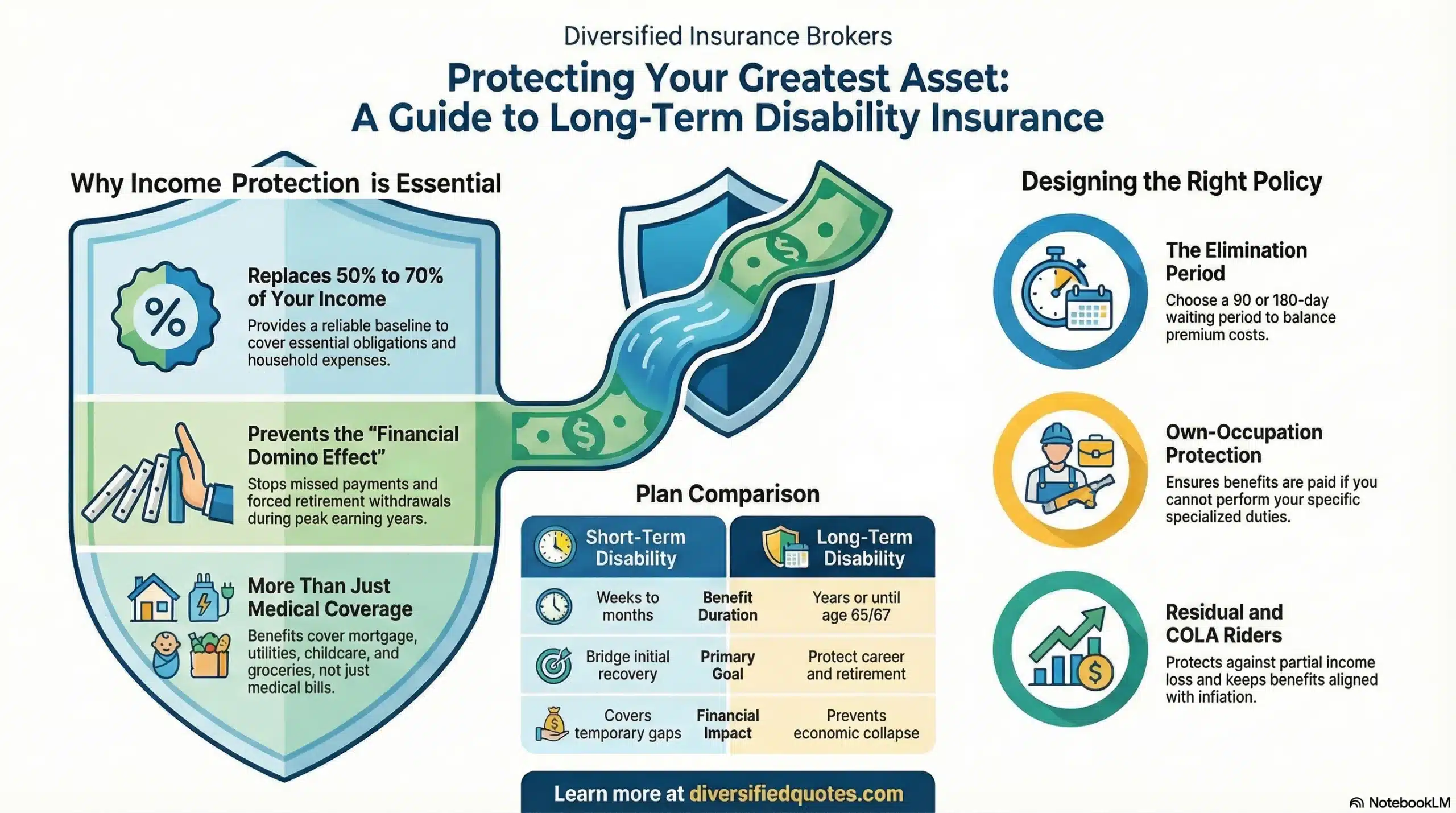
Most individual long-term disability policies offer elimination periods of 30, 60, 90, 180, or 365 days. A 90-day elimination period is the most common choice across the industry because it balances premium affordability with a realistic financial exposure window. Shorter elimination periods provide faster access to benefits but carry significantly higher premiums — particularly in the 30-day range, where the higher probability of short-term claim activity drives premium costs 15-25% or more above 90-day options. Longer elimination periods — 180 and 365 days — produce diminishing additional premium savings; the difference between a 90-day and 180-day elimination period is often only $10-$20 per month, while the additional financial exposure during the extended waiting period is substantial. For most professionals with adequate emergency reserves, 90 days represents the practical optimum. The key is matching the elimination period to actual available resources that can bridge the gap, not to what minimizes the monthly premium.
Protect Your Income With the Right Waiting Period
Request a personalized disability income quote and choose the elimination period that fits your savings strategy.
Request Disability Income QuoteCommon Elimination Period Options — Comparing the Tradeoffs
| Elimination Period | Premium Impact | Savings / Bridge Required | Best Fit |
|---|---|---|---|
| 30 days | Highest — typically 15-25%+ above 90-day premium; insurer absorbs the most common short-term disability risk | One month of essential expenses; modest buffer needed | Workers with minimal savings, immediate income dependence, no employer STD coverage, or irregular cash flow that cannot sustain a longer gap |
| 60 days | Moderately higher than 90-day; still meaningfully more expensive than 90-day due to the frequency of claims in the 30-60 day range | Two months of essential expenses; attainable for most professionals with modest reserves | Workers who want faster access than 90 days but cannot afford the premium of a 30-day period; a reasonable middle option for those building emergency savings |
| 90 days | Industry standard; most commonly quoted base point; the sweet spot between claim probability and premium cost | Three months of essential expenses; $5,000/month income = $15,000 bridge required; more for higher earners | The default choice for most employed professionals with established emergency savings or an employer short-term disability plan that bridges the gap |
| 180 days | Marginally lower than 90-day — often only $10-$20/month savings; diminishing returns beyond 90-120 days are significant | Six months of essential expenses; $5,000/month income = $30,000 bridge required | Financially disciplined professionals with 6+ months of liquid savings who want to reduce lifetime premium cost; only appropriate when the bridge is genuinely available |
| 365 days | Minimal additional savings beyond 180-day — often negligible in monthly premium terms; the financial exposure risk is the dominant consideration | One year of essential expenses; requires very substantial liquid reserves | High-net-worth professionals with a year of liquid reserves who are primarily concerned with catastrophic long-term protection and want the lowest possible ongoing premium |
What the Elimination Period Actually Means in Practice
The elimination period begins on the date you become disabled — typically the date you stop working due to injury or illness, not the date you file a claim or the date of diagnosis. This distinction matters because the clock starts with the event, not the paperwork. Most policies require claims to be filed within 60-90 days of becoming disabled; waiting longer can delay your first benefit payment even if the EP has been fully satisfied by then.
During the elimination period, you receive no benefits from your LTD policy. You are entirely responsible for covering essential living expenses: mortgage or rent, utilities, vehicle, food, insurance premiums, debt service, and any other fixed financial obligations. For a professional earning $10,000 per month, a 90-day elimination period represents $30,000 in personal financial exposure at the exact moment a health crisis is also generating medical costs and stress. For a professional earning $20,000 per month, the same 90-day period represents $60,000 in exposure. The elimination period is not a small consideration — it is the financial risk you are retaining personally in exchange for lower premiums. Understanding that retention risk clearly is the foundation for choosing the right waiting period. The broader long-term disability insurance framework covers how the EP fits within the complete policy design, including benefit period selection and rider choices that together determine real-world financial protection. The is disability insurance worth it context helps frame why this planning matters even when disability feels like a distant risk.
Continuous vs. Cumulative EP Satisfaction — A Contract Distinction That Matters
How your policy counts days toward the elimination period is one of the most important and least-read contract provisions. Some policies require continuous disability — you must be disabled without interruption for the full elimination period before the waiting period is satisfied. If you return to work for even one day during the EP and then relapse, the clock starts over. This matters enormously for conditions that fluctuate: chronic pain that allows brief returns to work, autoimmune conditions with periods of remission, or mental health conditions where function varies from week to week.
More favorable policies include an accumulation provision — also called an accumulation period — which gives you a longer window (typically twice the EP length) to accumulate the required number of disability days. Under this structure, if your elimination period is 90 days and the accumulation window is 180 days, you need to accumulate 90 days of disability within any 180-day span. If you return to work after 30 days, realize you cannot sustain it, and stop again, you do not lose the 30 days already accumulated. Your remaining EP is only 60 days. This provision is significantly more protective for fluctuating conditions and is worth identifying in any policy under consideration. The contract language around EP mechanics should be reviewed before any policy is purchased — and an independent broker can help identify which carriers use the most favorable accumulation provisions. This is directly relevant to how residual disability benefits interact with the elimination period, since some policies allow residual benefit qualification during EP if the income loss threshold is met even before total disability criteria are satisfied.
Recurrent Disability — When the Clock Does Not Reset
A recurrent disability provision addresses what happens if you satisfy the elimination period, collect benefits for a while, return to work, and then become disabled again from the same or related condition within a specified timeframe. Without this provision, you would have to satisfy a new elimination period from the beginning. With it, most policies treat the relapse as a continuation of the original claim if it occurs within the recurrence window — typically 3 to 6 months from the return-to-work date. This provision is particularly important for conditions with high relapse probability: back conditions, depression and anxiety disorders, cancer that goes into remission, or chronic conditions that are manageable for periods before requiring re-treatment. Understanding the recurrent disability terms in your specific policy prevents the surprise of discovering you must re-satisfy the EP when a condition you thought was resolved returns. This is a contract mechanic worth confirming before a disability occurs, not after. The disability insurance riders framework covers how recurrent disability provisions interact with other policy features, including the COLA rider that adjusts benefit amounts during long-duration claims.
Coordinating Short-Term and Long-Term Disability Coverage
The most effective way to handle the elimination period gap is to coordinate short-term and long-term disability coverage so one bridges into the other without a gap in income. Short-term disability coverage typically features 0-14 day elimination periods and benefit periods of three to six months. Long-term disability policies typically begin after 90 or 180 days. The ideal coordination structure: a short-term disability policy that pays for 90 days matches perfectly with a long-term policy using a 90-day elimination period. Benefits transition seamlessly from one to the other, creating continuous income replacement with no coverage gap. The full comparison of these two coverage types — how they differ in structure, duration, and purpose — is covered at short-term vs. long-term disability insurance.
Employer-provided sick leave and PTO can also reduce effective exposure during the EP. Many employer disability plans require exhausting sick leave before STD benefits begin, meaning total income may continue at full salary for some initial period before a gap opens. For new professionals with limited PTO accrual, or for 1099 workers with no employer benefits at all, the EP must be bridged entirely with personal savings — making the savings-to-EP alignment even more critical to plan correctly from the start.
How Much Savings Do You Need During the Elimination Period
The financial exposure calculation is straightforward but often underestimated: multiply your monthly essential expenses by the number of months in your elimination period. Essential expenses include mortgage or rent, utilities, vehicle payments, food, insurance premiums (including health insurance), debt minimums, and any other non-discretionary fixed obligations. This is the minimum liquidity buffer required to sustain a disability through the full EP without depleting retirement savings, liquidating investments, or accumulating high-interest debt. For a professional with $6,000 in monthly essential obligations, a 90-day EP requires $18,000 readily available in liquid savings before selecting that elimination period. A 180-day EP with the same expenses requires $36,000. What should not be used as EP bridge planning: retirement accounts (early withdrawal creates tax penalties and permanent wealth destruction), home equity lines of credit (taking on debt during a disability creates repayment obligations that compound the financial stress), or the assumption that you can cut expenses significantly during recovery (medical costs typically increase during the same period income decreases). The full calculation framework for right-sizing disability coverage — including how EP selection integrates with overall benefit sizing — is at how much disability insurance do I need.
How the Elimination Period Differs by Profession and Income Structure
The right elimination period is not universal across all occupations — it depends heavily on how income flows, whether employer bridge resources exist, and how quickly a disability would create financial pressure. Employed professionals with stable W-2 salaries, accrued PTO, and an employer short-term disability plan can often comfortably absorb a 90-day EP because income continues at some level through the initial period. Self-employed professionals and independent contractors have none of those bridges — when income stops, it stops on day one, and the full EP must be covered personally. Self-employed disability insurance planning should default to shorter elimination periods than the industry standard unless very strong emergency reserves exist. High-income specialists — physicians, dentists, and anesthesiologists — face particularly significant EP exposure because their monthly income is higher, making the absolute dollar exposure during any EP disproportionately large even at standard percentage savings. A physician earning $30,000 per month faces $90,000 in exposure during a standard 90-day EP — a figure that warrants careful savings analysis before accepting that period as the default. The disability insurance for physicians framework covers EP coordination alongside the medical residency context that makes early-career EP planning different from established practice. For office-based professionals like accountants and engineers with more typical salary structures, 90 days with adequate savings represents the standard planning approach. High-risk occupational roles — covered at disability insurance for high-risk occupations — may have carriers apply EP requirements differently, and disability insurance for pilots illustrates how specialized occupation contracts can have specific EP structure requirements tied to occupational risk.
The Elimination Period Within Your Full DI Policy Design
The elimination period is one of five major design decisions in a disability policy — alongside benefit amount, benefit period, disability definition, and rider selection. These decisions are not independent; they interact. A longer EP reduces premium, freeing budget for a stronger disability definition or additional riders. A shorter EP increases premium, potentially constraining what can be added elsewhere. For most buyers, the right sequence is: first, establish how much savings is genuinely available to bridge the EP gap without financial stress; second, select the EP that matches that available bridge; third, allocate the remaining premium budget to the strongest definition and benefit period possible.
Tax treatment intersects with this planning as well. When you pay disability premiums with personal after-tax dollars, benefits are generally received income-tax-free — meaning each benefit dollar is available without a tax reduction. This affects how large the benefit needs to be to replace actual take-home income, which in turn affects how much of the gross income replacement ratio needs to be covered by the benefit vs. bridged by savings during the EP. The full tax framework is at are disability insurance payments taxable. For business owners with fixed overhead beyond personal income, the EP coordination extends to the business overhead disability insurance policy alongside the personal LTD policy — both policies have their own EP requirements, and the business overhead exposure during the personal LTD EP must be separately accounted for. High income disability insurance covers EP planning at income levels where the exposure during any EP period is particularly significant, and the broader disability insurance by occupation resource covers how EP selection integrates with occupational class and available benefit designs across all professional categories. For an independent evaluation of how your current or proposed disability policy’s elimination period is structured, get a 2nd opinion on your disability insurance quote covers the review process.
Talk With an Advisor Today
Choose how you’d like to connect—call or message us, then book a time that works for you.
Schedule here:
calendly.com/jason-dibcompanies/diversified-quotes
Licensed in all 50 states • Fiduciary, family-owned since 1980
FAQs: Disability Insurance Elimination Periods Explained
What is an elimination period in disability insurance?
The elimination period is the waiting period between when your disability begins and when your policy starts paying benefits. It functions like a time-based deductible — instead of paying a dollar amount out of pocket, you are self-insuring the initial period of a disability from personal savings or other income sources. Common elimination periods for long-term disability insurance are 30, 60, 90, 180, and 365 days. The longer the elimination period, the lower the premium — but the greater your personal financial exposure if a disability occurs while savings are limited.
Is a 90-day elimination period the right choice for most people?
For most employed professionals with adequate emergency savings — typically three months of essential living expenses in liquid, accessible form — a 90-day elimination period represents the industry standard sweet spot between affordability and realistic financial exposure. Many employer-sponsored plans also use 90 days. However, the right EP depends on your specific situation: self-employed and 1099 workers with no employer bridge resources may need a 30- or 60-day EP, while financially disciplined individuals with 6+ months of liquid savings might reasonably extend to 180 days for modest premium savings. The EP should match your actual available bridge, not what minimizes the monthly premium.
What is the difference between a continuous and cumulative elimination period?
A continuous elimination period requires uninterrupted disability for the full EP length — returning to work even briefly resets the clock. A cumulative elimination period (also called an accumulation provision) allows you to total the required disability days within a longer window. For example, 90 days of disability accumulated within a 180-day window satisfies the EP, even if you returned to work for periods in between. The cumulative structure is significantly more protective for fluctuating conditions — chronic pain, autoimmune disorders, mental health conditions — and is worth identifying when comparing policies. This contract distinction is one of the most important EP mechanics to verify before purchasing.
What happens if I return to work during the elimination period and then become disabled again?
It depends on the contract language and whether the policy uses a continuous or cumulative EP structure. Under a continuous EP without an accumulation provision, returning to work during the EP typically resets the clock. Under a cumulative provision, previously accumulated days are usually credited and the remaining EP continues from where you left off. Additionally, most policies include a recurrent disability clause that applies once you have already satisfied the EP and collected benefits: if you return to work and then become disabled again from the same or related condition within the recurrent disability window (typically 3-6 months), the policy may allow you to resume the claim without satisfying a new elimination period. Review both your EP satisfaction method and your recurrent disability provision before a disability occurs.
How does short-term disability coordinate with the long-term disability elimination period?
The most effective coordination is to match the short-term disability benefit period to the long-term elimination period. If your LTD policy has a 90-day elimination period and you carry a short-term disability policy that pays for up to 90 days, benefits transition seamlessly from one to the other with no income gap. If you carry only long-term coverage, your personal savings must bridge the entire elimination period. Some policies allow short-term disability benefits to satisfy the LTD elimination period directly — meaning the clock continues running even while short-term benefits are paying. Confirm this coordination mechanic with your specific carriers, as terms vary.
Is there a significant premium difference between a 90-day and 180-day elimination period?
Typically minimal — often only $10-$20 per month. The major premium savings in EP selection happen in the short ranges: going from 30 days to 90 days produces substantial savings because the probability of a 30-60 day claim is significantly higher than a 90+ day claim. Once the EP is extended beyond 90-120 days, the additional actuarial risk reduction is modest, and the premium savings follow suit. The practical implication is that most professionals should choose their EP based on available savings rather than premium optimization — going from 90 to 180 days saves very little in premium while doubling the personal financial exposure during a disability.
About the Author:
Jason Stolz, CLTC, CRPC, DIA, CAA and Chief Underwriter at Diversified Insurance Brokers (NPN 20471358), is a senior insurance and retirement professional with more than 25 years of real-world experience helping individuals, families, and business owners protect their income, assets, and long-term financial stability. As a long-time partner of the nationally licensed independent agency Diversified Insurance Brokers, Jason provides trusted guidance across multiple specialties—including fixed and indexed annuities, long-term care planning, personal and business disability insurance, life insurance solutions, Group Health, Travel Medical and Evacuation Insurance, and short-term health coverage. Diversified Insurance Brokers maintains active contracts with over 100 highly rated insurance carriers, ensuring clients have access to a broad and competitive marketplace.
His practical, education-first approach has earned recognition in publications such as VoyageATL, and contributions from his agency featured in Kiplinger and GoBankingRates— highlighting his commitment to financial clarity and client-focused planning. Drawing on deep product knowledge and years of hands-on field experience, Jason helps clients evaluate carriers, compare strategies, and build retirement and protection plans that are both secure and cost-efficient. Visitors who want to explore current annuity rates and compare options across multiple insurers can also use this annuity quote and comparison tool.
Explore More Disability Insurance Options: Browse our complete guide to Disability Insurance Planning & Education — covering how it works, riders, elimination periods, own occupation, costs & buying guides from 100+ carriers.
Last Reviewed: June 6, 2026 |
Reviewed by: Jason Stolz, CLTC, CRPC, DIA, CAA
Chief Underwriter, Diversified Insurance Brokers, Inc. | NPN: 20471358 | Diversified Insurance Brokers, Inc. — Licensed in all 50 states
Fact Checked by: Tonia Pettitt, CMIP©
Medicare Specialist, Diversified Insurance Brokers, Inc. | NPN: 14374308 | Diversified Insurance Brokers, Inc. — Licensed in all 50 states
Did you find this content helpful? Leave us a Google review — it helps others find trustworthy guidance too.
Editorial Standards: Diversified Insurance Brokers maintains rigorous editorial standards to ensure accuracy, clarity, and independence in all content. Learn more about our editorial standards and commitment to transparency.
