
Annuities in Your 40s and 50s
As an Independent Annuity Broker, we compare rates across 100+ carriers and 1,000 different annuities— not just one company’s product offerings — to find the best fit for your goals.
Annuities in Your 40s and 50s

Jason Stolz CLTC, CRPC, DIA, CAA
Annuities in your 40s and 50s represent one of the most strategically valuable retirement planning decisions available during your peak earning years — not because annuities are universally appropriate for everyone in this age range, but because the time horizon available at this life stage is precisely what makes annuity deferral most powerful. An individual who funds a fixed indexed annuity with an income rider at age 48 and defers income activation for 15 years allows the income base to compound through the roll-up mechanism for a period that dramatically increases the guaranteed annual withdrawal amount at retirement. The same individual who waits until age 60 and defers for only three years before income begins has a fraction of the income base growth advantage. The annuity deferral window — the time between funding and income activation — is the core financial engine of income-focused annuity strategies, and that window is never wider or more available than in your 40s and 50s.
The financial context of your 40s and 50s also creates a specific vulnerability that annuities in your 40s and 50s are designed to address. This period is characterized by peak income, maximum investment balances, and the early stages of the critical zone — the 5-10 years before and after retirement — during which sequence of returns risk is most damaging. A portfolio that suffers a significant drawdown at age 58 does not have 30 years to recover. It has perhaps 7-10 years before income withdrawals begin — and those withdrawals will accelerate the damage done by a market decline at the wrong moment. Allocating a portion of the retirement portfolio to guaranteed income vehicles during your 40s and 50s is not a conservative retreat from growth — it is a structural risk management decision that protects the income the rest of the portfolio is intended to generate. At Diversified Insurance Brokers, Jason Stolz, CLTC, CRPC, DIA, CAA helps mid-career professionals design annuity strategies that fit their specific income timeline, tax situation, and liquidity requirements — comparing products across our carrier network to identify which annuity structure produces the best income outcome for a given funding date, deferral period, and retirement age. Our resource on who is best suited for an indexed annuity covers the suitability analysis framework for this age group specifically.
Ensure you are receiving the absolute top rates
Current Fixed Annuity Rates
Compare today’s best fixed annuity rates from top carriers.
View Current RatesCurrent Bonus Annuity Rates
See which annuities offer the highest upfront bonus today.
View Bonus RatesRequest an Annuity Quote
Submit our annuity request form to get personalized rate options.
Quote Request FormLifetime Income Calculator
Use our calculator to see how much guaranteed income your annuity can provide.
How Different Annuity Types Serve Different 40s and 50s Priorities
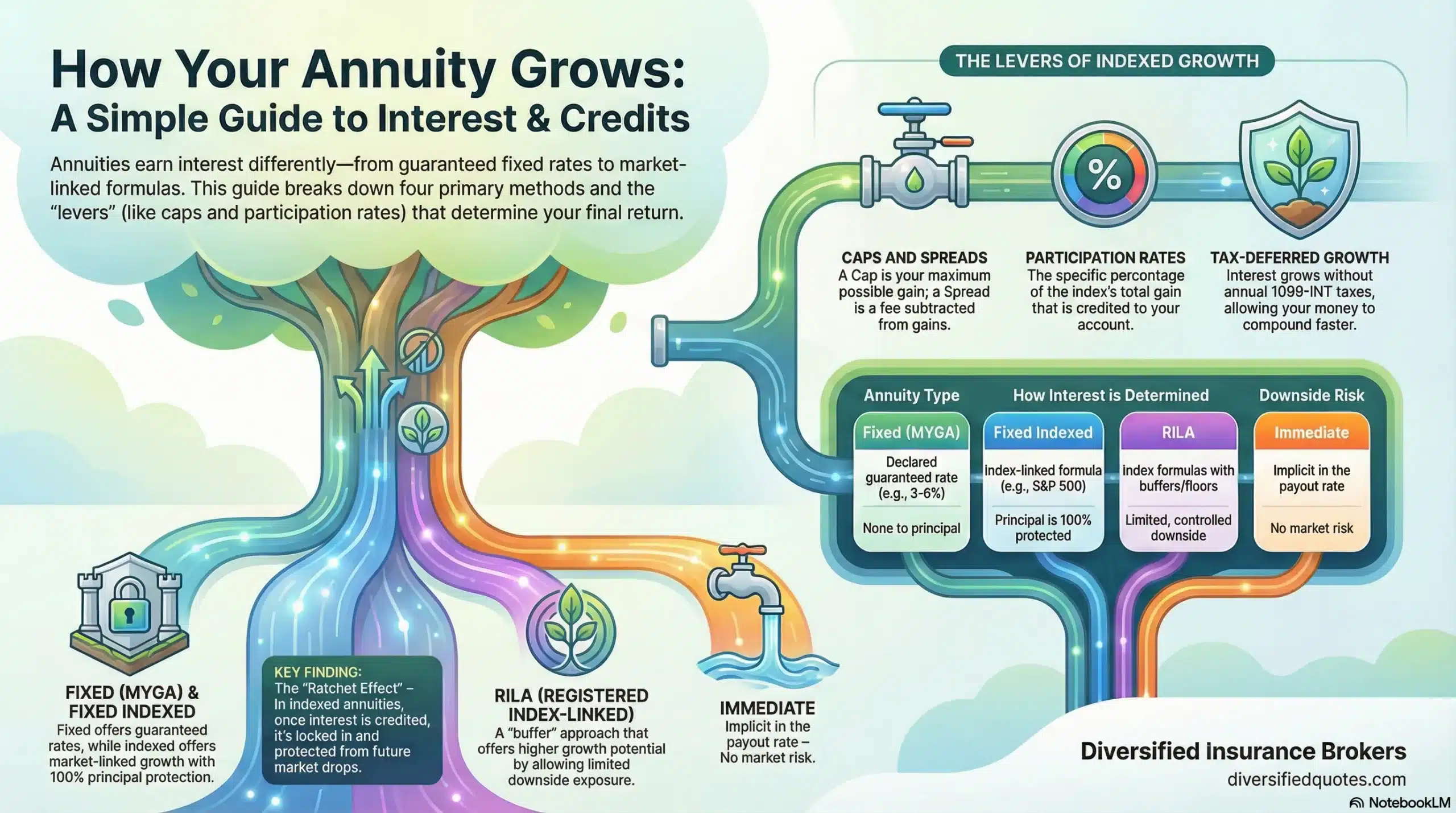
Annuities in your 40s and 50s are not one product but a product category — and the most appropriate annuity structure depends on which retirement planning priority is most pressing at a given point in the decade. The comparison below maps the four most commonly relevant annuity structures to the specific priorities that mid-career professionals in this age group are trying to solve.
| Priority | Fixed Annuity (MYGA) |
FIA Without Income Rider |
FIA With Income Rider (GLWB) |
Bonus FIA With Income Rider |
|---|---|---|---|---|
| Maximize guaranteed income at retirement | Moderate — accumulation can be annuitized but no built-in income roll-up | Moderate — index crediting grows account value; income requires annuitization | Best — income base roll-up during long deferral creates maximum guaranteed payout | Best + — bonus amplifies the starting income base, accelerating roll-up compounding |
| Tax-deferred accumulation beyond 401(k)/IRA limits | Yes — declared rate compounds tax-deferred in non-qualified annuity | Yes — index credits compound tax-deferred with principal protection | Yes — account value grows tax-deferred alongside income base roll-up | Yes — bonus enhances starting base for both tax-deferred account value and income |
| Principal protection from market loss | Full — declared rate, no market exposure | Full — floor prevents market-driven loss | Full — account value floor; income base grows independently | Full — same as FIA + rider; bonus protected from day one |
| Upside participation in favorable markets | None — declared rate is fixed regardless of market performance | Yes — index credits in positive years (subject to cap/participation) | Partial — account value participates; rider fee reduces net crediting | Partial — same as FIA + rider; rider fee is the primary growth constraint |
| Liquidity during deferral period | Limited — free withdrawal provision; surrender charges on excess | Limited — same as MYGA structure | Limited — excess withdrawals can permanently reduce income base | Most restricted — bonus vesting schedule adds complexity to early access |
| Best age range for starting | Any — most effective as near-term protected accumulation (3-10 yr term) | 40s-mid 50s — benefits from index growth over medium deferral | Early-to-mid 40s — longer deferral produces the highest income | Early-to-mid 40s — bonus amplification is most valuable with 15+ year deferral |
The table clarifies the central argument for annuities in your 40s and 50s: the longer the deferral period between funding and income activation, the more powerful the income rider roll-up mechanism — and the 40s and early 50s represent the optimal window for capturing that compounding effect. A buyer who funds at 45 with a 15-year deferral horizon has more than twice the roll-up growth available compared to a buyer who funds at 58 with a 7-year deferral horizon, using the same contract and the same premium. Our resource on guaranteed lifetime withdrawal benefits explained covers the income rider mechanics that drive this deferral advantage in full detail.
The Financial Reality of Your 40s and 50s — Why Annuity Timing Matters Now
Your 40s and 50s are simultaneously your highest earning years and the beginning of the critical zone for retirement income planning. This dual reality creates a specific set of financial conditions that makes annuities in your 40s and 50s particularly valuable as a planning tool. Income is high, meaning there is capital available for annuity funding. Tax brackets are elevated, meaning tax-deferred accumulation produces meaningful after-tax compounding advantages. Retirement is 10-25 years away, meaning the deferral window for income base roll-up is at its maximum. And market balances are large enough that a significant drawdown — 25%, 30%, 35% — translates into six-figure or seven-figure losses from which a portfolio with a limited recovery window may not fully recover before income withdrawals begin.
The sequence of returns risk that makes annuities in your 40s and 50s a structural retirement income tool is not a theoretical concern — it is the mechanism that has caused retirement income plans to fail for households that appeared well-funded at peak earning years. A household with $1.5 million in equity-heavy retirement accounts at age 56 that experiences a 35% drawdown in the two years before planned retirement at 60 faces a $525,000 reduction in the portfolio from which withdrawals must begin. The market may recover over the following decade — but withdrawals taken from the depleted balance during that recovery permanently prevent full recovery by removing shares from the pool available to participate in the rebound. Allocating a portion of that $1.5 million to principal-protected annuity vehicles before the drawdown scenario occurs — not after — eliminates this risk from the allocated portion entirely. Our resource on sequence of returns risk covers the mechanics and historical severity of this retirement income vulnerability in detail.
Tax-Deferred Growth Beyond Qualified Plan Limits
One of the most underutilized arguments for annuities in your 40s and 50s applies specifically to high earners who are already maximizing their qualified retirement plan contributions — 401(k), 403(b), IRA, SEP-IRA — and are looking for additional tax-advantaged accumulation options. Non-qualified annuities (funded with after-tax dollars outside of a qualified plan) provide unlimited additional tax-deferred accumulation. There are no IRS contribution limits on the premium that can be placed into a non-qualified annuity in a given year, and the credited interest compounds without generating an annual tax obligation until funds are withdrawn.
For a high earner in a combined federal and state marginal tax bracket of 35-40%, the tax deferral benefit of compounding on the pre-tax balance rather than the after-tax balance represents a meaningful long-term accumulation advantage. The eventual tax liability on withdrawal is real — distributions are ordinary income — but the deferral of that liability to retirement, when most high earners are in lower marginal tax brackets than their peak working years, adds to the after-tax return. The non-qualified annuity essentially functions as an unlimited additional tax-deferred retirement savings vehicle alongside the contribution-limited qualified plan structure. Our resource on what should I do with my 401(k) after I retire covers how qualified plan assets interface with annuity strategies at retirement, which is relevant for 40s/50s buyers planning how their non-qualified annuity will coordinate with eventual 401(k) distributions.
Fixed Annuities in Your 40s and 50s — Predictable Growth for Earmarked Capital
Fixed annuities — particularly multi-year guaranteed annuities (MYGAs) — serve a specific and valuable function in the annuities-in-your-40s-and-50s planning framework: they provide a defined, guaranteed return for a specific time period with no market exposure and no annual tax drag. For mid-career professionals who have capital earmarked for a specific future purpose — a near-retirement income reserve, a bridge fund to activate between retirement and Social Security optimization, or conservative capital that should not be exposed to market risk regardless of current equity market conditions — a MYGA provides a higher-than-CD yield with the additional benefit of tax-deferred compounding.
Fixed annuity rates in the current market have been meaningfully competitive with intermediate-duration Treasuries and CDs for mid-career buyers willing to accept the surrender period structure that governs early withdrawal. The key discipline is matching the MYGA term to the actual time horizon for the earmarked capital — a five-year MYGA is appropriate when the funds can genuinely be committed for five years, not as a substitute for liquid reserves. You can review current annuity rates and current fixed annuity rates to compare MYGA yields across carriers and terms available today. Our resource on highest fixed annuity rates covers the current rate environment and how MYGA yields compare to alternative conservative vehicles.
Fixed Indexed Annuities in Your 40s and 50s — Principal Protection With Growth Potential
Fixed indexed annuities are the most commonly funded annuity type for buyers in their 40s and 50s who have meaningful capital to protect and a 10-20 year deferral horizon before income is needed. The FIA structure offers what the fixed annuity cannot — index-linked participation in positive market years — while maintaining the principal protection that the market portfolio cannot offer. For buyers in this age range whose concern is not maximizing returns but ensuring that the capital allocated to retirement income is available at retirement regardless of market conditions, the FIA structure directly addresses both sides of the objective.
The most important design element to understand about fixed indexed annuities in your 40s and 50s is that the crediting parameters — caps, participation rates, spreads — are not permanent features of the contract. They are typically set for each crediting period (commonly one year) and renew based on the prevailing interest rate environment and carrier pricing decisions. This means the initial crediting terms visible at application may not persist for the full deferral period. Our resource on do fixed indexed annuity rates change covers this dynamic and how buyers should manage expectations around index crediting over a long deferral period. Our resource on what is the downside of a fixed indexed annuity covers the full tradeoff analysis that every buyer in this age group should complete before selecting a FIA. Our resource on do you lose your principal in an indexed annuity covers the principal protection mechanism in the specific context of market decline scenarios.
The Income Rider — How Annuities in Your 40s and 50s Create a Personal Pension
The income rider — specifically the guaranteed lifetime withdrawal benefit (GLWB) — is the mechanism that transforms annuities in your 40s and 50s from a savings vehicle into a future income replacement for the pension that most mid-career professionals will never receive from an employer. The income rider works by establishing a separate income base alongside the account value. The income base grows through a contractually defined roll-up rate during the deferral period — regardless of index performance, market conditions, or account value fluctuation. When income is activated, a payout percentage based on the buyer’s age at activation is applied to the income base to determine the guaranteed annual withdrawal amount, which continues for life.
The income rider roll-up rate — the mechanism that grows the income base during deferral — is the core variable that makes annuities in your 40s and 50s more powerful than annuities funded in your late 50s or at retirement. A buyer who funds at 45 with an income rider that rolls up at a defined rate for 15 years has an income base that is substantially larger than a buyer who funds at 55 with a 5-year deferral period — using the same premium and the same contract. The multiplication effect of roll-up compounding over 15 years versus 5 years is not additive but exponential, and it directly translates to a permanently larger guaranteed annual withdrawal amount for life. Our resource on what is an income annuity roll-up rate covers the mechanics of how roll-up rates work and how they interact with payout factors to determine the final guaranteed income amount. Our resource on best fixed indexed annuities for income covers the current competitive landscape for income-rider FIA products.
Bonus Annuities — Amplifying the Income Base at Funding
Bonus annuities add a premium credit — typically ranging from 5% to 20% or more depending on the carrier and product design — to the contract’s income base, account value, or both at the time the annuity is funded. For buyers in their 40s and 50s planning a long income deferral period, a bonus credit that enhances the starting income base creates a compounding amplification effect: a larger starting income base that grows through the roll-up mechanism for 10-15 years produces a significantly larger guaranteed income than the same roll-up applied to a non-bonus starting base.
The tradeoff with bonus annuities is the vesting schedule and surrender structure that typically accompanies the bonus. The bonus is credited immediately but may vest over a defined period — meaning that early surrender or excessive withdrawals can forfeit all or part of the credited bonus. For buyers in their 40s and 50s whose intent is to hold the contract for the full deferral period rather than access funds early, the bonus vesting structure is a manageable tradeoff for the income amplification benefit. Our resource on bonus annuity over 20% covers the highest-bonus products currently available. Our resource on what is a bonus annuity vesting schedule covers how bonus vesting works and what to evaluate before selecting a bonus product.
Annuities vs. the 4% Rule — Why Guaranteed Income Changes the Equation
The 4% rule — the heuristic that a retirement portfolio can sustain annual withdrawals equal to 4% of the starting balance — is a probability-based guideline derived from historical portfolio return sequences, not a guarantee. The rule fails in specific market scenarios: when major drawdowns occur early in the withdrawal phase, when low-return environments persist for extended periods, or when longevity significantly exceeds the 30-year horizon the original research modeled. For buyers in their 40s and 50s who are planning retirement income 10-20 years ahead, the uncertainty embedded in a probability-based withdrawal strategy is exactly what annuities in your 40s and 50s are designed to replace with contractual certainty for the income base portion of the plan.
A retirement income plan that replaces the 4% rule on a portion of the portfolio with a guaranteed lifetime withdrawal from an annuity funded during the 40s or 50s achieves several structural improvements simultaneously. The guaranteed income cannot fail due to sequence of returns risk, because the contractual payout is independent of account value performance once income begins. The guaranteed income cannot be outlived, because the GLWB structure pays for life regardless of longevity. And the guaranteed income allows the remainder of the portfolio — the market-exposed investments — to be invested more aggressively or maintained for growth with longer time horizons, because the income floor is already secured and does not depend on that portfolio surviving intact. Our resource on retirement income calculator provides a modeling tool for comparing 4% rule projections against guaranteed income scenarios, and our resource on no-cost insurance policy review covers how existing annuity contracts can be evaluated for performance against current market alternatives.
Rolling Qualified Plan Assets Into Annuities in Your 40s and 50s
Many buyers considering annuities in your 40s and 50s want to fund an annuity using existing qualified plan assets — 401(k) balances, IRA balances, profit-sharing plan proceeds, or other qualified accounts — rather than new after-tax capital. Qualified plan assets can be transferred to an annuity through a direct rollover or trustee-to-trustee transfer without triggering a taxable event, preserving the tax-deferred status of the funds within the annuity contract. The annuity then becomes a qualified annuity, with all distributions subject to ordinary income tax at the time of withdrawal.
Funding an annuity with qualified plan assets in your 40s and 50s is appropriate when the goal is transitioning a portion of market-exposed qualified assets into a protected vehicle with guaranteed income potential — particularly for buyers who have accumulated substantial 401(k) balances and want to “fence off” a portion from future market risk. The key coordination consideration is that qualified annuities are subject to required minimum distribution rules beginning at age 73, which means the income design of the annuity must accommodate the RMD requirement when it arrives — confirmed withdrawals from the annuity must be structured to meet or exceed the RMD amount without triggering excess withdrawal provisions that could damage income rider benefits. Our resource on how to transfer a profit-sharing plan to an annuity covers the transfer process for this specific qualified plan type. Our resource on what is a non-spousal inherited IRA covers the distribution rules that apply to annuities inherited by non-spouse beneficiaries, which is relevant for buyers in this age group planning beneficiary outcomes.
Living Benefits — What Riders Are Worth Evaluating in Your 40s and 50s
Beyond the core income rider, buyers considering annuities in your 40s and 50s frequently encounter optional rider provisions that can add meaningful protection to a long deferral contract. Living benefit riders — provisions that allow accelerated or enhanced access to annuity value under qualifying life circumstances — are particularly relevant for mid-career buyers who are committing capital to a 10-20 year structure and want protection against scenarios that would make early access necessary.
Nursing home care riders and enhanced withdrawal provisions for long-term care events allow policyholders to access additional contract value — beyond the normal free withdrawal percentage — if they enter a nursing home, require home health care, or are diagnosed with a qualifying chronic condition. These riders effectively add a long-term care funding component to the annuity at modest additional cost, providing a safety valve for the scenario that most threatens a long deferral commitment. Our resource on annuity with nursing home care rider covers how these provisions work and how they interact with the income rider mechanics. Our resource on short-term fixed indexed annuity options covers shorter-surrender-period alternatives for buyers in their 50s who want FIA protections but need more liquidity flexibility than standard 10-year contracts provide.
Request a Personalized Annuity Income Strategy
Receive a customized income projection comparing fixed, indexed, and bonus annuity options using your age, premium, and desired retirement income start date — so you can see exactly how deferral timing affects your guaranteed lifetime income.
Start My Annuity QuoteRelated Pages
Compare current rates, understand income rider mechanics, and evaluate product structures for mid-career annuity planning.
Financial Protection Essentials
Specialized underwriting guidance, end-of-life cost planning, inherited IRA rules, and burial insurance comparisons.
Talk With an Advisor Today
Choose how you’d like to connect—call or message us, then book a time that works for you.
Schedule here:
calendly.com/jason-dibcompanies/diversified-quotes
Licensed in all 50 states • Fiduciary, family-owned since 1980
FAQs: Annuities in Your 40s and 50s
Are annuities a good idea for people in their 40s and 50s?
Yes — for the right portion of the retirement portfolio and the right buyer profile. The 40s and 50s represent the optimal window for annuity income deferral because the longest available deferral periods produce the most powerful income base roll-up compounding. Buyers who fund an income rider annuity at 45 and defer income for 15-20 years capture roll-up growth that buyers in their late 50s cannot replicate. Additionally, this age range is when sequence of returns risk becomes most consequential — major portfolio drawdowns 5-10 years before retirement create permanent damage that annuity principal protection prevents for the allocated portion. The considerations that determine whether annuities in your 40s and 50s make sense for a specific buyer are: whether income certainty is a priority at retirement, whether there is capital that can be committed to a 10-15 year structure without creating liquidity stress, and whether tax-deferred accumulation beyond qualified plan limits provides meaningful benefit. You can explore highest fixed annuity rates to see how guaranteed yields compare in the current market.
What’s the difference between a fixed annuity and an indexed annuity for someone in this age group?
A fixed annuity (MYGA) offers a guaranteed declared interest rate for a defined term with zero market exposure — predictable, stable, and most appropriate for capital earmarked for near-term retirement income or conservative allocation within a broader retirement plan. A fixed indexed annuity links interest credits to the performance of a market index with a principal protection floor — offering measured upside in positive market years and zero reduction from market loss in negative years. For buyers in their 40s and 50s with a 10-20 year deferral horizon, the FIA with an income rider is often the more powerful income planning tool because the income base roll-up compounds over the deferral period regardless of index performance. For buyers in their 50s with a shorter deferral horizon who want rate certainty and principal protection without income rider complexity, the MYGA may be more appropriate. Our resources on best fixed annuities and best fixed indexed annuities for income cover the competitive landscape for both product types.
How does a lifetime income rider work in an annuity?
A lifetime income rider (GLWB) establishes a separate income base alongside the annuity’s account value. The income base grows through a roll-up mechanism during the deferral period — at a defined contractual rate, independent of index performance or account value changes. When the owner activates income, a payout percentage based on their age at activation is applied to the income base to determine the guaranteed annual withdrawal amount. That amount is paid annually for life — even if withdrawals eventually deplete the account value to zero. The annuity income continues as long as the insured lives and the contract is in force. The rider typically carries an annual fee charged against the account value. The most important variable for buyers in their 40s and 50s is the roll-up rate and how it compounds over the planned deferral period, which directly determines the income available at retirement. Our resource on what is an income annuity roll-up rate covers this mechanic in full, and our resource on guaranteed lifetime withdrawal benefits explained covers the complete GLWB structure.
Can I roll over a 401(k) or IRA into an annuity?
Yes. Qualified plan assets — 401(k), 403(b), traditional IRA, SEP-IRA, profit-sharing plan, and most other tax-advantaged accounts — can be transferred to an annuity via direct rollover or trustee-to-trustee transfer without triggering taxes. The tax-deferred status of the funds is preserved inside the annuity contract, with all future distributions subject to ordinary income tax at the time of withdrawal. The annuity then becomes a qualified annuity, subject to required minimum distribution rules beginning at age 73. For buyers in their 40s and 50s considering a 401(k) rollover at a job transition, funding an annuity with the proceeds can secure guaranteed income for a portion of the balance while maintaining growth potential. Our resource on how to transfer a profit-sharing plan to an annuity covers the transfer process for profit-sharing plans specifically, and our resource on what is a non-spousal inherited IRA covers inherited IRA rules relevant to buyers planning beneficiary outcomes for annuity contracts funded with qualified assets.
How do annuities compare to the 4% rule for retirement income?
The 4% rule is a probability-based guideline — not a guarantee. Research supporting it is based on historical return sequences; it fails under specific conditions including early-retirement market drawdowns, prolonged low-return environments, and longevity that significantly exceeds 30 years. Annuities with income riders provide contractual income guarantees that do not fail under those scenarios. The tradeoff is liquidity — the annuity premium is committed to a contractual structure — but the income is genuinely unconditional. For mid-career buyers in their 40s and 50s who want to protect a portion of their retirement income from the scenarios where the 4% rule is most likely to fail, an income-rider annuity funded with a long deferral period provides a structural alternative that removes the probability dependency from the income floor. Our resource on retirement income calculator provides a tool for comparing these approaches with specific income projections.
Are annuities safe for someone in their 40s or 50s?
Yes — fixed and fixed indexed annuities protect principal from market loss. The guarantees are backed by the insurance carrier’s financial strength and reserves, and state guaranty associations provide coverage for annuity values to defined limits if a carrier becomes insolvent. For buyers in their 40s and 50s, the most relevant “safety” questions are: Is the carrier financially strong? Is the surrender period aligned with the buyer’s actual time horizon for the funds? Are emergency reserves being maintained outside the annuity? And is the income rider design clearly understood before funding? A properly structured annuity strategy for this age group is safe in the specific sense that the principal protection and income guarantees are contractual — they do not depend on market conditions or portfolio performance after the contract is issued. Our resource on are annuities guaranteed covers the contractual basis of these protections.
What happens if I need access to my money before retirement?
Most annuity contracts allow penalty-free withdrawal of a defined percentage — commonly 10% of account value — per year after the first contract year without surrender charges. Withdrawals above this amount during the surrender period trigger charges. Many contracts also include waiver provisions for qualifying events — nursing home confinement, terminal illness diagnosis, or unemployment — that eliminate surrender charges under those circumstances. For buyers in their 40s and 50s planning a long deferral, the discipline of maintaining adequate liquid reserves outside the annuity is the most direct protection against needing to access contract funds during the surrender period. Emergency reserves, near-term known obligations, and capital that might be needed within the surrender period should never be funded into an annuity. Our resource on short-term fixed indexed annuity options covers shorter-surrender-period alternatives for buyers who want FIA protections with more liquidity flexibility.
Do annuities have fees?
Fixed annuities and MYGAs typically have no annual management fees — the yield is net of the carrier’s margin without additional charges. Fixed indexed annuities without income riders also typically carry no separate annual fee, though the crediting parameters (caps, participation rates) reflect the carrier’s cost of providing the index strategy and the principal protection. Fixed indexed annuities with income riders carry an annual rider fee — typically expressed as a percentage of the account value or income base — that reduces the net interest credited to the account value each year. This rider fee is the cost of the guaranteed lifetime income benefit and should be evaluated against the income guarantee it provides rather than treated as a standalone drag. Our resource on best fixed annuities covers the no-fee MYGA category in the current market.
Can I add living benefits or long-term care coverage to an annuity?
Some annuity contracts include optional living benefit riders — nursing home care riders, enhanced withdrawal provisions for long-term care qualifying events, or chronic illness riders — that allow policyholders to access additional contract value above the normal free withdrawal percentage if they meet qualifying care criteria. These riders add a long-term care funding component at modest additional cost, providing access to annuity value for care expenses without surrendering the contract. For buyers in their 40s and 50s who are planning a long-term commitment to an annuity contract, evaluating the available living benefit riders is part of the due diligence process — particularly for buyers who have not separately addressed long-term care planning. Our resource on annuity with nursing home care rider covers how these provisions work within the annuity structure.
How do I know which type of annuity is right for someone in their 40s or 50s?
The right annuity structure depends on three primary variables: the income goal at retirement (how much guaranteed income is needed from the annuity and when), the time horizon available for deferral (which determines how much income base roll-up can be captured), and the liquidity requirement (how much of the funded amount may be needed before surrender period end). Buyers with 15+ year deferral horizons and strong income goals are most naturally suited to FIA with income rider products, where the roll-up compounding advantage is maximized. Buyers with shorter deferral horizons or primary goals of capital protection rather than income creation are better suited to MYGA or no-rider FIA structures. Bonus annuity products amplify income for buyers with long deferral periods who can accept the vesting structure. Reviewing best annuity rates for seniors provides context for where rates and income projections land when the deferral period ends at retirement age, helping buyers project backward to determine what starting premium and deferral period produces the needed income.
About the Author:
Jason Stolz, CLTC, CRPC, DIA, CAA and Chief Underwriter at Diversified Insurance Brokers (NPN 20471358), is a senior insurance and retirement professional with more than 25 years of real-world experience helping individuals, families, and business owners protect their income, assets, and long-term financial stability. As a long-time partner of the nationally licensed independent agency Diversified Insurance Brokers, Jason provides trusted guidance across multiple specialties—including fixed and indexed annuities, long-term care planning, personal and business disability insurance, life insurance solutions, Group Health, Travel Medical and Evacuation Insurance, and short-term health coverage. Diversified Insurance Brokers maintains active contracts with over 100 highly rated insurance carriers, ensuring clients have access to a broad and competitive marketplace.
His practical, education-first approach has earned recognition in publications such as VoyageATL, and contributions from his agency featured in Kiplinger and GoBankingRates— highlighting his commitment to financial clarity and client-focused planning. Drawing on deep product knowledge and years of hands-on field experience, Jason helps clients evaluate carriers, compare strategies, and build retirement and protection plans that are both secure and cost-efficient. Visitors who want to explore current annuity rates and compare options across multiple insurers can also use this annuity quote and comparison tool.
Explore More Annuity Options: Browse our complete guide to Annuities 101 — covering annuity education, planning guides, pros & cons, how to choose & buy from 100+ carriers.
Last Reviewed: May 26, 2026 |
Reviewed by: Jason Stolz, CLTC, CRPC, DIA, CAA
Chief Underwriter, Diversified Insurance Brokers, Inc. | NPN: 20471358 | Diversified Insurance Brokers, Inc. — Licensed in all 50 states
Fact Checked by: Tonia Pettitt, CMIP©
Medicare Specialist, Diversified Insurance Brokers, Inc. | NPN: 14374308 | Diversified Insurance Brokers, Inc. — Licensed in all 50 states
Did you find this content helpful? Leave us a Google review — it helps others find trustworthy guidance too.
Editorial Standards: Diversified Insurance Brokers maintains rigorous editorial standards to ensure accuracy, clarity, and independence in all content. Learn more about our editorial standards and commitment to transparency.
