
Travel Medical and Evacuation from Chechnya
Travel Medical and Evacuation from Chechnya

Jason Stolz CLTC, CRPC, DIA, CAA
Travel medical and evacuation insurance from Chechnya is designed for situations where medical care, logistics, and security conditions can change quickly — and where the cost of resolving a medical emergency is often driven by transportation and coordination rather than just the initial treatment. Whether you are traveling for business, journalism, contract work, research, humanitarian work, or extended residence, the purpose of this coverage is to ensure you can access appropriate emergency care and, when necessary, be moved to a facility capable of treating your condition safely and effectively without exposing you to costs that can quickly reach tens or hundreds of thousands of dollars.
Chechnya travel planning is fundamentally different from travel planning to destinations with predictable healthcare access and straightforward emergency routing. In higher-friction environments, the biggest financial and logistical exposures tend to be uncertainty and time: uncertainty about where the nearest adequate facility is, uncertainty about how quickly a medically appropriate transfer can be coordinated, and uncertainty about what resources are realistically available at the moment they are needed. When those realities combine with the cost of medically staffed air transportation, emergency care, and international coordination, the financial risk can escalate rapidly — often within hours of a serious event beginning.
At Diversified Insurance Brokers, we help travelers compare plans built for higher-risk destinations and choose coverage that prioritizes emergency medical benefits, a clear evacuation process, and assistance services that can coordinate next steps during a real event — not simply reimburse you after the fact. If you are comparing coverage types before selecting a destination-specific plan, it helps to start with our overview of travel medical insurance and then review how emergency medical evacuation insurance works when the nearest adequate facility may not be close.
Travel Medical & Evacuation Coverage for Chechnya
Apply online for coverage designed for higher-risk travel, including emergency medical treatment and evacuation support.
Get Coverage Options| Chechnya Location / Traveler Type | Medical Access Reality | Key Coverage Priority | Primary Evacuation Route |
|---|---|---|---|
| Grozny — journalism / business / diplomatic | Republican Clinical Hospital and city clinic network provide emergency stabilization and basic care; specialist depth for complex cardiac, neurological, and trauma events limited relative to Western standards; Russian-language environment creates communication barriers for non-Russian speakers; Grozny Airport provides domestic Russian connections | War and civil unrest exclusion language reviewed explicitly before purchase; security evacuation assessed separately from medical; assistance team with North Caucasus operational experience; evacuation limits adequate for Moscow routing; Russian-language medical coordination support | Moscow as primary — major Moscow private hospitals (European Medical Centre, Medsi, GMS Clinic) provide Western-standard specialist care; approximately 1,800 km by air; Makhachkala (Dagestan) as closer staging option for initial stabilization before Moscow routing |
| Mountain regions — Chechen highlands / Argun Gorge / Itum-Kali | Very limited medical infrastructure in highland areas; Itum-Kali and border-adjacent districts have minimal clinic presence; mountain terrain creates road accident and altitude injury risk; proximity to Georgia border creates cross-border corridor consideration for some evacuation scenarios; road conditions variable especially in winter | Maximum evacuation limits; activity coverage confirmation for mountain trekking and off-road travel; assistance team pre-engaged before mountain itinerary; ground-to-Grozny transport coordination as first evacuation leg; war exclusion review essential for any North Caucasus highland travel | Ground transport to Grozny for initial stabilization; Grozny Airport to Moscow for specialist care; Georgia border crossing to Tbilisi as alternative international routing for cases where Georgian routing is clinically or logistically preferable |
| Journalists / researchers / documentary teams | Work creates access to politically sensitive locations with security dimensions that directly intersect with medical risk; local fixer and translator networks may not align with insurance authorization requirements; communication security concerns may delay assistance team contact; work schedule creates irregular health maintenance patterns | Security evacuation coverage as separate product evaluated alongside medical; war and conflict exclusion explicitly reviewed and confirmed with carrier before deployment; pre-trip assistance team briefing on work nature and locations; documentation protocols established before entering field locations | Grozny to Moscow for most medical events; Tbilisi (Georgia) as international alternative where Russian routing creates complications; assistance team must be briefed on communication security requirements specific to journalism deployment before trip begins |
| NGO / humanitarian / long-term contractors | Extended assignment duration significantly increases cumulative medical probability; organizational medical protocols may or may not align with plan’s authorization requirements; limited routine healthcare access in Grozny outside emergency care context; mental health support infrastructure minimal outside capital | Assignment-length plan structure; international health insurance evaluation for assignments exceeding 90 days; organizational emergency protocols pre-coordinated with assistance team before deployment; pre-existing condition terms reviewed for all long-stay travelers; mental health benefit availability confirmed | Moscow as primary for most events given domestic Russian routing infrastructure; Tbilisi or Istanbul as international alternatives for cases requiring routing outside Russia; European routing from Moscow for highest-complexity subspecialty events |
| Diaspora family visits / cultural / religious travel | Family network may provide some local orientation but cannot substitute for insurance authorization and assistance team coordination; local hospital access may differ for visitors versus residents; older diaspora travelers with medical history create elevated risk during Grozny summer heat; return travel logistics may intersect with U.S. Russia travel restrictions | Pre-existing condition terms reviewed given typically older diaspora traveler profile; return travel complications considered in repatriation benefit structure; heat illness coverage for summer Grozny visiting; U.S. carrier Russia coverage confirmed explicitly given sanction-adjacent payment considerations | Moscow for serious events; European routing (Istanbul, Frankfurt, Warsaw) for cases where direct U.S. repatriation requires staging outside Russia given current flight restriction environment |
Healthcare Infrastructure in Chechnya: What Travelers Need to Know
Chechnya is a federal subject of Russia located in the North Caucasus. Its healthcare infrastructure has undergone significant reconstruction since the conflicts of the 1990s and early 2000s, and the Republic of Chechnya has invested in rebuilding medical facilities in Grozny and other urban areas. The capital Grozny has hospitals and clinics capable of handling a range of emergency situations. However, the level of specialist care, advanced diagnostic capability, surgical subspecialty availability, and pharmaceutical supply that travelers from Western countries may expect can be inconsistent — particularly outside of Grozny, in rural or mountainous areas, or during situations where facility capacity is stressed.
For travelers experiencing a serious emergency — a significant trauma, a cardiac event, a serious infection requiring intensive care, or a condition requiring specialist surgical intervention — the realistic question is often not whether any treatment is available, but whether the available treatment meets the standard required for the specific condition. When it does not, the difference between a favorable and an unfavorable outcome may depend entirely on how quickly a transfer to a higher-capability facility can be arranged and funded. That is the specific gap that travel medical and evacuation insurance addresses — not routine care, but the high-stakes scenarios where care quality and transport speed are the critical variables.
For travelers on longer assignments or residence-based stays rather than short-term trips, it can be useful to compare against international health insurance options, which are structured differently from travel medical plans and provide a broader framework for ongoing access to care beyond emergency-only coverage.
Why Travel Medical and Evacuation Coverage Matters for Chechnya
In any international destination, emergency care can be expensive. In higher-risk regions, the practical issues extend well beyond price. A serious medical event can require immediate decisions about where to receive care, whether local treatment is adequate for the condition, and how to coordinate a medically appropriate transfer if it is not. Those decisions are time-sensitive and often depend on real-time factors: facility capacity, current conditions affecting transport, and the availability of medically staffed aircraft or ground vehicles. Without a plan that includes both the financial coverage and the coordination infrastructure, travelers face these decisions while simultaneously managing a medical crisis — a combination that produces worse outcomes and much higher costs.
Travel medical coverage addresses emergency treatment expenses: hospitalization, physician services, diagnostics, imaging, surgical services, intensive care, and medically necessary prescriptions tied to a covered illness or injury. Evacuation benefits address what might be called the “location problem” — the reality that in a serious emergency, the appropriate medical response may require transport to a different city, a different country, or a higher-capability facility than what is locally available. Air medical evacuation with a medical crew and appropriate equipment can cost $50,000 to $200,000 or more depending on origin, destination, and the patient’s medical needs during transport. This is why travelers in destinations like Chechnya consistently prioritize evacuation and assistance services as strongly as they prioritize the medical benefit maximum — because the evacuation is often the most expensive single element of a serious emergency.
Coverage Considerations for Journalists, Contractors, and NGO Workers
Chechnya attracts a specific traveler profile that includes journalists covering the North Caucasus region, security and logistics contractors, humanitarian and NGO workers, academic researchers, and business travelers with commercial interests in the region. Each of these profiles carries different risk exposure and different coverage requirements that standard travel insurance products may not address adequately.
Journalists and media professionals working in the field face occupational hazards that some standard travel medical plans classify as high-risk activities and exclude from coverage. Understanding whether a policy covers injuries sustained during the course of professional journalism — including field reporting, documentary work, and conflict-adjacent reporting — is essential before departure. Many standard plans that exclude “hazardous activities” do not clearly define whether professional journalism qualifies, which creates ambiguity at exactly the wrong moment.
Contractors and worksite personnel face similar questions around occupational coverage. Whether a plan covers injuries sustained during the course of employment — at a worksite, in a vehicle, or during work-related activities — or whether it limits coverage to leisure and personal travel activities can significantly affect which plans are appropriate. Organizations sending personnel to the region often have specific insurance requirements, and individual travelers should confirm that their personal plan aligns with both the organization’s requirements and the realistic risk exposure of their specific assignment.
NGO and humanitarian workers should evaluate whether their organization provides group coverage for field personnel and how individual travel medical insurance coordinates with any organizational coverage. Understanding which coverage is primary and which is secondary — and whether combined limits are sufficient for the destination — is important before travel begins. For any traveler whose professional activities in the region create coverage ambiguity, working with a broker who can help match plan language to trip reality is the most reliable approach. Our resource on high-risk travel insurance covers additional considerations for travelers whose activities or destinations require more specialized coverage structures.
What the Coverage Is Designed to Do in a Real Emergency
In a real medical event, the most valuable feature of a strong plan is often not any single line item — it is the combination of benefits and the coordination process that connects them. A good travel medical plan provides coverage for emergency treatment expenses, but it also includes access to a 24/7 emergency assistance team that can coordinate care in real time: helping identify appropriate facilities, communicating with local providers, managing approvals for high-cost services, and coordinating evacuation when medically necessary. The assistance function is operationally critical because medical evacuation is not something a traveler can arrange independently on short notice. It is medically directed, logistically complex, and typically requires coordination between the assistance team, the sending facility, the receiving facility, the transport provider, and the insurer — simultaneously.
When local care is limited or the situation requires specialist oversight that is not available on-site, the typical sequence is stabilization at the nearest available facility followed by coordinated transfer once the patient is stable enough for transport. A strong plan supports that sequence cleanly: the assistance team communicates with providers in real time, confirms medical necessity for the transfer, coordinates the appropriate transport, and documents the event so that claims are handled with clarity rather than dispute. A weak plan — or no plan — forces the traveler or their family to manage these logistics themselves, under time pressure, without the infrastructure or the institutional relationships that make rapid coordination possible.
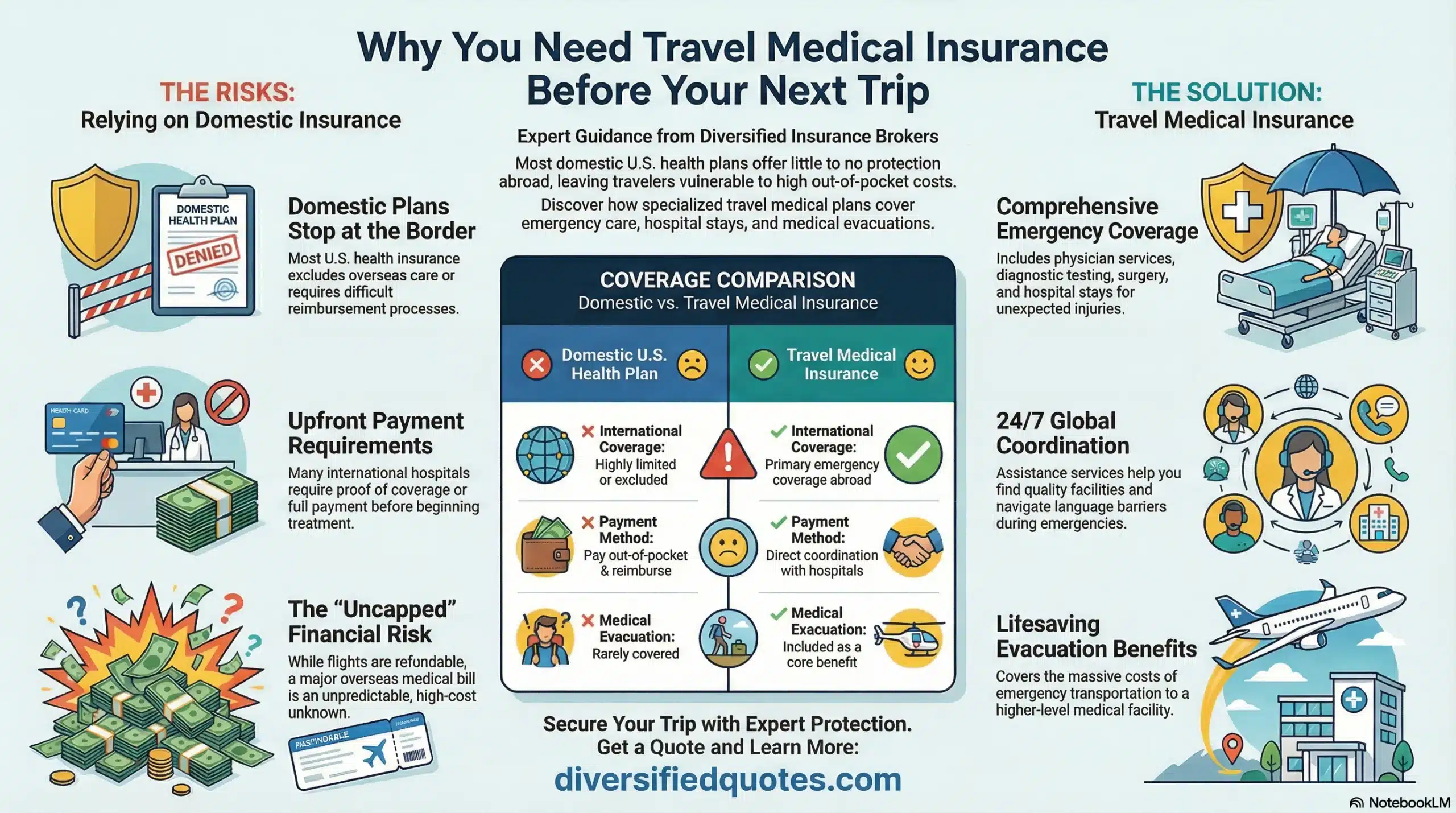
This is also why travelers should avoid assuming that any product labeled “travel insurance” provides meaningful medical protection. Many trip-focused insurance products are designed primarily for cancellation and interruption coverage and include emergency medical benefits as a secondary, limited feature with lower limits and less comprehensive assistance infrastructure. For travel to Chechnya or similar higher-risk destinations, the emergency medical and evacuation structure is the primary product — cancellation coverage is secondary.
Common Situations Where Coverage Becomes Critical
Most travelers do not experience dramatic emergencies, but serious medical events rarely announce themselves in advance. A situation can begin as a moderate symptom that escalates over hours into something requiring intensive care. An injury that initially seems manageable can require imaging, specialist assessment, and surgical intervention that is not available at the nearest facility. A condition that was stable before travel can become complicated by the timing, environment, and limited specialist access that characterize travel in higher-friction regions. In these scenarios, the financial exposure is determined not just by the treatment costs but by how quickly the right care can be accessed and whether transportation is required to reach it.
Vehicle accidents are among the most common triggers for serious claims in the North Caucasus region and similar environments — road conditions, driving standards, and the prevalence of mountainous terrain create elevated accident risk. Falls, worksite injuries, and other unexpected physical events create immediate needs for imaging, orthopedic care, and sometimes surgical intervention. In higher-risk environments, the complication is frequently not just the injury itself but the path from injury to appropriate treatment — and the cost of covering that path when it requires air transport.
Illness claims carry their own challenges. Severe infections, gastrointestinal emergencies, respiratory conditions, cardiac events, and neurological emergencies can require monitoring capabilities, specialist oversight, and pharmaceutical resources that are not reliably available at every regional facility. The time from symptom onset to decision about escalation is often short, and the consequences of delayed escalation can be severe. Travelers benefit from a plan that gives them a direct line to medical professionals who can help make those decisions in real time — not just a reimbursement process that begins after the event is over.
Medical Evacuation vs. Security Evacuation
Many travelers use the term “evacuation” broadly to mean any organized exit from a difficult situation, but travel insurance plans draw a clear distinction between medical evacuation and security evacuation — and the distinction matters significantly in terms of how benefits work and when they apply.
Medical evacuation is tied to medical necessity and is coordinated through the plan’s emergency assistance team. The purpose is to transport the traveler to the nearest facility that can adequately treat the medical condition when local care is insufficient. Medical evacuation is covered under the plan’s evacuation benefit when the assistance team confirms medical necessity, coordinates the transport, and the policy terms support the claim. The process is medically directed — meaning a physician affiliated with the assistance team or the sending facility determines that evacuation is necessary based on the patient’s condition and the available local resources.
Security evacuation — when it is included in a plan at all — is a separate benefit triggered by specific security events such as civil unrest, terrorism, natural disasters, or other defined circumstances that make the area unsafe for the traveler to remain. Security evacuation coverage is not universal, is often subject to specific definitions and exclusions, and may require that a government body or recognized authority declare a specific type of emergency before the benefit is triggered. Coverage availability, limits, and triggering conditions vary considerably across plans. Travelers who are specifically concerned about security evacuation for their Chechnya trip should review this benefit explicitly in the policy language rather than assuming it is included.
For most travelers, the reliable planning priority is to secure strong medical coverage with meaningful medically-necessary evacuation benefits and a clear assistance process — then separately evaluate whether security-focused evacuation coverage is needed based on the nature and duration of the trip and any organizational requirements. Our resource on travel and medical insurance for high-risk travel covers how these different coverage layers interact for travelers in elevated-risk destinations.
Pre-Existing Conditions and Coverage Expectations
Pre-existing condition coverage is one of the most consequential variables for travelers who have ongoing diagnoses, regular medications, prior injuries, or stable chronic conditions — and it is also one of the most commonly misunderstood elements of travel medical insurance. Plan approaches to pre-existing conditions vary widely: some policies exclude pre-existing conditions entirely for both medical treatment and evacuation; others provide limited coverage under “acute onset” definitions that cover sudden, unexpected complications of a stable pre-existing condition but exclude treatment of the underlying condition itself; and some plans offer optional pre-existing condition waiver provisions when certain enrollment timing requirements are met.
Because the definitions and exclusions vary by plan, travelers should treat pre-existing condition coverage as a policy-definition question requiring explicit review — not an assumption. A traveler with well-controlled hypertension may find that a cardiac event during travel is treated very differently across different plans depending on whether the condition is classified as pre-existing and whether the plan’s acute onset language applies to the specific event. In higher-risk environments where access to care may already be delayed or limited, having a pre-existing condition excluded from coverage at the moment of an emergency is a particularly serious gap. The best approach is to confirm exactly how the plan handles your specific medical history before departure rather than discovering the limitation during a claim.
How Coverage Is Typically Priced
Travel medical and evacuation insurance is priced primarily on the factors that most strongly predict claim exposure: the traveler’s age, the length of the covered trip, the destination’s risk classification, the selected medical benefit maximum, the deductible structure, and the limits and structure of evacuation benefits. Age is one of the most significant pricing factors because medical claim likelihood and severity increase with age. Trip length matters because more travel time equals more exposure. Destination risk affects carrier appetite and pricing in ways that are not always reflected in simple premium comparisons across destinations.
Higher medical maximum limits cost more in premium but provide substantially more protection against the tail risk of a catastrophic event — an event that may be unlikely on any given trip but whose financial consequences without coverage can be permanently damaging. In destinations where medical evacuation is a realistic scenario, travelers typically prioritize meaningful evacuation limits — $100,000 to $500,000 or more — over lower-cost plans with evacuation caps that would not realistically cover air medical transport over distance. Price is an important factor but is rarely the optimal primary decision criterion for higher-risk travel. The goal is to match coverage structure and limits to the actual risk profile of the trip — and to ensure that the plan’s assistance infrastructure is capable of functioning effectively in the destination’s operational environment.
How to Use Your Coverage if Something Happens
In an emergency, the single most important action a traveler can take — when circumstances permit — is to contact the plan’s 24/7 emergency assistance line as early as possible in the event. The assistance team’s function is not simply administrative. They provide medical direction, help identify appropriate local facilities, confirm the authorization steps required under the policy for high-cost services, and manage the logistics of evacuation when it is medically necessary. Most plans require that medical evacuation be arranged through the assistance process rather than independently — and for good reason: independently arranged evacuation that does not meet the plan’s coordination requirements may not be covered even when the underlying medical need is legitimate.
Documentation is a practical safeguard throughout any medical event. Medical records, physician notes, diagnostic results, itemized bills, discharge summaries, and receipts for all expenses should be retained from the beginning. For evacuation events, the assistance team’s authorization records and coordination documentation are often important elements of the claim file. The goal of documentation is not bureaucratic — it is to ensure that the claim process has the information needed to confirm coverage and that there is no ambiguity about timing, medical necessity, or the nature of the event when the claim is reviewed.
Finally, travelers should understand that evacuation destinations are determined by medical necessity and the nearest facility capable of adequately treating the condition — not necessarily the traveler’s home country or preferred destination. Evacuation to the home country (medical repatriation) is a specific benefit that may or may not be included depending on the plan, and it requires its own medical determination. These distinctions are why understanding the plan’s evacuation terms before an emergency occurs produces significantly better outcomes than trying to understand them during one.
Why Diversified Insurance Brokers
Selecting the right travel medical plan for a higher-risk destination is a question of suitability and specificity — not a commodity purchase. For Chechnya, the right coverage means a policy with strong emergency medical limits, clear and meaningful evacuation terms, and an assistance infrastructure capable of coordinating care under real operational pressure. It also means aligning the plan with trip reality: the duration and nature of the travel, the specific activities being undertaken, any known medical history that could change how coverage applies, and any organizational coverage requirements that must be met.
Diversified Insurance Brokers helps travelers compare options across multiple plans, apply correctly for the coverage they need, and avoid the most common mistakes in higher-risk travel insurance — including assuming that all plans treat evacuation identically, assuming that “travel insurance” automatically means comprehensive medical coverage, and assuming that the lowest-cost option provides adequate protection for the destination’s actual risk profile. When the destination is higher-risk, the safest time to address coverage gaps is before departure — not during an emergency when options no longer exist.
Secure International Medical Coverage
Protect yourself with travel medical coverage and evacuation support for higher-risk travel situations.
Apply NowGet Protected Before You Go
When travel involves higher uncertainty, stronger coverage is not a convenience — it is a practical safeguard against a category of financial risk that can be very large and very sudden. Travel medical and evacuation insurance is designed to give you access to emergency care and medically necessary transport without exposing you to costs that can reach six figures in a serious event. Once a serious emergency occurs, there is no window to retroactively add evacuation coverage, raise benefit limits, or change plan definitions. The planning window is entirely before departure.
If you are traveling to or working in Chechnya, the coverage decision should be made with the destination’s actual risk profile in mind: prioritize meaningful medical benefit limits, clear and tested evacuation terms, and an assistance process with the operational capability to coordinate care quickly under the conditions that make higher-risk travel challenging. That combination is what transforms a medical emergency from a potential financial and logistical catastrophe into a managed problem with a clear resolution path.
Explore Travel Medical & Evacuation Coverage for Chechnya
Apply online to compare options designed for higher-risk destinations and emergency evacuation needs.
View Coverage OptionsFinancial Protection Essentials
Explore travel medical, evacuation, and high-risk travel insurance resources for international travelers.
Related Travel Medical & Evacuation Pages
Talk With an Advisor Today
Choose how you’d like to connect—call or message us, then book a time that works for you.
Schedule here:
calendly.com/jason-dibcompanies/diversified-quotes
Licensed in all 50 states • Fiduciary, family-owned since 1980
Travel Medical & Evacuation from Chechnya — FAQs
Travel medical insurance for Chechnya is designed to cover the costs of emergency medical treatment during a covered illness or injury — including hospitalization, physician and specialist services, diagnostic testing and imaging, surgical procedures, intensive care, and medically necessary prescriptions. The emergency medical benefit is the financial layer that addresses treatment costs at whatever facility the traveler receives care. The evacuation benefit addresses the separate and often more expensive problem of getting to the right facility when local care is insufficient — covering medically necessary transport to the nearest adequate facility, including air medical transport with appropriate medical crew and equipment when the patient’s condition requires it. For travel to Chechnya specifically, the combination of emergency medical coverage and meaningful evacuation benefits is the essential foundation, because the most expensive element of a serious emergency in a higher-friction environment is frequently the transportation rather than the treatment itself. Air medical evacuation from the North Caucasus to a facility in Western Europe or Turkey can cost $50,000 to $200,000 or more depending on origin, destination, and the medical complexity of the transport.
Chechnya has healthcare facilities in Grozny and other urban areas, but the level of specialist care, advanced diagnostic capability, surgical subspecialty availability, and pharmaceutical supply that travelers from Western countries may require in a serious emergency can be inconsistent — particularly outside of the capital, in rural or mountainous terrain, or for conditions requiring specialist intervention that may not be available locally. For a traveler experiencing a significant trauma, a cardiac event, a serious infection requiring intensive care, or a neurological emergency, the critical question is not whether any treatment is available but whether the available treatment is adequate for the specific condition. When it is not, the outcome depends on how quickly a transfer to a higher-capability facility can be arranged, authorized, and funded. Medical evacuation in this context is the mechanism that connects the traveler to the level of care their condition requires — and without insurance coverage providing both the financial benefit and the coordination infrastructure to make that evacuation happen quickly, the logistics become the traveler’s or their family’s problem to solve under extreme time pressure.
Some travel medical and evacuation plans include security evacuation as a separate benefit, but it is not universal — and it is almost always defined and governed differently from medical evacuation. Medical evacuation is triggered by medical necessity as determined by a physician: it exists to move a patient to an adequate treatment facility. Security evacuation, when included, is triggered by specific security events such as civil unrest, political instability, terrorism, or natural disasters that create an unsafe environment for the traveler to remain. The triggering conditions, definitions, and exclusions for security evacuation vary significantly across plans. Some require that a government authority issue a specific level of travel advisory or declaration before the benefit is triggered. Others have geographic or activity exclusions that may apply in certain regions. Travelers who are specifically concerned about security evacuation coverage for their Chechnya trip should review that benefit explicitly in the policy terms — understanding the triggering event definition, any exclusions, the limits, and the coordination process — rather than assuming it is included because the product is labeled as “evacuation insurance.” If security evacuation is a specific requirement for your trip, work with a broker who can identify plans that include it with terms that actually match your situation.
Pre-existing condition coverage varies significantly across travel medical plans and is one of the most important coverage variables for travelers with ongoing health histories. Some plans exclude pre-existing conditions entirely — meaning any condition that existed, was treated, or for which medication was taken before the policy’s effective date is not covered for either treatment or evacuation during the trip. Other plans provide limited coverage under an “acute onset” definition, which typically covers sudden, unexpected, and severe symptoms of a pre-existing condition that require immediate treatment — but excludes ongoing treatment of the underlying condition, elective care, or events that were predictable given the diagnosis. Some plans offer a pre-existing condition waiver that removes or reduces exclusions when the policy is purchased within a specified window of the initial trip deposit. Because the specific language and definitions vary by plan and determine what is and is not covered in a real emergency, travelers with any significant medical history should treat pre-existing condition coverage as a policy-specific question requiring explicit review rather than a general assumption. For travel to Chechnya, where access to specialist care may already be limited, having a significant medical event excluded from coverage at the point of crisis is a particularly serious gap that merits careful advance attention.
Common exclusions in travel medical plans that are particularly relevant for Chechnya travel include: pre-existing conditions not covered under the plan’s specific terms or waiver provisions; high-risk or hazardous activities not covered by the plan — which may include professional journalism, certain contractor work, extreme sports, or activities in conflict-affected areas depending on the plan’s language; evacuation that is not coordinated through the plan’s assistance process or that is not confirmed as medically necessary under the policy terms; care that is deemed elective or non-emergency rather than medically necessary; and, in some cases, travel to destinations with specific exclusions based on government travel advisories. Some plans also exclude coverage for injuries sustained while under the influence of alcohol or drugs, for self-inflicted conditions, and for pre-existing mental health conditions. The most reliable way to understand which exclusions apply to your specific trip, activities, and health history is to review the policy’s exclusion section explicitly before purchase — not after an emergency occurs. Working with a broker familiar with higher-risk destination coverage can help identify plans whose exclusion profiles are most favorable for your situation.
The most important action to take when a medical event occurs — and when circumstances permit — is to contact the plan’s 24/7 emergency assistance line as early as possible. The assistance team is the operational center of the evacuation process: they provide medical direction, help identify appropriate receiving facilities, communicate with local providers at the sending location, confirm the authorization requirements under the policy, and coordinate the logistics of transport. For most travel medical plans, medical evacuation must be arranged through the assistance process rather than independently — meaning that a traveler who arranges their own air medical transport without prior authorization through the assistance team may face a situation where the evacuation benefit does not apply even though the underlying medical need is legitimate. The assistance team’s phone number should be saved in the traveler’s phone before departure, written down separately, and shared with a trusted contact at home who can initiate the call on the traveler’s behalf if the traveler is incapacitated. Early contact — even before a situation has clearly escalated to evacuation level — allows the assistance team to monitor the situation and be positioned to act immediately if the medical picture changes.
Under most travel medical and evacuation plans, the evacuation destination is the nearest facility that is medically adequate to treat the condition — not necessarily the traveler’s home country or preferred destination. Medical necessity and facility capability are the determining factors, not geographic preference. For a traveler in Chechnya, the nearest adequate facility for a given condition might be in Grozny, in Moscow, in Georgia, in Turkey, or elsewhere depending on the specific condition and the resources available at different facilities at the time of the event. Evacuation to the home country — often called repatriation of the patient — is a specific benefit that may or may not be included in a given plan and typically requires an additional medical determination that the patient is stable enough for long-distance transport and that no adequate treatment is available at a closer facility. Travelers who specifically want to ensure coverage for repatriation to their home country should review whether that benefit is explicitly included in the plan they are evaluating, and at what limits and under what conditions it applies.
There is no universal answer, but the guiding principle for higher-risk destinations is to select limits that would realistically cover the worst credible scenario — not just the most likely scenario. For emergency medical treatment, limits of $250,000 to $1,000,000 or more are commonly recommended for international travel to destinations where hospital costs could accumulate significantly during a serious illness or injury requiring extended intensive care or specialist treatment. For medical evacuation, limits of at least $100,000 to $500,000 are appropriate for travel to destinations where air medical transport over significant distances is a realistic possibility — because a medically equipped air ambulance from the North Caucasus to a higher-capability facility in Western Europe can cost well into six figures for a single transport. The evacuation limit is particularly important because it is often the most expensive element of a serious emergency in a higher-risk environment, and a plan with a strong medical benefit but an inadequate evacuation limit leaves the traveler exposed at precisely the point where the costs are highest. For travelers whose organizations have minimum coverage requirements, those requirements should be treated as a floor rather than a ceiling.
No — and the distinction is important for travelers to Chechnya and similar destinations. Trip insurance is a broad category that encompasses cancellation and interruption coverage — protection for the financial investment in travel arrangements if a trip is cancelled, cut short, or disrupted by covered events. Many trip insurance products include some emergency medical coverage as a component, but that medical coverage is often secondary to the trip protection focus and may include lower benefit limits, more restrictive definitions, and less robust assistance infrastructure than a dedicated travel medical plan. Travel medical insurance is designed specifically for emergency medical expenses during travel — with medical coverage as the primary benefit, meaningful evacuation limits, and 24/7 assistance services structured for real-time medical coordination. For travel to Chechnya, where the emergency medical and evacuation exposure is the primary risk and trip cancellation coverage is a secondary concern, a dedicated travel medical plan or a comprehensive plan that prioritizes medical and evacuation benefits is the appropriate product. Relying on a trip-focused insurance product as the primary medical protection for a higher-risk destination is one of the most common and consequential errors travelers make in this category.
For emergency treatment claims, the process typically begins with the traveler or the treating facility contacting the plan’s assistance team during or immediately after the event. The assistance team helps manage authorization for high-cost services, maintains a record of the medical event, and can facilitate direct billing between the facility and the insurer in some cases — reducing the traveler’s need to pay out of pocket and seek reimbursement. When out-of-pocket payment is required due to facility payment requirements, receipts, itemized bills, medical records, and documentation of diagnosis should be retained from the beginning. For evacuation claims, the assistance team’s involvement and authorization documentation are critical elements of the claim file — because the claim review will confirm that the evacuation was medically necessary, that it was coordinated through the appropriate process, and that the destination was appropriate given the patient’s condition. The practical advice is to document everything from the beginning, contact the assistance team as early as possible in any event, and follow the plan’s authorization procedures rather than acting independently on high-cost decisions. Claims that are well-documented and coordinated through the plan’s process are resolved more quickly and with less dispute than claims where the traveler made independent decisions about care or transport without prior authorization.
About the Author:
Jason Stolz, CLTC, CRPC, DIA, CAA and Chief Underwriter at Diversified Insurance Brokers (NPN 20471358), is a senior insurance and retirement professional with more than 25 years of real-world experience helping individuals, families, and business owners protect their income, assets, and long-term financial stability. As a long-time partner of the nationally licensed independent agency Diversified Insurance Brokers, Jason provides trusted guidance across multiple specialties—including fixed and indexed annuities, long-term care planning, personal and business disability insurance, life insurance solutions, Group Health, Travel Medical and Evacuation Insurance, and short-term health coverage. Diversified Insurance Brokers maintains active contracts with over 100 highly rated insurance carriers, ensuring clients have access to a broad and competitive marketplace.
His practical, education-first approach has earned recognition in publications such as VoyageATL, and contributions from his agency featured in Kiplinger and GoBankingRates— highlighting his commitment to financial clarity and client-focused planning. Drawing on deep product knowledge and years of hands-on field experience, Jason helps clients evaluate carriers, compare strategies, and build retirement and protection plans that are both secure and cost-efficient. Visitors who want to explore current annuity rates and compare options across multiple insurers can also use this annuity quote and comparison tool.
Explore More Travel Medical Insurance Options: Browse our complete guide to Africa & Middle East Travel Medical Insurance — covering medical evacuation coverage for Africa, Middle East & high risk destinations.
Last Reviewed: June 18, 2026 |
Reviewed by: Jason Stolz, CLTC, CRPC, DIA, CAA
Chief Underwriter, Diversified Insurance Brokers, Inc. | NPN: 20471358 | Diversified Insurance Brokers, Inc. — Licensed in all 50 states
Fact Checked by: Tonia Pettitt, CMIP©
Medicare Specialist, Diversified Insurance Brokers, Inc. | NPN: 14374308 | Diversified Insurance Brokers, Inc. — Licensed in all 50 states
Did you find this content helpful? Leave us a Google review — it helps others find trustworthy guidance too.
Editorial Standards: Diversified Insurance Brokers maintains rigorous editorial standards to ensure accuracy, clarity, and independence in all content. Learn more about our editorial standards and commitment to transparency.
