
Is Long-Term Care Insurance Worth the Cost?
The cost of long-term care remains one of the most underestimated and emotionally charged risks in retirement planning. Families often assume Medicare will step in, or that personal savings will be sufficient, only to discover too late that extended care is not a short-term event and not a minor expense. Whether care is provided in your home, inside an assisted living community, or within a skilled nursing facility, the financial impact compounds quickly. National averages for private nursing facilities now exceed six figures annually, and even modest in-home assistance can run thousands per month. For retirees who have spent decades building portfolios, managing taxes, and coordinating income streams, one extended health event can unwind years of disciplined planning. This is why the question is not simply whether long-term care insurance costs money — it is whether ignoring the risk costs far more.

When evaluating whether long-term care insurance is worth it, the conversation must begin with understanding the actual exposure. Long-term care is not strictly about nursing homes. It includes custodial care, supervision due to cognitive decline, and assistance with basic functions that most of us take for granted. Eligibility for benefits typically hinges on the inability to perform two of six activities of daily living (ADLs) such as bathing, dressing, transferring, eating, toileting, or maintaining continence, or the presence of severe cognitive impairment. These triggers matter because they define when a policy pays and when personal funds must cover the gap. Without coverage, families often liquidate retirement accounts at inopportune times, sell real estate, or disrupt carefully structured annuity income strategies. Others rely on adult children, introducing stress and unintended financial strain across generations.
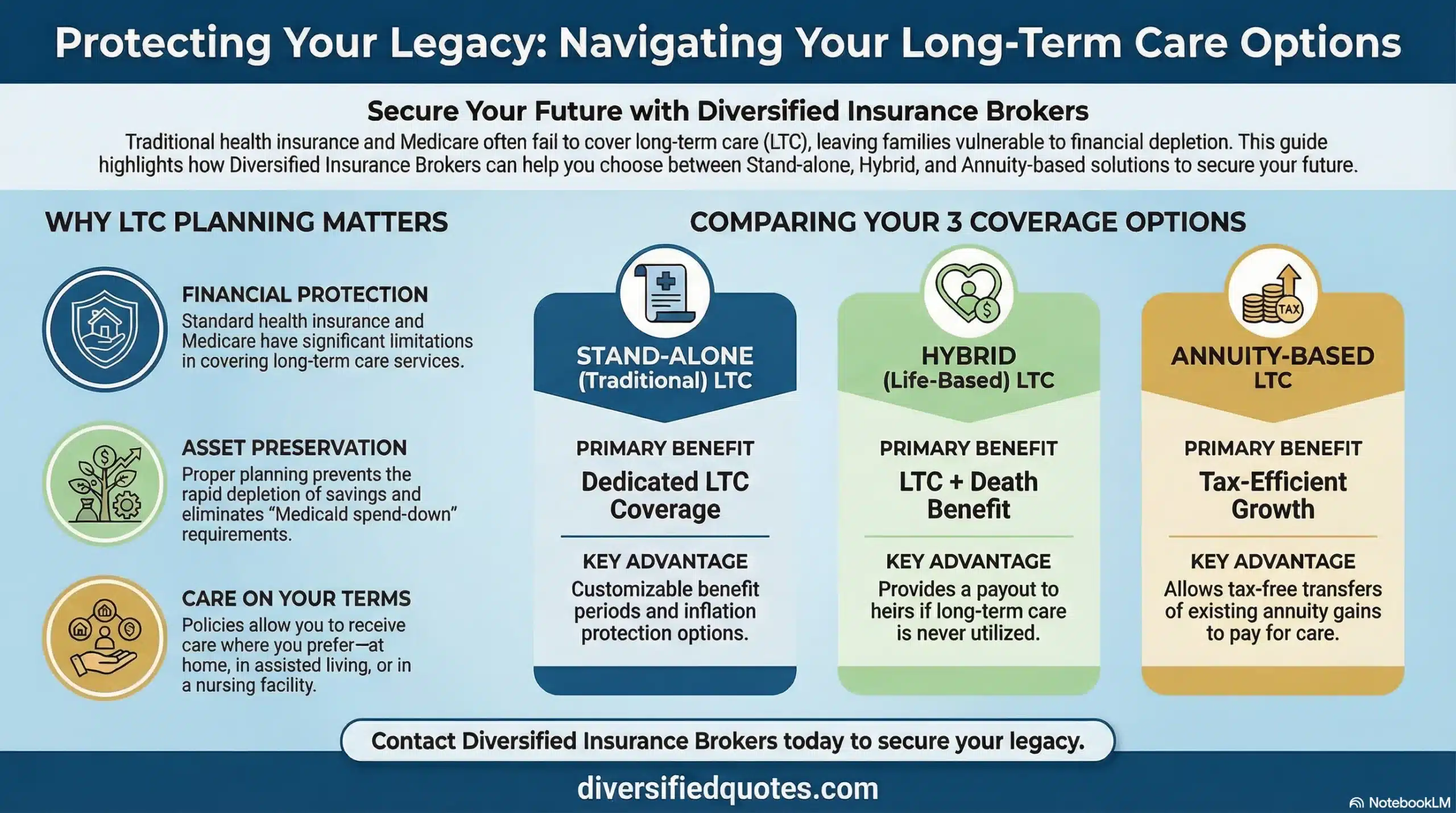
Traditional long-term care insurance was designed to transfer this risk to an insurer in exchange for annual premiums. When purchased in one’s 50s or early 60s, underwriting is typically more favorable and premiums are meaningfully lower than waiting until later years. Policies can provide daily or monthly benefits for two, three, five years or longer, often with inflation protection riders that increase coverage over time. For households in the middle-to-upper asset range — those with too many assets to comfortably qualify for Medicaid but not enough to self-insure multi-year care without lifestyle compromise — traditional coverage can serve as a powerful asset-protection tool. It preserves independence, protects legacy goals, and allows care choices that may otherwise be limited.
However, the long-term care insurance marketplace has evolved. Earlier generations of policies experienced premium adjustments as insurers recalibrated actuarial assumptions. That history created skepticism. Today’s policies are structured more conservatively, and many families also explore alternatives that did not exist two decades ago. One increasingly popular approach involves hybrid long-term care solutions that combine life insurance or annuities with long-term care riders. These designs address the “use it or lose it” concern by ensuring that if long-term care benefits are never fully used, a death benefit or residual value remains for heirs. For some individuals, particularly those uncomfortable committing to indefinite premiums, hybrids provide contractual guarantees and reposition existing assets into leveraged coverage.
For example, a repositioned CD, brokerage allocation, or underperforming asset can sometimes be transferred into a non-qualified long-term care annuity, allowing tax-advantaged growth that can be used for qualifying care expenses. This structure can create multiple dollars of care benefits for every dollar repositioned, depending on age and design. Unlike traditional annual premium policies, many hybrid contracts are funded with a single premium or a limited payment schedule, eliminating long-term payment uncertainty. The suitability of these solutions depends heavily on liquidity needs, tax positioning, and retirement income coordination.
It is also critical to understand what happens without planning. Many retirees assume Medicare will pay for long-term care, but Medicare primarily covers short-term skilled rehabilitation following hospitalization and does not pay for ongoing custodial care. To better understand the distinction, reviewing Does Medicare Cover Long-Term Care? can clarify common misconceptions. Medicaid, on the other hand, may cover extended care but requires significant asset spend-down and limits facility choice in many states. For retirees who value flexibility and control, relying solely on public programs can dramatically reduce options.
Request a Long-Term Care Planning Review
Compare traditional and hybrid long-term care solutions based on your age, health, assets, and retirement goals.
Another factor influencing whether coverage is worth the cost is qualification. Long-term care insurance is medically underwritten. Chronic conditions, mobility limitations, cognitive impairment, and certain prescription histories can affect eligibility. Understanding how to qualify for long-term care insurance helps determine whether traditional, hybrid, or asset-based solutions are viable. Waiting too long can eliminate options entirely. In many cases, planning earlier preserves both insurability and affordability.
Cost comparisons must also be framed properly. Premiums may range from a few thousand dollars annually depending on age and benefit structure. When compared against potential six-figure annual care costs over multiple years, the leverage becomes clearer. Some policies include shared benefit riders for couples, allowing one spouse to use the other’s unused benefit pool. Others include return-of-premium provisions, such as designs explored in Long-Term Care Insurance with Return of Premium, providing additional estate protection if coverage is never utilized. These features transform the evaluation from a simple expense analysis into a broader risk-management strategy.
It is also worth comparing policy structures. For couples, shared benefit long-term care policies can maximize flexibility, especially when health outcomes between spouses are unpredictable. Meanwhile, understanding how long-term care coverage differs from other programs — as explained in Medicare vs. Long-Term Care Insurance — ensures expectations are realistic before claims ever arise.
Ultimately, the question “Is long-term care insurance worth it?” becomes deeply personal. For individuals with significant liquid assets capable of absorbing multi-year care without impacting lifestyle or heirs, self-insuring may be feasible. For those with moderate portfolios, pensions, Social Security income, or annuities structured for income stability, an unexpected care event can introduce stress and force asset reallocation. Insurance shifts that uncertainty to a carrier and protects the broader retirement framework.
Protect Your Retirement From Extended Care Costs
Explore asset-based, hybrid, and traditional long-term care strategies tailored to your financial situation.
There is no universal answer — only strategic alignment between risk tolerance, financial capacity, and personal values. Long-term care insurance is not purchased for investment return; it is implemented for asset preservation, independence, and dignity. When structured thoughtfully and integrated alongside retirement income, tax planning, and estate objectives, it can provide clarity in an area of planning often clouded by uncertainty. The true cost to evaluate is not simply the premium — it is the potential erosion of decades of disciplined saving if care becomes necessary without a plan in place.
Related Pages
Financial Protection Essentials
Compare the best multi-year guaranteed annuity (MYGA) rates by term length to match your retirement income timeline and interest strategy.
Review Your Options With an Experienced Advisor
Whether you’re researching insurance coverage, planning for retirement, or simply looking for clarity, it helps to review your options with a knowledgeable advisor. The team at Diversified Insurance Brokers will help you compare carriers, understand trade-offs, and design a strategy aligned with your goals—without pressure or obligation.
Licensed nationwide • Independent advisors • Family-owned since 1980
FAQs: Is Long-Term Care Insurance Worth It?
What does long-term care insurance actually cover?
Long-term care insurance can help pay for home health care, assisted living, adult day care, memory care, and nursing home care when you need help with daily activities or have a cognitive impairment, depending on the policy you choose.
Who should consider long-term care insurance?
It is most appropriate for people who want to protect retirement assets, avoid relying solely on family or Medicaid, and can afford premiums without straining their budget, typically in their 50s or early 60s.
Is long-term care insurance expensive?
Premiums can be significant, but the cost of care is often much higher. Whether it feels expensive depends on your age, health, benefit amount, inflation protection, and how much of the potential care expense you want the policy to cover.
Can premiums increase over time?
Yes. Many traditional long-term care policies are not guaranteed level premium contracts. Carriers can request rate increases on a class basis, subject to state approval, which can raise your costs later in life.
What happens if I never need long-term care?
With traditional policies, you may pay premiums and never use the benefits, similar to homeowners or auto insurance. Hybrid life or annuity-based policies can provide death benefits or cash value even if you never use long-term care benefits.
How do I know if long-term care insurance is worth it for me?
It depends on your assets, income, family situation, and risk tolerance. People who want to protect savings, preserve choice in care settings, and avoid burdening family often see long-term care insurance as worthwhile.
Is self-funding care a better option than buying insurance?
Self-funding may work for households with substantial assets, but it concentrates the risk on your portfolio. Long-term care insurance can share or transfer that risk to an insurer, so the decision depends on your comfort with potential future costs.
What role does inflation protection play in the value of a policy?
Inflation protection helps benefits keep pace with rising care costs over time. It increases premiums, but without it, today’s coverage amounts may be insufficient decades from now, reducing the long-term value of the policy.
Can long-term care insurance help protect a spouse or family?
Yes. Coverage can help prevent one spouse’s care needs from depleting joint assets, reduce pressure on adult children to provide hands-on care, and preserve more of the estate for heirs or a surviving spouse.
When is the best time to buy long-term care insurance?
Many people explore coverage in their 50s or early 60s, when they are more likely to qualify medically and premiums are generally more affordable than waiting until later in retirement.
About the Author:
Jason Stolz, CLTC, CRPC and Chief Underwriter at Diversified Insurance Brokers (NPN 20471358), is a senior insurance and retirement professional with more than two decades of real-world experience helping individuals, families, and business owners protect their income, assets, and long-term financial stability. As a long-time partner of the nationally licensed independent agency Diversified Insurance Brokers, Jason provides trusted guidance across multiple specialties—including fixed and indexed annuities, long-term care planning, personal and business disability insurance, life insurance solutions, and short-term health coverage. Diversified Insurance Brokers maintains active contracts with over 100 highly rated insurance carriers, ensuring clients have access to a broad and competitive marketplace.
His practical, education-first approach has earned recognition in publications such as VoyageATL, highlighting his commitment to financial clarity and client-focused planning. Drawing on deep product knowledge and years of hands-on field experience, Jason helps clients evaluate carriers, compare strategies, and build retirement and protection plans that are both secure and cost-efficient. Visitors who want to explore current annuity rates and compare options across multiple insurers can also use this annuity quote and comparison tool.
