
Should You Use a Fixed Indexed Annuity for Growth and Income?
If you’re looking for a retirement solution that offers both principal protection and the opportunity for market-linked growth, a fixed indexed annuity (FIA) deserves serious consideration. Fixed indexed annuities are designed for individuals who want to participate in a portion of stock market gains—often tied to an index such as the S&P 500—without risking market losses to their principal. Unlike variable annuities, FIAs are not directly invested in the market. Instead, interest is credited based on a formula tied to index performance, with built-in downside protection. That means when the market declines, your account does not lose value due to those losses. For many retirees and pre-retirees, that balance of protection and growth creates a powerful foundation for long-term retirement planning. If you’re new to the concept, understanding how a fixed indexed annuity works is the first step toward evaluating whether this strategy fits your goals.

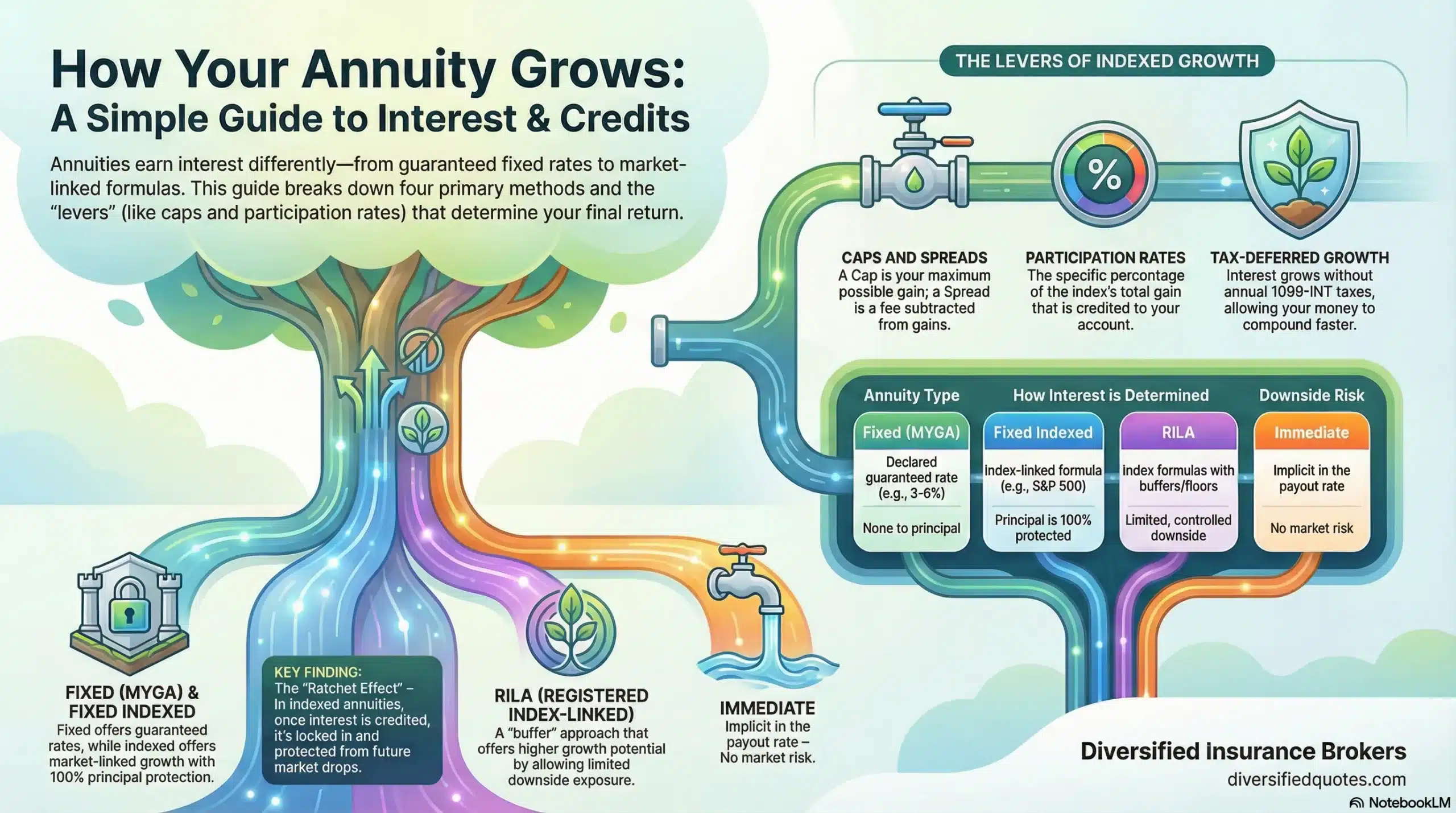
At its core, an FIA credits interest based on index performance using methods such as caps, participation rates, or spreads. For example, a cap limits the maximum interest you can earn in a given term, while a participation rate determines the percentage of index growth credited to your account. These crediting methods allow insurance companies to provide upside potential while still guaranteeing that your principal is protected from market downturns. If the index posts negative returns during a contract year, your credited interest for that period is typically zero—but never negative. This is one of the defining benefits of FIAs and a key reason many retirees allocate a portion of their savings into them, especially after experiencing market volatility in traditional portfolios. For a deeper look at how downside protection works, review how fixed indexed annuities protect against market downturns.
Tax deferral is another major advantage. Like other annuities, FIAs grow tax-deferred, meaning you do not pay taxes annually on interest credited inside the contract. Instead, earnings compound until you withdraw funds. Over time, this compounding effect can significantly enhance growth compared to taxable accounts. For retirees rolling over IRA or 401(k) funds, an FIA can provide structured growth without adding market exposure. For non-qualified funds, tax deferral can be especially valuable for high-income earners seeking to manage annual tax liability.
Many FIAs also offer optional income riders that can generate guaranteed lifetime income. These riders often include roll-up rates or bonuses applied to an income base used solely for calculating future withdrawals. While the income base is not a cash value you can withdraw as a lump sum, it may grow at a guaranteed rate for a specified period, creating predictable income later in retirement. If your primary goal is building guaranteed income you cannot outlive, understanding whether annuities pay income for life can help clarify how income riders function within a comprehensive retirement plan.
Flexibility is another strength. FIAs can be structured for accumulation, income, or a blend of both. Some investors use them to protect a portion of their portfolio while maintaining market exposure elsewhere. Others use them as a bond alternative during periods of rising interest rates. If you are comparing strategies, reviewing fixed vs indexed annuity differences can clarify when each approach may be appropriate. Fixed annuities offer declared interest rates with complete predictability, while indexed annuities introduce performance-linked growth with principal protection.
It is also important to evaluate surrender schedules and liquidity provisions. Most FIAs allow annual free withdrawals—commonly up to 10% of the account value—without surrender penalties. Reviewing annuity free withdrawal rules ensures your contract aligns with your liquidity needs. Proper structuring can allow flexibility while still capturing competitive crediting opportunities.
Ensure You Are Receiving the Absolute Top Rates
Current Fixed Annuity Rates
Compare today’s best fixed annuity rates from top carriers.
Current Bonus Annuity Rates
See which annuities offer the highest upfront bonus today.
Request an Annuity Quote
Submit our annuity request form to get personalized rate options.
Another consideration when evaluating FIAs is carrier strength. Because guarantees are backed by the issuing insurance company, financial ratings matter. Comparing insurers helps ensure your retirement strategy rests on a stable foundation. Many retirees research company strength before investing, which is why reviewing detailed carrier analyses—such as those available across our site—can provide additional confidence. As independent advisors, we compare products across more than 75 top-rated insurance carriers rather than recommending a single company’s lineup.
Indexed annuities can also complement other strategies. Some retirees combine them with laddered fixed annuities for structured liquidity. Others allocate a portion of assets to indexed growth while maintaining conservative investments elsewhere. If you’re considering multiple strategies, exploring laddering annuities may help you understand how staggered contracts can improve flexibility and rate capture over time.
Because FIA contracts vary significantly, details matter. Caps, participation rates, income rider costs, surrender periods, and bonus structures all influence outcomes. Understanding how annuities earn interest is critical before committing funds. Some contracts emphasize accumulation, while others prioritize lifetime income. Aligning features with your timeline and retirement objectives ensures you are not simply chasing a headline rate but implementing a cohesive plan.
Lifetime Income Calculator
Use our calculator to see how much guaranteed income your annuity can provide.
Fixed indexed annuities are best suited for individuals who want principal protection with growth potential, retirees seeking guaranteed lifetime income, and conservative investors who are uncomfortable with full market exposure. They are not designed for aggressive growth seekers, but for those who value balance and stability. By diversifying across product types and carriers, you can create a retirement income structure that blends safety, flexibility, and long-term sustainability.
At Diversified Insurance Brokers, we compare FIAs across more than 75 top-rated insurance carriers—helping you find the right balance of protection, growth, and income based on your retirement goals. We take the time to explain contract details clearly, evaluate multiple illustrations, and design strategies tailored to your timeline. Whether you are preparing to retire or already drawing income, our goal is to ensure you understand exactly how your annuity works before you sign.
Related Pages
Financial Protection Essentials
Understand annuity guarantees, interest rate examples by investment size, and how retirement income strategies work in practice.
Talk With an Advisor Today
Choose how you’d like to connect—call or message us, then book a time that works for you.
Schedule here:
calendly.com/jason-dibcompanies/diversified-quotes
Licensed in all 50 states • Fiduciary, family-owned since 1980
FAQs: Should You Use a Fixed Indexed Annuity for Growth and Income?
What is a fixed indexed annuity (FIA)?
A fixed indexed annuity is an insurance contract that provides principal protection while offering interest growth linked to a market index.
Can a fixed indexed annuity provide income for life?
Yes. Many fixed indexed annuities offer optional income riders that can provide guaranteed lifetime income.
How does growth work in a fixed indexed annuity?
Interest is credited based on index performance using caps, spreads, or participation rates, with no loss in down market years.
Are fixed indexed annuities safe?
They provide protection from market losses, but guarantees depend on the financial strength of the issuing insurance company.
Is an FIA better for growth or income?
FIAs are commonly used for income planning, but can also serve as a conservative growth vehicle when income is deferred.
What are the downsides of a fixed indexed annuity?
Potential downsides include surrender charges, limits on upside growth, and added costs for optional income riders.
Who is a good candidate for a fixed indexed annuity?
FIAs are often suitable for individuals seeking a balance of growth potential, income guarantees, and protection from market volatility.
About the Author:
Jason Stolz, CLTC, CRPC and Chief Underwriter at Diversified Insurance Brokers (NPN 20471358), is a senior insurance and retirement professional with more than two decades of real-world experience helping individuals, families, and business owners protect their income, assets, and long-term financial stability. As a long-time partner of the nationally licensed independent agency Diversified Insurance Brokers, Jason provides trusted guidance across multiple specialties—including fixed and indexed annuities, long-term care planning, personal and business disability insurance, life insurance solutions, and short-term health coverage. Diversified Insurance Brokers maintains active contracts with over 100 highly rated insurance carriers, ensuring clients have access to a broad and competitive marketplace.
His practical, education-first approach has earned recognition in publications such as VoyageATL, highlighting his commitment to financial clarity and client-focused planning. Drawing on deep product knowledge and years of hands-on field experience, Jason helps clients evaluate carriers, compare strategies, and build retirement and protection plans that are both secure and cost-efficient. Visitors who want to explore current annuity rates and compare options across multiple insurers can also use this annuity quote and comparison tool.
