
Annuity Rollover Options for Teachers

Jason Stolz CLTC, CRPC
Annuity Rollover Options for Teachers require more than simply moving money from one account to another. Educators often spend decades contributing to 403(b) plans, 457(b) deferred compensation accounts, and state pension systems. When retirement approaches or a job transition occurs, the decisions surrounding those accumulated funds can permanently shape income security for the next 25 to 35 years. A rollover is not just paperwork. It is the moment where accumulation turns into distribution strategy. The structure you choose determines how much risk you retain, how much income you can guarantee, how taxes will be managed, and how stable your retirement lifestyle will ultimately feel.
Teachers face unique retirement planning dynamics. Many have pensions, but not all pensions fully replace working income. Some districts have frozen benefits. Others provide modest cost-of-living adjustments. Meanwhile, 403(b) accounts often sit invested in variable products exposed to market volatility. A poorly timed downturn just before retirement can significantly impact income sustainability. Because of this, many educators explore fixed annuities, fixed indexed annuities, or lifetime income annuities as rollover destinations that emphasize principal protection and guaranteed income rather than continued exposure to equity risk.
Before Rolling Over, Compare Today’s Strongest Annuity Guarantees
Review current fixed rates and top bonus indexed annuity structures designed for retirement income stability.
View Highest Fixed Annuity Rates View Highest Bonus FIA RatesUnderstanding 403(b) and 457(b) Rollover Rules for Educators
When a teacher retires, resigns, or changes school districts, employer-sponsored retirement accounts become eligible for rollover. A 403(b) or 457(b) plan can be transferred into an IRA or annuity without triggering taxes, provided the transfer is structured as a direct rollover. This means funds move directly from the plan custodian to the receiving insurance company. No withholding occurs. No 60-day rule applies. No early withdrawal penalties are triggered. The tax status of the funds remains intact.
Indirect rollovers, where funds are sent to the participant personally, can create unnecessary risk. Plans typically withhold 20% for federal taxes in such cases, and the full balance must be redeposited within 60 days to avoid taxation. For educators nearing retirement, avoiding administrative errors is critical. Proper coordination with the plan administrator and insurance carrier ensures a seamless transfer.
If you would like a refresher on how these accounts function before rollover, our guides on how a 403(b) works and how a 457(b) works explain contribution rules, tax deferral mechanics, and withdrawal structures in greater detail.
Why Teachers Consider Annuities After Retirement
Unlike private-sector employees who often rely entirely on 401(k) balances, teachers frequently have a pension foundation. However, pensions rarely cover 100% of pre-retirement income. Healthcare costs rise. Inflation erodes purchasing power. Market volatility threatens supplemental accounts. An annuity rollover can serve as a stabilizing component within the overall retirement income strategy.
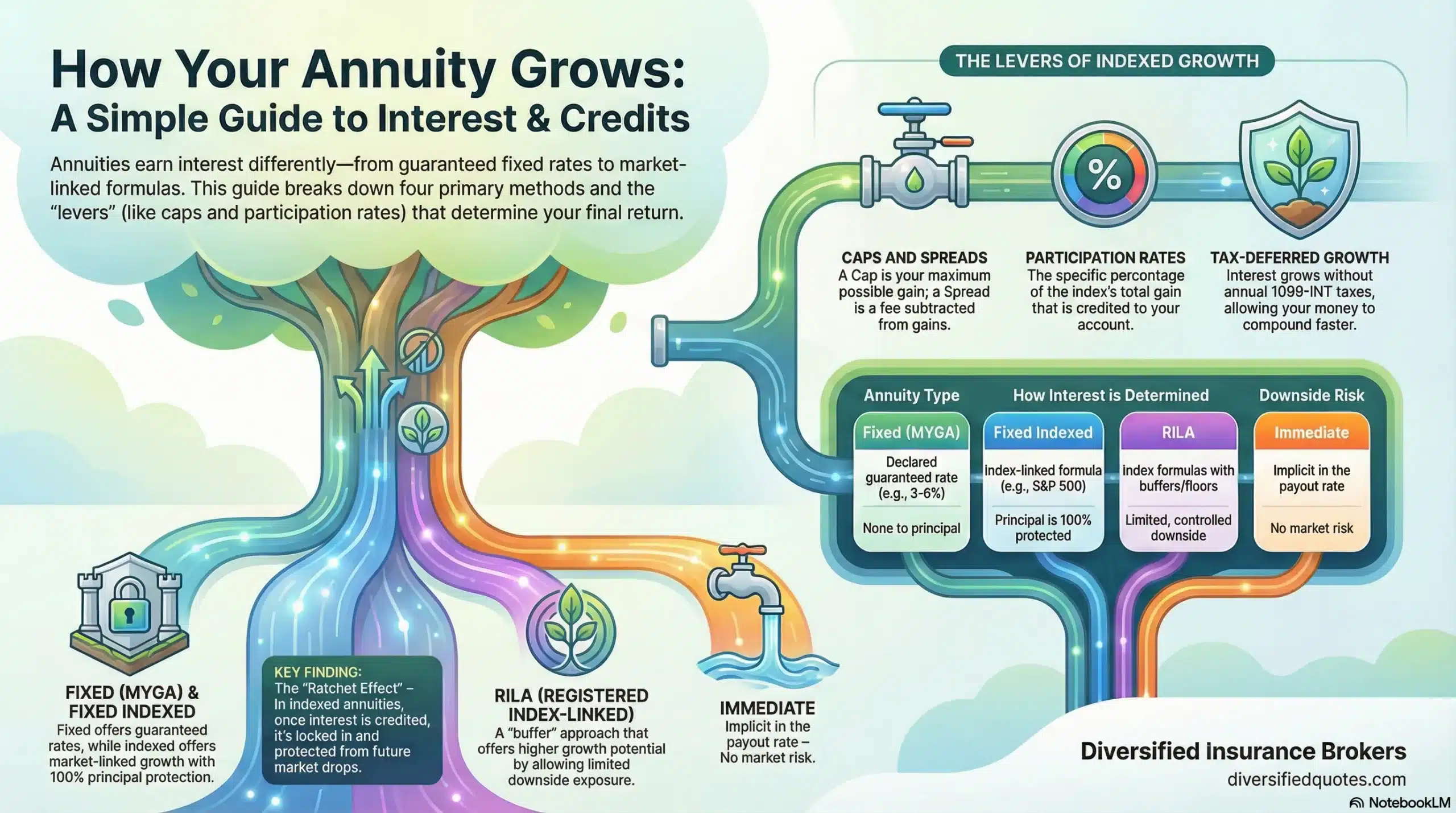
Fixed annuities provide guaranteed interest over defined periods. Fixed indexed annuities provide market-linked growth with principal protection. Income annuities convert assets into guaranteed lifetime income. Each option addresses a different retirement risk: reinvestment risk, market risk, or longevity risk. Determining which risk matters most depends on your pension strength, Social Security timing, age, and income goals.
Fixed Annuity Rollovers for Conservative Educators
A fixed annuity rollover is often selected by teachers who want certainty. These contracts lock in a guaranteed interest rate for a set number of years. If you roll $300,000 into a 5-year fixed annuity at 5.60%, that rate remains constant for five years regardless of market conditions. Your principal grows tax-deferred and is not subject to equity volatility.
For educators transitioning into retirement within a short timeframe, fixed annuities can act as a capital preservation bridge. They protect assets during the early retirement years when sequence-of-returns risk is most dangerous. Reviewing current offerings on our Highest Guaranteed Annuity Rates page ensures competitive positioning before transfer.
Fixed Indexed Annuity Rollovers for Growth with Protection
Many teachers want more than a fixed rate but less risk than market exposure. Fixed indexed annuities provide interest credits linked to a market index while guaranteeing that principal cannot decline due to market losses. In years when the index rises, the contract credits gains up to the cap or participation rate. In years when the index falls, the credited rate is zero, not negative.
This design can be particularly attractive for educators retiring during uncertain economic cycles. Gains are locked in annually. Previously credited interest cannot be lost due to later downturns. Income riders can be added to create guaranteed lifetime income starting at a future date.
Competitive structures and bonus-enhanced designs can be reviewed on our Highest Bonus FIA Rates page.
Creating Guaranteed Lifetime Income from a 403(b)
Income is ultimately the objective. Retirement planning is not about account balances; it is about reliable monthly cash flow. When a teacher rolls a 403(b) into an annuity with a lifetime income rider, the contract can guarantee payments that continue for as long as the retiree lives. This effectively creates a personal pension supplementing any state pension benefits.
Estimate Your Guaranteed Lifetime Income
Model income payouts from leading carriers below.
Income projections vary by age, deferral period, and rider design. Modeling before rollover provides clarity around what portion of retirement expenses can be contractually guaranteed.
Tax Considerations When Rolling Over Teacher Retirement Accounts
Most 403(b) and 457(b) contributions are pre-tax. When rolled into a traditional annuity IRA, tax deferral continues. Withdrawals are taxed as ordinary income. Required Minimum Distributions apply at the IRS-mandated age. Coordinating income activation with pension start dates and Social Security timing can reduce bracket spikes and Medicare premium increases.
Teachers retiring before age 59½ may benefit from 457(b) flexibility, as those plans often allow penalty-free withdrawals upon separation from service. Understanding plan-specific rules is important before consolidation.
Case Study: Structuring a Teacher Rollover Strategy
Consider a 60-year-old educator with $450,000 in a 403(b) and a modest pension covering 55% of final salary. Rather than leaving the entire account invested in variable funds, she allocates $250,000 to a fixed indexed annuity with a lifetime income rider beginning at 67, ensuring guaranteed supplemental income. The remaining $200,000 remains liquid in an IRA for flexibility. This balanced approach protects essential income while maintaining accessible assets.
Request a Personalized Teacher Rollover Review
We’ll analyze your 403(b), 457(b), and pension benefits to design a protected income strategy.
Request Your Annuity ReviewFinancial Protection Essentials
Income sustainability, underwriting guidance, and long-term healthcare cost planning to protect retirement security.
Talk With an Advisor Today
Choose how you’d like to connect—call or message us, then book a time that works for you.
Schedule here:
calendly.com/jason-dibcompanies/diversified-quotes
Licensed in all 50 states • Fiduciary, family-owned since 1980
FAQs: Annuity Rollover Options for Teachers
Can I roll my 403(b) into an annuity when I retire?
Yes. When you retire or separate from service, you can transfer your 403(b) balance into a fixed, fixed indexed, or income annuity using a direct rollover. This avoids taxes and preserves the tax-deferred status of your retirement funds. Planning ahead is important—similar to preparing financial protection before extended travel such as travel medical coverage for Sweden.
What is the safest rollover option for teachers?
For maximum principal protection, many educators choose fixed annuities or fixed indexed annuities. These protect against market losses and can provide guaranteed income options, making them attractive for conservative retirement planning. Risk management principles also apply in areas like travel medical and evacuation coverage for Austria.
Is there a tax penalty for rolling over my 403(b)?
No. A properly structured direct rollover avoids taxes and early withdrawal penalties. Funds must transfer directly from your plan administrator to the receiving institution.
Can I roll a 457(b) into an annuity?
Yes. 457(b) balances can be rolled into an IRA annuity. One advantage of 457(b) plans is that withdrawals after separation may not carry a 10% early withdrawal penalty before age 59½.
Will I lose my pension if I roll over my 403(b)?
No. Your pension is separate from your 403(b) or 457(b). Rolling over supplemental accounts does not affect your defined benefit pension. Coordinating rollover decisions carefully is just as important as reviewing benefit structures in policies like travel medical coverage for Vietnam.
What type of annuity provides lifetime income?
Income annuities and fixed indexed annuities with lifetime income riders can guarantee payments that continue for as long as you live, helping supplement your pension and Social Security.
Are annuities safe for teachers?
Fixed and fixed indexed annuities protect principal from market losses and are backed by the issuing insurance company’s claims-paying ability. State guaranty associations provide additional layers of protection within limits.
How long does a rollover take?
Most direct rollovers take between 2 and 4 weeks depending on plan administrator processing times and paperwork accuracy. Similar documentation timing considerations can apply in other financial arrangements such as travel medical and evacuation coverage for Lebanon.
Can I split my rollover into multiple annuities?
Yes. Many educators diversify by splitting funds between different annuity types, carriers, or term lengths to balance liquidity and income timing.
What happens if the market drops after I roll into a fixed indexed annuity?
Your contract value will not decline due to market losses. In down years, the credited interest is simply 0%, preserving your accumulated principal.
When should teachers start planning a rollover?
Ideally, begin planning 6–12 months before retirement to compare rates, coordinate paperwork, and structure income start dates efficiently.
Can I continue contributing to my 403(b) after rolling over old balances?
If you remain employed, you can usually continue contributing to your current plan while rolling over previous employer balances.
How are annuity withdrawals taxed?
If your 403(b) or 457(b) contributions were pre-tax, withdrawals from the annuity will be taxed as ordinary income. Required Minimum Distributions apply according to IRS rules.
Do annuities charge fees?
Fixed annuities typically do not charge annual management fees. Fixed indexed annuities may include rider costs if lifetime income features are added. All costs are disclosed in the contract.
How do I get a personalized rollover analysis?
You can request a customized comparison using our secure annuity review form. We’ll evaluate your account balance, age, pension income, and retirement timeline to determine the most appropriate rollover strategy. Thorough review processes are just as important when evaluating international coverage such as travel medical and evacuation coverage for Congo.
About the Author:
Jason Stolz, CLTC, CRPC and Chief Underwriter at Diversified Insurance Brokers (NPN 20471358), is a senior insurance and retirement professional with more than two decades of real-world experience helping individuals, families, and business owners protect their income, assets, and long-term financial stability. As a long-time partner of the nationally licensed independent agency Diversified Insurance Brokers, Jason provides trusted guidance across multiple specialties—including fixed and indexed annuities, long-term care planning, personal and business disability insurance, life insurance solutions, and short-term health coverage. Diversified Insurance Brokers maintains active contracts with over 100 highly rated insurance carriers, ensuring clients have access to a broad and competitive marketplace.
His practical, education-first approach has earned recognition in publications such as VoyageATL, highlighting his commitment to financial clarity and client-focused planning. Drawing on deep product knowledge and years of hands-on field experience, Jason helps clients evaluate carriers, compare strategies, and build retirement and protection plans that are both secure and cost-efficient. Visitors who want to explore current annuity rates and compare options across multiple insurers can also use this annuity quote and comparison tool.
