
Best Burial Insurance for Parents over 70

Jason Stolz CLTC, CRPC
Best burial insurance for parents over 70 usually comes down to one simple goal: making sure your family is not forced to pay funeral costs, final bills, or last-minute expenses out of pocket. If you’re helping a parent in their 70s (or older) get coverage, you’re doing something incredibly practical—because planning gets harder and more expensive the longer you wait, and not every life insurance company treats senior health profiles the same way.
At Diversified Insurance Brokers, we help families nationwide compare burial insurance and final expense life insurance for parents over 70, including options that may offer immediate coverage (level benefits from day one) and backup options that still provide a guaranteed path to coverage when health concerns make underwriting tougher. The best plan is the one that is affordable long-term, easy to keep active, and structured so the family knows exactly what happens when a claim is filed.
One of the biggest mistakes adult children make is assuming there’s only one type of burial insurance. In reality, there are multiple underwriting paths, and for people over 70, the difference between level benefit and graded benefit can determine whether the policy pays the full amount immediately or has a waiting period. This guide walks you through what to look for, how to shop efficiently, and how to choose a coverage amount that fits your parent’s goals without creating budget strain.
Get a Burial Insurance Quote for Your Parent (Age 70+)
We’ll compare carriers for seniors and show options with immediate coverage when available.
What burial insurance for parents over 70 actually is
Burial insurance (also called final expense life insurance) is typically a small, permanent life insurance policy designed to pay a cash benefit to a beneficiary after the insured passes away. The benefit is meant to be used for real-world costs that come quickly—such as a funeral home bill, cremation or burial costs, travel for family, final medical expenses, or household bills that may still need to be paid during the transition.
For parents over 70, burial insurance is usually the most realistic type of coverage because it is built specifically for senior ages. Unlike large term life policies that are priced aggressively for younger applicants, final expense coverage is designed to be accessible in later years, even when someone has common health conditions or takes multiple medications.
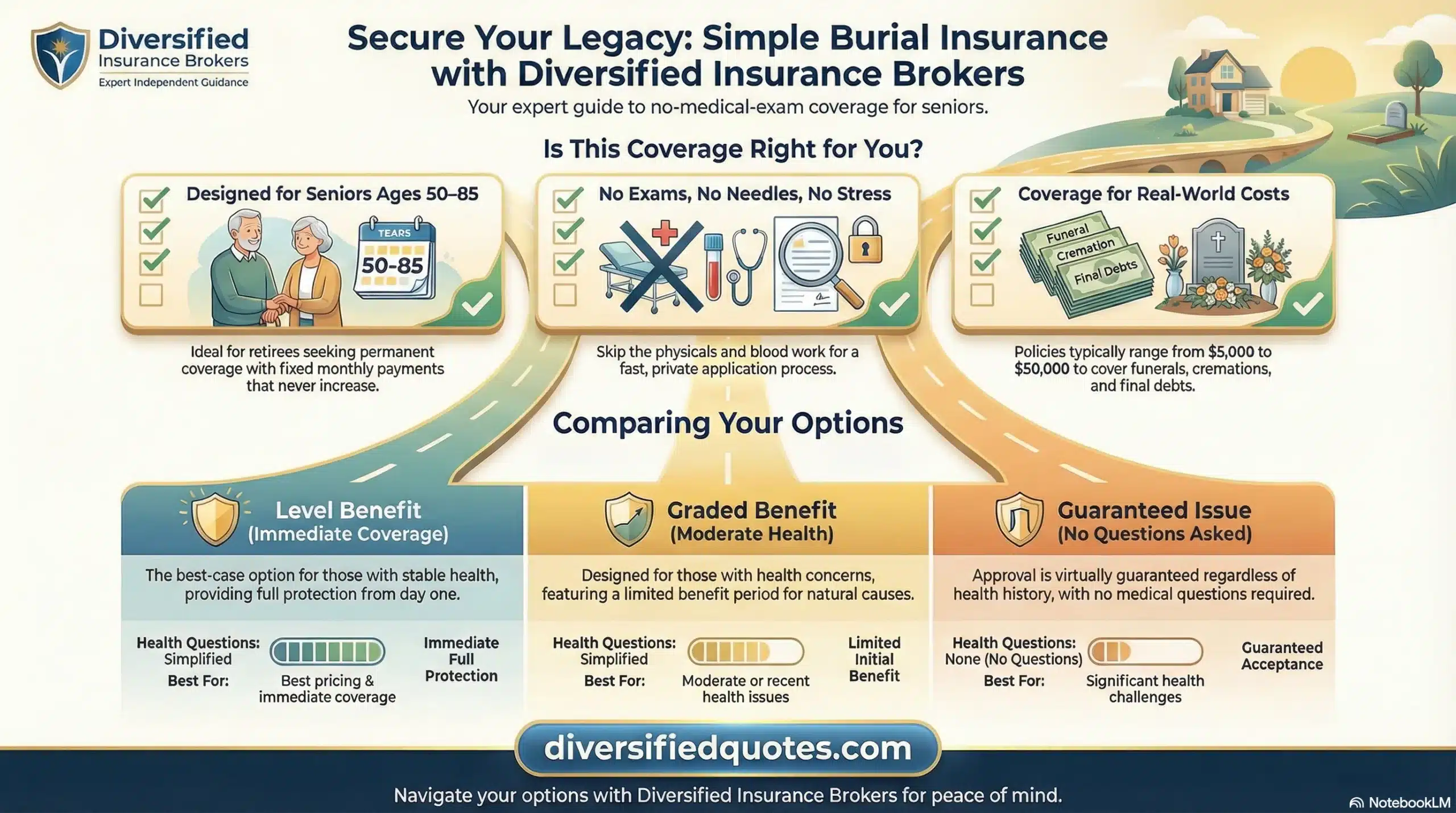
It’s important to understand that “burial insurance” is not a separate category of insurance that functions differently than life insurance. It’s life insurance—just sized and marketed for final expenses. That’s why you’ll often see face amounts like $5,000, $10,000, $15,000, $20,000, and sometimes up to $50,000 depending on the carrier and underwriting type.
If you want a broader overview of plan styles and how approvals work across different health profiles, this guide is a helpful reference point: burial insurance services.
Why adult children help parents over 70 buy burial insurance
If you’re researching burial insurance for a parent, you’re probably motivated by one of three situations.
First, you may be trying to remove the financial burden from the family. Even a “simple” end-of-life plan can create costs quickly, and many families don’t want to fund those expenses out of personal savings or credit cards—especially during a difficult and emotional time.
Second, you may be trying to avoid uncertainty. A lot of older adults assume they will “handle it later,” but time is not always on your side. The longer you wait, the more likely health changes can limit options. Securing a permanent policy now can lock in a stable plan that stays in place.
Third, you may be trying to protect your parent’s legacy. Many older adults don’t want their children spending money on funeral arrangements instead of using their savings for their own families. Burial insurance can keep the financial plan clean and predictable.
For parents who have additional health complexity, it may also be helpful to review how underwriting works in senior ages: life insurance with pre-existing conditions.
Burial Insurance Calculator (Senior Pricing)
Use this calculator to get a realistic baseline on pricing by age and state. Then we’ll help you compare immediate vs graded options.
Tip: Start at $10,000–$20,000, then adjust based on your parent’s budget and goals.
The 3 types of burial insurance for parents over 70 (and why the difference matters)
Most burial insurance policies for seniors over 70 fall into one of three approval categories. The main difference is not “brand name”—it’s how the policy treats health questions and whether the policy pays the full death benefit immediately or uses a waiting period for natural causes of death.
Simplified issue burial insurance (best value when health fits)
Simplified issue is typically the best blend of affordability and speed for parents over 70 who can answer “no” to a small set of health questions. There’s usually no medical exam, and approvals can be fast, but the carrier still screens for major risks like recent hospital stays, serious diagnoses, advanced disease progression, or need for nursing care.
When a parent qualifies for simplified issue, the policy is often a level benefit plan—meaning the full death benefit is payable from day one once the policy is active. This is why simplified issue is usually the first place we check if your goal is immediate coverage.
Graded (modified) burial insurance (coverage still available, but with a waiting period)
If a parent has more complicated health conditions, carriers may still offer coverage, but with a graded benefit. This means the full death benefit is not always payable for natural causes during the first 1–2 years (depending on carrier rules). Instead, the policy often pays a return of premium plus interest or a limited percentage during that initial period.
This is not “bad insurance.” It is simply a structure that lets insurers offer coverage to higher-risk applicants while still maintaining long-term affordability. The key is making sure the family understands the graded period clearly before buying.
Guaranteed issue burial insurance (acceptance-first option)
Guaranteed issue burial insurance is designed for parents who are unlikely to qualify for simplified underwriting due to serious or multiple conditions. It typically requires no medical exam and no health questions, with approval based mostly on age and state eligibility.
Guaranteed issue almost always includes a graded benefit period. If your parent needs a “yes” option and has had prior declines or complicated medical history, this can still be the most dependable way to put a permanent benefit in place.
If your family is specifically focused on policies that pay from day one, you may also want to review: best burial insurance with immediate coverage.
What “immediate coverage” means (and how to confirm it for a parent over 70)
When families say they want “immediate burial insurance,” they usually mean one thing: the full death benefit is available right away for natural causes, not just accidental death. That matters because most claims are natural-cause claims, and families want the coverage to work as expected regardless of timing.
The best way to confirm immediate coverage is to ensure the policy is a level benefit design (not graded or modified). The second step is confirming that the policy is actually in force, which generally means the application has been approved, the policy has been issued, and the first premium has been drafted or paid.
For parents over 70, we typically approach this by quoting simplified issue level-benefit plans first (when the health profile fits), then providing graded or guaranteed issue alternatives only if needed. That way, you can see the best-case option and the backup option side-by-side without confusion.
How much burial insurance should you buy for a parent over 70?
Most families start the same way: they estimate funeral costs and choose a face amount that covers the essentials. That’s a good starting point, but the best burial insurance decision is not only about the number—it’s about making sure the policy stays affordable and stays active.
For parents over 70, common coverage amounts often include:
$5,000–$10,000 — Often used for basic cremation and small final expenses, especially when budget is the top priority.
$10,000–$20,000 — A very common range for funeral costs and some additional bills, while still keeping premiums manageable.
$20,000–$30,000 — Often used for broader coverage needs, especially if the family wants extra buffer.
If you’d like a deeper framework for choosing the right number, this guide is helpful: how much burial insurance do I need.
When affordability is a concern, it’s usually better to buy a smaller policy that can be maintained long-term than to stretch for a larger amount that may become difficult later. The best burial insurance plan is the one your parent can keep.
What affects burial insurance rates for parents over 70?
Burial insurance pricing for seniors is not random. Carriers use a small set of factors that shape the premium, and understanding those factors helps you avoid overpaying and helps you compare options accurately.
Age is a major driver. In general, a 71-year-old will typically pay less than a 79-year-old for the same face amount, all else equal. That’s one reason acting sooner matters.
Tobacco use can significantly increase premiums. Some carriers price tobacco especially aggressively at older ages, and for those applicants, it becomes even more important to shop carriers rather than defaulting to one option.
Health conditions and medications matter mostly for simplified issue. Many parents over 70 still qualify for immediate level-benefit coverage if their conditions are controlled and they can answer “no” to the most sensitive underwriting questions.
Policy type matters. Guaranteed issue policies can cost more because the carrier isn’t collecting health information, and graded benefits are often built into the design. Simplified issue can be the best value when a parent qualifies.
If build is a factor for your parent, these guides can also help frame expectations:
burial insurance for overweight people and burial insurance for people with high blood pressure.
How to shop burial insurance for your parent over 70 the smart way
The smartest shopping process is one that reduces false starts, avoids unnecessary declines, and gets you to the correct underwriting path quickly.
We usually recommend starting with a few simple steps:
Step 1: Decide the goal. Are you covering funeral costs only, or do you want extra buffer for bills and family costs? Defining the goal prevents you from choosing a face amount that is either too small to matter or too large to keep.
Step 2: Start with simplified issue when possible. If your parent’s health profile fits, simplified issue can deliver immediate coverage and better pricing. It’s often the best overall value.
Step 3: Have a backup option ready. If simplified issue isn’t available, graded or guaranteed issue can still get coverage in place. The priority is having a plan that works for your family’s reality.
Step 4: Keep the process simple. One of the biggest mistakes is applying randomly to multiple carriers. Different carriers interpret similar medical history differently, and applying unnecessarily can create confusion. A strategic approach is usually cleaner and faster.
If you want another helpful baseline comparison for senior plans, this page is also a great reference: burial insurance for seniors.
Common mistakes families make with burial insurance for parents over 70
Mistake #1: Assuming “no exam” means “no waiting period.” Many policies skip the medical exam, but still have health questions. And guaranteed issue plans can have a graded benefit period even though approval is easy.
Mistake #2: Over-buying coverage. If premiums are too high, families risk a lapse later. A smaller policy that stays active is usually better than a larger one that becomes stressful.
Mistake #3: Not confirming the policy is active. “Approved” is great, but the most important thing is “in force.” Confirm the effective date and first premium draft.
Mistake #4: Forgetting beneficiary details. Make sure beneficiaries are correct, and that someone in the family knows where the policy is stored and how to file a claim.
If you want to understand how payouts work from a tax standpoint, this guide is also helpful: is life insurance death benefit taxable.
Why work with Diversified Insurance Brokers
Helping a parent over 70 get burial insurance shouldn’t feel confusing. Our job is to make the process clear and realistic. We compare senior-friendly policies, explain the difference between immediate and graded benefits, and help you choose a coverage amount that fits your parent’s monthly budget without creating stress.
Because we’re independent, we can shop multiple carriers and match your parent’s health profile to plans that are most likely to approve at the best available rate. We also help families avoid buying the wrong plan simply because the marketing sounded good.
If you’re ready to compare options, the fastest next step is to request a quote below.
Compare Burial Insurance for Parents Over 70
We’ll show immediate-coverage options first, then provide backup plans if graded or guaranteed issue is needed.
Financial Protection Essentials
Core strategies to protect retirement income, prepare for healthcare costs, and build long-term financial stability.
Talk With an Advisor Today
Choose how you’d like to connect—call or message us, then book a time that works for you.
Schedule here:
calendly.com/jason-dibcompanies/diversified-quotes
Licensed in all 50 states • Fiduciary, family-owned since 1980
FAQs: Best Burial Insurance for Parents Over 70
What is the best burial insurance for parents over 70?
The best burial insurance for parents over 70 is usually a final expense whole life policy that offers level premiums, lifetime coverage, and a fast approval process. Many families start by comparing simplified issue policies (short health questions, often immediate coverage) and then use guaranteed issue as a reliable backup if health history is more complicated.
Can my parent get burial insurance after age 70?
Yes. Many carriers offer burial insurance for seniors in their 70s, and approvals are often easier than people expect. Most options do not require a medical exam. Eligibility depends on age, state, and whether your parent qualifies for a simplified issue plan or needs a guaranteed issue policy.
Do parents over 70 need a medical exam to get coverage?
In most cases, no. The majority of burial insurance policies for seniors over 70 are no-exam plans. Instead of an exam, carriers typically use either a short health questionnaire (simplified issue) or no health questions at all (guaranteed issue).
How much burial insurance should parents over 70 buy?
Most families choose coverage amounts between $10,000 and $25,000. A good starting point is the expected funeral or cremation cost, plus a cushion for related expenses like travel, unpaid bills, or final medical balances. The best plan is one that stays affordable long-term and remains in force.
What is the difference between immediate coverage and graded coverage?
Immediate coverage (often called level benefit) means the full death benefit is available right away once the first premium is paid. Graded coverage typically applies to guaranteed issue policies and may limit natural-cause payouts during the first 2 years (often returning premiums paid plus interest). After the graded period ends, the full benefit usually becomes payable.
What health conditions can prevent immediate burial insurance coverage?
Immediate coverage burial insurance may be harder to qualify for if your parent has had recent hospitalizations, active cancer treatment, oxygen use, major cardiac events, advanced dementia, or certain severe conditions. If simplified issue isn’t available, guaranteed issue coverage is often still an option.
Will burial insurance premiums increase after age 70?
Most final expense whole life burial insurance policies are designed with level premiums, meaning the monthly cost typically does not increase as your parent gets older. As long as premiums are paid on time, coverage generally remains in force for life.
How quickly can a burial insurance policy start for a parent over 70?
Many simplified issue burial policies can be approved in minutes to a few days. Once issued and paid, coverage is active. Guaranteed issue policies can also be issued quickly because there are no health questions, but they usually include graded benefits during the early policy years.
Can an adult child own the policy and pay the premiums?
Yes. In many cases, an adult child can be the payer and may also be able to be the policy owner, depending on the carrier’s rules and state requirements. This can help prevent missed payments and ensures the beneficiary designations stay updated and clear.
What’s the best way to keep burial insurance affordable at age 70+?
To keep costs affordable, focus on the coverage amount you actually need, compare multiple carriers, avoid unnecessary riders, and choose a plan your parent can keep long-term. If health allows, simplified issue policies often provide better pricing and immediate benefits compared to guaranteed issue.
What if my parent has been declined for life insurance before?
A prior decline doesn’t mean burial insurance is unavailable. Many seniors who are declined for traditional life insurance can still qualify for simplified issue burial coverage. If not, guaranteed issue burial insurance can still provide acceptance and permanent coverage, with a graded benefit period early on.
Does burial insurance pay out quickly to help with funeral costs?
In many cases, yes. Burial insurance is designed to provide a fast, cash benefit to the beneficiary. Once a claim is filed with a valid death certificate and required documents, many carriers process small final expense claims quickly so families can handle funeral expenses without financial stress.
About the Author:
Jason Stolz, CLTC, CRPC and Chief Underwriter at Diversified Insurance Brokers (NPN 20471358), is a senior insurance and retirement professional with more than two decades of real-world experience helping individuals, families, and business owners protect their income, assets, and long-term financial stability. As a long-time partner of the nationally licensed independent agency Diversified Insurance Brokers, Jason provides trusted guidance across multiple specialties—including fixed and indexed annuities, long-term care planning, personal and business disability insurance, life insurance solutions, Group Health, and short-term health coverage. Diversified Insurance Brokers maintains active contracts with over 100 highly rated insurance carriers, ensuring clients have access to a broad and competitive marketplace.
His practical, education-first approach has earned recognition in publications such as VoyageATL, highlighting his commitment to financial clarity and client-focused planning. Drawing on deep product knowledge and years of hands-on field experience, Jason helps clients evaluate carriers, compare strategies, and build retirement and protection plans that are both secure and cost-efficient. Visitors who want to explore current annuity rates and compare options across multiple insurers can also use this annuity quote and comparison tool.
