
Disability Insurance for Self Employed

Jason Stolz CLTC, CRPC
When you are self-employed, your income is not “guaranteed” by an employer. It is created by your ability to show up, perform, deliver, sell, and produce results. If an illness or injury keeps you off the job for weeks or months, there is no HR department to keep paychecks coming—and there is rarely a safety net strong enough to protect both your household and your business. That is exactly why disability insurance for self-employed professionals is one of the highest-impact protections you can put in place. It is designed to replace part of your income so you can keep your financial life stable while you recover.
At Diversified Insurance Brokers, we help self-employed individuals build disability coverage that matches real-world cash flow. That means the policy is designed around how you actually earn income, how your work is classified, what documentation the carrier will require, and what happens to your revenue when you can only work at partial capacity. If you are newer to disability coverage, start with our core overview of disability insurance, then come back to this page to evaluate which features matter most when you do not have employer-sponsored benefits.
Self-employed income protection is not about buying “a policy.” It is about building a structure that pays when your business reality changes. If you can’t travel, can’t be on-site, can’t perform hands-on work, can’t sell, or can’t deliver the work clients pay for, income can drop fast—and some of that income loss can be permanent if clients move on. The best disability plan anticipates that risk and gives you breathing room to recover without forcing you to drain savings, borrow money, or accept bad business decisions just to stay afloat.
Get a Self-Employed Disability Quote
Compare occupation definitions, residual riders, and benefit designs that match how you actually earn income.
Nationwide comparison • Independent advice • No obligation
Why disability insurance matters more when you work for yourself
Self-employed people are used to managing risk. You may carry general liability, professional liability, cyber coverage, business property, or commercial auto. But the most common catastrophic risk for many owners is not a lawsuit—it is losing the ability to earn. A disability can force you to pause work, reduce output, lose clients, cancel contracts, and disrupt the pipeline that normally creates your revenue. Even a “short” disability can create long-term consequences if it causes you to miss key projects or lose repeat business.
Think about how fragile cash flow can be when it is tied to performance. A consultant who bills $10,000 per month and gets sidelined for six months can lose more than just $60,000 of income. They can lose retainers, referrals, and momentum. A contractor who cannot be on-site may still have bids out, work scheduled, and a reputation to protect—yet physical limitations can make that impossible. Disability insurance is built specifically to protect the income stream that funds everything else in your life, including long-term plans such as retirement contributions and saving strategies that often show up on our annuity and retirement pages like Are Annuities Worth It? and Are Annuities a Good Investment?.
For many self-employed professionals, disability risk is more likely than death risk during working years. That is why disability coverage is often evaluated side-by-side with life insurance planning (if you are building a broader protection plan, our starting point is how to get life insurance). Your goal is not to buy the cheapest policy. Your goal is to build a plan that pays when your real-world work limitations show up.
How self-employed disability policies pay benefits
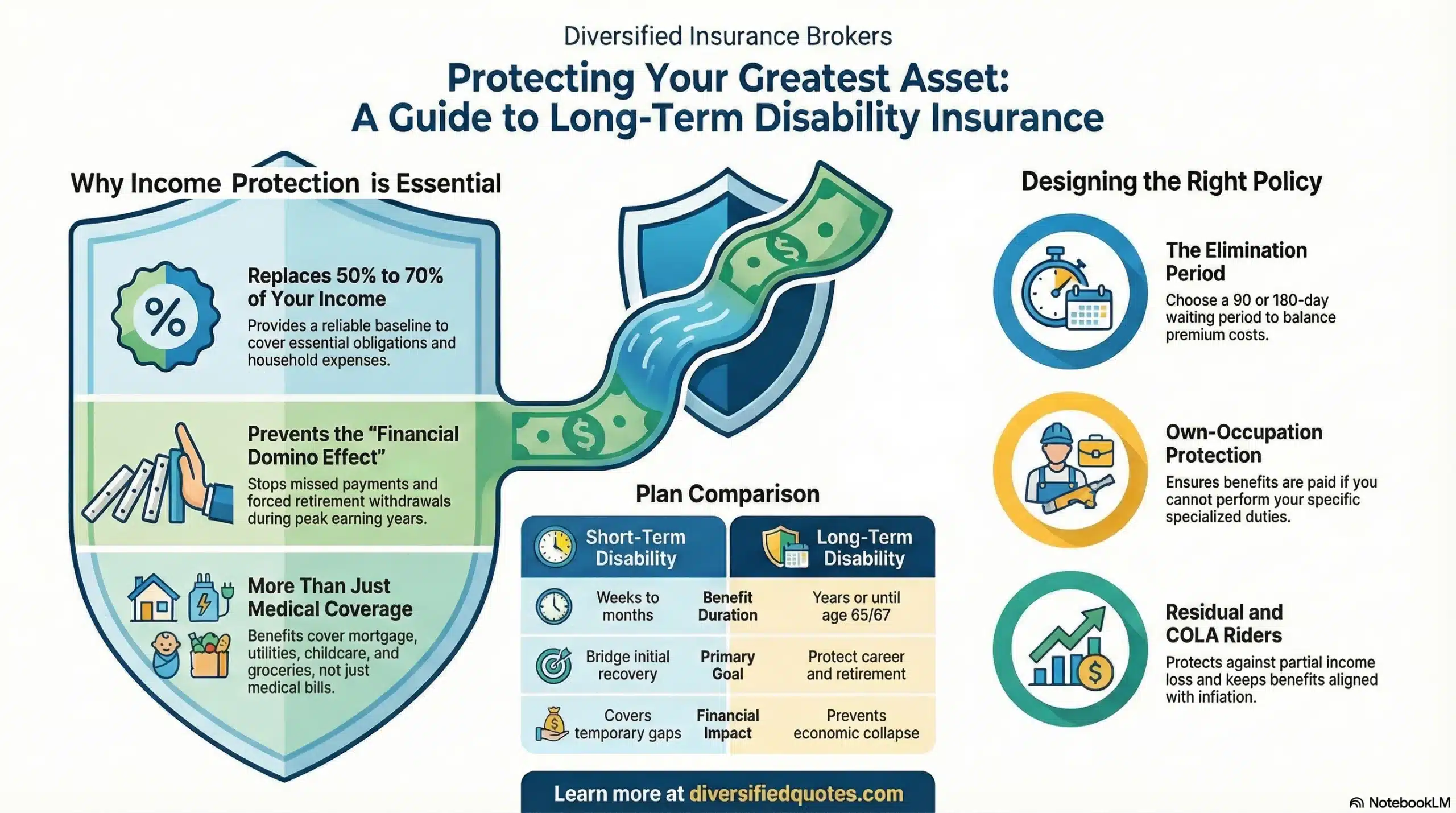
Disability insurance pays a monthly benefit when you meet the policy’s definition of disability and satisfy the elimination period (waiting period). The key is that “disability” is defined in your contract, and that definition is where many policies differ. A strong policy focuses on whether you can perform the material and substantial duties of your occupation—not just whether you can do any job at all.
For self-employed individuals, benefit amounts typically depend on verified earnings, often using tax returns and financial documentation. This is where planning matters. If your tax strategy minimizes taxable income aggressively, you may also be limiting the income the carrier is willing to insure. That does not mean you should abandon good tax planning, but it does mean you should understand the tradeoff before you need coverage. The underwriting process is both medical and financial, and the financial side is often the biggest surprise for business owners.
Most self-employed applicants benefit from a structure that protects them in both total and partial disability scenarios. Total disability claims are obvious—you cannot work. But partial disability is common in the self-employed world, where you may still be able to do some tasks, manage a team, or work limited hours, yet your income drops because you cannot perform the high-value duties that produce most of your revenue. This is why residual (partial) disability coverage becomes a centerpiece of strong self-employed policy design.
Coverage types that are most relevant for the self-employed
Individual Disability Insurance (IDI) is the foundation for most self-employed income protection plans. It is personally owned, not tied to an employer, and is typically built to pay for long durations—often to age 65 or 67—when a covered sickness or injury prevents you from working under the policy definition. For someone without group coverage, IDI is usually the most direct way to create dependable paycheck replacement during extended recovery periods.
Own-occupation disability coverage is often the most important definition to evaluate for specialized professionals. In plain terms, strong own-occupation language can pay benefits if you cannot perform the material and substantial duties of your specific occupation—even if you could work in another capacity. This matters when your income is driven by specialized tasks, licensing, technical skill, or physical ability. If you want a deeper explanation of how definitions work and why they matter, see own-occupation disability insurance.
Residual (partial) disability riders are especially valuable for self-employed people because disability is rarely all-or-nothing. Residual coverage is designed to pay a proportionate benefit when you can still work but suffer a measurable loss of income due to sickness or injury. For many entrepreneurs, the most realistic claim scenario is working reduced hours, avoiding certain physical tasks, or losing the ability to travel, sell, or perform production work—while still doing some limited duties. Residual benefits can keep cash flow stable during that partial-output period.
Business Overhead Expense (BOE) coverage protects the business rather than your household. BOE reimburses eligible fixed business expenses—such as rent, utilities, certain payroll, equipment leases, and essential operating costs—while you are disabled, usually for a shorter duration (often 12 to 24 months). BOE can be the difference between returning to a functioning business and returning to a collapsed one. BOE is often paired with personal IDI rather than replacing it, because your household still needs income even if overhead is reimbursed.
Short-term disability is a separate conversation. Some self-employed people want shorter benefit periods and simpler underwriting, particularly if budget is tight or they primarily want to cover a short recovery window. If that is your preference, the best starting point is our page on how to buy short-term disability insurance online, which explains typical durations, waiting periods, and differences between short-term and long-term disability protection.
Accident insurance can also be useful as a supplement when someone wants injury-only protection and understands the limitations. Accident coverage is not a replacement for true disability insurance because it does not usually protect you from sickness-related disabilities (which is a major claim driver), but it can help in certain budget-driven designs. If someone is exploring that route, a clearer comparison starts at how to buy accident insurance online.
How much disability insurance do self-employed people typically need?
Many self-employed professionals target roughly 60% to 70% of pre-disability income, but the real target depends on documented earnings, fixed household obligations, business overhead, and how variable revenue is. Carriers set maximum benefit limits and may treat different income types differently—especially when income is a mix of wages, distributions, and business profits. That is why benefit design is not just a quote. It is a structure built around what can actually be insured and what you truly need to protect.
A practical way to estimate need is to separate it into two buckets. First, personal living expenses: housing, utilities, food, transportation, insurance, debt payments, and family obligations. Second, business obligations that must be paid regardless of health: rent, essential payroll, software, recurring contracts, equipment payments, and other fixed costs that keep operations alive. If overhead is minimal, you may primarily need personal income replacement. If overhead is significant, the plan often needs both personal DI and a business-focused layer.
The elimination period choice (for example 30, 60, 90, or 180 days) is typically about balancing cost against cash reserves. If you have a healthy emergency fund and strong access to cash, a longer waiting period may reduce premiums while still protecting you from the larger risk: a long duration disability. If reserves are thin or income is highly sensitive to missed weeks, a shorter waiting period may make more sense—especially in designs coordinated with short-term disability strategies.
What makes self-employed underwriting different
Self-employed underwriting is often more complex than W-2 employee underwriting because carriers must verify the stability and insurability of your income. Most self-employed applicants are asked for tax returns (often two years), and carriers may request additional documentation when income is volatile, recently increased, or based on commissions and variable revenue. If you have had a strong year followed by a weaker one, that can also affect the benefit amount the carrier will offer.
Occupation classification is another major variable. What you do day-to-day matters. A business owner who is truly office-based may receive a different classification than an owner who also performs physical labor or hands-on production. In claims scenarios, the policy definition is applied to your occupational duties, so accurate duty descriptions matter at application—especially for specialized and hybrid roles. The goal is that the policy you buy matches how you earn.
Medical underwriting still matters, of course. But for self-employed people, the financial and occupational side is often where the biggest misunderstandings happen. The best carrier is not always the one with the lowest premium. It is the one whose definitions, rider options, and underwriting approach align with your situation.
Common mistakes self-employed buyers make
One common mistake is buying a minimal policy that only pays for total disability and skipping residual coverage. For entrepreneurs, partial disability is often more likely than total disability, and it is also the scenario where cash flow can quietly collapse. Without residual benefits, a business owner may keep working through a recovery at reduced output while income falls—exactly when support is needed most.
Another mistake is setting a waiting period that assumes income can be paused without consequences. Self-employed income is not always paused—it can be lost through client churn, missed deadlines, or broken contracts. If your business model is highly sensitive to missed time, you may need a tighter elimination period or supplemental coverage.
A third mistake is ignoring business overhead risk. Even if household bills are covered, many owners still face a second financial threat: fixed business expenses that continue whether or not revenue is coming in. If the business collapses, recovery becomes much harder—even after health improves.
Built for Partial Disability, Not Just “All or Nothing”
If your biggest risk is reduced capacity and reduced revenue, a residual rider can matter more than the base benefit.
Case example: what this looks like in real life
Example: 41-year-old self-employed professional with variable revenue. A self-employed consultant relies on client meetings, travel, and presentations. A significant illness leads to several months of reduced ability to travel and meet clients in person. They can still do some remote work, but overall income drops sharply because the highest-value activities are limited. A policy with a strong residual rider pays a proportionate benefit during the income-loss period, helping stabilize household finances while the consultant gradually rebuilds full activity.
Without residual coverage, the consultant may keep working at reduced output while income falls—creating a “silent” financial spiral. The person feels productive because they are still working, but the numbers do not lie. That is why self-employed policy design is less about “Will it pay if I am completely disabled?” and more about “Will it pay in the realistic situations where my business income drops materially?”
Who should prioritize disability insurance if they are self-employed?
Disability coverage is useful for most self-employed people, but it becomes especially critical when income is tied directly to personal output, licensing, physical ability, or specialized skill. Consultants, contractors, professional service providers, sales-driven owners, medical and dental professionals, attorneys, and anyone whose business cannot run profitably without their full involvement are usually high priority candidates.
It is also important when your household depends heavily on your income or when you are building long-term assets that you do not want to disrupt during a health event. A well-designed disability plan helps you avoid tapping retirement savings prematurely, which can derail broader planning strategies. If you are coordinating protection with retirement strategy, your annuity and retirement resources—starting at our annuities hub—can help tie the whole picture together.
Finally, self-employed disability planning is often the difference between making decisions calmly and making decisions under pressure. If a disability forces you to choose between “selling at a bad time,” “borrowing money,” or “walking away from a business you built,” you are not really choosing—you are reacting. Disability insurance converts that uncertainty into predictable options.
Protect the Income Your Business Depends On
If your income is tied to your output, the right policy can keep your household and business stable during recovery.
Related Pages
Additional disability and income-planning resources for self-employed professionals:
Financial Protection Essentials
Burial insurance comparisons, travel protection planning, carrier reviews, and post-heart attack life insurance guidance.
Talk With an Advisor Today
Choose how you’d like to connect—call or message us, then book a time that works for you.
Schedule here:
calendly.com/jason-dibcompanies/diversified-quotes
Licensed in all 50 states • Fiduciary, family-owned since 1980
FAQs: Disability Insurance for Self-Employed
What counts as a disability on a self-employed policy?
Policies define disability based on your ability to perform job duties. With a strong own-occupation definition, you may qualify when you can’t perform the material and substantial duties of your specific occupation.
How do carriers verify income for self-employed applicants?
Carriers typically review recent tax returns and may consider business financials to confirm insurable earnings and determine the maximum monthly benefit they can offer.
What elimination period should I choose?
Common elimination periods are 30–90 days, but longer waits can reduce premium. The best choice depends on savings, cash flow, and how quickly a disability would strain your finances.
Do I need residual (partial) disability coverage?
Often, yes. Self-employed claims frequently involve reduced capacity rather than total inability to work. Residual benefits can pay proportionately when you’re working but experiencing a loss of income.
Should I consider BOE coverage in addition to personal DI?
If you have fixed overhead like rent, staff, or recurring contracts, BOE can reimburse eligible business expenses while personal DI replaces household income. Many owners use both.
Can I increase coverage later if my income grows?
Many policies offer future increase options that allow benefit increases as income rises, often without repeating medical underwriting (subject to financial verification).
Are benefits taxable?
Tax treatment depends on who pays premiums and how. Many individual policies paid with after-tax dollars produce benefits that are generally tax-free, while BOE benefits are typically taxable but may be deductible as business expenses. Confirm with your tax professional.
About the Author:
Jason Stolz, CLTC, CRPC and Chief Underwriter at Diversified Insurance Brokers (NPN 20471358), is a senior insurance and retirement professional with more than two decades of real-world experience helping individuals, families, and business owners protect their income, assets, and long-term financial stability. As a long-time partner of the nationally licensed independent agency Diversified Insurance Brokers, Jason provides trusted guidance across multiple specialties—including fixed and indexed annuities, long-term care planning, personal and business disability insurance, life insurance solutions, Group Health, and short-term health coverage. Diversified Insurance Brokers maintains active contracts with over 100 highly rated insurance carriers, ensuring clients have access to a broad and competitive marketplace.
His practical, education-first approach has earned recognition in publications such as VoyageATL, highlighting his commitment to financial clarity and client-focused planning. Drawing on deep product knowledge and years of hands-on field experience, Jason helps clients evaluate carriers, compare strategies, and build retirement and protection plans that are both secure and cost-efficient. Visitors who want to explore current annuity rates and compare options across multiple insurers can also use this annuity quote and comparison tool.
