
Group Health Insurance

Jason Stolz CLTC, CRPC
Group Health Insurance (Level-Funded)—often called group level funding—is one of the fastest-growing strategies for small and mid-sized employers who want more cost control without taking on full self-funded risk. In simple terms, level-funded group health combines the predictable monthly billing structure of traditional fully insured plans with the transparency, reporting visibility, and potential premium refund opportunities typically associated with self-funded arrangements.
For employers facing annual renewal increases, unpredictable trend adjustments, or limited carrier flexibility, level-funded group health can create a more stable long-term budgeting framework. Many employers are drawn to level funding not just because of refund potential, but because it provides real claim visibility, stop-loss financial protection, and better alignment between actual employee health utilization and long-term employer cost outcomes.
If your company is evaluating ways to control healthcare spending while maintaining strong employee benefits, level-funded group health may represent a meaningful step forward. For business owners also evaluating risk protection strategies, many choose to coordinate benefit planning alongside broader protection planning like Key Person vs. Buy-Sell Life Insurance and Buy-Sell Life Insurance for Business.
Compare Level-Funded Group Health Options
We build side-by-side funding comparisons based on your census, location, and participation structure.
—
Why Employers Are Moving Toward Level-Funded Group Health
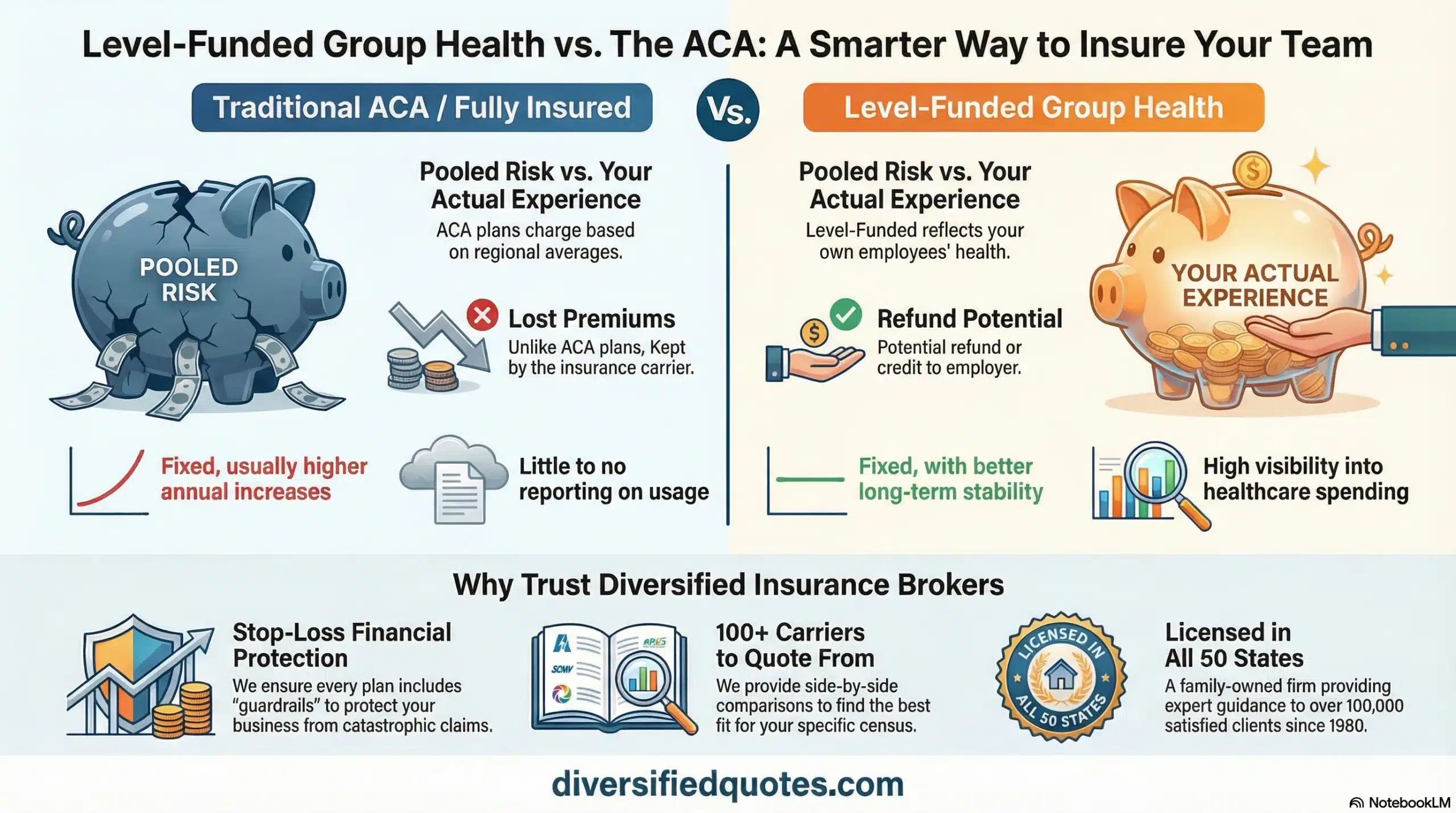
Traditional fully insured health plans were designed to simplify administration by transferring all risk to the insurance carrier. While that simplicity remains attractive, many employers now realize they are paying premiums based on pooled regional risk rather than their own workforce health experience. Level-funded group health allows employers to participate more directly in the financial outcomes tied to their group’s actual claim performance.
Predictable monthly billing remains intact, but employers gain additional transparency into how healthcare dollars are actually being spent. Over time, this visibility can allow companies to make smarter plan design adjustments, wellness strategy decisions, and contribution structure updates.
For some employers, refund potential is the initial attraction. For others, long-term cost trend control and stop-loss financial protection are the primary drivers. The reality is that most successful level-funded programs combine all three benefits: cost stability, risk protection, and performance-based cost opportunities.
—
How Level-Funded Group Health Actually Works
Level-funded plans operate using a structured monthly payment that includes three primary cost components. The first is claims funding, which represents the projected cost of expected medical and pharmacy claims. The second is administrative cost, which covers network access, claims processing, compliance support, and customer service. The third is stop-loss insurance, which protects employers from catastrophic claim exposure beyond defined thresholds.
Throughout the year, claims are paid from the claims funding portion. If claims remain below projected expectations, unused claim funding may be eligible for surplus reconciliation at the end of the contract period. If claims exceed expected levels, stop-loss coverage helps limit employer exposure to predictable thresholds.
This structure allows employers to maintain fixed monthly cash flow while still gaining access to claim performance-based outcomes that do not exist in traditional fully insured plans.
—
Premium Refund Potential: What Employers Should Realistically Expect
Premium refunds in level-funded group health typically come in the form of surplus reconciliation. If total claims fall below projected funding targets and contract rules allow surplus distribution, employers may receive a refund or credit. However, surplus is never guaranteed and should be viewed as a possible performance outcome rather than a primary planning assumption.
Most experienced employers evaluate level-funded plans based on three financial scenarios: favorable claims year, average claims year, and high claims year. This modeling approach gives leadership clarity around both upside opportunities and worst-case financial exposure. Many employers ultimately select level funding because of improved cost predictability, even in years when no surplus is returned.
—
Small Group Eligibility and Participation Considerations
Level-funded plans have expanded dramatically in recent years. Many carriers now support groups as small as two enrolled employees, although eligibility varies by state and underwriting guidelines. Participation stability is often more important than group size when determining long-term program success.
Participation consistency helps underwriting models more accurately predict claims patterns. When participation fluctuates dramatically, claim predictability can decrease. This is why many level-funded programs include minimum participation thresholds and waiting period guidelines.
Some carriers allow inclusion of 1099 workers when eligibility requirements are met. Because eligibility rules vary by carrier and state, it is important to evaluate group structure carefully during quoting.
—
See If Your Group Qualifies for Level Funding
Upload a simple census and we’ll evaluate eligibility and refund potential ranges.
—
Plan Design Flexibility and Employee Experience
Level-funded group health plans support many of the same benefit structures employees expect from traditional group coverage. Broad PPO networks, EPO network options, preventive care coverage, virtual care access, pharmacy programs, and wellness incentive structures are commonly available. Many employers pair high deductible health plans with HSAs or integrate HRAs to help offset employee out-of-pocket exposure.
Virtual care utilization continues to play a major role in claim cost stabilization. Early access to telemedicine, behavioral health resources, and chronic care coaching can help reduce avoidable emergency and specialty care costs. Over time, these engagement tools can meaningfully influence long-term claim performance trends.
—
Stop-Loss Insurance: The Backbone of Financial Protection
Stop-loss insurance is a critical component of level-funded plan design. Specific stop-loss protects against large individual claims, while aggregate stop-loss protects against total claim exposure exceeding projected annual limits. Together, these protections allow employers to benefit from performance-based claim outcomes while still maintaining predictable financial guardrails.
For many employers, stop-loss protection is actually more valuable than refund potential because it stabilizes worst-case financial exposure. Over time, strong stop-loss structures often create more consistent long-term budgeting than traditional fully insured renewal volatility.
—
Strategies That May Improve Long-Term Cost Performance
Employers who actively promote preventive care utilization often see stronger long-term claim outcomes. Early screening, chronic condition management, and primary care engagement can help prevent higher-cost acute events. Pharmacy optimization strategies, including generic substitution and specialty pharmacy management, can also help stabilize cost trends.
Employee education plays a major role in claim cost outcomes. Employees who understand where to access appropriate levels of care often generate lower overall claim cost trends without sacrificing care quality.
—
Model Best Case and Worst Case Cost Scenarios
We show level-funded, fully insured, and hybrid funding comparisons.
—
Why Many Employers View Level Funding as a Long-Term Strategy
Level funding allows employers to move away from purely pooled risk models and toward performance-informed benefit planning. Over time, access to claim reporting allows employers to make smarter plan design decisions that support both employee health and employer cost control.
Many employers who transition to level funding remain there long term because it provides a balance of predictability, flexibility, and performance-based cost alignment.
—
Related Group Health Strategy Pages
Explore funding strategies, employer protection planning, and cost control resources.
Financial Protection Essentials
Carrier evaluations, international travel medical protection, and pre-settlement funding education resources.
Talk With an Advisor Today
Choose how you’d like to connect—call or message us, then book a time that works for you.
Schedule here:
calendly.com/jason-dibcompanies/diversified-quotes
Licensed in all 50 states • Fiduciary, family-owned since 1980
FAQs: Group Level-Funded Health Insurance
What is level-funded group health insurance?
Level-funded group health combines features of fully insured and self-funded plans. Employers pay one fixed monthly amount that includes claims funding, administration, and stop-loss protection. At the end of the year, unused claims funds may be eligible to be returned depending on contract rules.
How do premium refunds or surplus credits work?
If claims are lower than expected for the plan year, some level-funded programs allow a portion of unused claim funding to be returned as a surplus credit or refund. The exact calculation and timing depend on the carrier contract and claim run-out period.
Are refunds guaranteed with level-funded plans?
No. Refunds depend on claims performance, participation stability, plan design, and contract rules. Many employers choose level funding for cost transparency and stop-loss protection even in years when no surplus is returned.
How small can a group be for level-funded insurance?
Some carriers allow groups as small as two enrolled employees, depending on state rules and underwriting guidelines. Eligibility can vary, so group structure and participation are important during quoting.
Can 1099 contractors be included in level-funded group plans?
Some level-funded programs allow 1099 workers if they meet eligibility requirements, but rules vary by state and carrier. It’s important to confirm eligibility before structuring enrollment.
What happens if claims are higher than expected?
Stop-loss insurance protects the employer from catastrophic claim exposure beyond defined thresholds. This helps maintain predictable budgeting even during higher claim years.
Are monthly costs predictable with level-funded plans?
Yes. Employers pay a fixed monthly payment that bundles claims funding, administrative costs, and stop-loss premiums, making budgeting more stable compared to traditional renewal spikes.
Why are more small employers switching to level-funded group health?
Many employers choose level funding for improved claims visibility, potential refund opportunities, and better long-term cost control compared to traditional fully insured plans.
About the Author:
Jason Stolz, CLTC, CRPC and Chief Underwriter at Diversified Insurance Brokers (NPN 20471358), is a senior insurance and retirement professional with more than two decades of real-world experience helping individuals, families, and business owners protect their income, assets, and long-term financial stability. As a long-time partner of the nationally licensed independent agency Diversified Insurance Brokers, Jason provides trusted guidance across multiple specialties—including fixed and indexed annuities, long-term care planning, personal and business disability insurance, life insurance solutions, Group Health, and short-term health coverage. Diversified Insurance Brokers maintains active contracts with over 100 highly rated insurance carriers, ensuring clients have access to a broad and competitive marketplace.
His practical, education-first approach has earned recognition in publications such as VoyageATL, highlighting his commitment to financial clarity and client-focused planning. Drawing on deep product knowledge and years of hands-on field experience, Jason helps clients evaluate carriers, compare strategies, and build retirement and protection plans that are both secure and cost-efficient. Visitors who want to explore current annuity rates and compare options across multiple insurers can also use this annuity quote and comparison tool.
