
Guaranteed Issue Life Insurance Under Age 50

Jason Stolz CLTC, CRPC
At Diversified Insurance Brokers, we help clients get life insurance when traditional underwriting is difficult—especially for people under 50 who have prior declines, complicated medical histories, or simply want a faster, more certain path to coverage. Guaranteed Issue (GI) Life Insurance under age 50 can provide permanent protection without medical exams or health questions, which makes it one of the most straightforward ways to put a benefit in place when health uncertainty is the biggest obstacle. If you’ve been searching for a true “yes” option and keep running into medical roadblocks, this guide explains how under-50 GI programs work, what you can realistically expect, and how to compare GI to other no-exam alternatives so you choose the best value for your situation.
It’s important to start with one key truth: under-50 guaranteed issue coverage exists, but it’s not as common as age-50+ guaranteed issue. Most GI programs are marketed for final-expense needs in older age bands, but there are carriers, niches, and state variations that may allow guaranteed issue at younger ages. That’s why shopping matters. The right approach is to confirm eligibility where you live, understand the carrier’s age band and maximum face amount, and then compare GI side-by-side with simplified-issue or other no-exam paths that can sometimes deliver better pricing or fewer restrictions.
If you’re trying to understand what “guaranteed issue” really means, and how it differs from other no-exam products, this overview on life insurance with no medical questions asked can help clarify the terminology you’ll see across different carriers.
Get Your Guaranteed Issue Quote (Under Age 50)
No exams. No health questions. We’ll confirm what GI options are available in your state and show alternatives if you can save money.
What guaranteed issue life insurance under age 50 is (and what it isn’t)
Guaranteed issue life insurance is a type of coverage where acceptance is not based on your medical history. In a true GI program, the carrier does not require a medical exam, does not ask health questions, and does not use your answers to decide whether you qualify. If you fall within the eligible age range and meet the carrier’s basic administrative requirements, approval is typically automatic. Most GI policies are structured as permanent coverage (often whole life), which means they are designed to stay in force for life as long as premiums are paid. Many GI whole life policies also build cash value over time, which can create additional flexibility later if you need access to funds.
What GI coverage usually is not: it’s generally not designed for large income replacement amounts, and it’s usually not the cheapest cost per dollar when compared to underwritten policies. GI coverage is best viewed as a certainty-first solution. If your primary problem is, “I keep getting declined,” GI can put a real policy in place. But if you are healthy enough to qualify for simplified-issue or fully underwritten term or whole life, those routes often provide larger face amounts and lower premiums. That’s why the best approach is typically to confirm GI availability and also compare it to other no-exam options that may still be available depending on your situation.
Why under-50 GI coverage is harder to find
GI is most commonly marketed as final-expense coverage for older ages because that is where demand is highest. Under age 50, many consumers are still eligible for traditional underwriting, so fewer carriers build GI programs specifically for that market. Even when under-50 GI exists, the carrier may limit face amounts, tighten state availability, or restrict how many policies can be issued to one person. The result is that you have to shop smarter: you need to confirm the exact eligible age band, the coverage range, and whether the program is offered in your state.
This is one reason we emphasize a “compare first” approach. Some people assume they need GI because they’ve been declined once. But declines can happen for reasons that don’t apply across all carriers, or because an applicant applied for the wrong product type. If you’ve had a decline tied to your health history, this guide on life insurance with pre-existing conditions can help you understand why underwriting outcomes vary so much—and why a different path may still be available.
Who GI life insurance under 50 is designed to help
Under-50 GI is typically designed for people who want a guaranteed “yes” option when underwriting is uncertain, stressful, or likely to result in a decline. We most often see GI under 50 make sense for applicants who have recent declines, multiple conditions, complex prescription histories, or a health event that makes traditional underwriting unrealistic in the near term. It can also be helpful for people who value privacy and speed—no labs, no medical records requests, and no phone interviews about health history.
Another common situation is “coverage gap” planning. Someone may be between treatments, recently diagnosed, or in a stabilization period where underwriters want more time and documentation. GI coverage can serve as a baseline benefit while you wait to re-apply for traditional coverage later. Some clients use GI to put a small permanent policy in force, then pursue a larger term policy after they have better stability and documentation. In these scenarios, GI becomes a bridge that helps protect your family while you rebuild eligibility.
What you can expect from under-50 GI policies
Most under-50 GI policies share a common set of features. First is the simplified enrollment. You’ll typically provide basic personal information, choose a face amount within the program’s allowed range, select a payment method, and name beneficiaries. Because there is no medical underwriting, the process is often fast. Second is level premiums. Most GI whole life policies are designed with premiums that do not increase over time, which matters for long-term affordability.
Third is the face amount structure. Many GI programs are designed for smaller benefits. Some carriers allow coverage to be increased by stacking policies or combining with other programs, but those rules vary. The key is not to assume. If you need a specific amount, confirm what is possible in your state and whether there are realistic ways to build a larger total benefit through multiple solutions.
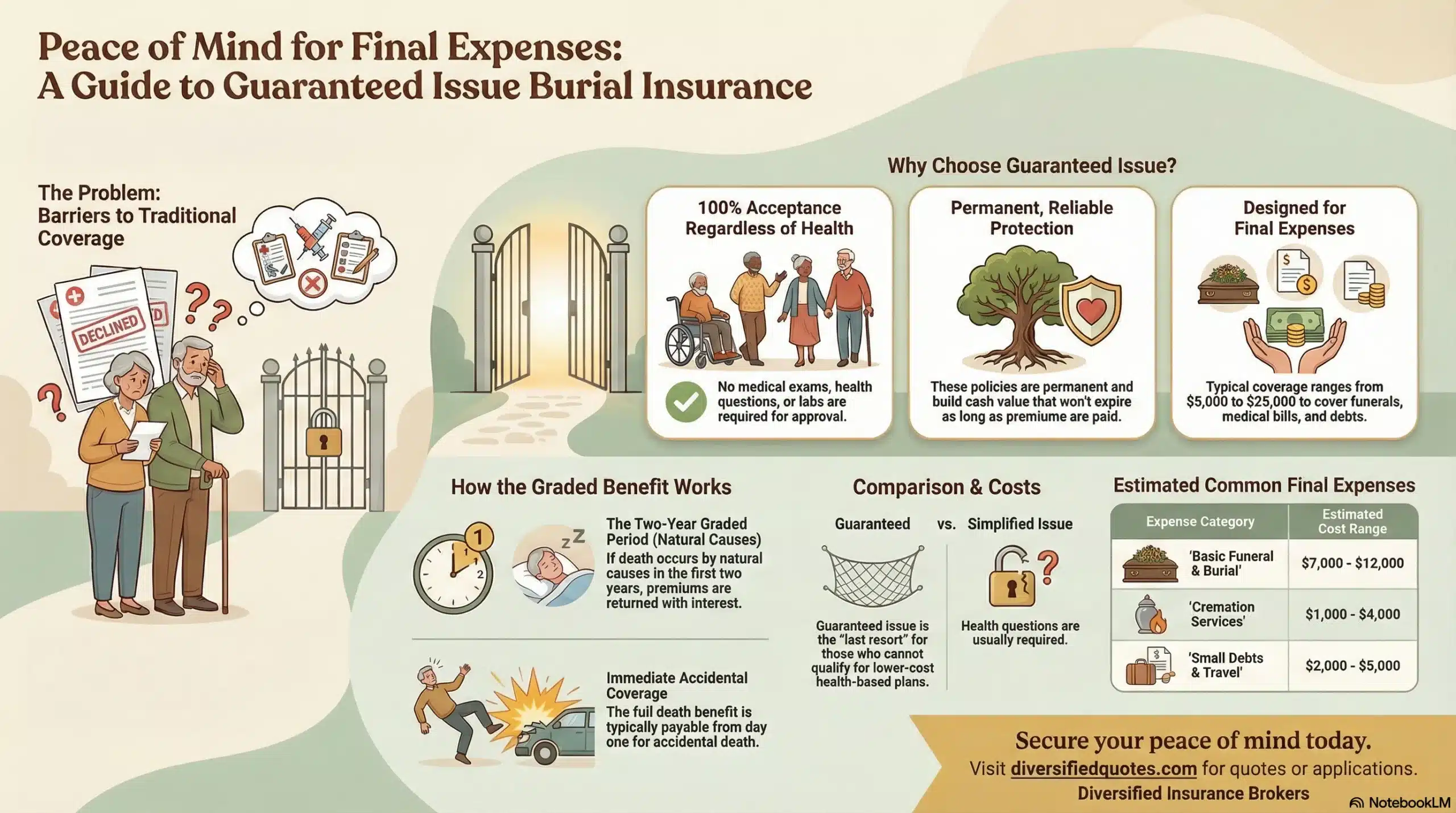
Finally, many GI policies include a graded death benefit during an initial period—most commonly two years. That graded period is one of the most important features to understand before you buy.
Graded death benefits: the single most important detail to understand
Many people hear “guaranteed issue” and assume the full death benefit is payable immediately for any cause of death. Often, that is not how guaranteed issue works. Because the insurer is accepting applicants without medical screening, many GI policies protect the carrier from immediate claims by using a graded benefit period for non-accidental death. During that initial period, if the insured passes away from natural causes, the policy may pay a limited amount—often the return of premiums paid plus a stated amount. After the graded period ends, the policy generally pays the full face amount for covered deaths as long as premiums remain paid.
Accidental death is often treated differently. Many designs pay the full face amount for accidental death from day one, even during the graded period. Exact definitions and rules vary by carrier and state, so you should always review the contract language. The practical takeaway is simple: if you are purchasing GI coverage under 50, assume there may be a graded period and make sure you understand it clearly. If your top priority is immediate full coverage, the best path—when possible—is often simplified issue or an underwritten policy.
If you’re trying to understand how “no exam” policies differ from policies with “no questions,” this is where many families get tripped up. That’s why our educational guide on no medical questions asked coverage is worth reading before you apply.
Why GI is priced higher per dollar of coverage
Guaranteed issue premiums are typically higher than simplified-issue or underwritten coverage for one main reason: the carrier has less information about risk. When a company does not evaluate medical history, it must price assuming a wider range of outcomes. That means you may pay more for the same face amount than you would if you qualified for a policy that asks health questions or reviews medical records. This is not a flaw; it’s the tradeoff that makes guaranteed acceptance possible.
However, “higher premium” does not automatically mean “bad value.” If your realistic alternatives are limited, the right comparison may be GI versus no coverage. For many families, a smaller GI benefit that stays active long-term can still be a meaningful solution. The key is to choose a face amount and premium that fit your monthly budget, and to understand exactly what the benefit pays during any graded period.
How to decide on a realistic face amount under 50
Under 50, coverage needs can look very different from traditional “final expense” planning. Some people under 50 want GI coverage strictly for end-of-life costs. Others want a baseline amount to protect family members against immediate expenses and provide some breathing room—especially if larger coverage is not currently available.
The right face amount starts with your goal. If your goal is “funeral and final costs only,” a smaller amount may work. If your goal is “create a safety net while I work on qualifying for more coverage,” you may want a bit more, even if it’s still modest. It can also help to think about your must-cover items such as a short runway of household bills, rent or mortgage for a short period, travel costs for family, and outstanding balances you’d want cleared.
If your needs are more closely tied to burial planning, this page can provide a helpful frame of reference: How Much Burial Insurance Do I Need?
GI under 50 vs. simplified issue: the comparison that often saves money
A common mistake is assuming that “no exam” means “guaranteed issue.” Many simplified-issue policies skip the exam but still ask a short set of health questions. If you can answer those questions favorably, simplified issue can offer a better price per dollar and may provide immediate level benefits. The tradeoff is that a “yes” answer to certain questions can trigger a decline.
Because of that, the best strategy is usually to check GI availability and then check simplified-issue eligibility—without wasting time or triggering unnecessary applications. Our advisors can help identify whether you’re likely to pass simplified issue screens and whether the savings would be meaningful, or whether GI is the most realistic path given your history. If you’ve had a previous decline, reviewing the patterns described in pre-existing conditions underwriting can help you understand why some simplified screens are challenging.
Practical scenarios where GI under 50 can be the right move
Consider a 42-year-old who recently applied for term coverage and was declined due to a new diagnosis that has not stabilized. In that case, GI whole life can lock in a permanent policy now—no waiting for medical records or “six months of stability” requirements—while the family builds a plan to re-apply for larger coverage later. The GI policy may not replace the larger need long-term, but it prevents the family from remaining uninsured during a critical period.
Another example is a 38-year-old with a complex prescription profile and multiple ongoing conditions who keeps encountering underwriting delays and uncertainty. GI can provide a clear, predictable option: a policy that issues without questions, with level premiums, and with a benefit designed to help loved ones manage expenses if something happens unexpectedly. In many cases, the emotional relief of “we at least have coverage in place” matters as much as the numbers on paper.
What to gather before you request a quote
The good news is GI coverage requires far less medical detail than underwritten options. In most cases, the essentials are straightforward: your age, state, desired coverage amount, and basic beneficiary details. But because under-50 GI availability can vary, it helps to provide your preferred budget range and whether you are open to alternatives like simplified issue.
If you have had prior declines, it can also help to share when the decline occurred and what reason you were given. That single detail can quickly guide whether a simplified option is realistic or whether GI is the best path. If you want the fastest way to confirm availability and pricing, use the form below. We’ll check GI options available under 50 in your state and then show other paths only if they truly improve value.
Not sure if GI is your best option? We’ll compare GI vs. simplified-issue and show what’s actually available in your state.
How Diversified Insurance Brokers helps
Our job is to make the process simple, realistic, and pressure-free. We confirm what guaranteed issue options exist under age 50 where you live, explain face amount limits and any graded period clearly, and then compare GI to alternatives only when it makes sense. We also help you avoid the most common mistakes we see in the market: buying the wrong “no exam” policy because the marketing sounded similar, selecting a face amount that strains the budget, or misunderstanding how graded benefits work during the early years.
We focus on clarity because GI life insurance can be an excellent solution when it’s matched properly to the client’s goals. The right plan is the one you can keep in force long-term, that your beneficiary can use easily, and that protects your family from preventable financial stress.
Request Your Guaranteed Issue Quote (Under 50)
We’ll confirm what’s available in your state and show the best path to get covered today.
Financial Protection Essentials
Employer health planning, high-risk life insurance guidance, retirement transitions, and long-term care comparison tools.
Talk With an Advisor Today
Choose how you’d like to connect—call or message us, then book a time that works for you.
Schedule here:
calendly.com/jason-dibcompanies/diversified-quotes
Licensed in all 50 states • Fiduciary, family-owned since 1980
FAQs: Guaranteed Issue Life Insurance Under Age 50
Is guaranteed issue life insurance available under age 50?
It’s less common than age 50–80 offerings, but some carriers and state variations do allow guaranteed issue below 50. Availability, eligible ages, and face amounts vary by carrier and state.
What ages are typically eligible?
Programs may open as early as the mid-40s in certain states, while others begin at 50. For applicants in their 20s–30s, true guaranteed-issue options are rare; we’ll check state-specific options and alternatives.
How much coverage can I get under age 50?
Guaranteed-issue face amounts are usually modest, often $5,000–$25,000 (sometimes higher/lower), aimed at final-expense needs. Larger amounts typically require simplified or fully underwritten policies.
Is there a waiting period?
Yes. Most guaranteed-issue policies use a graded death benefit for the first 2 years: non-accidental death pays premiums paid plus interest; accidental death is generally covered at 100% from day one. Exact terms vary by carrier and state.
How do premiums compare to other options?
Because there’s no medical underwriting, premiums are typically higher per dollar of coverage than simplified-issue or fully underwritten options. If you can answer a few health questions, simplified-issue may cost less and may avoid graded benefits.
Is guaranteed issue term life available, or is it whole life only?
True guaranteed-issue is most commonly whole life (permanent coverage with cash value). Guaranteed-issue term life under 50 is rare; if available, it’s typically through group or employer programs with limits.
What alternatives exist if I’m under 50 and can’t find GI in my state?
We’ll check simplified-issue options (no exam, brief health questions), employer or association group coverage, and individualized term/whole life paths that fit your medical history. If you’re exploring “no questions” products, start here: Life Insurance With No Medical Questions Asked.
Does guaranteed issue build cash value?
Yes—guaranteed-issue whole life typically accumulates cash value that can be accessed via policy loans or surrender. Loans and surrenders can reduce cash value and the death benefit.
How fast can coverage start?
Applications can be quick, and many policies issue rapidly once enrollment details are complete. Coverage typically becomes effective after the first payment is made (subject to any graded benefit period for non-accidental death).
Note: Ages, amounts, and graded periods vary by carrier and state.
About the Author:
Jason Stolz, CLTC, CRPC and Chief Underwriter at Diversified Insurance Brokers (NPN 20471358), is a senior insurance and retirement professional with more than two decades of real-world experience helping individuals, families, and business owners protect their income, assets, and long-term financial stability. As a long-time partner of the nationally licensed independent agency Diversified Insurance Brokers, Jason provides trusted guidance across multiple specialties—including fixed and indexed annuities, long-term care planning, personal and business disability insurance, life insurance solutions, Group Health, and short-term health coverage. Diversified Insurance Brokers maintains active contracts with over 100 highly rated insurance carriers, ensuring clients have access to a broad and competitive marketplace.
His practical, education-first approach has earned recognition in publications such as VoyageATL, highlighting his commitment to financial clarity and client-focused planning. Drawing on deep product knowledge and years of hands-on field experience, Jason helps clients evaluate carriers, compare strategies, and build retirement and protection plans that are both secure and cost-efficient. Visitors who want to explore current annuity rates and compare options across multiple insurers can also use this annuity quote and comparison tool.
