
How Much Does a $5 Million Annuity Pay

Jason Stolz CLTC, CRPC
How much does a $5 million annuity pay? With a premium this large, the more important question is usually what role you want guaranteed income to play in your broader retirement plan. A $5,000,000 annuity can be structured to create a strong “income floor” that is designed to pay for life, regardless of market conditions, while leaving other assets invested for growth, liquidity, and legacy goals. At Diversified Insurance Brokers, we compare income options from more than 100 highly rated carriers so you can see side-by-side how different annuity structures behave—immediate income, deferred income, and fixed indexed annuities with income riders.
Many high-net-worth households reach retirement with an unusual problem: they have enough assets, but they do not have enough certainty. A portfolio can feel large and still feel fragile if you are relying on market returns to fund spending for decades. That is where annuities can fit. The purpose of a $5 million annuity strategy is not to “beat the market.” It is to convert a portion of your capital into contractual guarantees that can stabilize cash flow, reduce sequence-of-returns risk, and simplify monthly decision-making.
On this page, you’ll find a lifetime income calculator, practical guidance on how payouts are determined, and planning considerations that matter specifically at the $5,000,000 level—such as single vs. joint life income, deferral timing, beneficiary protections, and how to coordinate guaranteed income with the rest of your retirement plan. If you want additional context on the “personal pension” concept, you can review our related guide here: How Much Does a $1 Million Annuity Pay?.
See Your $5,000,000 Annuity Income
Compare lifetime payout options and request a personalized illustration package.
Or preview today’s top fixed & bonus annuity rates:
Lifetime Income Calculator
Heads up: This calculator accepts premium inputs up to $2,000,000. For premiums above the tool’s limit, request a personalized illustration.
Why a $5 Million Annuity Is Usually About Strategy, Not Just Income
When people ask “How much does a $5 million annuity pay?” they often want a single number. In practice, the outcome depends on how you want the annuity to function inside your plan. At this premium level, the decision is rarely “annuity or no annuity.” It is more often, “How much guaranteed income do I want, how soon do I need it, and what protections do I want for my spouse and beneficiaries?” Those choices determine the structure, and the structure determines the payment.
One retiree might want a strong, pension-like monthly paycheck that starts now. Another might want to lock in income that begins later to protect late-retirement spending. Another might want to use a fixed indexed annuity design to keep principal protected while creating a future lifetime income option. These are all valid paths, and they can produce very different guaranteed payment profiles even at the same premium amount.
That is why the most useful starting point is to define the “job” of the annuity. Is it meant to cover essential expenses? Is it meant to reduce portfolio withdrawal pressure? Is it intended to protect a surviving spouse? Is it meant to create predictable cash flow so other assets can be invested more aggressively or used for opportunistic purchases? When you can answer those questions, it becomes much easier to compare structures and determine which guarantees are worth paying for.
What Actually Determines How Much a $5,000,000 Annuity Pays
Annuity payouts are not a generic “rate” you can apply across every situation. They are priced outcomes tied to the contract design. At a high level, the payment is driven by four major categories: timing, life coverage, product structure, and optional protections.
Timing and start date. When you start income is one of the biggest drivers. Income that begins sooner is priced differently than income that begins later. Some retirees choose to begin income immediately because they want the certainty right away. Others delay the start date because they want higher future income or they already have other sources covering early retirement years.
Single-life versus joint-life coverage. A single-life payout is designed to maximize income for one person. Joint-life coverage is designed to continue income for two lives and typically starts lower because the insurer expects to pay for a longer combined time horizon. For couples who value survivor security, joint-life designs can be worth exploring even if the initial payment is smaller.
Product structure. Immediate income annuities, deferred income annuities, and fixed indexed annuities with income riders each work differently. Immediate income is designed to convert premium into a predictable paycheck. Deferred income is designed to lock in a future paycheck that begins on a date you choose. Fixed indexed annuities with income riders can be designed to protect principal while building a pathway to future guaranteed withdrawals.
Optional protections and guarantees. Features such as period-certain guarantees, refund options, and income adjustments can increase the security profile of the contract, but they can also affect the starting payment. More guarantees typically mean tradeoffs. The “best” design is usually the one that aligns with your priorities: maximum income, stronger survivorship, beneficiary protections, or a balance of the three.
How High-Net-Worth Households Use a “Personal Pension” at the $5 Million Level
A $5,000,000 annuity is often used to create a stable income floor—sometimes called a “personal pension.” The purpose is to take a portion of wealth and convert it into contractual guarantees that show up month after month, regardless of what markets are doing. When that guaranteed income is designed to cover essential expenses, the rest of the plan becomes more resilient and often easier to manage emotionally.
One of the most common retirement risks is sequence-of-returns risk: experiencing poor market performance early in retirement while also taking withdrawals. Even if markets recover later, early withdrawals from a down portfolio can permanently reduce long-term sustainability. A guaranteed income stream can reduce the need to sell investments during downturns. That can help preserve the portfolio and may increase long-term confidence.
At higher asset levels, guaranteed income can also simplify decision-making. When a dependable portion of spending is covered, the remaining assets can be invested more strategically. Some families keep more liquidity for opportunities. Some focus more aggressively on legacy. Others aim for tax planning and distribution planning. The point is that guaranteed income can create the “stable base” that allows the rest of the plan to be flexible.
For couples, a personal pension strategy is often about survivorship security. If one spouse dies, household income can change—especially if pensions or Social Security benefits are reduced. Joint-life income designs can help provide continuity of cash flow so a surviving spouse does not face an abrupt lifestyle downgrade.
Choosing Between Immediate Income, Deferred Income, and Income Riders
At $5,000,000, the structure you choose matters. These are the three broad approaches most retirees evaluate when the goal is guaranteed lifetime income.
Immediate income approach
Immediate income structures are designed to begin paying relatively soon. They tend to be straightforward, pension-like solutions: you place the premium, and you receive a predictable payment based on the contract terms. For retirees who want simplicity and certainty now, this is often the first structure to explore.
The most important decision points in immediate income designs are whether the income is for one life or two lives, and whether you want additional protections such as a certain period or refund option. These protections can be especially important for retirees who worry about committing capital and want clarity around what happens in different scenarios.
Deferred income approach
Deferred income designs are often used when the household wants a guaranteed paycheck later. Some retirees already have income sources covering early retirement years, but they worry about later years—especially healthcare costs and longevity. A deferred start date can serve as a “late retirement insurance policy” that turns on at a future age.
This structure can be appealing because it targets the years when uncertainty is often highest. It also creates a defined future payment that can make long-term planning easier, especially for households that want to reduce the need to depend on market performance later in life.
Fixed indexed annuities with income riders
Fixed indexed annuities with income riders are typically used when retirees want principal protection and a pathway to guaranteed income, while also keeping some flexibility around when income begins. These designs often involve a benefit base that can grow under the terms of the rider, and then a guaranteed withdrawal percentage applied when income is activated.
The key is that these are not one-size-fits-all. The rider terms, income percentages, and tradeoffs vary by product and by state. That is why side-by-side illustration is essential. Some designs emphasize higher future income. Others emphasize flexibility or different beneficiary protections. The best approach depends on what you want the annuity to accomplish inside your plan.
Single-Life vs. Joint-Life Income at High Premium Levels
At $5,000,000, single-life versus joint-life is a defining decision because it changes the purpose of the annuity. Single-life designs usually maximize income for one person. Joint-life designs emphasize continuity for a spouse. Many couples choose joint-life income even if it starts lower because the household value of the guarantee is higher: it protects the surviving spouse’s standard of living.
Joint-life designs can also be customized in many cases. Some are structured so income continues at the same level for the survivor. Others reduce income for the survivor under certain terms. The “best” structure is the one that matches your household needs and the other income sources available for the survivor.
If survivorship planning is a priority, it is often helpful to evaluate the annuity alongside Social Security claiming decisions, pension options (if applicable), and any other income sources that may change after the death of one spouse. The goal is to avoid a surprise drop in predictable cash flow.
Coordinating a $5 Million Annuity with the Rest of Your Retirement Income
A $5,000,000 annuity strategy is rarely implemented in isolation. Most retirees also have other income sources and other assets that require coordination. The planning question becomes: which dollars are guaranteed, which dollars are flexible, and how should they work together over time?
Many households use annuity income to cover essential expenses and then use the rest of the portfolio for discretionary spending, larger purchases, gifting, and growth. This can reduce withdrawal pressure on investments and may make the portfolio easier to hold through volatility. In addition, when a stable income floor is in place, retirees often feel more comfortable making strategic tax moves because day-to-day spending does not depend entirely on portfolio performance.
It can also be helpful to think in terms of “income layers.” Social Security is one layer. Pensions (if any) are another. Annuity income can be another. Portfolio withdrawals can be the flexible layer on top. When the guaranteed layers are strong enough, the flexible layer can be managed with less stress, because it is not responsible for paying every essential bill.
For additional context around how annuities can function inside taxable (non-qualified) planning, you can review: Non-Qualified Annuity. For a broader look at “income floor” strategies, explore: Pension Alternative.
Common Mistakes to Avoid When Evaluating a $5,000,000 Annuity
At high premium levels, most “mistakes” are not about the annuity itself—they are about mismatching the annuity structure to the role it is supposed to play. Here are a few pitfalls we commonly help clients avoid.
Comparing different structures as if they were identical. Immediate income, deferred income, and income rider approaches are not the same product, even if they all produce “income.” If you compare a rider-based design to a pure income annuity without matching assumptions, the comparison will be misleading.
Ignoring survivorship planning. If the annuity is meant to support a household, you need to model what happens when one spouse dies. The “best” payment on paper may not be the best household guarantee in real life.
Overlooking liquidity planning. The goal is not to lock up money unnecessarily. It is to carve out the portion of assets that you want to convert into guarantees. The rest of the plan should still preserve adequate liquidity for opportunities, unexpected expenses, and flexibility.
Focusing on a single carrier or a single illustration. At $5,000,000, small differences in payout factors and contract terms can add up. Side-by-side comparisons across carriers are often the clearest way to make a confident decision.
Who a $5,000,000 Annuity Strategy May Fit Best
A $5 million annuity strategy is not “required” to retire successfully, but it can be a powerful tool if you value predictable cash flow and want to reduce reliance on market withdrawals. This approach is often attractive to retirees and pre-retirees who have built significant wealth and now prefer to convert part of that wealth into contractual guarantees for stability.
It may also fit well for households that want to simplify retirement income. Rather than managing a complex withdrawal strategy year after year, some retirees prefer a clear, guaranteed paycheck that shows up on schedule. This can be especially appealing if you want to reduce daily attention to the markets and focus more on lifestyle, family, and long-term priorities.
Many high-net-worth households also use annuity income to support more strategic long-term planning. When essential spending is supported by guaranteed income, it can be easier to plan gifting strategies, charitable goals, or long-term investment objectives without worrying that market volatility will disrupt the basics of your lifestyle.
See Your Exact Numbers
We’ll run a side-by-side comparison across multiple carriers and design a personalized income plan around your $5,000,000 allocation.
Related Annuity Payout Pages
Compare how annuity income changes across different premium levels in this series.
How Much Does a $50,000 Annuity Pay? How Much Does a $100,000 Annuity Pay? How Much Does a $250,000 Annuity Pay? How Much Does a $500,000 Annuity Pay? How Much Does a $750,000 Annuity Pay? How Much Does a $1 Million Annuity Pay? How Much Does a $2 Million Annuity Pay? How Much Does a $3 Million Annuity Pay? How Much Does a $10 Million Annuity Pay?Related Retirement Income Education
Helpful guides for comparing guaranteed income with market-based retirement withdrawal strategies.
What Is the 4% Rule? Pension Alternative Strategies Annuities Overview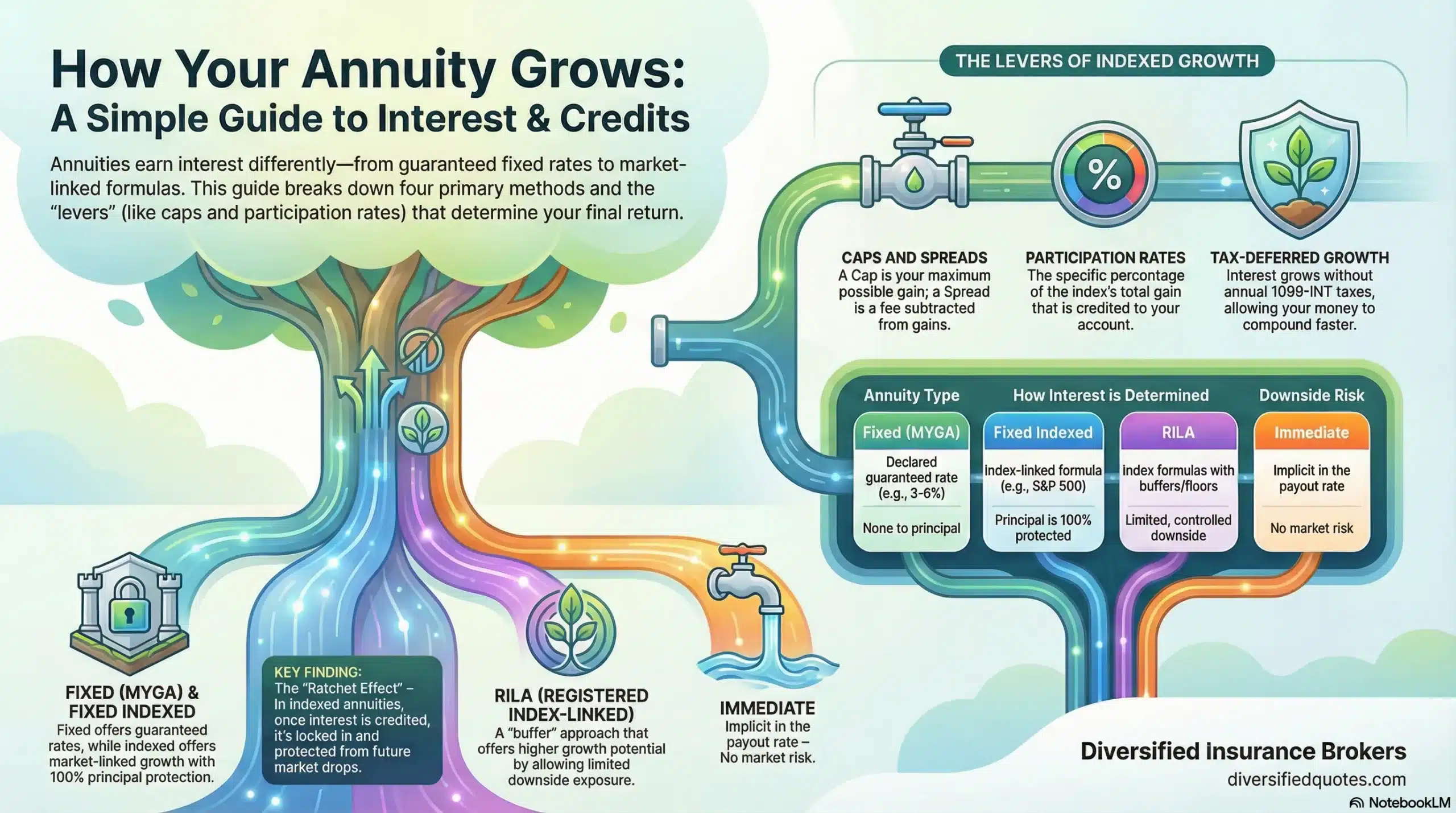
Talk With an Advisor Today
Choose how you’d like to connect—call or message us, then book a time that works for you.
Schedule here:
calendly.com/jason-dibcompanies/diversified-quotes
Licensed in all 50 states • Fiduciary, family-owned since 1980
FAQs: How Much Does a $5 Million Annuity Pay?
How much does a $5 million annuity pay per month?
The monthly income from a $5 million annuity depends on your age, the type of annuity, single vs. joint-life design, and current payout rates. For example, using illustrative payout factors around 8% to 8.5% at common retirement ages, income can range from roughly $400,000 to $425,000 per year, or about $33,000 to $35,000 per month, before any reductions for extra benefits or riders.
How does my age affect the payout on a $5 million annuity?
Age is one of the biggest drivers of payout rates. The older you are when income begins, the higher the payout percentage is likely to be, because the insurance company expects to make payments for fewer years. Starting income earlier provides more years of cash flow but usually at a lower payout rate than waiting until 65, 70, or beyond.
What is the difference between single-life and joint-life payouts?
A single-life payout is designed to maximize income for one person and stops when that person dies, unless extra guarantees are added. A joint-life payout covers two people, usually spouses, and continues income for the surviving partner. Because the company is guaranteeing two lifetimes, joint-life income is typically lower than single-life income for the same $5 million premium.
Which annuity types are commonly used for a $5 million income plan?
Larger income plans often use a mix of single premium immediate annuities (SPIAs), deferred income annuities (DIAs), and fixed indexed annuities with income riders. SPIAs are best for income that starts right away, DIAs for income starting at a future date, and fixed indexed annuities with riders for those who want principal protection, potential index-based growth, and a flexible income start date.
Can I add inflation protection to a $5 million annuity?
Some annuities offer inflation features such as fixed annual cost-of-living adjustments or payouts that can increase based on underlying index performance. These options usually start at a lower initial income level compared with a level-payout design, but they may help your payments keep up better with rising costs over a long retirement.
What protections are available for my beneficiaries?
Beneficiary protection can be built in through options such as cash-refund, period-certain guarantees, or enhanced death-benefit riders. These features help ensure that if you pass away early, a portion of the remaining value or a minimum stream of payments goes to your heirs. In exchange, they usually reduce the starting income compared with a pure lifetime-only payout.
How are payouts from a $5 million annuity taxed?
If the annuity is funded with qualified dollars from an IRA or 401(k), payments are generally taxed as ordinary income when received. If funded with non-qualified, after-tax dollars, only the gain portion of each payment is taxable, with the rest treated as a return of principal under IRS rules. Your individual tax treatment depends on the account type and distribution method you choose.
Can I split $5 million across multiple annuity carriers?
Yes. Larger cases are often diversified across several insurers or product types. Splitting $5 million among multiple carriers can help manage issuer concentration risk, take advantage of different features or payout designs, and align with state guaranty association limitations. The trade-off is additional paperwork and more contracts to review and manage.
How does a $5 million annuity fit with Social Security and pensions?
A $5 million annuity is often used to create a private pension that complements Social Security and any employer pensions. Guaranteed annuity income can cover essential expenses, allowing you to coordinate the start of benefits, delay Social Security when appropriate, and use market-based accounts more strategically for growth, legacy, or one-time purchases.
How do I get personalized payout numbers for my $5 million?
To see personalized numbers, you would typically provide your age or ages, state of residence, premium amount, desired income start date, and whether you prefer single-life or joint-life coverage. With that information, an independent brokerage can compare multiple carriers, show you compliant illustration sets, and help you evaluate which designs best match your income, liquidity, and legacy goals.
About the Author:
Jason Stolz, CLTC, CRPC and Chief Underwriter at Diversified Insurance Brokers (NPN 20471358), is a senior insurance and retirement professional with more than two decades of real-world experience helping individuals, families, and business owners protect their income, assets, and long-term financial stability. As a long-time partner of the nationally licensed independent agency Diversified Insurance Brokers, Jason provides trusted guidance across multiple specialties—including fixed and indexed annuities, long-term care planning, personal and business disability insurance, life insurance solutions, and short-term health coverage. Diversified Insurance Brokers maintains active contracts with over 100 highly rated insurance carriers, ensuring clients have access to a broad and competitive marketplace.
His practical, education-first approach has earned recognition in publications such as VoyageATL, highlighting his commitment to financial clarity and client-focused planning. Drawing on deep product knowledge and years of hands-on field experience, Jason helps clients evaluate carriers, compare strategies, and build retirement and protection plans that are both secure and cost-efficient. Visitors who want to explore current annuity rates and compare options across multiple insurers can also use this annuity quote and comparison tool.
