
How Much Does a $500,000 Annuity Pay?

Jason Stolz CLTC, CRPC
How much does a $500,000 annuity pay? For many retirees, half a million dollars is the cornerstone of a retirement income plan. The most important question isn’t just “What’s the payout?” — it’s whether the income can reliably support your lifestyle for the rest of your life without forcing you to depend on market withdrawals at the wrong time. With Diversified Insurance Brokers, you can compare lifetime income options from 100+ top-rated carriers and evaluate how a $500,000 premium can be turned into a predictable paycheck you can’t outlive. On this page, you can model scenarios using a real-time income calculator, learn what actually determines annuity income, and see how retirees use annuities to build a personal pension that anchors the rest of the plan.
It’s also important to set expectations correctly. Annuity income isn’t a single universal “rate.” It’s a priced outcome based on your age, when you start income, the type of annuity you select, and which protections you choose for a spouse or heirs. Two people can both be shopping for a $500,000 annuity and still receive very different guaranteed income amounts because they value different tradeoffs: higher starting income versus survivor protection, level income versus structured income, more flexibility versus more guarantees. That’s why the calculator on this page is the best starting point — then a carrier illustration shows exact guaranteed income based on your inputs.
Many retirees are drawn to annuities because they want simplicity and stability. Instead of constantly asking whether the portfolio will cooperate, a lifetime annuity can function as a personal pension that arrives month after month. When the income is designed correctly, it can reduce sequence-of-returns risk and take pressure off your investments. That can be especially valuable during volatile markets, when selling assets to fund spending may lock in losses. The goal is not to replace every income source — it’s to create a dependable foundation so the rest of your assets can be managed more confidently.
See Your $500,000 Annuity Income
Compare lifetime payout options and get a personalized illustration.
Or preview today’s top fixed & bonus annuity rates:
Current Annuity Rates | Annuities Overview
Lifetime Income Calculator
Tip: Use the calculator to test different ages and income start dates. Then request an illustration to see exact guaranteed income for your situation.
Why We Avoid Publishing “Typical” Payout Estimates
Many annuity pages online lead with a neat chart of “typical income,” but those charts often mislead consumers because they mix apples and oranges. An annuity income quote is the output of a specific design. If you change the design, the income changes. That is why publishing a single “expected payout” for a $500,000 annuity can create the wrong impression — especially for couples who need joint coverage, retirees who want refund protections, or families who want to delay income to strengthen later retirement years.
Instead of giving you a number that may not match your priorities, we focus on the decisions that actually drive guaranteed income. The calculator on this page is built for scenario testing, so you can see how income changes when you adjust key levers. Then, when you request an illustration, we can show carrier-specific guaranteed income amounts with the same inputs — making the comparison fair and meaningful.
What Actually Determines How Much a $500,000 Annuity Pays
Annuity income is priced using actuarial assumptions, prevailing interest rates, and the exact contract guarantees you select. The guaranteed income is not based on stock market performance, and it does not require you to predict future returns. Instead, you choose a structure, and the insurer guarantees income under that structure. This is why the details matter.
Your age and income start date are major drivers. Starting income sooner generally emphasizes cash flow now. Deferring income can change pricing because the expected payout horizon changes. Neither is “better” in every case. The right answer depends on your retirement timeline and the role the annuity plays in your plan.
Single-life versus joint-life coverage is another large lever. Single-life income is designed for one person’s lifetime and often produces a higher starting payment. Joint-life income is designed to last as long as either spouse is living, which usually reduces the starting payment but can be invaluable for survivorship protection. Many couples choose joint income because stability for the surviving spouse is worth more than maximizing the first payment.
Guarantee features can also change the numbers. Period-certain guarantees, refund provisions, and other design elements may reduce starting income in exchange for stronger protections, clearer family outcomes, or greater confidence that the annuity fits the household’s goals.
The type of annuity is a major factor too. Some annuities are primarily designed for immediate guaranteed income. Others are designed for accumulation first, then income later. Understanding the differences helps you choose the structure that fits your situation.
Three Main Ways Retirees Use a $500,000 Annuity for Guaranteed Income
When people say “annuity,” they may be referring to very different strategies. A $500,000 premium can be used to create income now, income later, or a flexible income pathway that can be activated when you’re ready. Many retirees also layer strategies instead of choosing just one approach.
1) Immediate lifetime income (SPIA-style personal pension)
An immediate income annuity is designed to convert premium into guaranteed payments that begin right away (or very soon). Retirees often use this structure to create an income floor that covers essential expenses. The value is predictability — a paycheck you can’t outlive that arrives regardless of markets.
For many households, the point of immediate income is not to “beat the market.” It’s to stabilize retirement spending. When essential expenses are covered by guaranteed income, the rest of the portfolio can be invested and managed with a longer-term view, reducing the temptation to sell investments at the wrong time during volatility.
Immediate income structures can also include important protections depending on your goals. Couples may prioritize joint coverage. Others may value guarantees or refund features to shape what happens if death occurs earlier than expected. The “best” option is the one that matches your household priorities.
2) Deferred lifetime income (DIA-style future paycheck)
A deferred income annuity is designed to start paying at a future date you select. Retirees often use deferred income to strengthen later retirement years or protect against longevity risk. Many households have strong income early in retirement from Social Security, pensions, or investment withdrawals, but worry about later-life stability. Deferred income can act like a second pension starting later.
This approach can also help create clarity. Instead of relying on forecasts, you define a contractual income stream that begins at a chosen age. That can support a more confident spending strategy and reduce anxiety about living longer than expected.
3) Fixed indexed annuities with income riders (accumulate, then turn on income)
Fixed indexed annuities (FIAs) with lifetime income riders are often used when the retiree wants an accumulation phase before activating income. The contract can credit interest based on index strategies while protecting principal from market losses (subject to the insurer’s claims-paying ability), and rider mechanics can build future income potential. This structure can be useful when income timing is flexible and the retiree wants a defined income pathway without needing to predict markets.
Because rider features and index-crediting strategies vary widely, comparisons matter. If you want a deeper educational overview of rider-based income planning, our guide to fixed indexed annuities with lifetime income riders is a helpful next step.
Why Many Retirees Create a “Personal Pension” With $500,000
For many households, a $500,000 annuity becomes the foundation of a personal pension — a stream of income that arrives month after month, no matter what markets are doing. Instead of worrying whether portfolio withdrawals will last, a lifetime annuity can provide a guaranteed baseline. That can be especially valuable if your retirement plan relies heavily on investments that can fluctuate.
Another major reason retirees use annuities is sequence-of-returns risk. Even a well-diversified portfolio can struggle if significant withdrawals occur during a prolonged downturn. A guaranteed income stream can reduce the need to sell investments during those periods, which can help the portfolio recover over time. This is not just a math problem — it’s also a behavioral problem. Retirees often feel more comfortable staying invested when they know a base paycheck is already covered.
For couples, the personal pension concept becomes even more meaningful. Joint-life income can maintain household stability if one spouse dies. Without survivorship planning, the surviving spouse may experience an income drop due to changes in Social Security benefits or the loss of a pension payment. Many families choose joint income because protecting the surviving spouse’s lifestyle is a core planning objective.
Single-Life vs. Joint-Life Income
Choosing single-life or joint-life income is one of the most important decisions in annuity planning. Single-life options generally provide the highest income for one person. Joint-life options are priced to last as long as either spouse is living. While joint income usually starts lower, it can be the difference between a stable retirement and a survivorship income cliff.
The right choice depends on your household situation. If both spouses have strong independent income sources and your plan can tolerate income changes after the first death, single-life may be sufficient for some cases. If one spouse depends heavily on the other, or if the household wants predictable income that continues regardless of who is living, joint-life is often the preferred design. The best approach is to compare both designs with the same inputs and then decide based on household priorities.
How to Coordinate a $500,000 Annuity With Social Security, Pensions, and Investments
A $500,000 annuity rarely stands alone. Most retirees also have Social Security, pensions, IRAs, and taxable investments. Many households use annuity income to cover essential expenses such as housing, utilities, groceries, insurance premiums, and baseline lifestyle needs. Then, Social Security and portfolio withdrawals can be used for discretionary spending, travel, gifting, and other flexible goals.
This type of coordination can reduce stress during volatile markets. When guaranteed income covers essentials, portfolio decisions become less reactive. Instead of asking, “Can we afford to spend this year?” you can focus on a long-term plan with clearer boundaries and more flexibility. It can also help retirees avoid over-withdrawing in good years and panicking in bad years.
Some households also use annuity income to support tax planning. Predictable income can make it easier to time Roth conversions, manage capital gains, or coordinate withdrawals across accounts. If you are comparing the “annuity paycheck” approach to market-based withdrawal rules, it helps to understand the assumptions behind those rules. Our overview on the 4% rule provides helpful context.
If you want more education on building pension-like income, you can also explore our pension alternative resources. For broader annuity education and up-to-date context, visit our Annuities Overview and Current Annuity Rates pages.
Should You Annuitize the Full $500,000 or Only a Portion?
One of the most common planning questions is whether to annuitize the entire $500,000 or only use part of it. Many retirees prefer a blended strategy. They may annuitize enough to cover essential expenses and keep the rest invested for liquidity, growth, and discretionary goals. This approach can produce a balanced plan: stable income plus flexibility.
Annuitizing a portion can also allow you to “stage” decisions. Some retirees purchase income in layers over time, which can spread interest-rate timing risk and align purchases with changing income needs. Others prefer one clean purchase for simplicity. There is no universal answer — the right approach depends on your income floor needs, other income sources, your comfort with market risk, and how important liquidity is to you.
If you are within a few years of retirement, it can be especially useful to model scenarios: income now, income later, single versus joint, and different guarantee features. The calculator at the top of this page is designed for that scenario testing, and a carrier illustration will show exact guaranteed income for each design.
What You Receive When You Request a $500,000 Illustration
When you request an illustration through Diversified Insurance Brokers, we don’t just send a single number. We create apples-to-apples comparisons based on your priorities. If you want income now, we compare immediate income designs. If you want income later, we show deferred income options. If you want flexibility and upside potential with principal protection, we compare rider-based income strategies. If you want spousal protection, we illustrate joint-life structures with survivorship options.
The goal is clarity: you should see how changing one lever changes the payment. That’s how you make a confident decision with $500,000 — by seeing real tradeoffs, not internet averages.
Ready to See Your Exact Numbers?
We’ll compare carriers side-by-side and deliver a clear, personalized income plan.
Related Annuity Payout Pages
Explore the “How Much Does a(n) X Annuity Pay” series across different premium levels.
How Much Does a $50,000 Annuity Pay? How Much Does a $100,000 Annuity Pay? How Much Does a $250,000 Annuity Pay? How Much Does a $750,000 Annuity Pay? How Much Does a $1 Million Annuity Pay? How Much Does a $2 Million Annuity Pay? How Much Does a $3 Million Annuity Pay? How Much Does a $5 Million Annuity Pay? How Much Does a $10 Million Annuity Pay?Related Retirement Income Education
Additional guides to help you compare guaranteed income with market-based withdrawal strategies.
Pension Alternative Strategies Best Fixed Indexed Annuities with Lifetime Income Riders What Is the 4% Rule?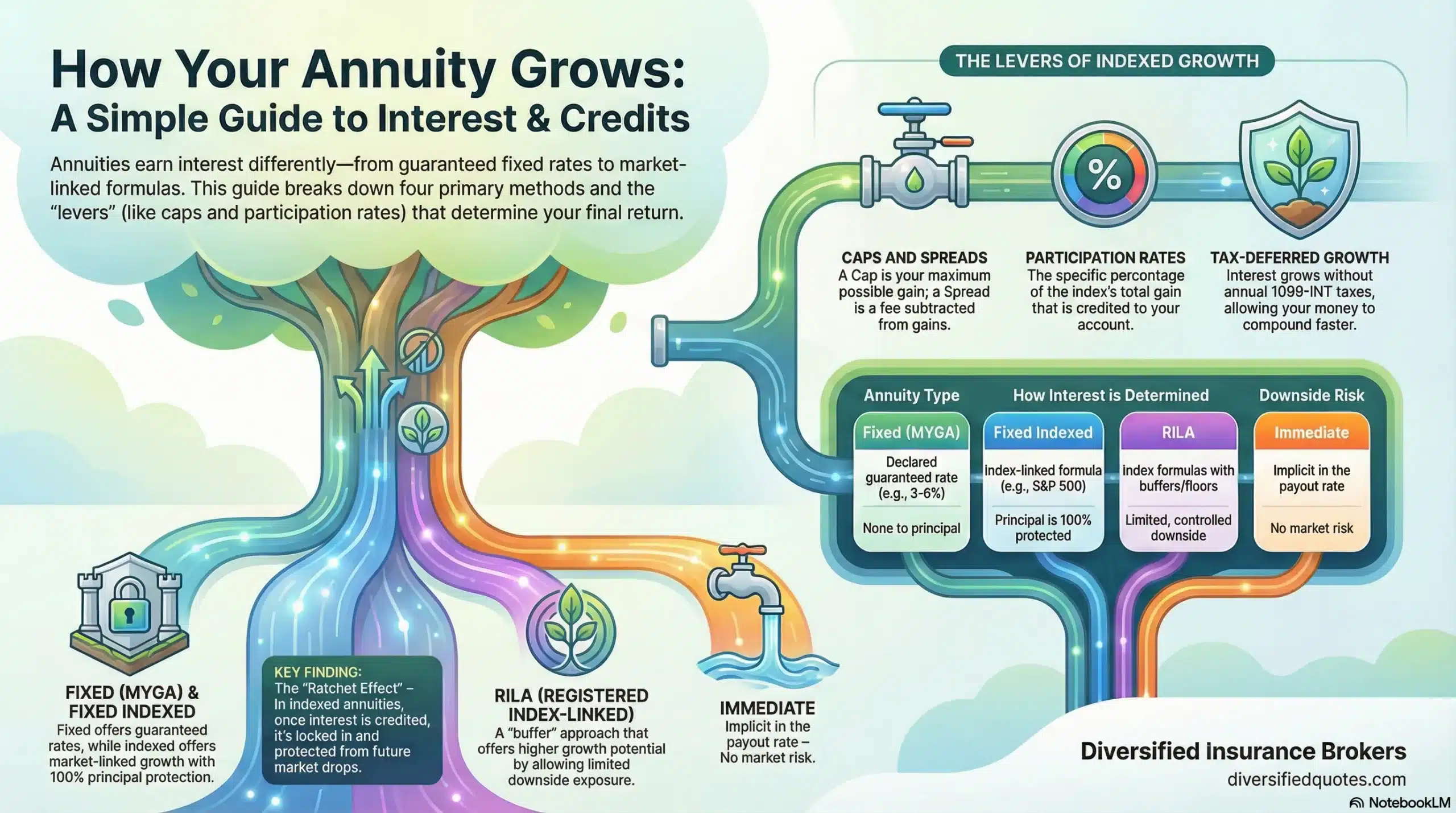
Talk With an Advisor Today
Choose how you’d like to connect—call or message us, then book a time that works for you.
Schedule here:
calendly.com/jason-dibcompanies/diversified-quotes
Licensed in all 50 states • Fiduciary, family-owned since 1980
FAQs: How Much Does a $500,000 Annuity Pay?
How much does a $500,000 annuity pay per month?
At age 65, a $500,000 fixed annuity can pay around $3,400–$3,500 per month for life, depending on carrier and product type.
Which type of annuity pays the most income?
Immediate annuities typically offer the highest initial income, while deferred annuities can grow for a higher payout later. Income riders provide flexibility with guaranteed lifetime withdrawals.
Can I receive joint lifetime income for my spouse?
Yes. Joint-life options continue payments for both spouses’ lifetimes, offering security for surviving partners with slightly reduced monthly payouts.
Are payouts guaranteed?
Yes. Fixed and fixed indexed annuities offer guaranteed lifetime income based on the issuing insurer’s claims-paying ability.
How are annuity payouts taxed?
Qualified funds (e.g., IRAs) are taxed as ordinary income. Non-qualified funds are taxed only on the growth portion of each payment through the exclusion ratio.
Can I add inflation protection?
Yes. Some annuities include fixed COLA increases or index-based growth options. These typically start with smaller payments that rise over time.
Are there surrender charges or fees?
Deferred annuities may include surrender periods during the first 5–10 years. Income riders, if added, may include small annual fees disclosed up front.
Can I split $500,000 between multiple annuities?
Yes. Many clients ladder annuities across carriers or start dates to diversify features, payout timing, and issuer exposure.
What happens if I pass away early?
Depending on the contract, your beneficiaries may receive remaining guaranteed payments or a refund of any unused premium through refund or period-certain options.
How do I get a custom quote?
Provide your age, state, start date, and payout type (single or joint). Our independent advisors compare 100+ carriers and deliver a personalized report.
About the Author:
Jason Stolz, CLTC, CRPC and Chief Underwriter at Diversified Insurance Brokers (NPN 20471358), is a senior insurance and retirement professional with more than two decades of real-world experience helping individuals, families, and business owners protect their income, assets, and long-term financial stability. As a long-time partner of the nationally licensed independent agency Diversified Insurance Brokers, Jason provides trusted guidance across multiple specialties—including fixed and indexed annuities, long-term care planning, personal and business disability insurance, life insurance solutions, and short-term health coverage. Diversified Insurance Brokers maintains active contracts with over 100 highly rated insurance carriers, ensuring clients have access to a broad and competitive marketplace.
His practical, education-first approach has earned recognition in publications such as VoyageATL, highlighting his commitment to financial clarity and client-focused planning. Drawing on deep product knowledge and years of hands-on field experience, Jason helps clients evaluate carriers, compare strategies, and build retirement and protection plans that are both secure and cost-efficient. Visitors who want to explore current annuity rates and compare options across multiple insurers can also use this annuity quote and comparison tool.
