
How Much Does a $6 Million Annuity Pay

Jason Stolz CLTC, CRPC
How much does a $6 million annuity pay? With a premium this large, the right answer is never a generic “typical payout” chart. The guaranteed payment depends on how you design the income: when it starts, whether it covers one life or two, what protections you choose for a spouse or heirs, and which income engine you use (immediate income, deferred income, or a fixed indexed annuity with a lifetime income rider). At Diversified Insurance Brokers, we compare income quotes from more than 100 highly rated carriers so you can see exactly what a $6,000,000 premium can generate for your age, your state, and your retirement goals — with clear, apples-to-apples illustrations that show how each design choice changes the outcome.
Most high-net-worth retirees are not trying to “get the highest number” on paper. They are trying to build stability. They want an income floor that is not dependent on markets, that reduces sequence-of-returns risk, and that protects household cash flow if one spouse dies or if markets go through a long volatile stretch. A $6 million annuity strategy can create a private “personal pension” layer that supports lifestyle spending while giving the rest of the portfolio more freedom to stay invested, rebalance patiently, and pursue long-term growth or legacy goals.
This page explains what actually determines how much a $6 million annuity pays, why we avoid publishing “typical” payout estimates for large premiums, how different annuity structures create guaranteed income, and how to integrate a large annuity allocation with Social Security, pensions, retirement-account distributions, and taxable portfolios. Use the calculator below to model scenarios and then request a carrier illustration for exact payments above the tool’s cap.
See Your $6,000,000 Annuity Income
Compare lifetime payout options and request a personalized illustration.
Or preview today’s top fixed & bonus annuity rates:
Current Annuity Rates | Annuities Overview
Lifetime Income Calculator
Heads up: This calculator accepts premium inputs up to $2,000,000. For a $6,000,000 premium, the most accurate way to determine guaranteed income is through a carrier illustration priced to your age, state, and contract design.
Why We Don’t Publish “Typical” Payout Estimates for a $6,000,000 Annuity
At smaller premium levels, a rough range can be a helpful first look. At $6,000,000, publishing a “typical payout” number often creates the wrong anchor. A large-premium annuity is almost always designed around specific goals — replacing a paycheck, building a stable income floor, protecting a spouse, shaping cash flow over time, or aligning income with an estate plan. Those goals drive the contract structure, and the structure drives the payment.
Two contracts can both be “$6 million annuities” and still produce very different guaranteed payments because they solve different problems. Income can start immediately or later. It can cover one lifetime or two. It can be optimized for maximum lifetime payment or designed with refund features for heirs. It can be level for simplicity or structured in layers to match real retirement spending patterns. Generic estimates ignore those levers and often leave families confused when real quotes differ from internet numbers.
That’s why the most useful approach is: model your options with the calculator, then request a carrier illustration for exact payments. A carrier illustration shows the income based on the actual factors that matter: your age, your state, your start date, and the precise contract options you choose.
What Actually Determines How Much a $6 Million Annuity Pays
Annuity income is priced — not guessed. Carriers determine guaranteed income using actuarial longevity assumptions, prevailing interest rates, and the guarantees embedded in the contract. The income amount is not a “market return,” and it does not depend on daily stock performance. It is a contractual promise backed by the claims-paying ability of the insurer and defined by the contract terms.
Age and income start date are primary drivers. The older you are when income begins — or the longer you defer income — the pricing changes because the expected payout horizon changes. Starting income now prioritizes cash flow now, which can be appropriate for paycheck replacement or immediate retirement stability. Deferring income can be appropriate if you want larger payments later or want to build a second “income wave” that begins after a certain age.
Single-life versus joint-life coverage is another major lever. Single-life income is priced for one lifetime. Joint-life income is priced to last as long as either spouse is living. That survivor protection can be extremely valuable because it reduces the chance of an income gap after the first death. The tradeoff is that joint-life pricing often produces a different initial payment profile because the carrier expects to pay longer.
Guarantee features and family protections can also change the payout. Options like period-certain guarantees or refund provisions can create clarity for heirs and can make the annuity feel more “balanced” from a family perspective. Those protections can reduce the starting income compared with a life-only structure, but they can align the contract with your legacy priorities.
Income shape and inflation treatment matters as well. Some families want the highest starting income and handle inflation risk through other assets. Others want income that grows or is structured in layers. The “right” answer depends on how your spending is likely to evolve and what inflation-hedging assets exist elsewhere in the plan.
Funding source and tax positioning affects the after-tax result. Qualified dollars (IRA/401(k)) and non-qualified dollars can be used in different ways, and the tax treatment can influence how the annuity integrates with RMD planning, Social Security timing, and portfolio distributions. In large cases, the goal is often to optimize income after taxes while reducing planning surprises.
Three Main Ways a $6,000,000 Annuity Can Create Guaranteed Income
When someone says “annuity,” they may be referring to very different income engines. Understanding the difference helps you choose the structure that matches your timeline and priorities. In many $6 million cases, the best result is a layered approach rather than one single product type.
1) Immediate Lifetime Income (SPIA-style personal pension)
An immediate income annuity is built for one job: converting premium into guaranteed payments that begin right away (or very soon). For retirees who want to eliminate portfolio withdrawal pressure and create a stable income floor, this approach can be highly effective. It can function like a private pension, delivering predictable cash flow regardless of market conditions.
High-net-worth households often use immediate income as a foundational “income base layer.” The goal is to cover lifestyle-critical expenses — the portion of spending that should not depend on markets. When this layer exists, the rest of the portfolio can be managed with more patience and less forced selling during volatility.
Even within immediate income, structure matters. Joint-life versus single-life coverage, refund provisions, and guaranteed periods change both the payment and the family outcome. The correct comparison is always apples-to-apples: same timing, same survivorship assumptions, same guarantee features, so the differences reflect real carrier pricing and real tradeoffs.
2) Deferred Lifetime Income (DIA-style future pension)
A deferred income annuity delays income to a future start date. This is often used to protect against longevity risk or to create a “second paycheck” later in retirement. Many households have strong income early in retirement from other sources, but want stronger guarantees later. Deferred income can provide that stability.
Deferred designs can also make planning clearer. Instead of relying only on projections, the family defines contractual income beginning at a chosen age. That can simplify spending policy decisions and can reduce anxiety about “what if we live longer than expected?” When coordinated well, deferred income becomes a powerful tool for later-life planning.
The design levers are similar: start date, joint-life coverage, and guarantee features. The right plan is usually the one that fits your long-term cash flow map rather than the one that looks best on a generic chart.
3) Fixed Indexed Annuities With Lifetime Income Riders (accumulation, then income)
Fixed indexed annuities with lifetime income riders are often used when a household wants an accumulation phase before turning on income. These contracts can credit interest based on index strategies (without exposing principal to market losses), and income rider mechanics can be used to build future guaranteed income potential. Many families like this structure because it offers flexibility around income timing while still creating a defined income pathway.
In large-premium planning, this structure is often used as part of a layered plan: one portion of the income strategy stabilizes income now, while another portion is structured to increase income later. That can create a smoother income trajectory over time and can align income with real retirement spending patterns.
Because rider mechanics vary by carrier, this is exactly where illustrations matter. How the income base is calculated, how joint-life features work, how deferral changes guarantees, and what happens when income begins are not the same across products. For deeper context, many families also review our guide to fixed indexed annuities with lifetime income riders to understand the structural differences before comparing carriers.
Why Build a “Personal Pension” From $6 Million
For many high-net-worth retirees, the challenge is not accumulating assets — it’s turning those assets into stable, predictable income without being forced into bad timing decisions. Portfolio withdrawals during down markets can permanently reduce long-term outcomes because you sell more shares to generate the same cash flow. This is one reason many retirees eventually seek contractual income: it stabilizes cash flow and reduces sequence-of-returns risk.
A $6 million annuity strategy can create a powerful income floor that is not dependent on market performance. Fixed and fixed indexed annuities are designed around principal protection and contractual guarantees, which means the income base layer is insulated from daily market swings. When essential spending is covered by guaranteed income, the remaining portfolio can be invested with more patience and fewer forced decisions.
For couples, joint-life guaranteed income can protect the surviving spouse from an abrupt drop in household income. That stability is often one of the most valuable outcomes of annuity planning. Even if joint-life income begins with a different payment profile than single-life, many families prefer the household protection and simplicity it provides.
How a $6,000,000 Annuity Fits Into a Broader Retirement Plan
Large annuity allocations rarely stand alone. Most households are coordinating Social Security, pensions (if available), RMD planning, taxable portfolios, and sometimes business interests or real estate income. The annuity is typically used to cover essential expenses or to create a stable baseline so other assets can be managed strategically.
Many retirees like to define an “income floor” by combining Social Security, pensions, and annuity income. This income floor covers the must-pay portion of spending: housing, insurance, utilities, healthcare, and baseline lifestyle costs. With that baseline protected, portfolio assets can be used for discretionary spending, gifting, and growth — and withdrawals can be timed more intelligently.
Households also often use guaranteed income to support more advanced planning decisions. When lifestyle spending is covered, a retiree may feel more comfortable with tax planning strategies, repositioning assets, or maintaining growth exposure in the portfolio. Some families coordinate annuities with non-qualified planning as well; if you want a deeper overview of how non-qualified annuity money is commonly treated, our non-qualified annuity guide is a helpful educational reference.
To see how the current pricing environment influences carrier options, our Current Annuity Rates page can provide context for why guaranteed income quotes can change over time and why side-by-side comparisons matter.
Liquidity and Flexibility in a $6 Million Annuity Strategy
Liquidity concerns are valid — especially at large premium levels. The best way to handle liquidity is not to make an income contract behave like a liquid brokerage account. The best way to handle liquidity is to design your plan in layers so liquidity exists where it belongs. Many successful high-net-worth annuity strategies do not commit the full premium into one contract. Instead, they may allocate a portion to guaranteed income while maintaining a separate liquidity layer in liquid investments or cash reserves.
Some households also ladder decisions over time. Instead of turning on all income at once, they may structure income in stages. This approach can reduce timing risk and can align income with spending patterns that change as retirement progresses. The right answer depends on household cash flow needs, other assets, and the degree of certainty you want in your baseline income.
If you’re exploring strategies like staging or laddering, our page on laddering annuities can help explain why many retirees prefer a “layered” approach rather than committing everything to one single timing decision.
How to Think About “Payout vs. Protection” Tradeoffs
Every annuity comparison involves tradeoffs. The higher the starting income, the fewer additional protections are typically built in. The more protections you add — joint-life coverage, refund options, guaranteed periods, inflation shaping — the more the carrier is promising, and the pricing changes to reflect that. The correct goal is not maximizing a single number. The correct goal is aligning the contract to your plan.
For example, some households optimize for the strongest possible income floor and rely on other assets for legacy. Others want income plus a defined family outcome if death occurs earlier than expected. Others prioritize spousal protection above all. These are all valid goals — the important part is making the choice intentionally and understanding how it changes the guaranteed payment.
This is also why illustrations matter. A well-built illustration set shows you how each design choice changes the payment so you can decide which tradeoff is worth it.
Common Mistakes in Large-Premium Annuity Decisions
Anchoring to a “typical payout” number. Large premiums deserve customized comparisons. A generic number rarely reflects the design you actually need.
Chasing the highest initial payment. Many households care more about survivorship protection, predictability, and clarity than squeezing incremental income from one design. “Best” is usually defined by fit.
Ignoring the rest of the plan. Annuities should be evaluated inside your broader retirement income architecture — Social Security, pensions, RMDs, portfolio withdrawals, and tax planning.
Failing to plan liquidity outside the income layer. The annuity is an income tool. Liquidity should be handled intentionally elsewhere. When each tool has one job, the plan becomes simpler and more resilient.
How We Quote a $6,000,000 Annuity Case (What You Receive)
When you request an illustration, we don’t simply run one quote and send a number. We identify what role the annuity should play in your plan: income now, income later, layered income, spousal protection, legacy protections, or a combination. Then we build an apples-to-apples comparison set across multiple highly rated carriers. That means the same timing, the same survivorship assumptions, and the same guarantee features so the differences you see are real — not the result of mismatched inputs.
You receive a clear explanation of the options and the tradeoffs. We also show how changing one lever — like moving the start date, switching to joint-life, or adding a refund feature — affects the payment. The goal is clarity and confidence. A $6 million decision should feel structured, not uncertain.
If you want broader education on annuity categories and how they are used, our Annuities Overview page provides a helpful baseline and can make it easier to interpret what you see in illustrations.
See Your Exact Numbers
We’ll compare payouts from 100+ carriers and deliver a clear, personalized income plan.
Related Annuity Payout Pages
Explore the “How Much Does a(n) X Annuity Pay” series across different premium levels.
How Much Does a $100,000 Annuity Pay? How Much Does a $500,000 Annuity Pay? How Much Does a $1 Million Annuity Pay? How Much Does a $3 Million Annuity Pay? How Much Does a $5 Million Annuity Pay? How Much Does a $10 Million Annuity Pay?Related Planning Strategies
Explore strategies commonly used to structure large annuity allocations and retirement income planning.
Laddering Annuities 40% Bonus Annuity Guide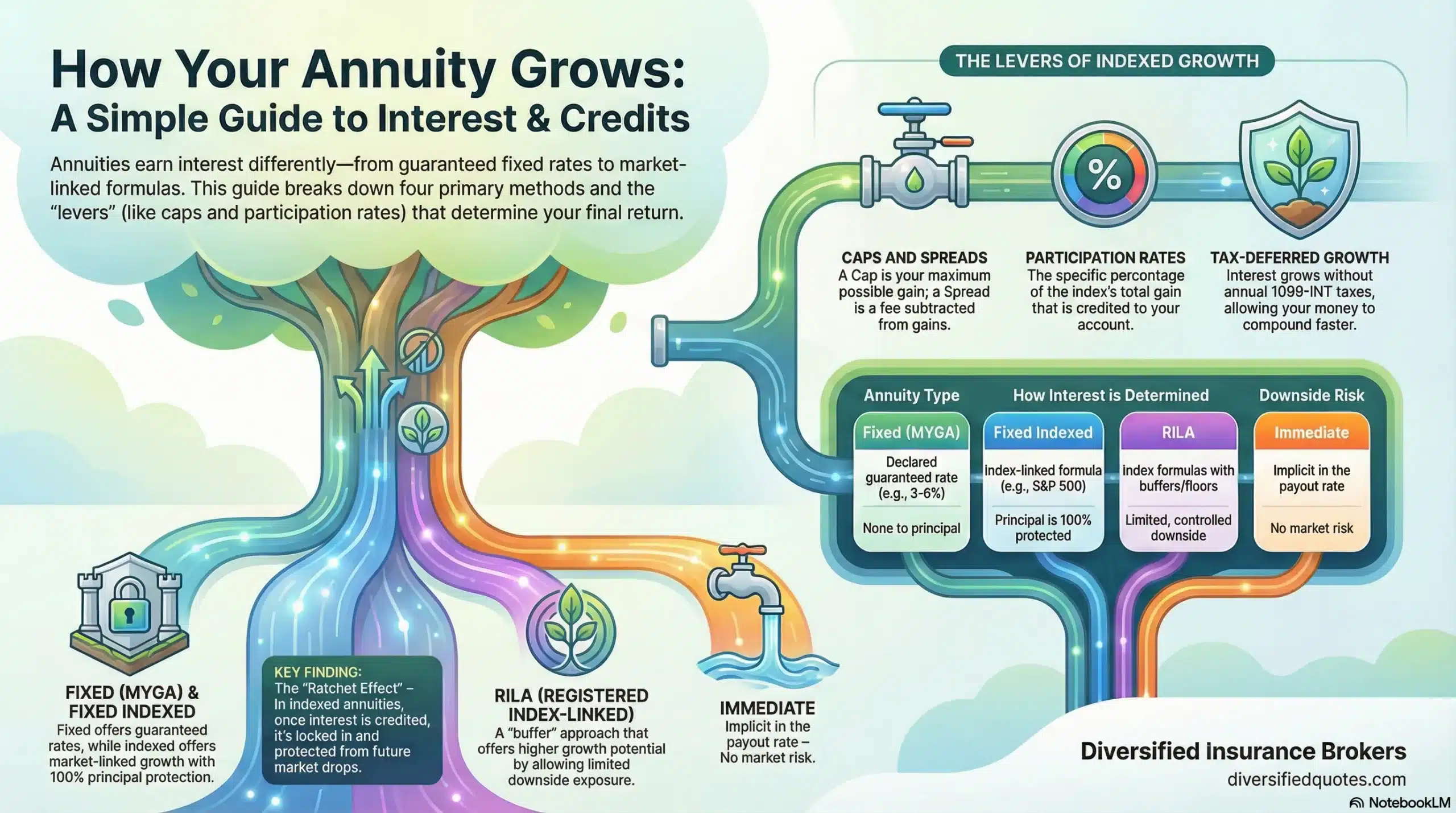
Talk With an Advisor Today
Choose how you’d like to connect—call or message us, then book a time that works for you.
Schedule here:
calendly.com/jason-dibcompanies/diversified-quotes
Licensed in all 50 states • Fiduciary, family-owned since 1980
FAQs: How Much Does a $6 Million Annuity Pay?
How much does a $6 million annuity pay per month?
It depends on age at income start, single vs. joint-life, product type (SPIA, DIA, or FIA with income rider), deferral length, and carrier rates. Older start ages and single-life options generally pay more per month.
What are typical annual payouts for $6,000,000?
Representative examples (subject to carrier/product): age 60 ≈ 8.0% → ~$480,000/yr; age 65 ≈ 8.2% → ~$492,000/yr; age 70 ≈ 8.5% → ~$510,000/yr. Joint-life or added guarantees may reduce the initial amount.
Which option typically pays the highest guaranteed income?
Single-life immediate income or a later deferred start often produces the highest guaranteed payout. Joint-life protects a spouse but lowers the monthly amount to cover two lifetimes.
Can I include beneficiary protection?
Yes. Cash-refund or period-certain options can protect beneficiaries if death occurs early. These features generally reduce the starting income.
How are payouts taxed on $6 million?
Qualified funds (IRA/401(k)) are typically fully taxable as ordinary income when paid. Non-qualified funds use the gain-only taxation via the exclusion ratio.
Can I add inflation protection?
Some contracts offer fixed COLA or inflation-adjusted options. They start lower but may keep pace with costs over time. We’ll compare level vs. inflation options side by side.
Should I split $6M across multiple carriers?
Often yes. Large allocations are commonly diversified across issuers or products to manage features, capacity, and underwriting. State guaranty association limits vary by state.
Will lifetime payouts satisfy RMDs on qualified money?
Some lifetime income structures can help satisfy RMDs automatically; others require coordinating separate withdrawals. We’ll model the RMD effect for your design.
How do I get personalized quotes for $6M?
Provide age(s), state, premium amount, start date, and single vs. joint-life. We’ll compare 100+ carriers and deliver compliant illustrations tailored to your scenario.
About the Author:
Jason Stolz, CLTC, CRPC and Chief Underwriter at Diversified Insurance Brokers (NPN 20471358), is a senior insurance and retirement professional with more than two decades of real-world experience helping individuals, families, and business owners protect their income, assets, and long-term financial stability. As a long-time partner of the nationally licensed independent agency Diversified Insurance Brokers, Jason provides trusted guidance across multiple specialties—including fixed and indexed annuities, long-term care planning, personal and business disability insurance, life insurance solutions, Group Health, and short-term health coverage. Diversified Insurance Brokers maintains active contracts with over 100 highly rated insurance carriers, ensuring clients have access to a broad and competitive marketplace.
His practical, education-first approach has earned recognition in publications such as VoyageATL, highlighting his commitment to financial clarity and client-focused planning. Drawing on deep product knowledge and years of hands-on field experience, Jason helps clients evaluate carriers, compare strategies, and build retirement and protection plans that are both secure and cost-efficient. Visitors who want to explore current annuity rates and compare options across multiple insurers can also use this annuity quote and comparison tool.
