
Life Insurance for Overweight Applicants

Jason Stolz CLTC, CRPC
Applying for life insurance as an overweight or obese applicant can feel intimidating because many people assume “weight alone” determines the outcome. In real underwriting, weight is only one part of the picture. Carriers use height-and-weight guidelines (often called build charts) to place applicants into health classes, but those charts vary by insurer and the final decision is heavily influenced by the full risk profile—blood pressure, labs, medications, sleep apnea, diabetes risk, and whether your medical records show stability over time.
At Diversified Insurance Brokers, we help overweight applicants find affordable coverage by matching their build profile to carriers with more favorable guidelines and by presenting the case in a way underwriters can process quickly and fairly. In many situations, the “best” carrier is not the one with the lowest advertised rate—it’s the one whose build chart and underwriting philosophy align with your health metrics. If you’re comparing options beyond weight, this broader guide can also help: Life Insurance with Pre-Existing Conditions.
Get a High-Risk Life Insurance Quote
If you’re overweight, don’t assume you’ll be declined. Go to the “General Medical” category on our High-Risk Life Insurance page and submit your information securely.
How Carriers Evaluate Weight
Most carriers use a build chart rather than a single BMI cutoff. That chart compares your height and weight and assigns a range that maps to an underwriting class. Where things get interesting is that build charts are not standardized. One carrier may allow a higher maximum weight for a Standard Non-Smoker class, while another might begin table ratings at a lower weight for the same height. That difference alone can translate into a meaningful pricing gap, even when the rest of your health profile is clean.
Underwriters also interpret build in context. If your blood pressure is controlled, your labs look stable, and your medical records do not show obesity-related complications, many carriers will be more comfortable issuing coverage in a better class than you’d expect. On the other hand, if weight is paired with sleep apnea, elevated A1C, fatty liver disease, uncontrolled hypertension, or a recent cardiac evaluation, carriers will often assume compounding risk and price accordingly.
The practical takeaway is that overweight applicants do not have “one” outcome. They have a carrier-matching problem. Our job is to shop the underwriting lanes that align with your specific build and health profile, rather than letting one conservative build chart set your price for the entire market.
What Underwriters Look At Beyond the Scale
Weight may be the headline, but it is rarely the full underwriting story. Carriers price policies based on measurable risk factors and the pattern those factors create. A heavier applicant with excellent blood pressure, strong lipid numbers, and no metabolic issues can sometimes land in a more favorable class than a lighter applicant with uncontrolled hypertension and abnormal labs.
Blood pressure and cholesterol are typically the first “offset factors” underwriters review. If these are controlled without extensive medications, underwriting often becomes simpler. If you want to understand how these metrics affect pricing, you may also want to review how carriers price term coverage and what variables move premiums: Term Life Insurance Calculator.
Diabetes and pre-diabetes risk matter because they can connect weight to long-term complications. If you have diabetes, carriers generally focus on A1C trends, medication stability, and whether there are complications. If you do not have diabetes but have borderline glucose or a recent A1C concern, it’s still worth packaging the file properly so the underwriter understands the trend and control.
Sleep apnea is another common factor. For overweight applicants, carriers often want to know whether you’ve been evaluated, whether treatment is compliant (if prescribed), and whether symptoms are stable. Many people assume sleep apnea automatically creates a decline; in practice, compliant, stable cases are often insurable, but documentation makes the difference.
Family history and age can also shift how carriers interpret build. Some carriers provide more build flexibility at older ages because the pricing emphasis shifts toward overall stability and the absence of major complications. Others remain strict. This is another reason why shopping matters.
How Weight Can Affect Your Health Class and Premium
When weight moves you out of a preferred class, the policy can still be very affordable—especially in term coverage—because the base pricing is designed to be cost-effective. What changes is the health class applied to that base pricing. Depending on the carrier, you may see outcomes like Standard Non-Smoker, a mild table rating, or a flat extra in certain scenarios. The same height and weight can produce different results across carriers, and the differences become more pronounced as the requested death benefit increases.
It’s also important to separate “pricing impact” from “approval risk.” Many overweight applicants are still approved for fully underwritten coverage. The question is usually not “can I get a policy,” but “which carrier will treat my build the most favorably when everything else is considered.” That’s the core advantage of working with an independent agency that can shop multiple underwriting philosophies.
Standard vs. Overweight Underwriting
The table below is a general comparison of how underwriting often differs when weight is a material factor. The most important point is that the “overweight” column is not fixed. It varies by carrier, and it changes based on your labs and comorbidities.
| Factor | Standard-Weight Applicant | Overweight Applicant |
|---|---|---|
| Health Class | Preferred or Standard | Standard, Table-rated, or Substandard (varies by carrier/build chart) |
| Premiums | Lowest available | Higher in some cases, but often competitive with the right carrier |
| Approval Odds | High | Moderate to high when health metrics are stable and the carrier is matched correctly |
| Impact of Other Health Issues | Minimal | May compound risk (sleep apnea, diabetes risk, hypertension, abnormal labs) |
Case Example
A 42-year-old male, 5’10” and 250 lbs, applied for $500,000 of 20-year term life insurance. One carrier treated his build conservatively and offered a Table 4 rating, which significantly increased the premium. We then shopped the case to a carrier with a more generous build chart and stronger alignment with his otherwise stable health profile. He was approved at Standard Non-Smoker rates, saving more than $1,200 annually. This type of pricing swing is exactly why independent market access matters for overweight applicants.
Practical Tips That Can Improve Outcomes
Overweight applicants often get better results when the file is positioned cleanly and consistently. The goal is to reduce uncertainty for underwriting and to keep the decision anchored to your actual risk profile rather than assumptions. That starts with accurate height and weight reporting and continues with stable records that show your health metrics are controlled.
If you’ve recently lost weight, it can help—especially when you’ve maintained the lower weight long enough for underwriting to view it as stable. If weight loss is very recent, some carriers treat the application cautiously because they want to confirm the change is durable. In those cases, we can often recommend timing or carrier choices that preserve your best options.
Another common improvement lever is understanding policy structure. Term coverage is usually the most cost-effective option when the priority is income replacement and mortgage protection. If you want a longer-term solution, conversion features can matter. This resource explains how conversion works and why it can be a valuable “future-proofing” tool: Convert Term to Permanent Life Insurance.
Life Insurance Calculator
If you want a quick starting point for term lengths and coverage amounts, you can use the calculator below to explore pricing ranges. The estimates help you frame the budget and coverage target, but final pricing depends on underwriting review and carrier selection. For additional term comparisons, you can also review: 1-Year Term Life Insurance.
Estimate Your Life Insurance Premiums
Compare quotes from dozens of carriers, then refine the best path based on your build profile and health metrics.
Life Insurance Quoter
Why Work With Diversified Insurance Brokers?
Since 1980, Diversified Insurance Brokers has helped high-risk applicants secure life insurance across a wide range of underwriting profiles. Being overweight is not an automatic disqualifier, and it should not force you into a one-carrier decision. Our team’s value is in carrier matching and case positioning—identifying which companies have the most favorable build charts and aligning your application to the underwriter expectations that lead to a fair decision.
When weight overlaps with broader medical underwriting, our high-risk practice is designed for exactly that kind of case: High-Risk Life Insurance. If your goal is smaller, simplified coverage for final expenses, you can also explore: Burial Insurance.
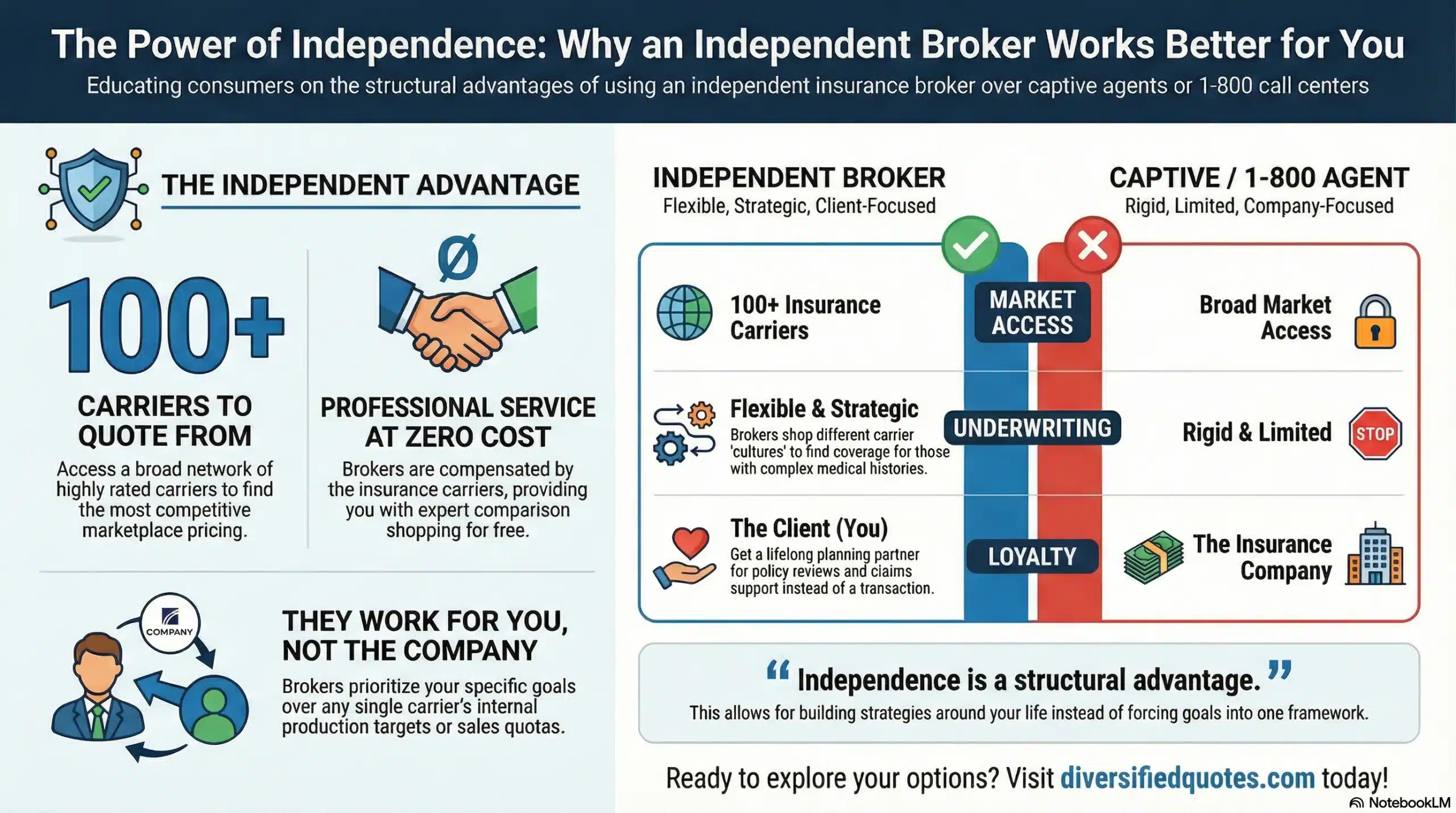
Finally, if you want to understand why independent shopping changes outcomes—especially for cases where underwriting is sensitive—this guide is a helpful read: Best Independent Insurance Agent.
Compare Term Life Insurance Lengths
Explore different term periods to find coverage that best matches your timeline and budget.
Talk With an Advisor Today
Choose how you’d like to connect—call or message us, then book a time that works for you.
Schedule here:
calendly.com/jason-dibcompanies/diversified-quotes
Licensed in all 50 states • Fiduciary, family-owned since 1980
FAQs: Life Insurance for Overweight Applicants
Does being overweight mean I can’t get life insurance?
No. Being overweight does not automatically disqualify you. Many carriers approve overweight applicants for fully underwritten policies. The impact is usually on the underwriting class and premium, and that varies by carrier and overall health profile.
How do insurers evaluate “overweight” risk?
Carriers typically start with a height-and-weight (build) chart, then review related risk factors such as blood pressure, cholesterol and labs, sleep apnea, diabetes risk, and overall medical history. The build chart ranges differ between insurers, which is why shopping matters.
What rating or pricing outcomes should I expect?
Outcomes range from Standard Non-Smoker to table-rated offers depending on how far outside a carrier’s build chart you are and whether there are additional health concerns. Mild overweight with stable metrics can still price competitively with the right carrier.
Does recent weight loss help reduce premiums?
It can. Many carriers prefer to see stable maintenance of the lower weight for a period of time before giving full credit. If weight loss is recent, some carriers may be cautious, while others will partially credit the improvement depending on documentation and trends.
What policy types are usually available for overweight applicants?
Most overweight applicants can pursue traditional underwritten term and permanent life insurance. When build is paired with significant complications, simplified-issue or guaranteed-issue coverage may be alternatives, and some applicants use a combination of employer group coverage and personal coverage.
How can I improve my approval odds and pricing?
Improve modifiable metrics like blood pressure and labs, document stable health trends, disclose your full medical history accurately, avoid tobacco, and work with an independent broker who knows which carriers have more generous build charts and flexible underwriting.
Diversified Insurance Brokers specializes in helping high-risk applicants secure coverage, even after serious health conditions.
About the Author:
Jason Stolz, CLTC, CRPC and Chief Underwriter at Diversified Insurance Brokers (NPN 20471358), is a senior insurance and retirement professional with more than two decades of real-world experience helping individuals, families, and business owners protect their income, assets, and long-term financial stability. As a long-time partner of the nationally licensed independent agency Diversified Insurance Brokers, Jason provides trusted guidance across multiple specialties—including fixed and indexed annuities, long-term care planning, personal and business disability insurance, life insurance solutions, Group Health, and short-term health coverage. Diversified Insurance Brokers maintains active contracts with over 100 highly rated insurance carriers, ensuring clients have access to a broad and competitive marketplace.
His practical, education-first approach has earned recognition in publications such as VoyageATL, highlighting his commitment to financial clarity and client-focused planning. Drawing on deep product knowledge and years of hands-on field experience, Jason helps clients evaluate carriers, compare strategies, and build retirement and protection plans that are both secure and cost-efficient. Visitors who want to explore current annuity rates and compare options across multiple insurers can also use this annuity quote and comparison tool.
