
Travel Medical and Evacuation from Congo

Jason Stolz CLTC, CRPC
“Congo” can refer to two different countries: the Democratic Republic of the Congo (DRC) and the Republic of the Congo. Both can involve long travel distances, variable infrastructure, and meaningful differences between care options in major cities versus outlying areas. If you’re traveling, working, volunteering, or living abroad in either country, travel medical and evacuation insurance from Congo is designed to protect you from two problems that often happen together in real emergencies: the cost of treatment and the challenge of getting to the right facility fast enough.
In Kinshasa (DRC) and Brazzaville (Republic of the Congo), you may find better private-care options than you would in rural areas, but “better” does not always mean “fully equipped” for complex emergencies. When a situation needs specialist care, advanced imaging, ICU capacity, complex trauma support, or a dependable supply chain for medications, the best medical decision may be regional transfer—sometimes within-country, sometimes to a neighboring hub, and sometimes to a larger center abroad. The financial exposure can be severe without coverage, and the logistics can be overwhelming if you’re trying to coordinate care in a crisis.
At Diversified Insurance Brokers, we help travelers compare options that emphasize what matters most when you’re far from home: meaningful emergency medical limits, a clear evacuation process, and a strong assistance team that can coordinate transport, receiving facilities, and communications when time is critical. If you’re also comparing broader plan types beyond destination-specific pages, you can start with medical travel insurance and then narrow to the plan style that best matches your trip length and risk profile.
Travel Medical & Evacuation Coverage for Congo
Get coverage designed for medical emergencies and coordinated evacuation support for travel or extended stays in the DRC or the Republic of the Congo.
Why Travel Medical & Evacuation Coverage Matters in the Congo Region
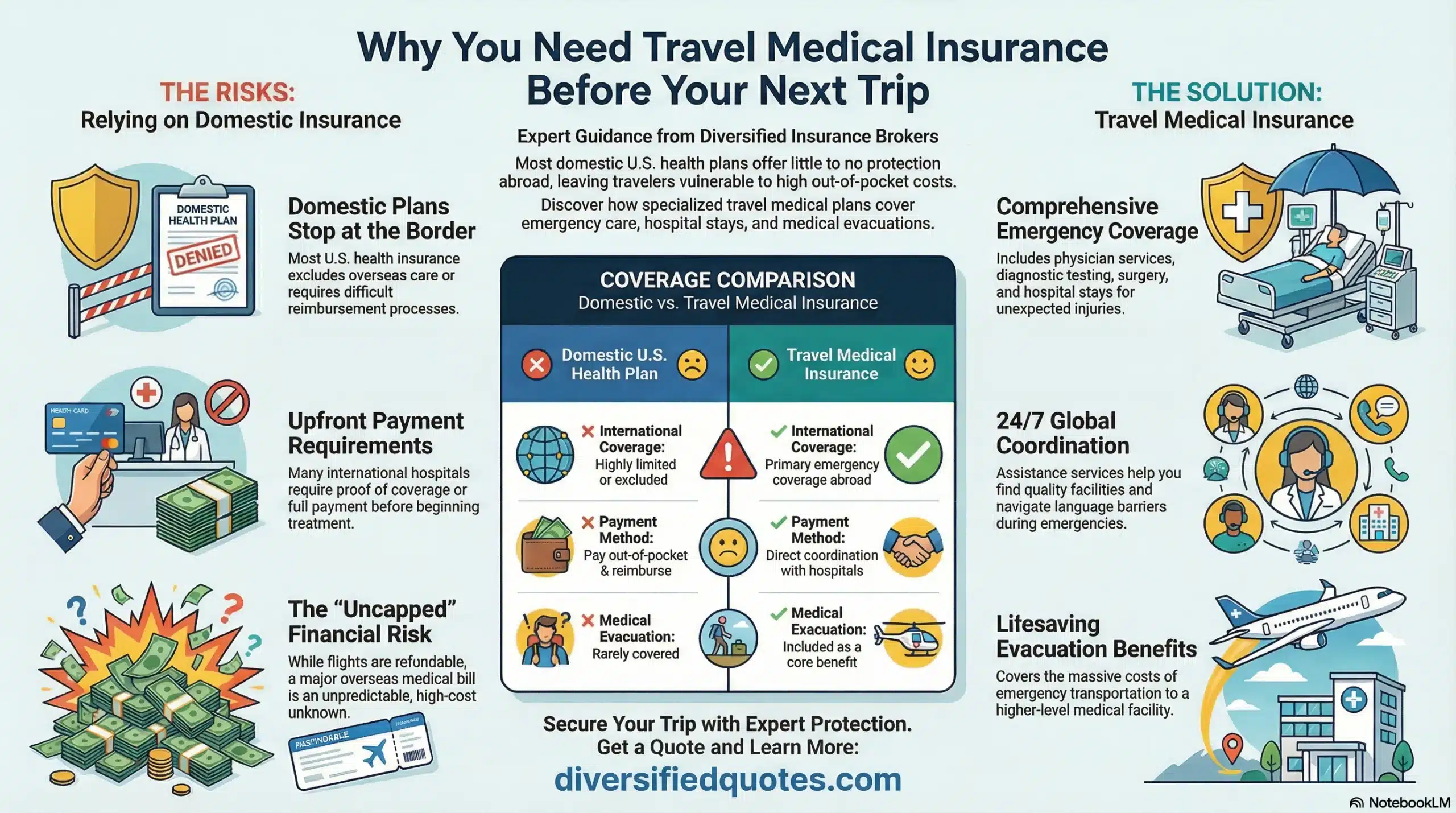
Most people think “travel insurance” is about flight delays or luggage. In higher-risk or infrastructure-variable regions, the bigger risk is a medical event that escalates quickly. A serious infection, a traumatic injury, or a sudden complication can turn into a high-cost problem fast—especially if the appropriate treatment is not immediately available where you are. That’s why destination-specific travel medical coverage is built around emergency response, not minor inconveniences.
In both Congo nations, the most important feature is usually the evacuation pathway. Even if you never need it, knowing it exists changes your options during an emergency. Instead of being limited to what’s locally available, the plan can help move you to an appropriate level of care. That can mean transfer to a better-equipped facility in a major city, to a regional hub, or to another country if medically necessary under the plan’s rules. In practical terms, evacuation coverage is about access: access to better care, better outcomes, and coordinated logistics—without a six-figure bill attached.
If you’re comparing broader destination profiles, you may also want to review high risk travel insurance to understand why some plans treat evacuation, exclusions, and approvals differently depending on where you’re traveling and what you’ll be doing there.
What “Travel Medical and Evacuation Insurance” Typically Covers
Coverage varies by carrier and policy design, but most travel medical and evacuation plans focus on emergency and urgent care needs. The medical portion generally helps with covered treatment for a new illness or injury that happens during the covered period. The evacuation portion is designed for situations where appropriate care is not available locally or where transport to a different facility is medically necessary and coordinated through the assistance team.
In real terms, this coverage is intended to help with emergency physician services, diagnostics, medically necessary hospitalization, and treatment related to a covered incident. It may also include covered prescriptions tied to the emergency, follow-up stabilization care, and medically necessary transportation between facilities. The value of the policy is not just the reimbursement, but the coordination—because the assistance team can help you navigate hospital admissions, medical communications, and transport approvals when you’re in a vulnerable position.
When comparing plan language, it’s also helpful to understand the difference between travel medical products and broader international health insurance. Travel medical is often better suited for shorter trips or defined travel windows, while international health plans can be designed for longer residence-style coverage. The right fit depends on whether you’re visiting, rotating in and out for work, or relocating for an extended stay.
Why Evacuation Is Usually the Most Important Benefit
When a serious event happens, the biggest cost is often not the first doctor visit—it’s what comes after. Intensive care, trauma stabilization, emergency surgery, specialty consults, and extended inpatient stays can create large bills quickly. In many parts of the Congo region, the bigger issue is that the best medical decision may involve transfer to a facility with more advanced resources. That is where evacuation becomes the make-or-break feature.
Evacuation is expensive because it’s complex. It can involve medical escorts, specialized aircraft or routing, ground transport to an airstrip, coordination with receiving hospitals, and medical documentation handoffs. The assistance team’s job is to coordinate this process so you’re not trying to negotiate logistics on the phone during a crisis. Plans differ on how “medical necessity” is determined and how approvals work, which is why choosing a plan based solely on price can create problems later.
If your travel plan includes multiple countries, rural travel, or extended time away from major cities, it may also help to compare destination-specific pages like travel medical and evacuation from Burundi or travel medical and evacuation from the Central African Republic, since the same plan may behave differently based on logistics and access realities.
DRC vs. Republic of the Congo: Why the Distinction Matters
The DRC and the Republic of the Congo are different countries with different travel patterns, different concentrations of infrastructure, and different access paths. The goal of insurance planning is not to label one as “safe” and one as “unsafe.” It’s to understand the practical reality: where you will be, what care options are nearby, and what you want the plan to do if local care is insufficient.
If you’re primarily in Kinshasa or Brazzaville, your first step in an emergency may be care in a private facility. If you’re operating outside major urban areas, you should assume that distance and transport logistics become a bigger variable. In either case, it’s wise to choose coverage as if evacuation is possible—because if you need it, you usually need it quickly.
Common Real-World Situations Where This Coverage Helps
Most claims are not dramatic movie scenes. They’re common medical problems that become harder to manage when you’re far from home: a severe infection, dehydration complications, a fracture or significant injury, a sudden abdominal event, or a complication requiring imaging and specialist evaluation. What makes these more challenging abroad is not just the condition itself—it’s the uncertainty around where to go, how to pay, and how to get to a higher level of care if the first facility can’t handle it.
In many international settings, hospitals may require deposits or payment arrangements before services proceed. Even when care is available, navigating documentation, language barriers, and admissions processes can slow response. The assistance component of a strong travel medical plan is designed to reduce that friction by coordinating care and guiding next steps based on your policy terms.
Example Scenario: From Local Emergency to Regional Transfer
Consider a business traveler in Kinshasa who experiences a severe medical emergency that requires specialty care. The immediate priority is stabilization. After initial treatment, the medical team determines that the safest path is transfer to a regional center with higher capability. Without coverage, the traveler and family may be faced with a rapid series of decisions: which facility, which transport, how to secure medical escorts, and how to pay for services that can easily move into five- or six-figure territory.
With the right travel medical and evacuation policy, the assistance team coordinates the transfer, communicates with receiving facilities, and arranges eligible transportation under the plan’s rules. This is the core value proposition: financial protection paired with coordinated logistics, so the crisis doesn’t become a second emergency.
Secure International Medical Coverage
Apply for travel medical coverage that includes emergency treatment and evacuation support for Congo travel or extended stays.
Pre-Existing Conditions: What to Watch For
Pre-existing condition coverage is one of the most misunderstood parts of travel medical insurance. Some policies exclude pre-existing conditions entirely. Others offer limited protection for sudden and unexpected flare-ups under “acute onset” language. Some may require additional underwriting or specific eligibility conditions. Because definitions vary by carrier, you should never assume that two plans treat medical history the same way.
The practical planning question is simple: if a condition could plausibly affect you during the trip, you want to understand how the policy defines it, how it handles acute events, and whether you must meet any timing or stability requirements. This matters even more in regions where specialist care may be limited, because you may be relying on evacuation coverage if symptoms escalate and local care cannot manage the situation.
If your travel profile is more complex—long stays, multiple countries, or frequent relocation—compare against international health insurance options, which may be structured differently than short-term travel medical policies.
Security Evacuation vs. Medical Evacuation
Many travelers assume “evacuation” means any evacuation. In reality, medical evacuation and security evacuation can be separate benefits. Medical evacuation is tied to medical necessity and is typically coordinated when a patient must be transported to an appropriate facility due to the limits of local care. Security evacuation, when offered, may apply to defined events like political unrest or natural disasters, but it is not universally included and usually has specific triggers and exclusions.
The key is not to rely on marketing language. You want to confirm what the plan covers, what it excludes, and whether security-related services require additional riders or separate coverage. If you are traveling for journalism, contracting, aid work, or remote operations, this distinction matters, because some policies treat risk regions differently.
How Pricing Typically Works
Travel medical and evacuation insurance is usually priced based on age, trip duration, destination profile, deductible, medical maximum, and evacuation benefit structure. Higher limits and longer coverage windows tend to cost more, but they also reduce your financial exposure when a serious event happens. The better way to think about pricing is not “cheapest policy,” but “cost compared to the largest plausible bill.” In destination profiles where evacuation is realistic, the gap between low limits and appropriate limits can be the difference between manageable risk and a financial shock.
If you’re coordinating group travel, extended programs, or frequent trips, it may be helpful to compare plan structure against pages like cheap group travel insurance, which focuses on broader group structures that can pair with medical-focused coverage depending on the trip’s needs.
How to Use the Coverage During an Emergency
Most plans work best when the assistance team is involved early. If a serious medical issue occurs, contacting the assistance number as soon as possible can help ensure that care coordination, facility routing, and evacuation approvals follow the policy’s process. Some plans require authorization for evacuation or higher-cost services. Waiting until after transport is arranged can create reimbursement disputes or delays.
In practical terms, you also want to keep documentation: admission notes, physician notes, invoices, discharge summaries, receipts, and any transport documentation. Even when a plan coordinates payment, having complete records makes the claim process smoother. If you are traveling with family members, it’s also wise to keep a digital copy of your policy and emergency contact steps so that someone else can communicate if you are incapacitated.
Why Work With Diversified Insurance Brokers
Travel medical plans can look similar until you read the details. Our job is to help you avoid the two biggest mistakes: choosing limits that don’t reflect evacuation reality and choosing a plan whose exclusions don’t match your travel profile. We help travelers and organizations compare options with an emphasis on clarity—what’s covered, how evacuation is authorized, what documentation is needed, and how the assistance team operates in real emergencies.
If you’re also evaluating higher-risk destination planning more broadly, you may want to compare this page against travel medical and evacuation from Chad and travel medical and evacuation from Kenya, since evacuation routing and access can vary significantly by region.
Explore Travel Medical & Evacuation Insurance for Congo
Compare medical and evacuation coverage options built for travel and extended stays in the DRC or the Republic of the Congo.
Related Travel Medical Pages
If you’re comparing destinations or planning multi-country routes, these pages help you match plan design to real-world medical access and evacuation needs.
Related Destination Pages
Use these destination pages to compare how coverage needs can change with infrastructure, distance to care, and travel logistics.
Talk With an Advisor Today
Choose how you’d like to connect—call or message us, then book a time that works for you.
Schedule here:
calendly.com/jason-dibcompanies/diversified-quotes
Licensed in all 50 states • Fiduciary, family-owned since 1980
Travel Medical & Evacuation from Congo — FAQs
What is covered under travel medical & evacuation insurance for Congo?
Does “Congo” coverage apply to both the DRC and the Republic of the Congo?
Why is evacuation coverage so important in the Congo region?
Do policies include pre-existing conditions?
What are common exclusions I should watch for?
Does evacuation always mean leaving the country?
How are premiums calculated?
What documentation is needed for a claim or evacuation?
Is coverage valid in remote or unstable regions?
About the Author:
Jason Stolz, CLTC, CRPC and Chief Underwriter at Diversified Insurance Brokers (NPN 20471358), is a senior insurance and retirement professional with more than two decades of real-world experience helping individuals, families, and business owners protect their income, assets, and long-term financial stability. As a long-time partner of the nationally licensed independent agency Diversified Insurance Brokers, Jason provides trusted guidance across multiple specialties—including fixed and indexed annuities, long-term care planning, personal and business disability insurance, life insurance solutions, Group Health, and short-term health coverage. Diversified Insurance Brokers maintains active contracts with over 100 highly rated insurance carriers, ensuring clients have access to a broad and competitive marketplace.
His practical, education-first approach has earned recognition in publications such as VoyageATL, highlighting his commitment to financial clarity and client-focused planning. Drawing on deep product knowledge and years of hands-on field experience, Jason helps clients evaluate carriers, compare strategies, and build retirement and protection plans that are both secure and cost-efficient. Visitors who want to explore current annuity rates and compare options across multiple insurers can also use this annuity quote and comparison tool.
