
Travel Medical and Evacuation from Sudan

Jason Stolz CLTC, CRPC
Sudan is a destination where the “what if” planning matters more than almost anywhere else. Years of instability, conflict, and humanitarian strain have left many regions with limited medical infrastructure, inconsistent access to medications and supplies, and serious constraints on emergency response. Travelers may be entering Sudan for humanitarian work, NGO support, journalism, business or contracting assignments, family visits, or specialized projects that take them outside major urban corridors. In many cases, the itinerary includes remote movement, limited transportation options, and a need to make decisions quickly if something goes wrong.
That reality is why travel medical and evacuation insurance from Sudan is not a “nice to have.” It is a core part of the travel plan. The issue is not only whether you have coverage, but whether you have a reliable pathway to care if local facilities cannot provide the level of treatment you need. In high-risk environments, the difference between a manageable medical event and a crisis is often the ability to coordinate the next step—specialty care, advanced diagnostics, ICU-level support, or surgical capacity—which may require leaving the country.
At Diversified Insurance Brokers, our advisors help travelers match coverage design to real-world conditions. In a place like Sudan, the most important parts of the policy are often the ones people skim: the evacuation benefit, the assistance services, the definition of “nearest appropriate facility,” and the coverage rules around pre-existing conditions. The goal is not to buy the cheapest plan. The goal is to buy a plan that can work when circumstances are messy, time matters, and the traveler needs a coordinated response—not a pile of paperwork.
Traveling without the necessary coverage is not advised, because in Sudan a serious injury or illness may quickly become an evacuation scenario. Even if a traveler is near a larger city, local care can be constrained by staffing, equipment, supply chain limitations, or surge capacity during periods of unrest. Outside major centers, the gap widens, and the ability to access definitive care may depend on your evacuation pathway.
Why Coverage Matters in Sudan
When travelers think about medical coverage, they often imagine a simple sequence: visit a clinic, see a doctor, get treatment, recover. In Sudan, that sequence is not guaranteed. The practical problem is that many hospitals and clinics may not have the advanced resources required for complex conditions. That can include limitations in imaging, lab capability, specialist availability, anesthesia and surgical support, blood products, ICU monitoring, or even consistent medication access. A traveler can receive initial stabilization but still be in a situation where appropriate care requires transfer elsewhere.
Another challenge is the variability by region. Even if a traveler is based near Khartoum or another urban hub, movement across the country can change the risk profile quickly. Road conditions, long distances, checkpoints, and logistical barriers can make routine transport difficult—especially during emergencies. In those situations, emergency medical evacuation is not a luxury. It can be the most realistic route to definitive treatment.
Finally, conflict and security constraints can complicate access to care. This does not mean every traveler will encounter a security issue, but it does mean that medical logistics can become more complicated during periods of instability. A strong plan with a reliable assistance team helps reduce friction by coordinating treatment, documenting medical necessity, and arranging transport options when local resources are insufficient.
What Travel Medical Insurance Typically Covers During a Sudan Trip
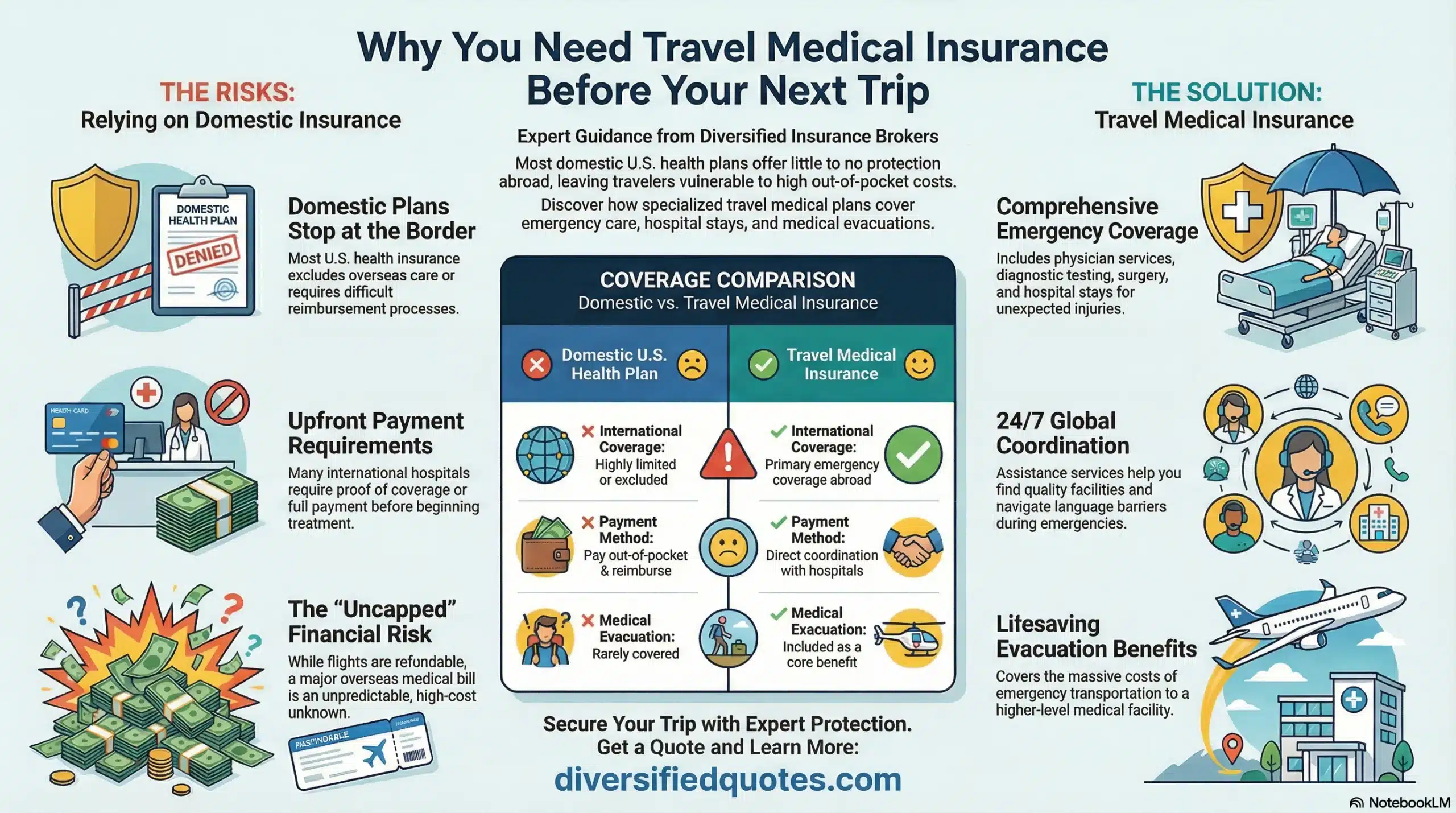
Travel medical insurance is designed for unexpected illness or injury while you are traveling. Depending on the plan, it can cover emergency physician services, eligible hospital charges, diagnostics where available, and certain prescription medications tied to a covered event. It may also include outpatient care for sudden illness or injury—again depending on the policy structure and the nature of the incident.
In Sudan, travel medical coverage often functions as the foundation benefit: it helps pay for emergency treatment when care is available and appropriate. But for many serious incidents, the coverage that changes outcomes is the evacuation benefit, because that is what makes it possible to move from “initial stabilization” to “definitive care.”
If you want a plain-English overview of how travel medical insurance differs from trip cancellation coverage and why it matters for international travel, this is a good reference point: Travel Medical Insurance.
Emergency Medical Evacuation: Often the Most Important Benefit for Sudan
Emergency medical evacuation coverage is designed to respond when local treatment is not adequate for the medical condition. Policies commonly describe evacuation to the “nearest appropriate facility,” which means the receiving destination is chosen based on medical capability—not convenience. In Sudan, that “nearest appropriate facility” may be in another country if the care required is not reasonably available locally.
Evacuation can involve several different pathways. In urgent cases, it may be air ambulance. In others, it may be a medically escorted commercial flight after stabilization. It may also involve ground transfer to a border or a more capable regional facility. The best plans include a 24/7 assistance service that coordinates the process: communicating with local providers, confirming medical necessity, selecting the receiving facility, arranging transport, and guiding documentation so the claim can be properly supported.
When people think about evacuation, they often focus only on cost. Cost matters, but coordination matters just as much. Without a coordinated assistance team, a traveler may lose valuable time trying to figure out who can accept them, how to route transport safely, and what paperwork is required. In Sudan, that coordination can be the difference between timely access to care and unnecessary delay.
For a deeper overview of what evacuation insurance is designed to do, how “medical necessity” is typically handled, and why limits matter, see: Emergency Medical Evacuation Insurance.
How Much Coverage Should You Consider for Sudan?
Coverage needs vary by itinerary, trip length, and the traveler’s medical profile, but for Sudan the discussion usually starts with evacuation. Many travelers consider at least $100,000 in emergency medical coverage and $250,000 to $500,000+ for evacuation and repatriation. The reason is straightforward: cross-border medical logistics, air transport, and medically managed routing can become expensive quickly—especially when the traveler is outside major hubs or when the situation requires urgent movement to a higher level of care.
If your travel is longer-term—such as an extended assignment, expatriate living, or repeated in-and-out travel—some travelers evaluate options that function more like ongoing international coverage rather than short-trip protection. In that case, it can help to compare: International Health Insurance.
Pre-Existing Conditions: Definitions and Timing Matter
Pre-existing conditions are one of the most common reasons travelers experience claim confusion. “Pre-existing” can be defined differently by different policies, and many plans apply look-back periods, stability requirements, or exclusions that change how an event is handled. Some plans exclude pre-existing conditions entirely. Some cover acute onset under specific definitions. Some offer limited coverage for stable conditions. Some may offer waivers if the policy is purchased within a defined window tied to travel dates or deposits.
In a destination like Sudan, pre-existing clarity matters even more because the claims that require evacuation can become expensive and urgent. If a traveler has a known medical history that could plausibly be connected to an emergency—cardiac history, asthma/COPD, diabetes, seizure history, chronic GI issues, prior surgeries, ongoing medications—it is worth choosing a policy based on the actual definitions rather than assumptions. The goal is to avoid a scenario where the traveler needs urgent coordination, but the event becomes disputed due to a pre-existing clause.
Payment Realities: Direct Billing vs. Reimbursement
Travelers should plan for a range of payment scenarios. In many international settings—especially high-risk environments—direct billing is not always available, and some clinics may request payment at the time of service. For smaller outpatient issues, travelers may need to pay and then submit documentation for reimbursement. For serious events (hospital admission, surgery, complex diagnostics, or anything trending toward evacuation), the smartest approach is to contact the assistance hotline immediately so the case can be documented and coordinated from the start.
Even when direct billing is possible, it often requires proactive coordination and documentation. That is why the “assistance” component of a travel medical plan is so important: it helps reduce friction and speed up decisions when time matters.
Security Evacuation vs. Medical Evacuation
It is important to distinguish medical evacuation from political or security evacuation. Standard travel medical policies typically focus on medical emergencies—illness and injury—rather than evacuation triggered by political unrest or security threats. If a traveler wants coverage for political/security evacuation, that generally requires a plan or rider that explicitly includes it, or a separate crisis/evacuation product designed for those risks.
That said, security conditions can still affect how a medical event is managed. Even if the policy is medical in nature, the assistance team’s ability to coordinate routing in a complicated operating environment is often a key value point. In Sudan, the “medical problem” and the “logistics problem” can show up at the same time, which is why plans with strong coordination are often preferred.
Scenario: Why Evacuation Coverage Changes Outcomes
Consider an aid worker in Khartoum who develops a rapidly worsening, life-threatening illness. A local facility may provide initial stabilization, but specialized care is not available or capacity is constrained. In that moment, the pathway to care is often transfer to a higher-level facility—potentially outside Sudan. With evacuation coverage, the assistance team can coordinate medical necessity, identify an appropriate receiving facility, route transport, and align documentation so the transfer can happen quickly.
Without coverage, the traveler may be forced to self-fund private evacuation or attempt to navigate a limited referral pathway under time pressure. Even if the traveler can eventually arrange transport, delays and logistical friction can meaningfully impact outcomes. In serious cases, time matters. Coverage that supports rapid coordination is not just a financial tool—it is a practical response plan.
If your travel profile is inherently higher risk—remote work, field assignments, contracting, or movement outside major hubs—this page is a helpful comparison point when selecting plan types and benefit structures: High Risk Travel Insurance.
Who Should Consider Travel Medical and Evacuation Coverage for Sudan?
This coverage is especially relevant for expatriates working in oil, mining, infrastructure, or development roles; business travelers visiting Khartoum or other hubs; aid and humanitarian workers operating in crisis-affected areas; and journalists or consultants whose work requires movement across regions with limited medical access. It is also important for long-term residents who spend time outside areas where medical resources are concentrated.
If your trip involves multiple countries or you are comparing Sudan to other higher-risk destinations, destination comparison pages can help clarify how coverage needs shift with infrastructure and logistics. For example, travelers commonly compare with nearby or similarly complex routes such as Travel Medical and Evacuation from South Sudan or Travel Medical and Evacuation from Somalia.
How to Choose the Right Plan for Sudan
The simplest way to choose a plan is to focus on a small set of “decision drivers” that matter most in Sudan. First, confirm the evacuation limit and how evacuation is defined (nearest appropriate facility; medical necessity requirements). Second, prioritize a plan with robust 24/7 assistance and coordination, because that is what makes evacuation workable in practice. Third, review pre-existing condition definitions and exclusions so you understand how a claim would be treated if a chronic condition is involved. Fourth, confirm your coverage territory and any restrictions tied to activities, remote work, or field operations.
In Sudan, you are not just buying a benefit schedule—you are buying a response pathway. The best plan is the one that can coordinate care, documentation, and routing when “normal” healthcare access is not realistic.
Traveling to Sudan?
Apply today for travel medical and evacuation insurance to safeguard your health during your trip.
Get Covered for Your Trip to Sudan
Apply online now for comprehensive travel medical and evacuation coverage.
Related Travel Medical Pages
If you’re comparing plan types or building a multi-country route, these pages help you line up coverage design with real-world medical access and evacuation needs.
Related Destination Pages
These destination pages help you compare how needs change based on infrastructure, distance to care, and travel logistics.
Talk With an Advisor Today
Choose how you’d like to connect—call or message us, then book a time that works for you.
Schedule here:
calendly.com/jason-dibcompanies/diversified-quotes
Licensed in all 50 states • Fiduciary, family-owned since 1980
Travel Medical & Evacuation Insurance — Sudan (FAQ)
Do I need travel medical & evacuation insurance for Sudan?
Yes. Medical infrastructure can be limited, and serious cases may require evacuation to a nearby country for higher-level care. A plan with strong medical and high-limit evacuation benefits is strongly recommended.
What does travel medical coverage typically pay for?
Most plans cover eligible emergency treatment for unexpected illness or injury, such as physician services, hospital charges, diagnostics where available, and certain prescriptions tied to a covered event.
What does medical evacuation usually include?
Evacuation typically includes coordination by a 24/7 assistance team and medically necessary transport to the nearest appropriate facility when adequate care isn’t available locally—often outside Sudan depending on the condition.
How much medical and evacuation coverage should I consider?
Many travelers choose at least $100,000 in medical coverage and $250,000–$500,000+ for evacuation/repatriation due to the potential cost of cross-border transfers and air transport.
Will clinics or hospitals accept my insurance directly?
Direct billing is not guaranteed. For smaller services, you may need to pay and submit documentation later. For serious events, call the assistance hotline immediately so the case can be coordinated properly.
Are pre-existing conditions covered?
Coverage depends on the plan. Some policies exclude pre-existing conditions, others provide limited coverage under specific definitions. Review look-back periods, stability rules, and exclusions before purchase.
Does a standard plan include political or security evacuation?
Usually not. Standard benefits typically focus on medical emergencies. If you want political/security evacuation coverage, choose a plan or rider that explicitly includes it, or use a separate crisis product.
How do I initiate an evacuation or start a claim?
Call the 24/7 assistance number immediately and provide your location, condition, and facility details. The team coordinates next steps and guides documentation for the claim.
What documents should I keep accessible?
Keep your policy number, assistance contact info, itinerary, passport/visa details, medication list, and secure digital copies of key documents accessible offline.
When should I buy coverage and how long should it last?
Buy coverage before departure so it starts on day one, and set the dates to cover your full itinerary—including transit days and possible delays—to avoid gaps.
About the Author:
Jason Stolz, CLTC, CRPC and Chief Underwriter at Diversified Insurance Brokers (NPN 20471358), is a senior insurance and retirement professional with more than two decades of real-world experience helping individuals, families, and business owners protect their income, assets, and long-term financial stability. As a long-time partner of the nationally licensed independent agency Diversified Insurance Brokers, Jason provides trusted guidance across multiple specialties—including fixed and indexed annuities, long-term care planning, personal and business disability insurance, life insurance solutions, Group Health, and short-term health coverage. Diversified Insurance Brokers maintains active contracts with over 100 highly rated insurance carriers, ensuring clients have access to a broad and competitive marketplace.
His practical, education-first approach has earned recognition in publications such as VoyageATL, highlighting his commitment to financial clarity and client-focused planning. Drawing on deep product knowledge and years of hands-on field experience, Jason helps clients evaluate carriers, compare strategies, and build retirement and protection plans that are both secure and cost-efficient. Visitors who want to explore current annuity rates and compare options across multiple insurers can also use this annuity quote and comparison tool.
