
What Is a Fixed Indexed Annuity with an Income Rider?

Jason Stolz CLTC, CRPC
What is a fixed indexed annuity (FIA) with an income rider? It’s an annuity that combines principal protection and index-linked growth with the option to turn the contract into guaranteed lifetime income—without permanently giving up control of your account value. If you want downside protection today plus a dependable “personal pension” later, understanding how FIA income riders work can help you decide whether they belong in your retirement plan.
For many retirees and pre-retirees, the attraction is simple: you want to protect a portion of your savings from market losses, you want a clear plan for income later, and you don’t want to feel like you’re gambling your retirement on timing. A fixed indexed annuity with an income rider is designed to address those concerns by separating “how your money grows” from “how your income is guaranteed.” That separation can be confusing at first, but once you understand it, you can evaluate FIAs with riders in a much more practical way.
At Diversified Insurance Brokers, we typically see this strategy used when someone wants to create a reliable income floor that complements Social Security and any pension income, while keeping enough flexibility to handle real-life changes. The income rider is not a magic feature and it is not the right solution for everyone. But when the contract design matches your timeline and withdrawal needs, this approach can make retirement income feel dramatically more stable, especially for households that are uncomfortable with the idea of taking withdrawals from a portfolio during market downturns.
Compare FIA Income Riders
We shop 100+ carriers to find strong payout rates, fair rider costs, and flexible liquidity for your timeline.
Request an Income Annuity Quote See Current Fixed Annuity Rates
How a Fixed Indexed Annuity with an Income Rider Works
A fixed indexed annuity with a guaranteed lifetime withdrawal benefit (GLWB) rider really has two parallel values running at the same time. Your account value is the actual cash value you own. It grows based on the index crediting strategies you select and can be used for withdrawals, emergencies, or legacy. The income benefit base is a separate “bookkeeping” figure that exists only to calculate your guaranteed lifetime withdrawals; you can’t cash it out directly, but it drives the size of your eventual income check.
That “two values” concept is the core of what makes FIAs with income riders different from what most people expect. When someone hears “income rider,” they often assume it means the contract is automatically paying income, or that the “income value” is money they can withdraw. In most designs, it is not. The income base is a calculation number. It can grow by roll-up credits, step-ups, or other rider-specific formulas. Then, when you start income, the carrier applies an age-based payout factor to that income base to determine your guaranteed annual withdrawal amount.
During the deferral phase—those years before you turn on income—the income benefit base may receive a roll-up credit, such as a simple or compound percentage per year, or step-ups when your indexed strategies perform well. When you’re ready to start income, the carrier applies an age-based payout percentage to that benefit base. The result is a guaranteed annual withdrawal amount you can receive for life, either for a single life or for joint lives if you’re planning for a spouse as well.
It’s worth slowing down here because this is where most misunderstandings happen. The account value can grow based on the annuity’s index strategy. It may credit interest in some years and credit zero in other years, depending on how the index performs and the caps/participation/spread structure. That account value is also the value that typically determines what can be withdrawn, what may be left to beneficiaries, and how surrender schedules apply. The income base, on the other hand, is usually tied to the rider’s guarantees and is often not reduced by a “zero interest year” the same way account value can be affected. The rider is designed to create a predictable income calculation path, even when growth is uneven.
The key distinction from traditional annuitization is control. With a GLWB rider, you keep your account value intact. You can still see a statement value, still access funds (subject to contract limits), and still leave remaining value to beneficiaries. If market conditions and withdrawals eventually reduce the account value to zero, the income rider steps in and continues paying your lifetime income as long as you live. That combination of control, lifetime protection, and potential index-linked growth is what makes FIAs with income riders so appealing for many retirees.
Another practical way to think about an FIA with an income rider is that it’s a plan for two different phases of retirement. In the earlier phase, you want principal protection and a reasonable chance to grow the account value without market losses. In the later phase, you want a reliable paycheck that you can’t outlive. The rider is designed to convert “accumulation years” into “income years” using a rules-based formula. The better you align the timeline with the rider’s design, the more predictable the outcome tends to feel.
In real planning, most people are not trying to maximize every last dollar of upside. They’re trying to reduce risk of failure. They want to make sure retirement income still works even if markets struggle early, or if they live longer than expected, or if one spouse lives far longer than the other. That is why FIAs with GLWB riders are often evaluated alongside other guaranteed income tools. They can help reduce the stress of taking withdrawals from volatile assets and can create a dependable baseline that keeps the rest of the plan more flexible.
Why Choose an FIA with an Income Rider?
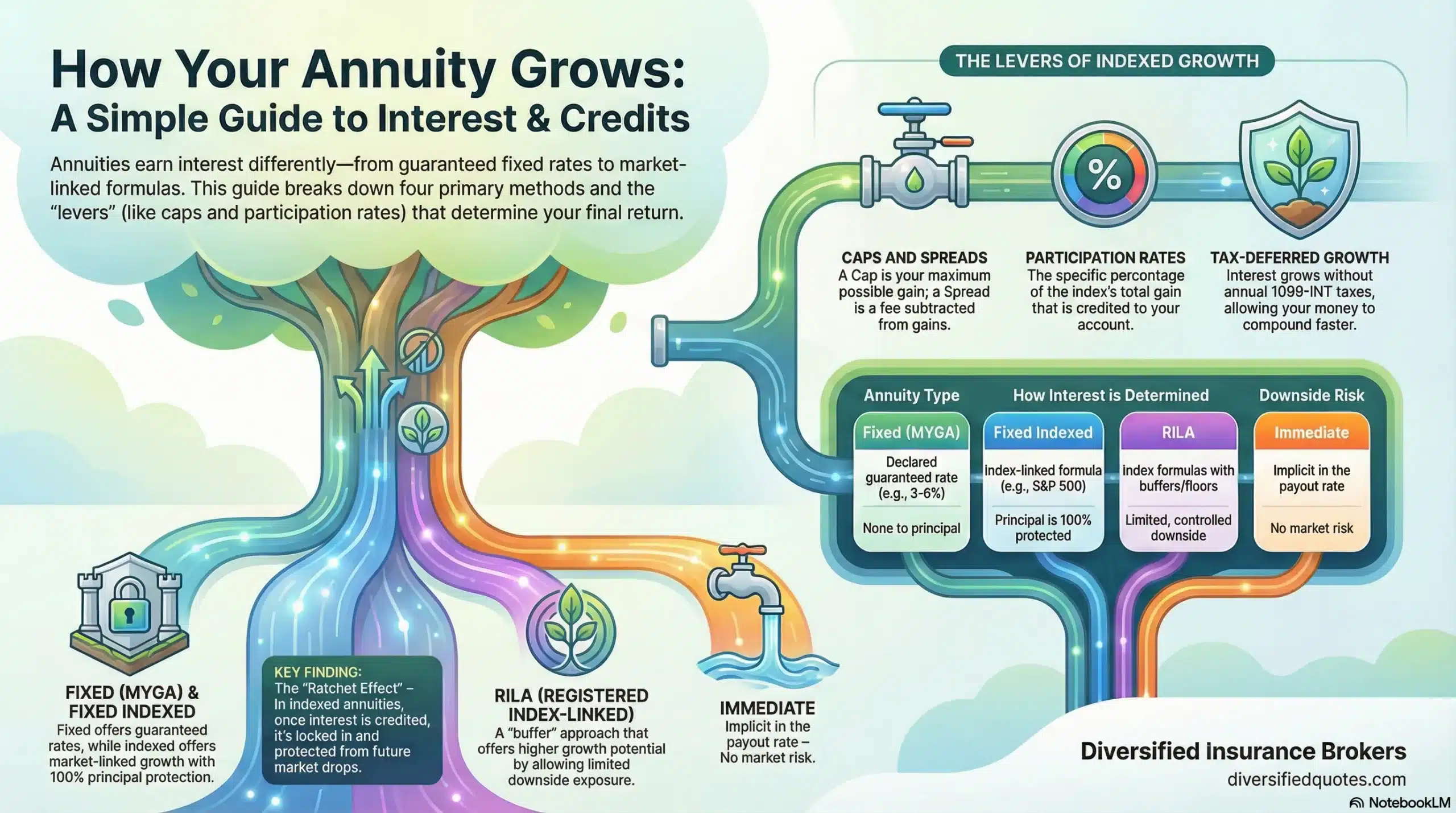
Many retirees want a balance between growth potential and downside protection, but they also need predictable income later. An FIA with an income rider offers a 0% floor so your account value is not reduced by market index declines, while still allowing you to participate in a portion of market upside through caps, participation rates, or spreads. This structure can feel very different from traditional market investing because you’re trading some of the unlimited upside for a controlled risk profile anchored by principal protection.
When you’re ready to retire, the income rider can act like a personal pension. You choose when to flip the switch and start lifetime withdrawals, and in many designs, waiting longer improves the guarantee. This can be especially powerful if you are planning for longevity or if one spouse has a higher life expectancy. The rider lets you defer income to a later age, building a larger benefit base and a higher payout percentage for that future you.
At the same time, you retain the option value of an account that you still own. If your needs change—perhaps you want to move funds to a different strategy, cover a large expense, or leave more to heirs—you are not locked into a pure “income only” decision the way you would be with a traditional immediate annuity. For many clients who value protected growth plus future flexibility, this blend of guarantees and control can be a strong fit.
There is also a behavioral benefit that matters more than many people admit: a guaranteed lifetime withdrawal feature can make it easier to spend confidently. People often underspend in retirement because they’re afraid of running out of money. When a portion of income is contractually guaranteed, it becomes easier to spend within a plan because the “income floor” is not dependent on daily market movement. That does not mean the annuity replaces the rest of the plan. It means the annuity can stabilize the plan so other assets can be used more rationally.
Another reason this strategy can be valuable is the way it can smooth the transition from work income to retirement income. Some people retire earlier than planned. Others stop working gradually. Others have a gap before Social Security starts. An FIA with an income rider can be positioned to start income when you need it, not necessarily immediately. You can create a “future paycheck” plan where the guaranteed income turns on at an age that makes sense, while the rest of the portfolio remains available for flexibility.
It’s also common for people to like the idea of guarantees but dislike the idea of “giving up their money.” A traditional immediate annuity can feel like a one-way decision because you exchange premium for income. With an FIA income rider, you keep a visible account value and you can often leave remaining value to beneficiaries. That control is not unlimited, but it can be a meaningful difference in how people feel about the decision.
Key Trade-Offs and Things to Watch For
An FIA with an income rider is not purely free; the rider often has an annual fee, usually expressed as a percentage of either the account value or the income benefit base. That fee buys you the guarantee that your income will last for life, even if the account value is eventually exhausted. The question is whether that guarantee provides enough value in your specific situation compared with alternatives, such as a stand-alone fixed annuity, a single premium immediate annuity (SPIA), or drawing from an investment portfolio.
When evaluating rider cost, it helps to focus on the role of the rider, not just the percentage. The rider is essentially insurance against two primary risks: longevity risk (living longer than expected) and sequencing risk (needing to take withdrawals during down years). If those risks are meaningful for your household, paying for a guarantee can be rational. If those risks are not meaningful because you have a large surplus of assets, or you have income sources that already cover most expenses, the rider may be less necessary. That is why the decision should be tied to the plan, not to a generic preference for or against annuities.
Index crediting terms—such as caps, participation rates, and spreads—can also change over time. Carriers usually reset these terms annually within the ranges spelled out in the contract. It’s important to understand that although your principal is protected, your future upside is influenced by these renewal decisions. Many clients work with us to monitor renewals and compare them to other options, including the broader annuity marketplace and tools like our annuity payout calculator.
Finally, be aware of withdrawal rules. Taking more than the rider-defined lifetime withdrawal amount, starting income earlier than planned, or skipping deferral years (in certain designs) can reduce guarantees. If you’re considering early withdrawals from retirement accounts for other reasons—such as structured 72(t) distributions described on our page about 72(t) distributions—it’s important to coordinate those plans so you don’t unintentionally harm your annuity guarantees.
A good way to avoid regret is to assume your life will not be perfectly predictable. The best FIA with an income rider is one where your likely retirement behaviors align with the contract’s rules. If you think you may need to take large withdrawals early, you need to evaluate how that affects the rider. If you think you may want to reposition the strategy before the surrender schedule ends, you need to evaluate surrender charges. If you think you may delay income, you need to evaluate what happens to the rider benefits over time. These are not “gotchas.” They are the contract mechanics that should be matched to your plan.
There are also emotional trade-offs that matter. Some people love the certainty of an income guarantee and prefer having a predictable baseline. Others dislike paying rider fees or dislike the idea of a contract. The best planning results typically come from pairing your psychology with the right structure. Retirement income is not only math. It is also behavior. A strategy that you can stick with is often better than a theoretically perfect strategy that you abandon at the wrong time.
Model Income, Then Compare Real Rider Designs
If you want to see how age and deferral timing can change lifetime payout potential, review current rates and then use the income calculator on this page to model scenarios before you request a personalized comparison.
See Current Fixed Annuity Rates Request an Income Annuity Quote
FIA + Rider vs. SPIA vs. DIA vs. Fixed-Only
When you think about guaranteed income, an FIA with an income rider is just one option among several. A single premium immediate annuity (SPIA) converts a lump sum into a stream of payments that starts right away and typically cannot be reversed. A deferred income annuity (DIA) works similarly but starts payments at a future date you select. A multi-year guaranteed annuity (MYGA) focuses on guaranteed growth over a set term, without built-in lifetime income.
Instead of viewing these options as competitors, it can help to view them as tools designed for different jobs. A SPIA is designed to maximize income immediately because you are converting premium into a payment stream right now. A DIA is designed to maximize income later because you are deferring income start and allowing the payout factors to become more favorable. A fixed-only annuity (like a MYGA) is designed to maximize predictable accumulation for a defined period, which may later be repositioned into income planning if desired. An FIA with a rider aims to blend growth potential (with principal protection) and future lifetime income—while keeping more control than an immediate annuity.
If you are comparing these approaches, the decision often comes down to which trade-off you prefer. Do you want the highest guaranteed income possible, even if you give up control of the account? Or do you want a strong income guarantee while keeping a visible account value and some flexibility? Do you want income now, or later? Do you want the simplest structure, or are you willing to accept a bit more complexity if it helps you feel safer about your retirement income plan?
Rather than using a table, here’s a plain-English way to compare them in real retirement planning terms. An FIA with a GLWB rider is often chosen when someone wants principal protection and the option to create lifetime income without fully annuitizing the premium. A SPIA is often chosen when someone needs a paycheck immediately and wants the strongest income per dollar right now. A DIA is often chosen when someone wants to lock in a future paycheck that starts later and typically pays more because of deferral. A fixed-only annuity (MYGA) is often chosen when someone wants a predictable rate for a predictable term and may or may not convert any portion of that into lifetime income later.
There is no “one best” solution for everyone. Clients who prioritize the highest possible payout today might favor a SPIA or DIA, while those who value control and flexibility often prefer an FIA with an income rider or a ladder of fixed annuities. Many households end up blending strategies: using FIAs for lifetime guarantees, MYGAs for medium-term accumulation, and other assets for liquidity and growth.
That blending approach is common because retirement is rarely one-dimensional. You may want an income floor for essential expenses, you may want liquidity for unknowns, and you may want some growth potential for inflation and future goals. When FIAs with income riders are used well, they tend to sit in the “income floor” category—helping ensure that baseline spending is covered even if markets disappoint. The rest of the plan can then be built around flexibility and long-term growth.
Who Is This Strategy Best For?
An FIA with an income rider often fits pre-retirees who are three to ten years away from retirement and want to lock in a future income guarantee today, even if they’re not quite ready to turn on the income yet. It can also work well for retirees who want to shift a portion of their portfolio away from market volatility into something with a defined income promise, but who still like the idea of maintaining access to their account value for unplanned expenses or legacy goals.
Couples frequently use this strategy when one spouse is especially concerned about outliving savings. A joint-life income rider can provide a lifetime paycheck that continues for as long as either spouse is alive, complementing Social Security and pensions. For investors who are moving money from CDs, money markets, or low-yield bonds, FIAs with income riders can offer a way to move into conservative annuity-based growth while keeping the future option of lifetime income on the table.
This approach can also fit households that want to reduce “retirement fragility.” Retirement fragility shows up when your plan depends heavily on market performance in the first years of retirement. If you retire into a downturn and you are withdrawing from a portfolio, your portfolio may not recover as easily because withdrawals lock in losses. Having a guaranteed income floor can reduce the need to withdraw from volatile assets during those periods. That does not make the annuity “better” than investing. It means the annuity can be used to protect against a specific failure mode that many retirees fear.
Another strong fit is the household that wants a future paycheck to start at a specific age. Some people want to delay Social Security for higher lifetime benefits but need income in the years in between. Others want income to increase later in retirement, when other income sources may not keep up with costs. An income rider can be designed around those milestones, particularly when you understand how deferral and payout percentages interact. In many designs, the longer you wait to start income, the higher the payout factor becomes, and the higher the lifetime withdrawal amount can be.
On the other hand, this strategy may be less appropriate for someone who expects to need large, unpredictable withdrawals early, or for someone who cannot tolerate the idea of a surrender schedule at all. It may also be less appropriate for someone who already has strong guaranteed income sources that cover nearly all spending needs. In that case, adding another income guarantee may not be necessary, and simpler accumulation tools may be a better match. The correct answer depends on what problem you are trying to solve.
Choosing the Right Income Rider
Income riders are not all built the same. Some are optimized for high income after a short deferral period; others favor longer deferral and high payout percentages in later years. Your timeline is one of the most important inputs. If you expect to defer for only a few years, you may prioritize a stronger initial payout percentage. If you have a longer runway, a higher roll-up rate or market-based step-up features might be more valuable.
You’ll also want to decide between single-life and joint-life coverage. Single-life payout rates are typically higher because they are based on just one person’s life expectancy. Joint-life riders, on the other hand, continue as long as either covered spouse is alive, which means slightly lower payout rates in exchange for stronger survivor protection. Inflation features matter too. Some designs automatically step up income when index strategies perform well, while others offer cost-of-living adjustments (COLAs) that start income lower but allow it to rise over time. Each of these design choices affects both current income and long-term sustainability.
Liquidity is the final piece of the puzzle. Most contracts include some form of free-withdrawal provision—for example, 10% of account value per year without surrender charges. It’s important to know how these withdrawals interact with the income rider. Taking more than the contractual lifetime withdrawal amount, or tapping the account heavily during the deferral phase, can reduce future guarantees. Part of our role is to walk through these trade-offs so you understand exactly how the contract behaves before you commit.
One of the most practical rider questions is: “What behavior does this rider assume?” Some riders assume you will defer for a certain number of years and then take withdrawals within the contract’s guidelines. Some riders assume you will not take excess withdrawals. Some riders assume you want maximum future income and are willing to accept certain rider fees to get it. If your real-life plan does not match the rider’s assumptions, the rider can feel disappointing. If your plan does match, the rider can feel like a well-designed pension substitute.
It is also important to understand that the rider and the index crediting strategy are connected, even if they are separate parts of the contract. Some contracts offer multiple crediting strategies with different caps or spreads. Those strategies influence account value growth. Account value growth can influence whether you ever need the rider’s “income-for-life even if the account value is gone” feature. Stronger growth can preserve account value longer, which can increase legacy and flexibility. We often help clients evaluate how the crediting choices and rider choices work together so the contract behaves the way the client expects.
Explore High-Dollar Annuity Payouts
How Index Crediting and Rider Guarantees Interact
Fixed indexed annuities often get oversimplified as “market-like returns with no downside.” That is not the right way to think about them. A better way to think about an FIA is that it is an insurance contract with principal protection that credits interest using an index-linked formula. The index is not a direct investment in the stock market. The annuity does not “own” the index the way an index fund does. Instead, the insurer uses a crediting method—often with caps, participation rates, or spreads—to determine how much interest is credited based on the index’s movement over a period.
When you add an income rider, you are adding a second layer: a contractual income guarantee that is not purely dependent on the account value. That is why the “two values” concept matters. The account value is driven by index credits and contract rules. The income base is driven by rider rules. Those rider rules may include roll-up credits, step-ups, and payout factors. The result is that you can have a predictable income calculation path even if index credits vary from year to year.
However, these parts are not completely independent in real life. If the account value grows well, you often preserve more legacy and maintain more flexibility. Strong account value growth can also reduce the chance that the rider ever needs to “carry the income” after account depletion. If growth is weaker, the rider’s guarantee becomes more valuable because it ensures the paycheck continues. In either case, the rider is not “free income.” It is a guarantee that you can rely on if life or markets do not cooperate with a perfectly smooth retirement plan.
One of the best ways to evaluate this is to consider your essential expenses and your baseline income sources. If you want to ensure essential expenses are covered no matter how long you live, a rider-backed income stream can make sense. Then your discretionary spending and long-term growth goals can be supported by other assets. This division can make retirement feel more stable because you are not asking one pool of money to do every job at the same time.
Understanding “Guaranteed Lifetime Income” Without Giving Up Ownership
A common question is: “How can the annuity guarantee income for life if I still own the account value?” The answer is that the rider is an insurance promise backed by the insurer’s general account. As long as you follow the rider’s rules, the insurer commits to paying the specified lifetime withdrawal amount. That payment stream is defined by the rider’s calculation method and payout factors. If the account value is still positive, withdrawals typically come from the account value. If withdrawals and performance eventually reduce the account value to zero, the insurer continues the rider payments because the rider was priced to provide that guarantee.
This is why rider fees exist and why surrender schedules exist. The guarantee has a cost, and the insurer needs the contract to persist long enough for the economics to work. That does not mean “the insurer wins and you lose.” It means the product is designed for a specific use case: long-term retirement income planning with a commitment to follow the contract’s rules. When the product is used for that purpose, it can be extremely effective. When it is used as a short-term parking place or a high-liquidity account, it can be mismatched.
In many retirement plans, the goal is not to empty the annuity. The goal is to create a stable income stream that continues regardless of market outcomes. The annuity can also leave remaining account value to beneficiaries if income withdrawals and performance do not fully deplete it. That can be appealing for people who want both income security and some legacy potential. The tradeoff is that you accept caps/participation/spreads and you accept rider fees and surrender schedules in exchange for the guarantee.
How Diversified Insurance Brokers Evaluates an FIA with an Income Rider
When we evaluate an FIA with an income rider, we typically focus on three practical categories: the quality of the income guarantee, the clarity and fairness of the rider rules, and the long-term tradeoffs compared with alternatives. People often fixate on one number—like a roll-up rate or a cap—and miss the bigger picture. The better approach is to evaluate how the contract behaves over time given realistic usage.
In the income category, we look at how the benefit base can grow, how step-ups work, when payout factors become attractive, and how single vs. joint payout options affect the plan. In the rules category, we look at how withdrawals reduce benefits, how excess withdrawals work, and what happens if you need flexibility. In the tradeoff category, we look at rider cost, index crediting competitiveness, and whether the design truly improves the retirement plan compared with simpler options.
We also look at how the contract fits into the broader retirement picture. The annuity should not exist in isolation. It should support how income will be produced throughout retirement, including how it coordinates with other income sources, how it reduces pressure on other assets, and how it supports the household’s comfort level with risk. In many cases, the annuity is not trying to replace investing. It is trying to stabilize income so the rest of the plan can be implemented more confidently.
Preview Income Scenarios
Use the tool below to explore lifetime income illustrations based on age, deferral years, and single vs. joint payouts. We’ll confirm contract-specific terms and options in your custom quote.
Use the Income Calculator, Then Request a Rider Comparison
Run a few age-and-deferral scenarios below. When you’re ready, we’ll compare real rider designs and show how guarantees and fees line up across carriers.
Request Your Personalized Quote See Current Fixed Annuity Rates
💡 Note: The calculator accepts premiums up to $2,000,000. If you’re investing more, results increase in direct proportion — for example, doubling your premium roughly doubles the guaranteed income at the same age and options.
When you run scenarios, focus on the decision you are actually trying to make. Are you trying to decide whether you want lifetime income at all, or are you trying to decide which rider design fits your timeline? The first question is a planning question. The second question is a product comparison question. The calculator is helpful for visualizing how age and deferral timing can change lifetime income illustrations, but the final decision should always be tied to the specific contract terms you are offered in a personalized quote comparison.
It can also help to model more than one scenario. Many people assume they will start income at one age, but retirement often changes. If you model an earlier start and a later start, you can see how the plan behaves under different timelines. That way, if life changes, you are less likely to feel trapped. A good annuity strategy should still make sense even if retirement timing shifts by a few years.
Related Pages
Related Income Rider & Planning Pages
If you’re researching FIAs with income riders, these pages help you compare protected growth, payout concepts, and planning coordination.
High-Dollar Payout Examples
These examples help illustrate how premium size and income structure can change payout outcomes.
See Your Best FIA + Rider Options
We’ll benchmark payout rates, rider costs, and growth strategies across 100+ carriers so you can compare options side by side.
Talk With an Advisor Today
Choose how you’d like to connect—call or message us, then book a time that works for you.
Schedule here:
calendly.com/jason-dibcompanies/diversified-quotes
Licensed in all 50 states • Fiduciary, family-owned since 1980
FAQs: Fixed Indexed Annuity with an Income Rider
Can I lose money with an FIA income rider?
Your principal and previously credited interest are protected from market index losses, but account value can still decline if rider fees, withdrawals, or surrender charges exceed new interest credits. The lifetime income guarantee itself depends on the claims-paying ability of the issuing insurer.
When is the right time to start income?
Starting income later usually means a larger benefit base and a higher age-based payout percentage, which can increase your lifetime income. The ideal start date depends on your retirement timeline, health, and other income sources, so we typically compare multiple ages and show break-even and longevity scenarios before you decide.
What’s the difference between the benefit base and the account value?
The benefit base is a calculation value used solely to determine lifetime withdrawal amounts; it usually cannot be taken as a lump sum. The account value is your actual cash value that earns index credits, can be accessed within contract limits, and may pass to beneficiaries if it remains when you die.
How do single-life and joint-life income options differ?
A single-life option pays for as long as one person is alive and typically offers a higher payout percentage. A joint-life option pays while either covered spouse is living, which provides more security for a surviving spouse but usually comes with a slightly lower annual payout.
Are income rider fees worth the cost?
Rider fees can be worthwhile when the guaranteed lifetime income meaningfully improves your retirement security compared with alternative strategies. We evaluate rider costs alongside SPIAs, DIAs, fixed-only annuities, and portfolio withdrawals to determine whether the guarantee is adding enough value for your specific situation.
What happens if my account value goes to zero?
If you have followed the rider’s rules and are taking only the allowed lifetime withdrawals, the GLWB continues to pay your guaranteed income even after the account value is depleted. That ongoing payment is the core promise you are paying the rider fee to secure.
Can I still leave money to my beneficiaries?
Yes. As long as there is account value remaining at death, it can pass to your beneficiaries according to the contract’s payout provisions. If the account value has already reached zero but income is still being paid under the rider, there may be little or no remaining value for heirs, so beneficiary outcomes depend on how long you live and how the policy performs.
About the Author:
Jason Stolz, CLTC, CRPC and Chief Underwriter at Diversified Insurance Brokers (NPN 20471358), is a senior insurance and retirement professional with more than two decades of real-world experience helping individuals, families, and business owners protect their income, assets, and long-term financial stability. As a long-time partner of the nationally licensed independent agency Diversified Insurance Brokers, Jason provides trusted guidance across multiple specialties—including fixed and indexed annuities, long-term care planning, personal and business disability insurance, life insurance solutions, Group Health, and short-term health coverage. Diversified Insurance Brokers maintains active contracts with over 100 highly rated insurance carriers, ensuring clients have access to a broad and competitive marketplace.
His practical, education-first approach has earned recognition in publications such as VoyageATL, highlighting his commitment to financial clarity and client-focused planning. Drawing on deep product knowledge and years of hands-on field experience, Jason helps clients evaluate carriers, compare strategies, and build retirement and protection plans that are both secure and cost-efficient. Visitors who want to explore current annuity rates and compare options across multiple insurers can also use this annuity quote and comparison tool.
