
40% Bonus Annuity

Jason Stolz CLTC, CRPC
A 40% Bonus Annuity is designed for long-term retirement income planning—not short-term speculation. When structured properly, it contractually guarantees that the value used for income or legacy purposes will grow to 140% of your original premium over a defined vesting period, typically ten years. For conservative pre-retirees and retirees who prioritize principal protection, predictable accumulation, and enhanced lifetime income potential, this type of fixed indexed annuity can play a powerful strategic role.
Unlike market-based portfolios that fluctuate daily, a 40% bonus annuity eliminates downside exposure to stock market losses. Your principal is protected from negative index performance, and the guaranteed growth component continues according to contract terms regardless of volatility. At the same time, many contracts allow additional upside through index-linked crediting strategies. The result is a structured blend of certainty and measured growth potential.
At Diversified Insurance Brokers, we evaluate these strategies independently across multiple carriers. We compare vesting schedules, income rider multipliers, surrender timelines, liquidity features, and financial strength ratings to ensure that a 40% bonus structure genuinely improves projected retirement outcomes—not just headline percentages.
What a 40% Bonus Annuity Actually Means
A true 40% bonus annuity typically refers to a fixed indexed annuity that guarantees the benefit base used for income calculations will increase by 40% over a specified vesting period. Most commonly, this equates to approximately 4% annual guaranteed growth for ten years, reaching 140% of the original premium.
For example, a $300,000 premium could be contractually guaranteed to grow to $420,000 for income calculation purposes after ten years. This increase is not dependent on stock market performance. It is embedded in the policy design.
This structure differs from traditional investment accounts and even from standard fixed annuities. If you are comparing multiple structures, it is helpful to review how fixed indexed annuity rates change over time and how those changes affect long-term income projections.
How the Vesting Schedule Works
One of the most misunderstood aspects of bonus annuities is vesting. The 40% increase does not typically appear as an immediately liquid addition to your cash value. Instead, it vests gradually over time. Each contract year, a portion of the guaranteed growth becomes fully credited. By the end of the vesting period, the full 40% enhancement is locked in for income and structured payout purposes.
This long-term orientation is intentional. High-bonus contracts are designed for individuals who do not anticipate withdrawing their entire premium within the first several years. Understanding liquidity provisions is critical, and reviewing general guidelines on annuity free withdrawal rules can clarify how penalty-free withdrawals typically function.
Most 40% bonus annuities allow annual penalty-free withdrawals of approximately 7% to 10% beginning in year one, along with nursing home or terminal illness waivers that increase flexibility during qualifying health events.
Principal Protection and Market Volatility
A central advantage of a 40% bonus annuity is principal protection. Negative market years do not reduce your contract value due to index losses. When markets decline, your annuity simply credits zero for that period rather than experiencing a loss.
This feature can be especially valuable during early retirement, when sequence-of-returns risk can permanently impair portfolio sustainability. By shifting market risk from the retiree to the insurance carrier, a bonus annuity creates a defined accumulation path regardless of volatility.
If you are concerned about whether indexed annuities truly protect principal, reviewing whether you lose principal in an indexed annuity can provide additional clarity on how protection mechanisms are structured.
Index Crediting: Additional Growth Potential
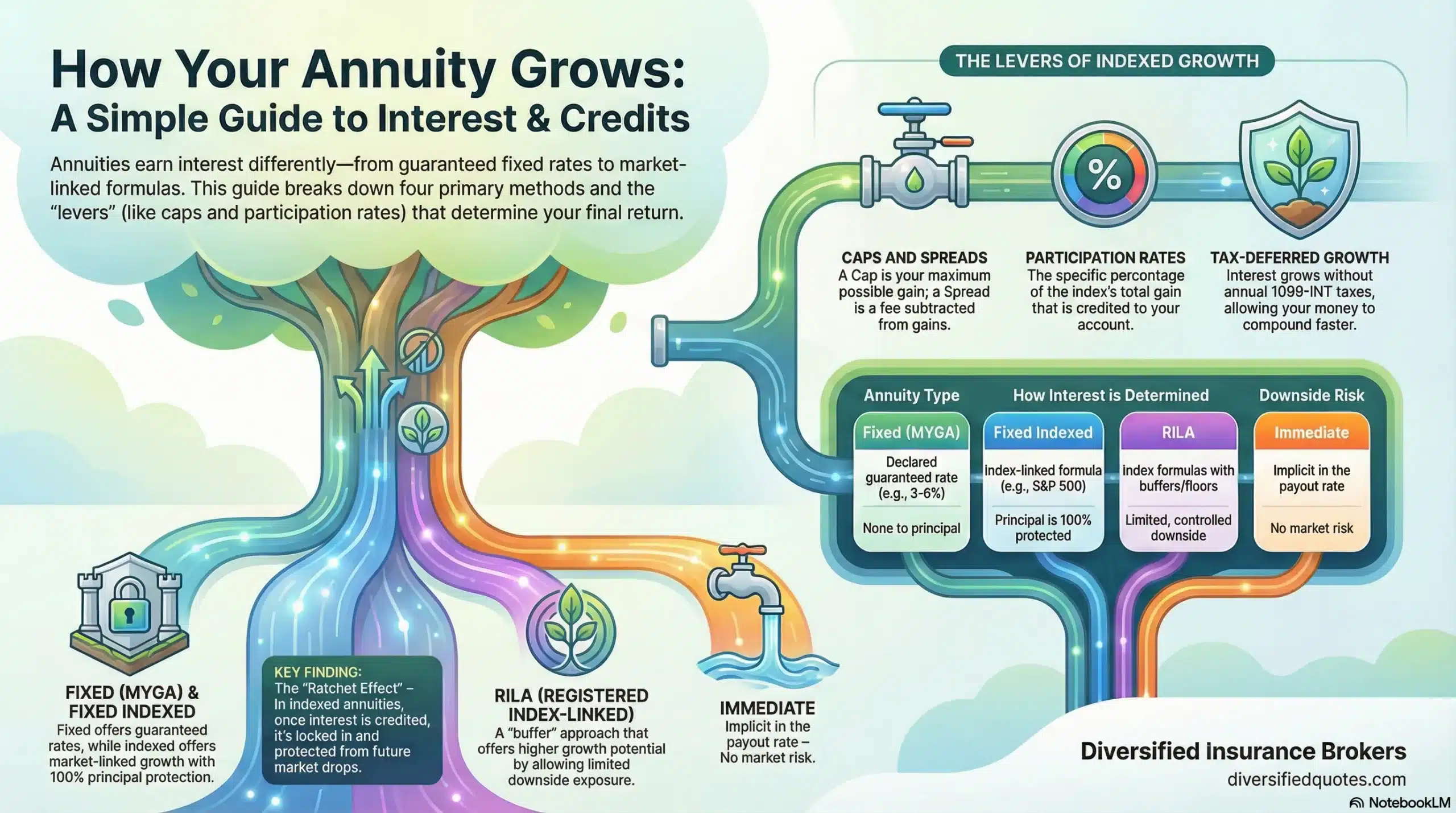
Beyond the guaranteed 40% vesting increase, most contracts offer index-linked crediting strategies tied to benchmarks such as the S&P 500. While gains are typically subject to caps, spreads, or participation rates, positive market years can add interest to the contract without exposing principal to downside losses.
Understanding how these mechanics work is essential before selecting a contract. Participation rates and caps may adjust after the first term, which is why reviewing how indexed structures function—and how they compare to traditional fixed products—is important when building a long-term strategy.
If you are evaluating broader suitability, consider reading who is best suited for an indexed annuity to determine whether this structure aligns with your risk tolerance and retirement timeline.
Income Planning: Where the 40% Bonus Matters Most
The true leverage of a 40% bonus annuity becomes clear when an income rider is activated. Lifetime income payments are calculated based on the enhanced income base, not just the original premium. Because the income base grows to 140% over the vesting period, the payout percentage applied at activation produces higher guaranteed lifetime income than a comparable non-bonus annuity.
For example, a 62-year-old investing $400,000 may see their income base reach $560,000 after ten years under a 40% vesting structure. If the payout factor at age 72 is 6%, that equates to $33,600 annually in guaranteed lifetime income—regardless of future market performance.
This structure is particularly valuable for individuals rolling over IRA or 401(k) assets who want to create a predictable income floor while maintaining some index-linked growth potential.
Legacy and Death Benefit Planning
Many 40% bonus annuities also provide enhanced death benefit structures. In some contracts, beneficiaries may receive the greater of the accumulated account value or the enhanced benefit base, depending on contract design and rider selection.
Understanding how these provisions function is critical, especially for clients focused on wealth transfer planning. Reviewing how annuity beneficiary death benefits work can help clarify payout options and tax treatment.
Comparing 40% Bonus Annuities to Other Fixed Strategies
Not every retirement plan requires a high-bonus indexed structure. Some clients prefer traditional fixed annuities that emphasize interest rate stability without index mechanics. Others may compare these contracts against alternative bonus structures such as those outlined in bonus annuity options over 20%.
Evaluating side-by-side comparisons is critical. The right solution depends on age, deferral period, liquidity needs, tax positioning, and income objectives.
If you are primarily focused on guaranteed interest rates without index exposure, you may also wish to review current fixed annuity rates to compare traditional fixed options.
Who Is a Strong Candidate?
A 40% bonus annuity is generally best suited for conservative pre-retirees or retirees between ages 55 and 70 who have a 7–10 year horizon before initiating income. It is ideal for individuals who value guarantees, seek protection from market downturns, and want enhanced lifetime income potential.
It may not be appropriate for short-term investors, highly aggressive equity investors seeking unlimited upside, or individuals who anticipate needing full liquidity within the early surrender period.
Strategic Integration With Healthcare and Retirement Planning
Retirement income planning should not occur in isolation. Social Security timing, Medicare decisions, tax strategy, and long-term care considerations all interact with guaranteed income structures. Clients often review healthcare coordination resources such as best Medicare rates while building their retirement income framework.
When positioned correctly within a broader strategy, a 40% bonus annuity can serve as the protected income core of a diversified retirement plan.
Request a Personalized 40% Bonus Illustration
Because contract design varies significantly by carrier, age, and rider selection, personalized illustrations are essential before allocating funds. We compare nationally recognized carriers, evaluate financial strength, and project income outcomes under conservative assumptions.
See How a 40% Bonus Could Impact Your Retirement
Request a side-by-side comparison showing guaranteed growth, projected lifetime income, and liquidity features tailored to your age and premium amount.
Request My Personalized IllustrationRelated Pages
Continue researching fixed indexed annuities, bonus structures, rates, and income planning strategies below:
Financial Protection Essentials
Chronic condition underwriting guidance, dental and vision options, financial firm reviews, and state-level consumer protections.
Talk With an Advisor Today
Choose how you’d like to connect—call or message us, then book a time that works for you.
Schedule here:
calendly.com/jason-dibcompanies/diversified-quotes
Licensed in all 50 states • Fiduciary, family-owned since 1980
40% Bonus Annuity FAQs
What is a 40% bonus annuity?
A 40% bonus annuity is typically a fixed indexed annuity that includes a contractual enhancement designed to increase the value used for income or legacy calculations over time. Many buyers compare these designs to traditional fixed indexed annuities to understand how bonus structures differ from standard crediting approaches.
Is the 40% bonus guaranteed?
Yes. The bonus feature is contractually guaranteed by the issuing carrier if the policy is held through the vesting period. Reviewing carrier strength—such as evaluating Americo’s financial stability—can help assess insurer backing.
How does the vesting schedule work?
Most designs vest gradually over a multi-year surrender period, often around 10 years. During this time, surrender charges may apply. Understanding how annuity surrender charges work is important before purchasing.
Can I lose money in a 40% bonus annuity?
Fixed indexed annuities provide principal protection from market losses. However, withdrawals above free limits during the surrender period could reduce value. Comparing to options like MYGA annuities can help clarify safety differences.
Does the bonus apply to cash value?
In many contracts, the bonus applies to an income or benefit base rather than immediate surrender value. Reviewing how annuity income riders function helps clarify this distinction.
Can I still earn interest beyond the guaranteed bonus?
Yes. Most bonus annuities offer index-linked crediting strategies for additional growth during positive market years. Comparing with current fixed indexed annuity rates can help evaluate overall earning potential.
Are there liquidity options?
Many contracts allow annual penalty-free withdrawals, often 5–10% of the account value. Reviewing annuity free withdrawal rules ensures expectations are clear before committing funds.
Who is a good candidate for a 40% bonus annuity?
These annuities may suit conservative savers seeking guaranteed accumulation or future income. Some retirees compare bonus annuities with lifetime income annuity options when evaluating payout strategies.
How do I know if a 40% bonus annuity is right for me?
Suitability depends on time horizon, liquidity needs, and retirement income goals. Comparing against alternatives like how an immediate annuity works can provide additional clarity when building a retirement income plan.
About the Author:
Jason Stolz, CLTC, CRPC and Chief Underwriter at Diversified Insurance Brokers (NPN 20471358), is a senior insurance and retirement professional with more than two decades of real-world experience helping individuals, families, and business owners protect their income, assets, and long-term financial stability. As a long-time partner of the nationally licensed independent agency Diversified Insurance Brokers, Jason provides trusted guidance across multiple specialties—including fixed and indexed annuities, long-term care planning, personal and business disability insurance, life insurance solutions, Group Health, and short-term health coverage. Diversified Insurance Brokers maintains active contracts with over 100 highly rated insurance carriers, ensuring clients have access to a broad and competitive marketplace.
His practical, education-first approach has earned recognition in publications such as VoyageATL, highlighting his commitment to financial clarity and client-focused planning. Drawing on deep product knowledge and years of hands-on field experience, Jason helps clients evaluate carriers, compare strategies, and build retirement and protection plans that are both secure and cost-efficient. Visitors who want to explore current annuity rates and compare options across multiple insurers can also use this annuity quote and comparison tool.
